
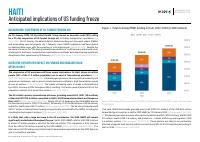
(2025-02) Haiti: Anticipated Implications of the US Funding Freeze (Anticipatory Note, 21 February 2025)
Summary — This ACAPS anticipatory note analyses the implications for Haiti of the 90-day suspension of US-funded foreign aid ordered on 20 January 2025. The US was Haiti's largest humanitarian donor, providing about 65 percent (USD 190.6 million) of funding committed to the 2024 Humanitarian Needs and Response Plan, and the note assesses sector-by-sector exposure across WASH, health, food security, nutrition, protection, and shelter for the six million Haitians in need. It also flags security spillovers through suspended contributions to the Multinational Security Support mission.
Key Findings
- The US was Haiti's dominant humanitarian donor, providing about 65 percent (USD 190.6 million) of 2024 HNRP funding and nearly half (USD 23.1 million) of all funding committed to the 2025 HNRP by 12 February 2025, leaving the USD 908.2 million 2025 appeal likely to remain severely underfunded.
- Food security is the most exposed sector, having received nearly 50 percent of US humanitarian funding in 2024; the freeze is expected to push food insecurity beyond the 5.54 million people projected in IPC Phase 3 or above for March-June 2025.
- WASH and health disruptions raise cholera and disease risks amid an outbreak with 9,500 suspected cases in 2024, while waiver exclusions covering family planning threaten reproductive healthcare in the country with the western hemisphere's highest maternal mortality.
- The freeze affects security assistance: USD 13.3 million of pending US contributions to the UN's MSS fund was suspended and expert police advisors furloughed, risking space for increased gang activity.
- Reduced food and livelihood assistance is likely to intensify harmful coping strategies, including recruitment of children into armed gangs, with children already estimated at 50 percent of armed group members and hunger identified as the main driver.
Full Description
Following the 20 January 2025 US executive order suspending foreign aid for 90 days, ACAPS assesses the actual and potential implications for humanitarian operations in Haiti, where six million people (half the population) need assistance and IDP numbers rose 230 percent in 2024 to 1.04 million. The US provided about 65 percent (USD 190.6 million) of the USD 295.5 million committed to the 2024 Humanitarian Needs and Response Plan, with nearly half going to food security (USD 107.6 million), followed by WASH (over USD 24 million) and health (over USD 11 million). By 12 February 2025, USAID had already provided nearly half (USD 23.1 million) of all funding committed to the 2025 HNRP, which seeks USD 908.2 million for 3.9 million people. The note works sector by sector through the ambiguities of the 'life-saving humanitarian assistance' waiver, distinguishing activities likely covered, likely excluded (including family planning and programmes labelled 'gender or DEI ideology'), and of uncertain status. The methodology is a secondary data review anchored in the 2024 REACH Multi-Sectoral Needs Assessment.
Anticipated impacts include heightened cholera and waterborne disease risk for 3.8 million people needing WASH assistance amid an outbreak concentrated in Artibonite, Centre, and Ouest; deteriorating access to healthcare for 4.2 million people, with disproportionate effects on maternal health in a country with the western hemisphere's highest maternal mortality; and worsening food insecurity beyond the 5.54 million people already projected in IPC Phase 3 or above for March-June 2025, as suspended cash transfers and agricultural inputs hit the March-May sowing periods. The note links reduced assistance to negative coping strategies, including child recruitment into gangs, children being an estimated 50 percent of armed group members. It also documents security spillovers: USD 13.3 million of pending US contributions to the UN fund for the Multinational Security Support mission was suspended and expert police advisors furloughed, potentially creating space for expanded gang activity.
Notes
ACAPS thematic/anticipatory analysis