Extracted text from the original document for search indexing.
HAITI
GDP contracted by 4.2 percent in 2024 amid gang violence
and an ongoing political-institutional crisis. Agriculture has
been the most severely impacted sector, disproportionately
reducing the incomes of the poor and vulnerable: nearly 4 in
10 Haitians now live on less than US$2.15/day 2017 PPP.
Despite these challenging conditions, tight monetary policy
and continued fiscal consolidation strengthened the macro-
economic framework, helping to reduce inflation.
Key conditions and challenges
Deep structural challenges including state capture and an un-
conducive business environment continue to hamper economic
growth and poverty reduction. Underdeveloped financial mar-
kets and weak competition have contributed to a large infor-
mal economy.Indefinite suspension of US commercial flights
to the main airport and continued border shutdown with
the Dominican Republic isolate Haiti and constrain domestic
resource mobilization. Economic mobility is hampered by a
weak labor market, dominated by low quality, poorly remu-
nerated jobs, especially for women. Indicators of human cap-
ital are weak with limited access to quality healthcare and
education: just 4 in 10 children are born in health facilities
and learning-adjusted years of schooling (at 6.1) are below
theregionalaverage.
Haiti faces a deepening fragility trap, as structural challenges, in-
stitutional crisis, persistent gang violence and a growing human-
itarian crisis have undermined development prospects. Disaster
risk management and response systems are inadequate to man-
age vulnerability to natural hazards and climate change. Economic
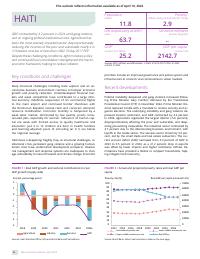
Population
1
Poverty
2
million millions living on less than $2.15/day
11.8 2.9
Life expectancy at birth
3
School enrollment
years primary (% gross)
63.7 ..
GDP
4
GDP per capita
5
current US$, billion current US$
25.2 2142.7
Sources: WDI, MFMod, and official data. 1/2024. 2/2012 (2017 PPPs). 3/2022.
4/2024. 5/2024.
priorities include an improved governance and justice system and
infrastructure to connect rural communities to urban markets.
Recent developments
Political instability deepened and gang violence increased follow-
ing Prime Minister Gary Conille’s dismissal by the Transitional
Presidential Council (CTP) in November 2024. Prime Minister Fils-
Aimé replaced Conille with a mandate to restore security and or-
ganize elections. The underlying instability and gang violence de-
pressed investor sentiment, and GDP contracted by 4.2 percent
in 2024. Agriculture registered the largest decline (-5.6 percent),
disproportionately affecting the poor and vulnerable, and deep-
ening pre-existing inequalities. The industrial sector contracted by
4.7 percent due to the deteriorating business environment, with
layoffs in the textile sector. The services sector shrank by 3.9 per-
cent, led by the small trade and real estate subsectors. The cur-
rent account deficit (CAD) narrowed from 3.3 percent of GDP in
2023 to 0.5 percent in 2024, as a 21.2 percent drop in exports
was offset by lower imports and higher remittance inflows. Re-
mittances have provided a lifeline to recipient households, help-
ingmitigatefoodinsecurity.
FIGURE 1 /Real GDP growth and sectoral contributions to real
GDP growth (supply side)
-5
-4
-3
-2
-1
0
1
2
2018201920202021202220232024e
Agriculture Industry ServicesGDP
Percent, percentage points
Sources: Haiti Statistical Office (IHSI) and World Bank staff calculations.
FIGURE 2 /Actual and projected poverty rates and real GDP per
capita
0
10000
20000
30000
40000
50000
60000
70000
0
10
20
30
40
50
60
70
80
90
100
20122014201620182020202220242026
International poverty rate Lower middle-income pov. rate
Upper middle-income pov. rateReal GDP pc
Real GDP per capita (constant LCU)Poverty rate (%)
Source: World Bank. Notes: See footnotes in table on the next page.
This outlook reflects information available as of April 10, 2025.
Macro Poverty Outlook / April 202534
Tax revenues plummeted from 6.3 percent in 2023 to 5.2 per-
cent in 2024 as the economy contracted. However, a retrench-
ment of capital spending and cuts in non-priority current expen-
ditures helped contain the fiscal deficit, which narrowed from
2.1 percent of GDP in 2023 to 0.1 percent in 2024. The com-
bined effect of tight fiscal policy and a better anchored mon-
etary policy stance, with zero monetary financing of the fiscal
deficit by the central bank (BRH), helped ease price pressures.
The gourde appreciated by 1.6 percent against the US dollar in
2024 owing to tight fiscal and monetary policy, strong remit-
tanceinflows,andweakimports.
Consumer price inflation declined from an average of 44.2 percent
in 2023 to 25.8 percent in 2024. High food inflation (averaging 34.7
percent in 2024) disproportionately affected the poor and vulner-
able, who spend a larger share of income on food. The share of
Haitians living on less than US$2.15/day 2017 PPP is estimated to
have climbed to 36.2 percent in 2024, from 31.1 percent in 2021.
Outlook
GDP is forecast to contract by 2.2 percent in 2025. The lingering
political crisis and gang violence are expected to depress private
investment, while high inflation dampens private consumption.
Modest GDP growth is expected by 2026 as investment increases
from a low baseline, assuming improvements on the political and
security fronts. Trade policy changes may further depress textile
exports, compounding existing security and business challenges,
but the full impact of the recent measures is difficult to gauge as
policy shifts may continue to unfold. Exports are forecast to ac-
celerate in 2026 assuming greater clarity on a potential extension
of a preferential trade agreement on textiles with the USA. A re-
sumption of GDP growth would gradually reverse poverty trends,
with the share of Haitians living on less than US$2.15/day 2017
PPP projected to drop slightly from 37.6 percent in 2025 to 36.7
percentby2027.
A balanced current account in 2025 is forecast to move into deficit
by 2026 as growth resumes and imports pick up. Increased govern-
ment spending ahead of planned elections and weak agricultural
productivity are expected to contribute to inflationary pressure in
2025, moderating over the medium as security conditions improve.
Tax revenue collection is set to improve gradually as a new general
tax code goes into effect. However, the fiscal deficit will widen from
0.1 percent of GDP in 2024 to 1.2 percent in 2025 owing to larger
security and elections-related spending.
The path ahead remains fraught with downside risks and depends
on an effective political transition and improvements in security. A
credible budgetary framework and an appropriate mix of fiscal and
monetary policy will remain key to reducing inflation and strength-
ening growth prospects. Inclusive growth will require strengthen-
ing the business environment, expanding social protection, and en-
hancing the institutional framework for disaster risk management,
including better preparedness and response systems.
Recent history and projections 2021/22 2022/23 2023/24e2024/25f2025/26f2026/27f
Real GDP growth, at constant market prices -1.7 -1.9 -4.2 -2.2 2.0 2.5
Private consumption -0.7 0.1 -5.2 -4.6 1.6 1.1
Government consumption 17.6 3.3 1.6 35.0 2.7 6.7
Gross fixed capital investment -9.9 -17.6 -36.3 -50.0 62.7 50.3
Exports, goods and services 2.4 -9.6 -31.9 -24.5 5.5 6.1
Imports, goods and services 4.9 -0.4 -16.2 -4.8 6.5 7.3
Real GDP growth, at constant factor prices -1.8 -3.6 -4.4 -2.2 2.0 2.5
Agriculture -4.5 -5.6 -5.6 -3.2 1.0 2.0
Industry -0.4 -3.8 -4.7 -1.7 2.5 3.4
Services -1.6 -2.9 -3.9 -2.2 2.0 2.3
Employment rate (% of working-age population, 15 years+) 55.8 55.8 55.8 55.8 55.8 54.9
Inflation (consumer price index) 27.6 44.2 25.8 29.7 20.3 14.1
Current account balance (% of GDP) -2.4 -2.6 -0.6 0.0 -1.1 -1.2
Net foreign direct investment inflow (% of GDP) 0.2 0.1 0.2 0.2 0.1 0.1
Fiscal balance (% of GDP) -3.2
-2.1 -0.1 -1.2 -0.1 0.1
Revenues (% of GDP) 6.6 7.4 6.0 6.4 7.0 7.4
Debt (% of GDP) 26.6 24.8 15.0 16.2 16.3 16.0
Primary balance (% of GDP) -2.9 -1.8 0.2 -0.9 0.1 0.4
International poverty rate ($2.15 in 2017 PPP)
1,2
32.3 34.1 36.2 37.6 37.2 36.7
Lower middle-income poverty rate ($3.65 in 2017 PPP)
1,2
61.4 62.6 65.4 66.7 66.4 65.9
Upper middle-income poverty rate ($6.85 in 2017 PPP)
1,2
88.0 88.4 89.5 90.0 89.9 89.7
GHG emissions growth (mtCO2e) 0.6 -0.4 -0.4 0.1 1.8 2.5
Source: World Bank, Poverty and Economic Policy Global Departments. Emissions data sourced from CAIT and OECD.
Notes: e = estimate, f = forecast. Data in annual percent change unless indicated otherwise.
1/ Calculations based on SEDLAC harmonization, using 2012-ECVMAS. Actual data: 2012. Nowcast: 2013-2024. Forecasts are from 2025 to 2027.
2/ Projection using neutral distribution (2012) with pass-through = 0.87 (Med (0.87)) based on GDP per capita in constant LCU.
This outlook reflects information available as of April 10, 2025.
Macro Poverty Outlook / April 202535