
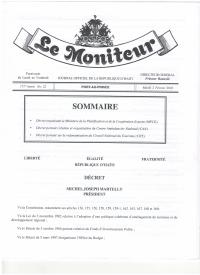
(2016-02) Decree Organizing the Ministry of Planning and External Cooperation (MPCE)
Summary — Signed by President Michel Joseph Martelly and published in Le Moniteur (No. 22, 2 February 2016), this decree revises the 10 March 1989 decree on the Ministry of Planning and External Cooperation (MPCE), updating its mission, structure, and functions to modernize Haiti's national planning system and strengthen management of the public investment program.
Key Findings
- Revises the 1989 decree governing MPCE to modernize national development planning and public investment management.
- Assigns MPCE 15 distinct attributions spanning national/local planning, land-use coordination, and public investment programming.
- Tasks MPCE with negotiating and coordinating multilateral and bilateral cooperation agreements.
- Gives MPCE authority to orient and coordinate NGO development-aid action nationally and locally.
- Establishes the Ministry's organic structure, including a Directorate-General with three specialized units and two administrative directorates.
Full Description
This decree, issued by President Michel Joseph Martelly on the report of the Minister of Planning and External Cooperation after Council of Ministers deliberation, revises the 10 March 1989 decree defining the organization and functioning of the Ministry of Planning and External Cooperation (MPCE). The preamble cites the need to ensure convergence and coherence of national and local development and land-use planning actions, the State's duty to steer and coordinate public development aid and NGO action in support of national and local development efforts, and the need to modernize the National Planning System and strengthen management of the National Public Investment System, adapting the Ministry's mission, attributions, organization, and functioning to new realities.
Article 1 gives MPCE the mission of steering, animating, and piloting the country's socioeconomic development planning process, mobilizing external resources, and ensuring coordination through sectoral structures. Article 2 lists fifteen attributions, including setting socioeconomic development priorities through national and local plans, ensuring coherence between sectoral and national plans, coordinating national land-use planning schemes, supporting territorial collectivities' development planning, coordinating and programming public investment and its insertion into the national budget, encouraging private investment through cooperative movements and Public-Private Partnerships, negotiating financial/technical, multilateral and bilateral cooperation agreements, and coordinating NGO development-aid actions. Titles II onward establish the Ministry's organic structure: a Minister's Office, a Directorate-General with an Études et Programmation Unit (UEP), a Departmental Directorate Coordination Unit (UCDD), and an ICT/Documentation Unit (UTICD), plus two administrative directorates: Administrative and Budget Affairs (DAAB) and Human Resources (DRH).