
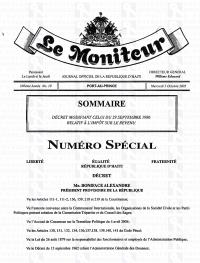
(2005-10) Decree Amending the 29 September 1986 Decree on Income Tax
Summary — Signed by Provisional President Boniface Alexandre and published as a special edition of Le Moniteur (No. 10, 5 October 2005), this decree reforms Haiti's Income Tax code on the report of the Minister of Economy and Finance, replacing the 1986 and 1988 decrees and the 1995 amending law, and modernizing the tax base, residency rules, exemptions and withholding obligations.
Key Findings
- Establishes a unified Income Tax for individuals and a Corporate Tax for companies, repealing the 1986 and 1988 decrees and the 1995 amending law.
- Defines Haitian tax residency via a 183-day presence test, professional activity in Haiti, or center of economic interests in Haiti, taxing worldwide income of residents and Haiti-source income of non-residents.
- Lists seven taxable income categories: property, industrial/commercial profits, non-commercial profits, wages/salaries, managers' pay, capital gains, and movable-capital income.
- Exempts civil/military pensions, disability and health/life insurance indemnities, State and territorial-collectivity revenues, and nonprofit association surpluses.
- Imposes a 20% liberatory withholding on non-resident service providers, a 25% penalty on non-compliant withholding agents, and monthly fines of 25,000-300,000 gourdes for non-declaration.
Full Description
This decree, published as a special edition of Le Moniteur (No. 10, 160e Année) on 5 October 2005, modernizes Haiti's income tax system 'to make it a performant instrument in the service of socio-economic development,' repealing the 29 September 1986 decree, the 27 September 1988 amending decree, and the 5 February 1995 amending law. It establishes a unified Impôt sur le Revenu for individuals and an equivalent Impôt sur les Sociétés for companies and other legal entities, taxing the global net income of taxpayers domiciled in Haiti and the Haiti-source income of non-residents. Tax residency is defined by a 183-day presence test, exercise of a professional activity in Haiti, or the center of one's economic interests being in Haiti; accredited diplomatic and consular agents are exempted within the limits of international law, except for their private Haiti-source income.
The decree lists seven categories of taxable income (property income, industrial/commercial profits, non-commercial profits, wages and salaries, managers' remuneration, capital gains on movable/immovable property, and income from movable capital) and exempts civil and military pensions, disability and work-accident indemnities, life and health insurance benefits, severance-notice indemnities, State and territorial-collectivity revenues (except commercial/industrial public enterprises), and surpluses of recognized nonprofit associations. It imposes a 20% liberatory withholding tax on payments to non-resident service providers during temporary stays in Haiti, with a 25% penalty for non-compliant withholding agents, and monthly fines of 25,000 to 300,000 gourdes on entities failing to declare payments made to members and other beneficiaries.