
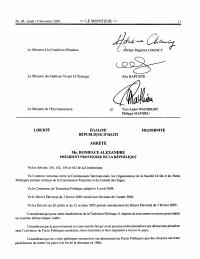
(2005-11) Decree Establishing a Public Subsidy Fund for Political Party Election Campaigns
Summary — Signed 12 October 2005 by President Provisoire Boniface Alexandre and published in Le Moniteur No. 86 (17 November 2005), this decree creates the Bureau de Gestion des Subventions Publiques aux Partis Politiques (BGSP) at MEF, allocating 55 million gourdes in public campaign financing to political parties competing in Haiti's 2005-2006 local, legislative and presidential elections.
Key Findings
- Creates the Bureau de Gestion des Subventions Publiques aux Partis Politiques (BGSP) at MEF to administer campaign financing for the 2005-2006 elections.
- Allocates a base envelope of 55 million gourdes, supplementable by international cooperation funds.
- Eligibility requires CEP accreditation, a verified list of 40,000 citizen signatures, and signing an anti-corruption commitment (Port-au-Prince Agreement).
- Each qualifying party receives a flat 1.5 million gourdes plus a proportional envelope based on candidate coverage across electoral districts (10%/5%/2.5% tiers).
- Misuse of subsidy funds is treated as criminal misappropriation of public funds with mandatory reimbursement.
Full Description
Adopted during the political transition following the Consensus de Transition Politique of 4 April 2004 and the 3 February 2005 Electoral Decree, this decree responds to concerns that Haitian political parties lacked structured financing and were vulnerable to funds of dubious origin, and that fraud-tainted results of past elections could not serve as a basis for allocating support. It creates the BGSP within MEF and earmarks 55 million gourdes (supplementable by international cooperation funds) for parties and party groupings officially accredited by the Conseil Électoral Provisoire (CEP) that meet Articles 148-152 of the Electoral Decree. Eligibility requires each party to submit a list of 40,000 Haitian citizens with national ID numbers and signatures, submitted on both paper and electronic media (preferably CD) for verification against the CEP's electoral register; parties must commit in writing to abide by the Electoral Decree, the electoral code of ethics, refuse funds of dubious origin, and sign the Port-au-Prince Agreement drafted by the Unité de Lutte Contre la Corruption. Each qualifying party receives a flat 1.5 million gourdes, plus an additional envelope proportional to the breadth of candidates fielded (10 percent of remaining funds for parties fielding candidates in 100 percent of electoral districts, 5 percent for 50 percent coverage, 2.5 percent for 25 percent coverage, distributed iteratively until funds are exhausted), disbursed into a dedicated bank account requiring joint signatures for expenditures above 25,000 gourdes. Funds must be used exclusively for campaign purposes; parties must submit a financial report to the CEP within a month of the election's close, and misuse is treated as a criminal misappropriation of public funds subject to reimbursement.