
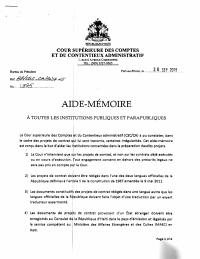
(2015-09) Aide-Mémoire to All Public and Parapublic Institutions on Draft Public Contracts
Summary — The Superior Court of Auditors and Administrative Disputes (CSCCA), dated 30 September 2015, issues a 25-point checklist to help public and parapublic institutions prepare draft contracts correctly before submission for the Court's mandatory review. It covers language, currency, legal citations, mandatory annexes by contract type, procurement thresholds, amendment caps and advance-payment bonding.
Key Findings
- The CSCCA reviews only unexecuted draft contracts and requires them in one of Haiti's two official languages.
- Foreign-currency payment clauses must include a gourde equivalence tied to the BRH reference exchange rate.
- Cumulative contract amendments (avenants) cannot exceed 30% of the initial contract value.
- Advance payments are capped at 30% of the initial contract and must be 100% bonded.
- Contracts subject to National Public Procurement Commission validation are null and void if not submitted for that validation.
Full Description
This aide-mémoire, signed by CSCCA president Fritz Robert Saint-Paul on 30 September 2015, responds to recurring irregularities the Court observed in draft public contracts submitted for its mandatory advisory review. It clarifies that the Court reviews only unexecuted draft contracts, not contracts already executed; that drafts must be written in one of Haiti's two official languages under Article 5 of the 1987 Constitution as amended in 2011, with foreign-language documents requiring sworn-translator certification; that foreign-state-issued contract documents must be consular-registered and legalized by the Ministry of Foreign Affairs; and that the gourde is the reference currency, with an exchange-rate equivalence clause required for payments denominated in foreign currency, referencing the BRH's reference rate. It sets out mandatory content by contract category (works, services, intellectual services/consultancies, supplies, leases), including tax-compliance certificates (quitus fiscal type C), National ID (CIN) and fiscal-registration numbers, notarized powers of attorney, and technical/financial documentation. It caps cumulative contract amendments at 30% of the initial contract value, caps advance payments at 30% of the initial contract with 100% bonding, and requires contracts under the National Public Procurement Commission's jurisdiction to be submitted for validation or be null and void. For low-value service contracts (at or below HTG 25,000), it recommends grouping up to 25 agents per submission form to streamline processing, without waiving the obligation to transmit each contract separately.