
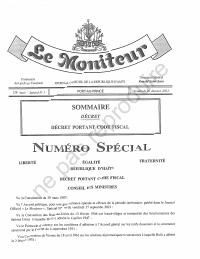
(2023-01) Fiscal Code Combining the General Tax Code and the Book of Fiscal Procedures
Summary — This decree, published in Le Moniteur's Special Issue No. 3 of 20 January 2023, consolidates Haiti's scattered tax legislation into a single Fiscal Code comprising the General Tax Code (CGI) and the Book of Fiscal Procedures (LPF). It was issued by the Council of Ministers under the de facto executive legislative authority exercised while Parliament remained inoperative, replacing decades of piecemeal fiscal decrees and laws dating back to the 1960s.
Key Findings
- Consolidates decades of fragmented Haitian tax legislation (1948-2022) into one unified Fiscal Code.
- Structured in two books: the General Tax Code (CGI) and the Book of Fiscal Procedures (LPF).
- Adopted by decree under the Executive's emergency legislative authority while Parliament was inoperative.
- Explicitly aims to modernize, simplify, and increase transparency of the tax system while strengthening both taxpayer rights and fiscal administration controls.
- Issued on the report of the Minister of Economy and Finance after deliberation in the Council of Ministers.
Full Description
The Fiscal Code, decreed by Haiti's Council of Ministers on the report of the Minister of Economy and Finance, was published as a special issue of Le Moniteur on 20 January 2023. Its preamble recites dozens of prior fiscal and customs-related decrees and laws stretching from 1948 to 2022 that the new code is meant to supersede and harmonize, citing the need for a modern, simplified, and transparent tax system that strengthens taxpayer rights while reinforcing the administration's control powers. The code is organized into two books: Book I, the General Tax Code (Code Général des Impôts, CGI), and a Book of Fiscal Procedures (Livre des Procédures Fiscales, LPF), reflecting international best practice in structuring national tax codes.
The decree was adopted under the constitutional provision allowing the Executive to legislate by decree while the Legislative Power remains inoperative, a recurring feature of Haitian fiscal lawmaking since Parliament's mandates lapsed in the early 2020s. Because of the document's length (244 pages), only the preamble and opening pages were reviewed in detail; they establish the legal basis, rationale, and structure of the code without yet reaching the substantive tax provisions.