
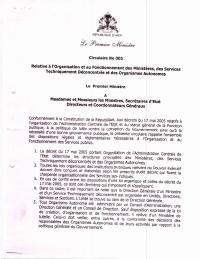
(2017-05) Circular No. 005 on the Organization and Functioning of Ministries, Deconcentrated Technical Services and Autonomous Agencies
Summary — A Prime Minister's circular reminding ministers, secretaries of state, directors-general and heads of autonomous agencies of the legal framework governing the organization of the central public administration under the 17 May 2005 civil service decrees. It restates merit-based recruitment rules, the role of the Office of Management and Human Resources (OMRH), and sanctions against favoritism in appointments.
Key Findings
- Ministries and autonomous agencies derive their structure and mission strictly from law and the 2005 civil-service decrees.
- Recruitment to permanent civil-service posts must go through OMRH-supervised, legally established procedures.
- Favoritism and nepotism in public appointments are explicitly prohibited and subject to criminal sanction under anti-corruption law.
- Directors-general of autonomous agencies remain accountable to overall government policy despite institutional autonomy.
- OMRH and ministerial HR directorates are tasked with enforcing these organizational norms.
Full Description
Circular No. 005, issued by Prime Minister Jack Guy Lafontant, sets out the legal principles governing the internal organization of the central administration, its deconcentrated technical services and autonomous public agencies. It grounds ministerial authority in the 17 May 2005 decrees on the general civil service statute and the 2004 decree on the organization of the central administration, and situates these against anti-corruption legislation. The circular reiterates that a ministry's mission and structure derive from law and that autonomous agencies must be steered by a director-general and a board of directors who answer to overall government policy. It stresses that recruitment and appointment to permanent public-service posts must follow legally established procedures administered with OMRH oversight, that favoritism and nepotism are prohibited and punishable (including imprisonment) under corruption-prevention law, and instructs OMRH and the ministries' human-resources directorates to enforce these norms across the administration.