
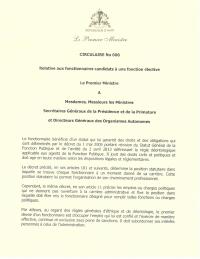
(2015-04) Circular No. 006 on Civil Servants Standing as Candidates for Elective Office
Summary — Signed by Prime Minister Evans Paul on 17 April 2015, this circular reminds ministers, secretaries-general and directors-general of autonomous agencies that civil servants seeking elective office must request leave of absence (mise en disponibilité) and contractual agents must resign, with automatic contract termination once an electoral authority approves their candidacy. It also bars use of state resources for electoral or partisan purposes.
Key Findings
- Civil servants running for elective office must request leave of absence (mise en disponibilité) for personal convenience.
- Contractual public agents must request contract termination or face automatic resiliation upon candidacy approval.
- Leave-of-absence requests must be routed through OMRH, which reports to the Prime Minister.
- State equipment and resources cannot be used for electoral or partisan purposes, under threat of sanction.
Full Description
Circular No. 006, signed by Prime Minister Evans Paul on 17 April 2015, addresses the status of civil servants who decide to run for elected office. It recalls that the civil-service statute (decree of 1 May 2005 revising the general civil-service statute, together with the 2 April 2013 order on ethical conduct) guarantees agents civil and political rights but requires them to act within legal and regulatory bounds. Citing Articles 135 and following of the decree, it holds that any civil servant deciding to run for an elective post must file a request for leave of absence for personal convenience (mise en disponibilité) with the competent administrative authorities; a contractual public agent in the same situation must request termination of their contract, failing which approval of their candidacy by the electoral authority automatically terminates the contract with all legal consequences. Any leave-of-absence request must be communicated to the Office of Management and Human Resources (OMRH), which reports to the Prime Minister. The circular also directs the relevant authorities to prevent the use of state equipment and resources for electoral or partisan purposes, warning that violators are liable to sanctions under public-administration law and regulation.