
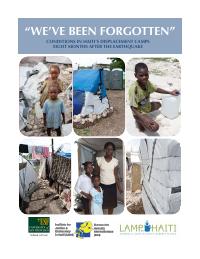
(2010-09) "We've Been Forgotten": Conditions in Haiti's Displacement Camps Eight Months After the Earthquake
Summary — A five-month follow-up survey of 90 displaced families in six camps finds aid has slowed or stopped, with systematic violations of rights to food, water, sanitation, housing, and protection eight months after the earthquake.
Key Findings
- Aid had slowed and even stopped in each of the six camps surveyed, making life far worse for most families eight months after the earthquake. Basic rights were systematically violated: 75 percent of families had someone go an entire day without eating, 44 percent primarily drank untreated water, 27 percent defecated in a container, plastic bag, or on open ground, and 78 percent lived without enclosed shelter. Protection was inadequate, with 94 percent of families feeling they could not return home and 48 percent threatened with forced eviction since the earthquake. The report urges a rights-based approach to relief, donor accountability, locally sourced food aid, and an end to forced evictions.
Full Description
This report by the LAMP for Haiti Foundation, IJDH, the Bureau des Avocats Internationaux, and the University of San Francisco School of Law presents findings from a five-month follow-up of 90 Haitian families displaced by the January 12, 2010 earthquake. The initial February 2010 survey in six camps produced the report Neglect in the Encampments, presented to the Inter-American Commission on Human Rights. In July 2010, 52 of the original families were located and re-interviewed, and their living conditions were measured against standards in the Haitian Constitution and international law on displaced persons. The survey found evidence of systematic rights violations: 75 percent of families had someone go an entire day without eating in the past week, 44 percent primarily drank untreated water, 27 percent defecated in containers or the open, 78 percent lived without enclosed shelter, and 48 percent had been threatened with forced eviction. With over 1.3 million Haitians still in roughly 1,300 camps, the report concludes aid slowed or stopped in each camp surveyed and issues nine recommendations, including rapid aid disbursement, adherence to the UN Guiding Principles on Internal Displacement, and ending forced evictions.
Notes
IJDH/BAI/LAMP for Haiti/USF longitudinal camp survey, second round; ayitistats wave B