
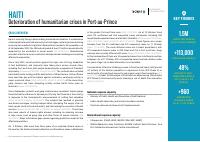
(2022-11) ACAPS Briefing Note: Haiti - Deterioration of Humanitarian Crises in Port-au-Prince (1 November 2022)
Summary — ACAPS documents the sharp deterioration of humanitarian conditions in Port-au-Prince in late 2022, when the gang blockade of the Varreux fuel terminal, anti-government protests, and the first cholera cases in over three years converged. By mid-October, over 960 suspected cholera cases had been recorded, 4.7 million Haitians faced Crisis (IPC Phase 3) or worse food insecurity, and 19,200 people in Cité Soleil were at Catastrophe (IPC Phase 5) levels. The note maps sectoral needs in food, WASH, health, nutrition, shelter, and education under severe access constraints.
Key Findings
- Cholera returned to Haiti on 2 October 2022 after more than three years without a reported case, reaching 115 confirmed and 964 suspected cases with at least 33 deaths by 19 October, concentrated in gang-controlled Cité Soleil and Port-au-Prince, with 42 percent of suspected cases among children under ten.
- The gang blockade of the Varreux fuel terminal since September 2022 cut off gasoline and diesel nationwide, shutting hospitals dependent on generators, halting water trucks and municipal pumps, and leaving 30 percent of Digicel's antennae without fuel.
- Food insecurity reached a record: 4.7 million people (48 percent of the population) faced Crisis (IPC Phase 3) or worse levels, and 19,200 people in Cité Soleil were classified at Catastrophe (IPC Phase 5), Haiti's first such classification.
- Access to affected populations collapsed as roughly 60 percent of the Port-au-Prince metropolitan area fell under gang control or influence, over 113,000 people were internally displaced, and more than 200 schools closed with gangs occupying almost 25 percent of schools.
- The UN Security Council established a sanctions regime on 21 October 2022 (arms embargo, travel ban, asset freeze), and the US and Canada supplied armoured vehicles to the Haitian police after President Henry requested international military assistance.
Full Description
This briefing note, published on 1 November 2022, assesses the compounding humanitarian crises in Port-au-Prince as social unrest, gang violence, fuel shortages, and a resurgent cholera outbreak converged. Since July 2022, protests against the high cost of living and fuel-subsidy cuts had paralysed major cities, while armed gangs blockaded the Varreux fuel terminal from September, cutting off gasoline and diesel, disrupting food and water supply chains, shutting hospitals dependent on generators, and leaving 30 percent of Digicel's antennae without fuel. The UN estimated at least 1.5 million people directly affected by the escalation. On 2 October, after more than three years without a reported case, cholera returned: by 19 October there were 115 confirmed and 964 suspected cases with at least 33 deaths, concentrated in Cité Soleil and Port-au-Prince, and 42 percent of suspected cases involved children under ten.
The note details sectoral needs: 4.7 million people (48 percent of the population) faced IPC Phase 3 or worse food insecurity, including 19,200 in Cité Soleil at Catastrophe (IPC Phase 5), the first such classification in Haiti; over 35 percent of the population lacked basic drinking water services while fuel shortages idled municipal water pumps; around 29,000 pregnant women risked losing access to critical care; almost 100,000 children under five with severe acute malnutrition were especially vulnerable to cholera; more than 113,000 people were internally displaced; and roughly 2.4 million children were affected by schools failing to reopen, with gangs occupying almost a quarter of schools in Port-au-Prince. Contextual sections cover the G9/G-Pèp turf war (roughly 60 percent of the metropolitan area under gang control or influence), inflation above 30 percent, a poverty rate of 52.4 percent in 2021, the UN Security Council's 21 October sanctions regime, and Haiti's structural exposure to climate hazards.
Notes
re-downloaded from ACAPS fileadmin after gather error