
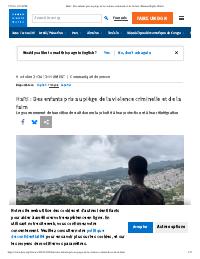
(2024-10) Haiti: Children Trapped by Criminal Violence and Hunger
Summary — This Human Rights Watch news release documents how hundreds or thousands of Haitian children, driven by hunger and poverty, have joined criminal groups where they are forced into illegal activities and abused, with recruitment intensifying in response to police and Multinational Security Support mission operations. Based on 58 interviews in Port-au-Prince in July 2024, including 16 children, it calls on the transitional government to prioritise protection, education and legal pathways for children's rehabilitation and reintegration.
Key Findings
- Hundreds or thousands of children, driven mainly by extreme hunger and poverty, have joined criminal groups that pay 100 to 20,000 gourdes a month plus food and shelter, recruiting from around age 10; humanitarian and government sources estimate at least 30 percent of criminal group members are children.
- Recruitment intensified after joint Haitian National Police and Multinational Security Support mission operations began in mid-July 2024, with groups like Village de Dieu running dedicated units to train children in weapons, checkpoints and observation posts.
- Girls associated with criminal groups are exploited for domestic labour and systematically subjected to rape and sexual exploitation, and families in gang-controlled areas are increasingly forced to hand over daughters in exchange for protection.
- BINUH recorded 105 children killed (78 boys, 27 girls) between January and mid-September 2024, more than 300,000 children are internally displaced, about 125,000 suffer severe acute malnutrition and nearly 3 million children need humanitarian aid.
- Response capacity is critically underfunded: by September UNICEF had received only 30 percent of the 30.4 million dollars needed for education and 25 percent of the 30 million needed to protect nearly 600,000 children, while the juvenile court has been paralysed since 2019 and the juvenile detention centre now mixes children with adults.
Full Description
Published on 9 October 2024, this Human Rights Watch news release documents the recruitment and use of children by Haiti's criminal groups, based on a July 2024 visit to Port-au-Prince with interviews of 58 people, including 16 children (12 boys and 4 girls) living in gang-controlled areas of Port-au-Prince, Carrefour, Gressier and Cité Soleil, plus meetings with the Prime Minister, ministers, the Transitional Presidential Council president, the police director and the Multinational Security Support mission commander, and 20 remote interviews. Criminal groups control about 80 percent of the capital, where some 2.7 million people, including half a million children, live under their rule according to UNICEF, and humanitarian and government sources estimate that at least 30 percent of criminal group members are children. All children interviewed said extreme hunger was the main reason they joined; groups pay 100 to 20,000 gourdes a month plus food and shelter, recruit from around age 10, train boys in weapons handling and use them as lookouts, porters and in confrontations, while girls are exploited for domestic labour and subjected to sexual exploitation and rape. Recruitment has intensified since joint police-MSS operations began in mid-July 2024, with groups like Village de Dieu running dedicated child-training units. BINUH recorded 105 children killed between January and mid-September 2024, more than 300,000 children are internally displaced, about 125,000 suffer severe acute malnutrition and nearly 1,000 schools in Ouest and Artibonite were closed, depriving about 160,000 children of schooling. The release urges the transitional government to build a comprehensive child protection strategy anchored in the Convention on the Rights of the Child, strengthen the disarmament, demobilisation and reintegration commission, fix the paralysed juvenile justice system, and calls for international funding: by September UNICEF had received only 30 percent of the 30.4 million dollars needed for education and 25 percent of the 30 million needed to protect nearly 600,000 children.
Notes
web article printed to PDF