
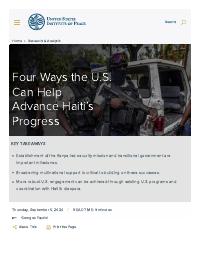
(2024-09) Four Ways the U.S. Can Help Advance Haiti's Progress
Summary — Writing around Secretary of State Blinken's September 2024 visit, the first by a U.S. secretary of state in nearly a decade, Georges Fauriol takes stock of Haiti's post-April 2024 milestones (transitional government, MSS deployment) and sets a 90-day U.S. agenda: sustain the security mission, act on economic recovery through HOPE/HELP renewal and Global Fragility Act operationalization, mobilize the diaspora, and unify a disaggregated U.S. strategy.
Key Findings
- Since the April 2024 CARICOM-mediated agreement, Haiti has installed a transitional government (TPC plus PM Conille) and received the Kenyan-led MSS, with Blinken's September 2024 visit the first by a U.S. secretary of state in nearly a decade.
- The MSS suffers a perception problem: it is not a U.N. peacekeeping operation but an HNP-support mission, and even the full 1,000-strong Kenyan contingent will be insufficient without other contingents deploying.
- HOPE/HELP trade preferences, representing over 80 percent of Haiti's exports, expire in September 2025 and contracts are already diverting away; their demise would be catastrophic.
- Haitian civil society is ready to work: the National Conference's Comité de Pilotage and the GAT are first steps toward constitutional revision and the February 2026 transition.
- The U.S. challenge is not the absence of a Haiti strategy but its disaggregated character; Washington must unify security funding diplomacy, GFA operationalization, diaspora mobilization and multilateral donor coordination (World Bank, IDB).
Full Description
This September 2024 analysis assesses progress since Haiti's April 2024 political agreement mediated by CARICOM, which set a February 2026 timetable for an elected government: a transitional structure led by the Transition Presidential Council and PM Garry Conille is in place, and the Kenyan-led MSS is active. Fauriol notes Conille's dynamism against tensions within the TPC, and a perception problem around the MSS, which is not a U.N. peacekeeping operation but a support mission for the depleted Haitian National Police, and whose full Kenyan contingent of 1,000 will anyway be insufficient. Civil society readiness is flagged as underappreciated: the National Conference's Comité de Pilotage and the Groupe d'Assistance à la Transition (GAT) are first steps toward the February 2026 milestones of constitutional revision, a redefined societal compact and judicial reform.
The 90-day U.S. agenda has four planks. First, keep up with security: the U.S. as chief fundraiser must push others, especially in the hemisphere, to contribute, and support the MSS beyond funding (training, logistics, medical). Second, economic recovery: renew the HOPE/HELP trade preferences expiring September 2025, which have represented over 80 percent of Haiti's exports and whose demise would be catastrophic, and operationalize the Global Fragility Act's 10-year, locally led resilience approach, including support to Haiti's universities. Third, mobilize a diaspora that lacks a unified voice. Fourth, unify and clarify U.S. strategy across Caribbean, Latin American, European and multilateral relationships, including the World Bank and the Inter-American Development Bank; the challenge is not the absence of a strategy but its disaggregated character.
Notes
Recovered from Wayback Machine (USIP 2025 publisher takedown); web article printed to PDF