
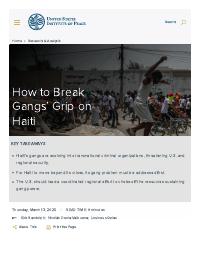
(2025-03) How to Break Gangs' Grip on Haiti
Summary — USIP analysts warn Haiti's gangs are evolving into transnational criminal organizations threatening U.S. and regional security, with over one million people displaced and 5.4 million Haitians going hungry. They call for harmonizing the fragmented international sanctions regimes, a U.S.-led interagency task force linking law enforcement, maritime interdiction (JIATF-S, CBSI) and the MSS mission, and choking off the arms flows, 73 percent of traced Caribbean firearms originating in the U.S.
Key Findings
- Haiti's gangs are evolving from localized groups into transnational criminal organizations whose smuggling routes move weapons, drugs and people across the Caribbean, threatening U.S. and regional security.
- As of January 2025 over one million people are displaced (a majority children) and 5.4 million Haitians, nearly half the population, do not have enough to eat.
- The international sanctions regime is a disorganized puzzle: about 45 Haitians sanctioned across jurisdictions but only seven by the U.N. Security Council, with Russia and China blocking Panel of Experts recommendations and gaps letting elites operate unimpeded.
- A GAO report found 73 percent of traced firearms recovered in the Caribbean (2018-2022) came from the U.S., largely via Florida ports, exposing export-oversight gaps.
- A dedicated U.S. interagency task force linking law enforcement, an arms-interdiction-expanded JIATF-S, CBSI intelligence sharing and the MSS mission could choke off the resources sustaining gang power.
Full Description
This March 2025 analysis by Kirk Randolph, Nicolás Devia-Valbuena and Louiceus Ozias argues that breaking organized crime's grip must precede Haiti's institutional recovery. A new U.N. report shows armed groups extending control into new territories: over one million displaced (a majority children), impassable roads and 5.4 million Haitians, nearly half the population, without enough to eat, while the Bwa Kale vigilante movement fills the vacuum left by an overwhelmed police force. The gangs' evolution into transnational criminal organizations moves drugs, weapons and people along the same smuggling routes, threatening the wider hemisphere.
The authors' first target is the 'disorganized puzzle' of sanctions. Around 45 Haitian nationals are sanctioned by one or more jurisdictions, including former president Michel Martelly, ex-parliamentarians Prophane Victor, Joseph Lambert and Youri Latortue, and businessmen Gilbert Bigio, Reynold Deeb and Sherif Abdallah, but the U.N. Security Council has sanctioned only seven individuals, mostly gang figures like Chérizier and Vitel'Homme Innocent, while Russia and China block action on U.N. Panel of Experts recommendations; harmonization should precede expansion. Second, enforcement gaps: a GAO report found 73 percent of traced firearms recovered in the Caribbean in 2018-2022 came from the U.S., many through Florida ports. They propose a dedicated interagency task force centralizing arms-trafficking prosecutions, expanding JIATF-S's counter-narcotics mandate to weapons interdiction, leveraging the Caribbean Basin Security Initiative for intelligence sharing with the Dominican Republic, Bahamas and Jamaica, and linking these efforts to the MSS mission. The tools exist, they conclude; what is missing is unified, sustained use of them.
Notes
Recovered from Wayback Machine (USIP 2025 publisher takedown); web article printed to PDF