
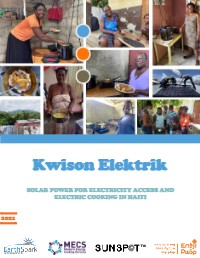
Enèji Solè pou Aksè Elektrisite ak Kuizin Elektrik an Ayiti
Rezime — Rapò sa a eksplore potansyèl kuizin elektrik nan zòn riral Ayiti lè li deplwaye otoklòk elektrik ak recho endiksyon nan fwaye ki konekte ak yon mikwo-rezo solè PV kominotè ak fwaye ki pa sou rezo a. Pwojè pilòt la montre valè kuizin elektrik pou kominote lokal yo ak operatè mikwo-rezo yo.
Dekouve Enpotan
- Kizin elektrik diminye tan pou kwit manje, espesyalman pou manje de baz yo.
- Kizin elektrik ogmante chay griyaj ak itilizasyon dèlko.
- Patisipan yo te wè divès avantaj nan kuizin elektrik, patikilyèman tan yo te sove.
- Ekonomi finansye sou depans chabon yo ka enpòtan.
- Aksè enèji debaz se yon benefis esansyèl sistèm ki pa sou rezo yo bay.
Deskripsyon Konple
Etid sa a eksplore potansyèl kuizin elektrik nan zòn riral Ayiti lè li deplwaye otoklòk elektrik ak recho endiksyon ak entegre mèt entelijan nan 20 fwaye ki konekte ak yon mikwo-rezo solè PV kominotè ansanm ak recho ak fou ki sipòte pa sistèm solè + batri otonòm nan 8 fwaye ki pa sou rezo a. An jeneral, pwojè pilòt la montre valè kuizin elektrik pou kominote lokal yo ak operatè mikwo-rezo yo. Rezilta kle yo endike ke kuizin elektrik nan kontèks sa a se yon katalis pou amelyore kalite lavi pou kominote yo, yon chemen esansyèl pou amelyore sèvis pou operatè mikwo-rezo yo, epi yo ka ogmante ak finansman ki baze sou rezilta ak lòt ankourajman entelijan.
Teks Konple Dokiman an
Teks ki soti nan dokiman orijinal la pou endeksasyon.
2021 SOLAR POWER FOR ELECTRICITY ACCESS AND ELECTRIC COOKING IN HAITI Kwi son Elektrik PAGE | 2 Kwi son Elektrik: Solar Power for Electricity Access and Electric C o oking in Haiti Authors Andy Bilich , Wendy Sanassee, Allison Archambault, Adam Eberwein, Jean Thaylord Acknowledgments The authors would like to thank the following individuals for their help in implementing the research study and scoping, developing, edi ting , and reviewing this report: Doug Danley, Madison Sturgess , Teresa Danley, Joey Dunn , Jon Leary, Jane Long, Simon Batchelor Funding Funding for this project generously provided by a research grant funded by Loughborough University (via the Modern Ener gy Cooking Serv ices Initiative under UKAID). Pictures All pictures used in this report are property of EarthSpark International. Photo credits: Wendy Sanassee EarthSpark International EarthSpark International builds energy - related business models that e xpand opportuni ty for people living in hard - to - reach places. We focus first on what can work in Haiti. Where there is no incumbent infrastructure , there is an opportunity to build energy systems that use today's technologies, business models, and community participation to deliver clean, affordable, reliable electricity. This is our way of working towards climate justice and Sustainable Energy for All . ©20 21 EarthSpark International PAGE | 3 Kwi son Elektrik: Solar Power for Electricity Access and Electric Cooking in Haiti Table of Contents List of Figures ................................ ................................ ................................ ................................ ............. 5 Abbreviations ................................ ................................ ................................ ................................ ............. 6 EarthSpark Inter national ................................ ................................ ................................ ........................... 7 Execu tive Summary ................................ ................................ ................................ ................................ ... 9 Introduction ................................ ................................ ................................ ................................ .......... 11 Introduction ................................ ................................ ................................ ................................ .............. 11 Study Overview ................................ ................................ ................................ ................................ ... 11 Report Organization ................................ ................................ ................................ ............................ 12 Background ................................ ................................ ................................ ................................ ............... 14 Energy Access and Access to Clean Cooking ................................ ................................ .................. 14 Traditional Cooking Impacts ................................ ................................ ................................ .............. 15 Historical Approaches to Clean Cooking ................................ ................................ ......................... 18 El ectric Cooking Research ................................ ................................ ................................ .................. 20 Electric Cooking ................................ ................................ ................................ ................................ ....... 20 Electric Cooking and Microgrids ................................ ................................ ................................ ....... 23 Challenges for Electric Cooking ................................ ................................ ................................ ......... 25 Overview ................................ ................................ ................................ ................................ ............... 27 Methodology and Data ................................ ................................ ................................ ........................... 27 Participants ................................ ................................ ................................ ................................ ........... 27 Training ................................ ................................ ................................ ................................ ................. 29 Electric Cooki ng Technology and Installations ................................ ................................ ............... 30 Data Sources ................................ ................................ ................................ ................................ ......... 31 Overview ................................ ................................ ................................ ................................ ............... 33 Results ................................ ................................ ................................ ................................ ........................ 33 Baseline Cooking Fuels ................................ ................................ ................................ ....................... 33 Participant and Menu Profiles ................................ ................................ ................................ ............ 35 Electric Cooking and Customer Consumption ................................ ................................ ................ 37 PAGE | 4 Kwi son Elektrik: Solar Power for Electricity Access and Electric C o oking in Haiti Microgrid Operations and Power Quality ................................ ................................ ....................... 42 Customer Surveys ................................ ................................ ................................ ................................ 44 Charcoal Costs and Indicative Willingness to Pay ................................ ................................ .......... 46 Key Takeaways ................................ ................................ ................................ ................................ ..... 50 Discussion ................................ ................................ ................................ ................................ ................. 52 Community Impacts - Catalyst for I mproved Quality of Life ................................ ....................... 52 Impacts for Microgrid Models and Operators – Critical Pathway for Improved Service ......... 55 Social Inclusion and Gender Impacts ................................ ................................ ................................ 58 Scaling - up Electric Cooking ................................ ................................ ................................ ............... 59 Future Research ................................ ................................ ................................ ................................ .... 62 Lessons Learned ................................ ................................ ................................ ................................ ....... 64 Design, Performance and Technical Issues ................................ ................................ ...................... 64 Electric Cooking Equipment ................................ ................................ ................................ ............... 66 User Acceptance and Uptake ................................ ................................ ................................ ............. 68 Data Analysis and Collection ................................ ................................ ................................ ............. 68 Conclusion ................................ ................................ ................................ ................................ ................ 70 Conclus ion ................................ ................................ ................................ ................................ ............ 70 Annexes ................................ ................................ ................................ ................................ ..................... 71 Annex: References ................................ ................................ ................................ ................................ 71 PAGE | 5 Kwi son Elektrik: Solar Power for Electricity Access and Electric Cooking in Haiti List of Figures Figure 1: Comparison of Primary Cooking Fuels by Region ................................ ............................. 15 Figure 2: Impacts of Traditional Cooking ................................ ................................ ............................. 16 Figure 3: El ectrical Setup for “SparkS tove” system ................................ ................................ ............ 30 Figure 4: Base Meal Type and Addition to Meal Frequencie s ................................ ........................... 36 Figure 5: Average Cooking/Prepping Times by Meal Type ................................ .............................. 38 Figure 6: Electric Cooking Events by Device ................................ ................................ ....................... 39 Figure 7: Summary of Individual Pa rticipant Electric Cooking ................................ ........................ 40 Figure 8: Average Electricity Consumption per Customer by Device ................................ ............. 41 Figure 9: Daily Total Microgrid Electricity Consumption in October ................................ .............. 42 Figure 10: Hourly Average Microgrid Electricity Consumption ................................ ...................... 43 Figure 11 : Advantages and Disadvantages of Electric Cooking ................................ ....................... 45 Figure 12: Percentage Savings on Charcoal Expenditures ................................ ................................ . 47 Figure 13: Use of Savings from Electric Cooking ................................ ................................ ................ 48 Figure 14: Indicative Willingness to Pay for Electric Cooking ................................ .......................... 49 PAGE | 6 Kwi son Elektrik: Solar Power for Electricity Access and Electric C o oking in Haiti Abbreviations EP Enèji Pwòp EPC Electric pressure cooker ES EarthSpark EUR Euros HTG Haitian Gourde KW Kilowatts KWH Kilowatt hours LIDC Low - Income Developing Country MECS Modern Energy Cook ing Services SIDS Small Island Developing States SM SparkMeter USD US Dollar PAGE | 7 Kwi son Elektrik: Solar Power for Electricity Access and Electric Cooking in Haiti EarthSpark International EarthSpark International is a non - prof it headquartered in Washington DC that builds business models to solve energy poverty. We focus on what can work in Hai ti while building best practices relevant around the world . EarthSpark has been working on energy access in rural Haiti since 2009: • 2009 - 12: Built network of 100 independent retailers for small - scale solar + cookstoves • 2012: Launched Haiti’s fi rst pre - pay microgrid in, expanded to a town - sized solar smart grid for ~2000 people in 2015. • 2015: Established microgrid landscape Haiti through nat ional microgrid market study in partnership with Enèji Pwòp • 2019: Secured the first ever microgri d operatin g license from Haiti’s new energy regulator to launch a second smart solar microgrid; began pre - development for two additional grids. • 2020: Secured f unding commitment from Green Climate Fund towards microgrid expansion blended finance project in Haiti. Dur ing its operations, EarthSpark has been constantly innovating and developing real - world solutions to on the ground problems for communities and energ y access. So far, EarthSpark has incubated and spun off 3 companies: • Enèji Pwòp is a Haitian micr ogrid oper ations company that currently operates two microgrids in Les Anglais and Tiburon . Learn more at https://www .enejipwop.com/ • S parkMeter provides microgrid operators with smart metering and billing services. SparkMeter, developed initially for EarthSpark’s microgrid work in Haiti, is now t he leading global supplier of smart metering services for energy access mic rogrid operators around the world. Learn more at https://www.sparkmeter.io/ • P articipant Power is a microgrid development company that leverages blended financing to support new microgrid projects. Learn more abou t EarthSpark ’ s work at http://www.earthsparkinternational.org/ . P artners S UN S POT – SUNSPOT™ is a s elf - contained off - grid solar electric power system . The SUNSPOT™ solar electric cooking system provide s a clean, efficient and cost - effective alternative to wood or charcoal. Solar electric cooking is made possible by three recent tre nds – the dramatic fa ll in the price of solar panels for utility projects, the availability of low cost, PAGE | 8 Kwi son Elektrik: Solar Power for Electricity Access and Electric C o oking in Haiti highly efficient i nduction cookstoves and the introduction of Pay - As - You - Go financing in rural communities. Learn more at www.sunspotpv.com . Modern Electric Cooking Services (MECS) – M odern Energy Cooking Services (MECS) is a five - y ear programme funded by UK Aid (DFID) in partnership with Loughborough University. The intended outcome is a market - ready range of innovations (technology and business models) which lead to improved choice of affordable and relia ble modern energy cooking s ervices for consumers. We will seek to have the MECS principles adopted in the SDG 7.1 global tracking framework and hope that participating countries will incorporate modern energy cooking services in energy policies and plannin g. Learn more at m ecs.org.uk . PAGE | 9 Kwi son Elektrik: Solar Power for Electricity Access and Electric Cooking in Haiti Executive Summary Around the world, people are realizing that fire - based cooking is neither good for the cooker nor for the climat e. O ver 2.8 billion people are still r elying on charcoal, biomass or kerosene to coo k. Traditional cooking fuels are often expensive, bad for people’s health, a nd bad for the environment. The impacts are particularly outsized for women in rural communities. G lobal “ clean cooking ” efforts have focused on improved cookstoves, biomass briqu ettes, and expansion of LPG. However , clean cooking has lagged significantly compared to the need , and the solutions have often not fully solved the problems. Re cent initiatives focus ing on electric cooking are a welcome shift . For too long a ccess to elect ricity and access to improved cooking technology have been siloed. Combining the two iss u es has the potential to more effectively meet people’s basic needs while boosting the business model for solar - powered electricity system s in remote comm unities. This study explores the potential of electric cooking in rural Haiti by deploying electric pressure cookers and induction stoves w ith integrated smart meters in 20 households connected to a community scale solar PV microgrid as well as cookers and stoves suppor ted by stand - alone solar+battery systems in 8 off - grid households. Overall, the pilot project has showcased the value of elec tric cooking for both local communities and microgrid operators. Key findings indicate that electric cooking in this context is a: • Catalyst for improved q uality of life for communities – P articipants ’ primary observatio n was the time savings and convenience of electric cooking compared to traditional fuels. I ndicative willingness to pay values for most participants met or exceeded exi sting microgrid tariffs which highlights the op portunity for electric cooking to support improved livelihoods for vulnerable households . T he electric cooking deployments also significantly reduce the risk of household air polluti on. • C ritical pathway for im proved service for microgrid operators – Electric cooking require s significant ly more energy than what most “ energy access ” microgrids have been designed to deliver . This is both a challenge and an enormous opportunity for microgrid developers . The signifi cant n ew revenue stream may be an incentive to build more robust infrastructure which, in turn, del ivers additional benefits to the community and operator. Electric cooking also reduces GHG emissions from baseline fuels (a key metric for microgrid reg ulato rs and investors) and further allows for greater utilization of i nstalled solar as cooking profiles in Haiti align with solar production . • Scaling - up electric cooking – R esults - based financing and other smart incentives could specifically connect clean cook ing to other sustainable development goals, especially food security, energy access, poverty alleviati on, and health. This deliberate connection PAGE | 10 Kwi son Elektrik: Solar Power for Electricity Access and Electric C o oking in Haiti c ould help to catalyze and coordinate investments and service delivery to target communities. O verall, the proj ect is a first - step working to prove the viability, effect iveness, and attractiveness of electric cooking technologies pow ered by robust, reliable solar + storage energy systems supporting critical socioeconomic development outcomes in Haiti. The hope is t hat this will help to demonstrate key demand for the solut ion and create actionable evidence for how to effectively desi gn business models and frameworks to better support future electric cooking rollouts. PAGE | 11 Kwi son Elektrik: Solar Power for Electricity Access and Electric Cooking in Haiti Introduction From steaming fluffy rice with b lack bean sauce to fried plantains and plenty of tropical fruit to vibrant vegetable, meat, and fish stews , t he intoxicatin g aromas of Haiti’s cooking provide a conduit to its culture. In Haiti, food brings families and comm unities together. While Haiti's cuisine is both nourishing and flavourful , the reliance on charcoal and other woodfuels presents serious risks to househol d health and opportunity for its communities, particularly women and young children . By empowering co mmunities with electric clean co oking powered by reliable electricity from EarthSpark’s existing solar microgrids operations in Haiti, there is enormous po tential to curb the negative health, socioeconomic, and environmental impacts of status quo cooking f uels while preserving the rich c ulinary tradition that underpins Haitian society. Study Overview The present study explores the potential for electric cook ing powered by reliable community - scale solar PV microgrids to provide an effective alternative to tr aditional cooking methods for ru ral communities in Haiti. The study is part of a broad research grant funded by Loughborough University (via the Modern Ene rgy Cooking Services Initiative under UKAID) and implemented by EarthSpark International. Leveraging detailed smart meter consumptio n data and energy/food journals from 28 households equipped with electric pressure cookers and electric induction stoves, t his project builds a baseline for Introduction PAGE | 12 Kwi son Elektrik: Solar Power for Electricity Access and Electric C o oking in Haiti electric cooking in Haiti and beyond, by establishing a k nowledge base for electric cooking awarene ss building, customer preferences (especially for cooking times/recipe limitations/taste), operating costs and impact on mi cro grid operations, key challenges and barriers, and best practices/lessons learned for ele ctric cooking in rural Haiti. Key research questions for the study include, but are not limited to: • What is the baseline situation for traditional cooking in rural H aiti ? • Can electric cooking devices support Haitian cooking both in terms of physical capabi lity, but also for meeting the expectation s and preferences of local communities? • How can electric cooking devices be deployed effectively in a microgrid context to support community cooking needs without compromising other microgrid electricity service ? • H ow can electric cooking enable time and co st savings and reduction of harmful indoor air pollution for households, particularly women? • What tariff design and other f inancing mechanisms are needed to support affordability and uptake of electric cooking solu tions? • What actions need to be taken to su pport an enabling environment for clean electric cooking in Haiti and beyond? Report Organization The report is organized i nto the following sections: Section 1: Background – Background information and context on energy access and access to clean cooking fuels, impacts of traditional cooking fuels, and traditional approaches to clean cooking for developing communities with an emphasis on Haiti. Section 2: Electric Cooking – An overview of electric cooking research in developing communities, particularly hi ghlighting key challenges to overcome and applications for microgrid contexts. Section 3 : Methodology and Data – Study meth odology, technology selection, participant selection, and data sources/analysis approach for the electric cooking study . Section 4 : R esults and Analysis – Results and analysis including consumer preferences, compatibility of Haitian meals with electric coo king, electric cooking consumption profiles, cost con siderations, and impact on microgrid operations Section 5 : Discussion – Implicat ions of the research for broader electric cooking in Haiti and beyond including a discussion of community impacts , impacts on microgrid models and operators, social inclusion, finances and affordability , development of an enabling environment for electric clean cooking , and key future research steps. Section 6 : Challenges and Lessons Learned – A discussion of key challenges durin g the PAGE | 13 Kwi son Elektrik: Solar Power for Electricity Access and Electric Cooking in Haiti study and important lessons learned that can be leveraged in future research . Section 7 : Conclusion – Discussion of the ove rall impact of the study and the critical next steps . Section 8: Annexes – Supporting information including refer ences , participant surveys and energy diaries, etc. PAGE | 14 Kwi son Elektrik: Solar Power for Electricity Access and Electric C o oking in Haiti Energy Access and Access to Clean Cooking A n estimated 789 million people worldwide lacke d access to electricity in 2018 (IRENA, 2020) . In Haiti, only 30% of the population (5 - 10% in rural areas) ha s access to electricity (World Bank Scaling Renewable Energy Program, 2015) . While progre ss has been seen for electricity access with the population gaining access outpacing population growth, access to clean fuels and technologies for cooking remains a critical obstacle to achieving the United Nations Sustainable Development Goal 7 (SDG7) whi ch aims to, ensure universal access to affordable, reliable and modern ener gy 1 In rural areas w ith large charcoal production operations, there is a lot higher proportion of charcoal used for cooking . services by 2030 (International Energy Agency, 2019) . In 2018, over 2. 8 billion people live d without access to clean cooking fuels and technologies, relying instead on woodfuels, charcoal, kerosene, and other solid biomass fuels as their primary cooking fuel. T he most recent projections from the International Energy Agency (IEA) suggests that the global community will fall far short of the 2030 univer sal access target with over 2.3 billion people still without access to clean cooking by 2030 and 1.8 billion in 2 040 (International Energy Agency, 2019) . In Haiti, an est imated 97.3% of rural households depend primarily on so lid fuels for household cooking (74.7% wood, 22.5% charcoal , 0.1% lignite 1 ) and the vast majority Background PAGE | 15 Kwi son Elektrik: Solar Power for Electricity Access and Electric Cooking in Haiti of cooking i s done indoors (63%) and on inefficient traditional unvented and unimproved cookstoves or over open flames (Institut H aïtien de l’Enfance and IFC, 2018) ( Figure 1 ) . Traditional Cooking Impacts Combusti on of traditional cooking fuels like biomass and kerosene in inefficient cookstoves or over open flames results in high levels of household air p ollution (HAP) and e xposure to health - damaging pollutants, especially for women and young children (World Health Organization, 2014) (Clean Cooking Alliance, 2017) . This life - long exposure, including through critical periods of maternity and child development, can have serious consequences for health (World Health Organization, 2014) . The World Health Organization estimates that almost 3.8 million people die each year fro m illness es like pneumonia, stroke, ischaemic heart disease, chronic obstructive pulmonary disease (COPD) and l ung cancer that are attributable to HAP from the use of kerosene and biomass fuels for cooking (World Health Organiza tion, 2018) . In Haiti, the World Health Organization estimates that there were over 11,000 deaths Figure 1 : Comparison of P rimary Cooking Fuels by Region PAGE | 16 Kwi son Elektrik: Solar Power for Electricity Access and Electric C o oking in Haiti attributab le or partially attributable to HAP in 2016 including over 2,000 children under 5 (World Health Organization, 2016) . In addition to the elevated HAP risks, traditional cooking also creates significant socioeconomic challenges, particularly for women in rural communities. On average women can spend 4 - 6 hours per day on collecting and preparing fuel for cooking and for c oo king activities themselves. This can have significant impacts on health, education, income opportunities, and simply leisure time for women which serves to sustain and exacerbate gender inequality in developing communities (Pr actical Action Consulting, 2019) . Further, the lost economic potential from unpaid work hours collecting fuel for women amounts to Figure 2 : Impacts of Traditional Cooking PAGE | 17 Kwi son Elektrik: Solar Power for Electricity Access and Electric Cooking in Haiti an estimated $12 trillion annually (McKinsey Global Institute, 2015) . Haitian women for exampl e spend twice as much time on domestic tasks as men and can spend up to five hours per day collecting firewood , collecting water , and cooking (Global Alliance for Clean Cookstoves, 2017) . Socioeconomic impacts are also se e n from fuel expenditures which can represent a significant portion of household inc o me and limit available income for other necessa r y expenditures like education and food (World Bank and, 2014) (Practi cal Action Consulting, 2019) . In 2015 , with a traditional stove and traditional wood charcoal, the average ho usehold in Haiti sp en t an estimated 58 - 67 htg/day on fuel (Global Alliance for Clean Cookstoves, 2017) and approxima tely 10% of their annual income on fuel (Clean Cooking Alliance, 2017) . This is co mpounded by the use of inefficient stoves . Additional evidence from EarthSpark’s microgrid planning surveys highlights that in more remote rural areas in Southern Haiti nearly 100% of households utilize wood or charcoal for cooking and that some households can spend upwar ds of 1000 htg every week for cooking fuels. In addition to the human health , gender , and socioeconomic impacts, utilizing wood, charcoal, and other solid fuels can contribute to other externalities including forest degradation, biodiversit y loss, soil deg radation and climate change (SEI and HIVOS, 2020) . In fact , c ooking and heating fuels like wood, agri culture waste, and charcoal are estimated to contribute almost 25% of global black carbon emissions (Bo nd, et al., 2013) and non - renewable woodfuels contribute an estimated 1.9 - 2.3% of greenhouse gas emissions annually. Haiti still has over 75% of its primary energy supply from biomass and woodfuels (Internati onal Energy Agency, 2018) and does experience environmental degradation from charcoal and woodfuel production , Haitian w oman with a traditional stove PAGE | 18 Kwi son Elektrik: Solar Power for Electricity Access and Electric C o oking in Haiti particularly in certain local c ommunities. In Haiti these impacts may be less pronounced than previously estimated . A recent report on the cha rcoal industry in Haiti highlights that Haiti’s tree cover is significantly higher than previously estimated and while there are localized impact s from charcoal production, the decentralization of charcoal production in Haiti has led to forest recovery in traditional production areas. Further, there are indications from production trends that indicates high utilization of renewable biomass for char coal production in Haiti (World Bank, 2018) ( Figure 2 ) . However, there is still localized environmental degradation in many areas. Historical Approaches to Clean Cooking Globally efforts towards the exp ansion of clean cooking alternatives have focused on improved cookstoves, biomass briquettes, and expansion o f LPG . However, clean cooking has lagged significantly compared to needed action to meet SDG7. As above, t he IEA’s 2019 update for SDG Outlook esti mates that the current pathway for access to clean fuels for cooking will leave over 2.3 billion people witho ut access in 2030 and over 1.8 billion in 2040 (International Energy Agency, 2019) . F urther, while definitely an impr ovement in emissions over the status quo fuels, LPG and ICS stoves including kerosene all utilize fossil fuel s which can still cause localized health impacts while also contributing greenhouse gas emissions which drive globa l climate change. In Haiti ther e have been several efforts working to expand the use of ICS and LPG , most notably USAID/Chemonics’ Improved Cooking Technology Program and the Clean Cookstove Alliance’s Action Plan for Haiti. The ICTP project focused on expansion of improved biomass cook stoves and LPG for urban food providers and households in the capital of Port - au - Prince. The project had mixe d results with 6% of househ olds in the program area adopting improved cookstoves, and 44% of Haitian w oman cooking o ver traditional stove PAGE | 19 Kwi son Elektrik: Solar Power for Electricity Access and Electric Cooking in Haiti orphanages, 12% of schools, and 22% of street food ven dors adopting LPG (USAID/Chemonics, 2015) . The Action Plan and associated effor ts have also focused on imp roving the production and availability of efficient cookstoves, improving the efficiency of charcoal production, and cre ating an enabling environment for market growth (Global Alliance for Clean Cooksto ves, 2017) . These efforts have mirrored challenges faced by other global initiatives in that deployment and uptake of clean cooking has been slow , especially for rural households given cultural practices, initial capital cost for alternatives, availabili ty of cookstoves, limited s upply chains, and community engagement. PAGE | 20 Kwi son Elektrik: Solar Power for Electricity Access and Electric C o oking in Haiti Electric Cooking Research A number of recent initiatives have now been focus ing on electric cooking as a key competitor and opportunity for clean cooking in developing communities. Th e updated Beyond Fire Report on electric cooking from Hivos and the World Future Council highlighte d that due to significant decreases in both batter ies and PV modules (76% and 82%, respectively since 2010) as well as expanding demonstrations for customer preference and functionality, electric cooking is rapidly becoming a viable solution for clean cook ing deployment, particularly in mini - grid systems . The study specifically found that electric slow cookers and pressure cookers can enable household cookin g costs between EUR 15 and 21/month for SHS (17.65 – 24.71 USD) and between EUR 3.56 – 9.53/mon th for mini - grids (4.19 – 11.21 USD) indicating that ele ctric cooking i s w ell within the range of cost - competitiveness of other cooking alternatives . Compared to the original report, the updated study also highlighted the key importance of appliance efficiency for electric pressure cookers in driving unit econo mics for electric cooking (SEI and HIVOS, 2020) (Couture & Jacobs, Beyond Fire: How to Achieve Electric Cooking, 2019) (Couture & Jacobs, 2016) . In the 2020 report “C ooking with Electricity: A Cost Perspective”, the Energy Sector Management Assistance Program (ESMAP) e xplored five case studies for a range of electric cooking solutions in different contexts (urban, national grid in Kenya; urban, national grid in Zambia; rural micro - hydro mini - grid in Myanmar; rural, solar hybrid mini - grid in Tanzania; and rural, off - grid SHS in Kenya). Overall , the report highlighted that eCooking on national grids Electric Cooking PAGE | 21 Kwi son Elektrik: Solar Power for Electricity Access and Electric Cooking in Haiti o r mini - /micro - hydropower is already cost - effective for many people today and that by 2025, the costs of cooking with AC appliances connected to solar hybrid mini - grids ($8 – $25 /month) and with DC appliances powered by solar home systems ($11 – $24/month) beco me competitive (ESMAP, 2020) . One of the l argest research efforts for electric clean cooking is the Modern Electric Cooking Services (MECS) Progr amme which has developed a long series of electric cooking research working to build a strong evidence base of deployment ready technologies and markets for clean cooking and support a shift in business - as - usual thinking for clean cooking (Bat chelor S. , Brown, Scott, & Leary, 2019) . The research started with the “eCook” and “PV Cook” concept s which basically couple SHS and/or battery chargers with electric cooking devices (initially electric hot plates) for applications in deve loping comm unities (Brown & Leary, 2015) (Brown, Leary, Davies, Batchelor, & Scott, 2017) . A 2018 multi - criteria decision analysis for eCook/PV Cook explored a wide variety of factors expected to affect the uptake and potential impact of eCook. These factors included i nfrastructure (i.e. how easy it is to obtain components in country and in commu nities ; energy access rates, etc.), culture ( i.e. what do people cook and how), human ( i.e. availabilit y of local expertise, energy policy, empowerment of women), physical ( i.e. climate conditions, deforestation, etc.), and economics ( i.e. financing option s, cos t of alternatives/status quo) . The analysis highlighted that there are significant sizeable marke ts (millions of potential users) where the costs of electric cooking applications are expected to be highly competitive against existing commercialised p olluti ng fuels. Specifically, in countries with charcoal prices above 1.35USD/kg, kerosene prices below 4.34USD/l or LPG prices below 6.07USD/kg, in 2020 it will be cheaper to use PV - eCook than these fuels under all scenarios. Countries in between these ra nges will be cheaper under some scenarios and more Haitian w om an with “SparkStove” system PAGE | 22 Kwi son Elektrik: Solar Power for Electricity Access and Electric C o oking in Haiti expensive under others, suggesting that some mar kets are likely to emerge within e ach country. Haiti was one country where the eCook concept was seen to be quite viable (Batchelor S. , et al., 2018) . MECS has followed up on this initial research with focused country level rese arch on electric cooking particula rly electric pressure cookers in a number of different applications and countries . A first study of urban applications of electric cooking in Kenya highlighted that in urban contexts with relatively high traditional fuel prices and moderate electricity pr ices, both direct AC and battery - supported eCooking can already offer considerable cost savings and will become more compet itive as polluting fuel prices continue to increase over time. Another off - grid study in Kenya high lighted that charcoal prices alrea dy make solar electric cooking cost effective and that the penetration of SHS and PAYG solar in communities will enable sol ar cooking to be cost comparable to investing in LPG. In Zambia, MECS modelling has shown that elec tricity is already by far the chea pest option and LPG is not competitive at all. Battery - supported cooking is already the cheapest way to mitigate issues wit h load - shedding and blackouts in more urban environments. A Tanzania case study highlights the effe ctiveness of electric cooking supp orting small cooking enterprises despite high mini - grid tariffs for electricity (Leach, Leary, S cott, & Batchelor, 2019) . In a study of electric cooking design in Cambodia, a significant majori ty of participants highlighted a preference to adopt electric cookstoves mostly due to taste. The study also highlighted a strong desire to control their ene rgy consumption patterns and understand the unit costs for electr ic cooking (initial perception is that electricity is more expensive). To explore this, the study utilized smart meters to support expanded customer awareness building and behavioural shifts and found that smart metering, and particularly focused energy li teracy for customers to see/unders tand the electricity consumption and cost patterns associated with various common cooking exercises w as a strong supporting factor for adoption of electric c ooking alternatives (MECS, 2020) . A summary of the results from elect ric pressure cooker field studies in Kenya, Tanzania, and Zambia highlights that electric pressure cookers are highly desirable and that over 90% of the cult ural cooking menus can be cooked effectively on electric pressure cookers . Despite this and substan tial energy savings over traditional hotplates and other devices, electric pressure cookers were only chosen 50% of the time by participants which highlights significant opportunity for training and awareness building for end users (Batchelor S. , Brown, Scott, & Leary, 2019) . Other MECS research has also included load modelling for electric cooking devices, technical assessment s of specific cooking devices, political economy of electric cook ing, as well as the development of PAGE | 23 Kwi son Elektrik: Solar Power for Electricity Access and Electric Cooking in Haiti multiple electric pressure cooker recipe books for different foods and geographies. Outside of the MECS initiative , a research study assessing the desirabi lity of electric pressure cookers in off - grid households in Kenya specifically found that e lectri c pressure cookers are generally desirable as they are perceived as time - saving and easy to use in comparison with biomass cooking. The study estimated that if electri c cooking was below roughly $14.10 per month in costs, users would make the switch from f irewood (Access to Energy Institute, 2019) . Electric Cooking and Microgrids A key point from the early research on electric cookin g is that a utility business model is seen as the most attractive for poor households, particular ly if combined with mobile enabled payment mechanisms because it can overcome some of the financial barriers and risks from the new electric cooking technologi es (Brown & Leary, 2015) (Brown, Leary, Davies, Batchelor, & Scott, 2017) . The recent ESMAP report further supports this by concluding “the uptake of eCooking will depend substantially on the will ingne ss of the private sector — in particular solar companies, mini - grid operators and utilities — t o adopt the technology as part of the suite of services it offers its customers.” Given the challenges in many rural areas for expansion of centralized utilit y mode ls , m icrogrid s , particularly represent a key opportunity for energy access and electric cook ing as they can leverage critical economies of scale and utility business models to support electric cooking investment for customers and the cooking load can in tu rn help provide additional revenue streams for microgrid financial viability . This notion is further supported by the estimation that mini - grids will be the cheapest option for electricity access for 490 million of the 1.2 billion to be electrified by 2030 (Sustainable Energy For All, 2020) . In fact, t here have been a number of studies and projects already incorporating electric cooking load into microgrid operations (in Haitian w oman with electric cookers PAGE | 24 Kwi son Elektrik: Solar Power for Electricity Access and Electric C o oking in Haiti addition to the MECS studies previously mentioned) . A few key studies are discussed below: Accelerating uptake of electric cooking on AC microgrids th rough business and delivery model innovations (MECS, 2020) The study found that customers appreciated cooking with the electric pr essure cookers and that the cookers had a positive impact on customer quality of life (decreased cooking time, decreased health impacts from smoke) with minimal impacts on cooking costs. Electricity consumption data from household electricity meters showed that customer electricity consumption on average increased by 2.6 kWh per month (~20% increase) demonstrating an active demand for electric cooking . The project also highlighted the importance of in - person hands - on training for electric cooking for custom ers as well as financial assistance (the study leveraged a loan facility) to support households o vercoming the initial cost of the pressure cookers. Unlocking electric cooking on Nepali micro - hydropower mini - grids (Clements, et al. , 2020) A 2020 study introduced electric cooking for 10 households in a micro - hydro mini grid i n Nepal and found that the transition to electric c ooking reduced firewood collection times as well as cooking times for participants and that participants enj oyed cooking on the stoves due to elimination of indoor air pollution. Participants generally coo ked two meals per day on average consuming 0.25 kWh /day and 0.14 kWh/meal. The study also highlighted high initial capital costs for electric cooking technolog ies as well as the reliability of electric supply as key potential barriers to electric cooking i n microgrid settings. Enabling combined access to e lectricity and clean cooking with PV microgrids: new evidences from a high - resolution model of cooking loads (Lombardi, Riva, Sacchi, & Colombo, 2019) Participant with “SparkStove” system PAGE | 25 Kwi son Elektrik: Solar Power for Electricity Access and Electric Cooking in Haiti A 2019 study in Tanzania conducted an assessment of the techno - economic potential of a fully - renewable solar micro - grid for electricity load and electric cooking in community and house hold applications. The study highlighted cost - competitiveness for electric cooking particularly f or community service applicatio ns. Specifically, the study found a range of Levelised Cost for Cooking a Meal (LCCM) for electric cooking ranging between 0.16 and 0.70 USD/kWh (depending on assumptions for device penetration and fuel stacking). which was c omparable to all other cooking options for the area. Not only does the analysis highlight that highly - efficient electric cooking can be cost - competitive with a ll other cooking options, but also that the profitability of electric cooking is much higher when a cost - optimised modern energy system configuration is utilized. Tecno - economic assessment of an off - grid PV - powered community kitchen for developing regions (Dufo - Lopez, Zubi, & Fracastoro, 2012) An assessment of off - grid PV+ battery mini - grid systems coupl ed with low demand cooking appliances (rice cookers) for communities in India, Indonesia, Bangladesh, Pakistan, and Nigeria foun d the leveli s ed energy cost for electric cooking in a microgrid setting to be around 0.0 3€ per me al or less and the life cycle e missions of the system (manufacturing, transport and decommissioning) to be around 7 gCO2 per meal. Power Generation Planning of Galapagos’ Microgrid Considering Electric Vehicles and Induction Stoves (Clairand, Arriaga, Canizares, & Alvarez - Bel, 2019) An analysis of integrating electric cooking load from induction stoves under Ecuador’s National Effici ent Cooking Program into the planned expansion of island microgrids in the Galapagos highlighted that the economic impacts of el ectric cooking load depended on the penetration of devices and their utilization as well as the varied predictability of those c ooking loads. The study found electricity demand for electric cooking to range between 0.3 - 0.6 kW h, 1 - 2 kWh, 0.8 - 1.6 kWh (breakf ast, lunch, and dinner respectively). The study ultimately supported integrating electric cooking into future microgrid developm ent and expansion. Challenges for Electric Cooking Some critical challenges that were highlighte d by a number of the studies (Scott, Jones, & Batchelor, 2020) , (Brown, Leary, Davies, Batchelor, & Scott , 2017) , (MECS, 2020) , (MECS, 2020) (Batchelor, Khan, Scott, & Leary, 2017) (MECS, 2020) include: Financial Barriers : Given the applica tions for poor communities, the most critical barrier has been the cost of the electric cooking s ystems both in terms of the upfront capital, but also the time to actually procure electric cooking components. Further in many cases there was a perception th at the price of electricity was higher (even where electricity is cheaper) and in other cases the value of the time PAGE | 26 Kwi son Elektrik: Solar Power for Electricity Access and Electric C o oking in Haiti spent gathering fuel in the baseline situation isn’t always factored into household decision - making or perception of value. Awareness : Awar eness of electric cooking technologies and their potential applications and benefits is very limi ted for end - users, but also even for development partners, government staff, and local leaders. This a significant barrier for commercialization of electr ic co oking technologies. Availability of Technology : The bottlenecks for electric cooking equipment (a nd supporting spare parts) often lie in the supply chain and the availability of technology in country and particularly in community for rural areas. Infr astru cture/Electricity Availability : There is significant u ncertainty for end - users on the availabilit y/sufficiency of electricity supply for cooking. For many, mini - grids and national electricity grids have significant load - shedding and unpredictable cuts to e lectricity supply which can interrupt cooking on electric systems. There is also a challenge rela ted to weak local electricity infrastructure (particularly for electricity connections and wiring); Quality and Type of Technology Available : The size of many electric cooking appliances available are too small for the cooking needs of large families. Furt her there tends to be varied quality levels for electric pressure cookers and other devices available to end - users. Overall, the research ha s demonstrated that the right program design, support, and awareness building can overcome these challenges and that on the whole electric cooking is an increasingly viable and attractive option for modern clean cooking in developing communities. Overall, the research has d emonstrated that the right program design, support, and awareness building can overcome these cha llenges and that on the whole electric cooking is an increasingly viable and attractive option for modern clean cooking in developing commun ities. Overview The study explores the potential of electric cooking in rural communities in Haiti by deploying electric pressure cookers and induction stoves with integrated smart meters in 20 households connected to a community scale solar PV microgri d as well as cookers an d stoves supported by stand - alone solar+battery systems (SUNSPOT™ solar electric cooking system) in 8 off - grid households. The study was conducted by EarthSpark International, a non - profit based in Washington DC that builds business models to solve energy poverty, in partnership with Enèji Pwòp, an EarthSpark International sp inoff that is a microgrid operations company currently operating two microgrids in rural Haiti. The study was conducted in the rural community of Les Anglais in Southwestern Haiti whic h is the site of EarthSpark and Enèji Pwòp’s first microgrid in Haiti. T he microgrid itself is a 100kW solar PV hybrid microgrid serving about 2000 people. Participants In total 20 on - grid households and 8 off - grid households were s elected to participate in the electric cooking study. Participants were selected based off of a number of criteria. All households were encouraged to participate through direct engagement from Enèji Pwòp staff. Unfortunately , some of this selection was com plicated by COVID - 19. F or on - grid participant s , the first requirement was that participants nee ded to be existing Enèji Pwòp customers. After that selection was based on a combination