
Évaluation du secteur agricole: Rapport d'évaluation final
Resume — Ce rapport évalue le secteur agricole en Haïti afin d'éclairer la conception des nouvelles activités agricoles de l'USAID/Haïti. L'évaluation utilise une analyse documentaire, des entretiens avec des experts agricoles et un travail de terrain pour identifier les approches techniques efficaces. Il recommande que l'USAID se concentre sur la collaboration avec le secteur privé, la sélection stratégique des approches techniques, la priorité à la planification de la durabilité et la motivation du gouvernement à améliorer l'environnement favorable.
Constats Cles
- Aucune approche unique ne garantit le succès ; l'efficacité dépend de la combinaison des approches tout au long de la chaîne de valeur.
- Les chèques pour intrants et le paquet de formation/technologie, associés à la mise en relation des producteurs avec les marchés, constituent une combinaison efficace.
- Travailler avec les principaux membres de la communauté, y compris les bénéficiaires, les autorités locales et le secteur privé, contribue à la réussite des projets.
- Les catastrophes naturelles, la bureaucratie gouvernementale et la médiocrité des infrastructures entre l'exploitation et le marché peuvent être planifiées.
- La durabilité est le plus grand défi pour les activités des donateurs.
Description Complete
L'évaluation du secteur agricole fournit une analyse des interventions agricoles de l'USAID en Haïti, en se concentrant sur l'identification d'approches techniques efficaces pour éclairer la conception des activités futures. L'évaluation utilise une approche mixte, comprenant une analyse documentaire de la littérature existante, des entretiens avec des experts agricoles clés et la collecte de données sur le terrain par le biais de discussions de groupe, d'entretiens avec des informateurs clés et d'observations directes. L'étude examine diverses interventions soutenues par l'USAID, d'autres donateurs, le gouvernement haïtien, des ONG et le secteur privé, en évaluant leur efficacité à accroître les revenus des ménages, à créer des emplois, à améliorer l'accès aux marchés, à renforcer la résilience des producteurs, à améliorer la gestion des ressources naturelles, à stimuler la productivité au niveau des exploitations et à améliorer la sécurité alimentaire.
Texte Integral du Document
Texte extrait du document original pour l'indexation.
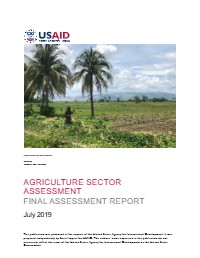
This publication was produced at the request of the United States Agency for International Development. It was prepared independently by Social Impact for USAID. The authors’ views expressed in this publication do not necessarily reflect the views of the United States Agency for International Development or the United States Government. AGRICULTURE SECTOR ASSESSMENT FINAL ASSESSMENT REPORT July 2019 PHOTO CREDIT: DR. ZURI LINETSKY XXXXXX SOURCE: ZURI LINETSKY DISCLAIMER The author’s views expressed in this publication do not necessarily reflect the views of the United States Agency for International Development or the United States Government. AGRICULTURE SECTOR ASSESSMENT FINAL ASSESSMENT REPORT July 2019 Evaluation Mechanism Number: AID-521-C-17-00002 Haiti Evaluation and Survey Services (ESS) for USAID/Haiti Activity On cover: Photo by Dr Zuri Linetsky in May 2018 in the Artibonite Valley. He was on his way to Cap-Haitian to collect data for an Aid for Trade assessment. The picture shows rice fields in preparation for sowing/transplanting, and a farmer looking over the fields apparently in a hurry to go to work. i | AGRICULTURE SECTOR ASSESSMENT FINAL REPORT USAID.GOV ABSTRACT The United States Agency for International Development (USAID) assistance in Haiti has traditionally focused on long-term reconstruction and development, promoting economic growth, job creation, agricultural development, providing basic health care and education services, and improving government effectiveness. Agriculture is one of USAID/Haiti’s main areas of intervention for which the current goal is to ensure that Haitians have access to nutritious, affordable food by promoting increased locally sourced food through agricultural production. The purpose of this Agriculture Sector Assessment is to inform the design of USAID/Haiti’s new agricultural activities. This assessment consisted of three phases: a desk review, interviews with agriculture experts, and fieldwork, which included focus group discussions, key informant interviews, and direct observations. As a result of this Assessment, we recommend that USAID focus on four main priority areas in its future programming: 1. Focus on working with the Private Sector; 2. Strategically select technical approaches; 3. Prioritize sustainability planning; and 4. Motivate the government to substantially improve the Agriculture enabling environment. USAID.GOV AGRICULTURE SECTOR ASSESSMENT FINAL REPORT | ii ACKNOWLEDGEMENTS The assessment team would like to thank the Government of Haiti representatives who made time to engage with the team and provide valuable insights and relevant documents to inform this assessment. The team also thanks the members of the private sector who took time out of their very busy schedules to share their ideas and experiences, and the members of the donor community for sharing their insights from their collective years of experience in-country. We are also grateful to the non-governmental organizations and implementing partners for putting aside time to meet with us and for their quick responses to our many requests for documents and information during their very demanding schedules. Finally, we would like to thank the United States Agency for International Development team for its valuable insights, assistance and guidance during our preparation and execution of the assessment. iii | AGRICULTURE SECTOR ASSESSMENT FINAL REPORT USAID.GOV CONTENTS Abstract ................................................................................................ .......... i Acknowledgements...................................................................................... ii Contents ....................................................................................................... iii List of Tables ............................................................................................... iv Acronyms ................................................................................................ ...... v Executive Summary .................................................................................. viii Assessment Purpose, Use, and Questions ............................................................ viii Assessment Design, Methods, and Limitations........................................................ ix Summary Findings and Conclusions ........................................................................ xi Recommendations ................................................................................................. xiii Assessment Background .......................................................................... 16 Contextual Background .......................................................................................... 16 Haiti’s Agriculture Context ...................................................................................... 16 Government of Haiti’s Key Agriculture-Related Policies and Strategies ................ 17 The Aid Landscape in Haiti’s Agriculture Sector .................................................... 17 Assessment Purpose and Audience ...................................................................... 18 Assessment Questions .......................................................................................... 18 Assessment Methods and Challenges ..................................................... 19 Organizational Structure ........................................................................................ 19 Roles and Responsibilities ..................................................................................... 20 Phase I: Desk Review ............................................................................................ 21 Phase II: Interviews with Key Agriculture Experts .................................................. 24 Phase III: Field Data Collection .............................................................................. 29 Findings and Conclusions ........................................................................ 34 AQ 1 Findings and conclusions .............................................................................. 34 AQ 2 Findings and conclusions .............................................................................. 48 AQ 3 Findings and conclusions .............................................................................. 56 AQ 4 Findings and conclusions .............................................................................. 60 Additional Findings Related to Cross-Cutting Themes........................................... 66 Recommendations ..................................................................................... 71 Focus on Working with the Private Sector ............................................................. 73 Strategically select technical approaches .............................................................. 73 Prioritize sustainability planning ............................................................................. 74 Motivate the government to substantially improve the enabling environment ........ 76 Annexes ...................................................................................................... 77 Annex A: Assessment Statement of Work .............................................. 77 Annex B: List and Definition of the 25 Technical Approaches .............. 82 Annex C: Case Studies .............................................................................. 99 Annex D: List of Respondents ................................................................ 133 USAID.GOV AGRICULTURE SECTOR ASSESSMENT FINAL REPORT | iv Annex E: Protocol for the Phase II Key Informant Interviews ............. 145 Annex F: Phase III Data Collection Protocols ....................................... 148 Annex G: Consent Form .......................................................................... 167 Annex H: Documents Referenced .......................................................... 168 Annex I: Disclosure of Conflict of Interest ............................................ 174 Annex J: Summary Information for Assessment Team ....................... 177 LIST OF TABLES Table 1: Interventions to Study .................................................................................................... ix Table 2: Number of Interventions Featuring Each Approach ...................................................... 23 Table 3: Interventions and Approaches for Fieldwork ................................................................. 27 Table 4: Number of KIIs, FGDs, and DOs .................................................................................. 30 Table 5: Interventions by Effectiveness Category ....................................................................... 35 Table 6: Relationship Between Technical Approaches and Restuls ........................................... 39 v | AGRICULTURE SECTOR ASSESSMENT FINAL REPORT USAID.GOV ACRONYMS AECID Spanish Agency for International Cooperation and Development AFD Agence Française de Développement AQ Assessment Question AS Irri I Appui aux Irrigants et aux Services aux Irrigants AT Assessment Team AVANSE Appui à la Valorisation du potentiel Agricole du Nord, à la Sécurité Économique et Environnementale ( Feed the Future North ) BIA Boutiques d’intrants agricoles CBO Community - Based Organization CFC Credit for Conservation CHASE Collectif Haitien pour l’Avancement du Suivi et de l’ E valuation CIRAD Centre de Coopération Internationale en Recherche Agronomique pour le Développement CLES Collectif de Lutte contre l’Exclusion Sociale CNSA Coordination Nationale de la Sécurité Alimentaire CPCN Cooperative Producers Cacao du Nord CRDD Centers for Sustainable Rural Development CREER Community Reconstruction for Economic and Environmental Resiliency CRS Catholic Relief Services CSO Civil Society Organization DCA Development Credit Authority DEED Développement Économique pour un Environnement Durable DEFI Projet de Développement des Filières DIA/MARND R Direction des Infrastructures Agricoles/ Ministère de l’Agriculture, des Ressources Naturelles et du Développement Rural DIME Development Impact Evaluation Dos Direct Observation DTL Deputy Team Leader EGAD Economic Growth and Agriculture Development FANTA Food and Nutrition Technical Assistance FAO Food and Agriculture Organization FFS Farmer Field School FGDs Focus Group Discussion FTF Feed the Future GFRP Strengthening the Management of Agriculture Public Services GOH Government of Haiti HAP Hillside Agricultural Program HIFIVE Haiti Integrated Financing for Value Chains and Enterprises project IDB Inter-American Development Bank IFAD International Fund for Agricultural Development IHSI Institut Haïtien de Statistiques et d’Informatique KIIs Key Informant Interview USAID.GOV AGRICULTURE SECTOR ASSESSMENT FINAL REPORT | vi KOREKAFE Consolidation de la compétitivité et la durabilité des coopératives caféières haïtiennes LEAD Leveraging Effective Application of Direct Investments LOKAL Limye ak organizasyon pu kolekyivite yo ale lwen MARNDR Ministry of Agriculture’s Natural Resources and Rural Development M&E Monitoring and Evaluation MFPA Microcrédit Financement Production Agricole MSME Microfinance, Small and Medium Enterprise MUSO Mutuelle de Solidarité MYAP Multi-Year Assistance Program NGO Non-governmental Organization ODA Official Development Assistance PACT-PV Plan d’actions à court terme d’appui à la production vivrière PADELAN Projet d’appui au développement local dans les Nippes PAPAH Programme d’Appui à la Production Agricole en Haïti PASAC Programme d’Appui à la Sécurit é́ Alimentaire et à la Création d’Emplois PASAH Programme d’Amélioration de la Sécurité Alimentaire en Haïti PCR Project Completion Report PIA-A Programme d’Intensification Agricole-Artibonite PMDN Programme de Mitigation des Désastres Naturels PNIA Plan National d’Investissement Agricole PPA Public-Private Alliances PPI Petits Périmètres Irrigués QA Quality Assurance RACPABA Racpaba Réseau des Associations Coopératives pour le Commerce et la Production Agricole du bas Artibonite RESEPAG Renforcement Des Services Publics Agricoles SAK REP Sac Plen Resiliency Enhancement Program SAEF Programme de Service d’Aide aux Entreprises et de Formation SANREM Research on Sustainable Agriculture and Natural Resource Management SATAG Societe Haitienne de Transformation Agro-alimentaire SECAL Projet de Sécurité Alimentaire SI Social Impact, Inc. SI-HQ Social Impact, Inc. Headquarters SME Small and Medium Enterprise SOGESOL Société Générale de Solidarité S.A. SOW Scope of Work SYAP Single Year Activity Program SYFAAH Système de Financement et d’Assurance Agricole en Haïti TL Team Leader UN United Nations UNDP United Nations Development Program USAID United States Agency for International Development VTE Vi, Tè & Eneji vii | AGRICULTURE SECTOR ASSESSMENT FINAL REPORT USAID.GOV WB World Bank WINNER Watershed Initiative for National Natural Environmental Resources USAID.GOV AGRICULTURE SECTOR ASSESSMENT FINAL REPORT | viii EXECUTIVE SUMMARY ASSESSMENT PURPOSE, USE, AND QUESTIONS The United States Agency for International Development (USAID) assistance in Haiti has traditionally focused on long-term reconstruction and development, promoting economic growth, job creation, agricultural development, providing basic health care and education services, and improving government effectiveness. Agriculture is one of USAID/Haiti’s main areas of intervention. The current goal is to ensure that Haitians have access to nutritious, affordable food by promoting increased local agricultural production. The purpose of this Agriculture Sector Assessment is to inform the design of USAID/Haiti’s new agricultural activities. The Agriculture Sector Assessment findings are intended to: • Guide USAID/Haiti’s future investments to meet key stakeholders’ needs in the agriculture sector. • Facilitate identification of approaches that the Economic Growth and Agriculture Development (EGAD) Office can choose to foster new programming to support Haitian agriculture development. To achieve this purpose, the assessment addresses the following questions: ASSESSMENT QUESTION 1 Which technical approaches including: 1. agricultural extension models; 2. agribusiness or industrial approaches; 3. policy and institutional framework support; and 4. other interventions supported by USAID/Haiti, other donors, Government of Haiti (GOH) agencies, non-governmental organizations (NGO) and the private sector, have demonstrated effectiveness towards attaining the following results in Haiti: i. increase beneficiaries’ household incomes; ii. create jobs; iii. improve market access at the end of a value chain; iv. improve producers’ resilience at the beginning of the value chain; v. improve natural resource management; vi. improve productivity at the farm-level; and vii. improve food security? ASSESSMENT QUESTION 2 To what extent have the technical approaches and/or interventions identified in the desk review demonstrated sustainability? ASSESSMENT QUESTION 3 What are the benefits to the agriculture sector of the Centers for Sustainable Rural Development (French acronym CRDD) and other similar organizations? ix | AGRICULTURE SECTOR ASSESSMENT FINAL REPORT USAID.GOV ASSESSMENT QUESTION 4 Which policies, procedures, and institutional frameworks in the enabling environment need to be addressed to achieve the results in Question 1? ASSESSMENT DESIGN, METHODS, AND LIMITATIONS PHASE I: DESK REVIEW In line with the Agriculture Assessment Scope of Work (SOW) (Annex A), the assessment team (AT) completed three key tasks during the desk review phase: 1. Provided preliminary answers to the assessment questions (AQ) with an emphasis on Questions 1, 1.1, and 1.2, including a list of technical approaches that have been implemented (Annex B). 2. Selected agriculture sector experts to be interviewed during Phase II. 3. Identified information gaps to be filled during Phase II, and lay a basis for selecting interventions to explore in Phase III. PHASE II: KEY INFORMANT INTERVIEWS WITH AGRICULTURE EXPERTS Following the desk review phase, the AT completed Phase II, conducting key informant interviews (KIIs) with agriculture experts. To select interventions for further study during fieldwork, the AT implemented four key steps: 1. Interviewed key agriculture experts familiar with the universe of agriculture interventions implemented in Haiti over the last 18 years; 2. Reviewed documents and information obtained during the KIIs, adding this information to the Intervention Matrix; 3. Identified the most cited interventions during the KIIs; and 4. Systematically selected following ten interventions for inclusion in Phase III of the assessment. TABLE 1: INTERVENTIONS TO STUDY INTERVENTION DONOR Renforcement Des Services Publics Agricoles (RESEPAG) World Bank Watershed Initiative for National Natural Environmental USAID Resources/Feed the Future (WINNER) Feed the Future north project (AVANSE)/Haiti USAID Small - scale Irrigation Development Project Phase I (PPI 1) International Fund for Agricultural Development (IFAD) Programme d'Amélioration de la Sécurité Alimentaire en Haïti UE (PASAH) Project of Technology Transfer to Small Farmers (PTTA) Inter - American Development Bank ( IDB) USAID.GOV AGRICULTURE SECTOR ASSESSMENT FINAL REPORT | x INTERVENTION DONOR Projet de sécurité alimentaire (SECAL) Agence Française de Développement ( AFD) Lèt Agogo VETERIMED Projet d’appui au développement local dans les Nippes (PADELAN) Canadian Cooperation Agri - Supply Private Investment PHASE III: FIELDWORK During the assessment’s fieldwork, Phase III, the AT studied (i) the sustainability of the activities supported by each intervention and technical approach; (ii) the benefits of the CRDD and other similar organizations to the agriculture sector; and (iii) policies, procedures, and institutional frameworks in the enabling environment that need to be addressed to achieve the results identified in Question 1. The AT also attempted to confirm the validity of the recommendations made by the agriculture experts in Phase II of the assessment. The findings provided recommendations about investments needed to boost agricultural productivity and income in Haiti. The AT conducted field assessments of all ten selected interventions (detailed case studies are presented in Annex C), which were studied for AQs 1, 2, and 4. The Watershed Initiative for National Natural Environmental Resources (WINNER) activity was the source of information to answer AQ 3 regarding CRDDs. The AT collected qualitative data using multiple methods and sources to mitigate the biases inherent in any one data collection method and leveraged the strengths of each method. Data were collected using three primary methods: • Semi-structured KIIs focusing on stakeholders having played a direct role in the interventions examined; • Focus Group Discussions (FGDs) with beneficiary households 1 ; and • Direct Observations (DOs) at field level. Data from these three sources were triangulated to identify areas of divergence or convergence. The preliminary findings developed through the desk review informed the coding process for the qualitative data collected which allowed the AT to triangulate the desk review and fieldwork data into a comprehensive set of findings, conclusions, and recommendations for the final report. The extent to which multiple informational streams provided coherent findings informed the robustness of assessment findings. In total, the AT identified seven stakeholder categories through the document review. A detailed list of respondents for each intervention is presented in Annex D. The AT also prepared sets of data collection questions for each of the AQs and associated sub-questions, which can be found in Annexes E and F. 1 These beneficiary households could either belong - or not - to CBOs. xi | AGRICULTURE SECTOR ASSESSMENT FINAL REPORT USAID.GOV Given the differing experiences of women and men in Haiti’s agricultural sector, the assessment attempted to collect and analyze sex-disaggregated data in accordance with USAID policy. In practice, men hold most positions of authority within the government, donor agencies, and implementing entities. While more respondents were men than women, every attempt was made to include a balance where possible. KIIs and FGDs responses have been systematically gender disaggregated, though the low rate of female participation means that women are underrepresented. In total, the AT conducted 75 KIIs, 21 FGDs, and 28 DOs between February 1 and March 12. The fieldwork was delayed for two weeks during this period due to political unrest in Haiti and the inability to conduct interviews. Once fieldwork could resume, the AT and data collection firm Collectif Haïtien pour l’Avancement du Suivi et de l’Evaluation (CHASE) worked in parallel to complete the KIIs, FGDs, and DOs. SUMMARY FINDINGS AND CONCLUSIONS FINDINGS AND CONCLUSIONS FOR AQ 1 There is no one perfect approach or combination of approaches that will work for every intervention in every situation. Any approach’s effectiveness depends on its appropriate combination with other approaches throughout the value chain to facilitate access to complementary services that meet community needs. The combination of Vouchers for Inputs and Training/Technology Package plus Linking Producers to Markets seems to be an especially effective recipe . Both the fieldwork and the desk review phases indicate that when approaches are combined better results are achieved. This particular combination was implemented by several of the most effective interventions, such as RESEPAG and SECAL in the South, and Appui à la Valorisation du potentiel Agricole du Nord, à la Sécurité Économique et Environnementale (Feed the Future North) (AVANSE) in the North. This combination seems to be especially effective because it targets key inefficiencies at several points along the value chain: inadequate access to affordable inputs, a lack of technical knowledge on improved techniques, and insufficient access to markets. Another combination that was similarly effective involved providing access to irrigation water in addition to access to inputs – this combination was seen in both SECAL and Petits Périmètres Irrigués (PPI). Working with various key members of the community, including beneficiaries, local authorities, and the private sector, assists in making projects successful. Good communication with and involvement of these actors will lead to greater contribution, ownership, and the ability to take advantage of existing connections and local knowledge to improve project quality. Natural disasters, government bureaucracy, and poor farm-to-market infrastructure may not be within a project’s ability to control but can still be planned for . Projects can anticipate these types of hindrances and plan in flexibility, resilience strategies, and alternative arrangements to be put in place in the event that the project is negatively affected by something outside of its control. USAID.GOV AGRICULTURE SECTOR ASSESSMENT FINAL REPORT | xii FINDINGS AND CONCLUSIONS FOR AQ 2 Most interventions exhibited a certain level of sustainability for some approaches, activities and benefits, but the only fully sustainable intervention studied in the fieldwork was by Agri-Supply. The approaches that have indicated the greatest potential for sustainability have been Vouchers for Inputs and Linking Producers to Markets, because they actively establish relationships with private sector input suppliers and buyers. The relationships can continue organically even after the activity ends because they are based on sound market- based principles and benefit all parties economically without external subsidies. Other factors for sustainability include close involvement of community members and local authorities in decision-making, with the goal of fostering ownership and motivation to continue the interventions after the activity ends. Ensuring that all links in the value chain are viable, functioning well, and not reliant on project support is another key aspect of sustainability that should be monitored throughout activity planning and implementation. Finally, as the sustainability of the operations of the private company Agri-Supply demonstrates, establishing a profitable enterprise that is managed as a business and operates in a value chain for which there is enough demand is the best way to ensure that activity’s benefits continue. Sustainability is likely the greatest challenge for donor activities. Interventions tend to be overly optimistic and unrealistic when it comes to sustainability planning. All donors and implementers understand the importance of sustainability and no donor activity is planned or implemented without some degree of sustainability planning. However, the assessment found that despite these good intentions, it is extremely difficult for donor-financed activities in Haiti to be 100 percent sustainable. Limited activity timelines and working in an environment full of inefficiencies (see the AQ 4 section for more discussion on the enabling environment) means that donor activities will always struggle with sustainability. CONCLUSIONS FOR AQ 3 CRDDs and similar structures are a useful model that provide some - and could provide more - benefits to communities . The types of services that CRDDs are providing include access to inputs, equipment, and services; they could also supply market intelligence and market facilitation. CRDDs and similar structures need committed managers, community and institutional involvement, and revenue-generating sources to be effective and sustainable. These factors are what set the successful, sustainable CRDDs apart from the CRDDs that discontinued certain services once the WINNER activity ended. The CRDD model is unlikely to be sustainable in the long-term if there is not a clear designation of ownership/responsibility, capacity and/or funding to manage them. CONCLUSIONS FOR AQ 4 Current inefficiencies are having a significant impact on the agriculture sector by disincentivizing investments and making access to inputs and market opportunities difficult for producers, decreasing farm productivity, and farmers’ opportunity to increase their incomes. xiii | AGRICULTURE SECTOR ASSESSMENT FINAL REPORT USAID.GOV Therefore, for future activities to be effective and sustainable these inefficiencies must be addressed. Many of the findings for AQ 4 were discussed throughout this report because the enabling environment affects every aspect of the agricultural sector , from access to water and inputs, to productivity, marketing, processing and exporting products. While there are many ways that interventions can become more effective and sustainable through selection of targeted technical approaches, good management, and strong relationships with the community, ultimately the effectiveness of any technical approach, or combination of approaches, depends as much on whether the environment is conducive to agricultural investment and profitability. The best planned interventions will continue to be limited in their effectiveness and sustainability by the restrictive and unsupportive enabling environment in Haiti. The assessment showed that the absence of an insurance system is discouraging farmers from investing in the agriculture sector, and lack of governance decreases the ownership of approaches and opportunities for coordination by the Ministry of Agriculture. These and the other inefficiencies in the enabling environment are having a negative impact on the agriculture sector and must be addressed to create a sector where interventions and their technical approaches can be more effective and sustainable, and where agriculture can be a greater contributor to the country’s economic growth. RECOMMENDATIONS As a result of this Assessment, we recommend that USAID focus on four main priority areas in its future programming: 1. Working with the private sector; 2. Strategically selecting technical approaches; 3. Prioritizing sustainability planning; and 4. Motivating the government to substantially improve the enabling environment. FOCUS ON WORKING WITH THE PRIVATE SECTOR The single most important factor for sustainability the AT found was the degree to which an activity followed private sector business practices and formed partnerships with existing and profitable private sector businesses. As described throughout this report, and in full alignment with USAID’s recently published Private Sector Engagement Policy , an activity’s results will only be sustainable if viable, profitable enterprises are put in place or developed by the end of the activity that do not require outside funding or assistance. Existing private sector entities are generally a better target for assistance than attempting to start new businesses from scratch during a short activity timeline, as existing businesses have already identified potentially profitable spaces in which to operate, know the local landscape better than outside donors can, and have ironed out many of the barriers to business already. When targeting the production side of the value chain, especially access to inputs, USAID should avoid the temptation to see quick wins that arise from unsustainable practices, such as giving away free inputs or services, and instead look for opportunities to nurture the private sector to provide these inputs and services. It may take more time to see increases in yields and incomes, but the results are more likely to persist in the long term. In terms of access to markets, the private sector is also the USAID.GOV AGRICULTURE SECTOR ASSESSMENT FINAL REPORT | xiv most effective place to look. In the assessment, the interventions that showed the greatest sustainability of results post-project were those where a partnership was established with a private sector buyer who continues to purchase produce, even without the facilitation of a donor- funded project. If attention is paid to ensuring that these are win-win relationships with benefits for both producers and buyers, these partnerships can continue for decades, contributing significantly more to farmers’ incomes and standards of living than a short-term activity that may see benefits for only three to five years. STRATEGICALLY SELECT TECHNICAL APPROACHES The findings sections presented a few technical approaches that seemed particularly effective. In particular, the specific combination of Vouchers for Inputs with Linking Producers to Markets, and a Training/Technology Package appeared to be the most effective. The most important thing, however, is that USAID strategically select approaches that make sense for a given situation and value chain. The technical approaches should target specific weaknesses in the value chain for a targeted area, set of results, and be complementary to ensure that the entire value chain functions smoothly. In addition, when selecting an approach or combination of approaches, USAID should anticipate the effects on the value chain, watershed, or community as a whole, and incorporate complementary additional technical approaches to mitigate any negative impacts, or take advantage of any potential opportunities for having an even greater impact. For example, accounting for changes in market prices if production increases significantly or anticipating water shortages if irrigation-dependent crops are being targeted. If an irrigation activity is planned, other water management or environmental conservation approaches are likely relevant and important to include. PRIORITIZE SUSTAINABILITY PLANNING It was surprising to find just how unsustainable the nine donor projects turned out to be (all of which looked very promising in the desk review). Unsustainable donor projects present an enormous missed opportunity to improve producers’ situations. USAID needs to make sustainability planning a top priority for all projects. Projects need to ensure a well-developed and viable private sector supply of affordable inputs and services (providing inputs for free or with subsidies during the activity will lead to short-term, not long-term, improvements in productivity). Activities also need to develop reliable marketing options that will continue even without the activity’s involvement. Finally, even though natural disasters cannot be controlled, activities should have contingency plans specifically in the case of natural disasters, so that the activity can continue to provide benefits even when the weather does not cooperate. Sustainability planning is especially applicable to the CRDDs. Although generation of money through service provision and fundraising was planned to sustain the CRDDs, in most cases, this strategy was only stated at the end of the activity and has not generated enough revenue, leaving the CRDDs financially unsustainable. Therefore, we recommend that USAID better supervise the implementation of similar exit strategies to ensure the sustainability of its intervention. MOTIVATE THE GOVERNMENT TO SUBSTANTIALLY IMPROVE THE ENABLING ENVIRONMENT xv | AGRICULTURE SECTOR ASSESSMENT FINAL REPORT USAID.GOV The enabling environment will continue to be a hindrance to the effectiveness and sustainability of donor activities and private investment in agriculture. USAID should consider how it can use its influence in Haiti to incentivize the government to make substantial improvements in the enabling environment, such as improved trade policies, or maintenance funds for roads. Based on this assessment, the key priority areas that could substantially improve the enabling environment for all agricultural enterprises are the following (see AQ 4 for more detail): 1. Governance and coordination at the sector level, including a state-sponsored focus on research and extension; 2. Harmonization of government interventions in the markets for fertilizer and other essential inputs; 3. Pass and implement the law on irrigation infrastructure management so the transfer of responsibilities to manage public agriculture infrastructure by water user associations is effective; 4. Increasing government capacity, including lowering staff turnover rates in the ministries responsible for overseeing donor activities, and improving management of procurement processes to allow for more efficient implementation of interventions; 5. Development of an Agricultural Insurance Industry; 6. Improvement in public farm-to-market infrastructure, especially roads; and 7. Improving the business environment, especially trade policy and access to credit. USAID.GOV AGRICULTURE SECTOR ASSESSMENT FINAL REPORT | 16 ASSESSMENT BACKGROUND CONTEXTUAL BACKGROUND The United States Agency for International Development (USAID) works to build a stable and economically viable Haiti. United States’ assistance focuses on long-term reconstruction and development; promoting economic growth, job creation, and agricultural development; providing basic health care and education services; and improving government effectiveness. To boost agricultural output and increase farmers’ income, USAID, through the Feed the Future (FNF) initiative, focuses on increasing agricultural productivity, improving watershed protection and strengthening agricultural markets. To accomplish its goals, USAID has introduced better inputs, new technologies, integrated natural resource management, and linked farmers directly to end-buyers. With USAID support, farmers doubled and quadrupled yields in targeted key crops. In partnership with the Haitian Government, USAID is also implementing a nutrition focused safety net program to combat food insecurity amongst the poorest communes. 2 HAITI’S AGRICULTURE CONTEXT Agriculture is central to the Haitian economy. It employs approximately 60 percent of the population and serves as the primary source of rural incomes. 3 The agricultural sector contributed 20.5 percent to gross domestic product in 2017 4 (Institut Haïtien de Statistiques et d’Informatique [IHSI], 2017) with a clear downward trend, while the sector remains the main income source in rural areas. National agricultural production accounted for only 50 percent of food availability in 2011 (Ministry of Agriculture’s Natural Resources and Rural Development [MARNDR], 2013), complemented by commercial imports (45 percent) and food aid. In the early 1980s, these imports accounted for only 19 percent of the food supply. Agricultural exports have decreased over time, mainly due to the inability to compete in the global market for sugar cane, and the decrease in timber exports due to unsustainable levels of deforestation. 5 Some of the key factors affecting the development of agricultural production in Haiti include: low access to credit and quality agricultural inputs, absence of an effective agricultural extension system combined with low levels of literacy among farmers, inadequate agricultural policies, limited budget 6 , inadequately coordinated state-led interventions, acceleration of land degradation, and natural disasters. As a result, the average agricultural yield in Haiti is among the lowest in the Latin America and Caribbean region. Post-harvest losses are significant and range between 50 percent and 60 percent of production 7 depending on local conditions, contributing to lower farmer incomes. 2 https://www.usaid.gov/sites/default/files/documents/1862/FINAL_Haiti_Country_Profile_March_2017_0.pdf 3 According to different sources, including the World Bank and the Institut Haitien de Statistique et d’Informatique (IHSI) 4 http://www.ihsi.ht/produit_economie_comptes_na_pib.htm 5 http://countrystudies.us/haiti/51.htm 6 Between 2010 and 2016, budget received by MARNDR was around 4 percent of the national budget (MARNDR, 2017). 7 https://www.copenhagenconsensus.com/publication/haiti-priorise-post-harvest-losses-theodat 17 | AGRICULTURE SECTOR ASSESSMENT FINAL REPORT USAID.GOV Rapid population growth (1.3 percent in 2016) 8 combined with inappropriate farming practices resulted in pressure on natural resources and acceleration of land degradation. The removal of tariff and non-tariff barriers has made Haiti’s agriculture sector the least protected in the Caribbean Region. 9 Haiti is now one of the countries with the highest level of food insecurity; 51.8 percent of the population is chronically undernourished. GOVERNMENT OF HAITI’S KEY AGRICULTURE-RELATED POLICIES AND STRATEGIES The Government of Haiti’s (GOH) agriculture sector policies, strategies, programs, and plans are presented in a series of documents, of which, the “MARNDR/Politique de Développement Agricole, 2011 is considered the centerpiece. 10 In line with the country’s growth and poverty reduction strategy, the GOH’s overall agriculture policy objective is to contribute in a sustainable manner to meeting the Haitian population’s food needs and the country’s socio-economic development. Specific objectives are to: (i) increase the coverage rate of domestic consumption by domestic production from 45 to 70 percent; (ii) ensure that the agricultural sector provides a decent income to about 500,000 farms; and (iii) increase the coverage of imports by agricultural exports from five percent (2009 figure) to 50 percent in 2025. 11 Haiti’s agricultural development policy 12 favors (i) a territorial approach based on the potential and specifics of Haiti’s different agro-ecological zones and seeking alignment and complementarity among the different actors, (ii) a watershed approach from the summit to the sea, and (iii) a sector approach gathering the GOH, non-governmental organizations (NGO), private sector, and producer organizations around the same table. 13 14 THE AID LANDSCAPE IN HAITI’S AGRICULTURE SECTOR With approximately 100 USD per inhabitant per year, Official Development Assistance 15 (ODA) transfers to Haiti are relatively large. In 2015, Haiti ranked 35 among countries receiving the most ODA per inhabitant. 16 8 https://data.worldbank.org/indicator/SP.POP.GROW 9 Tim Josling. Three Interventions in the Rice Market in Haiti. Haïti Priorise, Copenhagen Consensus Center, 2017. License: Creative Commons Attribution CC BY 4.0. 10 Other important policy documents include the Programme Triennal de Relance Agricole, 2013; Plan Directeur de Vulgarisation Agricole, 2011; Plan National d’Investissement Agricole (PNIA), 2010; Plans Stratégique et Programmatique 2014-2019 pour la Modernisation des Services de Protection Agro-phytosanitaire et d’Innocuité des Aliments, 2013; and Plan Directeur de la Formation Professionnelle Agricole, 2013. 11 Politique de développement agricole 2010-2025. 12 Politique de développement agricole 2010-2025. 13 Les axes prioritaires de l’administration Moise, 2018-2022 and Politique de développement agricole 2010-2025. 14 Feuille de route du Ministère de l’Agriculture and Les axes prioritaires de l’administration Moise, 2018-2022. 15 ODA is defined by the OECD as, “Flows of official financing administered with the promotion of the economic development and welfare of developing countries as the main objective, and which are concessional in character with a grant element of at least 25 percent (using a fixed 10 percent rate of discount). By convention, ODA flows comprise contributions of donor government agencies, at all levels, to developing countries (“bilateral ODA”) and to multilateral institutions. ODA receipts comprise disbursements by bilateral donors and multilateral institutions.” 16 https://www.indexmundi.com/facts/indicators/DT.ODA.ODAT.PC.ZS/rankings USAID.GOV AGRICULTURE SECTOR ASSESSMENT FINAL REPORT | 18 Major donors currently active in the Haitian agriculture sector include the Inter-American Development Bank (IDB), USAID, the European Union, and the World Bank (WB). 17 Only a limited number of programs and projects are jointly funded by these donors. While the main donors meet on a regular basis to coordinate their interventions, the sector coordinating forum (Table Sectorielle Agriculture) is currently inactive. Aid fragmentation in Haiti, along with a lack of institutional memory, and limited availability of evaluation reports, raises questions about the effectiveness of many projects executed in the agriculture sector during the last two decades. It also poses challenges in identifying the most successful approaches implemented in the agriculture sector. ASSESSMENT PURPOSE AND AUDIENCE The purpose of the Agriculture Sector Assessment is to inform the design of USAID/Haiti’s new agricultural activities by learning from existing best practices and approaches. The Agriculture Sector Assessment findings are expected to guide the Mission’s future investments to meet key stakeholders’ needs in the agriculture sector. Primary audiences for this assessment are USAID/Haiti, particularly the Economic Growth and Agriculture Development (EGAD) Office, key GOH institutions, and USAID/Washington. Other potential users may include relevant international donors working in the agriculture sector in Haiti including, but not limited to, WB, IDB, and Agence Française de Développement (AFD), the French Development Agency. ASSESSMENT QUESTIONS To achieve its purpose, the assessment seeks to answer the following assessment questions (AQ) and accompanying sub-questions: 18 ASSESSMENT QUESTION 1 Which technical approaches including: 1. agricultural extension models; 2. agribusiness or industrial approaches; 3. policy and institutional framework support; and 4. other interventions supported by USAID/Haiti, other donors, GOH agencies, NGOs, and the private sector have demonstrated effectiveness towards attaining the following results in Haiti: i. increase beneficiaries’ household incomes; ii. create jobs; iii. improve market access at the end of a value chain; iv. improve producers’ resilience at the beginning of the value chain, v. improve natural resource management; vi. improve productivity at the farm-level; and 17 Aide-memoire meeting with The Technical staff of the Ministry of Agriculture on April 4, 2018. 18 SOW including the assessment questions and sub-questions is presented in Annex A. 19 | AGRICULTURE SECTOR ASSESSMENT FINAL REPORT USAID.GOV vii. improve food security. Sub-Questions: 1.1 To what extent and how have approaches or interventions been combined to generate greater results? 1.2 What project and non-project related factors—such as the development corridors in the North and West under the post-earthquake strategy—have enabled or constrained the effectiveness of the approaches and/or interventions toward achieving results? ASSESSMENT QUESTION 2 To what extent have the technical approaches and/or interventions identified in the desk review demonstrated sustainability? Sub-Question 2.1: What factors have enabled or constrained sustainability? ASSESSMENT QUESTION 3 What are the benefits to the agriculture sector of the Centers for Sustainable Rural Development (French acronym CRDD) and other similar organizations? Sub-Questions: 3.1 What factors determine success/weakness of CRDDs and similar organizations? 3.2 In what sorts of functions should those centers specialize? 3.3 What have been the impediments to the GOH and other donors making full use of the CRDDs’ services? ASSESSMENT QUESTION 4 Which policies, procedures, and institutional frameworks in the enabling environment need to be addressed to achieve the results in Question 1? Sub-Question 4.1: How and to what extent are these policies, procedures, and institutional frameworks currently affecting agriculture activities and actors, including private sector success? ASSESSMENT METHODS AND CHALLENGES ORGANIZATIONAL STRUCTURE Haiti Evaluation and Survey Services (ESS) assembled a three-person assessment team (AT) that reflected a complementary mix of agriculture sector, policy assessment, private sector development, and capacity building expertise, as well as methodological knowledge. The Team Leader (TL), Cynthia Berning, is an Agriculture Specialist and an expert in evaluation. She was USAID.GOV AGRICULTURE SECTOR ASSESSMENT FINAL REPORT | 20 assisted by two Deputy Team Leaders (DTL), Jean Chariot Michel and Jempsy Fils-Aimé, who each have two decades of experience working in the Haitian agriculture sector. In the field, Mr. Wesner Antoine, the Haiti ESS Senior Evaluation Specialist, supported the AT. Mr. Antoine is an agriculture expert and brings over 20 years of experience in quantitative and qualitative data analysis experience in the Haitian context. He provided logistical and assessment support. Subcontractor Collectif Haitien pour l’Avancement du Suivi et de l’Evaluation (CHASE), a local research firm, supported qualitative data collection from focus group discussions (FGDs) and key informant interviews (KIIs). Working closely with the AT as described below, the subcontractor conducted all the FGDs, 14 of the direct observations (DOs) and 38 of the KIIs. The AT directly conducted the rest of the KIIs and DOs. ROLES AND RESPONSIBILITIES ASSESSMENT TEAM 19 The TL led the data collection, analysis, and reporting components of the Assessment. During the field phase, the two DTLs conducted the most critical KIIs and oversaw the FGD data collection, in collaboration with ESS and CHASE. After data collection concluded, the AT synthesized all information obtained, analyzed the data, and wrote this report. SOCIAL IMPACT HEADQUARTERS STAFF SI’s headquarters (SI-HQ) team managed the assessment and ensured its quality. To ensure delivery of a high-quality final product, the HQ Project Director reviewed all assessment deliverables—particularly the draft and final reports—against SI’s internal quality assurance (QA) procedures, Evaluation, Quality, Use, and Impact ® (EQUI ® ). SOCIAL IMPACT FIELD OFFICE STAFF The ESS field office staff operated as the central connection between the AT, SI-HQ, and USAID/Haiti. Maintaining frequent communications ensured that the Mission’s vision for this assessment was realized throughout the process. The field office staff also addressed logistics and other in-country related needs. DATA COLLECTION FIRM ESS subcontracted CHASE, which coordinated with ESS, SI-HQ staff, and the AT on the KIIs and FGDs design, planning, and implementation. The AT was responsible for developing the data collection instruments in coordination with CHASE and training CHASE team members so that they could collect the data as planned. The AT also ensured QA by attending a selection of KIIs and FGDs CHASE conducted, and reviewing the KII and FGD reports CHASE submitted. 19 Qualifications of the Assessment Team can be found in Annex J 21 | AGRICULTURE SECTOR ASSESSMENT FINAL REPORT USAID.GOV CHASE (i) planned data collection in the field, and mobilized skilled inte