

Children of Haiti: three months after the earthquake
Deskripsyon Konple
UNICEF assessment of the situation of children in Haiti three months after the January 2010 earthquake: progress made, remaining gaps and plans.
Teks Konple Dokiman an
Teks ki soti nan dokiman orijinal la pou endeksasyon.
UNICEF HAITI SITUATION REPORT APRIL 2010
CHILDREN OF HAITI
THREE MONTHS AFTER THE EARTHQUAKE
Progress, Gaps and Plans in Humanitarian Action
Supporting a Transformative Agenda for Children
April 2010
UNICEF HAITI SITUATION REPORT APRIL 2010
2
2
UNICEF HAITI SITUATION REPORT APRIL 2010
TABLE OF CONTENTS
Executive Summary p. 3
Glossary p. 4
Fast Facts p. 7
Introduction p. 8
Focus area reports p. 12
Nutrition
Health
Education
Early Childhood Development
WASH
Child Protection
Cross-cutting issues p. 31
Building consensus on a Transformative Agenda p. 35
UNICEF priorities in the Transformative Agenda p. 37
Financial resources p. 40
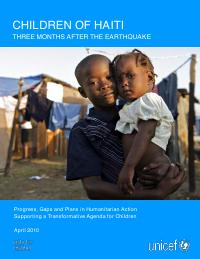
Cover page ©UNICEF/Noorani/2010
Stanley carries his 2-year old cousin, Marie Love, near their family’s makeshift tent shelter in the Parc Jean Marie Vincent settlement
in the Piste Aviation neighbourhood of Port-au-Prince.
3
3
UNICEF HAITI SITUATION REPORT APRIL 2010
4
4
UNICEF HAITI SITUATION REPORT APRIL 2010
EXECUTIVE SUMMARY
The earthquake that devastated Haiti on the 12th January 2010 UNICEF, in line with its Core Commitments for Children and with its part-
killed over 220,000 people, injuring over 300,000 and causing ners, has been delivering life-saving assistance to Haitian children in the
up to 4,000 amputations. Three million people, or 30 per cent sectors of water, sanitation and hygiene (WASH), nutrition, and health. As
of the population, have been affected; almost 1.3 million are part of its commitments, UNICEF has been providing children with a
living in temporary shelters in over 400 spontaneous sites in sense of safety and normalcy through designated spaces and materials
the Port-au-Prince area, while more than 600,000 have moved for education, recreation, and early childhood development. UNICEF has
to outlying areas, including some 300,000 children. also been working towards building and strengthening systems to protect
girls, boys and women from violence, exploitation, abuse and neglect.
This disaster has been a children’s emergency: nearly 1.5 mil-
lion children have been directly affected by the disaster; many In accordance with its inter-agency commitments, UNICEF, in close part-
more remain at risk and continue to require assistance and nerships with respective Ministries, is leading the Clusters in WASH, Nu-
protection. Girls and boys, who make up almost half of the trition, Education together with Save the Children, and the Sub-Cluster in
population, are among the most vulnerable groups. Child Protection. UNICEF is also working with WHO and the Ministry of
Health on resuming and expanding primary health care services.
Already before the earthquake, Haiti’s children were up
against unfavourable indicators: one in every 13 infant died It is clear that the humanitarian action taken over the past three months
before the age of five; over 30 per cent of Haitians under the has averted a post-earthquake crisis. There have been no outbreaks of
age of five were chronically undernourished; 55 per cent of diseases or epidemics so far. Much however, remains to be done. With
school-aged children were out of school; 50,000 were in some the upcoming rainy and hurricane seasons, the relocation of displaced
600 residential care facilities; an estimated 2,000 girls and people to safer shelters, along with the provision of basic services and the
boys were trafficked across borders annually. protection of children and women, remain a priority.
In the immediate aftermath of the earthquake, the logistical, UNICEF, with its partners, will continue to support the relief operations
communication and coordination challenges were massive: and assist in the reconstruction and recovery phase. Children must re-
the capital was debilitated with damaged and destroyed infra- main at the forefront of the reconstruction, recovery, and development
structure, including key Government buildings and entry processes. It is important that children’s voices are heard, their rights are
points into Port-au-Prince like the seaport. UN capacity was upheld, and their needs are addressed. UNICEF Haiti’s three priorities for
weakened by the loss of lives under the collapsed building, 2010 include:
while UNICEF staff lost family members and homes. Despite 1. Ensuring that children are in school;
this, the mobilisation of international humanitarian assistance 2. Preventing and addressing the threat of under-nutrition in chil-
in support of the Government of Haiti has been on a scale dren;
rarely - if ever - seen in the past, thanks to the generosity, 3. Protecting the most vulnerable from violence, exploitation,
commitment and support of governments, partners, and the abuse and neglect.
public.
UNICEF’s response has been possible due to the generous support pro-
UNICEF’s global response to this rapid-onset emergency has vided by donors, including Governments, National Committees, and indi-
been unprecedented. UNICEF has taken extraordinary meas- viduals. Implementing partners have been central to ensuring that ser-
ures to mobilise some 300 staff and consultants from around vices and supplies have been delivered to beneficiaries. UNICEF acknowl-
the world to work on the Clusters response, programmes and edges the tremendous efforts undertaken by voluntary organizations and
operations. There were visits from the Executive Director and individuals. Particularly commendable is the courage and commitment
Deputy Executive Director of UNICEF, senior management, demonstrated by Haitians inside the country and abroad, within UNICEF,
and from various National Committees. among displaced persons, in camp committees, and all those who have
dedicated their efforts to assisting the country.
To help address the unprecedented devastation and the sub-
sequent logistical constraints, the UNICEF Country Office in The challenge now is to build a Haiti with a transformative agenda to
the Dominican Republic established a support hub of a fluctu- make it a better place for all children and youth. We are taking a step
ating 20 – 25 staff, called Lifeline Haiti (LLH). The hub has sup- further: as an example, we are going beyond the “back to school” ap-
ported the needs of Haitian earthquake victims in delivering proach to an “all children in school” approach. Haiti’s recovery must be-
services at the border, facilitating relief efforts and the flow of gin with its children and their communities. Only with children at the cen-
supplies into the country. tre of the reconstruction effort can we build a new Haiti – a Haiti Fit for
Children.
5
5
UNICEF HAITI SITUATION REPORT APRIL 2010
GLOSSARY
ACF Action Contre la Faim (INGO)
ACTED Agency for Technical Cooperation and Development
ADF Americas development Foundation
ADMD Asociación Dominicana de Mitigación de Desastres (The Dominican Disaster Relief Association)
ADRA Adventist Development and Relief Agency
AIDS Acquired Immune Deficiency Syndrome
APROSIFA Association for the Promotion of Integral Family Healthcare
ARIS Acute respiratory Infection
ARV Anti Retroviral
AVSI Associazione Volontari per il Servizio Internationale
BPM Brigade de la Protection des Mineurs – Child Protection Brigade within the Police
BUGEP Bureau de Gestion du Préscolaire (MoE’s Preschool Education Unit)
CCCM Camp Coordination Camp Management
CES Centre d’Education Spéciale (National NGO for Special Education)
CFS Child Friendly Spaces
CIDA Canadian International Development Agency
Cluster Approach Concept of partnership between UN agencies, the International Red Cross and Red Crescent Movement,
international organizations, and NGOs. Partners work together towards agreed common humanitarian
objectives at global and field level to facilitate inter-agency complementarity by maximising resources.
CMAM Community Management of Acute Malnutrition
CNSA Commission Nationale sur la Sécurité Alimentaire (National Commission on Food Security)
CONANI Dominican republic National Child Protection Authority
CP Child Protection
CRS Catholic Relief Services
DHS Demographic and Health Survey
DINEPA Direction Nationale de l’Eau Potable (National Unit for WASH)
DPC Civil Protection Directorate
DPT3 Diphtheria, Pertussis and Tetanus vaccine
DTM Displaced Tracking Matrix
DR Dominican Republic
DRR Disaster Risk Reduction
DSNCRP Document de Stratégie Nationale pour la Croissance et pour la Réduction de la
Pauvreté (PRSP Document)
ECD Early Childhood Development
ECHO European Commission’s Humanitarian Aid Office
EFA Education for All
EFSA Emergency Food Security Assessment
EID Early Infant Diagnosis
EMMUS Enquete de morbiditie, mortalite et utilisation des services
EPF Emergency Programme Fund
EPI Expanded Programme of Immunisation
FAO Food and Agriculture Organisation of the United Nations
FIGO/SOGC International Federation of Gynaecology and Obstetrics
FOKAL Fondasyon Konesans Ak Libète (National NGO on Education and Culture)
Fondefh Fondation pour le Développement de la Famille Haïtienne
FOSREF Fondation pour la Sante Reproductive et l’Education Familiale
FPGL Fondation Paul Gérin Lajoie (International Development NGO)
GAM Global Acute malnutrition
6
6
UNICEF HAITI SITUATION REPORT APRIL 2010
GLOSSARY
FPGL Fondation Paul Gérin Lajoie (International Development NGO)
GAM Global Acute malnutrition
GAVI Global Alliance for Vaccines and Immunisation
GBV Gender Based Violence
GDP Gross Domestic Product
GHESKIO Groupe Haïtien d’Etudes de Sarcome de Kaposi et d’Infections Opportunistes
(National NGO on HIV/AIDS)
GTEF Groupe de Travail pour l’Éducation et la Formation (Presidential Commission on
Education and Training)
HAVEN House and community building charity
HEAS Epidemic Advisory System in Haiti
HIV Human Immunodeficiency Virus
HRC Haiti Response Coalition
IASC Inter-Agency Standing Committee
IARTE Inter-Agency real time Evaluation
IBESR Institut de Bien-Etre Social et de Recherches (MoSA’s Institute on Social Welfare
and Research)
IDB Inter-American Development Bank
IDEJEN Initiative pour le développment des jeunes
IDP Internal Displaced People
IHE Institut Haïtien de l’Enfance (National Haitian Child Institute)
IHSI Institut Haitien de Statistiques (National Institute of Statistics)
IMC International Medical Corps
IMCI Integrated Management of Childhood Illness
IMEP Integrated Monitoring and Evaluation Plan
IMR Infant Mortality Rate
I-NGO International NGO
IOM International Organization for Migration
ICRC International Committee of the Red Cross
IFRC International Federation of Red Cross
IRC International Rescue Committee
ISF Integrated Strategic
IT Information Technology
IYCF Infant and young child feeding
JCICS Joint Council on international children’s services
JPHRO Jenkins-Penn Haitian Relief Organisation
MDG Millenium Development Goal
MdM Médecins du Monde
MHPSS Mental Health and psycho-social support
MICS Multiple Cluster Inidator Survey
MINUSTAH Mission des Nations Unies pour la Stabilisation d’Haïti (United Nations Stabilization Mission in Haiti)
MENFP Ministère de l’Education et de la Formation -Ministry of Education
MSPP Ministère de la Santé Publique et de la Population - Ministry of Health
MJSP Ministère e de la Justice et de la Sécurité Publique - Ministry of Justice
MoP Ministère de la Planification et de la Coopération Externe - Ministry of Planning
MAST Ministère des Affaires Sociales et du Travail - Ministry of Social Affairs
MoU Memorandum of Understanding
MSB Swedish Civil Contingencies Agency
MSF Médecins sans Frontières (Doctors without Borders)
7
7
UNICEF HAITI SITUATION REPORT APRIL 2010
GLOSSARY
MSF Médecins sans Frontières (Doctors without Borders)
MUAC Middle Upper Arm Circumference
NCA Norwegian Church Aid
NGO Non-governmental organisation
NNF National Notario Foundation
NRC Norwegian Refugee Council
OCEDAH Office of Community Education and Diversity Affairs
OCHA United Nations Office for the coordination of humanitarian affairs
PCA Partnership Cooperation Agreements
PCNB Points de Conseil de Nutrition Pour les Bébés
PBR Programme Budget review
PDA Presbyterian Disaster Assistance
PDNA Post Disaster Needs Assessment
Pesadev Perspectives pour la Santé et le Développement
PMTCT Prevention of Mother-to-Child Transmission
PNH Police Nationale d’Haiti
PRSP Poverty Reduction Strategy Paper
RUIF Ready-to-use infant formula
RUTF Ready to Use Therapeutic Food
SAM Severe Acute Malnutrition
SC Save the Children
SFP Engineers without Borders – San Francisco Proffessionals
SOFA Solidarite Fanm Ayisyèn (National NGO for Women)
SSA Special Service Agreement
STD Sexually Transmitted Diseases
TdH Terre des Hommes (I-NGO)
U5 Under 5 years old
U5MR Under-five Mortality Rate
UN United Nations
UNAIDS Joint United Nations Programme on HIV/AIDS - Programme Acceleration Funds
UNDP United Nations Development Programme
UNFPA United Nations Population Fund
UNIFEM United Nations Development Fund for Women
UNOPS United Nations Office for Project Service
UNPOL United Nations Police
USAID United States Agency for International Development
VRQ Very Rapid Qualitative Approach
WASH Water, Sanitation and Hygiene
WFP World Food Programme
WHO/PAHO World Health Organisation/Pan American Health Organisation
YCSD Young Child Survival and Development
Zanmi Lasante Partners in Health
8
8
UNICEF HAITI SITUATION REPORT APRIL 2010
FAST FACTS
Over 3 million people have been affected by the earthquake, including some 1.5 million children.
Over 220,000 people died and 300,000 were injured.
Around 1.3 million are in emergency shelters in the Port-au-Prince area; over 600,000 people have left their
home communes for rural areas, including 300,000 children.
Total value of damages and losses estimated at $7.86 billion—120% of Haiti’s GDP in 2009. Over 4,300 edu-
cation facilities and 50 hospitals and health centres have bee n rendered unusable.
NUTRITION
Over 100,000 affected children under-5 years and pregnant and lactating women have benefited from the
Nutrition Cluster’s blanket feeding to prevent the deterioration of nutritional status.
UNICEF is supporting 19 of the established 23 baby tents and eight sites for community-based management
of acute malnutrition targeting 20,000 infants under-1 year; 6,500 children with Severe Acute Malnutrition
(SAM); 50,000 pregnant and lactating women; 166,000 children under-5 years.
PRIMARY HEALTH CARE
UNICEF has provided vaccines, injection devices and cold chain materials for the emergency vaccination
campaign. To date over 104,000 children aged 9 months to 7 years have been vaccinated.
UNICEF is supporting the Ministry of Health in expanding decentralized public health system for maternal,
neonatal and child health services. Over 134 Emergency Health Kits and health basic units have been sup-
plied to provide the minimum package of health services to approximately 134,000 people for three months.
EDUCATION
UNICEF and Cluster partners, with the Ministry of Education, have worked on a ‘movement for learning’ to
promote the gradual enrolment of all children and adolescents in Haiti. The most affected areas have begun
to progressively reopen in April. One week after the official reopening of schools, UNICEF visits have re-
vealed an encouraging trend of large numbers of children returning to schools.
UNICEF has distributed 875 school-in-a-boxes, 1,495 Early Childhood Kits (ECD), 2,226 recreation kits as well
as 1,400 school tents for temporary classrooms, ECD classes and to support the education, protection and
development of 170,000 children.
WATER, SANITATION AND HYGIENE (WASH)
Since 13 January, the Cluster has been supplying water trucks to some 400 destinations in Port Au Prince,
Leogane, Petit Goave, Grand Goave and Jacmel, and water through subsidized private sector kiosks.
UNICEF is supporting the provision of approximately 5 litres of water per day to some 1 million people
through 451 water kiosks and over 300 sites through different organizations.
Photo summary ©UNICEF/Noorani/2010
Almost 5,350 latrines have been installed by Cluster partners for the benefit of around 500,000 persons.
CHILD PROTECTION
Over 55,000 children per week benefit from 78 child friendly spaces set up . Each CFS benefits around 50-100
children/day through several shifts.
A call centre is receiving calls from frontline workers working with separated children. So far, over 767 sepa-
rated children have been registered.
The quality of care in 359 residential childcare centres hosting approximately 25,339 children has been
evaluated, and immediate needs of children have been addressed in half of the centres, with UNICEF sup-
port.
9
9
UNICEF HAITI SITUATION REPORT APRIL 2010
cially national staff. The majority had to leave their residences
INTRODUCTION as a result of the earthquake: some have slept in the streets, in
tents, in cars, others have stayed with family or relatives. All
national staff lost someone they knew or loved. Some nationals
chose to send their children abroad, to safe places where they
Overview can attend schools—this is a source of frustration for parents.
Impact of the earthquake
Three months since the devastating earthquake of 12 January Three months after — taking stock
2010, Haitians and the international community are only now This report takes stock of the main achievements in responding
coming to grips with the magnitude, depth and complexity of the to the immediate needs of children and those who care for
crisis. The infrastructure, government institutions, economic them– but also highlights the serious gaps and challenges that
systems—the fabric of society itself - have been dealt a blow on still exist to ensuring the large numbers of survival and protec-
a scale probably unprecedented in modern times. A generation tion of children affected by the earthquake.
of children have been marked by this disaster: with nearly 40 per
cent of all Haitians aged below 15 years; some 1.5 million chil- The report also traces an outline of the emerging vision for the
dren have been directly affected by the earthquake. country’s reconstruction and development, with children at the
centre of the plan. This is a vision that springs from the diverse
Unlike the Indian Ocean Tsunami, which devastated coastal voices of Haitian children and youth, from an increasingly vocal
communities in at least eight different countries, the Haitian civil society – and from the higher-level political consensus that
earthquake resulted in a comparable death toll (over 222,000 merely “building back” to the status quo prior to the earthquake
persons) in the highly concentrated political and economic cen- will not be sufficient to protect and progressively fulfil the rights
tre of a single, already fragile, nation. According to the Post Dis- of children.
aster Needs Assessment (PDNA), the total value of damage and
losses is estimated at US $7.86 billion. This is equivalent to more The resources mobilised in the wake of the disaster hold the
than 120 per cent of Haiti’s 2009 gross domestic product (GDP) - potential to think bigger—to plant the seeds of a
the highest relative cost of a disaster since the methodology was “transformative agenda” for a more equitable and participatory
applied 35 years ago. state, with decentralised social services and a solid social pro-
tection floor. A vision, in other words, of a Haiti fit for
Certainly, the emergency response phase has averted an even children.
worse catastrophe: the basic needs of many of the affected
population have been met, and major outbreaks of disease or
unrest have not materialized – yet. This has been no small
Shallow quake – deep vulnerability
achievement. A vast array of international and national partners Damages and losses in a fragile state
have mobilized huge resources and, after a slow start, ensured
the delivery of shelter, food, water, health, nutrition and other The 12 January earthquake registered 7 on the Richter magni-
basic services to well over a million affected people. tude scale, and was concentrated at a shallow depth of thirteen
kilometres. In comparison to the Indian Ocean Tsunami which
UNICEF Haiti in the crisis registered 9.3 – and the Chilean earthquake of 27 February reg-
UNICEF has mobilised an unprecedented global response with istering 8.8, this was not the greatest magnitude quake. It was
some 300 staff and consultants from around the world deployed the location of the epicentre however, (close to the capital and
to Haiti over the past three months. There are currently over the urban centre of Leogane) combined with Haiti’s fragility,
200 staff and consultants, up from 56 prior to the earthquake. deep, extreme poverty and urban overcrowding that explains
the particularly disastrous impact.
In the Dominican Republic , Lifeline Haiti was set up as a support
hub for the UNICEF Haiti Country Office with some 20—30 staff In 2009 the United Nations Human Development Index ranked
focussing on managing the emergency funds, channelling in aid Haiti 149th out of 182 countries, making it possibly the poorest
personnel, facilitating warehousing, transportation, as well as country in the western hemisphere, characterised by weak insti-
supplies logistics into Haiti, delivering services at the border, and tutions and governance structures. Social safety nets and pro-
providing information communication technology support. tection instruments for children were virtually non-existent be-
fore the crisis, with the allocation to the Ministry of Social Affairs
The earthquake also affected UNICEF personnel in Haiti, espe- just 0.55 per cent of the national budget. Basic social services
10
10
UNICEF HAITI SITUATION REPORT APRIL 2010
At dawn on 30 January, a baby and many others begin to stir, having spent the night in the
middle of a street in the impoverished Bel Air neighbourhood of Port-au-Prince, the capital.
©UNICEF/LeMoyne/2010
The fate of over 1 million homeless people continues to be uncertain, as they shelter in
temporary settlements, or with family and friends.
11
11
UNICEF HAITI SITUATION REPORT APRIL 2010
such as health and primary education were limited (only about led by government authorities is underway. Children make up
half of school aged children went to school and facilities were approximately half of the general population – and, it can be as-
run almost entirely by non-state actors and the private sector), sumed that they make up more than half of the displaced, there-
posing serious challenges for regulation of the sectors. In a coun- fore placing particular emphasis on the need for age-appropriate
try in which almost one in every 13 children died before the age services such as immunisation, infant and young child feeding,
of five, the national budget for 2010 for the Ministry of Health education, and protection. There is also a need for disaster risk
decreased by 50 per cent in comparison with 2009. reduction considerations in these areas, as most are at high risk
of floods.
Impact on Government
As the over-arching duty bearer for children, the government’s The number of spontaneous settlement sites and persons living
overall capacity to enable children to progressively realise their within them is under a process of review. A joint surge operation
basic rights has been further constrained by the earthquake. The is underway between the Camp Coordination, Camp Manage-
majority of central government institutions was devastated by ment (CCCM), Shelter and Water, Sanitation and Hygiene (WASH)
the quake, having lost staff as well as physical infrastructure, Clusters to consolidate information on population figures, loca-
assets and equipment – thereby crippling emergency response tion of sites and coverage of key interventions. Preliminary re-
and coordination and raising difficult questions about the credi- sults indicate that there are considerably more sites than initially
bility of country-wide governance. The Post Disaster Needs As- identified, and a much higher population in spontaneous settle-
sessment (PDNA) estimates that about 18,000 civil servants, 25 ments than has been tracked to date. Over the next weeks, an
per cent of the total, died in the earthquake. update to the Displacement Tracking Matrix (DTM) by CCCM will
confirm the official figures. Complementing these efforts and
In addition to loss of life, all seats of all branches of government expanding outside the metropolitan area, OCHA is tracking up to
were flattened along with thirteen of the fifteen ministries and 1,600 separate sites, and will release an official update on popu-
180 government buildings. Over 4,300 education facilities and lation estimates shortly. The Post Disaster Needs Assessment
more than 50 hospitals and health centres have been rendered (PDNA) estimated that the actual number of persons in spontane-
unusable. Damages and losses in the public sector comprised 30 ous settlement sites was over 1.3 million - in the metropolitan
per cent of the total. area of Port-au-Prince only.
There are also those communities that are affected, but not dis-
Humanitarian consequences placed. This group includes children and those who care for
A broad scope of challenges them, whose homes remain intact- but who are living in shat-
The first impressionable snapshots of the Haiti emergency cap- tered communities, where services, like education, and eco-
tured the devastation wrecked by 35 seconds of horror (220,000 nomic systems, including the transfer of remittances, have been
casualties, 300,000 injuries and, according to some sources up to disturbed or interrupted. This group includes host communities,
4,000 amputations) – but it is now the sprawling, makeshift set- who continue to bear the burden of new arrivals.
tlements, nestled precariously amongst rubble and other haz-
ards, that fill the cameraman’s lens. Early humanitarian re- Vulnerable groups (including disabled / disabled chil-
sponses focused on search, rescue and surgeries – but the most dren and elder)
pressing concerns now are for the survival, safety and overall The situation for vulnerable groups remains a concern. Accessibil-
wellbeing of homeless, displaced persons and the vulnerable ity to food, water and schools and so on needs constant rein-
communities that host them. forcement. Several good examples and best practices exist,, for
example regarding disabled specific design for latrines. However,
As of 1st March (the last available update), 604,215 persons the lack of light and location of latrines in camps for example,
have reported their arrival in “unaffected” departements, the remains a severe concern regarding women’s and children’s secu-
majority (462,000 or 75 per cent) in Gonaïve, Jeremille, Hinche rity. However, actions for improvement are ongoing. Vulnerable
and Les Cayes. Among those, over 100,000 are in the border group’s aspects are included in planning process for new camps.
areas on the Haitian side, the poorest part of the country before
the earthquake. Although this is a significant number, (and evi-
dence of stretched coping mechanisms, infrastructure and basic
social services is clear) – the actual number of persons moving
beyond the borders of their departements is assumed to be
much higher than this figure. A process of verification/update
12
12
UNICEF HAITI SITUATION REPORT APRIL 2010
continue to experience trauma, grief, sleeplessness and fear -
Psycho-social Impact on Children even months after the quake - as the bodies of caregivers,
Bricks and Mortar versus Hearts and Minds brothers, sisters and friends still lie close by, below rubble. Anxi-
ety is also an issue, as illustrated through anecdotal reports of
While damages to the physical world of buildings and bridges the dark, lurking fear for the return of “Monsieur Gudoo-
are somewhat measurable – assessing the impact on the less Gudoo”, (the frightening moniker given to the quake itself, remi-
tangible world of human relationships, systems and social struc- niscent of the deep rumbling sound the earth makes as it
tures, which ensure the survival, protection and development of shakes).
children, is more challenging.
Expanding mechanisms for psycho-social support and a return to
Although a comprehensive study on the psycho-social impact of structure and stability (such as education), are an important part
the crises on children and caregivers remains pending, Plan In- of the emergency response. At present, some 55,0000 children
ternational, supported by UNICEF, assessed 925 children and receive some kind of psycho-social support through recreational
youth in nine departments, to integrate their voices in the PDNA. activities and 78 child friendly spaces in nine different departe-
This exercise noted that children all through the country con- ments. While this is positive, it only touches the surface for na-
tinue to experience trauma, grief, sleeplessness and fear - even tion-wide healing. A more in-depth assessment of protection
months after the quake - as the bodies of caregivers, brothers, needs will take place by IOM, in partnership with UNICEF and
sisters and friends still lie close by, below rubble. Anxiety is also Protection Cluster partners, within the next month. This assess-
an issue, as illustrated through anecdotal reports of the dark, ment should fill a critical gap in knowledge and enable better
lurking fear for the return of “Monseiur Gudoo-Gudoo”, (the targeted planning.
frightening moniker given to the quake itself, reminiscent of the
deep rumbling sound the earth makes as it shakes). The most critical and appropriate intervention providing stabil-
ity, structure and a range of opportunities for support and refer-
Expanding mechanisms for psycho-social support and a return to ral is the resumption and expansion of schooling. While a full-
structure and stability (such as education), are an important part scale return to school is not possible at this time for a variety of
of the emergency response. At present, some 55,0000 children reasons a phased approach to the resumption of learning oppor-
receive some kind of psycho-social support through recreational tunities, is being employed, in support of the Ministry of Educa-
activities and 78 child friendly spaces in nine different depart- tion (see Education Section).
ments. While this is positive, it only touches the surface of needs
for nation-wide healing. A more in-depth assessment of protec-
tion needs will be taking place by IOM, in partnership with UNI-
CEF and Protection cluster partners, within the next month. This
assessment should fill a critical gap in knowledge and enable
better targeted planning.
The most critical and appropriate intervention providing stabil-
ity, structure and a range of opportunities for support and refer-
ral is the resumption and expansion of schooling. While a full-
scale return to school is not possible at this time for a variety of
reasons a phased approach to the resumption of learning oppor-
tunities, is being employed, in support of the Ministry of Educa-
tion (see Education Section below).
somewhat measurable – assessing the impact on the less tangi-
ble world of human relationships, systems and social structures,
which ensure the survival, protection and development of chil-
dren, is more challenging.
Although a comprehensive study on the psycho-social impact of
the crises on children and caregivers remains pending, Plan In-
ternational, supported by UNICEF, assessed 925 children and
youth in nine departements, to integrate their voices in the
PDNA. This exercise noted that children all through the country
13
13
UNICEF HAITI SITUATION REPORT APRIL 2010
UNICEF Nutrition
FOCUS AREA REPORTS
UNICEF contribution and commitments
NUTRITION UNICEF is providing technical assistance to the Ministry of Health
for development of policies and programmes in CMAM, Infant
Situation and Young Child Feeding and micronutrient deficiency control –
Based on the admissions into selective feeding centres, the while also providing financial and supply assistance to a range of
overall nutrition situation is stable with no reported significant NGOs and the Ministry, procuring anthropomorphic equipment
increase in cases of severe acute malnutrition. However, the and therapeutic and supplemental foods. To recover the capacity
levels of acute malnutrition are elevated above those pre-crisis of the Nutrition Department of the Ministry which was signifi-
– and, child malnutrition (Middle Upper Arm Circumference cantly decimated in the earthquake, UNICEF is supporting the
<125mm) may be higher among displaced persons living in provision of offices, vehicles, equipment and supplies and recruit-
camps, as indicated by the Emergency Food Security Assess- ment of additional staff.
ment (EFSA) completed by WFP and partners. The prevalence
of global acute malnutrition (GAM) among 6-59 month old chil- UNICEF achievements
dren was 4.5 per cent, out of which 0.8 per cent were severely Thus far, 19 of the total of 23 baby tents currently operating
malnourished. According to MUAC measurements taken from are supported by UNICEF and 8 new sites for CMAM,
children under five, 6.0 per cent of children 6-59 months may (targeting an estimated 20,000 infants under 1; 6,500 chil-
be malnourished, with 1.3 per cent of them severely malnour- dren with SAM; 50,000 pregnant and lactating women and
ished. This translates into a projected caseload of 108,000 chil- 166,000 children under 5). However, UNICEF’s partner NGOs
dren. The Cluster will begin data collection of a series of will support delivery of the nutrition package to beneficiaries
SMART methodology nutrition surveys on 19 April in Port-au- in a total of 95 planned baby tents/IYCF counselling sites, 80
Prince and continue through all disaster-affected areas in May. sites for community management of severe acute malnutri-
tion (CMAM) and two stabilization centres for complicated
In the coming weeks, due to the arrival of rains, there is likely to cases of SAM. UNICEF’s supports partners with direct finan-
be increased morbidity associated with diarrhoea, malaria and cial and supply assistance, as well as overall technical and
acute respiratory infections (ARIs) which could lead to malnutri- coordination support.
tion. Rains however, only compound a range of earthquake UNICEF financial support for implementation of the minimum
related threats. The quake disrupted the delivery of nutrition nutrition package amounts to some $7 million in signed pro-
services in health facilities, schools and institutions, it increased ject cooperation agreements (PCAs) with eight NGOs, and
food insecurity, destroyed and interrupted livelihoods, in- commitments to the Ministry of Health (MSPP). Four national
creased risks of infection and communicable diseases due to NGOs – Fondefh, Pesadev, Zanmi Lasante and Gheskio - and
displacement, and made implementation of proper feeding four international NGOs - ACF, Concern, Save the Children
practices more challenging for caregivers in general. These chal- and AVSI - are already partnering with UNICEF for implemen-
lenges have elevated the risk of acute malnutrition and micro- tation of the nutrition package.
nutrient deficiencies in infants, pregnant and nursing women
A further six NGOs are developing project proposals or have
and other vulnerable groups.
expressed interest in doing so, including for support outside
of Port-Au-Prince. UNICEF Nutrition Section is expected to
These challenges are combined with deeper vulnerabilities that
receive four additional proposals for review, from Fondation
existed prior to the quake. Approximately 1.8 million people in
St Boniface for Fonds des Blancs, Haiti Participative, CFM and
Haiti were food insecure before the current crises. More than
Save the Children.
60 per cent of 6-59 month old children suffered from anaemia.
Coverage of the major camps in Port-Au-Prince with nutrition
Vitamin A supplementation coverage was less than the target
services is close to being assured under these agreements
of 80 per cent in all but two departements. In addition, the
and through the wider Cluster response. As part of efforts to
prevalence of low birth weight was estimated at 25 per cent, a
decentralise the humanitarian response, UNICEF is expanding
strong indication of poor maternal nutritional status and 46 per
partnerships in Artibonite and Nord-Ouest (with ACF) and in
cent of women (15-49 years) suffered from anaemia. Whilst
Petit & Grand Goave (MDM-CH), in Nippes (with CFM) and in
breast feeding was widely practiced, the rate of exclusive
Leogane and Jacmel (with Save the Children).
breast feeding was estimated at 46 per cent. In sum, children
and women in Haiti face a variety of threats to nutritional
status, not easily addressed in an emergency phase.
14
14
UNICEF HAITI SITUATION REPORT APRIL 2010
HAITI NUTRITION
PRESENCE MAP
Stabilization Centre open or open in next 4 weeks
OPT site open or open in next 4 weeks
ICYF centre open or open in next 4 weeks
Prepared by the Nutrition Cluster
UNICEF is supporting AVSI, MDM-suisee; MDM Canada;
Merlin, Geskio, CNP, IMC, Pesadev, Pih; Save; ACF; Con-
cern; Tdh; Fondefh and Foundation St. Boniface with ei-
ther supply and/or financial assistance.
nities for integration and partnerships and building capaci-
UNICEF challenges ties of the MSPP and departements in order to develop a
A lack of tents to scale up the PCNBs has been noted. sustainable national public health nutrition system.
There is an urgent need to reinforce gap analysis of cover- The immediate response, the increased interest and re-
age for CMAM, SFP and IYCF programmes. sources available for nutrition and the guidance being de-
Malnutrition is the outcome of a range of threats. Without veloped are seen by the MSPP as opportunities to build a
rapid and at-scale responses across the food, health, WASH sustainable public health nutrition system, which does not
and nutrition sectors, inadequate nutrient intake in combi- exist at present in Haiti. The establishment of a network of
nation with the likelihood of disease outbreaks will in- paid community nutrition workers is one of the core ele-
crease the incidence of acute malnutrition and conse- ments of the proposed system and it has been clearly ar-
quently the number of child deaths. ticulated in the PDNA.
The issue of breast milk substitutes constitutes a challenge.
Mapping of donations of breastmilk substitutes, such as
infant formula, milk products, bottles and teats is ongoing. Nutrition Cluster
Advocacy efforts are needed in both Haiti and Santo Do-
mingo to stop the distribution of powdered milk or find
new areas of use for the milk.
Cluster coordination
UNICEF continues to co-chair the Nutrition Cluster with the Min-
istry of Health (Ministère de la Santé Publique et de la Popula-
UNICEF priorities tion—MSPP), who chairs coordination meetings. There are now
UNICEF’s key nutrition priorities in the next 12 months will 66 registered Cluster members and 25 active Cluster members
be to deliver a minimum package of effective high impact that regularly attend meetings. MSPP is an active player in tech-
nutrition interventions to vulnerable women and children nical working groups and participates in monitoring visits.
under five. One significant success resides in the elabora-
tion of a minimum package which has been agreed by the The Cluster worked through its partners to finalize a plan for
Ministry of Health and Cluster partners. The focus of the departmental level sub-cluster coordination with ACF, IMC,
Nutrition Section is on consolidating implementation of a MDM-CH, Save the Children and Terres des Hommes all actively
minimum nutrition package at scale, maximising opportu- participating, in close collaboration with Ministere de la Sante
15
15
UNICEF HAITI SITUATION REPORT APRIL 2010
Publique et de la Population (MSPP) departmental nutrition fant and young child feeding. A training of trainers for Com-
focal points. The Cluster Coordinator based in the Dominican munity-based Management of Acute Malnutrition (CMAM)
Republic has also visited Port au Prince to harmonize the pro- for workers in all ten departements was also completed in
grammes and coordinate planning. A Cluster Coordinator will March, supported by UNICEF and Cluster partners. The
be based in Jimani in the Dominican Republic for six weeks to trainings will continue at a decentralized level in the coming
complete an assessment and kick-start actions in the area. weeks in order to continue the scale up and integration of
selective feeding services.
The Cluster has two Information Management staff who have
adapted 3Ws to meet the needs of the Cluster partners for op- Infant and young child feeding
erational planning. The Information Management Officer also Points de Conseil de Nutrition Pour les Bebes (PCNBs) pro-
participates in cross-sectoral meetings to follow up on the new vide mothers with a safe and private place to receive opti-
site development and to better integrate responses. mal infant and young child feeding counselling and to re-
ceive ready-to-use infant formula (RUIF) if the infant meets
Cluster achievements specific criteria. Three agencies (Save, ACF and Concern)
reported from 20 sites that 1,744 mother/baby pairs at-
tended PCNBs (362 pregnant women, 1,382 children).
Blanket Supplementary Feeding
Two training sessions on the start-up and operation of
In order to prevent the deterioration of nutritional status, the
PCNBs were also conducted for 70 Cluster members. In Feb-
blanket feeding programme that was initiated by WFP, UNICEF,
ruary, Ready-to-use Infant Formula (RUIF) was released for
WHO and community groups was scaled up in late February
388 infants.
through collaboration with: Pesadev, Fondefh, ACF, Save the
Children, Concern and AVSI. Children 6-35 months were pro-
vided with a ready to use food (Supplementary Plumpy) that Cluster priorities
has 500 kcals per sachet, and micronutrients to supplement The priorities remain the scaling up of provision of treat-
what children are receiving at home. Children 36-59 months ment services for acute malnutrition and supporting optimal
and pregnant and lactating women received high energy bis- infant and young child feeding in advance of the rains.
cuits during the first round of blanket feeding. Over 100,000 While rains have already begun intermittently, the Cluster is
children under five and pregnant and lactating women in earth- preparing for the April/May heavy rains through mitigation
quake affected areas have benefited from blanket feeding strategies related to hygiene promotion and increased
which will continue over the next three months. screening and detection of malnutrition. The Cluster has
identified several NGOs, (Concern, Fondefh, IMC and Save
Treatment of acute malnutrition the Children) willing to start nutrition activities in new sites
Access to emergency nutrition services and optimal infant as the situation continues to evolve.
and young child nutrition services has improved in Port au The Cluster has also prioritized the need for access to rou-
Prince, Leogane (Petit Goave, Grande Goave) and Jacmel in tine surveillance information. Nutrition surveys are planned
the past three months. There are presently 136 outpatient for late April and a feeding centre database with quantita-
therapeutic feeding centres for the management of acute tive data from Cluster partners has been designed for both
malnutrition and 26 nutrition stabilization centres (to treat CMAM and IYCF activities. The Cluster is working with
children with complications) in operation. health and food security partners to establish community
Reports from partners indicate that at least 89 severely sentinel sites in order to monitor monthly shifts in mean
malnourished children under-five with medical complica- weight for height z-score and morbidity.
tions were admitted into inpatient treatment; 1,055 chil-
dren severely malnourished children under-five without
medical complications were admitted to outpatient thera-
peutic care centres and 1,731 moderately malnourished
children under-five were enrolled in targeted supplemen-
tary feeding programmes to date, based on 17 NGO re-
ports out of 45 Cluster partners.
Training related to infant and young child feeding and com-
munity management of acute malnutrition (CMAM) was
supported by UNICEF and provided to 411 participants and
6,653 caretakers have received counselling on optimal in-
16
16
UNICEF HAITI SITUATION REPORT APRIL 2010
UNICEF will play a key role in the Prevention of Mother to
PRIMARY HEALTH CARE Child Transmission (PMTCT). UNICEF is also supporting the
development of the health cluster work plan and participates
actively in the maternal health working group.
Situation
The immediate health concerns of children following the earth-
UNICEF is supporting Regional Health Directorates with essen-
quake were injuries. Three months later, women and children
tial drugs and health equipments in Jacmel, Hinche, Gonaives
are at a much higher increased risk of various health threats,
and Jeremie -and is negotiating agreements with six partners
particularly communicable diseases. The stress of displacement including Hopital Saint Boniface, Hopital Albert Schweitzer,
combined with lack of proper shelter, safe water and adequate Koze La Sante, RHASADE Haiti, FIGO/SOGC project, and
nutrition, and close proximity of persons in overcrowded shel- Quisqueya University. The UNICEF Annual Plan outlines a se-
ters have increased children’s susceptibility to acute respiratory ries of key outcome areas, with achievements grouped by
infections and deadly childhood diseases such as measles and these commitments:
diarrhoea. Fortunately, there are no reports of increased child-
hood diseases as yet. UNICEF is providing support to ensure immediate access to
basic health care for women and children, including support
The devastation also had an impact on health institutions and to emergency immunization activities. UNICEF is also working
staff. Given the extensive loss of infrastructure, of human lives, on the re-establishment of the sustainable decentralized pub-
and of the system of payments and support for health workers, lic health system for maternal, neonatal and child health ser-
children and mothers have had extremely limited access to ser- vices (including HIV services) at community and health facility
vices for common illnesses, post-trauma care, emergency ob- level:
stetric care, and preventive services such as the Expanded Pro-
gramme on Immunization (EPI). UNICEF achievements
The immunization campaign, developed by the Ministry
In 2007 and 2008, Haiti conducted a national vaccination cam- of Health jointly with WHO and UNICEF, is ongoing and
paign with measles and rubella vaccine targeting all children targeting infants between 6 weeks and 7 months for diph-
and young adults aged 1 – 19 years, regardless of previous vac- theria, tetanus, pertussis (DPT) vaccines, and children
cination status. Nationally, coverage was estimated at 80 per aged 9 months to 7 years for DPT /measles and rubella
cent, but only roughly 70 per cent in Cite Soleil. This same sur- vaccines, and children more than 8 years old with adults
vey estimated routine coverage for children 12 – 23 months of for diphtheria and tetanus vaccines. Vaccination is associ-
age with a measles vaccine at roughly 42 per cent, among chil- ated with vitamin A and de-worming tablet distribution
dren with vaccination cards. Routine coverage in the impacted for children below the age of 7 years. The campaign
areas ranged between 37 per cent and 71 per cent. There was started on 2 February and will reach 500,000 children
an urgent need therefore, in the post-quake context, to protect under seven.
children from vaccine –preventable disease. UNICEF provided the needed vaccines, injection devices
and cold chain materials for the emergency campaign
Over 2.2 per cent of the adult population (pre-crisis) was esti- targeting 250,000 children aged 9 months to 7 years. To
mated to be living with HIV and, according to pre-quake statis- date, over 104,000 children aged 9 months to 7 years
tics, only one in five HIV-positive pregnant women has access to were vaccinated in Port-au-Prince, with measles/rubella
ARV therapy to prevent mother-to-child transmission. Approxi- vaccine and received vitamin A supplement. Vaccination
mately 5,000 babies are born every year with HIV. activities are almost completed in Port-au-Prince, and are
ongoing in Leogane and Petit Goave; activities started
UNICEF Health early April in Gressier, Jacmel and Grand Goave.
53 new refrigerators were provided to health centres
(Port-au-Prince, Gressier, Leogane, Jacmel, Gonaives and
UNICEF contribution and commitments Hinche) and 3 NGOs (MSF, Red Cross and IFRC) to replace
those damaged during the earthquake and ensure quality
WHO is the IASC Cluster-lead agency for Health UNICEF is an
emergency and routine vaccination activities.
active member of the Cluster and co-leads a working group on
immunization. The Ministry of Health has stressed the impor- 35 midwifery kits have been delivered to partners to per-
tance of re-establishing the committee on HIV/AIDS, for which form 1,750 normal deliveries and four obstetric surgical
kits to perform an average of 400 complicated deliveries;
17
17
UNICEF HAITI SITUATION REPORT APRIL 2010
Some 400,000 long lasting insecticide treated nets have
been ordered for distribution to 200,000 households or
BASIC EDUCATION
sleeping spaces including pregnant women and children
under five years. The distribution strategy will include: in- Situation
formation and education about using a net, supplying Education is the key to the overall recovery, transformation
hanging materials (rope, safety pins, etc) with each net and development of Haiti, though the challenges within the
distributed, unpacking nets, direct hanging of nets and/or sector, in terms of access and quality, were already significant
follow up visits to be organized for all net distributions. even before the earthquake struck. A government report for
Dates for distribution are not yet set. 2008 (EMMUS - Enquête de morbidité, mortalité et utilisation
Financial support is being provided and material and equip- des services) recorded that 55 per cent of school-age children
ment needs identified at central and regional levels. were out of school in Haiti, whereas the Poverty Reduction
134 Emergency Health Kits and basic health units have Strategy Paper (PRSP) and the National Education for All Strat-
been provided to primary health clinics through NGOs in egy (2008) show 76 per cent net enrolment rate for primary
affected areas to provide the minimum package of health schools. In addition, public primary schools accounted for only
services, including integrated management of childhood 8 per cent of all education facilities, and hosted approximately
illnesses (IMCI), reproductive health, and safe delivery ser- 20 per cent of the total number of students in the system. The
vices, to some 134,000 people for three months through non-public sector also presented significant challenges in terms
mobile and fixed health facilities . of quality, with a virtual lack of regulation or control resulting in
The cold chain system, vaccines storage and propane gas the majority of these schools operating below minimum stan-
procurement and distribution have been assessed and a dards. The vast majority of schools, both public and private,
plan proposed for the rehabilitation of the cold chain sys- had poor infrastructure and school environments, as well as
tem. UNICEF will support the procurement of propane gas insufficient levels of basic furniture and learning materials.
over 12 months for 693 existing refrigerators for vaccina- Combined with low levels of capacity and qualifications of
tion centres across Haiti. The contracting process of a local teachers, the quality of education was already a major chal-
firm for gas provision and distribution has been finalized. lenge before the earthquake.
UNICEF participated actively in a UN agencies joint mission
(with UNAIDS, WFP, UNDP) assessing the post earthquake Since schools across the country closed after the earthquake,
UN response to the HIV/AIDS situation in Haiti and evaluat- up to 2.9 million children either experienced an interruption to
ing the needs of the Ministry of Health, providers and UN their studies or continued to lack access to basic education. The
agencies to increase services to People Living with HIV and earthquake destroyed an estimated 4,228 schools as well as
AIDS. One Programme Cooperation Agreements has been the Ministry of Education building itself, and led to the deaths
submitted by FOSREF (Fondation pour la Sante Reproduc- of around 38,000 students, 1,347 teachers and 180 education
tive et l’Education Familiale) for youth spaces in IDP camps personnel (Initial Situation Assessment, conducted by the Min-
to kick-start this process. istry of Education with logistical support of the Education Clus-
ter). The Education Rapid Joint Needs Assessment, conducted
UNICEF has participated in strategic discussions through by the Education Cluster between 22-25 February, surveyed
the health cluster and its working groups in community 240 sites in Port-au-Prince, Leogane and Jacmel and revealed
health, mobile clinics, reproductive health, disability, and that 28 per cent of schools had been destroyed and a further
waste management. 57 per cent damaged—a total of 85 per cent of schools de-
stroyed or damaged.
UNICEF priorities
In the same survey, 88 per cent of students and 86 per cent of
The re-establishment of PMTCT services, including infant parents cited cost as the single biggest barrier to school atten-
feeding support, along with partners, in at least 10 level-2 dance. There is a high demand for education though school
health facilities has not yet started. Discussions with part- fees and indirect costs associated with attending school
ners are ongoing to define strategies to restore treatment (uniforms, books) need to be reduced or eliminated to ensure
to HIV positive children and pregnant women who were that households can afford to send their children to school.
under treatment prior to the earthquake. Overall, there is much work to be done to restore confidence in
Support is needed for the re-establishment of routine the education system – from the safety and security of school
health services, including HIV/AIDS. There is a crucial need buildings and learning spaces, to the creation of a fully inclu-
to reinforce the institutional capacity of the Ministry of sive, regulated, free and effective education system.
Health at central and decentralized levels. The Ministry of Education authorised schools to re-open in the
18
18
UNICEF HAITI SITUATION REPORT APRIL 2010
indirectly affected departements on 1 February. According to and encourage enrolment and retention of students.
the Ministry, approximately 1,000 schools in South-East De-
partement resumed classes at the beginning of March while UNICEF achievements
the focus in the immediate term will be on non-formal learn-
UNICEF is continuing to facilitate the re-opening of 120
ing and provision of psycho-social support for school-aged
priority schools which started on 5th April. These schools
children. The reopening of schools in the West Departement
are receiving a full supply package (tents, teaching/
began from the 5th of April. One week after the official open-
learning materials, recreation kits and blackboards).
ing, visits by UNICEF have revealed a large number of children
For 28 of the 120 priority schools identified by the Minis-
returning to schools.
try, UNICEF is supplying water and sanitation facilities.
UNICEF has been preparing the ground through removal
Given the extent of damage to schools—with 85 per cent de-
of debris and levelling the surface before erecting the
stroyed or damaged - one of the greatest challenges to
tents, installing the water and sanitation facilities and
schools opening in affected areas is the clearance of rubble
raising the boundary walls. These 120 schools will accom-
(see special feature on schools in Leogane). Identification of
modate 70,000 children through a system of double
sites for debris clearance as well as the clearance itself is in
shifts.
process throughout affected departements – but the process
UNICEF has begun the distribution of 200,000 children
is slow and fraught with challenges. Delay in the identification
and teacher kits containing essential school supplies and T
of sites for debris clearance and authorisation for the clear-
-shirts to 600 schools to support children’s enrolment and
ance itself jeopardises the installation of temporary learning
attendance. A further 520,000 student kits have been
spaces and transitional structures for learning.
ordered. Agreement has also been reached with the Min-
istry of Education for the supply of 25,000 school benches
UNICEF Education and 1,000 teachers’ chairs and tables, which will be pro-
cured and distributed before September.
To support the resumption of learning in all phases and
UNICEF contribution and commitments areas, UNICEF has already distributed 870 school in a box,
UNICEF is working with the Ministry of Education and 1,495 ECD kits and 2,226 recreation kits as well as 1,400
other partners to implement a nationwide movement for school tents for temporary classrooms, ECD classes and to
learning which will promote enrolment of all children and support the education, protection and development of
adolescents (pre-school, primary and secondary). This 170,000 children.
implies both phased and parallel approaches with several In the first weeks of school, the teaching and learning
activities already implemented for the re-opening of process will focus on non-formal learning, life skills
schools at the beginning of April. (including disaster preparedness in relation to the hurri-
UNICEF’s support to partners has focused on technical, cane season) and the provision of psycho-social support.
coordination and supply assistance to date. Partnershi- In Mid April, UNICEF will hold a workshop with the Minis-
Cooperation Agreements are being negotiated with AVSI, try of Education and other partners to plan the scaling up
CRS, The Red Cross, Concern Worldwide, IEDA, ADRA, of school reopening to cater for all the school-aged chil-
Tear Fund, People in Need, and Operation Blessing, to dren in Haiti.
support the resumption of education for displaced chil- Approximately 4,000 schools have been surveyed and
dren and those living in spontaneous settlements. mapped by a UNICEF team of 54 enumerators. The total
The supply of tents is the first stage of the strategy to re- number of schools to be mapped is approximately 5,000,
store learning. UNICEF also has a commitment to support of which 3,800 are in the West Departement. The enu-
with semi-permanent and later on permanent construc- merators have collected the GPS coordinates and meas-
tion using the principles of building back better and child ured available space on which temporary classrooms and
friendly schools in partnership with the government. water and sanitation facilities can be placed. The World
To achieve free and equitable access to quality primary Bank has trained 100 engineers who are now using these
education for all children, including the elimination of GPS coordinated to conduct damage assessments of the
direct and indirect costs, UNICEF is supporting the World schools, which will determine requirements for demoli-
Bank, to develop a strategy for teacher compensation. A tion and clearance of debris.
workshop on the issue will be organised with the Ministry UNICEF continues to participate in inter-sectoral assess-
of Education in April, with technical inputs to be provided ments of IDP camps within Port-au-Prince and to date a
by UNICEF. The provision of teaching and learning materi- total of 24 sites with the largest populations have been
als to the children will reduce the cost burden on families
19
19
UNICEF HAITI SITUATION REPORT APRIL 2010
HEAVY LIFTING
Rubble clearance in primary schools slow but steady
©UNICEF/Hofmann/2010
College Chretien in Leogane, now only a pile of rubble. MINUSTAH forces begin rubble clearance at a local primary
school.
The 12 January earthquake was particularly devastating in Leogane District, the closest urban area to the epicentre. Only nine out of 182 pri-
mary schools remain standing and over 1970 students and 66 teachers lost their lives. Schools were obviously closed following the quake,
interrupting schooling for over 50,000 school aged children.
The single greatest obstacle to schools reopening now, in April, is rubble. Its everywhere. It blocks roads, spills into parks and dangerously
tumbles down hillsides. In Haiti as a whole there are estimated to be over 40 million tonnes of rubble. This amount of debris would fill 4 mil-
lion trucks. This is simply too much to handle. What is needed, for Leogane, and for other areas affected by the quake, is heavy lifting.
To lend a hand in Leogane, UNICEF and Education Cluster partners are coordinating with MINUSTAH forces, such as the Canadian and Korean
forces, to ensure that primary schools are prioritized in clearance efforts. The process is slow, but there are many reasons for this.
The process begins with assessment. Schools must be mapped and visited and the potential for the heavy machinery to access the site must
be confirmed. In some cases, access roads are blocked or too small to permit the entry of the heavy machinery. In other cases, the process
cannot be approved, since the vibrations of the debris removal may actually bring down the fragile walls of surrounding compounds. If clear-
ance is possible, meetings with local authorities and school directors must be held to secure authorisation– and, since the process can disturb
daily life surrounding the site, a clear timeline must be established for the works.
In many unfortunate cases, there is also a need to arrange a form of psycho-social support for families – as the bodies of children continue to
lie below the rubble. When remains are found in the debris, work must stop, and local authorities arrive to manage the recovery process. In
Haitian culture, similar to many others, the return of the body to a grieving family is a sign that the spirit still lives and can now rest. Since too
much time has past for identification of individual children, partners such as Medecins Sans Frontiers (MSF) are working with community lead-
ers to facilitate a process of healing and support.
When the rubble is collected – disposal then becomes an issue. In Leogane, authorities are coming up with creative strategies to dispose of
the debris. Some is being used to reinforce canal walls, in preparation for the upcoming rainy season. A large portion is also going towards
elevating the foundations of new schools, to ensure that they rise above seasonal floodwaters. The majority however, finds its way to a dump
site, which is rapidly becoming full. This is a huge issue all over the country… as rubble does not fit neatly in packages. The government is in-
vestigating the potential to re-process debris to recover useful parts (iron and cement can be transformed into aggregate) and recycling them
for other uses.
Once the rubble is cleared, the land must also be made free of hazards and debris- and leveled to enable either temporary structures and/or
reconstruction to occur. However, reconstruction may not be approved in the form that existed prior to the quake as the Government would
like to avoid any reconstruction that thwarts efforts to introduce sound urban planning. Given the staggered state of readiness in this proc-
ess, there will be a phased approach to the renewal of education in Leogane, and in most areas affected by the quake.
20
20
UNICEF HAITI SITUATION REPORT APRIL 2010
assessed by the education team. The assessments include April on basic teaching theory for literacy, numeracy and
identification of suitable spaces for creation of temporary life skills using the didactic materials and the use of teach-
learning spaces, availability of teachers and the identifica- ing and learning materials. The core group of trained train-
tion of the number of school-aged children. To date UNICEF ers will be sent to train principal inspectors, zone inspec-
has supported 11 of these sites through the supply of teach- tors, school directors, head teachers and partners in the
ing and learning materials. Schooling has resumed in eight of affected departements receiving the education kits.
the supported sites (Place de la Paix, Dahome, Cour du Ver-
gloire, Carrefour Centre Sportif, Fierté Cité Soleil, Tapis Vert,
Terrain ACRA, Dadadou) with 6,718 children enrolled, sup- UNICEF challenges
ported by partner organisations. Retaining sufficient numbers of teachers within the system
On 17 March, a working session was held with 12 key educa- will remain a challenge, in particular those who were en-
tion specialists within the Ministry of Education during gaged within the private sector.
which a Teacher’s Guide was validated by the Ministry of To reduce the costs for families of children returning to
Education and adapted to the Haitian context. schools, the issue of teacher compensation will have to be
In late March, one working session was held in Jacmel and addressed, to ensure that the full costs of employing
two in Port au Prince, bringing together approximately 20 teachers does not fall on the shoulders of hard-pressed
inspectors and other education officials as well as 100 teach- families.
ers and 23 representatives from 10 NOGs to introduce them
to the UNICEF education kits and to orient them on how the UNICEF priorities
kits should be used in the classroom. Upon the request of the Ministry of Education, UNICEF will
A core team of between 20 and 30 trainers will be identified support children to return or move into learning before the
in close collaboration with the government and be trained in end of the current school year and support teachers and
21
21
UNICEF HAITI SITUATION REPORT APRIL 2010
REPORTS FROM MOST AFFFECTED caregivers with psycho-social and material assistance.
UNICEF has given priority to supporting the Ministry of Edu-
DEPARTEMENTS tion to become operational following the destruction of most
of its infrastructure and has procured seven prefabricated
West Departement offices (each capable of housing ten people) and accompany-
Number of affected schools: According to the Education De- ing WASH facilities for use by the Ministry. The site has been
partment, there are a total of 316 schools, out of which 210 are cleared and at the time of going to print the offices were
destroyed, 92 damaged and 14 intact. In Petit Goave (and being established.
Grand Goave) there are a total of 244 schools, out of which 82
UNICEF is also supporting the Ministry of Education in estab-
destroyed, 115 damaged and 47 intact. However, additional
schools have been identified by the Main Inspector and part- lishing working procedures for school reconstruction. A
ners, which are not included on the Education Department list. school construction sub-group formed under the Education
Assessment: The results of the Ministry-led school damage Cluster has been reactivated under the leadership of the gov-
assessment in Leogane have been circulated and a team of ernment, and its work is ongoing. Several structural assess-
structural engineers from Hands-On Disaster Response have ments of the damaged schools are on-going and UNICEF is
conducted evaluations of intact schools in Leogane and Gressier supporting the Ministry to apply earthquake-resistant norms
(results yet to be released). Korean military forces (MINUSTAH) to existing school construction standards and providing guid-
have received authorisation to remove rubble from 136 primary ance on key standards and norms of child friendly schools.
(public and non-public) school sites. Save the Children has as-
Another priority is to assist with the long-term expansion of
sessed 100 schools in Leogane and is in the process of identify-
ing 20-30 sites for teaching and learning activities.
the education system, including through strategies that ad-
dress capacity development of teachers and education per-
Opening of schools: Schools are gradually opening in Leogane,
although rubble clearance is ongoing in some schools. sonnel.
Teacher capacity to support the psycho-social and learning
South-East Departement needs of children in a non-formal and child friendly environ-
Number of affected schools: According to the Education De- ment needs to be strengthened. Basic teaching guidelines
partment in South-East, there are between 1,000 to 1,300 and related teaching supports, such as teacher guides are
schools in the area and a student population of 130,000. Fig- being developed in partnership with the Ministry of Educa-
ures provided by the Ministry of Education report that 27 tion, to accompany the education kits in order to ensure
schools have been destroyed (12 out of which in Jacmel town), their quality implementation. A planned teacher training sys-
49 severely damaged, 118 damaged but can be repaired. The tem will follow a ‘cascade approach,’ in order to respond to
figures are likely an underestimation given the poor state of the needs of approximately 15,000 Haitian primary school
data before the earthquake. 405 tents are needed to set up
teachers.
temporary learning spaces. No figures are available yet regard-
ing enrolment rates.
Opening of schools: The Ministry of Education declared schools
open in the South-East as of 08 March 2010 (with the exception Education Cluster
of Jacmel town). According to informal reports 90 per cent
(around 1,000 schools) of the schools in the departement are
officially open to date. This figure is likely to be overestimated
Cluster coordination
as only 14 schools have received tents, debris clearance has not The Education Cluster is co-led by UNICEF and Save the Children
begun and inspection directives remain unclear. Many parents with an increasing role played by the Ministry of Education and a
fear to send their children to school for safety reasons. growing number of Education Cluster members. To date the Edu-
School feeding: WFP is ready to start school feeding for 65,000 cation Cluster coordinates 175 members from more than 100
children within the next three weeks in the South-East Departe- organisations who have asked to be included on the regular mail-
ment and will soon increase that number to 85,000 children, ing list, and the National level Cluster counts a steady number of
covering around 70 per cent of the (public and non-public) around 40-50 members at weekly coordination meetings in Port-
schools in the area. Prior to the earthquake WFP served 180 au-Prince. About half of these members provide regular program-
schools equalling to 57,000 students. The distribution starts on matic updates to the Cluster Coordinators.
the 05 April.
Cluster coordination has been also established in Leogane and
Jacmel as well as in Petit Goave, with meetings on a weekly basis.
Full-time Sub-Cluster Coordinators are stationed in Leogane
(which also covers Petit Goave) and Jacmel. Specific working
groups have been created to provide detailed recommendations
22
22
UNICEF HAITI SITUATION REPORT APRIL 2010
on the development of teacher training, psycho-social support, children out of school (an additional 1.6 million).
curriculum, Early Childhood Development and infrastructure/ A phased approach for school re-opening has been agreed
reconstruction. with the Ministry of Education to ensure a progressive return
to school for all children: April to June, 600 priority schools
The Information Management (IM) capacity of the cluster has will receive teaching and learning material from UNICEF for
been reinforced through a dedicated Education Cluster Informa- approximately 200,000 children; the second phase from June
tion Manager and an Education IM focal point within OCHA. Ad- to September will see the scaling up of re-opening of schools;
ditional personnel will further reinforce this capacity over the in the third phase in September all children will be supported
coming weeks. A “4W“ tool (what, where, when, who) exists and to access education.
needs updating with improved reporting from Cluster members, In terms of learning spaces, three phases are foreseen (1) Dis-
to enable mapping of interventions and gaps to be addressed. tribution of temporary learning spaces in the form of tents at
the beginning of April 2010, before the rains start; (2) Provi-
Cluster achievements sion of hurricane resistant and seismic proof, transitional
Overall, the Education Cluster is playing a key role in ensur- learning spaces, which would last for up to 2-3 years; (3) Per-
ing that Minimal Standards for Education in Emergencies are manent reconstruction over a longer-term period.
respected, including monitoring and evaluation activities.
The Education Cluster is also actively involved in the 2) Quality: Equitable, free and effective access to quality educa-
planned relocation of IDPs currently living in flood-prone tion (quality learning outcomes). The Education Cluster in sup-
and/or congested sites by contributing to physical site plan- port of the Ministry of Education is aiming at quality education
ning with the local community in new sites, with regards to through:
educational opportunities and facilities. Furthermore, the Identification of additional teaching personnel, accelerated
Education Cluster engages in the inter-cluster discussions on and more in depth teacher training (psychosocial support,
the development of a package of goods and services for methodology, pedagogy, emergency preparedness and re-
families and communities who are willing to host IDPs. sponse, Disaster Risk Reduction (DRR), Early Childhood Devel-
2,410 educational authorities in Duverge, Pedernales, Loma opment (ECD) etc.;
de Gabrera and Dajabon were trained, together with the Psychosocial support to teachers, children and parents;
Dominican Ministry of Education, Save the Children and Catch-up classes for children in order for them not to lose out
USAID, NNF, IDDI and ADMD in psycho-social recovery, and the school year;
disaster risk reduction and emergency preparedness. Provision of teaching and learning materials for children and
teachers (School-in-a-box kits, recreation kits, ECD, kits,
teacher kits, and student kits.
Cluster Challenges
Rubble clearance remains a challenge (see feature on Leo-
3) Transformation: Building of a national education system
gane).
(enhancing the regulatory capacity of the Ministry of Educa-
As schools open, it will be difficult to monitor enrolment
tion to manage standards in both public and non-public
rates due to the lack of an effective monitoring and report-
schools).
ing mechanism for the sector. This is complicated by the fact
This includes the reinforcement of the Ministry’s capacity in
that around 20 per cent of primary schools pre-crisis were
terms of human, financial and material resources. The Educa-
public ; private facilities did not consistently engage with the
tion Cluster will support both public and non-public schools.
formal sector.
Cluster priorities
In line with the overall Ministry of Education strategy, the Educa-
tion Cluster is focusing on three key areas in the short-, mid- and
long-term planning are made:
1) Access: Expanding educational learning opportunities to all
children.
In an initial phase, the Education Cluster is targeting close to
1.3 million children (aged 3-18 years) that were already in
school already prior to the earthquake – however, this tar-
get will gradually be expanded to include the 55 per cent of
23
23
UNICEF HAITI SITUATION REPORT APRIL 2010
©UNICEF/Bakody/2010
EARLY CHILDHOOD
DEVELOPMENT (ECD)
Situation
Prior to the 12 January earthquake, preschool enrolment of chil-
dren under-5 years stood at 20 per cent - equivalent to a total of
590,000 young children out of some 2.95 million. Only 5.5 per
cent of preschools were in the public sector, which served 4.7
per cent of preschool-aged children. The imbalance between the
public and private sector induced educational inequalities at all
levels. For example, the ratio of monitors per child could vary
from 1:40 and 1:20 between the public and private, respectively.
Usually, preschools lacked health and school cafeteria or can-
teen services. Most of the 20,000 preschool teachers were not
trained for modern preschool teaching. Parenting programmes
YOU DONT KNOW WHAT YOU are almost inexistent: no regular parenting programme with
support to young children existed in Haiti. Since the earthquake,
HAD, UNTIL ITS GONE the need for early childhood development and care has in-
creased, especially in relation to the range of vulnerabilities fac-
Learning opportunities in Haiti ing young children and caregivers in displaced communities.
PORT-AU-PRINCE, Haiti – Like most young girls their age, Talitha,
Rose-Laure, Bedelyne, Lovelie and Pranches take great care with UNICEF contribution and commitments
their handwriting, they can sing any number of French or Haitian ECD integrates sectors, reflecting the integrated needs of the
pop hits, and they always hang out together. Put otherwise, these child. Shortly after the earthquake, UNICEF established an Early
five girls have formed a social clique, as girls the world over have Childhood Development (ECD) Task Force in Port-au-Prince, with
the tendency to do.
the participation of Ministry officials, civil society, international
A UNICEF delegation last month visited the girls and the almost 50 NGOs and UN agencies. The Task Force has been promoting a
other children who live with them at a residential care centre in harmonized response addressing the holistic needs of young
the capital’s Bon Repos neighbourhood. Normally around the children both in the immediate survival and in the longer-term.
time, late in the morning, the children would have all been in
It is comprised of a core working group divided into three sub-
school. Instead, the team found the children loitering in a half-
asphalt, half-dirt parking lot, steps from the tents they sleep in.
working groups including Education, Child Protection, and
Less than twenty metres away, what once was their school lay as Health & Nutrition.
a pile of rubble.
Providing evidence of the success in advocating for an elevated
Bedelyne Cador, 12, has spent most of her life in this centre, ever
since her mother dropped her off at age 4 and never returned.
profile for ECD in the reconstruction agenda, the taskforce is
Bedelyne said, “I think UNICEF has come here to help this shelter now becoming an inter-ministerial commission, under the lead
and to help the children because Haiti is in danger. All the houses of the Ministry of Education (BUGEP -Bureau de Gestion de
have fallen down, and we don’t have a school anymore.” l’Education Prescolaire, a part of the Ministry of Education). The
With their sweat gluing their T-shirts to their skin, the children
official launch of the commission will be held on the three
joined hands and played games like Duck, Duck, Goose! and month memorial of the earthquake.
Simon Sez. Afterwards, the children taught a popular Haitian
game to the delegation, before expressing their thanks for the
food, water and other supplies that UNICEF had been providing UNICEF achievements
them. UNICEF has provided support to rural and mountainous ar-
Soon after, a shipment arrived at the centre. In support of the eas around Jacmel and Leogane to offer quality models of
Haitian government’s push to have all children learning and back early childhood development activities to young children
in school, UNICEF distributed a school tent, school-in-a-box and through community-based ECD centres.
recreational kits to the children. Bedelyne is back studying again. To date, 1,546 ECD Kits have been distributed through dif-
"If I stay in Haiti” she says, “I'll be happy because I am going to be ferent partners to cover the holistic needs of about 120,000
a doctor". young children, including through baby nutrition tents, or-
24
24
UNICEF HAITI SITUATION REPORT APRIL 2010
phanages, child friendly spaces, preschools and paediatric areas and 55 per cent in rural areas used improved water facili-
clinics. In addition to ECD Kits, UNICEF has also distributed ties. The vast majority of the population relied on bottled water,
several tents as a substitute to preschool settings, and is private vendors at kiosks or trucked supplies.
currently working on a list of preschools, which are to be
supported in the Ouest and Sud Est Departements, starting
with those attached to primary schools. UNICEF WASH
A two-week training programme for 25 Master Trainers on
ECD and Psychosocial Support has recently started with UNI- UNICEF contribution and commitments
CEF’s partners to ensure quality and scaling up of ECD inter- UNICEF has supported DINEPA to assess WASH needs in the main
ventions across the country. At a later stage, UNICEF antici- towns where the majority of people displaced by the earthquake
pates that all partners and caregivers using the ECD Kit will arrived – Gonaive, Port-de-Paix, Jean Rabel, Cap-Haitien, Oua-
benefit from this training. UNICEF partners are also con- naminthe, Hinche, Mirebalais, Les Cayes and Jeremie. DINEPA
ducting a series of trainings for caregivers and UNICEF is plans to increase WASH humanitarian action in these areas as
facilitating sessions on the use of ECD kits and is developing well as governmental presence. UNICEF has also cooperated in
a parenting programme aimed at improving family care the Dominican Republic with authorities and humanitarian part-
practices. ners to improve water and sanitation facilities in health centres,
hospitals and camps that received Haitians in the border area,
both in the Dominican side and in Haitian territory.
WATER, SANITATION AND
UNICEF Haiti has eight formal Partnership Cooperation Agree-
HYGIENE (WASH) ments with international and national NGOs (ACF, ACTED, CON-
CERN, SOLIDATES, CRF, SIF, Pompiers sans Frontiers, HAVEN) and
is in the process of negotiating an additional three to support
Situation displaced families and host communities in areas not directly af-
Many affected families in overcrowded camps do not yet have
fected by the earthquake including the poor border area with
access to a sufficient number of water and sanitation facilities,
Dominican Republic. In addition, UNICEF is also has a Memoran-
posing serious health risks to children. The safe disposal of hu-
dum of Understanding with DINEPA (valued at US$11.5 million),
man excreta in camps remains a serious concern. While hand
to ensure financial support, supplies, equipment, recruitment of
washing with soap is one of the most cost-effective measures in
staff, as well as provision of technical assistance.
reducing the incidence of diarrhoea, hand washing stations and
personal hygiene education is not sufficiently provided in Haiti
and remains a significant cultural hurdle. Reportedly, rates of UNICEF achievements
hand washing with soap at critical times are very low among the Preparedness: UNICEF was able to quickly start relief op-
affected population. erations through its existing stand-by agreements with NGOs
and its contingency stocks.
The vulnerability of the host communities, often impoverished, Water provision: UNICEF has provided support to DINEPA
has greatly increased as a result of the earthquake. and partners ensuring distribution of potable water to some
55 per cent of the affected population through water truck-
With the rains expected to start between April and May, envi- ing to camps and pre-existing water kiosks – around 70 per
ronmental and living conditions can deteriorate quickly in camp cent of the overall water trucking operation. Over 1.2 million
sites resulting in increased threats to the health of children. people have been reached with average of 5.5 litre/person/
day.
Prior to the earthquake, WASH services in Haiti were severely Sanitation: UNICEF’s contribution to the sanitation cover-
limited: total sanitation coverage was 17 per cent, with only 24 age achieved by the WASH Cluster is around 40 per cent.
percent of urban dwellers and 10 percent of rural dwellers using 2,307 latrines have been provided by UNICEF partners so far
improved sanitation facilities. Half of the rural population or 2.6 with the potential to reach 230,700 people. However, the
million people were practicing open defecation. The use of flying figure is likely to be higher since UNICEF has so far distrib-
toilets (plastic bags) and open defecation was common. Little uted a total of 5,777, latrine slabs. The total number of port-
municipal capacity to manage solid waste existed. WASH facili- able toilets in use is 797.
ties in both government and private schools were inadequate in Technical assistance: Through its partnership with the
quantity and quality. The total water coverage was 63 per cent. Swedish Civil Contingencies Agency MSB, UNICEF has pro-
Water supply coverage was estimated at 71 per cent in urban vided technical assistance to Direction Nationale de l’Eau
25
25
UNICEF HAITI SITUATION REPORT APRIL 2010
Potable (DINEPA) and Services Metropolitain de Collecte Sanitation: The construction of latrines is a challenge due
des Residus (SMCRS) in planning the extension of de- to the: lack of availability of space, the shallow water table
sludging and dumping sites. and lack of permission to dig by government and land own-
Hygiene promotion: UNICEF has provided support to ers. As an interim strategy, UNICEF is distributing and main-
DINEPA to develop hygiene messages and strategies. At taining portable latrines – but this is also not sustainable.
the request of the WASH cluster, UNICEF has provided
training for 59 hygiene coordinators of 20 cluster part-
ners. UNICEF is supporting partner organisations to roll
UNICEF priorities
out the strategies, including community-based hygiene Sanitation and hygiene: Increasing hygiene promotion,
promotion and distribution of hygiene kits. This approach drainage, waste management and environmental sanitation
is complemented by a mass media campaign: hygiene in camps will be critical in reducing the risk of outbreaks of
messages on the radio, soundtracks, posters and leaflets. WASH-related diseases during the approaching rainy sea-
son. To boost access to latrines, UNICEF, in cooperation with
Provision of water: UNICEF has supported the cost of
DINEPA and WASH Cluster partners, has started a large op-
the provision of water to the affected population in
eration for the provision and maintenance of 4,500 portable
camps and the subsidised distribution of water to kiosks
latrines for 450,000 people. The Clinton Foundation is pro-
through water tankering.
viding 4,500 latrines and the Office of Foreign Disaster Assis-
Distribution of supplies: UNICEF has distributed hy-
tance (OFDA) 20 de-sludging trucks.
giene kits to benefit 18,423 families, and large amounts of
Sustainable provision of water: A priority is to support
WASH items to cluster partners with low capacity to inter-
local authorities in identifying sustainable solutions for wa-
nationally procure such quantities.
ter provision through the rehabilitation of existing water
Capacity building: UNICEF has been strengthening na-
networks, drilling of boreholes and recovery of pre-existing
tional and local capacities of DINEPA and Municipal Au-
local water market.
thorities through technical assistance to coordinate and
Preparedness: UNICEF is procuring contingency supplies
manage humanitarian action, provide emergency re-
and reviewing stand-by agreements with partners to restore
sponse and plan the reconstruction of the country.
its rapid response capacity in all the Haitian territory in
preparation for the hurricane season.
UNICEF challenges Scaling up: UNICEF has been scaling up its technical assis-
Sustainable provision of water: A challenge is sustain- tance to partners, supporting training to build local capaci-
ing minimum water quantities for about 1 million people. ties, and scaling up its distribution of water and sanitation
DINEPA with the Cluster is examining how water trucking items, hygiene kits and the provision of financial help to
operations can be replaced by sustainable medium term WASH cluster partners. UNICEF is boosting its own recruit-
options such borehole drilling. The Cluster has also sup- ment process and improving working conditions.
ported repair of the water network, but because its exten- Border areas: Support to displaced families and host com-
sions reach primarily into more affluent neighbourhoods, munities in areas not directly affected by the earthquake,
extension of the network is also required. including the poor border area with the Dominican Republic,
Rainy season: The rains will bring severe challenges, needs to be strengthened. For this, Partnership Cooperation
including: how to support affected families outside of Agreements (PCAs) with several partners are being finalized.
camps; providing effective sanitation and hygiene services
and ensuring hygiene practices to avert diarrheal and
other diseases. Additional support is needed to ensure WASH Cluster
sufficient capacity within DINEPA. UNICEF and WASH Clus-
ter partners are expanding their technical support and
financial assistance. Cluster coordination
Under-planning: There appears to be a huge under- The overall WASH lead is DINEPA (Direction de l´Eau Potable et
planning for hand washing and bathing areas. Vulnerable de l´Assainissement) within the Public Works Ministry) sup-
groups with special needs such as disabilities or elderly ported by UNICEF as the WASH Cluster Lead Agency. Some 50
should be given greater consideration with regard to ac- organizations form part of the WASH Cluster. UNICEF’s Cluster
cess to services. Coordination Team has been providing technical and financial
Financial commitments to support DINEPA’s WASH strat- support to reinforce the capacity of the municipalities in coordi-
nating the response in their area. This has been key in ensuring
egy (requiring US$52 million), have been slow to material-
that local authorities are implicated and in securing the provi-
ise.
26
26
UNICEF HAITI SITUATION REPORT APRIL 2010
sion of services to its population. partners are supporting the provision of water through
451 water kiosks and over 300 sites through different
Areas covered by the Cluster include: Port au Prince, Jacmel, organisations. Minimum quantities of water are delivered
Gressier, Leogane, Grand Goave and Petit Goave.In Leogane, the to approximately 1 million people.
WASH Cluster is coordinating with over 40 organisations. Given Sanitation: 239,539 Non-food item kits have been dis-
the number of affected population in the Port-au-Prince metro- tributed; some 5,350 latrines have been distributed.
politan area, there is a greater concentration of agencies and
response in this region. Support continues in the five affected
municipalities outside of Port-au-Prince. Cluster priorities
Scaling up: WASH Cluster agencies are scaling up ser-
WASH Cluster Coordination support has also been reinforced in vices (primarily sanitation) to reduce public health risks
the Dominican Republic for the response at the border areas and and to respond immediately to any urgent WASH needs
for Haitians crossing into Dominican Republic. This greatly sup- during the rainy season
ported UNICEF’s ability to respond at the border area with part- Preparedness: The aim is to improve the coverage of
ners. The team has also supported the response and contingency water, sanitation and hygiene prior to the start of the
planning process in Haiti. heavy rains, and to work with the community and others
to ensure more effective drainage. The Hygiene Promo-
Cluster achievements tion Working Group is working together in coordination
Rapid WASH coverage: DINEPA, supported by UNICEF, with the Health Cluster to put in place preparedness and
was among the first government bodies to respond to the response activities in the event of disease outbreak.
emergency. Through Haitian institutions and Cluster part- Relocation: the Cluster coordination team is involved in
ners, the WASH coverage in camps has steadily improved the multi-actor planning including the assessment of sites
over the last three months - there has not been a reported for relocation and provision of immediate and medium-
increase in diarrhoeal disease. UNICEF and WASH Cluster term services.
27
27
UNICEF HAITI SITUATION REPORT APRIL 2010
WASH CLUSTER SANITATION AND HYGIENE DELIVERY AGAINST TARGETS AND STANDARDS
AS OF 5th April 2010
239539 p.*
NFI Kits
275000 p.
812 promotors
Hygiene Promotion 922 promotors
2200 promotor
258 p. Reported Progress
Hand Washing Facilities 579 p.
2200 p. Currently Planned
EPA standard
1103 p.
Showers 2419 p.
11000 p.
5347 p. *figures supplied A selected image from a flash card used in hygiene promotion train-
Latrines 9295 p. ings facilitated by UNICEF.
by Shelter Cluster
11000 p.
0 20 40 60 80 100
% progress against EPA standards
The EPA Eau Potable et Assainissement (EPA) standards represent targets for the end of Phase I (30th April). “Currently Planned” targets represent
the targets of those partners reporting their activities in the camps. Out of the 46 registered partners in WASH, 39 have ever reported their activi-
ties to-date. There is still significant under-reporting..
GENDER CONCERNS IN WASH
For women and children, especially adolescent girls, the absence of easy and safe access to toilets and having
to defecate behind bushes, tents, in plastic bags, buckets, or roadside ditches is a human dignity issue.
Women, adolescent girls and children often endure uncomfortable circumstances, lack of privacy, and the risk
of violence and abuse due to a number of aspects:
Latrine doors cannot be locked;
The lack of lighting in sites is an issue;
There is a lack of safely located women-only-toilets;
Long walking distances to latrines;
Menstruation adds considerably to the need for sanitary facilities.
Sexual harassment is a risk in camps, where women and girls often seek privacy in the darkness. These reali-
ties absorb women’s and girls’ time and threaten their wellbeing.
28
28
UNICEF HAITI SITUATION REPORT APRIL 2010
CHILD PROTECTION quake with IBESR, BPM, the Ministries of Justice and Social Af-
fairs. The agreements signed with both IBESR and BPM make pro-
visions for scaling up their staff, deploying them to key locations,
Situation providing office space, communication and logistics and linking
The January 12 earthquake has exacerbated the vulnerability and them with UNICEF directly and designated partners for technical
multidimensional protection risks for hundreds of thousands of staff. Since the earthquake, UNICEF has provided technical and
children in Haiti, especially for those separated/or at risk of sepa- financial assistance to the Government of Haiti and international
ration from family. A primary risk facing children immediately and national NGOs through 10 partnerships and is currently nego-
after the earthquake remains separation from family care. The tiating a further 10 agreements.
already weak systems in place to protect children have been fur-
ther depleted with the loss of social work personnel, logistics and The network of UNICEF’s partnerships is expanding as the scope
office space. Whilst some children have found temporary care of the programme evolves from an immediate focus on separated
with families and institutions that are protective, many others are children to prevention of trafficking, psychosocial support and
at risk of trafficking, abuse and exploitation. In addition, children gender-based violence. UNICEF has also been signing agreements
currently with families living in extreme poverty are vulnerable to with international NGOS like AVSI, Heartland Alliance, Save the
abandonment, raising the risk of a second phase of separation Children, IRC, CISP and CRS as well as national NGOs like IDEJEN,
and increased vulnerability to sexual abuse and violence. The Kay Fanm, SOFA and APROSIFA. Through the CP Cluster, partner-
situation remains extremely dynamic both in the capital and out- ships have enhanced outreach beyond Port-au-Prince to Leogane,
side; the flooding the rains will bring will cause further displace- Jacmel, Petit Goave, Les Cayes and Cap Haitien.
ment and all the related risks.
UNICEF is increasing its field presence of protection staff, assess-
Sexual violence reports are increasinging from the spontaneous ments and engagement with partners ready to work in these ar-
settlement areas in PaP and and across the country. Reports of eas. Key locations affected by the earthquake (Port Au Prince,
trafficking and illegal international adoption of minors have domi- Leogane and Jacmel) will be covered, as well as strategic border
nated the international press in the last months. The practice of points where children are most at risk from trafficking. An assess-
children being separated from their families, either to be placed ment mission to Gonaives, Hinche and Cap Hatian will clarify the
in institutional residential care within ‘orphanages’, creche, or to scope and scale of needs in those areas and the potential part-
serve as restavec, is believed to have increased since the earth- ners.
quake, especially in rural areas. Higher threats with regards to the
involvement of adolescents and youth in gang activity, urban UNICEF achievements
armed violence, and other risky behaviour such as substance Separated children registered: Over 767 separated chil-
abuse, are being reported. There is also an overwhelming need dren have been registered in camps and residential facilities
for psychosocial assistance for children affected by the earth- in all affected areas within Port-au-Prince, the cities of Leo-
quake. gane and Jacmel, in partnership with SCF, IRC, WV, CRS, CISP,
TdH, and Heartland Alliance.
Children in Haiti were vulnerable before the earthquake: Training: Over 150 caseworkers have been trained on regis-
Up to 200,000 children were reportedly exploited as domes- tration and family tracing of separated children.
tic workers;
Joint assessments: UNICEF significantly contributed to the
50,000 children were separated from their families in institu-
joint assessment with IBESR and BPM on the quality of al-
tions,
most 400 residential child care centres hosting over 25,000
Up to 4,000 children were living on the streets; children.
At least 2,000 children were trafficked annually through and
GBV reference card: As part of an effort with the Ministry
to the Dominican Republic.
of Women’s Affairs and operational agencies, UNICEF has
provided technical assistance to the GBV sub-cluster, sup-
UNICEF Child Protection porting efforts to produce a reference card in French and
Creole with reliable service providers for GBV survivors .
Institutional development and prevention of traffick-
UNICEF contribution and commitments ing: UNICEF has provided trainings to the IBESR team on
UNICEF’s technical and coordination assistance in the sub-cluster family reunification and reintegration, and awareness-
has been essential to the scale-up of services. UNICEF has been building activities on family reunification and reintegration
building on its strong partnerships established prior to the earth- for children and their families. UNICEF is funding the recruit-
29
29
UNICEF HAITI SITUATION REPORT APRIL 2010
ment of 40 social workers to conduct an investigation of Children in institutions require special attention. UNICEF will
child care institutions, as well as identify, register, accom- work with IBESR and child protection partners in the next
pany and reintegrate vulnerable children as needed. three months to register every child as a preventive measure
Combating violence, exploitation and abuse: With for trafficking and exploitation and to highlight priority cases
the Child Protection Brigades (BPM), UNICEF has provided for reunification and children exposed to abuse and exploita-
technical support to implement an emergency response tion.
project to prevent and combat trafficking and other forms
of violence against children. Identifying children at risk and putting in place measures to
Trafficking: Child protection actors along the border with strengthen the ability of families to care and protect their chil-
the Dominican Republic are carrying out preventive and dren is also a priority.
response efforts to trafficking. Heartland Alliance is work-
ing in collaboration with the Child Protection Brigades and UNICEF will strengthen the proximity of its partners to the
IBESR to monitor the border and prevent separated or most vulnerable communities, linking a monitoring and re-
unaccompanied children from being able to cross the bor- porting system to referrals in order to respond to children’s
der psychosocial needs and protect them from sexual violence.
Supplies: UNICEF has distributed to partners: 648 Early Through the Protection Cluster, UNICEF is contributing to the
Childhood Development (ECD) kits, each containing play strategy to strengthen security, prevent and respond to in-
and learning materials for up to 50 children up to the age creased reports of GBV. UNICEF will assess the capacity of
of 6, basic hygiene items, and a guide for caregivers; 1,637 local partners, associations and networks to conduct recrea-
Child Protection kits, which contain items such as clothes, tional, psychosocial and protection activities at community
towels, toothpaste, soap, sheets, sleeping bags, and blan- level.
kets, to children in residential care facilities and camps;
148 recreation kits have been provided; 1,689 ― Protect Safer shelter
Now kits (containing basic person dignity items and sleep- Managing the protection risks to children from the planned
ing mats) have been distributed. relocation exercises and preparedness for the rains is being
UNICEF continues to provide financial, technical and sup- addressed through advocacy with the U.S. military and the UN
ply assistance to the Sub-Cluster partners. Mission in Haiti. In addition to the information campaign being
developed for communities, supplies and partners are being
pre-positioned to ensure that children and families are pre-
UNICEF challenges pared for the move, that the exercise is conducted in a way
The registration of separated children has moved much that protects children and the camps being prepared to re-
faster than the reunification of children with their fami- ceive the children have specific services for children.
lies. There is a gap in the technical understanding of the
process as many of the caseworkers are new to the work
and require stronger supervision from the agencies which
employ them.
Child Protection Cluster
The insecurity of women and children in communities and
displaced locations has led to increased reports of rape Cluster coordination
and other gender-based violence. There is currently a lack The Child Protection Sub-Cluster, led by UNICEF, brings to-
of safe spaces for GBV survivors to seek information and gether 57 national and international child protection actors
referral to appropriate services. and partners participating either in meetings, or remotely
through the establishment of a Google group or other mecha-
nism to provide humanitarian and other child protection assis-
UNICEF priorities tance to those affected by the earthquake. The activities of 24
UNICEF will scale up the presence of child protection partners
partners reaching a total of around 150,000 persons in 24
in locations where children are most vulnerable and
communes have been mapped.
strengthen the government system for response.
The partners are: CRS, HA, HRC, CEMEAH, PADF, Food for the
It is critical to close the gap between registering a separated
Hungry, JCICS, NCA, SC, MSF, NRC, MDM Canada, Parole Ac-
child and tracing the family. The longer a child remains sepa-
tion, OCEDAH, AMURT, BB, CRCE, JCICS, IRC, SC, ADF, IRC,
rated from his or her family, the more difficult it can be to
Mercy Core, Aide médicale, PLAN, Tear Fund, Tout nest pas
trace the family.
Perdu, PADF, TDH, Food for the Hungry, Consortium for Rein-
30
30
UNICEF HAITI SITUATION REPORT APRIL 2010
SEPARATED CHILDREN IN HAITI
One Child’s Story of Family Reunification ©UNICEF/Noorani/2010
Eleven days after the quake, Sterling , pictured Sterling was encouraged to “bring back the Sterling walks with Pierre, the community
here, became separated from her father and memories” and to draw what she used to see volunteer, near the national football stadium in
was lost amidst the rubble and tents. A young in her home life. Here she draws a cemetery Port-au-Prince. When Sterling recognized famil-
man, found her and brought her to his mother, and a church, both which provide clues to the iar buildings, the adults followed her lead.
who took her in. UNICEF and a local volunteer location of her home in Carrefour.
facilitated the family tracing process.
Sterling climbs over rubble left by the earth- Sterling’s memory serves her well, but she Sterling speaks briefly to her father on the
quake, increasingly confident of her way. As finds not her own home – but an Aunt’s make- phone but is not sure it is him. Later, her father
her surroundings become familiar Sterling shift hut. With her aunt’s help, UNICEF was confessed “I ran immediately to a motorcycle
begins to run, skip and sing, pulling the mysti- able to call Sterling’s father on the phone. taxi. The driver asked for too much money, but I
fied adults behind her. said, ‘I don’t care, just take me to my
daughter.’”
A half hour later, Sterling’s father, Iste Mui, Iste Mui holds his daughter Sterling and listens The next day, finally at home, Sterling pauses to
cries and opens his arms to greet his lost to an older man (with cap) from the host fam- smile, writing and drawing in her home in the
daughter.. ily. Although Sterling was happy to see her fa- Carrefour neighbourhood of Port-au-Prince, the
ther, she spent one more night with her host capital.
family until her father provided necessary
proof of paternity.
31
31
UNICEF HAITI SITUATION REPORT APRIL 2010
forcement of Education. The main partners and counterparts Interim care: Solutions for interim care and family-based
for the sub-cluster within the Government are Institut du Bie- foster care are being looked at urgently.
nEtre Social et de Recherches (IBESR) and the BPM. Community-based psychosocial support: Over
55,000 children have been reached per week through the
Working groups: The Sub-Cluster has working groups focus- establishment of 78 child friendly spaces (CFS). Each CFS
sing on specific areas of child protection: 1) separated chil- benefits around 50-100 children/day through several
dren; 2) mental health and psycho-social support (MHPSS); 3) shifts.
child friendly spaces; 4) trafficking and abduction; and 5) com- Mental Health and Psychosocial Support (MHPSS):
munication for communities. The MHPSS Working Group has been formed; 34 organiza-
tions are providing MHPSS in 18 communes in the West
Decentralisation of clusters: The Sub-Cluster is working in (14 communes), South-East (1) and South (3) departe-
16 areas in Port-au-Prince as well as Leogane and Jacmel. The ments.
focus is on expanding in the field. There are designated child Awareness-raising for prevention of violence, abuse
protection focal points based in Leogane, Jacmel, Les Cayes as and exploitation: Around 3 million people have been
well as Gonaives. The work includes coordination on child pro- reached with child protection messages broadcast in Cre-
tection issues in IDP camps, as well as in the communities, on ole through 36 national radio broadcasts, printed on post-
issues related to separated children, family tracing and reunifi- ers and leaflets. One million mobile phone users have
cation, assessing residential care centres, child friendly spaces already been reached through SMS .
in camps and communities, psychosocial support. Trafficking: Child protection actors (IBERS, BPN, MI-
NUSTAH, UNICEF), along the border with the DR are carry-
Cluster in Dominican Republic: A 12-month Child Protec- ing out preventive and response efforts to trafficking.
tion Strategy has been developed to coordinate cross-border Heartland Alliance is working with the Child Protection
response activities in Haiti and the Dominican Republic, to- Brigades to monitor the border and prevent separated or
gether with Government officials. Training on 'Separated Chil- unaccompanied children from crossing the border. An
dren Family Tracing and Reunification system has been car- agreement with the Child Protection Brigade of the police
ried out in Santo Domingo, targeting 45 participants from bor- was signed to step up capacity for border surveillance and
der provinces and Santo Domingo. coordination from the capital, expecting to reach out to
50,000 children and their parents.
Cluster Achievements:
Gender-Based Violence (GBV): To address the rise in Cluster challenges
reports of GBV, the Child Protection and GBV Sub- Trafficking and GBV: There are increased reports of
Clusters, together with MINUSTAH, UNPOL and the Hai- cases of trafficking and of gender-based violence affecting
tian National Police have joined forces to patrol, monitor mainly girls, but also women and boys. It is essential to
and evaluate security issues related to child protection increase overall capacity to prevent and respond.
and GBV in six IDP camps (five are in Port-au-Prince, one
in Leogane).
Residential child care centres: The quality of 359 resi-
Cluster priorities
The cluster addresses specific protection needs and threats of
dential child care centres hosting around 25,339 children
children in the immediate phase, particularly the following:
has been evaluated throughout the country. IBESR and
Separated and unaccompanied children, with particular
UNICEF have been working in collaboration with the Child
attention to the youngest;
Protection Brigades (BPM) of the Haitian National Police
(PNH) to evaluate the needs, conditions, and quality of Children vulnerable to violence, abuse and exploitation,
care of orphanages, and to register children who have including GBV;
arrived in orphanages after the earthquake in order to Children associated with gangs or otherwise taking part in
promote family reunification. Emergency needs, such as violence.
food, nutrition, medical needs and shelter have been
identified and provided. Longer-term strategies on strengthening the national child
Call centre: This is now operational and taking calls from protection system, at both institutional and community levels,
will have all children in Haiti as indirect beneficiaries. Activities
frontline workers reporting children separated from their
and programmes implemented by partners and members in
parents. The call centre is staffed by IBESR, UNICEF and
the Child Protection Sub-Cluster aim to respond to the needs
Save the Children colleagues.
of 500,000 vulnerable children affected by the earthquake
32
32
UNICEF HAITI SITUATION REPORT APRIL 2010
and the needed responses.
CROSS-CUTTING ISSUES Shifting population:
The challenges in monitoring populations that are shifting
and camps that are increasing in numbers have complicated
planning efforts. Geographical mapping seems to be incom-
Cross-cutting challenges plete due to the lack of coordination in information manage-
ment and the dynamism of population movements.
Clusters and UNICEF programmes Scaling up a response to a mobile population in a dynamic
environment is a challenge to ensure the response is coordi-
Complexities and overstretched capacities:
nated, gaps are covered and key needs are addressed.
The complexity of the emergency, including the profound
Advocacy on children’s issues is needed.
needs, limited physical space in spontaneous settlements, the
collapsed government infrastructure, lack of a decentralised
Landownership issues:
system, and challenges in coordination has meant that capaci- Requires government action and have slowed down the
ties are overstretched. There is a need to scale up rapidly. speed of the relocation of communities. With many sites on
private land, negotiations are needed to enable provision of
High turnover:
services.
A challenge facing UNICEF’s programmatic response and Clus-
ter coordination is the high turnover of staff which has had a
Rainy season:
detrimental impact on medium and longer-term planning and The rains will bring severe challenges, including: how to sup-
on the continuity of key activities, such as thematic working port affected families outside of camps; providing effective
groups. Another repercussion has been a delay in the arrival sanitation and hygiene services and ensuring hygiene prac-
and distribution of supplies. tices to avert diarrheal and other diseases.
UNICEF is addressing the issue: technical capacity of cluster
members is expected to be strengthened over time as the Environment
situation stabilises and longer-term experts can be recruited in Haiti’s extremely vulnerable environment forms the baseline for
country. children’s opportunities beyond the emergency and early recov-
Language: ery phase. The emergency response needs to break the trend of
There is a need for aid and development workers with strong environmental degradation where possible.
French (and Creole) language skills. Coordination meetings are
too often held in English, which constitutes a challenge to pro- It is crucial that immediate, short-term solutions do not contra-
mote national ownership of the response, both through the dict necessary environmental actions, but capture opportunities
government and national NGOs. and moreover implement them to enhance improved health, se-
Decentralization: curity, economic opportunities and a more sustainable way ahead
Human resources and financial systems in some departements for the youngest generations of Haiti.
are weak. Logistical challenges in some areas means that
bringing in supplies to particular places can be difficult. Many For example, the direct link between charcoal production / defor-
partners are based in Port-au-Prince, and often lack the capac- estation / soil erosion / flooding and diminished agricultural op-
ity necessary to support efforts. portunities pose a direct threat to children’s health and liveli-
There is still a need to further expand the humanitarian re- hood. Thus, there is a need to encourage actions for sustainable
sponse into regions not yet covered. UNICEF is encouraging energy solutions. During the upcoming construction phase, there
expansion of partnerships in rural areas. is a need for all stakeholders to consider the risks with stone
quarries and soil erosion, as well as soil erosions (and waste) con-
Lack of capacity:
tribution to reoccurring flooding of channels, where at the end of
In some cases, operational NGOs have not had full capacity
the chain, children and children’s health will pay the highest
during the Haiti emergency response, creating unnecessary
price.
bottle necks, including the need for further capacity building.
This is especially so due to limited decentralisation and avail-
The international community’s commitment to support capacity
ability of technical staff.
building of the Haiti Government within waste-, excreta- and en-
National and local government structures have been affected
vironmental management in support of development of agricul-
by the earthquake and have limited capacity.
ture and pollution reduction, will be a key success factor for the
Under-reporting: outcome of the mission in general and the children’s health and
Ensuring regular reporting from partners has been a major opportunities in particular.
challenge, resulting in a lack of accurate picture of the gaps
33
33
UNICEF HAITI SITUATION REPORT APRIL 2010
©UNICEF/NYHQ2010-0098/RogerLeMoyne
On 27 January, Edeline Monastère, a shy, reed-thin 12-year-old, outside her family’s makeshift shelter in an encampment on the golf course of the Pétionville
Club in Port-au-Prince. She lost three fingers during the earthquake; they were crushed – “ecrasé net” is how she described it – when her house collapsed. She
was treated at the city’s Peace Hospital and returns there daily to have her dressing changed. Edeline claims it doesn’t hurt anymore.
net for affected communities in advance of the rainy season.
Cross-cutting priorities This included supporting larger efforts by government and part-
ners in the humanitarian community to ensure safer shelter for
populations. The Government has endorsed a strategy which
Decentralisation: UNICEF presence and partner- has five basic options for the affected population:
ships Return to a safe home, after evaluation by a trained asses-
sor (UNOPS and the Ministry of Public Works have now
For UNICEF, the cross-cutting priorities in the third month of re-
assessed 12,000 homes of which 40 per cent have been
sponse (in comparison to the first) have been: decentralisation of
deemed safe. In some cases therefore, a return to home
presence, partnerships and support to local authorities. UNICEF is
structures may be possible);
already present in Leogane and Jacmel, and its capacity continues to
be strengthened. In March, UNICEF laid the ground work for addi- Return to a safe plot, after debris has been removed;
tional bases in Gonaive, Jeremie, Hinches and Les Cayes, where a Stay with a host family (the potential for increasing support
sizable number of displaced persons are located. These bases will be to hosts is being explored by a technical working group for
served by a rotating, mobile team (“mobile antennas”) of pro- Host Families, under the leadership of the Humanitarian
gramme and operations specialists, who would cover all locations Country Team);
systematically. Storage space is also being made available through- Stay in a current spontaneous settlement, if conditions at
out the six field locations in line with the strategy of pre-positioning the site can be made to meet minimum standards in the
supplies in terms of contingency response. UNICEF is providing a medium term;
storage facility of 240m2 in Jacmel for inter-agency use. For those who do not have another option, move to a tem-
porary relocation site planned by the Government (at least
9,000 persons in six settlement sites are assessed as being
Safer shelter: UNICEF role at risk of injury and death due to floods, landslides and
Other efforts have recently focussed on ensuring a protective safety other rain related hazards);
34
34
UNICEF HAITI SITUATION REPORT APRIL 2010
The international community is working with the Haitian Gov- rolling three month workplans in March. Indicators in these
ernment to support Haitians, particularly those living in sites plans have been harmonized with partnership cooperation
where conditions could become life-threatening during the rainy agreements (PCAs) and a list of key outcome and output indica-
season, to find better shelter. Among the strategic activities sup- tors confirmed. These processes will greatly improve the results
ported by UNICEF are: -based planning and reporting of the Haiti office, and the feasi-
Strengthening the capacity of basic services such as educa- bility of evaluating the overall programmatic response.
tion, health care and nutrition, water and sanitation, in host
communities, as well as enhancing protective services for An integrated monitoring and evaluation framework/plan was
children; established. The monitoring of the situation of children and
Preparing sites identified by the Government for temporary women will be completed through: a) a monthly household
relocation by ensuring availability of basic services; based rolling rapid assessment targeting 900 households by
Working with partners, including Catholic Relief Services each area starting 19 April in temporary settlement sites (first
(CRS), Jenkins-Penn Haitian Relief Organization (JPHRO), the report available in May 2010); and b) a light Multiple Cluster
INGO Amurtel, International Rescue Committee (IRC), Save Indicator Survey (MICS) to establish critical base-line informa-
the Children, and the Haitian Scouts to raise community tion at the commune level. The destruction of households and
awareness on the five options - while helping prevent family the dynamic nature of population movements mean that mas-
separation during relocation. ter sampling plan from the 2003 Census must be updated, with
the potential for oversampling groups of interest, such as the
displaced. This revision will be completed by the National Insti-
Contingency planning: ensuring prepared- tute for Statistics by October 2010.
ness
Another important priority has been ensuring preparedness for Monitoring of UNICEF and Cluster programme performance will
additional shocks such as social unrest, the upcoming rainy and be facilitated by: a) monthly reports from Project Cooperation
hurricane seasons (April to November) as well as another possi- Agreements (PCA), tracked by each section; b) a monthly Panel
ble earthquake. For this purpose, UNICEF participated in the Survey will provide an indication of the results using SMS/Cell
Inter-Agency Standing Committee (IASC) mission to Haiti be- phone calls of key informants; and c) the qualitative, multi-
tween the 8 and 13 March 2010 to provide support to the UN indicator block cluster system of assessment (see special fea-
Humanitarian Country Team for the development of a contin- ture on facing page) which tracks availability and use of a range
gency plan for the next six months. It is estimated that in the of services implemented by partners and UNICEF in the settle-
worst case scenario, 1.8 million people would be at risk across ment sites in Port au Prince and in Jacmel and Leogane.
the country, and up to 500,000 could be displaced. The regions
deemed most at risk from flooding and landslides in the peak In partnership with UNFPA, UNDP, World Bank, UNICEF is con-
season of May/ June and August – October are: Artibonite tributing to the strengthening of the national capacity of the
(Gonaives, St-Marc), Sud-Est (Jacmel), Sud (Les Cayes), Grande National Institute of Statistics for the implementation of the
Anse (Jeremy) and Ouest (Leogane, Port-au-Prince). MICS and to recover and strengthen the Sector Information
Systems for Education and Health.
Shortly after the interagency exercise, the Civil Protection Direc-
torate (DPC) of the Government led a workshop in Port-au- An Inter-Agency Real-Time Evaluation (IA RTE) is being carried
Prince from 19 to 20 March to update the national preparedness out in Haiti which will feed back findings for immediate use by
plan. Regional workshops will be convened to update the haz- the broader humanitarian community, including UNICEF and
ards in each of the ten departements, confirming populations at the Humanitarian Country Team. UNICEF, alongside OCHA and
risk and defining department-specific preparedness plans and the IRC, is serving on the Evaluation Management Group that
partnerships. oversees the quality and independence of the evaluation. The
IA RTE will focus on the effectiveness and efficiency of the cur-
Monitoring and evaluation: improved analy- rent coordination and management systems, and will address
both relief and recovery issues. The evaluation team will en-
sis, planning and accountability for results gage with staff from UN agencies, international NGOs, national
The internal capacity for monitoring and evaluation of UNICEF’s NGOs, national stakeholders, government and donor organiza-
responses to the emergency in Haiti has been reinforced this tions, as well as military actors.
past month through surge support. A comprehensive annual
plan, with specific action plans for each technical sector, was
developed in February, followed by the development of specific
35
35
UNICEF HAITI SITUATION REPORT APRIL 2010
RAPID ASSESSMENT IN SPONTANEOUS SETTLEMENTS
Multi-cluster indicator block mapping: one solution
Potable Water does meet needs. Further
action/assessment required.
A very rapid qualitative (VRQ) approach to mapping the coverage of humanitarian interventions
As a Cluster and/or Sub-cluster lead in four sectors, UNICEF has a great interest in ensuring the rapid assessment of sites with a
methodology that identifies a range of vulnerabilities of children. The “Very Rapid Qualitative Approach” (or VRQ approach for
short) has been employed to conduct rapid, multi-sectoral indicator mapping of spontaneous settlement sites in Port-au-Prince.
The VRQ approach relies on a team of Haitian enumerators to assess the needs and response in sites of concern. Provided with
training to recognize adequate, inadequate and very inadequate response to different needs and situations, enumerators have
become experts in ranking which settlements have the best or worst living conditions. There is no list of mandatory questions –
the enumerators instead use tact and cultural traditions to gather information on living conditions. Enumerators are given a list
of indicators they must rank, but only topics to consider when assessing the character of a settlement.
Two teams (comprised of both men and women) enter the same camp but walk-through independently, then meet to share
results, compare tally sheets and decide on a final rank for each of the indicators. Rather than going through a list of pre-
defined questions and ticking boxes during interviews, the teams wander the camp, tallying examples of good and bad living
conditions and behaviours. They also listen to the needs of the occupants, individually, with key informants or in spontaneous
groups, while noting their observations. They have freedom to ask questions appropriate to the situation.
After assessing several different settlements together, the enumerators tend towards consensus and can complete the work
much faster. By encouraging similar judgments about living conditions through using sentinel camps assessed by UNICEF sector
specialists, this process is helping UNICEF and partners to find response gap hotspots.
This kind of assessment has now covered some 300 of the larger camps (especially those with greater than 5,000 persons and
those which UNICEF has agreements with partners). The results of the sheets are being entered into a geographic information
system (GIS), which will greatly facilitate both operation and strategic planning at a glance. It will notably demonstrate where
36camps are most in needs. The thematic mapping above gives an impression of the product used by technical clusters.
groups of
36
UNICEF HAITI SITUATION REPORT APRIL 2010
Within the “Social Re-building” agenda, there is a clear empha-
Building consensus on a transforma- sis on Education and Health, with the promise to “prioritise a
tive agenda system of education guaranteeing access to education for all
children, offering vocational and university education to meet
the demands of economic modernisation, and a health system
Action plan for National Recovery and De- ensuring minimum coverage throughout the country and social
velopment protection for the most vulnerable workers.” The plan suggests
In the midst of a complex political and constitutional context, it a more balanced and equitable development of the country.
is important that the voices of previously peripheral or margin-
alised groups—such as children - are heard. Although the na- The total value of requirements is $11.5 billion. There is also an
tion has experienced a devastating tragedy, a coalition of part- appropriate allocation to the social sector – with 50 per cent of
ners have noted a growing sense of solidarity, civic responsibil- the requirements designated for rebuilding the social sector; 17
ity and high resilience – possibly inspired by the sense of per cent for infrastructure, including housing, and 15 percent
shared experience. In “A Voice to the Voiceless”, a coalition of for environment and risk and disaster management.
six partners (Help, Kozepep, ATD Quart Monde, Zanmi Lasante,
the Office of the UN Special Envoy and MINUSTAH) summarize Aligning resources in support of change
the responses of 1,750 Haitian citizens in Haiti’s ten departe- To mobilize and align financial resources to the National Plan,
ments. The findings confirm a strong demand for participation, the 31 March International Donors Conference “Towards a
an end to exclusion, and an insistence on decentralization of New Future for Haiti” was opened by UN Secretary-General
public services with increased ownership by local actors. Ban Ki-moon. Co-hosting the conference was U.S. Secretary of
State Hillary Clinton. By the end of the New York pledging ses-
With an interest in channelling and capitalising on this energy, sion, some 59 pledges were made by different donors in sup-
UNICEF has been working at the “upstream” level, contributing port of the Government's plan, for a total sum of $5.266 billion
to Post Disaster Needs Assessment and shaping the growing for 2010-2011. Taking into account all figures, including funds
consensus on the parameters of the “transformative agenda”. already committed as part of the humanitarian response and
commitments made for the longer-term into 2013, overall
Even before the earthquake, there was a divide between the pledges totalled $9.81 billion.
executive and opposition parties, which is often the case in the
run-up to elections- let alone elections for the president, legis- A Haiti Reconstruction Fund, administered by the World Bank,
lature, municipal and local authorities. Now, with elections has been set-up to channel part of these funds, while an In-
postponed and the mandate of the parliament due to end on terim Haiti Recovery Commission has been established to over-
10 May, ongoing questions on constitutional affairs should not see the reconstruction effort, empower the Government, pro-
detract from the pressing need for consensus on reconstruction mote transparency and coordination and deliver concrete and
and recovery. Discussions to secure a temporary national as- sustainable results.
sembly, (which will carry out a constitutional reform that would
allow for voter registration and two rounds of elections – early Education, social protection, basic social services as well as pro-
next year), are positive. These processes represent opportuni- tecting and empowering the most vulnerable were high on the
ties not just to stabilise internal politics, but to influence and donor agenda, complementing the Action Plan.
shape the agenda for children.
Recognizing that the strategic role of MINUSTAH is evolving, a
The overarching framework that will guide this agenda is the proposal to refine the mandate to better support the political
Action Plan for National Recovery and Development of Haiti, process and state capacity building– as well as clarify the use of
released at the end of March. The plan outlines a basic plan for military assets to support humanitarian efforts as well as recov-
territorial, economic, social and institutional rebuilding during ery and reconstruction is being developed. A revised Integrated
three phases: an emergency period (which is used to address Strategic Framework (ISF) will also be developed, and more
immediate needs for shelter, basic education and preparation specifically, the UN’s response to the Action Plan for National
for shocks); and an implementation period (18 months for pro- Reconstruction plan will be defined. A broad shared vision for
jects to “kick-start” and establish a frameworks of incentives Haiti has been endorsed at the UN Principal’s level in New York
and supervision for private investment); and, a longer ten-year and will inform both these processes.
period, during which the reconstruction and recovery of Haiti
will become a reality. The latter will identify general and sector priorities where the
UN has added value, set a division of roles and responsibilities
37
37
UNICEF HAITI SITUATION REPORT APRIL 2010
©©UNICEF/NYHQ2010-0189/Noorani
Sofia feeds her five-month-old daughter a cup of ready-to-use infant formula, in a baby-friendly tent set up in the Champs-de-Mars Plaza in Port-au-Prince,
the capital. Ready-to-use formula, for use by mothers who cannot breastfeed their babies, comes already mixed with safe water, to avoid the risks of con-
tamination with unsafe water.
within a timeframe for implementation on the basis of agreed
guiding principles and approaches. Benchmarks will be set for the
UNICEF priorities in the Transformative
monitoring of progress against the plan by the SRSG and his Agenda
deputies. The linkages between the political process, security,
humanitarian response and longer-term recovery interventions
will be ensured through this framework. UNICEF is committed to Ensuring children are alive, strong, safe and
playing an active part in these planning processes while continu- learning
ing with the humanitarian response, recognizing that harmonised UNICEF’s 2010 annual plan outlines diverse programmes in five
approaches will be the key to the success of a transformative technical sectors and several cross-cutting areas – but three pri-
agenda. orities stand out as both urgent in the short term (to fulfil the
Core Commitments to Children in Emergencies) and essential to
UNICEF Haiti is also reconfiguring and expanding its programme the progressive and full realisation of rights by children, as out-
and commitments to adapt to the changed circumstances and lined in the transformative agenda. They should stand as mark-
vision. A Programme Budget Review (PBR) is currently being con- ers of the success of UNICEF in leveraging its resources to sup-
ducted - to confirm the appropriate office size and structure to port the government - and as markers of the achievement of not
match the proposed programme goals. The UNICEF Haiti Country just recovery, but of transformational development. All have a
Office will incorporate existing programmes, while increasing in strong focus on capacity development of national ministries and
size, scope, and content, with a significant number of additional local authorities for improved planning, monitoring, coordina-
posts. The PBR draws on a plan outlined in the Country Pro- tion and overall regulation of sectors, which have a predomi-
gramme Management Plan, which draws from the Haiti Annual nance of private sector and NGO actors (some of whom, remain
Plan – an internal document that outlines the organisational un-registered).
commitments in humanitarian action, early recovery – and the
transformative agenda for children.
38
38
UNICEF HAITI SITUATION REPORT APRIL 2010
1. Keeping children alive and strong : Arresting and revers- by the earthquake, such as children separated from their par-
ing the trend of chronic malnutrition ents or psychosocial distress, are well known and immense. In
addition, the quake further undermined previously fragile
According to recent studies, under-nutrition is an underlying mechanisms to protect children and exacerbated the wide-
cause of one third of mortality among children under the age of spread and diverse pre-existing forms of violence, abuse and
5 years and is a predictor of reduced school achievement, exploitation against children.
equivalent to a loss of up to 2-3 years of learning. Unfortu-
nately, once a young child becomes undernourished the related UNICEF’s second priority therefore, is to strengthen the protec-
damage cannot be undone. Research from Latin America shows tive environment to prevent and respond to child abuse and
that under-nutrition in childhood also reduces the income earn- exploitation issues. This will require working with government,
ing capacity of adults by up to 45 per cent. There is therefore, a civil society, the UN and other child protection actors on a vari-
critical window of opportunity which exists to ensure that chil- ety of issues including:
dren have the nourishment they need to survive and build the Prevention and response to separated children and promo-
capacity to reach their full potential. For a generation of Haitian tion of family based care. This includes community aware-
children – this means rapid action now. ness raising, material, financial and social support to vulner-
able families, family tracing and reunification, and improv-
Before the earthquake over 30 per cent of Haitian children un- ing the quality of care for separated children including those
der the age of 5 years were chronically undernourished, far in residential care facilities.
higher than the regional average of 14 per cent for Latin Amer- Strengthening government capacity on child protection.
ica and the Caribbean. Approximately 1.8 million were food This includes financial, material and technical support to
insecure and the prevalence of global acute malnutrition (GAM) IBESR and the child protection units within the police; legal
among 6-59 month olds was 4.5 per cent, out of which 0.8 per reform and policy related to alternative care, adoption, traf-
cent of the children were severely malnourished (according to a ficking; strengthening the government capacity on assess-
2008/09 survey). Now, with the stress of the earthquake, the ment, data collection and management and monitoring/
disruption of livelihoods and remittances, combined with the oversight of child protection issues; and development of
stress of displacement, acute malnutrition is expected to rise. capacity building plan for key government ministries on
The Nutrition Cluster is using a projected caseload of 30,000 child protection.
children under-five affected by global acute malnutrition, of Provision of child protection services including services for
which 4,850 cases are estimated to be severe. victims of gender-based violence, trafficking, and other
forms of violence exploitation such as hotlines, referral
UNICEF, as the Nutrition Cluster coordinator, is focused not mechanisms and multi-sectoral services for victims.
only on mobilising and supporting immediate life-saving inter- Mobilising civil society, communities and families to protect
vention – but also on building the capacity of the government children. This includes supporting child friendly spaces; mo-
to sustain longer-term efforts to improve infant and young child bilising community members including youth to prevent and
feeding practices and the prevention of micro-nutrient deficien- respond to child protection issues; messaging and informa-
cies. Efforts in this area are focussed on reaching pregnant tion provision on child protection issues including through
women and children up to the age of 24 months, with an inte- the media, arts and community mobilisation; provision of
grated package of services and behaviour change messages. community-based psychosocial support and community-
Evidence from various other countries has shown that this can based gender-based violence prevention and response.
be delivered effectively through a system of community-based
workers. Such a system is currently not present in a nation- For additional details on strengthening the protective environ-
wide, and coherent way, and UNICEF, as a part of its contribu- ment for children, please see the Child Protection section below.
tion to the transformative agenda, will support its establish-
ment and expansion. For a more detailed over view of plans, 3. Ensuring children are learning: Gaining momentum for a
see the Nutrition section below. nationwide movement
2. Keeping children safe: A protective environment with fam- The key to the overall transformation of Haiti is education. It is
ily at the core also the key to providing structure, stability and psycho-social
support to crises-affected children. However, the challenges, in
The protection of children from violence, abuse and exploita- terms of access, quality and achievement that the Haitian educa-
tion after the earthquake in Haiti is another pressing need and tion system faced even before the earthquake, and the complex
long-term challenge. The protection challenges directly created interface between the public and non-public provision of educa-
39
39
UNICEF HAITI SITUATION REPORT APRIL 2010
©UNICEF/Alcantara/2010
A young boy shows his drawing of his former home during a psychosocial support activity in
Daniel Fignole Camp, Port au Prince. Over 19,000 children are now reached each day with
recreation, sports and psycho-social support activities and through 78 “child friendly
spaces” managed by Cluster partners.
40
40
UNICEF HAITI SITUATION REPORT APRIL 2010
first time, coupled with strong and visible political will, as well
tion mean that an extraordinary response is required. Given
as the potential to mobilize significant resources for the trans-
the overwhelming demand for education however, this is not
formation. Reinforcing the priorities of the national plan,
only a priority –but an obligation to Haiti’s children.
President Préval of Haiti, at the New York Donors Conference,
said that education would be the radical pre-requisite for the
Oxfam America recently published findings of a survey carried
reconstruction effort, adding that without education there
out in Haiti prior to the Donors’ Conference. Out of 1,700 per-
could be no development.
sons surveyed in Leogane and Port-au-Prince, schools were
ranked the second most consistent priority, falling just behind
With this in mind, a nationwide movement for learning will be
jobs (26 per cent) and far outpacing homes (at 10 per cent).
launched in Haiti that will form the centrepiece of the educa-
An additional study, with a focus-group discussion methodol-
tion response. In line with the Ministry’s strategy for short-
ogy in both affected and non-affected departements, revealed
term emergency response and long term transformation, the
that youth are “acutely aware that education is the key to
For additional details, see the Education section.
knowledge and employment – but also to social mobility they
currently lack”.
These studies and others provide evidence of an overwhelm-
ing popular cry not just for resumption of schooling (at pre-
quake levels)– but for a comprehensive “overhaul” of the sys-
tem to expand, improve and standardize the curriculum and The official logo for the Government-led movement for learning
quality for all children. Fortunately, this groundswell is, for the “Mete men pou tout timoun ale lekol”
41
41
UNICEF HAITI SITUATION REPORT APRIL 2010
TOP DONORS
FINANCIAL RESOURCES
In the immediate aftermath of the earthquake, the UN and
partners launched a Flash Appeal totalling US$575,010,654.
UNICEF’s portion was US$127,975,000, representing 22 per
cent of the overall Flash Appeal (the second largest compo-
nent next to WFP).
Since the launch of the appeal, UNICEF has revised its require-
ments based on more accurate assessments of immediate
needs, the requirements currently stand at US$222,752,000.
UNICEF’s response activities in the Flash Appeal have received
strong support, with over US$186.6 million received as of 31st
March 2010.
UNICEF would like to acknowledge the generous contributions
of its public and private sector donors. More than two-thirds
of the contributions have been received from the private sec- The top ten donors for UNICEF’s humanitarian action in Haiti
tor so far, with the public sector providing the remaining against the Flash Appeal include:
funds.
U.S. Fund for UNICEF $53.93 million;
UNICEF is sincerely grateful for all contributions to help sup- Government of Canada $14.16 million;
port women and children in Haiti during this time of urgent German National Committee for UNICEF $9.2 million;
need. UNICEF would particularly like to acknowledge the do- Government of the United States at $9 million;
nors who have provided funds into “thematic pools” - 70 per French National Committee for UNICEF $8.48 million;
cent of the contributions (US$ 131.4 million) has been re- Belgian National Committee for UNICEF at $8.46 million;
ceived thematically enabling UNICEF to direct the flexible UK National Committee for UNICEF $7.38 million;
funding to meet the most urgent needs. Dutch National Committee for UNICEF $7.22 million;
Spanish National Committee for UNICEF $6.32 million;
Government of Japan $5 million
42
42
UNICEF HAITI SITUATION REPORT APRIL 2010
43
43
UNICEF HAITI SITUATION REPORT APRIL 2010
©UNICEF/Noorani/2010
FOR MORE INFORMATION ABOUT UNICEF PROGRAMMES IN HAITI:
Edward Carwardine, Interim Chief of Communication, ecarwardine@unicef.org
Stephanie Kleschnitzki, Emergency Reporting , skleschnitzki@unicef.org
Miriam Azar, Reports Specialist, miazar@unicef.org
44
44
Copyright: The United Nations Children’s Fund (UNICEF)