

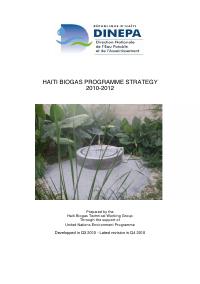
Stratégie du programme biogaz d'Haïti 2010-2012
Resume — Stratégie d'un programme biogaz élaborée par un groupe de travail technique avec l'appui du PNUE au second semestre 2010.
Constats Cles
- Addresses cooking fuel, the driver of charcoal demand and deforestation.
- Records over 1.5 million still displaced and over 1 million dependent on food aid as of June 2010.
- Prepared by a technical working group rather than a single agency.
Description Complete
Stratégie d'un programme biogaz élaborée par un groupe de travail technique avec l'appui du PNUE au second semestre 2010. La dépendance au charbon de bois est le moteur de la déforestation haïtienne, et le biogaz est l'une des rares solutions de cuisson n'exigeant pas d'importation ; la stratégie expose ce qui était proposé alors que le relèvement gardait des options ouvertes.
Texte Integral du Document
Texte extrait du document original pour l'indexation.
HAITI BIOGAS PROGRAMME STRATEGY
2010-2012
Prepared by the
Haiti Biogas Technical Working Group
Through the support of
United Nations Environment Programme
Developped in Q3 2010 - Latest revision in Q4 2010
DINEPA - Direction Nationale de l’Eau Potable et de l’Assainissement
1. INTRODUCTION 3
1.1 Purpose of the Strategy 3
1.2 Relief and Recovery background 3
2. BACKGROUND AND RATIONALE 4
2.1 Biogas background 4
2.2 Existing needs and potential applications 4
2.3 Existing biogas units and activities 7
2.4 Review of alternatives and limitations 8
2.5. Summary of rationale 9
3. BIOGAS PROGRAM 2010 – 2012 10
3.1 Goal and Objectives 10
3.2 Program coordination and development 10
3.3 Small-scale sub-program 11
3.4 Industrial Sub-program 11
3.5 Budget 12
3.7 Financing 12
3.7 Work plan 2010 - 2012 12
ANNEX: List of Biogas Technical Working Group Members 14
2010-2012 Haiti Biogas Strategy - Latest revision in Q4 2010 2
DINEPA - Direction Nationale de l’Eau Potable et de l’Assainissement
1. INTRODUCTION
1.1 Purpose of the Strategy
This strategy is designed for two purposes:
• To formalize and guide the activities of the Haiti Biogas Technical Working group;
• To inform other potential actors and investors in the field of biogas in Haiti of the
government approved strategy and scope of work for activities within this field.
This guiding document is first designed to be valid until the end of 2012, and then it will be
readapted by the partners in order to have a more long term strategy for biogas in Haiti. It will be
reviewed at regular interval (end of year) and may be adjusted accordingly.
1.2 Relief and Recovery background
Activities in the biogas field within Haiti for 2010 – 2012 will take place in a complex background
of disaster relief, recovery and development.
For relief, as of June 2010, over 1.5 million remain displaced from the earthquake and over 1
million are dependent on food aid. About 1 million of the displaced people are located in over
1340 camps of variable size and formality. A large scale humanitarian program is addressing
basic needs; however securing adequate shelter and sanitation remains very difficult.
For recovery, as of June 2010, the general direction of the recovery has been laid out in the
Haitian government Plan D’Action de Relevement and Development National (PARDN)
(PARDN). Of direct relevance to biogas, the PARDN makes clear reference to the need for
investments in sanitation (Section 4.3.6) with an estimated budget of US$160 million (Table 4.5).
Other relevant sections include agriculture (4.3.1) and access to electricity (4.2.4).
For long term development, the needs are possibly best expressed in terms of access to clean
water and sanitation. Before the earthquake, only 24% of Haitians had access to improved
sanitation in urban area and only 71% had improved water sources (2008 figures WHO/UNICEF
JMP). Hence there is an enormous unmet need for improved sanitation (which is closely linked
to the potable water needs due to water pollution issues).
2010-2012 Haiti Biogas Strategy - Latest revision in Q4 2010 3
DINEPA - Direction Nationale de l’Eau Potable et de l’Assainissement
2. BACKGROUND AND RATIONALE
2.1 Biogas background
Biogas is the shorthand label for the process of controlled anaerobic digestion of organic matter
combined with methane gas capture. The process converts organic waste such as human and
animal excreta and food wastes into methane, nutrient rich effluent (supernatant) and solid
sludge suitable for soil conditioning. The technology has been established for over 30 years
and several million units are apparently in operation worldwide. The technology is simple,
highly economic and scalable: the smallest units serve individual households whilst the largest
built process waste from thousands of livestock. However lessons learned in many countries
indicate that the technology needs to be introduced with care – technical problems do occur and
adapting the designs and operating systems to the local context is critical for its acceptance.
Economic marginality is also an issue for many designs and settings.
General background on biogas can be found at http://www.iea-biogas.net/ ,
http://www.ashdenawards.org/biogas and several other commercial websites and sources such
as http://www.completebiogas.com/toc.html
Family size Biodigestor in Petrópolis-RJ, Brazil.
2.2 Existing needs and potential applications
Biogas is a multi-thematic solution to multiple problems or needs. In the Haitian context, the
technology has the theoretical potential to partly address the following needs:
Human waste/sewage treatment: At present very little human waste is properly treated in Haiti.
Most toilets are simple pit latrines or emptied either directly into storm water drains or into basic
septic or holding tanks. Some tanks are emptied by trucks however the resultant highly polluting
waste is typically dumped directly into watercourses or into gullies which are flooded seasonally.
Since the earthquake, a fleet of desludging trucks has been mobilized to transport human waste
from collection points in the temporary camps. Most of this waste is going to dumpsites or again
2010-2012 Haiti Biogas Strategy - Latest revision in Q4 2010 4
DINEPA - Direction Nationale de l’Eau Potable et de l’Assainissement
to watercourses. This can cause serious human health problems as this is currently (Q4 2010)
the case with the cholera outbreaks affecting the country (as of October 29th, the Ministry of
Health has confirmed 4,714 hospitalized cases and 330 deaths from cholera and the WHO
affirms that the peak has not been reached yet). The root causes of this epidemic disease
demonstrate that long-term solutions to the disposal and sustainable treatment of human waste
are more needed than ever. In practical terms, there is a need to address human waste
treatment for practically all of the near 10 million population of Haiti with the needs possibly
most urgent in the 3 million urban populations in the regions affected by the earthquake. Human
waste can be simply treated by biogas units and indirectly produce 100.000 m3 biogas,
equivalent to 225.000 kWh (energy) per day. 1
A sludge tanker
Organic waste management: At present organic wastes (mainly discarded fruit and vegetable
matter) are not properly managed. Large quantities of material are dumped on streets, channels,
and gullies or at best transported to the local landfill. Landfills are generally uncontrolled and are
a major source of pollution, adding to the health hazards. Mixed organic waste can be treated
by biogas units to become a source of clean energy. Some of the waste coming from butcheries
can be used in biogas units too.
1
One adult person can generate 50 liter of biogas per day. Average with child is estimated to 33 l/day. One m3 biogas contains 2.6
MJ or 7.2 kWh energy. 25% to 35% can be converted to electricity, rest is heat losses.
2010-2012 Haiti Biogas Strategy - Latest revision in Q4 2010 5
DINEPA - Direction Nationale de l’Eau Potable et de l’Assainissement
Port au Prince marked vegetable waste.
Access to energy: Haiti is extremely energy poor. Essentially modern forms of energy-
specifically electricity and gas – are only available to a minority of households. The main part of
Haiti energy demand is covered with overexploited natural resources in the form of firewood and
charcoal. This situation is aggravating the chronic wood fuel resources deficit.
Biogas units increase access to energy through the use of human waste for the supply of
methane, which can be used for cooking or industrial heating. 2Large scale biogas units can
generate methane to supply cities with electricity from fuel gas engines or turbines. In fact,
human excreta from 1 million people can generate cooking gas for up to 100.000 households or
fuel 75.000 kWh/day gas powered electricity generator units. 3 Taking into account cultural
acceptance, relatively easiness to store and transport the gas as well as linkages with national
or local electricity grids, biogas has the potential to provide a small but locally useful percentage
of Haitian energy need.
2
VivaRio experience from Brazil says 50 liters biogas/day with 74% methane from an adult person. It gives 37 liter
methane corresponding 23 grams with a calorific value of 1312 kJ or 314 kcal or 364 Wh (the amount of energy 4,5
liter of water absorbs when heated from 30 to 100 degree Celsius)
3
Source: www.embrapa.gov.br.
2010-2012 Haiti Biogas Strategy - Latest revision in Q4 2010 6
DINEPA - Direction Nationale de l’Eau Potable et de l’Assainissement
Biogas powered generator Biogas based gas cooker
Fertilizer: The outputs of a fully operational biogas plant include liquid effluent (supernatant)
and solid residue (sludge). Both the liquids and the solids, though not sterile, contain high
levels of organic and inorganic matters, particularly nitrogen, and are very suitable for use as
fertilizers and soil conditioners. The viability of the use of these outputs is principally linked to
materials handling and transport costs – the materials need to be transported to the agricultural
sites or such activities need to come to the biogas unit. As an agricultural and developing
country, Haiti has a clear need for such outputs. The potential for use and associated
economics needs to be reviewed on a case by case basis.
2.3 Existing biogas units and approach used
There are two operating biogas units in the neighborhood of Bel-Air in Port-au-Prince, built by
Viva Rio as pilot models to benefit the community. Based on their success and, in partnership
with Norwegian Church Aid (NCA), Viva Rio is working to implement 18 additional bio systems
in the Haitian municipalities of Port au Prince and Cite Soleil until December 2010.
Viva Rio has been using a successful approach, which has been proven to work. It consists in
integrating the local community in the whole biogas implementation process: design,
construction and management. Viva Rio trains local workers to become experts in building and
managing the bio-system. It also promotes hygiene and the use of local materials and local
institutional resources.
Public Toilets in the Biogas Unit Biogas Unit or Biodigestor Lake zone or Biodigestor Liquid Effluent
2010-2012 Haiti Biogas Strategy - Latest revision in Q4 2010 7
DINEPA - Direction Nationale de l’Eau Potable et de l’Assainissement
2.4 Review of alternatives and limitations
This brief review of alternatives is based upon the simplification that the principal driver of
biogas for Haiti is improved sanitation, with energy and fertilizer aspects considered to be
important but secondary benefits. We also bear in mind that for DINEPA, the alternatives should
be based on individual or semi-collective treatment systems.
• The “do nothing’ or baseline alternative is inexpensive in investment cost however it is highly
damaging to human health (e.g. cholera outbreaks, etc.) and the environment. Hence it is
not considered a viable long term alternative.
• The basic alternative in use now consists in collecting the sludge in pits or portable toilets to
be emptied by desludging trucks. This alternative can be associated with a treatment
process on the final destination of the sludge. However it might be highly damaging to
human health and to the environment. Hence it is not considered a viable long term
alternative.
• One viable but only partial alternative is an increase in the use of deep pit toilets and
composting toilets. The pit toilets are relatively inexpensive but their long term application is
largely limited to rural and peri-urban areas. The composting toilets can be used anywhere,
but the compost needs to be brought to an area where farming is being done. This still
leaves an estimated 3 million or more urban dwellers without an adequate solution.
• Another potentially viable alternative is the increased use of holding tanks and septic tanks
with outfalls and infiltration systems. This would be a major improvement on the existing
situation but would still result in large scale use of desludging trucks and disposal of human
waste from the full tanks.
• Construction of decentralized waste water treatment systems (DEWATS). Those can include
the use anaerobic baffled reactors, septic tanks with several compartments… This solution
is interesting but not yet in use in Haïti. The out coming effluent can be used in fish ponds.
• The fourth major alternative is the construction and operation of sewage treatment works for
the human waste transported by trucks. The principal obstacle in this case is the cost – both
for construction and for operations. All other things being equal, industrial biogas should
have an economic advantage over conventional systems due to the simpler construction
and lower capital cost and the economic returns from gas production. This comparison
however depends upon moderate liquid effluent discharge standards or a beneficial use of
the effluent – biogas plants cannot achieve very strict discharge standards.
Whilst in theory, biogas has potentially a very broad application in Haiti, in practice, limitations
and operational issues noted in other countries might similarly constrain its potential here.
These issues include cultural issues, construction costs, space constraints, limited gas storage
and feedstock limitations (for example Haitian animal rearing practices are unlikely to yield
enough manure in most places). All of these issues will be addressed at the feasibility and
design stage to avoid sustainability problems and deliver real benefits.
2010-2012 Haiti Biogas Strategy - Latest revision in Q4 2010 8
DINEPA - Direction Nationale de l’Eau Potable et de l’Assainissement
2.5. Summary of rationale
In summary, there is a clear and major need for improved sanitation and environmental
solutions for Haiti. The cholera outbreak affecting the country urges the need to find sustainable
and long-term solutions to human waste treatment. Biogas can provide part of the solution to
this challenge, particularly in urban areas. The gas and fertilizer outputs are considered to be
co-benefits and would assist principally in reducing the overall operating costs - potentially to
the stage of generating a marginal profit for some operations. If successful and fully rolled out
across Haiti, it could provide sustainable benefits to 2 - 4 million people at a lower cost than the
noted alternatives.
2010-2012 Haiti Biogas Strategy - Latest revision in Q4 2010 9
DINEPA - Direction Nationale de l’Eau Potable et de l’Assainissement
3. BIOGAS PROGRAM 2010 – 2012
3.1 Goal and Objectives
Goal 2020: Provide economically sustainable improved sanitation to at least 2 million Haitians.
Goal - December 2012: Provide a low cost, environmentally acceptable sanitation solution to 1
million Haitians.
Objectives - December 2012:
• Develop an environmentally acceptable permanent solution for 50% of the human waste
collected in tanks in the Port au Prince region.
• Improve the access to clean toilets to 200,000 residents of transitional camps and marginal
areas (bidonvilles).
Outline Scope 2010 – 2012
The program scope for 2010 – 2012 will depend largely upon: a) funding for construction and
b) securing land for biogas units. At its full scale the scope of work would include:
1. Program coordination and development Coordination, development of government
awareness and policies as well as local technical capacity for construction and operation.
2. Small scale sub-program: expansion phase of small scale units to provide coverage for
200,000 residents of the Port au Prince region with a later expansion of pioneer sites into 10
other Haitian cities and major towns.
3. Industrial sub-program Design, construction and startup of an industrial biogas site with
power generation using human waste, waste from the butchery and vegetable waste in the
Port-au-Prince region.
Each of these major components is described in turn below.
3.2 Program coordination and development
Biogas is a completely new technology for Haiti and as such it presents both risks and
opportunities. To provide real benefits on a large scale it needs to grow very quickly from a very
limited base but also to develop locally applicable designs and social models. Finally it needs to
evolve into a self financing and self sustaining process within 5 years or less to enable it to
continue in the complete absence of foreign aid. Combined these present a major challenge.
In this context, the proposed scope of program coordination and development is as follows:
2010-2012 Haiti Biogas Strategy - Latest revision in Q4 2010 10
DINEPA - Direction Nationale de l’Eau Potable et de l’Assainissement
• Continuous coordination – provided initially by the Biogas Technical Working Group but
delegated at a later stage to a full time professional working within DINEPA.
• Awareness raising on biogas issues with the government, international partners and local
partners
• Support to the development of government policies regarding biogas.
• Capacity building linked to the technology - in addition to the working level capacity building
occurring with the urban and industrial sub-programs.
• Resource mobilization for the program.
3.3 Small-scale sub-program
The working model for the urban sub-program is the construction of up to 20 communal toilets
clustered around a small to medium scale biogas unit. The gas generated is normally used for
communal cooking or powering generators. The supernatant flows through a biological filter
system of water plants and trees and the solids are extracted yearly and used as soil
conditioner.
This model is technically well proven and has a low unit construction cost. However, if we want
to promote this system in order to serve the sanitation needs of the low-income towns of Haiti,
we will need to build thousands of units across the country. Those units must be operationally
self-sufficient through cost recovery via toilet fees and the use of the gas. The challenge in this
case is to continually improve the social and economic model in order to gain the acceptance of
the communities and to drive down the costs of construction and operation.
Between 2010 and 2012, the number of units to be built may range from 40 to over 500
dependent upon funding and feedback from the early efforts.
3.4 Industrial Sub-program
At present, the sludge coming from the camps is desluged on the national landfill of Truitier. The
total amount of human waste discharged daily represents approximately 500 m³. As the
number of sanitation facilities will increase, this volume will grow.
These volumes are appropriate for treatment in one or several industrial scale biogas units.
Such units have large digestion chambers and operate at high efficiency. Normally the gas
produced is used onsite to fuel a gas engine for electricity generation. They require full time staff,
a moderate amount of space (2000m² or more) and sustainable solutions for effluent use or
disposal. Capital costs and power outputs are completely dependent on the unit scale, type and
site layout but start at US$ 1 million or more. Running costs can be partly, if not completely,
recovered if the generated electricity is sold into the grid at commercial rates.
The site selection, design, approvals and construction process for industrial biogas units can
take well over a year in other countries and is anticipated to take at least one year in Haiti.
Specialist engineering expertise is required for this work. A substantive feasibility and design
process is required given the high uncertainties linked to the introduction of industrial biogas in
general and in Haiti in particular. The logical first steps therefore in launching an industrial
biogas program are a) to undertake a rigorous feasibility study and b) secure a suitable site.
2010-2012 Haiti Biogas Strategy - Latest revision in Q4 2010 11
DINEPA - Direction Nationale de l’Eau Potable et de l’Assainissement
The construction of an industrial biogas unit by end 2011 or earlier is proposed. This will be
dependent upon funding, a positive result from the feasibility study and the government of Haiti
securing an appropriate site.
3.5 Budget
The budget for the 2010 – 2012 program cannot be accurately predicted at this stage and is
expressed as a range in the table below.
Component Min Optimum Maximum Comments
Program coordination and 100,000 500,000 700,000 Coordination costs increase
development with program size
Small scale subprogram 1.000,000 2,000,000 6,000,000 Capacity constrained by space
availability in high-density
urban areas.
Industrial subprogram 2,000,000 5,000,000 10,000,000 Costs highly unpredictable at
this stage
Totals 3,100,000 7, 500,000 16,700,000 Range indicates uncertainty
prior to feasibility study
3.6 Financing
In Q3 and Q4 2010 the biogas program has secured and allocated approximately US$80,000
provided by Norwegian Church Aid and UNEP for the small-scale sub-programme and secured
US$130,000 through OCHA and UNEP for the industrial scale sub-programme. Overall, those
funding are being used to carry out in-depth feasibility study that will be translated into
technically sound and costed proposal for the installation and operation of small scale and
industrial biogas units in the Metropolitan Area of Port au Prince in 2011.
This implies the need for additional financing in Q1 2011 for the implementation of the project
proposals developed. At this point in time (October 2010), the budget needed is highly
uncertain but expected to be in the order of US$ 5 – 10 million. The proposal, in particular for
the industrial unit, will target the Haiti Recovery Fund and bilateral donors. The small-scale
subprogram will continue to target smaller donors such as NGOs but do not exclude the HRI.
3.7 Work plan 2010 - 2012
The 2010 – 2012 detailed work plan for the Haiti Biogas Program will change regularly as early
results are reviewed and financing secured. Hence it will be a living document and will be
developed and updated by the Biogas Technical Working Group at regular intervals.
2010-2012 Haiti Biogas Strategy - Latest revision in Q4 2010 12
DINEPA - Direction Nationale de l’Eau Potable et de l’Assainissement
2010-2012 Haiti Biogas Strategy - Latest revision in Q4 2010 13
DINEPA - Direction Nationale de l’Eau Potable et de l’Assainissement
ANNEX: List of Biogas Technical Working Group Members
DINEPA: Ingrid Henrys ingrid.henrys@dinepa.gouv.ht
UNEP: Maximilien Pardo maximilien.pardo@unep.org
UNOPS: David Tordjman davidtor@unops.org
UNICEF: Mark Henderson mhenderson@unicef.org / Georges Tabbal gtabbal@unicef.org
WASH cluster: Ben Harvey harveyben73@googlemail.com
IOM: Sirara Fernando sfernando@iom.int
USAID: Tingley Clement ctingley2@usaid.gov
Norwegian Church Aid: Sylvia Raulo ncahaiti@nca.no
Viva Rio: Rubem Cesar rubemcesar@vivario.org.br / Valmir Fachini fachini@vivario.org.br
For more information on the Biogas Technical Working Group please contact DINEPA at
ingrid.henrys@dinepa.gouv.ht
2010-2012 Haiti Biogas Strategy - Latest revision in Q4 2010 14