

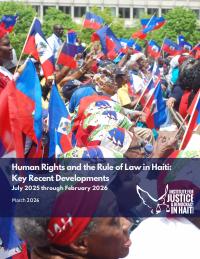
(2026) Dwa moun ak Eta de dwa an Ayiti : dènye devlopman enpòtan yo, jiyè 2025 rive fevriye 2026
Rezime — Aktyalizasyon peryodik IJDH ki dokimante kriz sekirite, gouvènans ak imanitè Ayiti a k ap vin pi grav soti jiyè 2025 rive fevriye 2026: plis pase 8 100 moun mouri, 1,45 milyon deplase, pasaj nan Fòs Represyon Gang yo ak yon nouvo gouvènman tranzisyon.
Dekouve Enpotan
- Omwen 8 100 moun te mouri akoz vyolans gwoup ame yo an 2025 e anviwon 1,45 milyon moun te deplase anndan peyi a nan janvye 2026, ak 80 a 90 % zòn metwopolitèn Pòtoprens anba kontwòl gwoup ame yo; rapò yo endike plis pase mwatye Ayisyen ki mouri an 2025 yo te mouri nan repons sekirite ki lye ak Leta, tankou operasyon dron ak abi gwoup otodefans sivil ak kontraktè prive yo. Gouvènman Akò avril 2024 la ak MSS la te fini san yo pa t atenn objektif yo, yo ranplase yo ak yon gouvènman ki konsolide anba Premye Minis Fils-Aimé, ke yo kritike pou yon dekrè desanm 2025 ki pwoteje ansyen ofisyèl yo, ak yon Fòs Represyon Gang ki apèn deplwaye e ki manke finansman. Kondisyon ekonomik ak sosyal yo vin pi mal toujou: yon setyèm ane bès ekonomik youn dèyè lòt, 25 % enflasyon, 35 % povrete ekstrèm, 5,7 milyon moun nan ensekirite alimantè egi, 12 % etablisman sante ak kapasite entène k ap fonksyone nòmalman, plis pase 1 600 lekòl fèmen ak yon gwo ogmantasyon kolera. Repiblik Dominikèn te ekspilse plis pase 265 000 Ayisyen an 2025 pandan Etazini te sispann prèske tout chemen pwoteksyon yo.
Deskripsyon Konple
Aktyalizasyon peryodik IJDH sa a kouvri peryòd jiyè 2025 rive fevriye 2026, kote gouvènman tranzisyon Akò avril 2024 la ak Misyon Miltinasyonal Sipò Sekirite ke ONI te otorize a te fini san yo pa t atenn objektif materyèl yo epi yo te ranplase pa yon gouvènman ki konsolide anba Premye Minis Alix Didier Fils-Aimé ak nouvo Fòs Represyon Gang yo. Rapò a dokimante plis vyolasyon dwa a lavi ak sekirite: omwen 8 100 moun mouri akoz vyolans gwoup ame yo an 2025, anviwon 1,45 milyon moun deplase anndan peyi a, 80 a 90 % zòn metwopolitèn Pòtoprens anba kontwòl gwoup ame yo, ak rapò ki di plis pase mwatye Ayisyen ki mouri an 2025 yo te mouri nan repons sekirite ki lye ak Leta, tankou frap dron ak abi gwoup otodefans sivil ak kontraktè militè prive yo. Li egzamine koripsyon ak konplisite ant aktè Leta ak gwoup ame yo, efondreman sistèm jistis la ak enpinite, ogmantasyon vyolans seksyèl ak rekritman timoun, ak degradasyon dwa ekonomik ak sosyal yo: 35 % povrete ekstrèm, 25 % enflasyon, 5,7 milyon moun nan ensekirite alimantè egi, sèlman 12 % etablisman sante ak kapasite entène k ap fonksyone nòmalman ak plis pase 1 600 lekòl fèmen. Li analize tou ekspilsyon masiv soti Repiblik Dominikèn, fèmti chemen pwoteksyon ameriken yo ak feblès repons entènasyonal la.
Teks Konple Dokiman an
Teks ki soti nan dokiman orijinal la pou endeksasyon.
Human Rights and the Rule of Law in Haiti:
Key Recent Developments
July 2025 through February 2026
March 2026
Human Rights and the Rule of Law in Haiti: Key Recent Developments, July 2025 through February 2026 i
About the Author
The Institute for Justice and Democracy in Haiti (IJDH) is a U.S.-based non-profit organization that works
in solidarity with its Haiti-based sister organization, the Bureau des Avocats Internationaux (BAI), to drive
systemic change in Haiti by helping Haitian activists and grassroots groups enforce their internationally-
recognized human rights. BAI and IJDH combine strategies including: (a) litigation in Haiti, the United
States and beyond; (b) public advocacy on the streets, in the press, in academia and on social media; (c)
capacity building for grassroots groups and activists; (d) training of human rights lawyers; and (e) nurturing
advocacy networks and collaborations worldwide. For nearly 30 years, BAI and IJDH have kept activists
safe, rallied global allies to the fight for human rights in Haiti, and impelled the justice systems to serve
marginalized communities.
Acknowledgments
IJDH would like to thank University of California, Irvine School of Law students Luke Antoun and Perrin
King for their pro bono contributions to preparing this Update.
IJDH is likewise deeply grateful to Nixon Boumba, Barbara Campbell, Rosy Auguste Ducéna, Jessica Hsu,
Jake Johnston, Michelle Karshan, Pascale Solages, and Florence Jeane Louise Vorbe for additional input
and feedback on drafts, and for their solidarity and collaboration with IJDH work.
Human Rights and the Rule of Law in Haiti: Key Recent Developments, July 2025 through February 2026 ii
Table of Contents
About the Author .............................................................................................................................. i
Acknowledgments ............................................................................................................................. i
Table of Acronyms .......................................................................................................................... iii
Executive Summary ........................................................................................................................ iv
I. Introduction .............................................................................................................................. 1
II. Violations of the right to life & security of the person ...................................................... 2
Violence by armed groups and related displacement ................................................................. 2
Government failure to protect civilians ...................................................................................... 3
III. Government misconduct, including institutionalized violence & corruption ................. 4
IV. Lack of access to justice & chronic impunity ..................................................................... 5
Justice sector dysfunction and chronic impunity ........................................................................ 5
Inhumane prison conditions ....................................................................................................... 5
V. Lack of equal rights & protections ...................................................................................... 6
VI. Collapse of economic & social rights ................................................................................... 8
Economy in decline ..................................................................................................................... 8
Access to water ........................................................................................................................... 8
Access to food ............................................................................................................................. 9
Access to healthcare ................................................................................................................... 9
Access to education .................................................................................................................. 10
VII. Emigration pressures ...................................................................................................... 10
VIII. Failures of the international community to respect the rights of Haitians ................ 11
Notes ................................................................................................................................................ 14
Human Rights and the Rule of Law in Haiti: Key Recent Developments, July 2025 through February 2026 iii
Table of Acronyms
BAI Bureau des Avocats Internationaux (Office of International Lawyers)
BINUH United Nations Integrated Office in Haiti
CARICOM Caribbean Community
CPJ Committee to Protect Journalists
DCPJ Direction Centrale de la Police Judiciaire (Central Directorate of the Judicial Police)
FAd’H Haitian Armed Forces
GSF Gang Suppression Force
HRW Human Rights Watch
IJDH Institute for Justice and Democracy in Haiti
IOM International Organization for Migration
IPC Integrated Food Security Phase Classification
MSF Médecins Sans Frontières (Doctors Without Borders)
MSS Multinational Security Support [Mission]
OCHA UN Office for the Coordination of Humanitarian Affairs
OHCHR Office of the UN High Commissioner for Human Rights
PAHO Pan American Health Organization
PHTK Pati Ayisyen Tèt Kale (Haitian Tèt Kale Party)
PNH Police Nationale d’Haïti (Haitian National Police)
RNDDH Réseau National de Défense des Droits Humains (National Network for the Defense of
Human Rights)
TPC Haiti’s Transitional Presidential Council (Conseil Présidentiel de Transition – CPT)
TPS Temporary Protected Status
ULCC Unité de Lutte Contre la Corruption (Haiti’s Anti-Corruption Unit)
UN United Nations
UNHCR United Nations High Commissioner for Refugees
UNICEF United Nations Children’s Fund
UNODC United Nations Office on Drugs and Crime
UNSC United Nations Security Council
WFP World Food Programme
Human Rights and the Rule of Law in Haiti: Key Recent Developments, July 2025 through February 2026 iv
Executive Summary
Haiti’s governance, security, and human rights crisis continued to deteriorate since IJDH’s last Update on
Human Rights and Rule of Law in Haiti in July 2025. The government and international responses remain
inadequate, and both Haiti’s transitional government and the UN-authorized Multinational Security
Support mission were replaced after failing to meet any material objectives. There is little indication that
the replacement transitional government consolidated around the sitting (transitional) Prime Minister or
the new UN-authorized Gang Suppression Force will transform the underlying causes of that failure,
which include government corruption and abuses; an enabling international preference for short-term,
militarized solutions; the willingness to marginalize Haiti’s civil society in favor of corrupt or complicit
elites; and a lack of committed and context-appropriate actions and funding.
This reporting period saw a further increase in violations of the right to life and security of the person that
the government has been unable or unwilling to control, and in which it is increasingly complicit. Over
8,000 people were killed in 2025, and nearly 1.5 million are displaced. Armed groups continued to
consolidate their control over large parts of the country, formalize their networks of checkpoints and
extortion schemes, and use extreme brutality to assert their dominance over the population. Haiti’s police
remain weak and largely ineffective at controlling armed group violence. An increasing number of non-
state actors, including civilian “defense” groups and foreign military contractors, are one troubling
element of an increasingly militarized and extrajudicial crisis response. The proliferation of armed non-
state actors is creating an ever-more fractured security environment, increasing civilian deaths and other
abuses, and undermining government authority.
Persistent corruption and collusion between state actors and armed groups continue to undermine efforts
to restore security and democratic governance. Credible allegations of corruption and complicity with
criminal groups persist at the highest levels of government and within security institutions. Patterns of
extrajudicial killings and widespread civilian harms by police and other government actors persist. Haiti’s
justice system remains largely unable to investigate or prosecute these and other serious crimes. Chronic
under-resourcing and insecurity have rendered many courts virtually or completely non-operational, and
impunity remains the norm for human rights abuses and corruption alike. Continued politicization of the
judiciary and recent government initiatives to immunize high-level officials from accountability for
corruption exacerbate these challenges. Persistent high rates of pretrial detention and inhumane prison
conditions violate the human rights to due process and to life, among others.
The insecurity and humanitarian crises continue to disproportionately impact individuals already at the
margins. Resources and protections are inadequate and particularly impacted by foreign assistance cuts
and policy changes. This reporting period saw another material increase in sexual violence against women
and girls, especially at displacement sites. Persistent marginalization of women and their needs – which
violates Haitian women’s right to equality and full participation in their government – continues to
perpetuate inequality and weaken the transition and security responses to the crisis. Armed groups
continue to exploit children’s acute vulnerabilities to privation to recruit them. Harms against children –
at the hands of all parties – are escalating. Planning for age-appropriate security response and community
reintegration is inadequate.
Haiti’s already catastrophic social and economic landscape has deteriorated further. Approximately 35%
of Haitians live in extreme poverty and about 5.7 million are acutely food insecure. The World Food
Program designated Haiti one of just five “famine hotspots” in the world. Widespread school and hospital
closures continue to impact hundreds of thousands.
In the face of these combined challenges, foreign states – notably the Dominican Republic and the United
States – continue to implement racist, inhumane, and in many cases illegal measures to restrict migration
for Haitians and to deport those already within their borders. Haitians returned to Haiti are extremely
vulnerable to further violence, exploitation, and displacement.
The international response to these challenges continues to reflect longstanding patterns that violate
Haitians’ rights to choose their government. It prioritize short-term, militarized engagement while
neglecting the structural causes of the crisis. Foreign interference once again dictated the composition of
Haiti’s new transitional government and continues to enable government corruption and dysfunction.
Changes to the mandates of the UN-authorized military intervention and residual political office similarly
raise concerns about the international community’s commitments to Haitian sovereignty and human
rights. At the same time, humanitarian funding has declined sharply even as needs continue to grow.
Human Rights and the Rule of Law in Haiti: Key Recent Developments, July 2025 through February 2026 1
I. Introduction
This reporting period
I
saw continued territorial capture and pervasive violence by armed groups;
unremitting government dysfunction accompanied by dubious foreign engagement; and – as a result –
further deterioration of the human rights and humanitarian situation from levels that had already earned
Haiti outlier status on indexes tracking human suffering. Of particular note are the predictably
1
unsuccessful tenure and ending of both the transitional government created pursuant to the April 3, 2024
Political Accord for a Peaceful and Orderly Transition (April 2024 Accord) and the Multinational
Security Support mission (MSS) imposed
2
by the international community. Both had proven ineffectual
at resolving Haiti’s complex governance and security crisis,
3
reflecting, among other failures, government
corruption and abuses; an enabling international preference for short-term, militarized solutions; the
willingness to marginalize Haiti’s civil society in favor of corrupt or complicit elites; and a lack of
committed and context-appropriate actions and funding.
4
Essentially none of the material benchmarks
relating to holding elections, restoring government functions, and tackling the metastasizing insecurity
relating to armed groups were met.
5
The same deficiencies underlie both the successor government that took over as the April 2024 Accord
mandate expired on February 7, 2026, and the Gang Suppression Force (GSF) that replaced the MSS on
September 30, 2025. As the end of its mandate approached, the April 2024 Accord government devolved
into a struggle for power, one that was resolved not by Haitians, but by international threats, backed by
U.S. warships deployed off Haiti’s coast.
6
The result has been a consolidation of power in the hands of a
sole head of state (Prime Minister Alix Didier Fils-Aimé), who had already been in power for a year and
therefore shares the poor security and governance record of the Transitional Presidential Council (TPC)
that appointed him.
7
Several major political parties and civil society groups – with notable holdouts and
critics – signed
8
a National Pact for Stability and the Organization of Elections (2026 Pact),
9
which
recognizes his authority and sets out the new transitional government mandate. The 2026 Pact has been
criticized for lacking a fixed term or effective controls against corruption and abuse, and for consolidating
power.
10
These features of the new transitional government are particularly troubling given Fils-Aimé’s long
association with private sector elites implicated in corruption and crimes.
11
It likewise appears to be
keeping in place a controversial decree issued by Fils-Aimé and the TPC in December 2025, which
protects top former government officials from accountability for corruption and other gross misconduct.
12
The decree risks enabling impunity and corruption that fundamentally shaped the TPC’s dysfunction,
13
and lies at the root of Haiti’s crisis as a whole.
14
Fils-Aimé’s government has also kept the
August/December 2026 election timeline
15
adopted by the TPC when its 2025 benchmarks proved
predictably unworkable.
16
The new timeline appears equally unrealistic for holding elections that include
the large and populous areas controlled by armed groups and comply with standards on fairness,
inclusivity, and credibility.
17
It also involves revived
18
plans for constitutional amendment through an
explicitly unconstitutional referendum.
19
Seen as a whole, the new transitional government’s agenda
appears to do little to address the factors precipitating Haiti’s governance collapse
20
or restore
constitutional order, and may instead exacerbate the underlying drivers of social instability.
21
As discussed more extensively in Section VIII below, the GSF likewise does not clearly solve for the
challenges that plagued the MSS and made it ineffective.
22
At the time of writing – five months into its
one-year renewable mandate – the GSF is barely deployed, is underfunded, and lacks clearly defined
operating procedures.
23
Moreover, changes to the mandate of the GSF and the complementary UN
Integrated Office in Haiti (BINUH)
24
actually step back from their predecessor missions’ commitment to
human rights principles and Haitian sovereignty.
25
These are compounded by the ongoing sharp cuts to
foreign aid and changes to related policies that are weakening an already inadequate humanitarian
response, with disproportionate impact on women and other marginalized groups.
26
Similarly, the
continued flow of weapons and ammunition into Haiti – primarily from the United States – remains
effectively unaddressed and fuels the scale and severity of the violence.
27
Finally, in what has become an increasingly militarized response to Haiti’s complex crisis, the Haitian
government has continued its reliance on non-state actors for addressing armed group violence, including
most notably private military contractors and local “defense” groups.
28
The former are linked with an
I
Previous Institute for Justice and Democracy in Haiti (IJDH) Updates are available on the IJDH website at IJDH, News and
Resources Publications: Human Rights Updates, https://www.ijdh.org/news-and-resources/publications/ (last visited Mar. 11,
2026).
Human Rights and the Rule of Law in Haiti: Key Recent Developments, July 2025 through February 2026 2
increased use of drones that have reaped escalating civilian casualties without significant impact on
armed group capacity.
29
The latter are not only committing human rights violations, but are increasingly
implicated in criminality that threatens to transform some of the “defense” groups into the very armed
groups they arose to constrain.
30
The result has been devastating for Haitian civilians. Reports indicate
that over half of Haitians killed in 2025 were killed not by armed groups, but by some element of the
government’s security response, and that a growing number are being displaced due to government and
MSS/GSF operations.
31
This abdication and diffusion of authority over the legitimate use of force also
undercuts government credibility, increases opportunities for corruption and government abuse, and
further complicates power and security dynamics in a manner that impedes Haiti’s prospects for
establishing peace and community reconciliation.
32
II. Violations of the right to life & security of the person
Catastrophic violence in Haiti has deepened further since IJDH’s last Update.
33
Armed groups, many now
operating jointly under the banner of Viv Ansanm,
34
still control huge swaths of territory
35
and brutalize
the population. Widespread killing and displacement have continued to increase. The resulting desperate
economic and humanitarian situation (see Section VI) fuels ongoing recruitment by armed groups,
36
furthering cycles of violence. Haiti’s government security forces remain unable to effectively protect the
population from armed groups. The transitional government has dramatically and opaquely increased its
reliance on non-state actors – including civilian “defense” groups, private military contractors, and the
newly-authorized GSF – to fill the vacuum. There have been few observable security gains and
significant resulting human rights concerns, including growing civilian casualties and other human rights
abuses, and expanding opportunities for abuse. In this context, the distinctions between civilians and
combatants, and between state and non-state actors, have become increasingly blurry,
37
highlighting the
continued breakdown of state control over security and of the rule of law, with attendant challenges to the
transitional government’s ability to restore peace and constitutional order.
38
Violence by armed groups and related displacement
• Armed groups have retained control over large parts of the West,
39
Artibonite,
40
and Center
Departments,
41
and continued to expand into other regions previously considered safe.
42
An estimated
80 to 90% of the Port-au-Prince metropolitan area remains under their control.
43
Armed groups have
strengthened their hold over key infrastructure and transportation – including roads, waterways, and
air traffic
44
– as a means of curtailing freedom of movement,
45
increasing revenue, and establishing
strategic bases.
46
• According to the UN, at least 8,100 people were killed due to armed group violence in Haiti in 2025.
47
Limited access to areas under armed group control means the real number may be even higher.
48
Armed groups continue to carry out large-scale attacks against the population in areas where they are
consolidating territorial control, leading to mass deaths and displacement.
49
However, attacks in
neighborhoods already solidly under their control have decreased (but not stopped), as the armed
groups no longer need to use mass violence to assert their domination in those areas.
50
• Armed groups continue to use calculated brutality as a primary tactic for advancing their aims.
51
Abuses include targeted executions;
52
mutilation;
53
beating and torture;
54
sexual violence;
55
burning
people;
56
using civilians as human shields;
57
indiscriminate shooting;
58
and looting and destroying
property, especially through arson.
59
There has also been a resurgence of kidnappings by certain armed
groups.
60
These are often accompanied by additional violence as a mechanism for extorting higher
ransoms or punishing the families of those unable to pay.
61
More generally, armed groups dictate most
aspects of life in neighborhoods under their control, exploiting the absence of reliable state services to
establish a system of criminal governance.
62
They sometimes portray themselves as “protectors” of the
population,
63
and UN reporting indicates the armed groups perform some governing functions,
including by enforcing certain rules against their own members.
64
In practice, however, armed groups
more often use their control to extort money while severely restricting movement
65
and inflicting
violence on civilians who resist their authority or are suspected of collaborating with police or civilian
“defense” groups.
66
For example, armed groups kill civilians who attempt to evade checkpoints or fail
to pay tolls,
67
and sometimes attack even those who do pay.
68
• Insecurity-related displacement has increased further, with armed groups deliberately displacing
communities to create strategic “buffer” zones between themselves and government security forces,
and as a mechanism for social, economic, and territorial control.
69
As of January 2026, approximately
Human Rights and the Rule of Law in Haiti: Key Recent Developments, July 2025 through February 2026 3
1.45 million people have been internally displaced due to the acute insecurity situation.
70
According to
the International Organization for Migration (IOM), 80% of internally displaced persons (IDPs) are
hosted in the provinces
71
and 85% are staying with host families or otherwise outside of displacement
sites.
72
The remaining 15% – nearly all of whom are in the Port-au-Prince metropolitan area
73
– are
living in 229 makeshift and fluctuating displacement sites,
74
including schools, churches, and other
public spaces.
75
Displacement, whether with host families or otherwise, continues to put significant
strain on local resources, overburdening already struggling healthcare facilities and schools, driving up
prices, and exacerbating tensions with host communities.
76
Displacement sites are overcrowded and
lack adequate access to food, drinking water, and sanitation and health services, putting IDPs at
increased risk of disease.
77
Hurricane Melissa in October 2025 exacerbated these vulnerabilities.
78
IDPs also remain at serious risk of violence from armed groups, with police virtually absent from
displacement sites.
79
The situation for women and children – who make up the significant majority of
the displaced population
80
– is particularly dire, including because they face an increased risk of sexual
exploitation and abuse.
81
Whatever state support or protections for IDPs exist remain inadequate.
82
In
fact, Haitian authorities have reportedly directed residents of downtown Port-au-Prince neighborhoods
to vacate their homes in advance of planned security operations without offering housing alternatives,
worsening the displacement crisis.
83
Humanitarian assistance is inconsistent and insufficient to meet
needs, including as a result of continued funding cuts.
84
Some IDPs have also reported abuse and
corruption among humanitarian actors.
85
• Targeted violence and impunity, alongside increased government repression,
86
continue to threaten
freedom of press.
87
Threats and attacks by armed groups against journalists have continued to escalate,
particularly against those reporting on criminal activities by armed groups.
88
In November 2025, the
Committee to Protect Journalists reported five attacks by armed groups against radio stations in just
six months.
89
Government failure to protect civilians
• The Haitian National Police (PNH) continues to lack sufficient personnel, resources and equipment,
and logistical and technical capabilities to effectively confront armed groups,
90
despite longstanding
foreign initiatives to reinforce PNH infrastructure and operational capacity.
91
The reconstituted Haitian
Armed Forces (FAd’H) likewise remain under-staffed, under-resourced, and largely unable to
effectively support the PNH.
92
The number of police officers currently on the force is unclear, with
estimates ranging from 6,000 to over 13,000,
93
although an initiative to recruit 4,000 new officers is
underway.
94
A UN official shared that the actual fighting capacity of the force is even lower –
approximately 1,000 officers
95
– and U.S. acting ambassador to Haiti Henry Wooster claimed fewer
than 400 officers were involved in armed operations.
96
Officers face immense danger from armed
groups, with at least 27 killed since IJDH’s last Update in July 2025.
97
Armed groups also continue to
attack, steal, and destroy police vehicles and infrastructure as a deliberate tactic to weaken PNH
capacity.
98
As of August 31, 2025, 79 of the 413 police facilities in the country were non-operational.
99
Persistent leadership issues – both within the security forces and in the government more generally –
and lack of coordination between central and department authorities exacerbate these challenges.
100
• Government security forces are conducting operations against armed groups and have reported limited
gains in certain areas,
101
but remain generally unable to project sufficient force, deploy in multiple
locations, or hold territory.
102
For example, security officials promised to reopen the main routes to
Port-au-Prince by February 7, 2026, but as of writing, this has not been accomplished.
103
In other
areas, police often do not respond to attacks – even when warned in advance of the impending
violence
104
– or flee in the face of armed groups’ superior numbers and firepower.
105
• The transitional government has given an expanding and murky role to private security contractors in
its security response.
106
Vectus Global, a private security company led by Erik Prince,
107
was initially
contracted to assist a government-created task force operating independently of the PNH to deploy
drones against armed groups.
108
According to Prince, the company now has two contracts with the
government that would have it playing an expanded security role and a longer-term advisory role on
restructuring revenue collection.
109
Which company actually holds those contracts, however, and the
full extent to which private contractors are involved in state security operations remain unclear.
110
There is also no evidence of human rights monitoring or accountability mechanisms overseeing their
functions.
111
This is especially concerning in light of the task force’s increasing use of drone attacks
that are likely illegal,
112
have already resulted in civilian casualties,
113
and risk further destabilizing the
already volatile security landscape while doing little to curb armed group violence to date.
114
To date,
Human Rights and the Rule of Law in Haiti: Key Recent Developments, July 2025 through February 2026 4
drone strikes have killed approximately 1,243 people, but have not affected any top armed group
leaders.
115
• Civilian-led “defense” groups have become an informal third arm of Haiti’s security apparatus as they
continue to formalize their operations and deploy force absent pushback from, and often in
coordination with, state security forces.
116
Although some among them have prevented armed group
incursions into new areas,
117
“defense” groups are increasingly responsible for human rights abuses.
“Defense” groups killed at least 676 people in 2025, including children.
118
All the killings are
extrajudicial and many target individuals on the basis of social factors, such as where they live or the
clothes they wear, rather than direct evidence of affiliation with armed groups.
119
Some “defense”
groups also increasingly engage in criminal activities unrelated to community protection, including
extortion and other violence,
120
and have even aligned themselves with certain armed groups.
121
Chronic impunity and normalization of extrajudicial executions by state security forces fuel these
abuses.
122
The line between police and civilian “defense” groups is blurry, with police openly
operating in tandem with armed civilians and facilitating their access to weapons (including from
already inadequate PNH stockpiles)
123
and equipment.
124
III. Government misconduct, including institutionalized violence & corruption
Widespread government corruption and collusion with armed groups directly precipitated Haiti’s crisis
125
and continue to impede pathways to restoring security and constitutional order. These patterns are visible
at all levels of the government, from the TPC and Prime Minister’s office to the PNH, and undermine
state legitimacy and institutional trust. Alongside a persistent lack of meaningful investigations or
accountability for these abuses,
126
the transitional government has taken concrete steps to silence dissent
and further institutionalize impunity.
127
In this permissive environment, police and other government
actors continue to use illegal, indiscriminate, and extrajudicial force.
• Persistent collusion between state actors and armed groups remains a significant barrier to restoring
security and good governance in Haiti.
128
There are long-standing credible accusations of complicity
with armed groups leveled against public officials at the highest level, including the TPC and Prime
Minister Fils-Aimé,
129
which remain unanswered. New allegations against political and economic
elites for financing criminal activities, employing armed groups to consolidate control, and complicity
in weapons and drug trafficking schemes have continued to emerge.
130
One report states that the leader
of a prominent armed group “maintains a network of individuals within governmental institutions,
including security agencies, which enables him to evade arrest and facilitate his criminal activities.”
131
Collusion between PNH officers and armed groups remains widespread, and there is consistent
evidence that police officers – as well as the private security contractors operating alongside them
132
–
provide weapons to armed groups.
133
• Police killed 3,225 people in 2025, according to the UN.
134
At least 18% of those killed were
unaffiliated with armed groups,
135
indicating a continued pattern of unlawful use of lethal force.
136
The
increased use of drones and heavy weaponry – particularly in poor, heavily populated areas where
avoiding harm to civilians is virtually impossible – continues to raise serious concerns around abuses
and lack of accountability.
137
Drone strikes alone have killed at least 43 civilians, including 17
children, in the past year.
138
In addition, public prosecutors and police executed at least 275 people
outside of the law since 2025,
139
and continue to arbitrarily arrest people found near the scene of an
alleged crime.
140
Police officers have been implicated in kidnapping schemes,
141
and there is evidence
that the Haitian Coast Guard is charging sailors to protect them from armed groups attacking and
extorting vessels.
142
Efforts to investigate and prosecute these abuses are limited and impunity remains
the norm.
143
• Pervasive corruption at all levels of government continues to undermine efforts to restore security and
stability.
144
Haiti dropped further on Transparency International’s latest Corruption Index, now ranking
169th out of 180 countries.
145
Investigations by Haiti’s Anti-Corruption Unit (ULCC) have uncovered
extensive and serious corruption in at least nine public institutions
146
and implicating several former
public officials, including former President Michel Martelly.
147
Despite these efforts,
148
the vast
majority of cases remain unprosecuted and impunity for financial crimes persists.
149
The TPC – which
was the subject of multiple corruption scandals during its tenure
150
– used its last months in power to
adopt a decree that effectively immunizes government actors from accountability and thereby enables
further corruption.
151
These dynamics reflect the patterns of impunity and corruption that precipitated
Human Rights and the Rule of Law in Haiti: Key Recent Developments, July 2025 through February 2026 5
Haiti’s current crisis, as exemplified by the embezzlement of over US$2 billion from the PetroCaribe
development fund by high-ranking government officials between 2008 and 2016, and the subsequent
use of armed groups to suppress popular demands for accountability.
152
IV. Lack of access to justice & chronic impunity
Haiti’s justice sector remains unable to deliver justice for Haitians due to persistent neglect and deliberate
dismantling by successive corrupt governments,
153
compounded by the acute insecurity crisis. Entrenched
corruption and politicization further drive impunity, which in turn fuels cycles of violence.
154
The
resulting due process violations,
155
including consistently high rates of pretrial detention, are exacerbated
by the inhumane conditions in Haiti’s prisons and serious problems with prison administration. The
implementation of a new penal code – published in June 2025 despite widespread concerns that the
process was unconstitutional
156
– has been postponed indefinitely.
157
Justice sector dysfunction and chronic impunity
• Chronic under-resourcing of the justice sector, exacerbated by the acute insecurity crisis, continues to
impede court operations.
158
In some areas, insecurity regularly prevents judicial staff from reaching
courts, rendering them effectively non-operational.
159
In others, courts are closed entirely: for example,
the Mirebalais Court of First Instance, Peace Court, and prosecutor’s office have been closed since
armed groups attacked Mirebalais in April 2025.
160
Chronic extended strikes by court personnel to
protest low salaries and poor working conditions further hinder judicial function.
161
As a result, the
vast majority of cases remain unheard.
162
• Institutionalized corruption and politicization of the judiciary likewise continue to erode access to
justice.
163
With few exceptions,
164
alleged criminals with links to political actors, access to money, or
affiliations with armed groups avoid arrest
165
or are released without facing trial.
166
There is evidence
that the new head of the Central Directorate of the Judicial Police (DCPJ) – responsible for
conducting criminal investigations – has inappropriately interfered in cases, accepted bribes in
exchange for releasing suspects, and operated outside judicial guarantees.
167
• The challenges described above perpetuate impunity, and grave human rights abuses, along with other
crimes, continue to go unaddressed.
168
There has been minimal to no progress even in high-profile
cases: in October, an appeals court ruled that the investigation into the assassination of former
President Jovenel Moïse – which had made very little progress and was plagued by dysfunction and
politicization from the outset – must be restarted due to procedural irregularities;
169
five years since the
assassination of former Port-au-Prince Bar Association President Monferrier Dorval in 2020, a final
indictment has been filed but there is still no investigating judge assigned to the case;
170
and
investigations into the assassinations of political activist Antoinette Duclair, journalist Diego Charles,
and LGBTQI+ activist Charlot Jeudy,
171
the PetroCaribe corruption scandal,
172
and numerous high-
profile massacres
173
remain stalled. Government efforts to address impunity have been largely
ineffective at best and deliberately obstructive at worst. The two specialized judicial units created by
the transitional government in April 2025 to investigate and prosecute financial and mass crimes –
criticized at the time for failing to consider the corruption and structural challenges that are at the root
of Haiti’s judicial dysfunction
174
– remain nonoperational.
175
In December 2025, the transitional
government adopted a decree establishing procedures for the High Court of Justice, which is
constitutionally mandated to address impunity for crimes committed by high-ranking government
officials.
176
However, the decree actually serves to shield those officials from accountability, thereby
enabling corruption and undermining the mandate of the nascent judicial unit tasked with addressing
financial crimes.
177
Inhumane prison conditions
• Catastrophic overcrowding in Haiti’s prisons remains an ongoing challenge,
178
exacerbated by
government failures to restore prison capacity after armed group attacks forced several major prisons
to close.
179
According to the UN, prisons are at three to eight times their intended capacity,
180
with so
little space per person that detainees are forced to sleep in shifts.
181
As a result, women and children
continue to be held in the same facilities as men, putting them at heightened risk of violence,
especially sexual violence.
182
In July 2025, 13 people held in the Jacmel prison died due to severe
overcrowding and extreme heat.
183
With limited government initiatives to reduce the number of people
held in pretrial detention,
184
rates remain high at approximately 82%.
185
The underlying due process
Human Rights and the Rule of Law in Haiti: Key Recent Developments, July 2025 through February 2026 6
violations raise serious concerns about the ability of any foreign mission to Haiti to detain individuals
in accordance with applicable law.
• The state remains unable to provide incarcerated persons with access to adequate food, clean water,
sanitation, and healthcare.
186
There is evidence that money allocated to provide food to incarcerated
persons is being corruptly diverted elsewhere.
187
Just three doctors serve the prison system and all are
based in Port-au-Prince, leaving most of the over 7,000 persons incarcerated across Haiti’s 14 facilities
without access to health professionals.
188
The health consequences are dire, with 134 incarcerated
individuals – nearly 2% of the prison population – dying in 2025, most “due to lack of medical care,
unsanitary cell conditions, insufficient food, and limited access to drinking water.”
189
• Deepening insecurity, corruption, chronic under-resourcing, and staffing shortages exacerbated by
overcrowding continue to impact prison security and administration.
190
According to Haitian human
rights organization Fondasyon Je Klere, for each prison officer there are over ten incarcerated persons,
and detainees sometimes control the keys to their own cells.
191
Authorities also continue to incarcerate
people in makeshift cells at police stations, putting them at increased risk of violence from supervising
officers with whom they share the space.
192
V. Lack of equal rights & protections
Haiti’s worsening violence, humanitarian crisis, and accompanying collapse of services continue to
disproportionately impact individuals with marginalized identities. A high-level UN official described
Port-au-Prince as “the worst place in the world to be a woman,”
193
reflecting the continuing surge in
gender-based violence (GBV)
II
that is weaponized by armed groups. Longstanding inequality and
discrimination, which restrict women’s educational and economic opportunities, enforce economic and
social dependence on men, and normalize GBV, result in disproportionate and distinct impacts on women
and girls from the general insecurity, food scarcity, economic collapse, and other stressors like Hurricane
Melissa described in this Update.
194
These in turn push women towards greater dependency and harmful
survival strategies, and thereby further entrench and deepen the underlying inequities.
195
Efforts to
prevent and address GBV are “grossly inadequate,”
196
and are illustrative of a general failure to fully
address the distinct needs of women and girls and their unequal status, including ensuring that women are
fully included among those making decisions and governing Haiti.
197
Examples include the scant presence
of women in Haiti’s transitional government
198
and the changes to UN mandates that remove all
references to “gender” and the importance of including women and youth in government.
199
The
impression is one of retrenchment on women’s rights, which UN human rights experts called “a strategic
failure” that threatens Haiti’s long-term prospects for peace, democratic government, and economic
prosperity.
200
Haiti’s future is also at risk due to ongoing failures to protect children from harms and to
implement effective measures for demobilization and reintegration that adequately take into account
armed group recruitment of minors – who are estimated to make up half of their members.
201
Other
groups made vulnerable by their unequal status in society, like LGBTQI+ individuals and persons with
disabilities, continue to experience disparate impacts from the crisis that are compounded by shrinking
support.
• GBV has continued to soar, with sexual violence the most common reported violation that
overwhelmingly affects women and girls.
202
Reported incidents for 2025 were 25% higher than for the
previous year, albeit “a fraction of the true scale” at 8,000.
203
Over 7,400 incidents were reported in the
first nine months of 2025, of which more than 4,100 involved sexual assault or rape – or more than
one reported act of gendered violence every hour (an average of 27 cases per day).
204
These numbers
significantly undercount the true GBV incidence in Haiti because fear of retaliation, revictimization,
and social exclusion – alongside limited services for victims and lack of trust in the justice system –
result in chronic underreporting.
205
• Much of the ongoing surge in GBV is attributable to armed groups,
206
which continue to weaponize
sexual violence as a means of spreading terror, holding territory, demonstrating power, and punishing
people living under the control of rival groups.
207
Rape by multiple perpetrators, with reports of up to
II
According to the UN, GBV is “an umbrella term for any harmful act that is perpetrated against a person’s will and that is based
on socially ascribed (i.e. gender) differences between males and females. It includes acts that inflict physical, sexual or mental
harm or suffering, threats of such acts, coercion, and other deprivations of liberty. These acts can occur in public or in private.” UN
High Commissioner for Refugees (UNHCR), Gender-based Violence, https://www.unhcr.org/gbv-toolkit/_test/ (last visited Mar.
11, 2026).
Human Rights and the Rule of Law in Haiti: Key Recent Developments, July 2025 through February 2026 7
20 aggressors at a time,
208
remains the most common form of sexual violence.
209
Other GBV includes
psychological and economic harm, human trafficking, forced relationships, forced prostitution, and
sexual slavery; GBV is also often accompanied by use of weapons, kidnapping, physical violence, and
killing.
210
Attacks are particularly prevalent in areas controlled by armed groups, on public
transportation, at displacement sites, and in remote communities.
211
Victims include both the very
young and the very old,
212
indicating an enormous breakdown of social norms. The attacks are also
often accompanied by significant physical, psychological, economic, and social consequences for
survivors. These include unwanted pregnancies and unsafe abortions; debilitating physical
impairments and sexually transmitted infections (STIs);
213
acute stigma and social rejection;
214
and
severe psychological trauma and suicidal ideation – all of which individually and jointly create
enormous economic burdens and barriers for survivor women and girls that can compound already
gendered poverty in the long term.
215
Omnipresent GBV also impedes the ability of women and girls
to safely transit through and transact in public spaces, reducing their opportunities for economic
activities and access to services.
216
This exacerbates gendered dependencies and pressures towards
transactional or survival sex.
217
• Women and girls make up the majority of those displaced
218
and are subject to additional
vulnerabilities at displacement sites due to the lack of security, privacy, and services; the desperate
humanitarian situation; and abusive management.
219
Displaced women and girls are disproportionately
exposed to GBV.
220
They also suffer gendered health impacts;
221
are subjected to sexual exploitation
and abuse, including at the hands of displacement site managers;
222
and are frequently driven to
survival sex by desperate need.
223
Further, women are extremely under-represented in displacement
site management, consideration of gender-specific vulnerabilities is limited, and there are few gender-
sensitive protection measures or services in place.
224
• The distinct needs of women and girls – whether for protection, recourse, specialized medical care, or
other basic needs and services – are not being met, and are disproportionately disrupted in the ongoing
breakdown of government functions and services described in this Update (see Sections I, II, and
VI).
225
Dedicated funding is a fraction of assessed and rising needs,
226
and has been especially
impacted by foreign assistance cuts and policies that specifically limit reproductive care for women
and girls.
227
The scarcity of services and resources – combined with insecurity, the cost of care, the
costs and infeasibility of transportation, limited information, and, for survivors of GBV, fears about
reprisals or stigma – render desperately needed medical and psychological care, shelter, and economic
support largely unattainable.
228
For the same reasons, survivors of GBV experience significant barriers
to accessing timely medical and prophylactic care, increasing the risk and impact of unwanted
pregnancies, STIs, and physical impairment due to the assaults.
229
The GBV-derived unwanted
pregnancies and STIs also render the general lack of adequate reproductive and sexual healthcare,
compounded by the lingering ban on abortion
230
and reduced access to contraception, more acutely
harmful.
231
Further, survivors of GBV generally lack recourse to effective police and legal protections
due to procedural hurdles, inadequate investigations, judicial dysfunction, institutionalized
mistreatment of survivors and indifference to GBV, lack of legal representation, and threats or fear of
retaliation.
232
There have been some measures undertaken to improve institutional protections and
responses for GBV,
233
but they have been described by the Global Protection Cluster as “limited and
uneven,” and impunity remains the norm.
234
• Haiti’s children are bearing the brunt of the crisis
235
as both victims and, increasingly, perpetrators
236
of acute harms. Violations against children include killing and maiming, recruitment into armed
groups, exploitation, abduction and trafficking, displacement, abandonment (especially for children
born of rape
237
), and denial of humanitarian access;
238
as well as psychological trauma from witnessing
or participating in horrific violence.
239
Sexual violence against minors (primarily girls), including
collective rape, has become particularly prevalent, with some children dying from the sexual
assaults.
240
Child rape survivors are experiencing STIs, severe physical injuries, and pregnancies –
which in turn pose significant risks to girls’ immature bodies alongside the added psychological
trauma, social stigma, and long-term obligations associated with bearing a child conceived from
rape.
241
Children, especially those from poor households, are distinctly vulnerable to violence and
privations more generally:
242
they represent 52% of IDPs;
243
they are more sensitive to food
insecurity;
244
and they are being deprived of their educations, with at least one in four kids out of
school.
245
Armed groups are weaponizing that vulnerability for recruitment, which remains high.
246
Child-focused protections and services are lacking,
247
and there is evidence of children being
extrajudicially killed, beaten, arbitrarily arrested, and inhumanely detained or mistreated in custody.
248
Human Rights and the Rule of Law in Haiti: Key Recent Developments, July 2025 through February 2026 8
There have been some efforts to incorporate age-appropriate and reintegration-oriented practices,
249
but they fall woefully short of what is needed given the scale of child recruitment and the special needs
of victimized children.
250
• Other marginalized groups likewise continue to face discrimination, exclusion, and violence,
251
and
U.S. foreign assistance policy changes are likely to adversely impact dedicated funding and
programs.
252
Discrimination and negative attitudes based on sexual orientation and gender identity
persist;
253
protections and funding are insufficient – and likely to deteriorate;
254
and there are reports of
distinctly degrading and punitive treatment of LGBTQI+
III
individuals kidnapped by armed groups.
255
Armed groups likewise attacked individuals they accused of “mystical” practices or witchcraft
256
and
rural farmers (“peyizan”),
257
who also face adverse impacts from funding cuts
258
and continued land
grabs.
259
Persons with disabilities and the elderly continued to face significant barriers to accessing
services and navigating insecurity and displacement, and to experience discrimination and stigma.
260
VI. Collapse of economic & social rights
Haiti’s already-catastrophic social and economic landscape continues to deteriorate.
261
Armed group
violence is deepening poverty and fueling Haiti’s hunger crisis. Widespread closures of medical facilities
and schools continue to drive the collapse of the health and education sectors. Hurricane Melissa’s
humanitarian toll highlights the compounding impacts of climate events, which are exacerbated by
chronic under-funding of prevention and response plans.
262
That social and economic fragility is the result
of long-term under-investment and institutional dysfunction rooted in persistent foreign interference and
extraction, as well as corruption and mismanagement by Haitian officials.
263
Sustainable solutions to
Haiti’s intersecting crises will require addressing these structural drivers, including through reparations
for past foreign harms.
264
Economy in decline
• Haiti’s economy continued its seventh consecutive year of decline through the end of 2025.
265
Approximately half the population lives below the poverty line,
266
with 35% living in extreme
poverty.
267
Inflation remains high at 25% as of December 2025,
268
reflecting enourmous rises in the
cost of essential goods.
269
The price of basic food products, in particular, is exceptionally high.
270
As a
result, many families are unable to afford bare necessities
271
and are increasingly forced to resort to
harmful coping strategies that further impoverish them.
272
• Insecurity exacerbates the long-term structural drivers of Haiti’s economic decline.
273
Armed groups
continue to impoverish Haitians through increasingly professionalized extortion and protection
schemes,
274
and an ever-expanding network of checkpoints where victims are forced to pay huge sums
of money to pass.
275
Forced displacement by armed groups is reshaping Haiti’s economy as fleeing
residents abandon businesses and property.
276
More generally, the insecurity continues to disrupt trade
flows, increase transportation costs, and impact commercial activity, resulting in job losses, reduced
access to goods, and higher prices.
277
The cost of fuel, in particular, has surged due to persistent
shortages exacerbated by armed group control of key roads, impacting the transport sector, agricultural
production, and public safety.
278
Access to water
• Access to drinking water, sanitation, and basic hygiene remains limited,
279
particularly in rural areas.
280
Displacement sites are also especially impacted, with many people forced to drink contaminated
water.
281
In Port-au-Prince, a government study testing commercially-produced drinking water sachets
found that over 80% of those analyzed were contaminated and posed a health risk.
282
According to
UNICEF, over one million children lack access to drinkable water.
283
Lack of access to clean water
and sanitation continues to aggravate the spread of cholera and water-borne diseases;
284
the UN’s 2016
promise to improve Haiti’s water, sanitation, and hygiene infrastructure as part of its plan to eliminate
UN-introduced cholera remains unfulfilled.
285
The wide-ranging impacts of lacking adequate access to
drinking water go beyond just public health, and also affect household food security and economic
resilience.
286
III
Lesbian, Gay, Bisexual, Transgender, Queer/Questioning, Intersex, and other sexual orientations and gender identities.
Human Rights and the Rule of Law in Haiti: Key Recent Developments, July 2025 through February 2026 9
• Haiti’s longstanding problems with water access and sanitation are rooted in government failures to
invest in infrastructure and manage resources,
287
made worse by environmental challenges
288
and
insecurity.
289
The October 2025 Hurricane Melissa and related flooding resulted in drinking water
shortages and contamination.
290
Armed group violence is impeding the delivery of drinking water and
critical sanitation supplies to displacement sites and isolated areas, compounding the already
disproportionate lack of access in those communities.
291
Access to food
• Haiti – identified by the World Food Programme (WFP) and Food and Agriculture Organization as
one of five “hunger hotspots” in the world
292
– remains in the midst of one of the worst hunger crisis in
its history.
293
Approximately 5.7 million Haitians, or about half the population, continue to face acute
food insecurity.
294
The Integrated Food Security Phase Classification (IPC) predicts that the hunger
crisis will overall deteriorate further and 5.9 million people will likely face acute food insecurity by
June 2026,
295
although there have been some marginal reductions in the number of Haitians at higher
emergency
IV
and famine
V
levels of food insecurity.
296
Many households, particularly among IDPs, are
unable to meet their nutritional needs, with people forced to skip meals or fast for days, reduce non-
food expenditures, and engage in harmful coping mechanisms.
297
Women and children are particularly
acutely impacted
298
and the WFP estimates that over 288,000 children under the age of five – over 7%
– will suffer from acute malnutrition.
299
• Insecurity and inflated food prices are the immediate drivers of Haiti’s acute food crisis.
300
Targeted
attacks by armed groups on agricultural infrastructure and increased violence in Haiti’s main
agricultural areas more generally have destroyed crops and forced farmers to abandon their land,
impeding food production.
301
Even when food is being produced, armed group control of key
transportation routes regularly prevents it from reaching markets, leading to further supply
shortages.
302
For example, armed groups continue to attack and extort Madan Sara – the women
traders who form the backbone of Haiti’s food distribution network – on their way to market.
303
As a
result, the food that is available is prohibitively expensive for many: according to the WFP, more than
half of Haitian households cannot afford their basic food needs.
304
Armed groups are weaponizing this
hunger crisis, alongside the lack of socio-economic opportunities, to recruit children to their ranks,
fueling the cycle of violence and privations.
305
• Persistent foreign interference with Haiti’s food sovereignty – exacerbated by agricultural policy
failures and neglect
306
and environmental challenges impacting food production
307
– is a longer-term
driver of Haiti’s protracted food crisis.
308
Further reductions to already inadequate humanitarian food
assistance compound these challenges.
309
Access to healthcare
• Targeted attacks by armed groups against hospitals and healthcare workers,
310
alongside generalized
insecurity and an increasingly indiscriminate security response,
311
continue to impact hospital
operations and force closures.
312
According to the Pan-American Health Organization (PAHO), just
12% of health facilities across the country with inpatient capacity are operating normally.
313
Several
major hospitals that were forced to close in 2024 and 2025 due to armed group attacks – including the
State University Hospital, the Bernard Mevs Hospital, and the University Hospital of Mirebalais –
remain closed.
314
Médecins Sans Frontières (MSF) permanently closed its emergency hospital center
in Turgeau in October 2025
315
and suspended its operations in the Bel Air neighborhood of Port-au-
Prince in January 2026
316
due to increased insecurity affecting patient and staff safety. St. Damien
Pediatric and St. Luke Hospitals closed for a month in August 2025 to protest the kidnapping of eight
people from their sister orphanage, further straining access to healthcare.
317
As insecurity forces
IV
Emergency-level food insecurity refers to households either living with very high acute malnutrition and excess mortality or
only able to meet their food needs by resorting to emergency livelihood strategies and asset liquidation. IPC, IPC Overview and
Classification System, https://www.ipcinfo.org/ipcinfo-website/ipc-overview-andclassification-system/en/ (last visited Mar. 11,
2026).
V
Famine- or catastrophic-level food insecurity refers to a situation where at least 20% of households have an extreme lack of food
and other basic needs and at least 30% are acutely malnourished, leading to higher mortality rates and the complete collapse of
people’s livelihood assets and strategies. IPC, IPC Overview and Classification System, https://www.ipcinfo.org/ipcinfo-
website/ipc-overview-andclassification-system/en/ (last visited Mar. 11, 2026).
Human Rights and the Rule of Law in Haiti: Key Recent Developments, July 2025 through February 2026 10
hospital closures, it also increases demand, leaving remaining healthcare facilities overwhelmed and
patients at risk.
318
• Even where hospitals are operational, insecurity impedes physical access for patients and healthcare
workers,
319
and generates acute shortages of medicine and critical supplies.
320
The closing of large,
public hospitals – on top of the general dearth of public healthcare institutions – has made reaching
hospitals or paying for healthcare increasingly impossible for Haitians impacted by the economic crisis
or living in rural areas.
321
Persistent staffing shortages compound these challenges.
322
The acute
challenges to healthcare access from armed group violence are built upon a foundation of chronic,
long-term under-resourcing of Haiti’s healthcare sector. Haiti has for years had one of the lowest per
capita public health budgets in Latin America and is highly dependent on foreign health assistance.
323
• The constant exposure to violence, surging displacement, and the desperate humanitarian situation
have created a mental health crisis in Haiti.
324
Children
325
and victims of sexual violence
326
are
particularly impacted. Chronic government failures to provide minimal mental health services
327
exacerbate the barriers to accessing healthcare, including psychological care, described above.
328
This
lack of access leaves Haitians at further risk of violence and suicide.
329
• The number of cholera cases sharply increased in 2025, with around 4,000 suspected cases, 256
confirmed cases, and 71 deaths.
330
The spread of cholera – recklessly introduced to Haiti by UN
peacekeepers in 2010 before reemerging in October 2022
331
– is driven by longstanding failures in
water, sanitation, and hygiene infrastructure.
332
Flooding caused by Hurricane Melissa
333
and increased
displacement in overcrowded and unsanitary conditions
334
contributed to the acute surge of cases in
2025. Insecurity and under-resourcing, exacerbated by continued cuts to foreign aid, impede
prevention and treatment.
335
Access to education
• Continued armed group attacks on schools
336
and the increasing use of schools as informal
displacement sites
337
are restricting access to education. More than 1,600 schools remain closed in the
West, Artibonite, and Center Departments due to insecurity, depriving over 243,000 children of formal
teaching.
338
Overall, over 1.5 million children lack regular access to school.
339
Children in
displacement sites are particularly impacted, with many losing entire years of their education.
340
• Even when schools remain open, attending is often not safe for many.
341
Most children in Haiti walk to
school, or take public buses or pick-up trucks, which increasingly requires traveling through armed-
group territory. In some areas, public transportation and school buses have stopped operating due to a
combination of insecurity, inflation, and fuel shortages, forcing parents to send children with
unregulated, expensive, and dangerous motorcycle taxis.
342
In others, public transportation is still
running, but children are forced to pay a “tax” to pass through areas controlled by armed groups.
343
The closure or forced relocation of many schools due to insecurity has resulted in severe overcrowding
in those that remain open, affecting the quality of education in those few working institutions.
344
These
challenges contribute to lower exam pass rates
345
and increase the risk of recruitment by armed
groups.
346
• The government response to these acute challenges remains inadequate and is rooted in chronic under-
resourcing of and general dysfunction within the school system.
347
Without government support,
growing economic hardship and the increased cost of sending children to school due to insecurity are
making access for poor children – who have always faced disproportionate barriers to education due to
the dearth of public institutions
348
– even more difficult.
349
VII. Emigration pressures
The number of pathways available for Haitians seeking to flee the country’s increasingly desperate
circumstances continues to dwindle. Even as foreign governments publicly emphasize Haiti’s worsening
insecurity and humanitarian crisis,
350
many are implementing ever more restrictive measures aimed at
preventing migration and refuge while escalating removals of Haitians from their territories.
351
The
Dominican Republic, in particular, is responsible for severe human rights abuses as it continues to target
Haitians for removal. The U.S. government has cut off virtually all legal pathways to protection in the
United States for Haitians. These policies are rooted in anti-Black racism and targeted anti-Haitian
discrimination,
352
and are consistently criticized as being inhumane, hypocritical, and, in many cases,
illegal.
353
Human Rights and the Rule of Law in Haiti: Key Recent Developments, July 2025 through February 2026 11
• The Dominican Republic remains responsible for over 98% of all removals of Haitians.
354
According
to the IOM, Dominican authorities expelled over 265,000 Haitians in 2025;
355
the Dominican
government’s own numbers are even higher, reporting nearly 380,000 expulsions in 2025.
356
Dominican authorities continue to target individuals for removal without respect to their immigration
status and solely based on the color of their skin.
357
Those targeted have no legal recourse.
358
The
Dominican Republic’s deportation operations have led to a myriad of human rights abuses, including
as a result of inhumane detention and deportation conditions, violence by authorities, and family
separation.
359
These violations have resulted in at least 54 deaths since 2021.
360
Dominican authorities
continue to deport Haitians seeking healthcare, particularly pregnant women, with severe
consequences for perinatal health.
361
Haitians’ vulnerability in the face of the Dominican government’s
migration policies leaves them at risk of extortion by corrupt officials.
362
• The U.S. government continues to restrict access to protections for Haitians and to unlawfully deport
them,
363
even as it evacuated staff from its embassy in Port-au-Prince and urged its own citizens not to
travel to Haiti.
364
Haitians targeted for removal are subject to detention in for-profit facilities in the
United States that lack adequate access to medical care, among other violations, resulting in three
deaths in 2025.
365
Haitians are also sometimes detained at the migrant detention facility at
Guantánamo Bay prior to deportation, exposing them to inhumane conditions and additional rights
violations.
366
The Trump administration has suspended all immigration applications for Haitians,
including asylum;
367
ended critical humanitarian parole and family reunification programs;
368
and
significantly reduced quotas for refugee resettlement to the United States.
369
A full visa ban for Haitian
nationals, first implemented in June 2025, remains in effect.
370
These policies disproportionately
impact poor Haitians and have the effect of excluding the most vulnerable from protection.
371
As of
writing, the current designation of Temporary Protected Status (TPS) for Haitians – which offers
protection for over 350,000 Haitians already in the United States prior to June 3, 2024
372
– remains in
effect, despite continued efforts by the Trump administration to terminate it.
373
• Haitian migrants who are returned to Haiti (returnees) are extremely vulnerable to Haiti’s intersecting
crises.
374
According to the IOM, over half of those returned in 2025 have been deported multiple
times,
375
exacerbating their vulnerability. Returnees are at increased risk of kidnapping because they
are perceived to have wealthy relatives abroad.
376
In reality, an IOM study on the reintegration of
returnees found that they have fewer resources and employment opportunities and are less likely to
have a social safety net than non-returnees.
377
Assistance to returnees remains limited and insufficient
to meet needs, including because of continued foreign funding cuts.
378
The current manner of returns
has been compounding these challenges: U.S. and Dominican governments almost exclusively return
Haitians to Cap-Haïtien (a city in the North Department) and towns along the Haitian-Dominican
border, respectively, regardless of their cities of origin, forcing many to travel long distances along
dangerous routes controlled by armed groups if they want to be reunited with their communities.
379
In
Cap-Haïtien and Belladère, the influx of returnees has intensified the pressure on local resources and
infrastructure already felt from internal displacement.
380
The situation for returnees is so desperate that
many attempt to flee again, resorting to increasingly desperate measures that leave them vulnerable to
violence, human trafficking, and exploitation by smugglers.
381
In a particularly brutal example, at least
four women who were reportedly deported from Puerto Rico were found beheaded near the Haitian-
Dominican border in January, and are believed to be victims of trafficking networks.
382
Dominican
officials sometimes act as both deporters and smugglers, taking bribes to allow recently deported
Haitians back into the country and furthering a vicious cycle of abuse.
383
VIII. Failures of the international community to respect the rights of Haitians
This reporting period has offered a stark illustration of the longstanding patterns of foreign engagement in
Haiti that prioritize short-term security responses while ignoring Haitian sovereignty and human rights.
These patterns – both old and new – influenced the collapse of Haiti’s transitional government. The
international community’s focus on bolstering what has been an ineffective and increasingly militarized
response at the expense of humanitarian assistance and support for good governance likewise continues to
undermine prospects for peace and constitutional order.
384
Persistent foreign pressure to hold elections,
even as the security situation deteriorates further and despite the lack of government credibility to hold
them, threaten to further destabilize the governance crisis.
385
• After two years of dysfunctional governance that was the predictable consequence of foreign
interference in Haiti’s transitional process in 2024,
386
Haiti’s international partners, particularly the
Human Rights and the Rule of Law in Haiti: Key Recent Developments, July 2025 through February 2026 12
United States, are once again interfering in Haiti’s internal politics in ways that undermine institutional
legitimacy and enable government dysfunction.
387
As the end of the TPC’s mandate approached on
February 7, the transitional government remained plagued by infighting and corruption, and had failed
to meet any of the established benchmarks for a smooth transition of power.
388
In the jockeying for
power as the mandate expired, the U.S. government and its allies insisted that Prime Minister Fils-
Aimé stay in power despite substantial Haitian civil society organizing to present an alternative
government that would prevent such an extreme consolidation of power,
389
going as far as issuing
threats against those who would oppose Fils-Aimé’s continued rule.
390
This support for Fils-Aimé
came despite his lack of a constitutional mandate to remain in office beyond February 7 and
notwithstanding concerns about what consolidating power in one person would mean for good
government in Haiti.
391
The U.S. government subsequently imposed visa restrictions against five TPC
members, apparently as punishment for attempting to oust Fils-Aimé.
392
In the days before February 7,
the United States deployed a warship and two U.S. Coast Guard vessels to the Bay of Port-au-Prince,
stating that it was a reflection of its “unwavering commitment to Haiti’s security, stability and brighter
future,”
393
but perceived as a threat to use force if its preferred transition outcome was not accepted.
394
• International actors have converted the MSS – which, as predicted by Haitian civil society, failed to
materially improve the security situation and drained resources
395
– into a more militarized and
independent “Gang Suppression Force”
396
that many experts say still lacks the resources, credibility,
and strategy necessary to sustainably reduce violence in Haiti.
397
The GSF does not appear to
materially solve the fundamental flaws that contributed to MSS failure.
398
Funding for the force is split
between voluntary contributions and UN assessed contributions,
399
but still falls far short of what is
needed,
400
especially given that the GSF is planned to deploy at five times the size of the MSS.
401
Countries appear reluctant to contribute funding.
402
Although GSF officials state they are confident the
majority of the proposed 5,500 personnel will be deployed by summer 2026,
403
as of the end of
January 2026 – four months into the GSF’s one year (renewable) mandate – fewer than 1,000 officers
have been deployed, most of whom were already in Haiti as part of the MSS.
404
The GSF marks a shift
away from supporting Haitian institutions, and notably is authorized to work independently of the
PNH.
405
While U.S. officials claim this will give the force greater freedom to go after armed groups,
406
experts wonder how GSF troops – who do not speak French or Haitian Creole – will be able to operate
on the ground without the police.
407
There are also significant concerns about the GSF’s intended
strategy and the lack of transparency around the mission’s command structure and engagement
protocols.
408
The GSF faces the same challenges as the MSS in terms of compliance and
accountability,
409
and, as of writing, has no operational structure for ensuring these objectives – but
has more opportunities for abuse given its more robust mandate.
410
The lack of sufficient gender
considerations in its mandate relative to that of the MSS raises additional concerns about inability to
protect and serve or even abuses against women and girls.
411
• High-volume arms trafficking from outside Haiti, which produces no weapons or ammunitions of its
own and has been subject to an arms embargo since 2023,
412
remains a significant driver of
insecurity.
413
Most weapons continue to come from the United States.
414
U.S. authorities have
undertaken some measures to stem the flow of weapons and prosecute traffickers,
415
but these remain
insufficient. Insecurity, capacity constraints, and widespread corruption
416
continue to impede efforts
by Haitian authorities to intercept arms shipments and prosecute perpetrators.
417
• International actors have continued to sanction Haitian individuals accused of corruption or collusion
with armed groups,
418
several of which remain under U.S. terrorism designations.
419
Haitian and
foreign governments have generally failed to prosecute sanctioned individuals, which has limited the
sanctions’ impact on armed groups.
420
Even when foreign governments do prosecute sanctioned
individuals, it is not always impactful. For example, armed group leader Jimmy Chérizier, who has
been under U.S. sanctions since 2020 and was indicted by the U.S. government in August 2025,
421
remains free and continues to perpetrate abuses in Haiti.
422
Some international actors also remain
reluctant to sanction many of the key political figures ultimately responsible for Haiti’s current crisis,
instead imposing visa restrictions and asset freezes on armed group members who do not travel or
have bank accounts.
423
In addition to having limited positive impact, these sanctions risk further
destabilizing Haiti’s economy, disrupting deliveries of essential goods, and impeding foreign
assistance by creating risks for foreign engagement with Haiti.
424
Recent politicized U.S. sanctions are
also contributing to Haiti’s protracted governance crisis.
425
• This reporting period has seen a further sharp decline in already-inadequate humanitarian assistance to
Haiti, even as needs continue to surge.
426
The 2025 humanitarian aid basket for Haiti was just 26.2%
Human Rights and the Rule of Law in Haiti: Key Recent Developments, July 2025 through February 2026 13
funded,
427
representing a significant decrease from previous years.
428
This is largely due to continuing
massive cuts to U.S. foreign aid, which previously funded about two-thirds of Haiti’s humanitarian
basket.
429
New expansions to the U.S. Global Gag Rule further restrict assistance to organizations that
provide abortion care or operate on gender-affirming and diversity, equity, and inclusion frameworks,
with potentially devastating impacts on women’s health and well-being, as well as that of others with
marginalized identities.
430
The dramatic decline in foreign assistance has already disrupted aid
operations in Haiti,
431
with food assistance especially affected.
432
These disruptions have disastrous
humanitarian, security, and economic consequences
433
and are damaging the population’s trust in
humanitarian actors.
434
The rising insecurity continues to complicate aid delivery and endanger staff,
and has forced some aid organizations to entirely cease operations in certain areas.
435
Diversion by
armed groups of cash assistance intended for populations under their control is also a common
occurrence, particularly in the insecure areas where humanitarian assistance is most needed.
436
These
acute challenges are happening in the broader context of longstanding harmful aid practices that
continue to impede Haiti’s development, even as they purport to help.
437
• BINUH’s mandate was renewed on January 29, 2026
438
with significant changes that strip away focus
on and commitment to human rights. The United States, which dominated the mandate negotiation
process, pushed through “a reduced mandate” over the objection of other UN Security Council
members.
439
The new mandate removes all uses of the word “gender” and replaces references to
“gender-based violence” with “sexual violence against women, men, and children.”
440
The United
States similarly overruled efforts to keep language emphasizing inclusivity and the participation of
women and youth as core principles for any political process,
441
as well as the usual qualifiers “free
and fair” in relation to elections in Haiti.
442
More generally, the new mandate no longer specifies
gender considerations and child protection as cross-cutting issues requiring distinct expertise in the
form of gender and child protection advisors.
443
These changes exclude consideration of broader
gendered harms beyond sexual violence, including discrimination,
444
and more generally represent a
fundamental shift away from supporting inclusive national dialogue and addressing GBV.
445
Human Rights and the Rule of Law in Haiti: Key Recent Developments, July 2025 through February 2026 14
Notes
1
The underlying dynamics are discussed in previous IJDH Updates. See IJDH, Human Rights Update – July 2025, note 17 and
associated text, p. 13 (Jul. 2025), https://www.ijdh.org/wp-content/uploads/HRU-July-2025.pdf; IJDH, Human Rights Update –
December 2024, p. 13 (Dec. 2024), https://www.ijdh.org/wp-content/uploads/December-2024-Human-Rights-and-the-Rule-of-
Law-in-Haiti-Key-Recent-Developments.pdf; IJDH, Human Rights Update – June 2024, pp. 2, 13-14 (Jun. 2024),
https://www.ijdh.org/wp-content/uploads/2024/06/Human-Rights-and-the-Rule-of-Law-in-Haiti-Key-Recent-Developments-
December-2023-through-May-2024.pdf.
2
IJDH previously documented the pressure exerted by foreign actors, primarily by the U.S. government and the Caribbean
Community (CARICOM), to shape the April 2024 Accord and resulting government and to impose a foreign military
intervention. See IJDH, Human Rights Update – July 2025, p. 13, notes 17, 459 and associated text (Jul. 2025),
https://www.ijdh.org/wp-content/uploads/HRU-July-2025.pdf; IJDH, Human Rights Update – June 2024, note 545-552 and
associated text (Jun. 2024), https://www.ijdh.org/wp-content/uploads/2024/06/Human-Rights-and-the-Rule-of-Law-in-Haiti-
Key-Recent-Developments-December-2023-through-May-2024.pdf; IJDH, Human Rights Update – December 2023, note 453
and associated text (Dec. 2023), https://www.ijdh.org/wp-content/uploads/2023/12/IJDH-HRU-Dec.-2023-12.11-FINAL.pdf;
Mario Joseph, Brian Concannon & Kristina Fried, Resisting U.S. Imperialism in Haiti: CARICOM's Role, Stabroek News (Jan.
27, 2025), https://www.stabroeknews.com/2025/01/27/features/in-the-diaspora/resisting-u-s-imperialism-in-haiti-caricoms-
role/#google_vignette.
3
See, e.g., Daniela Mohor, In Depth: Haiti's New Gang Suppression Force — What It Means for Haiti, The New Humanitarian
(Dec. 3, 2025), https://www.thenewhumanitarian.org/analysis/2025/12/03/haiti-depth-new-gang-suppression-force-what-it-
means-haiti; Jacqueline Charles, Decrees in Haiti make it difficult to prosecute corrupt officials, erode press freedom, Miami
Herald (Feb. 20, 2026), https://www.miamiherald.com/news/nation-world/world/americas/haiti/article314766071.html (“It was a
period of significant corruption and depletion of the public coffers, with little action to help the population in general and women
and girls in particular.”) (internal quotations omitted).
4
The crisis is rooted in a long-standing pattern of foreign policies on Haiti - from the Independence Ransom that France extorted
in 1825 to current migration policies seeking to quarantine all Haitians inside the crisis - that prioritize short-term solutions
serving foreign agendas while destabilizing Haiti and impoverishing Haitians. For a detailed overview of some of these patterns,
see Sandra Wisner & Brian Concannon, Debt and Dependence: Foreign Interference in Haiti and the Importance of Non-State
Actor Accountability, Northwestern Human Rights Journal (2023),
https://scholarlycommons.law.northwestern.edu/njihr/vol21/iss3/1/; Brian Concannon Jr., Kristina Fried & Sasha Filippova,
Restitution for Haiti, Reparations for All: Haiti’s Place in the Global Reparations Movement, University of Miami Inter-
American Law Review (2023), https://repository.law.miami.edu/umialr/vol55/iss1/6/; Willie Mack, Haitians at the Border: The
Nativist State and Anti-Blackness, Harvard Carr Center (Mar. 19, 2025), https://www.hks.harvard.edu/centers/carr-ryan/our-
work/carr-ryan-commentary/haitians-border-nativist-state-and-anti-blackness.
5
Under the April 2024 Accord, the transitional government was obligated to create (i) an independent electoral council chosen by
a broad spectrum of Haitian society; (ii) a national security council responsible for defining and supervising any international
security assistance; (iii) a Truth, Justice, and Reparations Commission; and (iv) an oversight body. It accomplished just one of
those obligations – the formation of the Provisional Electoral Council (CEP) – which was criticized for lack of transparency and
has not succeeded in holding elections on a timeline envisioned by the Accord. Similarly, joint security operations by the MSS
and Haitian state security forces did not materially improve the security situation, including as demonstrated by the revision of
the electoral timeline (see note 15). See IJDH, Human Rights Update – July 2025, (Jul. 2025), https://www.ijdh.org/wp-
content/uploads/HRU-July-2025.pdf (Jul. 2025), note 10; IJDH, Human Rights Update – December 2024, (Dec. 2024),
https://www.ijdh.org/wp-content/uploads/December-2024-Human-Rights-and-the-Rule-of-Law-in-Haiti-Key-ReIJDH, Human
Rights Update – December 2024, (Dec. 2024), cent-Developments.pdf (Dec. 2024), pp. 2, 13; IJDH, Human Rights Update –
July 2025, (Jul. 2025), https://www.ijdh.org/wp-content/uploads/HRU-July-2025.pdf (Jul. 2025), note 9 and associated text, p.
13.
6
See notes 386-394; Colete Lespinasse, Haïti: Le Premier Ministre Alix D. Fils-Aimé Assume Désormais Tous les Pouvoirs,
Coordination Europe Haiti (Feb. 19, 2026), https://www.coeh.eu/fr/haiti-le-premier-ministre-alix-d-fils-aime-assume-desormais-
tous-les-pouvoirs-sans-aucun-partage/ (reporting on observers describing the dynamic as a “soft coup”); see also Jake Johnston,
Private Sector Assumes Control of Haitian State, CEPR (Aug. 18, 2025), https://cepr.net/publications/private-sector-assumes-
control-of-haitian-state/ (discussing Fils-Aimé’s ties to Washington and DC-based lobbyists).
7
Fils-Aimé was appointed Prime Minister on November 11, 2025 by the now-defunct TPC pursuant to authorities derived from
the April 2024 Agreement. As such, he had no separate authority to remain in office beyond February 7, when the transitional
government’s mandate expired. Francklyn B. Geffrard, Pacte National de Stabilisation: Nécessaire ou Institutionnalisation d'une
Transition sans Fin?, Rhinews (Feb. 22, 2026), https://www.rhinews.com/opinion/pacte-national-stabilisation-necessaire-ou-
institutionnalisation-dune-transition-sans-fin/; COEH, Haïti: Le Premier Ministre Alix D. Fils-Aimé Assume Désormais Tous les
Pouvoirs, https://www.coeh.eu/fr/haiti-le-premier-ministre-alix-d-fils-aime-assume-desormais-tous-les-pouvoirs-sans-aucun-
partage (“According to statements from diplomatic representatives who share the same views as the Americans, Mr. Fils-Aimé
represents a guarantee for the continuation of efforts to achieve security in Haiti. But they forget that Mr. Fils-Aimé has already
been in power for a year, and his record is just as negative as that of the CPT, which resigned. Indeed, during his time as prime
minister, numerous communities fell into the hands of gangs, several massacres were perpetrated, and the number of children
recruited into gangs, violence against women and girls, forced displacements, and so on, has significantly increased.”).
8
A broad coalition operating under the banner of the “Consensus Politique pour le Redressement National de la Transition”
formally rejected the Pact. The coalition was joined by the Montana Accord and Pitit Dessalines groups, both of which held seats
on the TPC. The Montana Accord notably emerged as a political consensus movement in 2021 with broad support from civil
society and political groups and put forward its own mechanism for government transition and addressing structural injustices; it
ultimately joined the TPC in 2024, after being repeatedly sidelined in U.S.-backed transition efforts. Vant Bèf Info, Haïti : une
Human Rights and the Rule of Law in Haiti: Key Recent Developments, July 2025 through February 2026 15
coalition politique rejette le “Pacte national” et appelle à une transition refondatrice (Mar. 3, 2026),
https://vantbefinfo.com/haiti-une-coalition-politique-rejette-le-pacte-national-et-appelle-a-une-transition-refondatrice/; Rhinews,
Des organisations haïtiennes dénoncent un « Pacte pour la stabilité et les élections » qu’elles jugent illégal et téléguidé de
l’étranger… (Feb. 26, 2026), https://www.rhinews.com/politique/des-organisations-haitiennes-denoncent-un-pacte-pour-la-
stabilite-et-les-elections-quelles-jugent-illegal-et-teleguide-de-letranger/; John Fritz Moreau, Crise politique : plusieurs forces
nationales rejettent le Pacte et contestent la gouvernance actuelle, Juno7 (Mar. 3, 2026), https://www.juno7.ht/crise-politique-
rejet-pacte-national-haiti/; Juhakenson Blaise, Haitian political actors sign pact for stability and elections, approve Fils-Aimé’s
leadership, Haitian Times (Feb. 24, 2026), https://haitiantimes.com/2026/02/24/haitian-political-actors-signed-a-pact/ (Pitit
Dessalines called the pact “a blatant fraud that legalizes illegality”); see also Alterpresse, The Montana Accord's leadership
criticize TPC and PM Fils-Aimé, advocate for “a real alternative” to save Haiti, The Canada-Haiti Information Project (Dec. 5,
2024), https://canada-haiti.ca/content/montana-accords-leadership-criticize-tpc-and-pm-fils-aime-advocate-real-alternative-save
(in November 2024, the Montana Accord condemned the Fils-Aimé government as protested “tainted by the same illegitimacy,
the same opacity, the same flaws and the same conflicts of particular interest, in opposition to the national interest”); IJDH,
Human Rights Update – June 2022, pp. 1-2 (Jun. 2022), https://www.ijdh.org/wp-content/uploads/2022/06/IJDH-Human-Rights-
Update-June-2022.pdf; IJDH, Human Rights Update – December 2022, p. 1 (Dec. 2022), https://www.ijdh.org/wp-
content/uploads/2022/12/HRU-December-2022-FINAL.pdf; IJDH, Human Rights Update – June 2023, p. 12 (Jun. 2023),
https://www.ijdh.org/wp-content/uploads/2023/08/HRU-June-2023-FINAL_updated-8.14.pdf; IJDH, Human Rights Update –
December 2023, p. 12 (Dec. 2023), https://www.ijdh.org/wp-content/uploads/2023/12/IJDH-HRU-Dec.-2023-12.11-FINAL.pdf.
9
Pacte National Pour La Stabilite et l’Organization des Elections, available at
https://drive.google.com/file/d/1yYCxTM7jYeMYcTT6KRD6d8b41ZNvxU6c/view.
10
Critics say the 2026 Pact – the fourth transitional agreement since the assassination of President Moïse in 2021 – is yet another
iteration of the three that preceded it. “It speaks of stability. It invokes the separation of powers. But in its substance, it
concentrates the executive branch, frames the constitutional reform outside the usual procedures, and organizes the transition
under the aegis of the same actors. An endless cycle. Successive agreements, weakened institutions, circumvented norms,
worsened poverty.” Rezo Nodwes, Texte complet du 4ème accord post-mardi gras 2026, même scenario, nouveau nom (Feb. 22,
2026), https://rezonodwes.com/2026/02/texte-complet-du-4e-accord-post-mardi-gras-2026-meme-scenario-nouveau-nom/
(describing the TPC as having been “paralyzed by its internal contradictions,” resulting in “persistent instability, institutional
fragmentation, and a lack of coherent authority”). The 2026 Pact directly contradicts Haiti’s Constitution, which provides for a
dual executive, by putting executive power solely in the hands of Fils-Aimé and his Council of Ministers. It gives this unitary
executive an open-ended mandate, on a timeline terminated only by the holding of elections (art. 3). It envisions a Consultative
Committee, charged with supporting the implementation of the transitional government’s mandate pursuant to the Pact and
replacing the head of state if this becomes necessary (arts. 20-21, 26). Its membership is to be limited to Pact signatories (art. 22),
meaning civil society voices who had rejected the agreement (see note 8) will be excluded from shaping Haiti’s future. As with
the previous transitional governments – whose members were screened based on their acquiescence to the deployment of the
MSS, which had been strongly opposed by most of Haitian civil society (see IJDH, Human Rights Update – June 2024, note 550
and associated text (Jun. 2024), https://www.ijdh.org/wp-content/uploads/2024/06/Human-Rights-and-the-Rule-of-Law-in-Haiti-
Key-Recent-Developments-December-2023-through-May-2024.pdf) implicit acceptance of an international military intervention
is written into the 2026 Pact (art. 9 stipulates that “[t]he Government shall define the protocol for cooperation between the
national security forces and the Gang Suppression Force”). See also Francklyn B. Geffrard, Pacte National de Stabilisation:
Nécessaire ou Institutionnalisation d'une Transition sans Fin?, Rhinews (Feb. 22, 2026),
https://www.rhinews.com/opinion/pacte-national-stabilisation-necessaire-ou-institutionnalisation-dune-transition-sans-fin/; Vant
Bèf Info, Haïti : une coalition politique rejette le “Pacte national” et appelle à une transition refondatrice, (Mar. 3, 2026),
https://vantbefinfo.com/haiti-une-coalition-politique-rejette-le-pacte-national-et-appelle-a-une-transition-refondatrice/ (the
Consensus Politique pour le Redressement National de la Transition coalition says the Pact is “based neither on a genuine
inclusive national consensus nor on a solid legal foundation and cannot guarantee political stability or the organization of
credible elections”); John Fritz Moreau, Crise politique : plusieurs forces nationales rejettent le Pacte et contestent la
gouvernance actuelle, Juno7 (Mar. 3, 2026), https://www.juno7.ht/crise-politique-rejet-pacte-national-haiti/ (critics characterized
the National Pact as a “circumstantial arrangement concluded between weakened political actors” which, “in the absence of an
inclusive national consensus and a consolidated institutional framework, cannot guarantee the organization of free, credible, and
transparent elections”).
11
Jake Johnston, Private Sector Assumes Control of Haitian State, CEPR (Aug. 18, 2025), https://cepr.net/publications/private-
sector-assumes-control-of-haitian-state/ (Aug. 18, 2025); Haitiwire, Who Is Alix Didier Fils-Aimé? Haiti's New Interim Prime
Minister, https://haitiwire.com/who-is-alix-didier-fils-aime-haitis-new-interim-prime-minister/ (last visited Mar. 11, 2026);
BelPolitik, Little Known Fact: Alix Didier Fils-Aimé was Considered for Prime Minister of Haiti on Multiple Occasions,
https://www.belpolitik.com/blog/alix-didier-fils-aime-prime-minister-journey.html (last visited Mar. 11, 2026). Civil society and
political organizations have also raised concerns about two contracts signed by the new transitional government: one is a new
border and maritime security contract worth over US$500 million with a company called Evergreen Trading System Limited, and
the other is a US$6 billion contract with a company called Metric Correctional Facility S.A. for the rental of three prisons to be
built in Haiti (the Haitian government will bear the cost of construction for the prisons). Both contracts lack a legitimate
institutional basis and violate principles of national sovereignty. Vant Bèf Info, Haïti : une coalition politique rejette le “Pacte
national” et appelle à une transition refondatrice (Mar. 3, 2026), https://vantbefinfo.com/haiti-une-coalition-politique-rejette-le-
pacte-national-et-appelle-a-une-transition-refondatrice/; Fondasyon Je Klere (FJKL), Liquidation de la souveraineté nationale
via des contrats léonins : La Fondasyon Je Klere (FJKL) crie au scandale (Mar. 2026),
https://docs.google.com/document/d/1fyau3xLmrs-xd6QpCX3Lpr3IN6FYmgJLFTGKy0KLrKE/edit?tab=t.0 (noting that “the
sovereign functions of the state [which include internal security and public order, external security, taxation and currency] cannot
be delegated by the public authorities to the private sector”).
[... middle sections omitted for long document ...]
Human Rights and the Rule of Law in Haiti: Key Recent Developments, July 2025 through February 2026 87
then shipped from Florida aboard a cargo ship registered under the Honduran flag. The shipment transited through the port of
Haina in the Dominican Republic before being intercepted by authorities.”).
415
See Haiti – Trois Armes à Feu, 1,800 Cartouches et Matériels Saisis au Port, AlterPresse (Dec. 30, 2025),
https://www.alterpresse.org/Haiti-Trois-armes-a-feu-1-800-cartouches-et-plusieurs-materiels-saisis-au-port (“[T]he United States
Department of Homeland Security's investigative services seized, during the year 2025, more than 23,000 weapons and quantities
of narcotics destined for Haiti.”); Quixote Center, DHS Response Letter, (Dec. 16, 2025),
https://quixote.org/files/dhs_response_letter_dr._kim_lamberty_1.14.26.pdf (outlining U.S. screening measures for international
shipments departing the United States); U.S. Dep’t of Just., Haitian Nationals Charged with Unlawfully Smuggling Firearms
from the United States, (Jan. 6, 2026), https://www.justice.gov/usao-mdfl/pr/haitian-nationals-charged-unlawfully-smuggling-
firearms-united-states (one U.S. citizen and two Haitian nationals were indicted on “conspiracy to smuggle goods and unlawfully
ship firearms, smuggling goods from the United States, and unlawfully shipping firearms” to Haiti, and face a maximum penalty
of 20 years in federal prison if convicted”); UN Security Council, Final report of the Panel of Experts on Haiti submitted
pursuant to resolution 2752 (2024), ¶¶ 19-20, 85-90 (Sep. 25, 2025), https://docs.un.org/en/S/2025/597 (“With regard to the arms
embargo, the [U.S.] authorities stated that they continued to work closely with Haitian authorities and international partners to
address firearms trafficking. Those efforts included capacity-building initiatives for Haitian law enforcement and information-
sharing.”); Florida man arrested in alleged gun smuggling scheme to Haiti via PortMiamie, Haitian Times (Jul 18, 2025),
https://haitiantimes.com/2025/07/18/florida-man-smuggling-guns-haiti/. During the reporting period, U.S. courts sentenced three
individuals convicted of trafficking arms to Haiti. See U.S. Dep’t of Just., International Gun Trafficking Conspiracy Dismantled,
(Dec. 11, 2025), https://www.justice.gov/usao-mdfl/pr/international-gun-trafficking-conspiracy-dismantled; U.S. Dep’t of Just.,
Former Police Officer Sentenced to Three Years for Gun Trafficking, (Aug. 14, 2025), https://www.justice.gov/usao-
mdfl/pr/former-police-officer-sentenced-three-years-federal-prison-gun-trafficking-offense..
416
BINUH, Quarterly Report on the Human Rights Situation in Haiti (October – December 2025), pp. 18, 19 (Jan. 30 2026),
https://binuh.unmissions.org/sites/default/files/2026-
01/Quarterly%20Report%20on%20the%20human%20rights%20situation%20in%20Haiti%20%28October%20-
%20December%202025%29%20-%20ENGLISH_0.pdf (there has been no material progress in three criminal cases related to
arms trafficking in Haiti, one of which goes back to 2022); UN Office on Drugs and Crime, Explainer: Organized Crime and
Gang Violence in Haiti (Jan. 21, 2026), https://www.unodc.org/unodc/frontpage/2026/January/explainer_-organized-crime-and-
gang-violence-in-haiti.html#:~:text=With%20access%20to%20sophisticated%2C%20military,Drugs (“Haiti’s policing and
customs authorities – frequently the target of gangs – also struggle to staff and resource their agencies, meaning that many
borders and airstrips are poorly surveilled and patrolled, and shipments inadequately monitored.”); Christopher Shell, Haiti is in
a Crisis of State Capacity (Dec. 17, 2025),
https://web.archive.org/web/20251219153918/https://carnegieendowment.org/emissary/2025/12/haiti-crisis-state-capacity-gangs-
weapons-drugs?lang=en (under-resourcing of the Haitian military has left “the HNP with the tasks of urban policing, rural
patrols, border security, and maritime operations—a tall order for a force of roughly 9,000 officers policing a nation of 11
million”); UN Security Council, Final report of the Panel of Experts on Haiti submitted pursuant to resolution 2752 (2024), ¶¶
17-18, 83 (Sep. 25, 2025), https://docs.un.org/en/S/2025/597 (“The Haitian authorities did not report any seizures of arms or
ammunition at ports of entry [between September 2024 and September 2025] . . . and embargoed materiel continues to flow into
the country undetected. Field visits by the Panel indicate that law enforcement agencies continue to have limited access to most
ports of entry, which hampers effective efforts to implement the embargo, due to gang violence in Port-au-Prince and local
criminal groups operating near the land border. Furthermore, a handful of powerful businesspeople control some ports, including
in the south of Haiti, turning them into quasi-private entities where State agents have little access or are in collusion with criminal
networks. As a result, goods are able to flow in and out of the country uncontrolled.”); see also OHCHR & BINUH,
Intensification of Criminal Violence in Lower Artibonite, the Centre Department, and Regions Located East of the Metropolitan
Area of Port-Au-Prince, p. 20 (Jul. 2025), https://www.ohchr.org/sites/default/files/2025-07/2025-july-artibonite-and-mirebalais-
EN.pdf (“According to several United Nations reports, the Belladère border post (located in the Centre department,
approximately 100 kilometres from the capital) has, for several years, been a transit zone for trafficking in arms, drugs, and other
contraband goods, either coming from or destined for the Dominican Republic.”).
417
Jean Junior Celestin, Two Arms Seizures in Under Ten Days in Cap-Haïtien and Quartier-Morin, Le Nouvelliste (Jan. 7,
2026), https://lenouvelliste.com/en/article/263101/two-arms-seizures-in-under-ten-days-in-cap-haitien-and-quartier-morin;
Jaqueline Charles, They shipped high-powered ammo, guns to Haiti from Miami, federal prosecutors say, Miami Herald (Jan. 6,
2025), https://www.miamiherald.com/news/nation-world/world/americas/haiti/article314224327.html (Haitian police arrested
two individuals in connection with an arms trafficking scheme); Haiti – Trois Armes à Feu, 1,800 Cartouches et Matériels Saisis
au Port, AlterPresse (Dec. 30, 2025), https://www.alterpresse.org/Haiti-Trois-armes-a-feu-1-800-cartouches-et-plusieurs-
materiels-saisis-au-port; Christopher Shell, Haiti is in a Crisis of State Capacity (Dec. 17, 2025),
https://web.archive.org/web/20251219153918/https://carnegieendowment.org/emissary/2025/12/haiti-crisis-state-capacity-gangs-
weapons-drugs?lang=en (the author notes that “[u]pon landing at Cap-Haïtien International Airport in mid-November, . . . [their]
flight was met by customs officials who meticulously searched every pocket of every passenger’s bags. . . . looking for prohibited
electronic devices, namely drones”); BINUH, Quarterly Report on the Human Rights Situation in Haiti (April – June 2025), p. 17
(Jun. 2025), https://binuh.unmissions.org/sites/default/files/quarterly_report_on_the_human_rights_situation_in_haiti_april_-
_june_2025.pdf (in March and April 2025, PNH officials arrested six individuals in connection with arms trafficking schemes).
Few of the firearms that are seized in Haiti are submitted for tracing, further impeding efforts to hold traffickers, dealers and
manufacturers accountable. See Government Accountability Office, CARIBBEAN FIREARMS: Agencies Have Anti-Trafficking
Efforts in Place, But State Could Better Assess Activities (Oct. 2024), https://files.gao.gov/reports/GAO-25-107007/index.html.
418
Since IJDH’s last update, the U.S. government announced sanctions on former member of parliament Arnel Belizaire, former
Senator Antonio Cheramy, former police officer and head of National Palace security Dimitri Hérard, and armed group leader
Kempes Sanon. It also imposed visa restrictions on four unnamed TPC members and one cabinet minister (presumed to be
Minister of Finance Alfred Métellus). U.S. Dep’t of State, Designation of Two Former Haitian Public Officials for Significant
Human Rights and the Rule of Law in Haiti: Key Recent Developments, July 2025 through February 2026 88
Corruption, (Sep. 22, 2025), https://www.state.gov/releases/office-of-the-spokesperson/2025/09/designation-of-two-former-
haitian-public-officials-for-involvement-in-significant-corruption/; U.S. Dep’t of Treasury, Treasury Sanctions Terrorist Viv
Ansanm Affiliates (Oct. 17, 2025), https://home.treasury.gov/news/press-releases/sb0282; U.S. Dep’t of State, Visa Restrictions
for Haitian Official Supporting Gangs, (Nov. 24, 2025), https://www.state.gov/releases/office-of-the-spokesperson/2025/11/visa-
restrictions-of-haitian-official-supporting-gangs-and-other-criminal-organizations-in-haiti; U.S. Dep’t of State, Visa Restrictions
for Haitian Officials Empowering Terrorist Gangs, (Jan. 28, 2026), https://www.state.gov/releases/office-of-the-
spokesperson/2026/01/visa-restrictions-for-haitian-officials-empowering-terrorist-gangs-in-haiti; U.S. Dep’t of State, Visa
Restrictions for Transitional Presidential Council Members for Supporting Gangs, (Jan. 25, 2026),
https://www.state.gov/releases/office-of-the-spokesperson/2026/01/visa-restrictions-for-transitional-presidential-council-tpc-
members-for-supporting-gangs; Juhakenson Blaise, US slaps visa restrictions on CPT amid fight over changing Haiti’s PM,
Haitian Times (Jan. 27, 2026), https://haitiantimes.com/2026/01/27/us-visa-restrictions-haiti-presidential-council-gang-ties/. The
UN Security Council likewise announced sanctions against Hérard and Sanon. UN Security Council, Security Council Renews
Sanctions Regime on Haiti, Unanimously Adopting Resolution 2794 (2025) (Oct. 17, 2025),
https://press.un.org/en/2025/sc16195.doc.htm. The European Council announced sanctions against former president and PHTK
founder Michel Martelly, former Senators Youri Latortue and Rony Célestin, and the 5 Segonn armed group. European Council,
Haiti: Council Lists Three Individuals and One Entity over Gang Violence and Related Human Rights Abuses (Dec. 15, 2025),
https://www.consilium.europa.eu/en/press/press-releases/2025/12/15/haiti-council-lists-three-individuals-and-one-entity-over-
gang-violence-and-related-human-rights-abuses/; see also BINUH, Quarterly Report on the Human Rights Situation in Haiti
(October – December 2025), p. 21 (Jan. 2026), https://binuh.unmissions.org/sites/default/files/2026-
01/Quarterly%20Report%20on%20the%20human%20rights%20situation%20in%20Haiti%20%28October%20-
%20December%202025%29%20-%20ENGLISH_0.pdf (“As of 31 December 2025, 35 individuals remained under sanctions by
Canada, 20 by the United States, ten by the United Kingdom, and 18 by the European Union (EU), for acts undermining peace,
security, and stability in Haiti, as well as for serious human rights violations. In addition, ten individuals and two entities (Gran
Grif gang and the Viv Ansanm coalition of gangs) remained subject to the United Nations Security Council sanctions regime,
which was extended in October.”); BINUH, Report of the Secretary-General on the United Nations Integrated Office in Haiti,
S/2026/32, ¶ 46 (Jan. 15, 2026), https://docs.un.org/en/S/2026/32. US offers $5 million reward for information leading to arrest
of ‘Barbecue’ | Breaking News, Haitian Times (Aug. 12, 2025), https://haitiantimes.com/2025/08/12/barbecue-5-million-reward-
indictment/ (“Federal prosecutors have unsealed an indictment charging Jimmy “Barbecue” Cherizier with conspiring to violate
US sanctions by directing funds from the United States to his gang network in Haiti. Authorities are offering a $5 million reward
for information leading to his arrest or conviction. . .Cherizier, a former Haitian National Police officer, leads the Revolutionary
Forces of the G9 Family and Allies and helped create Viv Ansanm, a coalition of Haiti’s gangs designated as a Foreign Terrorist
Organization in 2025. Authorities say Cherizier has been under U.S. sanctions since December 2020 for his role in human rights
abuses.”). In December 2025, U.S. Congress passed the Haiti Criminal Collusion Transparency Act, which “mandates the U.S.
government to investigate, report on and impose sanctions against political and economic elites in Haiti who have colluded with
violent gangs.” Congress passes Haiti Criminal Collusion Transparency Act in defense bill, Haitian Times (Dec. 18, 2025),
https://haitiantimes.com/2025/12/18/congress-passes-haiti-criminal-collusion-transparency-act-in-defense-bill/. (“Faith in Action
International, an advocacy group, praised the legislation as a ‘potential turning point for Haiti’ and urged U.S. officials to fully
implement the law, including sanctions on influential individuals accused of financing gangs.”); U.S. Congress, Haiti Criminal
Collusion Transparency Act (Senate Amendment 3558), https://www.congress.gov/amendment/119th-congress/senate-
amendment/3558/text.
419
The U.S. Department of State designated Viv Ansanm and Gran Grif as Foreign Terrorist Organizations and Specially
Designated Global Terrorists. U.S. Dep’t of State, Terrorist Designations of Viv Ansanm and Gran Grif (May 2, 2025),
https://www.state.gov/releases/office-of-the-spokesperson/2025/05/terrorist-designations-of-viv-ansanm-and-gran-grif; Office of
Foreign Assets Control, Counter Terrorism Designations (May 2, 2025), https://ofac.treasury.gov/recentactions/20250502.
420
Mehdi Bouzouina, US hails progress on Haiti's anti-gang force, but elections face steep hurdles, France 24 (Feb. 28, 2026),
https://www.france24.com/en/americas/20260228-us-hails-progress-haiti-anti-gang-force-rubio-elections; see also UN Security
Council, Final report of the Panel of Experts on Haiti submitted pursuant to resolution 2752 (2024), ¶¶ 12-16, 83 (Sep. 25, 2025)
(attributing “the slow progress in the implementation of the sanctions regime in Haiti. . . . to the lack of awareness, but in most
part to the limited capacity of State institutions and political will of certain actors”).
421
The U.S. government also indicted and arrested a U.S. citizen accused of funding Chérizier. U.S. Dep’t of Just., Haitian Gang
Leader 'Barbecue' Indicted for Conspiracy to Violate U.S. Sanctions, (Aug. 12, 2025), https://www.justice.gov/opa/pr/haitian-
gang-leader-barbecue-indicted-conspiracy-violate-us-sanctions.
422
U.S. Dep’t of Just., Haitian Gang Leader 'Barbecue' Indicted for Conspiracy to Violate U.S. Sanctions, (Aug. 12, 2025),
https://www.justice.gov/opa/pr/haitian-gang-leader-barbecue-indicted-conspiracy-violate-us-sanctions (“Concurrent with the
indictment, the U.S. Department of State’s Transnational Organized Crime Rewards Program is offering a reward of up to $5
million for information leading to the arrest or conviction of Cherizier.”).
423
International Crisis Group, Undoing Haiti's Deadly Gang Alliance, pp. 30, 36 (Dec. 2025),
https://www.crisisgroup.org/sites/default/files/2025-12/110-haiti-deadly-gang-alliance%20%281%29.pdf (EU and UN sanctions,
which are largely limited to armed group leaders, “have little or no impact on individuals who have no bank accounts and do not
travel;” efforts at the UN Security Council to expand the list of sanctioned individuals who support armed group activities to
include Haitian politicians Rony Célestin and Youri Latortue were reportedly blocked by Russia, which said “it did not back
restrictions on political figures”).
424
Kenneth Mohammed, Sanctions are not a humane alternative to bombs. They are economic warfare, The Guardian (Jan. 28,
2026), https://www.theguardian.com/global-development/2026/jan/28/sanctions-economic-warfare-civilians-collateral-damage-
us-embargo-cuba-haiti-venezuela, (“Framed as driven by humanitarian or security concerns, the imposition of financial
restrictions, banking de-risking, diplomatic isolation and travel advisories have further severed Haiti from global trade. Sanctions
deepened poverty, decimated state capacity and accelerated displacement.”); UN Security Council, Report of the United Nations
Human Rights and the Rule of Law in Haiti: Key Recent Developments, July 2025 through February 2026 89
Office on Drugs and Crime pursuant to paragraph 9 of Security Council resolution 2692 (2023), UN Doc. S/2025/420, ¶ 17 (Jun.
27, 2025), https://docs.un.org/en/S/2025/420; (“The designation of Viv Ansanm and Gran Grif as foreign terrorist organizations. .
. . [can] generate unintended outcomes, including additional legal, criminal justice and operational complexities for humanitarian,
commercial and international actors. For example, reports have already started emerging that gangs are increasing extortion fees
in response to these designations. There are also fears that sanctions could disrupt fuel and other deliveries, pushing
transportation and other sectors to collapse.”); see also IJDH, Human Rights Update – July 2025, p. 14 (Jul. 2025),
https://www.ijdh.org/wp-content/uploads/HRU-July-2025.pdf.
425
See note 392.
426
International Rescue Committee, 2026 Emergency Watchlist, pp. 44-45 (Dec. 16, 2025),
https://www.rescue.org/sites/default/files/2025-12/Watchlist%202026.pdf, (“Haiti's humanitarian response is among the least
funded globally. … Cuts to funding are at risk of leaving 1.7 million people without aid amid a substantial risk in 2026 from the
mid-year hurricane season”); World Food Programme, A lifeline at risk: food assistance at a breaking point, p. 7 (Sept. 2025),
https://docs.wfp.org/api/documents/WFP-0000168972/download/ (“[Haiti] is facing its highest level of humanitarian needs since
the 2010 earthquake, at the very moment when humanitarian funding is being sharply reduced. . . . Haiti relied on USD1.3 bn in
aid annually – now funding is shrinking.”); World Food Programme, A lifeline at risk: food assistance at a breaking point, pp.
14, 17 (Sept. 2025), https://docs.wfp.org/api/documents/WFP-0000168972/download/.
427
OCHA, Financial Tracking Service: Haiti 2025, https://fts.unocha.org/countries/96/summary/2025. As of writing, the 2026
basket is 18.4% funded. OCHA, Financial Tracking Service: Haiti 2026, https://fts.unocha.org/countries/96/summary/2026 .
428
The humanitarian response plan for Haiti was 44.1% funded in 2024, 34.4% in 2023, and 51.7% in 2022. OCHA, Financial
Tracking Service: Haiti 2024, https://fts.unocha.org/countries/96/summary/2024; OCHA, Financial Tracking Service: Haiti
2023, https://fts.unocha.org/countries/96/summary/2023; OCHA, Financial Tracking Service: Haiti 2022,
https://fts.unocha.org/countries/96/summary/2022.
429
U.S. foreign aid to Haiti was reduced by 88% from 2024 to 2025. Promises from other donors, including the European
Commission and the governments of Canada, Sweden and Switzerland, to increase their support are “unlikely to fill the
significant gap left by the decline in United States funding.” World Food Programme, A lifeline at risk: food assistance at a
breaking point, p. 14 (Sept. 2025), https://docs.wfp.org/api/documents/WFP-0000168972/download/; Jaqueline Charles, As gang
rapes surge in Haiti, aid groups strain under demand for services, Miami Herald (Dec. 12, 2025),
https://www.miamiherald.com/news/nation-world/world/americas/haiti/article313038946.html (a Miami Herald analysis found
that Haiti organizations lost funding worth a total of US$1.3 billion from the U.S. Agency for International Development when
the Trump administration shut down the agency in 2025); Nawal Al-Maghafi & Jasmin Dyer, In a Haitian city ruled by gangs,
young rape survivor raises baby she was told to abort, BBC (July 23, 2025), https://www.bbc.com/news/articles/c07d3m3xk32o
(“Haiti has long been one of the largest recipients of funding from the US Agency for International Development (USAID),
which President Donald Trump has slashed, dubbing it ‘wasteful’”).
430
The rules prohibit U.S. non-governmental organization (NGO) recipients of foreign assistance from providing abortions,
providing “sex-rejecting procedures,” or engaging in “unlawful DEI-related discrimination” outside the United States. The
prohibition also extends to foreign NGOs and international organizations, which are additionally prohibited from funding any
other entity that engages in such activities. Chetan A. Patil et al., State Department Issues New Foreign Assistance Rules
Expanding the Mexico City Policy, Ropes & Gray (Jan. 30, 2026), https://www.ropesgray.com/en/insights/alerts/2026/01/state-
department-issues-new-foreign-assistance-rules-expanding-the-mexico-city-policy; MSF, MSF Condemns Sweeping Expansion
of Global Gag Rule (Jan. 27, 2026), https://www.doctorswithoutborders.org/latest/msf-condemns-sweeping-expansion-global-
gag-rule (referring to the Trump administration’s expansion of the Global Gag Rule as “an attempt to reshape US foreign
assistance along ideological lines”).
431
See World Food Programme, A lifeline at risk: food assistance at a breaking point, pp. 16-17 (Sept. 2025),
https://docs.wfp.org/api/documents/WFP-0000168972/download/ (“Funding cuts are weakening the capacity of national NGOs,
which constitute the front line of the response, and are crucial for accessing people living in the most-affected areas. While many
continue to operate, most told us they have implemented staff cuts and reduced salaries for those who remain. Numerous NGOs
have been forced to suspend or delay critical activities due to lack of resources or following the stop-work order from [the United
States Agency for International Development’s Bureau for Humanitarian Assistance].”).
432
See Linnea Fehrm, Haiti in-depth: As gang violence breeds hunger, Haitians seek homegrown solutions, The New
Humanitarian (Jan. 21, 2026), https://www.thenewhumanitarian.org/news-feature/2026/01/21/haiti-depth-gang-violence-breeds-
hunger-haitians-seek-homegrown-solutions, (discussing the devastating impacts of funding cuts on access to food assistance; for
example, “UNICEF’s nutrition programme under the Humanitarian Action for Children appeal reported a 72% funding gap in
2025”); World Food Programme, A lifeline at risk: food assistance at a breaking point, p. 15-17 (Sept. 2025),
https://docs.wfp.org/api/documents/WFP-0000168972/download/ (“[F]ood security is one of the lowest funded clusters, with
contributions amounting to USD 9.3 million out of the USD 425 million required to target 3.4 million people, i.e., only 2.2
percent funded, according to OCHA. . . . According to the Food Security Cluster (FSC), the number of partners reporting food
security activities dropped from 17 in 2024 to just 11 in 2025. Several partners have suspended monthly assistance due to lack of
operational capacity and at least 22 percent have reduced the size of food rations.”).
433
See UN Security Council, Amid Relentless Armed Violence, Collapsing Schools, Hospitals, Haiti Facing ‘Perfect Storm of
Suffering’, Secretary-General Warns Security Council (Aug. 28, 2025), https://press.un.org/en/2025/sc16158.doc.htm, (“Not
closing this [funding] gap is not just a technical statistical matter; it is literally the difference between life and death.”) (internal
quotations omitted); World Food Programme, A lifeline at risk: food assistance at a breaking point, pp. 16-17, 23 (Sept. 2025),
https://docs.wfp.org/api/documents/WFP-0000168972/download/ (noting the resulting protection gap for women and girls, in
particular); see also World Food Programme, A lifeline at risk: food assistance at a breaking point, p. 23 (Sept. 2025),
https://docs.wfp.org/api/documents/WFP-0000168972/download/ (without sufficient funding, the WFP is unable to carry out
Human Rights and the Rule of Law in Haiti: Key Recent Developments, July 2025 through February 2026 90
assessments and collect monitoring data, which impacts its ability “to identify emerging vulnerabilities, track deteriorating
conditions, or advocate effectively for resources”).
434
World Food Programme, A lifeline at risk: food assistance at a breaking point, p. 22 (Sept. 2025),
https://docs.wfp.org/api/documents/WFP-0000168972/download/.
435
OCHA, Haiti: Armed Attacks and Population Displacement in Montrouis - Update No. 1 (as of 6 January 2026) (Jan. 6,
2026), https://www.unocha.org/publications/report/haiti/haiti-armed-attacks-and-population-displacement-montrouis-update-no1-
6-january-2026#:~:text=HIGHLIGHTS,1%2C120%20people%20(225%20households); Daniela Mohor, Haiti in-depth: The new
Gang Suppression Force and what it means for Haitians, The New Humanitarian (Dec. 3, 2025), Daniela Mohor, In Depth:
Haiti's New Gang Suppression Force — What It Means for Haiti, The New Humanitarian (Dec. 3, 2025),
https://www.thenewhumanitarian.org/analysis/2025/12/03/haiti-depth-new-gang-suppression-force-what-it-means-haiti (the head
of MSF in Haiti said that “[w]orking conditions are becoming increasingly difficult, especially with the fear that has taken hold in
the humanitarian sector since a gang kidnapped UNICEF workers [in July]”) (internal quotations omitted); UN Security Council,
Report of the Secretary-General on the United Nations Integrated Office in Haiti, UN Doc. S/2025/641, ¶ 65 (Oct. 14, 2025),
https://docs.un.org/en/S/2025/641 (“Insecurity has constrained freedom of movement within Port-au-Prince and key supply
corridors, limiting [humanitarian] staff mobility, humanitarian access and logistics support. Local procurement capacity remained
negligible due to insecurity and economic contraction, forcing reliance on regional and international sourcing at higher cost and
longer lead times.”); World Food Programme, A lifeline at risk: food assistance at a breaking point, p. 8, 17 (Sept. 2025),
https://docs.wfp.org/api/documents/WFP-0000168972/download/ (noting that the closure of Port-au-Prince airport to passenger
traffic, in particular has presented “a major obstacle for humanitarians,” and that “[s]ome NGOs have also left Port-au-Prince
altogether because of insecurity”); see also UN Security Council, Final report of the Panel of Experts on Haiti submitted
pursuant to resolution 2752 (2024), ¶ 60 (Sep. 25, 2025) (six humanitarian workers were kidnapped by members of Viv Ansanm
in early July in the Port-au-Prince area and held for 21 days before being released).
436
For example, new U.S. funds worth about US$37.5 million are likely going to be disbursed in “areas identified as most ‘in
need’–metropolitan Port-au-Prince, Artibonite, and others–the same areas that are almost entirely controlled by gangs.” In these
areas, “[g]ang members have been known to divert distributions by stealing or extorting the money from recipients by forcibly
taking sim cards, falsifying cell numbers, etc., bolstering their operations and failing to make any positive impact on the intended
recipients. When the cash transfers are done by international organizations with few relationships in communities and little
understanding of the context and dynamics at play, this risk is compounded.” Funders Coalition for Haitian-led Development,
Emergency Funding or Entrenched Dependency? (Mar. 5, 2026), https://haitifunders.substack.com/p/emergency-funding-or-
entrenched-dependency.
437
See Haiti Funders, Emergency Funding or Entrenched Dependency?, https://haitifunders.substack.com/p/emergency-funding-
or-entrenched-dependency (explaining how funding practices “undermine local leadership, create competition for limited
resources, decimate domestic industry, funnel resources into the gangs, and break down the fabric of Haitian society,” and can be
used as tools to shape political outcomes); Linnea Fehrm, Haiti in-depth: As gang violence breeds hunger, Haitians seek
homegrown solutions, The New Humanitarian (Jan. 21, 2026), https://www.thenewhumanitarian.org/news-
feature/2026/01/21/haiti-depth-gang-violence-breeds-hunger-haitians-seek-homegrown-solutions (discussing the ways in which
foreign food aid practices in the 2000s weakened Haiti’s agricultural sector, and noting that “[m]ost agricultural experts are now
foreigners who rarely go into the fields”); World Food Programme, A lifeline at risk: food assistance at a breaking point, p. 15
(Sept. 2025), https://docs.wfp.org/api/documents/WFP-0000168972/download/ (as the proportion of flexible spending allowed
by donor countries has decreased, nearly all earmarked support is directed toward emergency assistance and logistics support,
which “severely limits the organization’s ability to pivot resources toward sustainable solutions and long-term resilience
programmes”).
438
UN Security Council, Resolution 2814, UN Doc. S/RES/2814 (Jan. 29, 2026),
https://www.un.org/en/media/accreditation/pdf/SCRes3.pdf.
439
Multiple countries – including Denmark, France, Greece, Latvia, the UK, Colombia, China, and Russia – expressed concern
about the changes. UN Security Council, Unanimously Adopting Resolution 2814 (2026), Security Council Renews Mandate of
United Nations Integrated Office in Haiti (Jan. 29, 2026), https://press.un.org/en/2026/sc16285.doc.htm; UN Security Council,
Resolution 2814, UN Doc. S/RES/2814 (Jan. 29, 2026), https://www.un.org/en/media/accreditation/pdf/SCRes3.pdf; Jaqueline
Charles, Troops for Gang Suppression Force in Haiti expected in April; U.N. says work is on track, Miami Herald (Jan. 29,
2026), https://www.miamiherald.com/news/nation-world/world/americas/haiti/article314499097.html; Security Council Report,
Haiti: Vote on BINUH Mandate Renewal (Jan. 28, 2026), https://www.securitycouncilreport.org/whatsinblue/2026/01/haiti-vote-
on-binuh-mandate-renewal-4.php (“The fact that the draft text [of the new mandate] . . . does not recall any of the previous
Security Council resolutions that established and developed BINUH’s mandate has been interpreted by some observers as a
further indication of the intention of the penholders to reshape BINUH’s mandate.”).
440
Compare UN Security Council, Resolution 2814, UN Doc. S/RES/2814, Preamble ¶¶ 4, 7, 2(vi) (Jan. 29, 2026),
https://www.un.org/en/media/accreditation/pdf/SCRes3.pdf, with UN Security Council, Resolution 2653, UN Doc. S/RES/2653,
Preamble ¶¶ 6, 13, 17-19, 4, 12, 16, 21 (Jul. 12, 2024), https://digitallibrary.un.org/record/4054146?ln=en&v=pdf, and UN
Security Council, Resolution 2476), UN Doc. S/RES/2476, ¶ 1(b)(ii) (Jun. 25, 2019),
https://docs.un.org/en/s/res/2476%282019%29; see also Security Council Report, Haiti: Vote on BINUH Mandate Renewal (Jan.
28, 2026), https://www.securitycouncilreport.org/whatsinblue/2026/01/haiti-vote-on-binuh-mandate-renewal-4.php
(“[U]nlike previous resolutions on BINUH’s mandate, the first draft of the resolution did not contain any language on women or
gender. During the negotiations, members such as Colombia, Denmark, and Greece advanced several proposals on these issues,
including requesting references to gender-based violence (GBV) and women’s participation in electoral and political processes. It
seems, however, that despite support for these additions from many Council members, the US remained reluctant to include these
references. While the second revised draft added references to the participation of “all Haitians” and sexual violence against
Human Rights and the Rule of Law in Haiti: Key Recent Developments, July 2025 through February 2026 91
“women, men and children”, the continued exclusion of substantive [women, peace, and security] WPS language was apparently
another key reason for the silence break by the five European members and Colombia.”).
441
Compare UN Security Council, Resolution 2814, UN Doc. S/RES/2814, Preamble ¶¶ 3, 2(i) (Jan. 29, 2026),
https://www.un.org/en/media/accreditation/pdf/SCRes3.pdf, with UN Security Council, Resolution 2653, UN Doc. S/RES/2653,
Preamble ¶¶ 7, 12, 2 (Jul. 12, 2024), https://digitallibrary.un.org/record/4054146?ln=en&v=pdf, and UN Security Council,
Resolution 2476), UN Doc. S/RES/2476, Preamble ¶¶ 8, 1(b)(iii) (Jun. 25, 2019), https://docs.un.org/en/s/res/2476%282019%29;
see also Security Council Report, Haiti: Vote on BINUH Mandate Renewal (Jan. 28, 2026),
https://www.securitycouncilreport.org/whatsinblue/2026/01/haiti-vote-on-binuh-mandate-renewal-4.php; UN Security Council,
Unanimously Adopting Resolution 2814 (2026), Security Council Renews Mandate of United Nations Integrated Office in Haiti
(Jan. 29, 2026), https://press.un.org/en/2026/sc16285.doc.htm (Denmark and Latvia emphasized that “women must have an equal
voice in making decisions about Haiti’s future”) (internal quotations omitted); UN Security Council, Resolution 2814, UN Doc.
S/RES/2814 (Jan. 29, 2026), https://www.un.org/en/media/accreditation/pdf/SCRes3.pdf (“Colombia regrets the resistance to
preserving fundamental elements of the mandate, in particular the comprehensive gender approach and the emphasis on inclusive
and representative political participation, especially of women and youth.”).
442
Compare UUN Security Council, Resolution 2814, UN Doc. S/RES/2814, ¶ 2(ii, iii) (Jan. 29, 2026),
https://www.un.org/en/media/accreditation/pdf/SCRes3.pdf (referring to “elections through a credible process”) with UN
Security Council, Resolution 2653, UN Doc. S/RES/2653, Preamble ¶¶ 8, 12, ¶¶ 2, 6 (Jul. 12, 2024),
https://digitallibrary.un.org/record/4054146?ln=en&v=pdf and UN Security Council, Resolution 2476, UN Doc. S/RES/2476, 
1(b)(i) (Jun. 25, 2019), https://docs.un.org/en/s/res/2476%282019%29; see also Security Council Report, Haiti: Vote on BINUH
Mandate Renewal (Jan. 28, 2026), https://www.securitycouncilreport.org/whatsinblue/2026/01/haiti-vote-on-binuh-mandate-
renewal-4.php (the “free and fair” language was “proposed by members including China, Colombia, Denmark, Greece, Russia,
and the UK”).
443
Compare UN Security Council, Resolution 2814, UN Doc. S/RES/2814, ¶ 2(vi) (Jan. 29, 2026),
https://www.un.org/en/media/accreditation/pdf/SCRes3.pdf (referring only to “maintaining dedicated capacity for protection
advisors”) with UN Security Council, Resolution 2653, UN Doc. S/RES/2814, ¶¶ 10, 12 (Jul. 12, 2024),
https://digitallibrary.un.org/record/4054146?ln=en&v=pdf (Jul. 12, 2024), and UN Security Council, Resolution 2476, ¶ 2, 3
(Jun. 25, 2019), https://docs.un.org/en/s/res/2476%282019%29; see also Security Council Report, Haiti: Vote on BINUH
Mandate Renewal (Jan. 28, 2026), https://www.securitycouncilreport.org/whatsinblue/2026/01/haiti-vote-on-binuh-mandate-
renewal-4.php (the reference to protection advisors in paragraph 2(iv) was apparently a compromise, after members including
Latvia and the UK requested that the text include references to women protection advisers and child protection advisers); UN
Security Council, Unanimously Adopting Resolution 2814 (2026), Security Council Renews Mandate of United Nations
Integrated Office in Haiti (Jan. 29, 2026), https://press.un.org/en/2026/sc16285.doc.htm (Denmark, Latvia, France, Greece, and
the UK called for a strengthened “human rights unit and dedicated women- and child-protection advisers,” whose “presence is
essential to continue monitoring and reporting on human rights violations in Haiti, including reporting on sexual and gender-
based violence, and grave violations against children”) (internal quotations omitted); UN Security Council, Resolution 2814, UN
Doc. S/RES/2814 (Jan. 29, 2026), https://www.un.org/en/media/accreditation/pdf/SCRes3.pdf (“Colombia regrets the resistance
to preserving fundamental elements of the mandate, in particular the comprehensive gender approach.”).
444
See UN Security Council, Resolution 2814, UN Doc. S/RES/2814 (Jan. 29, 2026),
https://www.un.org/en/media/accreditation/pdf/SCRes3.pdf (Colombia’s representative noted that the reduction of gender-based
violence to just sexual violence against women, men, and children “is not neutral; it obscures the structural nature of gender-
based violence as a violation of human rights and a manifestation of deep-rooted power inequalities, as well as integrated access
to justice and reparation mechanisms for survivors, and it consolidates the systematic exclusion of women from decision-making
spaces”).
445
See UN Department of Political and Peacebuilding Affairs, BINUH, https://dppa.un.org/en/factsheet/binuh-haiti (last visited
Mar. 11, 2026); see also Security Council Report, Haiti: Vote on BINUH Mandate Renewal (Jan. 28, 2026),
https://www.securitycouncilreport.org/whatsinblue/2026/01/haiti-vote-on-binuh-mandate-renewal-4.php