

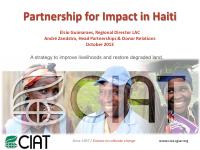
(2013-10) Strategie pour ameliorer les moyens de subsistance et restaurer les terres degradees en Haiti
Resume — Cette presentation CIAT-CGIAR propose une strategie pour ameliorer les moyens de subsistance et restaurer les terres degradees en Haiti.
Constats Cles
- Ajoute des preuves specifiques a Haiti issues de la recherche Haiti plus large de Land Portal.
- Appuie la recherche sur l'administration fonciere, les droits fonciers, le cadastre, la reconstruction du logement, l'information territoriale, l'amenagement rural ou les programmes de droits de propriete.
- Les metadonnees ont ete redigees manuellement a partir des PDF locaux et des notices sources recuperees.
Description Complete
La presentation situe le defi de securite alimentaire d'Haiti dans un contexte de rarete des terres et de l'eau, de stress climatique et d'investissement limite dans la recherche agricole. Elle propose une strategie de partenariat pour la production agricole durable, les solutions semencieres, la restauration des terres et l'amelioration des moyens de subsistance.
Texte Integral du Document
Texte extrait du document original pour l'indexation.
Partnership for Impact in Haiti
Elcio Guimaraes, Regional Director LAC
André Zandstra, Head Partnerships & Donor Relations
October 2013
A strategy to improve livelihoods and restore degraded land.
Since 1967 / Science to cultivate change
www.ciat.cgiar.org
The greatest food security
challenge ever in human history:
How to feed a growing
population with scarce land and
water, a fast-changing climate,
and inadequate investment in
agricultural research!
Food Insecurity and Undernutrition
Remain Persistent
Source: von Grebmer et al. 2011
Source: HarvestPlus 2011
Shenggen Fan | December 2011
Our
ability
to
grow
food
is
at
risk
Our Ability to Grow Food is at risk
CGIAR Consortium
CGIAR mission: Sustainable
Intensification by and for the Poor
CIAT, N.Palmer
• 75% from land already in use
• By small-scale farmers,
majority women
• Where the food is consumed
• In a climate smart way
Climate Change, Agriculture &
Food Security
More than 400 partners, including climate change
research community
Overcome threats of CC to food security, find
more effective ways of adjustment for vulnerable
rural communities. Identify and test pro-poor
mitigation and adaptation policies and
technologies.
By 2020, reduce poverty by 10 percent, lower
number of malnourished rural people by 25
percent in targeted regions. Reduce greenhouse
gas emissions by equivalent to 1,000 million tons
of CO2
Global Rice Science Partnership
(GRISP)
More than 300 partners
To break yield ceilings using genomics through breeding better drought and flood
tolerant varieties and finding innovative
ways for new varieties to reach farmers
and for increasing equity and efficient of
rice sector
Expected outcomes: by 2020 income gains
of US$11 billion annually, should lift about
72 million people out of poverty and 40
million people reach food security.
9
CIAT: A partner in global research for a
food secure future
• One of the 4 Centers that started the CGIAR, (founded in
1967) and currently operates from Kenya, Vietnam, and
Colombia (HQ)
• 400 professional staff, 200 scientists working across Africa,
Asia, and Latin America. Annual budget close to $100USM
CIAT’s Mission
To reduce hunger and
poverty, and improve human
health in the tropics through
research aimed at increasing
the eco-efficiency of
agriculture
Science for Impact
Improving agriculture and
changing lives across the tropics
Cali,
Since the 1960s, with a
current focus on Central
America, Colombia, and
the Amazon
Since the 1980s, with
activities now in 11
African countries
Since the 1980s, with
activities now in China,
Vietnam, Laos,
Cambodia, and Thailand
Creating
Quick Wins
CGIAR Research Program
on Climate Change,
Agriculture and Food
Security (CCAFS)
Crafting the
Crops of the
Future
Efforts intensify to
decode cassava
“alphabet soup”
Value Chain
Reactions
Four-legged futures – Turning
Vietnam’s cash cows into
productive assets
Results in
the Ground
Quesungual –
Remember the
name and not
just for Scrabble
Africa in the
forefront of soils
research
Climate
Change
Exposés
Tortillas on the
roaster
Eye in the sky –
Terra-i keeps
track of
deforestation
Colombia and
CIAT –
Partnering
with a Purpose
Ecosystem
signposts in
Orinoquia
Biopacific Park –
Toward a culture
of competitive
strength
“Rambo root” could
beat climate change
in sub-Saharan Africa
Hybrid rice
for Latin
America
Regional action
to strengthen
biosafety
Agricultural
transformation in
Ethiopia and beyond
Partnership
platforms
Connecting with
Colombia’s
scientific
diaspora
Better crops,
better
nutrition
The impact of CIAT’s
collaborative research
Commons
Beans
The adoption of
improved beans
in Africa will
generate net
benefits worth
nearly $200
million against
investments of
$16 million from
1986 to 2015,
with an internal
rate of return of
81%
Cassava
Tropical Forage
Rice
In Thailand and
Vietnam 90%
adoption of
improved
cassava has
generated
gains worth
$12 billion over
the last 2
decades
Estimates for
Central America
suggest that
Brachiaria
adoption
generated
additional value of
about $1 billion in
1 year, with 80%
of the gains
accruing to the
beef and 20% to
the milk industries
In Latin America
and the
Caribbean
improved rice
varieties
produced
benefits worth
$860 million
over 3 decades
Capacity
Strengthening
More than
12,000
professionals
from Latin
America, Africa,
and Asia have
benefited from
training offered
by the Center
Focus of CIAT’s R4D
•
•
•
•
•
Productivity
Natural Resources
Bean
Tropical Forages
Cassava
Rice
Genetic Resources
•
•
•
•
Soil Health
Soil & Ecosystem
Assessment
Soil & Land Information
Agronomy & Agriculture
Policy
• Climate Change
• Ecosystem Services
• Linking Farmers to
Markets
Colombia:
Climate Change Agreement
• Increased knowledge and
capacity for agroclimatic risk
management in Colombia
• Capacity to adapt to climate
change, through the evaluation
and validation of crop models
• Climate-smart options for crop
adaptation tested and validated
• Productivity gaps narrowed
Coffee, Colombia
A 2 °C increase equals a difference of 440 meters
altitude and major shifts of crops to new areas
Colombia and Nicaragua:
Forages Research
• Improved forages for ruminant
and monogastric animal feed
• Improved crop-livestock
productivity
• Degraded land restoration
• Enhanced soil fertility
• Carbon sequestration
• Reduced pressure on
deforestation
Peru:
Water Resource Management
• Technical cooperation on
applications of Soil and Water
Assessment Tool (SWAT) to benefit
the Ministry of Environment and
National Water Authority
• Design of mechanisms for sharing
benefits and costs of improving
water resource management
• New law implemented to
incentivize public and private
investment for water conservation
Peru, Nicaragua, and Honduras:
Learning Alliances
• Collaboration between NGOs,
research organizations, and
governments
• Knowledge exchange and design
of more effective development
strategies that respond to the
demands of the rural sector
• Establishment of long-term, trustbased relationships
• Diversified livelihoods through
effective agro-enterprise
interventions
El Salvador, Honduras & Nicaragua:
Agroforestry and Silvopastoral Systems
• Sustainable and resilient
alternative to traditional
unsustainable systems (e.g., slash
and burn)
• Safeguarding long-term soil
fertility and food production
• Smallholders adapted to extreme
weather
• Restoration of degraded lands for
biodiversity regeneration and
other ecosystem services
South Sudan:
Pan-Africa Bean Research Alliance
• Access to improved bean
varieties and expert
technical advice
• Domestic bean research
and production boosted
• Reduced reliance on
imports and lower prices
Haiti:
Climate Change Impacts
• Research on the impact of climate
change on coffee and mango
growing areas in Haiti
• Changes in temperature and
rainfall patterns will cause a
decrease of areas suitable for
coffee
• Mangos will remain highly
suitable in many regions of Haiti
– Altitudes of 500 to 700 meters
above sea level will benefit
CIAT & Haiti:
Collaboration for Food Security
A series of measures that CIAT can take, in collaboration local
partners, to help remedy Haiti’s severe food production constraints.
• Seed Solutions for Food Security: Help get local seed systems moving
through large-scale introduction, evaluation, and dissemination of
improved beans, cassava, rice (for both irrigated and upland areas), and
tropical forages.
• Resilient System Solutions for Sustainable Growth: Enhance resilience of
crop production through sustainable agroforestry/agrosilvopastoral
systems to help restore degraded soils to health.
• Linking Smallholders to Markets for Poverty Reduction: Help realize the
enormous potential of smallholder agriculture as an engine of inclusive
economic growth requires well-targeted, collaborative efforts to
strengthen the links between rural communities and markets.
Cassava an entry point for
Sustainable Agricultural Production
A stepwise strategy to improve livelihoods and restore degraded
lands. Meeting the immediate need for improved food supplies,
higher rural incomes, and renewable fuel sources, while showing
remarkable resilience under various stresses .
• Transitioning to higher value products: Using farmer
participatory methods, can reverse land degradation and
intensify production sustainably :
1. Site selection
2. Introduce improved varieties
3. Control soil erosion
4. Develop new markets
5. Land restoration
6. Move to high value crops
CIAT: Science to cultivate change
Contacts
Elcio Guimaraes
Regional Director LAC
e.guimaraes@cgiar.org
André Zandstra
CIAT – Head, Partnerships & Donor Relations
a.zandstra@cgiar.org
CIAT Headquarters
KM 17, Recta Cali-Palmira
Apartado Aéreo 6713
Cali, Colombia
Phone: +57 2 445 0000
www.ciat.cgiar.org