
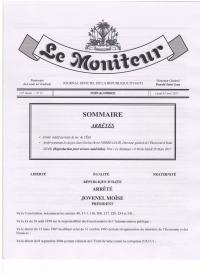
(2017-04) Decree on the State's Lifestyle Governing the Public Vehicle Fleet and Professional Equipment
Summary — Published in Le Moniteur N°52 (3 April 2017) on the report of the Minister of Economy and Finance, this arrêté imposes a state-austerity regime ('train de vie de l'État') on the public vehicle fleet and professional equipment, capping purchase values per vehicle category, restricting new acquisitions during fiscal year 2016-2017, and mandating inventories, geolocation and usage registers.
Key Findings
- New vehicle purchases capped at 2.8M HTG ('Service de l'État') and 3.2M HTG ('Officiel') per vehicle.
- Acquisition of new vehicles is banned for the remainder of FY2016-2017 without Prime Ministerial authorization.
- 'Service de l'État' vehicles must carry geolocation and a per-trip usage register.
- Public vehicles have a mandatory minimum five-year service life; professional equipment 10-25 years depending on type.
- Vehicles with over eight years of service may be sold, with priority given to the vehicle's usual user.
Full Description
Adopted amid the stated need to correct the budgetary situation and rationalize public spending, this comprehensive arrêté (Chapter I) requires every ministry and public institution to submit an up-to-date vehicle-fleet inventory to the Prime Minister's office, the MEF and the CSCCA within 30 days, verified by a joint Primature-MEF commission. It caps new vehicle purchases at 2,800,000 gourdes for vehicles registered 'Service de l'État' and 3,200,000 gourdes for those registered 'Officiel', bans new vehicle acquisitions during the remainder of fiscal year 2016-2017 without prior Prime Ministerial authorization, and requires 'Service de l'État' vehicles to carry geolocation systems and a movement register recording each trip's purpose, driver, mileage and fuel level. A minimum five-year service life is set for public vehicles, with mandatory maintenance registers and sanctions for premature wear from misuse. Chapter II extends similar inventory, acquisition-control and lifecycle rules (10-25 years depending on type) to professional equipment such as heavy machinery and generators, including fuel-stock controls to prevent diversion.