
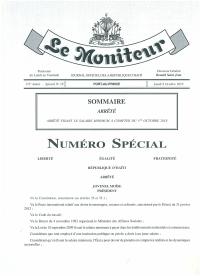
(2018-10) Decree Setting the Minimum Wage Effective 1 October 2018
Summary — Signed by President Jovenel Moïse and published as a special edition of Le Moniteur (N°18, 8 October 2018), this arrêté sets Haiti's daily minimum wage for an eight-hour workday, differentiated across eight sectoral segments (A through H) ranging from banks and telecoms to export-assembly industries, domestic work and agriculture.
Key Findings
- Highest tier (Segment A: finance, telecoms, import-export) set at 500 HTG/8-hour day.
- Export-assembly manufacturing (Segment F) set at 420 HTG, above general construction/wholesale tier (400 HTG).
- Domestic workers (Segment E) receive the lowest rate, 215 HTG/day.
- Agriculture, fishing and community press (Segment C) set at 350 HTG.
- Wage differentiated by eight sectoral segments rather than a single national minimum.
Full Description
Adopted on the report of the Minister of Social Affairs and Labor after Council of Ministers deliberation, and grounded in the 2009 minimum-wage law and Labor Code, this arrêté sets eight tiered minimum daily wages: 500 HTG (Segment A — private electricity production, financial institutions, telecoms, import-export commerce, supermarkets, private schools and universities, private health institutions); 400 HTG (Segment B — construction/BTP, wholesale trade, financial cooperatives, local-market manufacturing); 350 HTG (Segment C — restaurants, agriculture, forestry, livestock, fishing, retail trade, NGOs); 215 HTG (Segment E — domestic workers); 420 HTG (Segment F — export-oriented assembly and manufacturing industries); and 400 HTG each for Segments G (private security agencies, petroleum distribution) and H (private vocational schools, private hospitals with over ten employees). It abrogates all contrary prior arrêtés.