
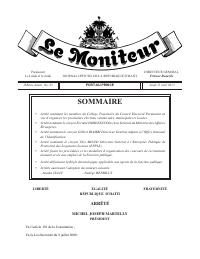
(2013-04) Decree Establishing the Code of Ethics Applicable to Civil Service Officials
Summary — Signed by Prime Minister Laurent Salvador Lamothe and published in Le Moniteur No. 63 (11 April 2013), this decree lays down a formal code of ethics and professional conduct for Haitian civil servants, including an oath of office, standards of integrity, loyalty and impartiality, and a taxonomy of disciplinary, penal and civil liability for professional misconduct.
Key Findings
- Requires an oath of office committing civil servants to loyalty, discretion and independence from outside influence.
- Bans acceptance of gifts or advantages beyond modest customary value and prohibits partisan political activity or religious proselytizing in service.
- Establishes three distinct liability tracks: disciplinary, penal and civil, each with due-process safeguards.
- Lists specific disciplinary faults including insubordination, falsified medical certificates and abuse of function.
- Lists specific penal offenses including concussion, corruption, influence peddling and misappropriation of public or private assets.
Full Description
Grounded in the 17 May 2005 general civil-service statute and the Conseil Supérieur de l'Administration et de la Fonction Publique's report, the decree requires every civil servant, upon taking office, to swear an oath to exercise their duties with loyalty, discretion and conscience and to refuse instructions from any external authority contrary to civil-service rules. It sets out general ethical duties: integrity, impartiality, dignity, discretion regarding administrative documents, subordination of personal interests to the administration's, a ban on using public office for influence-peddling, and restrictions on accepting gifts beyond modest customary value. Professional responsibilities include exercising one's post effectively and continuously, treating the public with diligence, maintaining punctuality and competence, avoiding partisan political activity or religious proselytizing while in service, and respecting fiscal obligations. The decree classifies liability into three forms: disciplinary (breaches such as insubordination, procedural violations, repeated unexcused absences, falsified medical certificates, unlawful private lucrative activity, abuse of function, or trafficking in administrative acts), penal (offenses under criminal law including concussion, embezzlement, corruption, influence peddling, and misappropriation of public or private assets), and civil liability, with due-process guarantees (a clearly established fault, a procedure safeguarding the civil servant's rights, and proportionality of sanction).