
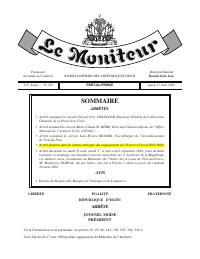
(2020-08) Order Setting the Early Closing Date for FY2019-2020 Spending Commitments
Summary — President Jovenel Moïse signed an order on August 30, 2020 setting September 4, 2020 as the closing date for spending commitments of first- and second-rank State administrative entities for fiscal year 2019-2020, published in Le Moniteur No. 140 of August 31, 2020.
Key Findings
- The order sets a hard closing date of September 4, 2020 for FY2019-2020 spending commitments across first- and second-rank State entities, explicitly citing COVID-19-driven staffing shortages and treasury/arrears risk as the rationale. It ties the deadline to an earlier August 15, 2020 cutoff for Public Investment Program (PIP) disbursement requests set by the Ministry of Planning, and enumerates seven categories of covered expenditures, from personnel movements to office supplies, with narrow exceptions for leases and next-year contracts.
Full Description
This arrêté, signed by President Jovenel Moïse at the National Palace on August 30, 2020 (Year 217 of Independence) and countersigned by Prime Minister Joseph Jouthe and the Minister of Economy and Finance Michel Patrick Boisvert among others, fixes September 4, 2020 as the deadline for closing spending commitments of first- and second-rank State administrative entities for fiscal year 2019-2020. After that date, any file submitted for the prior visa of the financial controller becomes inadmissible unless expressly authorized by the Prime Minister through the Minister of Economy and Finance. The order cites treasury management challenges in a difficult socio-economic context, the need to keep the expenditure chain fluid and limit payment arrears, a July 9, 2020 memorandum from the Ministry of Planning and External Cooperation that set August 15, 2020 as the deadline for disbursement requests under the 2019-2020 Public Investment Program (PIP), and the reduced staffing of public entities caused by the COVID-19 pandemic. Article 3 lists the expenditure categories covered: personnel movements (except transfers and terminations), secondments and staff placements, purchases of tangible fixed assets, draft contracts (except lease contracts and those taking effect in the next fiscal year), credit purchases and services, vehicle rentals, and office supplies and small equipment.