
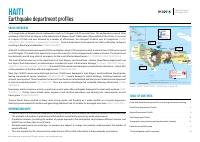
(2021-08) ACAPS Thematic Report: Haiti - Earthquake Department Profiles (20 August 2021)
Summary — Six days after the 14 August 2021 magnitude 7.2 earthquake, ACAPS profiles the three hardest-hit departments: Grand'Anse, Nippes, and Sud. By 20 August, about 2,100 people had died, more than 12,000 were injured, over 50,000 houses were destroyed, and at least 650,000 people (about 40 percent of the three departments' population) needed emergency assistance. Each profile combines pre-crisis vulnerability indicators with sector-by-sector damage data and access constraints, including gang roadblocks on the routes from Port-au-Prince and the flooding brought by Tropical Storm Grace.
Key Findings
- By 20 August 2021, the 14 August earthquake had killed about 2,100 people, injured over 12,000, and destroyed more than 50,000 houses across Sud, Nippes, and Grand'Anse, with at least 650,000 people (about 40 percent of the three departments' population) needing emergency assistance.
- Sud bore the heaviest toll: 1,832 confirmed deaths, 9,158 injured, roughly 30,000 houses destroyed and 42,700 damaged, 94 of 225 schools destroyed or damaged, and hospitals in Les Cayes overwhelmed with two of five operating rooms unusable.
- Pre-existing vulnerability magnified the impact: poverty reached 70 percent in Grand'Anse and 50 percent in Nippes and Sud, all three departments were at IPC Phase 3 food insecurity, and about 64 percent of households lacked access to clean water, soap, and hygiene products.
- Humanitarian access depended on gang-controlled national road 2 from Port-au-Prince; attacks on aid convoys in Miragoane gave way to an informal gang truce announced on 18 August, while a landslide on Route 7 cut the Les Cayes-Jeremie road.
- Tropical Depression Grace crossed Haiti on 16 August, two days after the earthquake, bringing heavy rain, flooding, and landslides that destroyed makeshift shelters and further restricted access to Pestel, Petit-Trou-de-Nippes, and Paillant.
Full Description
This thematic report, published on 20 August 2021, provides department-level profiles of the areas hit by the magnitude 7.2 earthquake that struck 13 km southeast of Petit-Trou-de-Nippes on 14 August. As at 20 August, at least 2.2 million people had been exposed, about 2,100 had died, more than 12,000 were injured, and over 50,000 houses were destroyed and 70,000 damaged across Sud, Nippes, and Grand'Anse; at least 650,000 people needed emergency humanitarian assistance. Tropical Depression Grace crossed Haiti on 16 August, adding flooding and landslides that destroyed makeshift shelters and cut roads. Each profile pairs the impact data with pre-crisis vulnerability: poverty rates of 70 percent in Grand'Anse and 50 percent in Nippes and Sud, stunting of 17-22 percent of children, IPC Phase 3 food-security classifications, and weak health systems (Nippes had 3.8 hospital beds per 100,000 inhabitants against a national average of 6.7).
Sud was the worst hit, with 1,832 confirmed deaths, 9,158 injured, and roughly 30,000 houses destroyed and 42,700 damaged (Le Nouvelliste figures); 94 of the department's 225 schools were destroyed or damaged, and two of five operating rooms in Les Cayes were unusable. Grand'Anse recorded 218 deaths, heavy damage in Jérémie and Pestel (where 1,810 water cisterns and 32 schools were destroyed or damaged), and fuel, supply, and staff shortages at all five Jérémie health facilities. Nippes, at the epicentre, counted 137 deaths and more than 14,000 houses destroyed, implying over 61,000 people displaced by destroyed homes. Access hinged on gang-held national road 2 out of Port-au-Prince, where an informal truce announced on 18 August allowed convoys through, while landslides on Route 7 between Les Cayes and Jérémie kept road access precarious. The report includes MapAction shake-intensity and hazard-susceptibility maps and the DG ECHO response map, with the EU allocating EUR 3 million and deploying a 12-expert civil protection team.
Notes
re-downloaded from ACAPS fileadmin after gather error