
(2021-08) ACAPS Briefing Note: Haiti - Earthquake (16 August 2021)
Summary — Published two days after the 14 August 2021 magnitude 7.2 earthquake near Petit-Trou-de-Nippes, this briefing note compiles the first available impact figures: around 1,300 dead, over 5,000 injured, and some 7,370 houses destroyed in Sud, Nippes, and Grand'Anse, with about one million people exposed to very strong shaking. It flags health, WASH, shelter, and logistics as priority needs and stresses that gang control of the only road linking Port-au-Prince to the southern peninsula, Tropical Storm Grace, political turmoil after President Moise's assassination, and COVID-19 would all complicate the response.
Key Findings
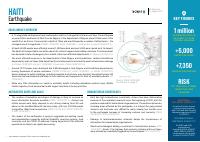
- The 14 August 2021 magnitude 7.2 earthquake near Petit-Trou-de-Nippes killed around 1,300 people and injured over 5,000 as at 16 August, with most fatalities in Sud department (at least 1,054) and about one million people exposed to very strong shaking.
- Some 7,370 houses were destroyed and 4,850 damaged in Sud, Nippes, and Grand'Anse, suggesting over 30,000 people needed temporary shelter, while damaged hospitals in Les Cayes, Pestel, Corail, and Roseaux were overwhelmed and short of medicine and equipment.
- Humanitarian access was already severely constrained before the quake: the only road from Port-au-Prince to the southern peninsula had been under gang control since early June 2021, forcing aid deliveries by boat or plane, and a quake-triggered landslide blocked Route 7 between Jérémie and Les Cayes.
- Tropical Storm Grace threatened 10-18 cm of rain within 48 hours of the earthquake, risking flooding and mudslides that would compound shelter, WASH, and food needs for people left homeless.
- The disaster struck amid compounding crises: the power struggle after President Moise's 7 July assassination, COVID-19 with only 14,074 vaccine doses administered and 22 percent vaccine acceptance, and around four million people already food-insecure, with the quake hitting during the southern harvest.
Full Description
This ACAPS briefing note, published on 16 August 2021, provides an initial assessment of the magnitude 7.2 earthquake that struck southwestern Haiti on 14 August at a depth of 10 km, 13 km southeast of Petit-Trou-de-Nippes. As at 16 August, around 1,300 people were reported dead (most in Sud department, with at least 1,054 fatalities) and over 5,000 injured; about 7,370 houses were destroyed and 4,850 damaged across Sud, Nippes, and Grand'Anse, suggesting over 30,000 people needed temporary shelter. Around one million people were exposed to very strong shaking (MMI VII and above), with over 230,000 living within 15 km of the epicentre. The Government declared a month-long state of emergency. Hospitals in Les Cayes and in Pestel, Corail, and Roseaux were overwhelmed, with damaged facilities, supply shortages, and patient transfers by helicopter; in Les Cayes, destroyed water tanks created an urgent need for safe drinking water.
The note emphasises that the earthquake struck an environment of already high humanitarian constraints. The only road from Port-au-Prince to the southern peninsula, through Martissant and Carrefour, had been under gang control since early June 2021, forcing aid to move by boat or plane, and a landslide blocked Route 7 between Jérémie and Les Cayes. Aggravating factors include the risk that Tropical Storm Grace would hit within 48 hours with 10-18 cm of rain; the power struggle after President Jovenel Moise's 7 July assassination; COVID-19 (about 20,500 cases and 576 deaths, with only 14,074 vaccine doses administered and 22 percent vaccine acceptance); and food insecurity already affecting around four million people, with the quake hitting during the southern peninsula's bean, maize, and yam harvest. Contextual data show 77 percent of the affected region living below the poverty line, and the note compiles lessons learnt from the 2010 earthquake and Hurricane Matthew responses, including coordination failures and the need to work in French and Creole.
Notes
re-downloaded from ACAPS fileadmin after gather error