
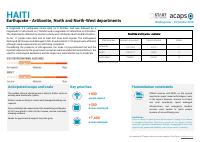
(2018-10) ACAPS/START Briefing Note: Haiti - Earthquake (12 October 2018)
Summary — This briefing note assesses the magnitude 5.9 earthquake that struck northern Haiti on 6 October 2018, followed by aftershocks of magnitude 5.2 and 4.2, affecting Artibonite, Nord, and Nord-Ouest departments. It records 17 deaths, at least 421 injured, 353 houses destroyed, 7,430 damaged, and an estimated 31,132 people affected, with shelter as the most pressing need and Port-de-Paix and Gros-Morne the hardest-hit towns. Given pre-positioned aid and the government-led response, ACAPS rates the need for international assistance as low to moderate.
Key Findings
- The 6 October 2018 magnitude 5.9 earthquake and its aftershocks killed 17 people and injured at least 421 across Artibonite, Nord, and Nord-Ouest departments, with Port-de-Paix (9 deaths, 200 injured) and Gros-Morne (7 deaths, 118 injured) hardest hit.
- Shelter was the most pressing need: 353 houses were destroyed and 7,430 damaged, leaving 31,132 people (7,783 households) needing urgent shelter assistance, concentrated in Port-de-Paix and Gros-Morne.
- The health response was strained, with the Immaculate Conception Hospital in Port-de-Paix running out of supplies, part of a hospital collapsing in Gros-Morne, and an overflowing river cutting injured people in Pilate off from emergency medical services.
- ACAPS rated the need for international assistance as low to moderate, given the DPC-led government response, pre-positioned stocks of 2,000 shelter kits and 2,260 metric tons of food, and support from UN agencies, ECHO, PAHO, and Cuban surgical teams.
- Vulnerability remained structural: unreinforced housing along Hispaniola's two major fault lines, trauma and 37,667 people still displaced from the 2010 earthquake, and northern communities still recovering from Hurricanes Matthew, Irma, and Maria.
Full Description
This briefing note, published on 12 October 2018 by ACAPS with the START Network, assesses the magnitude 5.9 earthquake that struck 19 km northwest of Port-de-Paix on 6 October 2018, followed by magnitude 5.2 and 4.2 aftershocks on 7 and 8 October. Based on Directorate of Civil Protection (DPC) figures, 17 people died (9 in Port-de-Paix, 7 in Gros-Morne, 1 in Saint-Louis-du-Nord) and at least 421 were injured across Artibonite, Nord, and Nord-Ouest. The earthquakes destroyed 353 houses and damaged 7,430, leaving 31,132 people (7,783 households) in need of shelter assistance, concentrated in Port-de-Paix (163 houses destroyed, 4,836 damaged) and Gros-Morne (115 destroyed, 2,050 damaged). Hospitals struggled: the Immaculate Conception Hospital in Port-de-Paix ran short of supplies, part of a hospital in Gros-Morne collapsed, and an overflowing river prevented emergency medical services from reaching the injured in Pilate. Forty-two institutional buildings were damaged in Artibonite, and schools were destroyed or damaged in Pilate, Gros-Morne, Port-de-Paix, and Plaisance.
The note rates the required international assistance as low to moderate, given the government-led response coordinated by the DPC, pre-positioned stocks (2,000 shelter kits and 2,260 metric tons of food), UN agencies ready to respond, EU ECHO technical experts and Copernicus satellite mapping, PAHO helicopter evacuations, and Cuban mobile surgical teams. Aggravating factors include a weak healthcare system, unreinforced housing along Hispaniola's two major fault lines, high population density (398 people per sq km nationally), lingering trauma from the 2010 earthquake that killed over 220,000 people, the 37,667 people still displaced from 2010, and the cumulative impact of Hurricanes Matthew, Irma, and Maria on northern departments. Information gaps concern displacement, infrastructure damage, and WASH needs; lessons learnt from 2010 stress early coordination and support to experienced staff.
Notes
re-downloaded from ACAPS fileadmin after gather error