
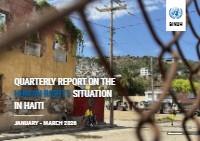
(2026-Q1) Rapò Trimès sou Sitiyasyon Dwa Moun an Ayiti
Rezime — Rapò trimès BINUH sa a kouvri sitiyasyon dwa moun an Ayiti soti janvye rive mas 2026. Li detaye vyolans gang, gwoup oto-defans, ak fòs sekirite yo, tankou asasina, blesi, kidnapin, ak vyolans seksyèl. Rapò a evalye tou fonksyonman sistèm jidisyè a ak sipò yo bay enstitisyon nasyonal ak sosyete sivil la.
Dekouve Enpotan
- 1 642 moun te mouri e 745 te blese ant janvye ak mas 2026, ak 69% pandan operasyon fòs sekirite kont gang yo.
- Omwen 292 viktim vyolans seksyèl ki gen rapò ak gang yo te anrejistre, ak 83% se te vyòl an gwoup.
- Gang yo te kontinye angaje yo nan trafik ak eksplwatasyon timoun, fòse minè yo patisipe nan aktivite kriminèl.
- Pwogrè te fèt nan operasyonalizasyon inite jidisyè espesyalize yo ak ankèt sou masak Wharf Jérémie a, ansanm ak ka koripsyon ak sipò pou gang yo.
- Kondisyon detansyon nan prizon ayisyen yo rete inimen, ak 18 lanmò anrejistre nan premye trimès 2026, sitou akòz mank swen medikal ak move kondisyon.
Deskripsyon Konple
Biwo Entegre Nasyonzini an Ayiti (BINUH) prezante rapò trimès li sou sitiyasyon dwa moun an Ayiti pou peryòd janvye rive mas 2026. Rapò a souliye yon kriz grav nan dwa moun ki make pa vyolans toupatou nan men gang ame, gwoup oto-defans, ak operasyon fòs sekirite yo. Pwoblèm kle yo gen ladan yon gwo kantite asasina ak blesi, kidnapin ki pèsiste, ak vyolans seksyèl ki gaye toupatou, sitou vyòl an gwoup, ki afekte fanm ak tifi. Dokiman an abòde tou eksplwatasyon timoun pa gang yo, enpak negatif vyolans sou dwa ekonomik, sosyal ak kiltirèl, ak defi sistèm jidisyè a ap fè fas, malgre kèk pwogrè nan operasyonalizasyon inite espesyalize yo ak ankèt sou krim grav. BINUH bay rekòmandasyon pou Gouvènman Ayisyen an ak kominote entènasyonal la pou adrese pwoblèm sa yo, mete aksan sou nesesite pou respekte lwa entènasyonal dwa moun, ranfòse pwosesis jidisyè yo, ak sipòte popilasyon vilnerab yo.
Teks Konple Dokiman an
Teks ki soti nan dokiman orijinal la pou endeksasyon.
BINUH JANUARY - MARCH 2026 Photo: ©OHCHR QUARTERLY REPORT ON THE HUMAN RIGHTS SITUATION IN HAITI QUARTERLY REPORT ON THE HUMAN RIGHTS SITUATION IN HAITI TABLE OF CONTENT Main takeaways and recommendations............................................................................................................................................................................... 1 Violence and human rights violations .................................................................................................................................................................................................... 1.2. Dynamics of violence linked to self-defense groups and non-organized members of the population within the framework of the “Bwa Kalé” movement......................... 1.3. Dynamics of violence linked to security force operations and the unnecessary and disproportionate use of force................................................................................ 3.1. Support to public authorities........................................................................................................................................................................................................... 1.4. Kidnappings................................................................................................................................................................................................................................... 1.5. Sexual violence............................................................................................................................................................................................................................... 1.6. Impact of gang violence and child exploitation................................................................................................................................................................................. 1.7. Impact of gang violence on economic, social and cultural rights........................................................................................................................................................ 2 Judicial system ..................................................................................................................................................................................................................................... 2.1. Functioning of the judiciary............................................................................ ................................................................................................................................ 2.2. Judicial proceedings on massacres and other serious human rights violations................................................................................................................................... 2.3. Judicial proceedings initiated for support to gangs and arms trafficking............................................................................................................................................ 2.4. Fight against corruption.................................................................................................................................................................................................................. 2.5. Fight against sexual violence........................................................................................................................................................................................................... 2.6. Conditions of detention in Haitian prisons........................................................................................................................................................................................ 2.7. International sanctions and legal proceedings abroad....................................................................................................................................................................... 3. Support to national institutions and civil society ................................................................................................................................................................................... 3.2. Support to the Gang Suppression Force............................................................................................................................................................................................ 3.3. Support to civil society organisations working in the field of protection............................................................................................................................................. 3 5 6 11 15 16 17 17 18 1.1. Dynamics of gang-related violence and their impact on human rights................................................................................................................................................ 12 14 15 19 20 20 20 21 21 22 22 22 23 United Nations Integrated Office in Haiti 2.8. Investigations into human rights violations committed by police officers........................................................................................................................................... Bureau intégré des Nations Unies en Haïti Main takeaways To the Haitian Government: accelerate the full operationalization of the specialized judicial units to combat mass crimes, sexual violence, and financial crimes, including through the appointment of deputy public prosecutors and judges assigned to them. To the Haitian Government: ensure that security force operations against gangs are conducted in full compliance with international human rights law. To the Haitian Government: with the support of the international community, accelerate the effective implementation of the vetting process within the police and bring to justice police officers accused of involvement in serious human rights violation. To the Haitian Government: with the support of the international community, strengthen and accelerate the establishment of a prevention, disengagement, and rehabilitation program for minors involved in gangs. To the international community: maintain Haiti on the international agenda and provide adequate financial and human support to ensure the full deployment of the Gang Suppression Force (GSF), as authorized by United Nations Security Council Resolution 2793 of 30 September 2025, in compliance with international human rights norms and standards. To the international community: continue updating the list of persons and entities subject to United Nations Security Council sanctions for having participated, directly or indirectly, in or supported criminal activities that undermine human rights. To States in the region: strengthen and increase inspections of cargo destined for Haiti on their territory, including at seaports and airports, in accordance with United Nations Security Council resolutions 2653 (2022), 2699 (2023), 2752 (2024) and 2794 (2025), which impose an arms embargo. Recommandations 1,642 people were killed and 745 injured: 27% by gangs, 4% by self-defense groups and members of the population, and 69% during security force operations against gangs. Reduction in gang criminal activities in the neighborhoods of Lower Delmas (Delmas) and Carrefour Feuilles, Bel Air, Pacot, Solino and Turgeau (Port-au-Prince). Coordinated gang attacks in the Lower Artibonite; no new territorial gains in the Centre department, although gangs remain present in the area, particularly in Mirebalais and Saut-d’Eau. At least 292 victims of sexual violence linked to gangs and other armed actors were recorded. At least 69 members of the population were killed or injured by explosive drones, including five children. 40 extrajudicial executions, and attempted executions, were allegedly committed by police officers. 1 police officer was killed and 9 others were injured. Progress was made in the operationalization of the two specialized judicial units. Progress was also recorded in the investigation into the Wharf Jérémie massacre, as well as in proceedings targeting several former public officials accused of supporting gangs, arms trafficking and corruption. United Nations Integrated Office in Haiti Q1 2022 Q2 2022 Q3 2022 Q4 2022 Q1 2023 Q2 2023 Q3 2023 Q4 2023 Q1 2024 Q2 2024 Q3 2024 Q4 2024 Q1 2025 Q2 2025 Q3 2025 Q4 2025 Q1 2026 0 500 1000 1500 2000 2500 3000 334 164 599 314 651 558 531 348 844 376 1200 369 1395 418 1101 533 1708 846 947 434 1239 522 1732 411 1621 580 1520 609 1251 713 1523 806 1642 745 killed Injured PEOPLE KILLED AND INJURED BETWEEN JANUARY 2022 TO MARCH 2026 United Nations Integrated Office in Haiti During attacks carried out by gangs 27% During security operations against gangs carried out by the Haitian National Police, sometimes supported by the Gang Suppression Force (GSF) and a private security company; during summary executions involving police personnel 69% During violence committed by self-defence groups and non-organised members of the population , as part of the “popular justice” movement known as “Bwa Kalé” 4% Breakdown of incidents by perpetrator and/or context 2% CENTRE 12% ARTIBONITE 85% WEST Geographical breakdown of killings and injuries Photo: ©HRS United Nations Integrated Office in Haiti I. VIOLENCE AND HUMAN RIGHTS VIOLATIONS 5 According to the Human Rights Service (HRS) of the United Nations Integrated Office in Haiti, between 1 January and 31 March 2026, at least 1,642 people were killed and 745 injured as a result of violence involving gangs, self-defense groups and non-organized members of the population, as well as during security force operations against gangs, supported in certain circumstances by the Gang Suppression Force (GSF) and a private military company . 1 Men represent 85 per cent of the victims, women 12 per cent and children two per cent . 2 The people killed and injured continue to be attributable to the following dynamics: United Nations Integrated Office in Haiti [1] During the last quarter of 2025 (October–December), at least 1,523 people were killed (1,331 men, 142 women, 36 boys and 14 girls) and 806 were injured (651 men, 132 women, 15 boys and eight girls). [2]1,642 people were killed (1,440 men, 172 women, 15 boys and 15 girls) and 745 were injured (540 men, 174 women, 16 boys and 15 girls). The vast majority of these incidents was documented in the metropolitan area of Port-au-Prince (85 per cent), followed by the Artibonite department (12 per cent) and the Centre department (two per cent). Sexual violence perpetrated by armed gangs continued, with at least 292 victims of rape (234 women, 57 girls aged between 12 and 17, and one man). The majority of cases, 83 per cent, were gang rapes. Seven victims were reported in the Artibonite department, another in the Centre department, while the others occurred in the West department. I. Violence and human rights violations DYNAMICS OF GANG-RELATED VIOLENCE AND THEIR IMPACT ON HUMAN RIGHTS 1.1 In the metropolitan area of Port-au-Prince, gangs were not able to extend their influence beyond the neighbourhoods already under their control, where they continued to commit serious abuses against local populations. Clashes between gangs also took place in Cité Soleil and Croix-des-Bouquets owing to disputes over territorial control. By contrast, gangs also withdrew from neighbourhoods such as Carrefour- Feuilles, Bel Air, Pacot, Solino and Turgeau. In these areas, the number of people killed or injured by gangs fell sharply. West department: metropolitan area of Port-au-Prince Location Number of people killed and injured among the population Duration of the attacks Duvivier, Terre Noire and Village de la Renaissance (Cité Soleil), and Bon Repos, Fourgy, Lilavois 10, Moleya and Sibert (Croix-des- Bouquets) 72 people killed and 57 injured 6-10 March 16 localities in the communes of Dessalines, Montrouis and Petite- Rivière de l’Artibonite 95 people killed and 38 others injured 29 – 31 March [3] 37 men, 14 women, three boys and three girls. [4] During the last quarter of 2025, at least 156 people were kidnapped for ransom by gangs, of whom 61 per cent were in the Artibonite department, 36 per cent in the metropolitan area of Port-au-Prince, and three per cent in the Centre department. At the same time, during this same period, at least 57 people were kidnapped for ransom by gangs, of whom 89 per cent were in the West department and 11 per cent in the Artibonite department . Moreover, gangs continued to engage in the trafficking and exploitation of children, forcing them to participate in criminal activities. 3 4 6 United Nations Integrated Office in Haiti In view of the trends observed since the beginning of 2025, the gangs operating in the capital remained largely confined to the areas under their control, without being able to extend their influence to other neighbourhoods, notably because of operations carried out by the security forces. Main gang attacks during the first quarter of 2026 Communes of Carrefour and de Gressier In the communes of Carrefour and Gressier, at least 42 people were killed and 66 others injured by members of the Ti Bois gang and the local cell of the Grand Ravine gang known as “ 103 Zombies ”. 5 This violence particularly targeted residents who refused to pay “taxes” to circulate from one neighbourhood to another or to set up their small stall in local markets, who tried to seek refuge in other areas of the capital or who had personal disputes with gang members. Most of these victims were attacked in the street or inside their homes, after which their bodies were burned. Other residents were killed by stray bullets fired during celebrations organised by gangs in open-air spaces, or while they were actively participating in security force operations against gangs. Moreover, some gang members were also killed or injured by other gang members after being accused of having committed thefts in homes. [5] 42 people were killed (36 men and six women) and 66 were injured (25 men, 33 women, three boys and three girls), of whom 84 per cent were members of the population and 16 per cent were gang member. I. Violence and human rights violations For example, on 7 January, members of the Terre Noire gang attempted to dig trenches in Carrefour Vincent in order to hinder the advance of police armored vehicles. Several residents of the area publicly opposed this act. In retaliation, on the same day, two of them were shot dead by gang members. The situation in the commune of Delmas remained relatively calm, with 23 victims documented in the neighbourhoods of Lower Delmas, Delmas 31, Delmas 45, Tokyo and Wharf Jérémie. 10 Since the end of January 2026, most members of the Delmas 6 and Tokyo gangs have left the neighbourhoods located in the Lower Delmas area to seek refuge in Fontamara (Carrefour) and Village de la Renaissance (Cité Soleil), following operations carried out by the security forces. Only residual elements remained on site in order to maintain a climate of instability and carry out targeted and rapid attacks. In this context, at least nine people (four residents and five gang members) were killed after being accused of having passed information to the police. A family, including a nine-year-old child, was also stabbed by individuals affiliated with the Delmas 6 gang after being accused of using witchcraft to weaken that same gang. The victims’ bodies were then burned with gasoline. A confrontation between the Wharf Jérémie and the Village de Dieu gangs was also documented in the Carrefour Aviation area (Delmas). Four members of the Village de Dieu gang were killed while transporting weapons to the commune of Cabaret. Commune of Delmas During the quarter, at least 116 people were killed and 85 others injured by gang violence in Cité Soleil and Croix-des-Bouquets. 6 Over 64 per cent of the victims (72 people killed and 57 injured) were documented during clashes which took place between 6 and 10 March, between the Chen Mechan and Kraze Baryè gangs on one side, and the 400 Mawozo , Canaan , Pierre VI and Tokyo gangs on the other. This violence particularly affected the localities of Duvivier, Terre Noire and Village de la Renaissance (Cité Soleil), as well as Bon Repos, Fourgy, Lilavois 10, Moleya and Sibert (Croix-des- Bouquets). These clashes, which would have been triggered by a conflict over control of Village de la Renaissance, confronting the leader of the Canaan gang with the leader of Pierre VI , also led to the suspension of all commercial activities and services in these areas, as well as the forced displacement of at least 3,000 residents . 7 Alongside these confrontations, gangs regularly fired indiscriminately in the neighbourhoods to prevent access by police patrols. At least 13 residents were killed or injured in these circumstances . Among the victims was a 17-year-old boy who was injured while he was in his classroom in Lilavois. 8 In the areas under their control, gang members also continued to use violence to “punish” individuals who did not comply with their rules, as well as to “sanction” offences such as theft, or to coerce individuals into joining their ranks. At least 33 people were killed and 26 others injured in this context. 9 7 United Nations Integrated Office in Haiti [6] 116 people were killed (95 men, 12 women, four boys and five girls) and 85 were injured (64 men, 11 women, five boys and five girls), of whom 51 per cent were members of the population and 49 per cent were gang members. [7] International Organization for Migration (IOM) (9 mars 2026). “Haiti – Emergency Tracking Tool 85 – Displacement following armed violence in Croix-des-Bouquets and Cité Soleil (8–9 March 2026)”, available at https://dtm.iom.int/reports/haiti-emergency-tracking-tool-85-displacement-following- armed-violence-croix-des-bouquets [8] Eleven people were killed (four men, five women and two girls) and two were injured (one woman and one boy). [9] 33 people were killed (29 men, two women and two boys) and 26 others were injured (19 men, six women and one boy), of whom 88 per cent were members of the population and 12 per cent were gang members. [10] 20 people were killed (18 men, one woman and one boy) and three were injured (three men), of whom 61 per cent were members of the population and 39 per cent were gang members. Communes of Cité Soleil and Croix-des-Bouquets I. Violence and human rights violations 8 United Nations Integrated Office in Haiti [11] 36 people killed (27 men, eight women and one boy) and 33 others injured (20 men, 11 women and two boys), of which 90 % were members of the population and 10 % gang members. [12] 18 men and one woman. [13] Three women were killed and 11 people were injured (six men, four women and one boy). During the quarter, only one incident was documented in Pétion Ville, on 8 January, during which two men, members of the self-defence group of Gros Jean, an area of the locality of Pernier, were wounded by gunfire. The victims were targeted by members of the Kraze Baryè gang. In Tabarre, only one incident was documented, on 27 March, when members of the Chen Mechan gang opened fire on the perimeter walls of the airport. Members of the Armed Forces of Haiti (FAd’H) returned fire. No casualties were reported. Commune of Port-au-Prince In the commune of Port-au-Prince, security force operations conducted since January 2025 (in neighbourhoods such as Carrefour-Feuilles, Bel Air, Pacot, Solino and Turgeau) have significantly weakened the operational capacities of the gangs located in these areas. Nevertheless, their members have continued to commit abuses. As a result, at least 69 people were killed or injured during the quarter. 11 Several types of abuses were documented in these areas. First, gang members targeted residents as well as other gang members who were perceived as opposing their criminal governance, or in order to “punish” for challenging their norms or for using Vodou, particularly in the neighbourhood of Wharf Jérémie. Other residents were shot dead following accusations of collaboration with the police. This occurred in Bel Air, in the downtown area and in Martissant. In some cases, the victims were stopped at random while moving through the street, questioned and their phones searched before being killed. 12 A third type of abuse involved gang members who carried out indiscriminate shootings, targeting both police vehicles on patrol and residents, in the latter case notably during firearms testing in inhabited areas. These incidents caused at least 14 victims . 13 Commune of Kenscoff In Kenscoff, the Village de Dieu gang continued its abuses against the population, relying on cells established since February 2025 throughout this rural commune. According to local sources, these abuses would have been carried out in retaliation for security operations conducted in the commune and/or to force the security forces to disperse while they were operating in other areas of the capital. In this context, between January and March 2026, at least 29 residents were killed and one other injured during attacks in the localities of Fort Jacques, Kajak, Nan Panyòl, Obléon, Platon Café, Robin and Viard. Gang members also killed residents working in their fields or attacked isolated homes. Communes of Pétion Ville and Tabarre Gang violence in Pétion Ville and Tabarre remained limited, which could be explained by the weakening of their operational capacities, but also by the relocation of several members to other areas under the control of their allies in order to avoid security force operations. During the night of 18 to 19 January, the Village de Dieu gang attacked the localities of Kajak, Obléon and Viard, situated near the Kenscoff road axis linking the capital to the Southeast department. Arriving between 1 a.m. Attacks in multiple locations by the Village de Dieu gang I. Violence and human rights violations [14] 132 people were killed (91 men, 36 women, one boy and four girls) and 72 others were injured (50 men, 20 women, one boy and one girl), of whom 95 per cent were members of the population and Members of Gran Grif gang in Marchand Dessalines, 31 march 2026. Source : social media No gang-related abuses were documented in Léogâne, located south of the capital, nor in Cabaret and Arcahaie, located at the northern entrance. The situation nevertheless remained volatile, as these areas had, in previous months, been subjected to sporadic gang attacks aimed at extending their territorial control over strategic urban centers and road axes situated on the outskirts of the capital. and 2 a.m., they opened fire indiscriminately on residences while the inhabitants were sleeping inside, killing 16 people in their beds. Before leaving the area, the attackers also set fire to 34 houses. Source : HRS Other communes in the West department: Arcahaie, Cabaret and Léogâne Artibonite department In the Artibonite department, at least 132 people were killed and 72 injured as a result of gang violence. 14 The most serious incident occurred between 29 and 31 March, in the communes of Dessalines, Montrouis and Petite-Rivière de l’Artibonite. During these three days, members of the Gran Grif gang, comprising more than one hundred men armed with rifles and equipped with portable radios, carried out coordinated attacks on 16 localities in which several self-defence groups were present. In total, 95 residents were killed and 38 others were injured. The attacks took placebetween 02:00 and 08:00, while the victims were in their Attacks in multiple locations by the Gran Grif gang homes. Some were dragged from their beds and shot dead in front of their houses. Others were killed or injured in the streets while trying to flee. Seven of the victims, belonging to self-defence groups, were killed during exchanges of fire with gang members while attempting to repel the attacks. The gang also set fire to at least 115 homes, and more than 9,000 people were forced to flee and seek refuge with host families or makeshift sites. Source : HRS 9 United Nations Integrated Office in Haiti 5 per cent were gang members. United Nations Integrated Office in Haiti GANG ATTACKS IN THE ARTIBONITE DEPARTMENT, LATE MARCH These attacks occurred after the criminal activities of the Gran Grif gang had declined sharply since the beginning of January 2026. Local sources attribute this decrease to a wanted notice issued by the authorities against an individual suspected of facilitating the gang’s supply of weapons and ammunition. At the end of March, the suspect was still at large. However, according to these same sources, the gang began to rebuild its operational capacity after receiving rifles and several boxes of ammunition towards the end of February 2026. The delivery was would have been facilitated by the Canaan gang, based on the northern outskirts of the metropolitan area of Port-au-Prince. During the quarter, other incidents were documented in different communes of the Artibonite department, involving in particular the Canaan , Cinq Étoiles , Kokorat Sans Ras and Raboteau gangs. At least 40 people were killed or injured for having challenged the rules imposed by these groups, following personal disputes with some of their members, or after being accused of maintaining links with self-defence groups. 15 I. Violence and human rights violations 11 United Nations Integrated Office in Haiti [15] 28 people were killed (21 men, two women, one boy and four girls) and 12 others were injured (nine men, two women and one girl), of whom 80 per cent were members of the population and 20 per cent were gang members. [16] One person was killed (a man) and five were injured (four men and one woman). [17] 81 people were killed (73 men, six women, one boy and one girl) and eight others were injured (five men and three women). [18] 28 people were killed (24 men, three women and one girl) and three were injured (men). gang on his small charcoal business. Since taking control of several communes in the Central Plateau, notably Mirebalais and Saut-d’Eau, in March 2025, the 400 Mawozo and Canaan gangs have erected barricades and high walls around the town centers, pushing the vast majority of the populations living there to flee to surrounding communes or towards Saint-Marc and Gonaïves. Moreover, members of these gangs frequently carry out incursions into the mountainous localities of Mirebalais in order to steal livestock, harvests and other property. Centre department : commune of Mirebalais Between January and March, abuses committed by gangs in the Centre department remained relatively limited. Three incidents involving the Canaan gang were documented in the commune of Mirebalais, resulting in one killing and five people injured . 16 For example, one of the victims was killed on 2 January inside his residence in the locality of Savane Lakoup for having refused to pay a “tax” imposed by the DYNAMICS OF VIOLENCE LINKED TO SELF-DEFENSE GROUPS AND NON- ORGANIZED MEMBERS OF THE POPULATION WITHIN THE FRAMEWORK OF THE “BWA KALÉ” MOVEMENT 1.2 During the first quarter of 2026, at least 81 people were killed and eight others injured by self-defence groups or members of the population. The majority of cases documented took place in the West department (55 per cent), followed by the Artibonite department (25 per cent) and the Centre department (13 per cent). The victims were targeted either for their presumed affiliation with gangs or for having committed ordinary criminal offences unrelated to gangs. 17 In some areas, self-defence groups continued to be perceived by the population as the only structures capable of providing a semblance of security. In the metropolitan area of Port-au-Prince, these groups notably responded to gang attacks in Fort-Jacques and Viard (Kenscoff), as well as in Turgeau and Pacot (Port-au-Prince). In the Artibonite department, clashes took place in Montrouis, Petite-Rivière de l’Artibonite and Saint-Marc, and in the Centre department, in the commune of Boucan-Carré. During these incidents, at least 31 gang members were killed or injured . 18 I. Violence and human rights violations 12 United Nations Integrated Office in Haiti [19] 1,149 people were killed (1,050 men, 88 women, seven boys and four girls) and 454 others were injured (350 men, 94 women, five boys and five girls). [20] In the capital, interventions were documented in Cité Soleil, Croix-des-Bouquets, Delmas, Gressier, Kenscoff, Port-au-Prince and Tabarre. Among the victims, on 4 January, a 12-year-old girl affiliated with the 400 Mawozo gang was killed during a confrontation with the self-defence group of Fort-Jacques in the locality of Lespinas. She was transporting weapons for other gang members but, according to local sources, she was not actively participating in the exchange of fire. Source: HRS Killing of 12-year-old girl in Lespinas Moreover, in the Artibonite department, operations took place in L’Estère, Liancourt, Montrouis, Petite- Rivière de l’Artibonite and Saint-Marc, and, in the Centre department, in Mirebalais and Lascahobas. [21] 196 people were killed (109 men, 76 women, seven children and four boys) and 192 were injured (100 men, 84 women, three boys and five girls). others were injured . More than 95 per cent of the cases were documented in the West department, while the Artibonite and Centre departments recorded three per cent and one per cent respectively . 19 20 According to data from the HRS, 24 per cent of the people killed or injured were members of the population who were not associated with gangs and lived in the capital. They were struck by stray bullets or by drone explosions while they were in their homes or in the streets. Among these victims were 11 children killed and 10 others injured. During security force operations, one member of the Haitian National Police (HNP) was killed and nine others were injured. 21 In line with the trend observed since March 2025, two types of interventions were carried out: on the one hand, ground operations, conducted notably by specialised units of the Haitian National Police (HNP), sometimes supported by the Armed Forces of Haiti (FAd’H) and the Gang Suppression Force (GSF); and, on the other hand, operations in support of the fight against gangs involving the use of explosive drones and a foreign private military company. Alongside those killed during confrontations, others were apprehended and then shot dead in the streets or at illegal checkpoints established by self-defence groups. These incidents were notably documented in areas under gang threat or subjected to their frequent attacks, such as Léogâne, Kenscoff and Pétion Ville, as well as Dessalines, Gonaïves, Petite-Rivière de l’Artibonite and Saint-Marc (Artibonite), and Mirebalais (Centre). Non-organised members of the population, armed with stones or machetes, also killed or injured people suspected of belonging to gangs, practicing witchcraft or having committed ordinary criminal offences, most often thefts from houses or shops. At least 27 people were targeted in these circumstances. The department most affected by this phenomenon was the West department (18 cases). Other incidents were documented in the Artibonite, Centre, North and North-West departments. DYNAMICS OF VIOLENCE LINKED TO SECURITY FORCE OPERATIONS AND THE UNNECESSARY AND DISPROPORTIONATE USE OF FORCE 1.3 Between January and March 2026, security force operations against gangs continued. During these operations, at least 1,149 people were killed and 454 Total 1 603 76% 24% Members of the population Gang Members Persons killed or injured during security force operations against gangs FIRST QUARTER 2026 I. Violence and human rights violations 13 United Nations Integrated Office in Haiti [22] 626 people were killed (548 men, 70 women, four boys and four girls) and 304 were injured (228 men, 70 women, three boys and three girls). [23] 155 people were killed (86 men, 61 women, four boys and four girls) and 164 were injured (91 men, 67 women, three boys and three girls). [24] 41 people were killed (23 men, 15 women and three boys) and 28 were injured (nine men, 17 women and two girls). 25] OHCHR (2020). “Guidance on less-lethal weapons in law enforcement”, available at https://www.ohchr.org/sites/default/files/Documents/HRBodies/CCPR/LLW_Guidance.pdf [26] 33 people were killed (29 men, three women and one boy) and seven were injured (five men, one woman and one girl). Ground operations During the quarter, at least 626 people were killed and 304 others were injured during ground operations carried out by the security forces against gangs, among whom were 319 members of the population, including 14 children . 22 23 The areas where the highest number of victims among the population was documented were Boston, Carrefour Drouillard, Carrefour Vincent and Pont Rouge (Cité Soleil), between Delmas 2 and Delmas 31 (Delmas), and Bel-Air, the downtown, La Saline, Martissant, Portail Léogâne, Poste Marchand and Turgeau (Port-au-Prince). In support of security force operations, a foreign private military company continued to carry out actions involving the use of explosive drones. These strikes were concentrated in the communes of Delmas and Port-au-Prince, although, for the first time since March 2025, an operation was conducted in Canaan (Croix-des-Bouquets), where a drone targeted the residence of the gang leader controlling the area. Among all those killed and injured during these drone operations, 69 were members of the population, including five children . 24 For example, on 11 March, two girls aged seven and nine were seriously injured when a drone fell into the yard of their home in Martissant. The injuries sustained by one of the girls required the amputation of one of her feet. It is important to recall that any use of lethal force by law enforcement officials, or by any other actor acting on behalf of the State, must always comply with international human rights law and respect the principles of legality, necessity, proportionality, non-discrimination, precaution and accountability . 25 Aerial operations carried out using explosive drones To date, the HRS has received no information indicating that the authorities have opened investigations to establish the circumstances and responsibilities relating to deaths and injuries caused during operations by the security forces and the private military company, including where children were affected. Outside security force operations, allegations of summary executions, or attempted summary executions, continued to be documented in the capital (70 per cent) and in the departments of Artibonite (25 per cent), Centre (1 case) and North (1 case), involving certain members of specialised units of the HNP. Within the capital, these incidents were documented in specific areas: Carrefour Drouillard (Cité Soleil), Delmas 2, 32, 40 and 41, as well as on the Airport Road (Delmas), Laferonay and Nan Rezèv (Léogâne), Delmas 95 (Pétion Ville), and Bel Air and the downtown area of Port-au-Prince. Likewise in the Artibonite, downtown Gonaïves and Marotte (Gonaïves), the downtown areas of the communes of Liancourt and Saint-Marc, and the localities of Payen and Bois Bélanger (Liancourt), were particularly affected. In total, during this quarter, at least 40 people, including three women and one girl, were victims of these executions or attempted executions . Two other cases involved members of the Brigade for the Protection of Protected Areas (BSAP), responsible for the execution of two men in Fort-Liberté and Trou-du-Nord (north- east department). 26 Some of these victims were executed inside their homes. Others were apprehended during patrols or at police checkpoints and then executed on the spot. Generally, they were accused either of belonging to or supporting gangs, or of having committed thefts, as was the case on 8 and 9 March in Nan Rezèv (Léogâne), when three men were apprehended by police officers and killed after Summary executions I. Violence and human rights violations 14 United Nations Integrated Office in Haiti [27] 37 men, 14 women, three boys and three girls. [28] This occurred notably in the neighbourhoods of Montagne Noire (Pétion Ville) and Dargout (Croix-des-Bouquets). [29] Sept personnes tuées (six hommes et une femme) et quatre autres blessées (tous des hommes) residents accused them of stealing from houses and shops in the area. Between 1 January and 31 March 2026, at least 57 people were kidnapped for ransom by criminal elements. 27 These figures represent only part of the total number of people kidnapped. In many cases, relatives of the victims do not report kidnappings to the police or to service providers, and choose to negotiate directly with the abductors, considering that this approach allows for a quicker release and helps avoid possible reprisals. Contrary to the previous period, when the majority of kidnappings took place in the Artibonite department, during the first quarter of 2026, the greater part of cases was documented in the West department, with 88 per cent, while 12 per cent took place in the Artibonite department. According to data from the HRS, in the West department, the Grand Ravine and Village de Dieu gangs were responsible for the majority of kidnappings (36 victims), mainly targeting the commune of Delmas, notably between the neighbourhoods of Delmas 31 and Delmas 75. These gangs also carried out kidnappings in Godet (Kenscoff), Vivy Mitchell and Montagne Noire (Pétion-Ville), as well as in Bourdon and in the city centre of the commune of Port-au-Prince. Other cases involved the 400 Mawozo and Ti Bois gangs, respectively in the neighbourhoods of Dargout (Croix-des-Bouquets) and Jasmin (Gressier). According to certain local sources, some of these kidnappings were allegedly committed or facilitated by police officers. In this regard, in February 2026, KIDNAPPINGS 1.4 a criminal network composed of 18 people, including five police officers who had allegedly participated in kidnappings in the communes of Delmas, Pétion Ville and Port-au-Prince, was dismantled by the Central Directorate of the Judicial Police (DCPJ). Administrative and judicial investigations into this case are being conducted by the DCPJ and the Inspectorate General of the Haitian National Police (IGPNH). While several victims were kidnapped inside their residences , the majority were abducted in the street, either when leaving their workplace or while entering or leaving their homes, which suggests that they had been specifically targeted and placed under surveillance. 28 For example, on 28 March, five people (a man, a woman, their two children aged four and six, as well as their nanny) were abducted by armed individuals in front of their residence in Bourdon. At around 22:00, as the family was returning home after a communion celebration, these individuals intercepted them and forced them into the two vehicles in which they had arrived. Source: HRS Kidnappings Compared with previous quarters, the Artibonite department was less affected by kidnappings, although the Cinq Étoiles and Gran Grif gangs abducted seven people in the localities of Mapou Lagon (L’Estère), Gadère (Saint-Marc) and Grazette (Petite-Rivière de l’Artibonite). All the victims were abducted inside their homes. During the quarter, seven people were also killed and four others were injured while attempting to resist kidnappings. 29 I. Violence and human rights violations 15 United Nations Integrated Office in Haiti [30] Because of the persistence of reporting constraints, notably fear of reprisals, social stigmatization and low trust in police and judicial institutions, only a limited number of victims report these incidents. [31] BINUH and OHCHR (February 2026). “Child victims of gang trafficking in Haiti: Rethinking responses”, available at https://www.ohchr.org/en/documents/country-reports/ohchrbinuh-children- trafficked-gangs-rethinking-responses. Between January and March, the Monitoring, Analysis and Reporting Mechanism (MARA) documented acts of sexual violence perpetrated by gang members against at least 292 victims (234 women, 57 girls aged between 12 and 17, and one man) . Seven victims were reported in the Artibonite department, another in the Centre department, while the others were documented in the West department. 30 Gang rape remained the principal violation, representing 83 per cent of cases, followed by rape and sexual exploitation. The areas most affected were neighbourhoods under gang influence in the communes of Cité Soleil, Croix-des- Bouquets, Delmas, Kenscoff, Port-au-Prince and Tabarre. According to information collected by the HRS, the incidents occurred mainly while victims were moving through the street (44 per cent). Other incidents took place in the victims’ homes (38 per cent), into which gang members forcibly entered, or in sites for internally displaced people in the capital (5 per cent) and in abandoned buildings (2 per cent). In the remaining cases, it was not possible to document where the assault had taken place. For example, on 12 January, a 16-year-old girl was apprehended in the Bicentenaire area (Port-au-Prince) by members of the Village de Dieu gang. The girl was returning home after fetching water to bathe. Under threat of firearms, the gang members forced her to accompany them to her home, where she was raped by several men. Gangs also continued to use sexual violence to punish women and girls who opposed their orders. For example, on 11 February in Mariani, two women were severely beaten and then raped by members of the Grand Ravine gang for having repeatedly refused to engage in “romantic relationships” with these individuals. SEXUAL VIOLENCE 1.5 IMPACT OF GANG VIOLENCE AND CHILD EXPLOITATION 1.6 In February, the Human Rights Service of the United Nations Integrated Office in Haiti (United Nations Integrated Office in Haiti) and the Office of the United Nations High Commissioner for Human Rights (Office of the United Nations High Commissioner for Human Rights) published a report entitled “Child victims of gang trafficking in Haiti: Rethinking responses” . According to the report’s findings, the majority of the 26 gangs operating in the country are involved in child trafficking, in a context marked by poverty, limited access to education, forced displacement and the collapse of public services. 31 The report shows that within gangs, boys are frequently recruited and exploited for various activities, ranging from minor tasks (such as carrying messages, monitoring law enforcement or collecting extortion payments) to serious crimes (including killings, kidnappings and confrontations with security forces). In accordance with international law, notably the Palermo Protocol, these children must always be considered victims rather than perpetrators of offences. Girls, and to a lesser extent boys, are often exposed to sexual violence, including sexual exploitation and slavery, perpetrated by gangs. Existing responses remain limited and fragmented: social protection programmes cover few people and are absent from urban areas affected by insecurity, while access to financial services remains restricted. Schools and child-friendly spaces play an essential protective role but remain fragile due to insecurity and lack of funding. Mental health services and vocational training opportunities are also insufficient, especially in areas under gang control. Security force operations have not managed to dismantle these criminal structures. Beyond the immediate trauma, the long-term consequences of this sexual violence are devastating and often result in psychological, economic and social impacts. I. Violence and human rights violations 16 United Nations Integrated Office in Haiti [32] International Organization for Migration (OIM) (December 2025). “Haiti — Report on the internal displacement situation — Round 12 (December 2025)”, available at https://dtm.iom.int/reports/haiti- Furthermore, children associated with gangs are often treated as perpetrators rather than victims, despite the existence of a national protocol governing their care, whose implementation remains hindered by a lack of resources and awareness. The report recommends an integrated approach aimed at strengthening social protection, access to essential services and economic opportunities for young people, while reducing the operational capacities of gangs in compliance with human rights and ensuring that affected children are referred to appropriate protection and reintegration services. IMPACT OF GANG VIOLENCE ON ECONOMIC, SOCIAL AND CULTURAL RIGHTS 1.7 Gang violence continued to have a negative impact on the economic, social and cultural rights of the population. During the quarter, 215 houses were looted and burned during gang attacks in the Artibonite, Centre and West departments. For example, the Gran Grif gang burned at least 115 residences between 29 and 31 March during coordinated attacks against 16 localities in the communes of Marchand-Dessalines, Montrouis and Petite-Rivière de l’Artibonite. Theft of crops and livestock in rural areas of the Artibonite and Centre departments was also frequent, undermining farmers’ livelihoods and worsening an already critical humanitarian situation. According to the International Organization for Migration, as of 31 March, at least 1,450,000 people, including more than 52 per cent children, were displaced across the country, representing an increase of more than 3 per cent compared with the estimates of September 2025 . This rise is particularly marked in the Artibonite department (23 per cent) . 32 33 Some improvements in the provision of basic public services were observed following security operations in the capital, particularly with the partial reopening of three public facilities (the Isaïe Jeanty maternity ward of Chancerelles Hospital, as well as health centres supported by Médecins Sans Frontières (MSF) in Cité Soleil and in the downtown area of Port-au-Prince). Efforts were also undertaken by the Ministry of National Education and Vocational Training and the Haitian National Police (HNP) to enable the gradual reopening of certain schools and the relocation of displaced students and teachers, particularly from downtown, La Saline, Bel-Air and Fort-National (Port-au-Prince) and Lower Delmas (Delmas). Finally, a recovery in economic activity was noted with the reopening of informal public markets, including the Carrefour Aéroport market (Delmas). report-internal-displacement-situation-round-12-december-2025. [33] Ibidem The general strike launched by the Collective of Haitian Prosecutors (COMADH) in mid- November 2025 was suspended at the end of February 2026, and prosecutors resumed their duties at the beginning of March. This movement denounced salary and treatment disparities between prosecutors and judges. However, as its demands have not yet been met, COMADH indicated that a resumption of the strike could be considered in the coming weeks, without setting a specific timeframe. In March 2026, the Ministry of Justice and Public Security (Ministry of Justice and Public Security (MJSP) organised a workshop in Port-au-Prince dedicated to presenting preparatory measures for the entry into force of the new Criminal Code and Code of Criminal Procedure, envisaged for 2027. Among these measures, speakers highlighted the need to adopt implementing regulations for the Codes and to train around 20 trainers, who would in turn be responsible for training other judicial actors across the country’s various jurisdictions. On 24 December 2025, the Council of Ministers had adopted a decree postponing their entry into force indefinitely. According to the authorities, this postponement aimed to prevent any legal uncertainty and to allow adequate preparation of judicial institutions. The new Codes introduce several substantial reforms to the Haitian judicial system. FUNCTIONING OF THE JUDICIARY 2.1 During the period under review, some progress was recorded within the judicial system, particularly towards the operationalisation of the specialised judicial units, as well as in the investigation of cases related to corruption and support for gangs. Nevertheless, persistent constraints in terms of resources, capacity and institutional organisation continued to hinder its functioning. 17 United Nations Integrated Office in Haiti II. JUDICIAL SYSTEM United Nations Integrated Office in Haiti HRS training with prosecutors and judges, 2026 Photo:© HRS (Human Rights Section of BINUH) II. Judicial system JUDICIAL PROCEEDINGS ON MASSACRES AND OTHER SERIOUS HUMAN RIGHTS VIOLATIONS 2.2 During the period under review, 14 judges assigned to the two specialised judicial units were designated by the Superior Council of the Judiciary (CSPJ). Created by decree in April 20