

(2015-07) CRS - La République dominicaine: Tensions avec Haïti concernant la citoyenneté et les questions migratoires
Resume — Cet aperçu du CRS traite du différend entre la République dominicaine et Haïti concernant le statut de citoyenneté des Dominicains d'origine haïtienne et des migrants sans papiers. Il souligne les préoccupations concernant l'apatridie, les expulsions potentielles et la capacité d'Haïti à accueillir les personnes déplacées.
Constats Cles
- La décision du Tribunal constitutionnel dominicain de 2013 a contesté le statut de citoyenneté des Dominicains d'origine haïtienne.
- La décision a appliqué rétroactivement un critère constitutionnel de 2010, rendant potentiellement de nombreuses personnes apatrides.
- Le gouvernement dominicain a élaboré des plans de naturalisation et de régularisation pour résoudre le problème.
- Les organisations internationales et les groupes de défense des droits de l'homme ont critiqué les politiques de la République dominicaine comme étant discriminatoires.
- Haïti dispose de ressources limitées pour faire face à un afflux important de personnes expulsées.
Description Complete
Ce rapport examine les tensions entre la République dominicaine et Haïti découlant d'une décision de 2013 du Tribunal constitutionnel dominicain qui remettait en question le statut juridique des personnes d'origine haïtienne nées en République dominicaine de parents sans papiers. La décision a appliqué rétroactivement un critère constitutionnel de 2010, rendant potentiellement de nombreuses personnes apatrides et passibles d'expulsion. Le rapport détaille les plans de naturalisation et de régularisation du gouvernement dominicain, les critiques internationales des pratiques discriminatoires et la capacité limitée d'Haïti à absorber un afflux important de personnes expulsées. Il met également en évidence les efforts internationaux visant à résoudre ces problèmes par le biais de canaux diplomatiques et de programmes d'assistance.
Texte Integral du Document
Texte extrait du document original pour l'indexation.
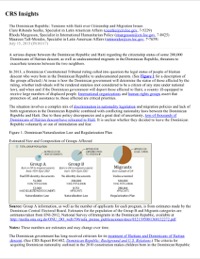
CRS Insights The Dominican Republic: Tensions with Haiti over Citizenship and Migration Issues Clare Ribando Seelke, Specialist in Latin American Affairs (cseelke@crs.loc.gov, 7-5229) Rhoda Margesson, Specialist in International Humanitarian Policy (rmargesson@crs.loc.gov, 7-0425) Maureen Taft-Morales, Specialist in Latin American Affairs (mtmorales@crs.loc.gov, 7-7659) July 15, 2015 (IN10317) A serious dispute between the Dominican Republic and Haiti regarding the citizenship status of some 200,000 Dominicans of Haitian descent, as well as undocumented migrants in the Dominican Republic, threatens to exacerbate tensions between the two neighbors. In 2013, a Dominican Constitutional Tribunal ruling called into question the legal status of people of Haitian descent who were born in the Dominican Republic to undocumented parents. (See Figure 1 for a description of the groups affected.) At issue is how the Dominican government will determine the status of those affected by the ruling, whether individuals will be rendered stateless (not considered to be a citizen of any state under national law), and when and if the Dominican government will deport those affected to Haiti, a country ill-equipped to receive large numbers of displaced people. International organizations and human rights groups assert that protection of, and assistance to, those affected are critical priorities. The situation involves a complex mix of discrimination in nationality legislation and migration policies and lack of birth registration in the Dominican Republic combined with conflicting nationality laws between the Dominican Republic and Haiti. Due to these policy discrepancies and a great deal of uncertainty, tens of thousands of Dominicans of Haitian descent have relocated to Haiti. It is unclear whether they decided to leave the Dominican Republic voluntarily or out of intimidation and fear. Figure 1. Dominican Naturalization Law and Regularization Plan Estimated Size and Composition of Groups Affected Source: Group A information, as well as the number of applicants for each program, is from estimates made by the Dominican Central Electoral Board. Estimates for the population of the Group B and Migrants categories are estimates taken from ENI-2012, National Survey of Immigrants in the Dominican Republic, available at http://media.onu.org.do/ONU_DO_web/596/sala_prensa_publicaciones/docs/0321395001368132272.pdf. Notes: These numbers are estimates and may change over time. The Dominican government has long received criticism for its treatment of Haitians and Dominicans of Haitian descent. (See CRS Report R41482, Dominican Republic: Background and U.S. Relations.) The criteria for acquiring Dominican nationality outlined in the 2010 constitution makes children born in the Dominican Republic to parents in the country illegally ineligible for citizenship. The 2013 tribunal ruling retroactively applied that criterion to the descendants of all undocumented migrants born in the country since 1929. President Danilo Medina has had to comply with the ruling, even though it has been harshly criticized by the international community as discriminatory toward people of Haitian descent. Under pressure from the U.S. government and other international actors, the Medina government developed a process to help resolve the citizenship status of those affected by the ruling who were born in the Dominican Republic. In May 2014, the Dominican Congress approved a naturalization law (169-14) allowing individuals in Group A (defined in Figure 1) to keep their citizenship and register their children as Dominican citizens. The legislation also provided an expedited path to citizenship for individuals in Group B who registered by February 1, 2015. While 8,755 people met that deadline, it is unclear what will happen to those who were unable to gather the necessary documents in that short time period or had their documents rejected. In November 2013, the Dominican Republic launched a regularization plan that gave migrants who were born outside the Dominican Republic 18 months to register for legal non-immigrant status through a process that ended on June 17, 2015. Per a presidential decree, the Dominican government has pledged not to begin any deportation proceedings until after regularization applications have been reviewed. More than 288,400 people applied, but many lacked documents to prove their country of origin. Nevertheless, they may still qualify for legal status. Those who are deemed ineligible could be deported. The Dominican government maintains that it has the right to define its deportation policy and that its policies will be fair, efficient, and coordinated with the Haitian government. Haiti has few resources to deal with a large influx of deportees who were not born in Haiti and have few or no ties to Haiti. Haitian law grants citizenship to children born of at least one Haitian parent but does not address second and third generations descended from Haitian citizens. The Haitian government has not been able to provide documents to all of its citizens requesting them for the Dominican regularization process. In a special session of the Organization of American States (OAS) on July 8, 2015, the Haitian foreign affairs minister expressed concern that mass deportations could destabilize Haiti in the midst of its current election cycle and threaten regional security. He asked the international community to intervene with Dominican authorities for a more flexible and humane treatment of the issue and for the Dominican Republic to return to negotiations for an updated protocol to govern repatriations. He also asked the Dominican Republic to respect human rights and guarantee that no denationalized foreign citizens be deported to Haiti. International Responses The international community has been working on the ground in the Dominican Republic and Haiti, as well as through diplomatic channels, to help resolve these citizenship and migration issues. Together with the International Organization for Migration (IOM) and implementing partners, the United Nations is working with the Dominican government to ensure that all those who are eligible access documents to prove their citizenship status. It is also working with the Dominican and Haitian governments on how to best provide protection, avoid mass deportations, ensure a process that includes transparent individual screenings for those affected, establish reception centers, monitor capability at the border, and maintain an ongoing dialogue. Several U.N. agencies, the U.S. government, and others have been engaged in ongoing, high-level discussions with the Dominican government to ensure that the naturalization and regularization plans benefit all who should qualify and that any potential deportations are conducted humanely. The U.S. Representative to the OAS and the Caribbean Community have expressed concerns about recent "voluntary removals" and urged both governments to reach agreement on repatriation protocols. An OAS mission visited the countries from July 9-14, 2015; its report should help guide international efforts. The United States is providing funding to IOM and civil society to support the current and evolving situations in both countries.