
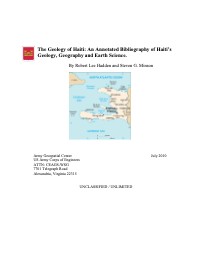
La géologie d'Haïti: Bibliographie annotée de la géologie, de la géographie et des sciences de la terre d'Haïti
Resume — Ce document est une bibliographie annotée axée sur la géologie, la géographie et les sciences de la terre d'Haïti. Il a été préparé par l'Army Geospatial Center en réponse à la crise humanitaire qui a suivi le tremblement de terre de janvier 2010 afin d'aider les ingénieurs en catastrophes et les planificateurs d'urgence.
Constats Cles
- Bibliographie complète sur la géologie, la géographie et les sciences de la terre d'Haïti.
- Préparée en réponse au tremblement de terre de 2010 pour aider aux secours en cas de catastrophe.
- Couvre des sujets pertinents pour les ingénieurs en catastrophes et les planificateurs d'urgence.
- Comprend des citations sur la topographie, les transports, l'eau, les préoccupations médicales et la sécurité.
- Fournit des informations sur l'accès aux documents cités par le biais de diverses bibliothèques et services.
Description Complete
Cette bibliographie annotée, compilée par l'Army Geospatial Center, offre un aperçu complet de la littérature relative à la géologie, à la géographie et aux sciences de la terre d'Haïti. Elle a été créée en réponse au tremblement de terre dévastateur qui a frappé Haïti en janvier 2010, dans le but de soutenir les efforts humanitaires du gouvernement américain et du Corps of Engineers. La bibliographie couvre un large éventail de sujets pertinents pour les ingénieurs en catastrophes et les planificateurs d'urgence, notamment la géologie, la géographie, la topographie, les transports, les ressources en eau, les préoccupations médicales et la sécurité. Elle comprend également des informations sur l'exploitation minière, l'agriculture, la démographie et les infrastructures.
Texte Integral du Document
Texte extrait du document original pour l'indexation.
The Geology of Haiti: An Annotated Bibliography of Haiti’s Geology, Geography and Earth Science. By Robert Lee Hadden and Steven G. Minson Army Geospatial Center July 2010 US Army Corps of Engineers ATTN: CEAGS-WSG 7701 Telegraph Road Alexandria, Virginia 22315 UNCLASSIFIED / UNLIMITED Bibliography of Haitian Earth Science Army Geospatial Center June 2010 2 REPORT DOCUMENTATION PAGE Form Approved OMB No. 0704-0188 Public reporting burden for this collection of information is estimated to average 1 hour per response, including the time for reviewing instructions, searching existing data sources, gathering and maintaining the data needed, and completing and reviewing this collection of information. Send comments regarding this burden estimate or any other aspect of this collection of information, including suggestions for reducing this burden to Department of Defense, Washington Headquarters Services, Directorate for Information Operations and Reports (0704-0188), 1215 Jefferson Davis Highway, Suite 1204, Arlington, VA 22202- 4302. Respondents should be aware that notwithstanding any other provision of law, no person shall be subject to any penalty for failing to comply with a collection of information if it does not display a currently valid OMB control number. PLEASE DO NOT RETURN YOUR FORM TO THE ABOVE ADDRESS. 1. REPORT DATE (DD-MM-YYYY) 28-July-2010 2. REPORT TYPE Bibliography 3. DATES COVERED (From - To) 1900 - 2010 4. TITLE AND SUBTITLE The Geology of Haiti: An Annotated Bibliography of Haiti’s G l G h d E th S i 5a. CONTRACT NUMBER Geology, Geography and Earth Science. 5b. GRANT NUMBER 5c. PROGRAM ELEMENT NUMBER 6. AUTHOR(S) HADDEN, Robert Lee and MINSON, Steven George 5d. PROJECT NUMBER 5e. TASK NUMBER 5f WORK UNIT NUMBER 7. PERFORMING ORGANIZATION NAME(S) AND ADDRESS(ES) AND ADDRESS(ES) 8. PERFORMING ORGANIZATION REPORT NUMBER US Army Corps of Engineers Army Geospatial Center ATTN: CEAGS-WSG 7701 Telegraph Road Alexandria, VA 22315 9. SPONSORING / MONITORING AGENCY NAME(S) AND ADDRESS(ES) 10. SPONSOR/MONITOR’S ACRONYM(S) Geospatial Information ib ( ) Library (GIL) ATTN: CEAGS-WSG 7701 Telegraph Road Alexandria, VA 22315 11. SPONSOR/MONITOR’S REPORT NUMBER(S) 12. DISTRIBUTION / AVAILABILITY STATEMENT Unclassified/Unlimited 13. SUPPLEMENTARY NOTES 14. ABSTRACT A bibliography on Haiti prepared by the Army Geospatial Center (AGC) to assist with humanitarian efforts offered by the US Government and the Corps of Engineers after the devastating earthquake hit Haiti on January, 2010. As such, this bibliography covers items of interest to disaster engineers and emergency planners, including citations on geology and geography, topography, transportation, water, medical concerns, and security. 15. SUBJECT TERMS Earth Sciences. Forests. Geology. Geography. Groundwater. Haiti. Hydrology. Maps. Meteorology. Mining. Soils. Surface-water. Trafficability. Transportation. Water. 16. SECURITY CLASSIFICATION OF: Unclassified / Unlimited 17. LIMITATION OF ABSTRACT 18. NUMBER OF PAGES 19a. NAME OF RESPONSIBLE PERSON R. Lee Hadden a. REPORT UU b. ABSTRACT UU c. THIS PAGE UU UU 254 19b. TELEPHONE NUMBER (include area code) (703) 428-9206 Standard Form 298 (Rev. 8-98) Prescribed by ANSI Std. Z39.18 The Geology of Haiti: An Annotated Bibliography of Haiti’s Geology, Geography and Earth Science By Robert Lee Hadden and Steven G. Minson Army Geospatial Center 7701 Telegraph Road Alexandria, VA 22315 September 2008 Robert.L.Hadden@usace.army.mil Preface This bibliography was produced quickly by the Army Geospatial Center (See: http://www.agc.army.mil/Haiti/index.html) in response to the humanitarian crisis caused by the massive magnitude 7.0 earthquake which struck Haiti in January 2010 with an epicenter about 15 km southwest of the capital, Port-au-Prince. An estimated 2 million people live within the zone of heavy to moderate structural damage. The earthquake is assessed as the worst in this region over the last 200 years. In support of national response efforts led by the U.S. State Department, the U.S. Agency for International Development, and U.S. Southern Command, and the U.S. Army Corps of Engineers has deployed an initial team of four engineers in response to the earthquake in Haiti. The team includes subject matter experts in civil, structural, electrical, and hydrological engineering. Two additional eight-person Forward Engineer Support Teams from USACE’s South Atlantic Division and two platoons of the 249th Engineer Battalion, approximately 40 Soldiers, were placed on alert and ready to deploy. The 249th Engineer Battalion, known as the “Army’s Power Company,” supplies commercial grade power-related technical services to installations and disaster-relief operations. USACE’s South Atlantic Division has identified and is preparing additional structural engineers for deployment if called upon. In support of this effort, the US Army Corps of Engineers’ Army Geospatial Center (AGC) has scanned a number of geological and hydrological maps of Haiti to assist the disaster planners on this mission. This data is used to select locations for supply dumps, emergency hospital locations, sanitation and clean water supplies. Other data on trafficability, transportation and terrain helped with the airlifting of supplies, evacuating the injured, and the prevention of bottlenecks in air, land and water traffic. The AGC web page has also helped civilian relief agencies in their efforts. The data are available around the world, and the US government, the United Nations and a number of non-governmental organizations have made use of this data in their humanitarian relief efforts. Some copyrighted and sensitive materials have been placed behind the PKI site, and are available only to US government civilian and military personnel with CAC Figure 1 U.S. Engineers, Haitians Remove Debris in Turgeau. April 2, 2010. By Chief Mass Communication Specialist James G. Pinsky, NAVFAC Public Affairs. See: http://www.dtic.mil/dtic/pdf/success/c leanup.pdf Bibliography of Haitian Earth Science Army Geospatial Center June 2010 2 access and for official use only. However, most of the information on the webpage is from open sources, and thus is available to anyone. Special thanks are given to all those people outside of the Army Geospatial Center who helped in this emergency project. They include the Reference Staff of the US Geological Survey Library who replied promptly to our requests and made their services so accessible (http://library.usgs.gov/); the public services staff of the Defense Technical Information Center (DTIC) who responded so quickly to our requests, and bent over backwards to make their information available online to the public (http://www.dtic.mil/dtic/index.html); and to the Reference Staff of the Geography and Map Division, The Library of Congress (http://www.loc.gov/rr/geogmap/). Bibliography of Haitian Earth Science Army Geospatial Center June 2010 3 Introduction The Physical Features of Haiti 1 Haiti is a country of about 28,000 square kilometers, and is about the size of the state of Maryland. It occupies the western third of the Caribbean island of Hispaniola (La Isla Española); the Dominican Republic takes up the eastern two-thirds and borders Haiti on the east. A series of treaties and protocols- the most recent of which was the Protocol of Revision of 1936- set the 388 kilometer long eastern border, which is formed partly by the Pedernales River in the south and the Massacre River in the north. The Dominican Republic is Haiti’s only land border. To the south and west it is bordered by the Caribbean and to the north by the Atlantic Ocean. Cuba lies some 50 miles (80 km) west of Haiti’s northern peninsula, across the Windward Passage, a strait connecting the Atlantic to the Caribbean. Jamaica is some 120 miles (190 km) west of the southern peninsula, across the Jamaica Channel, and Great Inagua Island (of The Bahamas) lies roughly 70 miles (110 km) to the north. Haiti claims sovereignty over Navassa (Navase) Island, an uninhabited U.S.-administered islet about 35 miles (55 km) to the west in the Jamaica Channel. Haiti is shaped like a horseshoe on its side with prominent peninsulas in both the north and the south, and a coastline of 1,771 kilometers long. Its shores are generally rocky, rimmed with cliffs, and indented by a number of excellent natural harbours. The surrounding seas are renowned for their coral reefs. Located between the peninsulas is the Ile de la Gonâve. Northwest of the northern peninsula is the Windward Passage, a strip of water that separates Haiti from Cuba, which is about ninety kilometers away. Haiti operates five hours behind Greenwich Mean Time (GMT). Topography: The generally rugged topography of central and western Hispaniola is reflected in Haiti’s name, which derives from the indigenous Arawak place-name Ayti (“Mountainous Land”). Five mountain ranges define Haiti’s topography, dividing the country into three regions: the northern region, which includes the northern peninsula; the central region; and the southern region, which includes the southern peninsula. The backbone of the island of Hispaniola consists of four major mountain ranges that extend from west to east. Haiti’s mountains are mainly limestone, although some volcanic formations can be found, particularly in the Massif du Nord. Karstic features, such as limestone caves, grottoes, and subterranean rivers, are present in many parts of the country. Although Haiti is mostly mountainous, the mountain ranges alternate with fertile but overpopulated lowlands. Haiti’s tropical climate is modified by the mountains and subject to periodic droughts and hurricanes. 1 The data in this introductory section are collected from a number of open literature and common knowledge publications and resources, such as various almanacs, AGI’s “Glossary of Geology”, various geographical dictionaries and gazetteers; encyclopedias such as the World Survey of Climatology, the Encyclopedia Britannica, Encarta, Water Encyclopedia, etc.; open source government publications and websites from the US Department of State, the Library of Congress, the Defense Technical Information Center, the Food and Agriculture Organization of the UN and many others; the CIA Factbook, and several different reports, articles and books on Haiti from federal government geological and geographical resources. Bibliography of Haitian Earth Science Army Geospatial Center June 2010 4 The lowest point is the Caribbean Sea at 0 meters and the highest peak, the Morne de la Selle, is located in the south, and reaches an altitude of 2,715 meters. Slopes of mountains with more than a 20 percent grade cover nearly two-thirds of the country. Haiti’s irregular coastline forms a long, slender peninsula in the south and a shorter one in the north, separated by the triangular-shaped Gulf of Gonâve. Within the gulf lies Gonâve Island which has an area of approximately 290 square miles (750 square km). There are no navigable rivers in Haiti. The largest lake is Etang Saumâtre, a salt- water body located in southern region. Lowland plains, which are quite limited in extent, are the most productive agricultural lands and the most densely populated areas. Plains constitute only about 20 percent of Haiti’s land, making cultivation difficult. Northern Region: The northern region has the country’s largest coastal plain, the Plaine du Nord (Northern Plain), which covers an area of 2,000 square kilometers. The Plaine du Nord lies along the northern border with the Dominican Republic, between the Massif du Nord and the North Atlantic Ocean. This lowland area of 2,000 square kilometers is about 150 kilometers long and 30 kilometers wide. The north’s major mountain range, the Massif du Nord (Northern Massif), buttresses this plain. It is a series of parallel chains known in the Dominican Republic as the Cordillera Central. This is an extension of the central mountain range in the Dominican Republic, which begins at Haiti’s eastern border, north of the Guayamouc River, and extends to the northwest through the northern peninsula. The Massif du Nord ranges in elevation from 600 to 1,100 meters and has an average elevation of some 4,000 feet (1,200 metres). The Citadel (Citadelle Laferrière), a fortress built by Haitian ruler Henry Christophe in the early 19th century, stands atop one of the peaks overlooking the city of Cap-Haïtien and the narrow coastal plain. Central Region: The central region of Haiti consists of two plains and two sets of mountain ranges. The Plateau Central (Central Plateau) extends along both sides of the Guayamouc River, south of the Massif du Nord. It runs eighty-five kilometers from southeast to northwest and is thirty kilometers wide. This interior basin is known as the San Juan Valley in the Dominican Republic and covers an area of more than 2,500 square kilometers. In Haiti it occupies about 150 square miles (390 square km) in the centre of the country. The Guayamouc River splits the Central Plateau and provides some of the country’s most fertile soil. The plateau has an average elevation of about 1,000 feet (300 metres), and access to it is difficult through winding roads. (See Transportation and Trafficability.) The Department du Centre, Haiti's Centre Department is one of the ten Departments of Haiti, and is located in the center of the country, along the border with the Dominican Republic. This Haiti Department is also known as “The Plateau Central”. It has an area of 3,675 km² and a population of 564,200 (2002). Its capital is Hinche. It borders the Dominican Republic to the east. The Centre department is divided into 4 arrondissements: Cerca la Source; Hinche; Lascahobas and Mirebalais. 2 2 Taken from “Haiti Geo.com,” at: http://www.haitigeo.com/ accessed July 25, 2010. Bibliography of Haitian Earth Science Army Geospatial Center June 2010 5 To the southwest of the Plateau Central are the Montagnes Noires, with elevations of up to approximately 600 meters. It is bounded by two minor mountain ranges on the west and south—respectively, the Cahos Mountains and the Noires Mountains. Southwest of the Montagnes Noires and oriented around the Artibonite River is the Plaine de l’Artibonite, measuring about 800 square kilometers. South of this plain lies the third major range, known as the Matheux Mountains (Chaîne des Matheux) in west-central Haiti and the Trou d’Eau Mountains (Chaîne du Trou d’Eau) farther east, corresponds to the Sierra de Neiba in the Dominican Republic. The range forms the northern boundary to the narrow Cul-de-Sac Plain, which is immediately adjacent to Port-au-Prince and includes the brackish Lake Saumâtre on the Dominican border. (The Plaine du Cul-de-Sac is a natural depression, twelve kilometers wide that extends thirty-two kilometers from the border with the Dominican Republic to the coast of the Baie de Port-au-Prince.) Southern Region: Haiti’s southern region contains a series of small coastal plains as well as the mountains of the Massif de la Selle. It encompasses both of Haiti’s highest point Montagne Terrible, 2,684 meters, and the Plaine du Cul-de-Sac, which is a natural depression 12 kilometers wide and 32 kilometers wide. South of the Cul-de-Sac Plain is the fourth major range, called the Massif de la Selle in Haiti and the Sierra de Baoruco in the Dominican Republic. It rises to 8,773 feet (2,674 metres) at Mount Selle, the highest point in the country. The mountains of the southern peninsula, an extension of the southern mountain chain of the Dominican Republic (the Sierra de Baoruco), extend from the Massif de la Selle in the east to the Massif de la Hotte in the west. The range’s highest peak, the Morne de la Selle, is the highest point in Haiti, rising to an altitude of 2,715 meters. The Massif de la Hotte varies in elevation from 1,270 to 2,255 meters. The range’s western extension on the southern peninsula is called the Massif de la Hotte (also known as Massif du Sud), which rises to 7,700 feet (2,345 metres) at Macaya Peak. The Cayes Plain lies on the coast to the southeast of the peak. Islands: Haiti’s land area includes numerous small islands as well as four large islands: Île de la Gonâve to the west, Île de la Tortue (Tortuga Island) off the north coast, and Île à Vache and Grande Cayemite, are situated, respectively, south and north of the southern peninsula. Ile de la Gonâve is sixty kilometers long and fifteen kilometers wide with an area of approximately 290 square miles (750 square km). The hills that cross the island rise to heights of up to 760 meters. Ile de la Tortue is located north of the northern peninsula, separated from the city of Port-de-Paix by a twelve-kilometer channel. The most northerly mountain range, known as the Cordillera Septentrional in the Dominican Republic, occurs in Haiti only on Tortue Island, off the northern coast. Tortue Island has an area of about 70 square miles (180 square km). In the 17th century it was a stronghold of privateers and pirates from various countries. Bibliography of Haitian Earth Science Army Geospatial Center June 2010 6 Caves of Haiti: Haiti has karst areas throughout most of its surface area, notably in the Hotte range in the south. In fact, “haiti” is also the local term for cone karst. Although caves have been long known in that country, and were often used for religious purposes, most of the exploration and documentation of the caves of Haiti comes from the 1980 Expédition Spéléologique Française (E.S.F.), led by Alan Oddou (Bull. Centre Mediterranéen de Spél., 1980, 2: “Contribution à la Connaissance Spéléologique de la Republique d’Haïti.” 33 pages. Their work was facilitated by the previous geological studies of J. Butterlin. Short caves: bim Séjourné (vallée de Jacmel) 167 meters deep, altitude 710 meters trouin Sene (massif de la Selle, Seguin) 92 meters deep trouin Seguin (massif de la Selle, Seguin) 72 meters deep trou Maïo 1 oe Nan Cadet (massif de la Selle, Seguin) 65 meters deep trouin de la Scierie (massif de la Selle, Seguin) 63 meters deep Long Caves: Trouin Sene (Massif de la Selle, Seguin) 1,668 meters deep Grotte de Port à Piment (massif du Macaya, Port à Piment) 1,000 meters deep Grotte de Conoubois (Camp Perrin) approx 900 meters deep. 3 See also: Miller, Gerrit Smith. 1929. “A Second Collection of Mammals from Caves near St. Michel, Haiti.” Washington, DC: Smithsonian Institution. Miscellaneous Collections. Volume 81 (9). 30 pages, 10 plates. Publication 3012. Seismic Activity: A long fault line crosses the southern peninsula and passes just south of Port-au- Prince. Haiti is subject to periodic seismic activity; earthquakes destroyed Cap- Haïtien in 1842 and Port-au- Prince in 1751 and 1770. Figure 2 Aerial view of buildings in Port-au-Prince damaged by the earthquake. Source: U.S. Navy/Mass Communication Specialist 2nd Class Chelsea Kennedy In January 2010 another catastrophic earthquake and its aftershocks resulted in severe damage to Port-au-Prince. Buildings collapsed throughout the capital and surrounding region, including many homes as well as large public structures such as the National Palace, the city’s cathedral, and hospitals. Estimates of the number of people killed ranged upwards of 200,000, and several hundred thousand others were injured. More than a million people were made 3 Courbon, Paul, et al. 1989. Atlas of Great Caves of the World. St. Louis, MO: Cave Books. Cave Research Foundation. Pages 59-60. ISBN: 0939748215. Bibliography of Haitian Earth Science Army Geospatial Center June 2010 7 homeless. To the west of the capital, near the quake’s epicentre, the city of Léogâne was almost completely ruined. Weather and Climate: Haiti’s is a generally hot and humid tropical climate; semiarid where the mountains in east cut off the trade winds. The north wind brings fog and drizzle, which interrupt Haiti’s dry season from November to January. But during February through May, the weather is very wet. Northeast trade winds bring rains during the wet season. Haiti is characterized by diurnal temperature variations that are greater than the annual variations and are modified by elevation. Average temperatures range from the high 70s F (about 25°C) in January and February to the mid-80s F (about 30°C) in July and August. The village of Kenscoff, at some 4,700 feet (1,430 metres), has an average temperature of about 60°F (16°C), whereas Port-au-Prince, at sea level, has an average of 79°F (26°C). In winter, frost can occur at high elevations. Because it is located on the leeward side of the island the influence of humid trade winds is not as great as in the Dominican Republic. The more humid districts are found on the northern and eastern slopes of the mountains. Some portions of the island receive less than 28 inches (700 mm) of rainfall per year. The northwestern peninsula and Gonâve Island are particularly dry. Some regions have two rainy seasons, lasting from April to June and from August to October, whereas other regions experience rainfall from May to November. Annual variations of precipitation can cause droughts, widespread crop failures, and famine. Haiti lies in the middle of the hurricane belt and is subject to severe storms from June to October, occasional flooding and periodic droughts. The southern peninsula, which is more vulnerable to hurricanes (tropical cyclones) than other parts of Haiti, suffered heavy damage from Hurricanes Allen (1980), Gilbert (1988), and Georges (1998). All parts of the country, however, can be hit by tropical storms and hurricanes. During the 2008 hurricane season, the country was struck by three tropical storms and one hurricane that resulted in torrential rains, extensive flooding and mudslides, and hundreds of reported casualties. The lack of government infrastructure and rescue services, combined with impassable roads and bridges, severely hindered rescue and relief efforts. Casualties were estimated at some 800 lives. Daily weather information in Haiti is available from national and international media. The Haitian meteorological service provides hurricane warnings via national radio. Most information local media broadcast only in Kreyol and/or French. Warnings are also available on the Internet from many sources. The average annual rainfall is 140 to 200 centimeters, but it is unevenly distributed. Heavier rainfall occurs in the southern peninsula and in the northern plains and mountains. Rainfall decreases from east to west across the northern peninsula. The eastern central region receives a moderate amount of precipitation, while the western coast from the northern peninsula to Port-au-Prince, the capital, is relatively dry. Temperatures are almost always high in the lowland areas, ranging from 15° C to 25° C in the winter and from 25° C to 35° C during the summer. Bibliography of Haitian Earth Science Army Geospatial Center June 2010 8 Mining and Economic Geology: Endowed with few commercially valuable natural resources, Haiti maintained only a small mining sector in the late 1980s; mining accounted for less than 1% of GDP, and it employed less than 1% of the labor force. Mining activity in the late 1980s mostly focused on raw materials for the construction industry. Natural resources of Haiti include bauxite, copper, calcium carbonate, gold, marble and hydropower. Haiti contains relatively small amounts of gold, silver, antimony, tin, lignite, sulphur, coal, nickel, gypsum, limestone, manganese, marble, iron, tungsten, salt, clay, and various building stones. Gold and copper are found in small quantities in the north of the country. The government announced the discovery of new gold deposits in the northern peninsula in 1985, but long-standing plans for gold production proceeded slowly. Copper also was mined, beginning in the 1960s, but production of the ore was sporadic. There are bauxite (aluminum ore) deposits on the southern peninsula, but large- scale mining there was discontinued in 1983. The country’s only bauxite mine, the Miragoâne mine in the southern peninsula, produced an average of 500,000 tons of bauxite a year in the early 1980s; however, in 1982 the declining metal content of the ore, high production costs, and the oversupplied international bauxite market forced the mine to close. Bauxite had at one time been the country’s second leading export. Haiti apparently has no hydrocarbon resources on land or in the Gulf of Gonâve and is therefore heavily dependent on energy imports (petroleum and petroleum products). Agriculture: The poorest country in the Americas, Haiti has a developing market economy based in large part on agriculture and light industries. Coffee is the main cash crop. Agriculture dominates the economy, but the domestic food supply has not kept pace with demand. As much as one-fifth of the food consumed in Haiti is imported or, sometimes, smuggled from the Dominican Republic or the United States; the imports have lowered overall food prices in Haiti, thereby further impoverishing the nation’s struggling farmers and compelling more people to migrate to urban areas. Agriculture employed 65 percent of labor force and accounted for 35 percent of GDP and 24 percent of exports in late 1980s. Production suffered from severe deforestation and erosion, primitive techniques, land fragmentation, and lack of public and private investment. Coffee was the leading export (a mild Arabica), but production consistently fell below country’s export quota as determined by International Coffee Organization. Other cash crops included sugar, cocoa, sisal, and cotton. Real per capita production of food crops declined during 1980s, necessitating high levels of basic grains imports. Common agricultural products include coffee, mangoes, sugarcane, rice, corn, sorghum, and wood. Many farmers concentrate on subsistence crops, including cassava (manioc), plantains and bananas, corn (maize), yams and sweet potatoes, and rice. Some foodstuffs are sold in rural markets and along roads. Haitian farmers sell it through a system of intermediaries, speculators, and merchant houses. Sugarcane is the second major cash crop, but since the late 1970s Haiti has been a net importer of sugar. Bibliography of Haitian Earth Science Army Geospatial Center June 2010 9 Goats and cattle are the most common livestock, with smaller numbers of pigs and horses. There is some poultry production. Following a massive outbreak of African swine fever in Haiti in the late 1970s, the country’s entire Creole pig population was exterminated by 1982. This deprived many peasants of their only asset, although other pig breeds were subsequently imported as replacements. Haiti’s soils and fishing zones are threatened. Only about 28.11% of the land is arable, permanent crops cover 11.53% of the land, and 60.36% has other uses (2005). Major problems include soil erosion (particularly on mountain slopes, which are seldom terraced), recurrent drought, an absence of irrigation, extensive deforestation (much of the remaining forested land is being cleared for agriculture and used as fuel), and inadequate supplies of potable water. The soils in the mountains are thin and lose fertility quickly when cultivated. The lower hills are covered with red clays and loams. The alluvial soils of the plains and valleys are fertile but overcultivated, owing to high population densities in those areas. Deforestation has caused much soil erosion, and as much as one-third of Haiti’s land may have eroded beyond recovery. Traditionally, Haitians have not exploited their fishing resources; because of the postindependence practice of living in the interior—away from the threat of a French invasion—Haitians have depended on agriculture rather than fishing for subsistence. There are some fisheries, however, in small ponds and various canals throughout Haiti. Although most fishing boats are small and poorly equipped, the potential for a commercial fishing industry does exist: the north-flowing currents off the coasts of Haiti carry major migrations of such deep-sea fish as bonitos, marlins, sardines, and tuna. Deforestation in Haiti is a serious problem that began with a high need for fuel for processing sugarcane during the French colonial period and continues to the present day with an intensified demand for charcoal for fuel in Port-au-Prince and other urban areas. Political instability and poor funding have been serious obstacles to efforts to reduce dependency on forests for fuel. A number of large-scale reforestation projects have been planned, but they have been postponed because of social and political unrest and the urgent need to fund other infrastructure projects. Today only a small fraction of Haiti’s land is forested. From the 17th to the 19th century, much of the natural vegetation was destroyed through clearing for agriculture, grazing, and logging. Deforestation accelerated during the 20th century as population increased, and the forests that once covered the country have been reduced to a tiny proportion of the total land area. Patches of virgin forest remain in the Massif de la Selle, which includes tall pines, and in the Massif de la Hotte, where an evergreen forest with giant tree ferns and orchids stands on the slopes of Macaya Peak. Bayahondes (a type of mesquite), cacti, and acacias form thorny woods on the dry plains. The mangrove swamps on the coast have also declined rapidly, as their trees have been overexploited for firewood and for the production of charcoal. One writer said: “Today less than 4 percent of Haiti’s forests remain, and in many places the soil has eroded right down to the bedrock. From 1991 to 2002, food production per capita actually fell 30 percent.” Further on, he wrote: “ Tè a fatige ,” said 70 percent of Bibliography of Haitian Earth Science Army Geospatial Center June 2010 10 Haitian farmers in a recent survey when asked about the major agricultural problems they faced. “The earth is tired.” 4 With the retreat of natural vegetation, wildlife has lost its habitat and shelter. Wild boars, guinea fowls, and wild ducks are no longer present, but caimans still inhabit rivers of the southern peninsula, and some flamingos are found on Gonâve Island, where they are often hunted. Little has been done to conserve Haiti’s flora and fauna, and few national or regional parks have been established. The lack of conservation measures has been particularly damaging for coral formations and the animal life associated with them. Demographics and population: The estimated population of Haiti is about 9,035,000 people, about 95 % of whom are black and about 5 % of who are either mulatto or white. Estimates for this country explicitly take into account the effects of excess mortality due to AIDS; this can result in lower life expectancy, higher infant mortality, higher death rates, lower population growth rates, and changes in the distribution of population by age and sex than would otherwise be expected (July 2009 est.) The life expectancy at birth for the total population is 60.78 years; 59.13 years for males and 62.48 years for females (2009 est.). Haiti’s death rate is high, mainly because of the prevalence of infectious and parasitic diseases, diseases of the circulatory system, and conditions associated with malnutrition. Moreover, Haiti has a higher incidence of HIV infection and AIDS and a higher infant mortality rate than any other country in the Western Hemisphere. Most people living in Haiti are at a high risk for major infectious diseases. Food or waterborne diseases include bacterial and protozoal diarrhea, hepatitis A and E, and typhoid fever; common vectorborne diseases are dengue fever and malaria; water contact diseases include leptospirosis (2009). Roughly three-fourths of Haitian households lack running water. Unsafe water— along with inadequate housing and unsanitary living conditions—contributes to the high incidence of infectious diseases. There is a chronic shortage of health care personnel, and hospitals lack resources, a situation that became readily apparent after the January 2010 earthquake. Languages: Creole (official), Haitian Creole (Kweyol, or Kreyol), and French are Haiti’s official languages. All Haitians speak Creole, but only about 10% of the people speak French fluently. English and Spanish are increasingly used as second languages among the young and in the business sector. Creole is normally used in daily life, and French is used in more formal circumstances. However, written Creole is not widely accepted, because the school system retains French as the main language of instruction. Most of the vocabulary of Haitian Creole is derived from French, but in its syntax it is similar to the Creole languages of the Caribbean and the Indian Ocean. 4 Bourne, Joel K. 2008. “Haiti Soil: Dirt Poor.” National Geographic. Accessed May 2010. See: http://ngm.nationalgeographic.com/2008/09/soil/bourne-text Bibliography of Haitian Earth Science Army Geospatial Center June 2010 11 Religions: Haiti has no official religion, and the constitution allows for religious freedom. However, Vodou (Voodoo, or Vodun), a religion whose gods ( lwa ) are derived from West African religions, has been officially sanctioned by the government as of April 2003, and Roman Catholicism, the dominant sect of Christianity, has been given special government recognition. Most Haitian Roman Catholics are also practitioners of Vodou. However, most of the country’s Protestants consider Christianity to be incompatible with Vodou. In addition to the older Protestant denominations established in the early 19th century (Methodists, Episcopalians, and Presbyterians), Baptists, Seventh-day Adventists, and Mormons came to Haiti during and after the period when the United States occupied the country (1915–34). About 80% of the population is Roman Catholic, 16% Protestant (Baptist 10%, Pentecostal 4%, Adventist 1%, other 1%), 1% none, 3% other. Liberation theology continues to have some influence in religious life, notably in the shantytown areas of Port-au-Prince and other towns. Increasing numbers of Haitians have converted to Protestantism through the work of missionaries active throughout the country. Economy: Haiti is the poorest country in the Western Hemisphere with 80% of the population living under the poverty line and 54% in abject poverty. Two-thirds of all Haitians depend on the agricultural sector, mainly small-scale subsistence farming, and remain vulnerable to damage from frequent natural disasters, exacerbated by the country’s widespread deforestation. While the economy has recovered in recent years, registering positive growth since 2005, four tropical storms in 2008 severely damaged the transportation infrastructure and agricultural sector. US economic engagement under the Haitian Hemispheric Opportunity through Partnership Encouragement (HOPE) Act, passed in December 2006, has boosted apparel exports and investment by providing tariff-free access to the US. A second version of the legislation, passed in October 2008 and dubbed HOPE II, has further improved the export environment for the apparel sector by extending preferences to 2018; the apparel sector accounts for two-thirds of Haitian exports and nearly one-tenth of GDP. Remittances are the primary source of foreign exchange, equaling nearly a quarter of GDP and more than twice the earnings from exports. Haiti suffers from a lack of investment because of financial insecurity and limited infrastructure, and a severe trade deficit. In 2005, Haiti paid its arrears to the World Bank, paving the way for reengagement with the Bank. Haiti received debt forgiveness for about $525 million of its debt through the Highly-Indebted Poor Country (HIPC) initiative in 2009. The government relies on formal international economic assistance for fiscal sustainability. Electricity production: 448 million kWh (2007 est.). Hydroelectricity provides roughly half of the power generated in the country, the remainder coming from thermal (mainly coal-fired) plants, especially in Port-au-Prince. However, the power supply is not Bibliography of Haitian Earth Science Army Geospatial Center June 2010 12 sufficient to satisfy current needs, and the main sources of energy for cooking are firewood and charcoal. The World Bank gave this estimation of Haiti’s electrical production in 2008: “In Haiti, the production, transport and distribution of electricity is the responsibility of EDH (Electricité d’Haiti), a public commercial company that is under the supervision of the MTPTC. Currently, the company provides electricity to 184,000 customers- who represent about 10 percent of the population. There has long been no maintenance. Thus, from an installed productive capacity of 220 MWh, the company now produces 60 MWh. EDH also faces a high number of illegal connections. The losses due to these illegal connection are estimated to be about 30 to 40 percent of the output.” 5 Oil consumption: 12,000 bbl/day (2008 estimate). Telephone: There are roughly 108,000 main lines in use and 3.2 million mobile/cellular lines (2008). Telecommunications infrastructure in Haiti is among the least developed in Latin America and the Caribbean; domestic facilities are barely adequate and international facilities are only slightly better. Mobile-cellular telephone services are expanding rapidly due, in part, to the introduction of low-cost GSM phones, and mobile-cellular teledensity exceeded 35 per 100 persons in 2008. Telephone domestic: coaxial cable and microwave radio relay trunk service; international: country code - 509; satellite earth station - 1 Intelsat (Atlantic Ocean). The website for the Consel National des Télécommunications (CONATEL) is in French: http://www.conatel.gouv.ht/ The radio broadcast stations in Haiti are: 41 AM stations, 53 FM stations and 0 shortwave stations (2009). The Internet country code: .ht; Internet hosts: 9 (2009); Internet users: 1 million (2008). Transportation and trafficability: The roads from Port-au-Prince to Cap-Haïtien, Les Cayes, and Jacmel have been paved but are not regularly repaired, and city streets are notorious for their many deep potholes. Most inland transportation is hampered by rough roads that may become impassable in inclement weather. Trucks and buses offer irregular and costly service from Port-au-Prince to the provincial towns. There is no railway service. The primary means by which the rural population travels are on foot, by bicycle, by public bus (known as a “tap-tap” in Haiti), or by donkey. The latter mode is also commonly used to transport goods. Airports: 14 (2009). Airports with paved runways total 4; one that is between 2,438 to 3,047 m and three airports with runways between 914 and 1,523 m (2009). Airports with unpaved runways total 10; two are between 914 and 1,523 m and eight are under 914 m (2009). Haiti has two international airports, the principal one at Port-au- Prince and another at Cap-Haïtien. Outside of Léogâne, a makeshift airstrip has been set up on part of Route 9, a highway of the commune, able to handle small planes (2010). The U.S. Federal Aviation Administration (FAA) has assessed the government of Haiti’s Civil Aviation Authority as not being in compliance with International Civil 5 World Bank. 2008. “Haiti: public expenditure management and financial accountability review.” World Bank Publications. Page 82. Bibliography of Haitian Earth Science Army Geospatial Center June 2010 13 Aviation Organization (ICAO) aviation safety standards for oversight of Haiti’s air carrier operations. Railroads: N/A. There are currently no functioning railways in Haiti except for transporting sugarcane. There are no rail connections with the neighbouring Dominican Republic. In the past Haiti used railroads, but today they are no longer in use due to other forms of transportation that have become available. In the past, horse tramways, steam railways and industrial tracks were used. Their dates of closure are unknown. Roads and highways: total: 4,160 km; paved: 1,011 km; unpaved: 3,149 km (2000). The World Bank gives this assesment of the roads in Haiti in 2008: “The road network: The Haitian transport network is not only insufficiently developed but it deteriorated significantly in the decade before 2004. That decade has seen the transport network in constant degradation. In 2004, according to the MTPTC, the road network consisted of 3,400km of roads, of which only 18 percent were paved. This network consists of 20.3 percent of primary roads (routes nationales), 44.4 percent of secondary roads (routes départmentales) and 35.4 percent of tertiary roads (routes communales) that link the rural communities to the secondary road network. Furthermore, only 20 percent of these roads are considered to be in acceptable condition. To address the maintenance issue, an autonomous entity- the Fonds d’Entretien Routier (FER)- has been progressively put in place from 2003 to ensure maintenance in this sector. The FER benefits from earmarked funds (coming from taxes on gasoline, car licenses, etc.) transferred directly by the MEF and act as a donor on issues regarding road maintenance (MTPTC plans and contracts while the FER finances). But this executing system has experienced some delays mainly due to a lack of planning and executing capacity of the MTPTC.” 6 Haiti has two main highways that run from one end of the country to the other. The northern highway, Route Nationale #1 (National Highway One), originates in Port- au-Prince, winding through the coastal towns of Montrouis and Gonaïves, before reaching its terminus at the northern port Cap-Haïtien. The southern highway, Route Nationale #2, links Port-au-Prince with Les Cayes via Léogâne and Petit Goâve. Maintenance for these roads lapsed after the 1991 coup, prompting the World Bank to loan USD 50 million designated for road repairs. The project was canceled in January 6 World Bank. 2008. Haiti: Public Expenditure Management and Financial Accountability Review. Page 82. Figure 3 Haitian citizens walking down a debris-strewn street after the earthquake. Source: USAID/staff photo Bibliography of Haitian Earth Science Army Geospatial Center June 2010 14 1999, however, after auditors revealed corruption. Haiti also has a third major highway, the Route Nationale #3, which connects Port-au-Prince to Cap-Haitien via the towns of Mirebalais and Hinche. This route links the capital and Le Cap to the central plateau; however, due to its poor condition, it sees limited use. The most common form of public transportation in Haiti is the use of brightly painted pickup trucks as taxis called “tap- taps.” They are named this because when a passenger needs to be let off they use their coin money to tap the side of the vehicle and the driver usually stops. Most tap-taps are fairly priced at around 10-15 gourdes per ride within a city. The catch to the price is that the driver will often fill a truck to maximum capacity, which is nearly 20 to 30 people. “Due to decades of deterioration of Haiti’s road network, the 250-km drive from Port-au-Prince to Cap Haitien, the largest city on the northern coast, can take up to seven hours on RN1, the country’s main highway.” 7 TRAFFIC SAFETY AND ROAD CONDITIONS: While in a foreign country, U.S. citizens may encounter road conditions that differ significantly from those in the United States. The information below concerning Haiti is provided for general reference only, and may not be totally accurate in a particular location or circumstance. Cars are supposed to be driven on the right side of the road in Haiti, but few roads have lane indicators and drivers use whatever part of the road is open to them, even if it is not the correct side of the road. Traffic is extremely congested in urban areas, and hours-long traffic jams develop throughout the country. Driving in Haiti must be undertaken with extreme caution. The situation on the roads can be described as chaotic at best, and it is advisable for those with no knowledge of Haitian roads and traffic customs to hire a driver through a local hotel. Roads are generally unmarked, and detailed and accurate maps are not widely available. Lanes are not marked and signs indicating the direction of traffic flow seldom exist. This lack of organization, along with huge potholes that appear without warning, may cause drivers to execute unpredictable and dangerous maneuvers in heavy traffic. The Haitian government lacks adequate resources to assist drivers in distress or to clear the road of accidents or broken-down vehicles blocking the flow of traffic. While drinking and driving is illegal in Haiti, people frequently drive after drinking, especially at night. Public transportation, as it is usually defined, does not exist in Haiti. While Haitians use buses, “tap-taps,” and taxis, which may observe regular routes, much like public transportation, none of these should be considered reliable. The Embassy strongly discourages their use. Those who drive in Haiti should do so defensively and conservatively, avoid confrontations such as jockeying for position, and 7 Inter-American Development Bank. 2009. “Haiti invests heavily in rebuilding roads: IDB helps finance an unprecedented push to improve transportation.” Webpage accessed: Apr 13, 2009. See: http://www.iadb.org/features-and-web-stories/2009-04/english/haiti-invests-heavily-in-rebuilding-roads- 5339.html Bibliography of Haitian Earth Science Army Geospatial Center June 2010 15 remain aware of the vehicles around them. Drivers should carry the phone numbers of people to call for assistance in an emergency, as Haitian authorities are unlikely to respond to requests for assistance. When traveling outside of Port-au-Prince, drivers should caravan with other vehicles to avoid being stranded in the event of an accident or breakdown. Although Haitian law requires that applicants pass both a written and a driving test to qualify for a drivers license, many Haitian drivers appear unaware of traffic laws. Signaling imminent actions is not widely practiced and not all drivers use turn indicators or international hand signals properly. For instance, many drivers use their left blinker for all actions, including turning right and stopping in the road, and others flap their left arm out the window to indicate that they will be taking an unspecified action. Drivers do not always verify that the road is clear before switching lanes, turning, or merging. Speed limits are seldom posted and are generally ignored. Speeding is the cause of many fatal traffic accidents in Haiti, as are overloaded vehicles on winding, mountainous roads and vehicles without brakes. Poor maintenance and mechanical failures often cause accidents as well. Drivers should be particularly cautious at night, as unlighted vehicles can appear without warning. Right of way is not widely observed in Haiti, and there are few operational traffic lights or traffic signs. It is advisable at most intersections to stop and verify that there is no oncoming traffic even if it appears that you have the right of way. Drivers can be quite aggressive and will seldom yield. Walls built to the edge of roads frequently make it impossible to see around corners, forcing drivers to edge their cars into the road at intersections to check for oncoming traffic. In addition to vehicles, a variety of other objects may appear on the road in Haiti, such as wooden carts dragged by people or animals, small ice cream carts, animals, mechanics working on vehicles parked on the street, and vendors and their wares. Vehicles are often abandoned in the road or by the side of the road. There are few marked crosswalks and sidewalks, and pedestrians often wend their way through traffic in urban areas. 8 According to the Washington Post, “Officials from the U.S. Army Corps of Engineers said Saturday [January 23, 2010] that they assessed the damage from the Jan. 12 quake in Port-au-Prince, Haiti, and found that many of the roads aren’t any worse than they were before because they’ve always been in poor condition.” 9 8 US Department of State. Bureau of Consular Affairs. “Haiti Country Specific Information.” See the website at: http://travel.state.gov/travel/cis_pa_tw/cis/cis_1134.html#traffic_safety accessed July 26, 2010. 9 Hedgpeth, Dana. 2010. “Haiti’s Bad Roads not Damaged by Quake, Army Engineers Say.” Washington Pot. January 23, 2010. The website was accessed on May 5, 2010. See: http://www.washingtonpost.com/wp-dyn/content/article/2010/01/23/AR2010012302113.html Bibliography of Haitian Earth Science Army Geospatial Center June 2010 16 Water and Sanitation : Haiti has an estimated resource of 14 cubic kilometers of freshwater (2000). Freshwater withdrawal for domestic (5%), industrial (1%) and agricultural (94%) use in Haiti is 0.99 cubic kilometers/year; per