
Entansifyon Vyolans Kriminèl nan Bas-Latibonit, Depatman Sant, ak Rejyon yo ki Sitiye nan Lès Zòn Metwopolitèn Pòtoprens
Rezime — Rapò sa a bay detay sou entansifyon vyolans gang nan Bas-Latibonit, Depatman Sant, ak zòn ki nan lès Pòtoprens ann Ayiti depi mas 2025. Li mete aksan sou ogmantasyon nan touye moun, kidnapin, vyolans seksyèl, ak deplasman, pandan gang yo ap eseye kontwole wout prensipal yo ak elaji kontwòl teritoryal yo.
Dekouve Enpotan
- Vyolans gang yo entansifye nan Bas-Latibonit, Depatman Sant, ak zòn ki nan lès Pòtoprens depi mas 2025.
- Gang yo ap eseye estratejikman kontwole wout prensipal yo ki konekte kapital la ak rejyon nò yo ak fwontyè Repiblik Dominikèn.
- Touye moun, kidnapin, vyolans seksyèl, ak destriksyon pwopriyete yo ogmante sevè nan lokalite ki afekte yo.
- Gwoup oto-defans yo te parèt, pafwa komèt vyolasyon dwa moun.
- Kominote entènasyonal la dwe ranfòse sipò li bay otorite ayisyen yo ak gwoup vilnerab yo pou anpeche plis destabilizasyon.
Deskripsyon Konple
Depi mas 2025, Depatman Sant ann Ayiti te fè eksperyans yon entansifikasyon vyolans gang ak vyolasyon dwa moun. Aktivite kriminèl pèsiste nan Bas-Latibonit ak rejyon ki nan lès Pòtoprens, ak gang yo ki ap etabli estratejikman yon prezans sou wout prensipal yo pou kontwole wout ki konekte kapital la ak rejyon nò yo ak fwontyè Repiblik Dominikèn. Ekspansyon sa a poze yon gwo risk pou pwopagasyon vyolans ak ogmantasyon trafik transnasyonal, sa ki kapab destabilize sou-rejyon Karayib la. L'ONU te dokimante yon gwo ogmantasyon nan touye moun, kidnapin, vyolans seksyèl, ak destriksyon pwopriyete, ak plis pase 1,018 moun touye ak 620 kidnape ant oktòb 2024 ak jen 2025 nan zòn ki afekte yo. Rapò a mete aksan tou sou patisipasyon gwoup oto-defans yo ak defi otorite nasyonal yo ak kominote entènasyonal la ap fè fas pou adrese kriz la.
Teks Konple Dokiman an
Teks ki soti nan dokiman orijinal la pou endeksasyon.
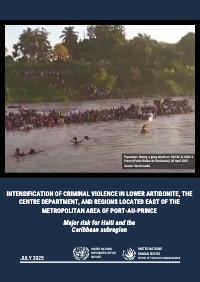
JULY 2025 INTENSIFICATION OF CRIMINAL VIOLENCE IN LOWER ARTIBONITE, THE CENTRE DEPARTMENT, AND REGIONS LOCATED EAST OF THE METROPOLITAN AREA OF PORT-AU-PRINCE Major risk for Haiti and the Caribbean subregion UNITED NATIONS HUMAN RIGHTS OFFICE OF THE HIGH COMMISSIONER UNITED NATIONS INTEGRATED OFFICE IN HAITI Population fleeing a gang attack on Cité de la Crête à Pierrot (Petite Rivière de l’Artibonite), 30 April 2025. Source: Social media Table of content Executive summary................................................................................................... 4 Artibonite department............................................................................................... 8 Phase 1: Continuation of 2023 trends......................................................................11 Phase 2: Pont Sondé massacre and other incidents (October – December 2024)............12 Phase 3: Decrease in abuses committed by gangs following the deployment of security forces, supported by the Multinational Security Support Mission.................................13 Phase 4: Resumption of attacks by the Gran Grif gang and new massacres....................15 Centre department...................................................................................................17 Phase 1: 2023 -2024, initial incursions by gangs into the Centre department to control roads..................................................................................................................20 Timeline of events in the Artibonite department..........................................................9 Timeline of events in the Centre department.............................................................18 Phase 2: Intensification of police operations and self-defence groups triggers escalation of gang violence, January–March 2025....................................................................21 Phase 3: Attacks in Mirebalais and Saut d’Eau...........................................................22 Phase 4: Territorial takeover and advance eastwards..................................................23 Ganthier and Fonds Parisien (West department)............................................................26 Phase 1: Attacks and takeover of Ganthier by the 400 Mawozo gang.............................28 Timeline of events in ganthier and Fonds Parisien (West department)..........................27 Phase 2: Attempted takeover of Fonds Parisien.........................................................29 Response of national authorities and the international community...................................30 Methodology for information collection and verification ................................................36 INTENSIFICATION OF CRIMINAL VIOLENCE IN THE LOWER ARTIBONITE, THE CENTRE DEPARTMENT AND EASTERN AREAS OF THE MAPP EXECUTIVE SUMMARY Intensification of Criminal Violence in Lower Artibonite, the Centre Department, and Regions Located East of the Metropolitan Area of Port-au-Prince 4 Since March 2025, the Centre department in Haiti has been the scene of intensified gang violence and a surge in human rights violations. In addition, intense gang-related criminal activity continues to be documented in the Lower and in regions located to the east of the metropolitan area of Port-au-Prince (MAPP). Artibonite The gangs appear to be pursuing a strategic objective of establishing a presence in localities along key roadways crossing the Centre and Artibonite departments, particularly with the aim of controlling routes that connect the capital to the northern regions and to the border with the Dominican Republic, in the east of the country. This expansion of gang territorial control poses a major risk of spreading violence and increasing transnational trafficking in arms and people, which could lead to significant destabilisation for countries in the Caribbean subregion, especially given the extremely limited presence of public administration and United Nations entities in these departments. With this expansion, the Human Rights Service (HRS) of the United Nations Integrated Office in Haiti (BINUH) and the United Nations High Commissioner for Human Rights (OHCHR) have documented a sharp increase in killings, kidnappings, sexual violence, and the destruction of property in the affected localities. According to the HRS, between 3 October 2024 – the date of the Pont Sondé massacre (Artibonite), which marked a turning point in the dynamics of violence – and 30 June 2025, at least 1,018 people were killed, 213 injured, and 620 kidnapped in the Artibonite and Centre departments, as well as in Ganthier and Fonds Parisien, located to the east of the metropolitan area of Port-au-Prince . More than 21 women and girls were also raped during this period . Some human rights abuses were committed during extremely violent incidents carried out by gangs, such as the Pont Sondé massacre (Artibonite) on 3 October 2024, during which at least 100 people were killed and 16 others injured within the space of a few hours. 1 2 3 Breakdown of victims: 1,018 killings (853 men, 132 women, and 33 children), 213 injuries (176 men, 35 women, and two children), and 1,296 kidnappings (761 men, 525 women, and 10 children). 1 Across the country, between 3 October 2024 and 30 June 2025, at least 4,864 people were killed (4,060 men, 668 women and 136 children), 1,597 others were injured (1,302 men, 254 women and 41 children), and 775 kidnapped (463 men, 298 women, and 14 children). 2 Eight women and seven girls, aged between 14 and 17, in the Artibonite department, and six women in the Centre department. It is important to emphasise that sexual violence, particularly when perpetrated by gang members, is widely underreported due to fear of reprisals, social stigma, lack of trust in law enforcement, and limited access to service providers. 3 In the Artibonite department, this figure represents a 9 per cent increase compared to the end of 2024, while in the Centre department, the increase is 118 per cent. Nationwide, the International Organization for Migration (IOM) recorded nearly 1,300,000 displaced persons by the end of June 2025. IOM (3 June 2025). « Haiti — Information sheet on the displacement situation in Haiti — Round 10 (June 2025)”, available at https://dtm.iom.int/reports/haiti-information-sheet-displacement-situation-haiti-round-10-june- 2025?close=true 4 Intensification of Criminal Violence in Lower Artibonite, the Centre Department, and Regions Located East of the Metropolitan Area of Port-au-Prince 5 In addition to these violations of the right to life and physical integrity, other abuses have been reported, such as extortion on roads, the destruction of public and private property, and the large-scale forced displacement of populations. As of 30 June 2025, over 92,300 people were displaced in the Artibonite department, and over 147,000 in the Centre department , in the context of an acute humanitarian crisis marked by restricted access to basic services and severe food insecurity. 4 In response to this situation, the national authorities deployed several specialised units of the national police, supported by the Multinational Security Support (MSS) mission, from Port-au-Prince, where a large proportion of the country’s security forces are concentrated. Locally, self-defence groups strengthened in an attempt to counter the rapid rise in gang violence and the authorities’ inability to contain it. In the short term, these efforts resulted in a slowdown in the expansion of gang activity and a reduction in abuses, although they did not lead to the effective recovery of control over the affected areas. One of the most concerning aspects, however, is the commission of numerous human rights violations and abuses, both by security forces (notably summary executions) and by self-defence groups (carrying out attacks against individuals suspected of supporting gangs). The HRS monitoring and investigation mechanism has confirmed that the MSS was not involved in any of these incidents. To prevent a rapid destabilisation of the subregion, the international community must strengthen its support to the Haitian authorities, who bear the primary responsibility for protecting the rights of their population, as well as to international and national organisations that provide assistance to vulnerable groups. Intensification of Criminal Violence in Lower Artibonite, the Centre Department, and Regions Located East of the Metropolitan Area of Port-au-Prince 6 To the General Directorate of the Haitian National Police: Recommendations to the national authorities : 5 Recommendations to the international community: Maintain the mandate and operational capacity of the United Nations Integrated Office in Haiti (BINUH). Provide specialised police units with the necessary and adequate resources to combat gangs, in accordance with international human rights law and based on the budgets allocated by the government. Continue the deployment, as authorised by the Security Council in its Resolutions 2699 (2023) and 2751 (2024), of the Multinational Security Support (MSS) mission in Haiti, in order to support the Haitian National Police in restoring security in the country, in strict compliance with international law, including human rights law. In line with Security Council Resolutions 2653 (2022), 2700 (2023), and 2752 (2024), take urgent and more stringent measures to prevent the direct or indirect supply, sale, or transfer to Haiti – from their territory, through their territory, by their nationals, or by means of vessels flying their flag or aircraft registered in their country – of arms and related materiel of all types. Continue to update the list of individuals and entities subject to the Security Council sanctions regime on Haiti, particularly for preparing, ordering, or committing acts in Haiti that are contrary to international human rights law. Handle all allegations of human rights violations involving police officers with increased diligence, and ensure that all complaints promptly lead to an impartial investigation conducted by an independent body with no institutional or hierarchical ties to the alleged perpetrators. Guarantee that the alleged perpetrators are immediately suspended from duty for the entire duration of the investigation if there is a risk that they may reoffend, retaliate against the alleged victim, or obstruct the investigation if allowed to remain in their position. To the judicial authorities: Establish, as a matter of urgency, the two specialised judicial units for dealing with mass crimes and financial crimes, as created by decree-law in April 2025. Instruct the Public Prosecutor’s Office to open investigations into all crimes committed in areas affected by gang violence, including the Lower Artibonite, the Centre department, and the commune of Ganthier. See reports of the High Commissioner for Human Rights, available at https://www.ohchr.org/en/countries/haiti 5 Ensure that the alleged perpetrators of such acts, as well as those who provide them with financial support, are prosecuted and, if found guilty, are duly tried and sentenced in proportion to the gravity of their actions. Strengthen the system for protecting victims of crimes and witnesses, in order to shield them from any form of retaliation. Intensification of Criminal Violence in Lower Artibonite, the Centre Department, and Regions Located East of the Metropolitan Area of Port-au-Prince 7 ARTIBONITE DEPARTMENT EXPANSION OF GANG CRIMINAL ACTIVITIES IN THE LOWER ARTIBONITE TIMELINE OF EVENTS IN THE ARTIBONITE DEPARTMENT Phase 1: Continuation of 2023 dynamics (late 2023 – September 2024) Local gangs, Gran Grif and Kokorat San Ras , strengthen their presence in the Lower Artibonite with the support of local political and economic actors, as well as gangs based in the capital. These gangs expand their criminal activities to Gros-Morne, L’Estère, Petite Rivière de l’Artibonite, Saint-Marc and Verrettes, and establish checkpoints and extortion points along National Road 1 and Departmental Road 11. These criminal activities lead to serious abuses against local populations, including killings, kidnappings, sexual violence, and the destruction of property. In the absence of law enforcement, self-defence groups supported by the diaspora form in the Lower Artibonite. While they provide local security, they also commit serious abuses, including the killing of individuals suspected of having ties to gangs. In October 2024, the Gran Grif gang attacks the population of Pont Sondé (Saint- Marc) in retaliation for their support of self-defence groups, leaving over 100 people dead, 16 injured, and displacing more than 6,000 individuals. This attack marks a turning point, prompting a response from security forces, including the deployment of specialised units of the HNP and the MSS to Petite- Rivière de l’Artibonite, and the temporary retaking of control in certain areas. This reinforcement includes the establishment, in October 2024, of a temporary base for the HNP and the MSS in Ségur (Petite Rivière de l’Artibonite). On 7 December 2024, the police station in downtown Petite Rivière de l’Artibonite is also retaken by the security forces. In the short term, the reinforcement of security operations leads to a significant decrease in abuses committed by the Gran Grif gang and pushes it to shift its criminal activities to remote rural areas. Notably, due to a lack of personnel to deploy across the whole of the Lower Artibonite, the police fail to prevent lightning attacks carried out by gangs in hard-to- reach areas such as Plassac, Pont Tilus, and Poterie (Petite Rivière de l’Artibonite). One such attack, documented on 11 December in downtown Petite Rivière de l’Artibonite, leaves at least 70 people dead, shot in their homes, and 20 kidnapped (12 men and 8 women). All the victims are suspected of belonging to or supporting self-defence groups. These attacks trigger a wave of reprisals between gangs and self-defence groups: on 11 December, the gang kills more than 70 people in Petite-Rivière de l’Artibonite, while self-defence groups kill at least 67 people between 9 and 12 December, mainly individuals believed to be relatives of gang members. At the same time, police units are involved in at least 17 extrajudicial executions, targeting individuals suspected of collaborating with Gran Grif. Phase 2: Massacre in Pont Sondé and other incidents (Octobre – Decembre 2024) Phase 3: Withdrawal of security forces and resumption of attacks (April – June 2025) Due to a lack of logistical and human resources, the security forces fail to maintain their presence in several key areas, while during the first quarter of 2025, the Gran Grif gang strengthens its weapons supply and manpower. Taking advantage of the growing security vacuum, the gang resumes its offensives from April 2025 in several localities, including Carrefour Paye, Cité de la Crête à Pierrot, Laverdure, Lucas, Précièse, Pontilus and Terre Noire (Petite Rivière de l’Artibonite), as well as Grand Hatte (Marchand Dessalines). On 30 April, the attack on Cité de la Crête à Pierrot leaves at least 57 people dead, 36 kidnapped, over 80 houses burned down, and more than 13,000 people forcibly displaced. During the assault, the joint HNP/MSS base in Ségur is surrounded by the gang, forcing its permanent abandonment. In retaliation, self-defence groups reactivate. On 20 May, in Préval (Petite Rivière de l’Artibonite), they kill at least 25 people and injure ten others, accusing the victims of collusion with Gran Grif . Despite occasional interventions, the security forces remain unable to restore order on a lasting basis. In June 2025, the total number of internally displaced persons in the Artibonite department reaches 92,304, representing a 9% increase compared to December 2024. Intensification of Criminal Violence in Lower Artibonite, the Centre Department, and Regions Located East of the Metropolitan Area of Port-au-Prince 11 At the end of 2023, BINUH and OHCHR raised the alarm about an intensification of gang- related criminal activity and human rights abuses in the Lower Artibonite region, the early signs of which had been observed as far back as the final months of 2022 . This violence was largely driven by the growing power of two local gangs, known as Gran Grif and Kokorat San Ras , who were supported by influential political and economic actors in the Artibonite region. These gangs also received backing from other criminal groups operating in Port-au- Prince – particularly the gangs from Canaan , Grand Ravine , and Village de Dieu – which provided them with weapons and manpower to help them seize control of National Road 1 and Departmental Road 11, with the aim of facilitating illegal trafficking toward the north of the country. The communes most affected were Gros-Morne, L’Estère, Petite Rivière de l’Artibonite, Saint-Marc, and Verrettes, most of them located in the Lower Artibonite region . 6 7 PHASE 1: CONTINUATION OF 2023 TRENDS In 2024, taking advantage of the lack of response from the authorities, these dynamics continued. The Gran Grif and Kokorat San Ras gangs strengthened their grip on several communes in the Artibonite department, where killings, kidnappings, and sexual violence were perpetrated against the local population . 8 In response, existing self-defence groups were reinforced, while new groups were formed. Supported by residents, who often see them as the only entities capable of ensuring security in their communities, as well as by the diaspora, which provides them with financial backing, these groups have committed a number of abuses, killing not only individuals suspected of gang affiliation but also members of their families. Most of these individuals were shot in their homes, outside any direct confrontation with the gangs, and their bodies were then burned. BINUH and OHCHR (November 2023), “Criminal Violence Extends Beyond Port-au-Prince: The Situation in Lower Artibonite from January 2022 to October 2023”, available at https://www.ohchr.org/en/documents/country-reports/criminal-violence-extends-beyond- port-au-prince-situation-lower 6 Ibidem 7 In 2024, in the communes of Gros-Morne, L’Estère, Petite-Rivière de l’Artibonite, Saint-Marc, and Verrettes, at least 548 people were killed (449 men, 76 women, and 23 children) and 131 others injured (105 men, 25 women, and one child) as a result of gang-related violence. During the same period, at least 847 people (487 men, 357 women, and three children) were kidnapped for ransom by gangs in these same communes. 8 Intensification of Criminal Violence in Lower Artibonite, the Centre Department, and Regions Located East of the Metropolitan Area of Port-au-Prince 12 In October 2024, the massacre carried out by the Gran Grif gang against the population of Pont-Sondé (in the commune of Petite-Rivière de l’Artibonite) marked a major turning point in the cycle of violence between gang members and self-defence groups. PHASE 2: PONT SONDÉ MASSACRE AND OTHER INCIDENTS (OCTOBER – DECEMBER 2024) The locality of Pont Sondé (located 13 kilometres north-east of the town of Saint Marc) sits at the intersection of two major roadways, National Road 1 and Departmental Road 11, which connect the capital to the north of the country. Since January 2024, the Gran Grif gang had set up a checkpoint at Carrefour Pey, just before the northern entrance to Pont Sondé. This became a major source of revenue for the gang. On the one hand, it enabled them to extort money from vehicles and passengers travelling along this route. On the other hand, it facilitated the movement and trafficking of illicit goods toward Gonaïves and Cap Haitian. At the beginning of September 2024, the self-defence group in the locality of Jean Denis (Petite Rivière de l’Artibonite) encouraged residents to avoid passing through Carrefour Pey and to use alternative routes. It also set up a roadblock at Patchwal, at the western exit of Pont Sondé, to hinder the criminal activities of the Gran Grif gang and prevent its advance towards the commune of Saint Marc. On 1 October, a video circulated on social media showing the leader of the Gran Grif gang , Luckson Élan , issuing death threats against anyone using the secondary roads around Pont Sondé. Two days later, on the morning of 3 October, members of his gang attacked Pont Sondé. According to information gathered by the HRS, they fired indiscriminately at houses located at the town’s exit along the road leading to Carrefour Pey. Alerted by the gunfire, residents attempted to flee. However, at least 100 people (87 men, ten women, and three infants) were killed, and 16 others injured (13 men and three women). Most victims were shot in public areas, while others died at Saint Nicolas Hospital in Saint Marc due to the severity of their injuries and the lack of resources available to medical staff. Before leaving the area, the gang set fire to at least 45 houses and 34 vehicles. Following this attack, over 6,270 people fled Pont Sondé and sought refuge in neighbouring communes including La Chapelle, Montrouis, Petite Rivière de l’Artibonite, and Saint Marc . 9 10 Luckson Élan has been identified by the United Nations as the leader of the Gran Grif gang and, as such, involved in activities that threaten the peace, security, and stability of Haiti and the wider region. For these reasons, he has been listed on the United Nations sanctions list in accordance with Security Council Resolution 2653 (2022): https://main.un.org/securitycouncil/en/content/luckson- elan 9 International Organization for Migration (IOM) (4 October 2024). “Haiti – Emergency Tracking 49 – Displacements Following Armed Attacks in the Commune of Saint Marc (3–4 October 2024)”, available at https://dtm.iom.int/node/43756 10 Intensification of Criminal Violence in Lower Artibonite, the Centre Department, and Regions Located East of the Metropolitan Area of Port-au-Prince 13 A few hours after the attack on 3 October, specialised police units – including the Temporary Anti-Gang Unit (UTAG) and the Haitian National Police Intervention Group (GIPNH) –, accompanied by personnel from the Multinational Security Support (MSS) mission, were deployed to the locality of Pont Sondé from Port-au-Prince. Between April and September 2024, the Gran Grif gang killed or injured at least 41 people (40 men and one child) and kidnapped 135 others (80 men, 54 women, and one child) in the areas of Carrefour Paye, Carrefour Dwèt, and Moreau Dwèt. However, between October 2024 and March 2025, the number of people killed or injured by the gang in these same areas fell to six (five men and one woman), while the number of kidnappings was 12 (ten men and two women). 11 PHASE 3: DECREASE IN ABUSES COMMITTED BY GANGS FOLLOWING THE DEPLOYMENT OF SECURITY FORCES, SUPPORTED BY THE MULTINATIONAL SECURITY SUPPORT MISSION These reinforcements enabled an increase in patrols, checkpoints, and operations against gangs. They also made it possible to establish a temporary base in a hotel building in the locality of Ségur (Petite Rivière de l’Artibonite) in October 2024, followed by the restoration of control over the police station in downtown Petite Rivière de l’Artibonite, on 7 December 2024. The positive effects of this reinforcement of security forces between October 2024 and March 2025 included a significant reduction in the territorial expansion of the Gran Grif gang, as well as a decrease in human rights abuses, particularly in localities where the gang typically operated, such as Carrefour Paye, Carrefour Dwèt, and Moreau Dwèt (commune of Petite Rivière de l’Artibonite) . 11 Furthermore, members of this gang were forced to retreat to their stronghold in the locality of Savien (Petite Rivière de l’Artibonite). During this period, they confined their criminal activities to remote rural areas far from the main roadways or carried out sudden, sometimes extremely violent, attacks against individuals suspected of belonging to self-defence groups. One such attack, documented on 11 December in downtown Petite Rivière de l’Artibonite, resulted in the deaths of at least 70 people (40 men, 20 women and ten children), who were shot in their homes. During this attack, more than 20 people were also kidnapped (12 men and eight women). All victims were suspected of belonging to self-defence groups or supporting them. The HRS has been unable to determine the fate of these abducted individuals. Intensification of Criminal Violence in Lower Artibonite, the Centre Department, and Regions Located East of the Metropolitan Area of Port-au-Prince 14 While the deployment of security forces contributed to a reduction in criminal gang activities in several communes of the Lower Artibonite, it was also accompanied by human rights violations involving specialised police units, particularly the Departmental Order Maintenance Unit (UDMO) and the Temporary Anti-Gang Unit (UTAG)*. During the first quarter of 2025, one male member of the Haitian National Police (HNP) was killed, and five others (all men) were injured, while one male member of the Multinational Security Support (MSS) mission was killed and another went missing . 12 Members of the HNP were killed and injured in the localities of Délugé (Montrouis), La Croix Périsse (L’Estère), and Moreau Dwèt (Liancourt). One member of MSS was killed in Pont Thema, while another went missing in Ségur. Both localities are in the commune of Petite Rivière de l’Artibonite. 12 Self-defense groups, sometimes operating alongside police units, targeted the relatives of gang members and anyone suspected of collaborating with them. For example, between 9 and 12 December, in the localities of Bois Laville, Passe-Barque, *Between October 2024 and June 2025, the UDMO and UTAG were involved in the summary execution of at least 17 people (15 men, one woman, and one boy), suspected of belonging to or supporting the Gran Grif gang. The victims, including a 16-year-old teenager, were apprehended on rural roads or in the streets of various urban centres. After often enduring violent interrogations in public or after being handed over to the police by community members, they were shot outside of any judicial process, and their bodies were then dumped in rivers or irrigation canals, or set on fire. The HRS monitoring mechanism established that the MSS was not involved in any of these summary executions. Source: HRS Violations involving police units and Ti Rouge (commune of Petite Rivière de l’Artibonite), the HRS documented that self- defence groups shot and killed at least 67 people (38 men, 21 women, and eight girls). Among the victims were at least 14 women and eight young girls suspected of being partners of gang members. Intensification of Criminal Violence in Lower Artibonite, the Centre Department, and Regions Located East of the Metropolitan Area of Port-au-Prince 15 By the end of March 2025, a lack of logistical resources and personnel had prevented the security forces from regaining control or restoring public order in the commune of Petite Rivière de l’Artibonite. Meanwhile, the Gran Grif gang had had time to reorganise. Carrefour Paye, Cité de la Crète à Pierrot, Laverdure Haut-Fourneau, Lucas, Précièse, Pontilus, and Terre Noire (all in Petite Rivière de l’Artibonite), as well as Grand Hatte (Marchand Dessalines). 13 PHASE 4: RESUMPTION OF ATTACKS BY THE GRAN GRIF GANG AND NEW MASSACRES From 21 March onwards, this gang launched attacks against several localities in the communes of Petite Rivière de l’Artibonite and Marchand Dessalines . During these attacks, the gangs targeted the population, firing indiscriminately at their homes and at individuals attempting to flee through the streets. 13 After the attack on this locality, gang members targeted the joint HNP and MSS base at Ségur, located a few kilometres away. Lacking the means to defend their installation, the security forces were forced to abandon it and retreat to the police station in downtown Petite Rivière de l’Artibonite. One of the most violent attacks took place on 30 April in Cité de la Crête à Pierrot, a locality situated in the commune of Petite Rivière de l’Artibonite (see box on the right*). To enter this locality, gang members launched their assault around 3 a.m., advancing on multiple fronts. At least 57 people were killed (35 men, 15 women, and seven boys), most inside their homes. Four others were abducted (one man, one woman, and two boys). Eighty residences were also set on fire. During their escape, residents were forced to cross the Artibonite River by swimming or using makeshift boats, leaving almost all their belongings behind. This attack, along with others in nearby localities around the same dates, forced more than 16,056 people to flee their homes. As of 30 June 2025, at least 92,304 displaced persons were living in extremely precarious conditions in the Artibonite department. Source: HRS The Gran Grif gang also resorted to kidnappings and sexual violence during these attacks. For example, at least eight victims (adult women) were raped in their homes in the commune of Petite Rivière de l’Artibonite during various assaults carried out between October 2024 and May 2025 (latest available data). * Massacre in Cité de la Crête à Pierrot (Petite Rivière de l’Artibonite), 30 April 2025 Intensification of Criminal Violence in Lower Artibonite, the Centre Department, and Regions Located East of the Metropolitan Area of Port-au-Prince 16 The resumption of attacks by the Gran Grif gang in the commune of Petite Rivière de l’Artibonite was followed by an increase in incidents involving self-defence groups. On 20 May, armed with machetes, members of self-defence groups from the localities of Barrière Léon, Capenyen, Chandelle, Jean Denis, and L’Estère stormed the locality of Préval (commune of Petite Rivière de l’Artibonite), where they killed at least 25 people (17 men and eight women) and injured ten others (seven men and three women). Some were killed while attending a religious ceremony in a church. The victims were primarily small-scale farmers, accused of “colluding” with members of the Gran Grif gang. CENTRE DEPARTMENT EXPANSION OF GANG CRIMINAL ACTIVITIES IN THE CENTRE DEPARTMENT TIMELINE OF EVENTS IN THE CENTRE DEPARTMENT The Belladère border post is a key hub for illicit trafficking between Haiti and the Dominican Republic, involving various institutional actors. The seizure of a large weapons cache in March 2025 confirms the scale of these flows. Control of the roads crossing the Centre department (notably RN3, RD11, and RD305) becomes a strategic objective for traffickers and gangs. Between 2022 and 2023, the communes in the Centre department remain relatively unaffected, but targeted attacks are recorded around illegal convoys. For example, in September 2023, the loss of a cocaine shipment between Hinche and Maïssade triggers a surge of violence in Mirebalais and Saut- d’Eau: 30 people are killed, 15 injured, and 800 families displaced. Self-defence groups emerge to provide security for local populations but also commit abuses around Mirebalais and Saut-d’Eau, including lynchings of individuals suspected of links to gangs Phase 1: Initial incursions into the Centre department (2022–2024) No direct attacks are recorded at the beginning of the year, but tensions worsen. At least 7 lynchings of individuals suspected of gang involvement take place. On 9 March, after a police search in Trianon (Mirebalais), two men are killed by the population following the discovery of more than 10,000 rounds of ammunition and several firearms. The establishment of roadblocks by self-defence groups, particularly in Trianon, slows the flow of weapons to Port-au-Prince and affects gang revenues, which rely on extorting vehicles and travellers. On 21 March, the 400 Mawozo and Canaan gangs attack Terre Rouge in retaliation for the establishment of the roadblock in Trianon. The Terre Rouge police station is set on fire, and the violence forces most of the population to flee. On 31 March, the same gangs attack Trianon, where they destroy the sub- police station and set fire to 50 homes. On the same day, they advance towards Mirebalais and attack the town centre. Phase 2: The intensification of police operations and self-defence groups triggers an escalation of gang violence (January–March 2025) On 31 March, the 400 Mawozo and Canaan gangs attack Mirebalais. The prison is targeted, allowing more than 515 detainees to escape. The police station is then set on fire, and at least 15 people are killed (including two nuns), most of them shot in their homes or in the street. At the same time, on 31 March, the Canaan gang attacks Saut-d’Eau. After a first assault is repelled, they return on 3 April with more than 600 men. Faced with this offensive, police officers and residents flee. No deaths are reported, but 20 homes are set on fire. On 21 April, the Canaan gang attacks La Chapelle (Artibonite) and sets up a checkpoint on RD11, before retreating to Saut-d’Eau after determining that the town has limited economic and strategic value at this stage. In June 2025, the Centre department records more than 147,000 internally displaced people, representing a 118% increase compared to December 2024. Phase 3: Attacks on Mirebalais and Saut-d’Eau (31 March – April 2025) In the absence of state services, the 400 Mawozo and Canaan gangs impose the beginnings of criminal governance: controlling access points, conducting street clean-up campaigns, and spreading propaganda through “Taliban FM,” a radio station seized in Mirebalais on 20 April. Even as they sponsor activities presented as benefiting the communities, the gangs simultaneously attack those same populations to spread fear and assert control. For example, on 8 June, they set fire to the public market in Mirebalais. On 13 May and again in mid-June, residents of Mirebalais and Saut-d’Eau occupy the Péligre hydroelectric plant (Mirebalais) on two occasions to protest against the State’s inaction in the face of insecurity, causing major power outages in the Centre and in Port-au-Prince. In June 2025, despite a few operations by the security forces, the communes of Mirebalais and Saut-d’Eau remain under gang control. Phase 4: Territorial takeover and early signs of criminal governance (April – June 2025) Intensification of Criminal Violence in Lower Artibonite, the Centre Department, and Regions Located East of the Metropolitan Area of Port-au-Prince 20 According to several United Nations reports, the Belladère border post (located in the Centre department, approximately 100 kilometres from the capital) has, for several years, been a transit zone for trafficking in arms, drugs, and other contraband goods, either coming from or destined for the Dominican Republic . These trafficking networks reportedly involve various actors, including gang leaders, former senators, government officials, merchants, transporters, as well as personnel from the Haitian Border Police (Polifront) and customs authorities . 14 15 PHASE 1: 2023 -2024, INITIAL INCURSIONS BY GANGS INTO THE CENTRAL DEPARTMENT TO CONTROL ROADS In this context, controlling the roads crossing the Centre department (particularly Departmental Road 305, National Road 3, and Departmental Road 11) is strategically important for the gangs and their supporting actors involved in these trafficking networks. 16 Between 2022 and 2024, populations living along National Road 3 and Departmental Road 305 were relatively spared from abuses committed by gangs, although some violent attacks were documented in connection with arms or drug convoys. For example, between 22 and 26 September 2023, in the commune of Saut d’Eau, more than 23 people were killed or injured , during an attack carried out by the gangs of Canaan and Village de Dieu . This violence would have been triggered by the diversion, a few days earlier, of a shipment of drugs and weapons between the communes of Hinche and Maïssade. According to a United Nations report , this shipment was intended for the Canaan gang. A few months later, in February 2024, members of the 400 Mawozo gang launched incursions into the localities of Terre Rouge and Fonds Cheval (Mirebalais), where they respectively ransacked the police sub-station and killed more than seven people (six men and one woman). 17 18 19 See, among others, United Nations Security Council Expert Group on Haiti (2024). “Final Report of the Expert Group on Haiti (S/2024/704) », available at https://docs.un.org/en/S/2024/704, and United Nations Office on Drugs and Crime (UNODC) (2023). “Haiti’s Criminal Markets: Mapping Trends in Firearms and Drug Trafficking”, available at https://www.unodc.org/documents/data-and- analysis/toc/Haiti_assessment_UNODC.pdf 14 Ibidem 15 Departmental Road 305 connects the border with the Dominican Republic to the town of Belladère. National Road 3 and Departmental Road 11 link the capital, Port-au-Prince, to the north of the country, specifically to the port cities of Cap Haitian and Port- de-Paix, passing through the communes of Mirebalais and Saut-d’Eau. 16 11 men were killed, and 12 others (seven men and five women) were injured. 17 United Nations Integrated Office in Haiti (BINUH) (October 2023). “Human Rights Situation – Quarterly Report: July to September 2023”, available at https://binuh.unmissions.org/sites/default/files/2023_q3_rapport_trimestriel_droits_humains_en.pdf 18 United Nations Office on Drugs and Crime (UNODC) (2024). “Report Submitted pursuant to Paragraph 9 of Security Council Resolution 2692 (2023) (S/2024/79)”, available at https://undocs.org/en/S/2024/79 19 Intensification of Criminal Violence in Lower Artibonite, the Centre Department, and Regions Located East of the Metropolitan Area of Port-au-Prince 21 With the shift of criminal gang activities towards the Centre department, local populations and authorities appealed to the authorities in Port-au-Prince for a reinforcement of security forces in the department but received little response. Meanwhile, self-defence groups gradually strengthened with the support of local residents and some members of the local police. Between October 2023 and December 2024, at least 40 individuals (38 men and two women), accused of belonging to or supporting gangs, were lynched by these groups in the localities of Mirebalais and Saut-d’Eau. PHASE 2: INTENSIFICATION OF POLICE OPERATIONS AND SELF- DEFENCE GROUPS TRIGGERS ESCALATION OF GANG VIOLENCE, JANUARY–MARCH 2025 During the first quarter of 2025, no gang attacks were reported in the Centre department. However, lynchings involving self-defence groups or unorganised members of the population, as well as summary executions carried out by police personnel, continued. At least seven men suspected of having links with the gangs of Canaan and Gran Grif were killed between January and March 2025*. On 9 March 2025, during a police search on National Road 3 in the Trianon area (Mirebalais), a minibus travelling the Gonaïves–Port-au-Prince route was intercepted. Officers discovered a cargo including 10,488 cartridges, three firearms – one Magpul rifle, two 12-gauge shotguns – as well as two magazines and a tightening key. The minibus driver reportedly told the officers that the goods were destined for Delmas 75 in the capital. Enraged, members of the local population who witnessed the scene lynched to death, using stones, sticks, and machetes, two individuals: the driver and another man present in the vehicle. Source: HRS Moreover, several self-defence groups began erecting roadblocks on certain sections of National Road 3, which angered gang leaders and triggered a series of attacks against these barricades. * Lynching of alleged gang members For example, on 19 March 2025, the Mirebalais self-defence group known as “Back-up Feray” erected a barricade made of concrete blocks and abandoned vehicles on National Road 3, at the locality of Trianon. The purpose of this barricade was to stop and search all trucks and vehicles passing through the area to prevent potential gang incursions into downtown Mirebalais. Intensification of Criminal Violence in Lower Artibonite, the Centre Department, and Regions Located East of the Metropolitan Area of Port-au-Prince 22 According to local institutional sources, this barricade slowed the delivery of weapons and ammunition to gangs operating in Port-au-Prince, and also significantly reduced the “revenues” generated by checkpoints they had established further downstream on National Road 3, near Morne à Cabrit (commune of Croix-des-Bouquets) . In response, on 21 March, after issuing threats on social media against the self-defence groups and the populations supporting them, the 400 Mawozo and Canaan gangs first attacked the locality of Terre Rouge (Mirebalais), where they set fire to the police sub-station, forcing officers to abandon it. Then, on 31 March, around 2 a.m., they advanced towards Trianon. There, they destroyed the sub-station and burned down fifty houses before heading towards the town of Mirebalais. 20 National Road 3 indeed offered an alternative to National Road 1, which posed much higher security risks for vehicles and passengers. 20 PHASE 3: ATTACKS IN MIREBALAIS AND SAUT D’EAU On 31 March, around 10 a.m., as a large number of heavily armed men belonging to the 400 Mawozo and Canaan gangs approached, agents of the Directorate of Penitentiary Administration (DAP) abandoned their posts at the Mirebalais prison. With no resistance, the gangs initially facilitated the escape of over 515 detainees and killed another who refused to flee. Subsequently, they attacked the town of Mirebalais. During this attack, the gangs set fire to the police station, which had just been abandoned by the security forces, and killed at least 15 people (11 men and four women). Most victims were shot inside their homes or in public spaces while attempting to flee. According to local sources, the toll could have been much higher if the population had not During their raid on the town, the gangs targeted the National School of Mirebalais. Armed with rifles, they stormed the premises, forcing students, teachers, and staff to flee. Two nuns from the Congregation of the Little Sisters of Saint Thérèse, who taught at the school, managed to escape and take refuge in a neighbouring house. However, as the gangs continued searching for residents, the two nuns were captured and then shot. Source: HRS * Assault on a school and murder of two nuns during the attack in Mirebalais fled the town en masse following the circulation, on 23 February 2025, of an audio message on social media in which the leader of the Canaan gang announced an imminent offensive on the locality. Intensification of Criminal Violence in Lower Artibonite, the Centre Department, and Regions Located East of the Metropolitan Area of Port-au-Prince 23 During these attacks, at least six people (four men and two women) were killed, and seven buildings, including the police station and a school, were set on fire. 21 Simultaneously with the attack on Mirebalais, the Canaan gang launched an offensive on the locality of Saut d’Eau, located 15 kilometres west of Mirebalais. The gang members first targeted the barricade erected by the town’s self-defence group, which controlled the flow of vehicles, particularly those coming from or going to the Dominican Republic. This assault was initially repelled by the local police and members of the self-defence group. However, according to local sources, a few days later, on 3 April, more than 500 gang members returned in force. Faced with this massive presence, the population, self-defence groups, and police decided to abandon the town. Although no one was killed or injured, at least 20 houses were set on fire. After taking Saut d’Eau, the Canaan gang continued its advance and attacked the commune of La Chapelle on 21 April, where they established a checkpoint on National Road 11. However, due to limited vehicle traffic on this section of road and the low gains generated from extortion, the gang returned to Saut d’Eau before attacking La Chapelle and the neighbouring locality of Martineau again between 22 and 25 June . 21 It was only after the attack on the town of Mirebalais that specialised police units were deployed, such as the Research and Intervention Brigade (BRI), the Departmental Order Maintenance Unit (UDMO), the Temporary Anti-Gang Unit (UTAG), and the Haitian National Police Intervention Group (GIPNH). This deployment had a very limited effect and did not enable the recovery of localities that had fallen under gang control. Following a modus operandi already observed in areas of Port-au-Prince under their control, the gangs began providing "services" to residents, exploiting the absence of public service representatives. PHASE 4: TERRITORIAL TAKEOVER AND ADVANCE EASTWARDS According to community sources and videos shared on social media by participants in these activities, the gangs claimed to organise celebrations for the population as well as public street-cleaning campaigns and repainting of house facades. However, according to these sources, since most residents of Mirebalais had left the town, the gangs encouraged residents living in neighbourhoods under their control in Port-au-Prince, particularly Canaan and Croix-des-Bouquets, to join them in these activities before returning to their places of residence. Intensification of Criminal Violence in Lower Artibonite, the Centre Department, and Regions Located East of the Metropolitan Area of Port-au-Prince 24 The 400 Mawozo and Canaan gangs also took over the premises of a local radio station called “Radio Panic FM”, which they renamed “Taliban FM” in reference to the Canaan gang, which refers to itself as “The Talibans”. For a few days, this radio station broadcast propaganda messages and hip- hop music praising the gangs and violence. Currently, the radio station is no longer operational, as gang members stole the equipment to take it back to their neighbourhood in Canaan. The insecurity caused by the presence of gangs forced the Mirebalais University Hospital, the largest health centre in the Centre department and one of the most important in Haiti, to close its doors. Until then, this hospital had provided essential medical care to thousands of people in this part of the country. One of the main streets in Mirebalais, barricaded by gangs, June 2025 Photo: réseaux sociaux At the beginning of June 2025, gang members ransacked and then set fire to the public market of Mirebalais, one of the main economic activity centres in the region. No casualties were reported, as the market had been abandoned by traders. The gangs also erected barricades around and throughout the town to prevent any intervention by law enforcement. This climate of persistent violence, combined with weak responses from the authorities, led to discontent among the populations of Domond, Péligre, and other neighbouring localities of Mirebalais. Thus, on 13 May and 17 June, residents of these localities and Saut d’Eau twice occupied the Péligre hydroelectric plant (Mirebalais) to protest against the “government’s inaction” in pushing back the gangs. For several days, these actions caused significant power outages in the Centre department as well as in the capital. During the occupation of the plant on 17 June, the protesters also caused substantial damage by destroying electrical pylons. According to local sources, members of the Haitian National Police (PNH) and the Armed Forces of Haiti (FAd’H) were then deployed to protect the infrastructure. Intensification of Criminal Violence in Lower Artibonite, the Centre Department, and Regions Located East of the Metropolitan Area of Port-au-Prince 25 As of the last update before the publication of this report, on 9 July, despite police operations attempting to regain control of the town of Mirebalais, the gangs continued their criminal activities. Thus, in early July, gangs launched attacks against the localities of Chambrum, Desvarieux, and Sarrazins (Lascahobas), located about twenty kilometres from the Dominican border and until then spared from gang violence. At the time of this report’s publication, clashes were ongoing between the gangs and the Haitian National Police (HNP), supported by the Protected Areas Security Brigade (BSAP) and local self-defence groups. During these clashes, on 3 July, one police officer was killed and another injured, while two BSAP agents were abducted by the gangs. Fearing attacks, residents of the town of Lascahobas, situated barely ten kilometres away, began to flee. 22 As of June 2025, over 147,000 internally displaced people were recorded in the Centre department, representing an increase of more than 118% compared to the last