

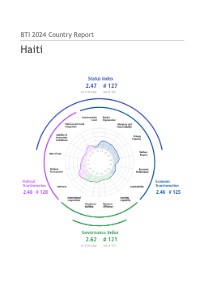
(2024-03) Rapò Peyi BTI 2024 - Ayiti
Rezime — Rapò Peyi BTI 2024 sou Ayiti a evalye transfòmasyon peyi a nan direksyon demokrasi ak ekonomi mache, ki kouvri peryòd 1ye fevriye 2021 rive 31 janvye 2023. Rapò a mete aksan sou kriz politik ak sekirite apre asasina Prezidan Jovenel Moïse, ogmantasyon vyolans gang yo, ak deteryorasyon sitiyasyon ekonomik la.
Dekouve Enpotan
- Kriz politik ak sekirite a vin pi mal apre asasina Prezidan Moïse.
- Vyolans gang yo ogmante, li pwopaje pi lwen pase Pòtoprens.
- Kriz ekonomik make pa gwo enflasyon ak kwasans negatif.
- Kapasite gouvènman an pou bay pwogram sosyal redwi.
- Ayiti ap fè fas ak gwo degradasyon anviwònman ak vilnerabilite nan katastwòf natirèl.
Deskripsyon Konple
Rapò Peyi BTI 2024 sou Ayiti a bay yon analiz konplè sou transfòmasyon politik ak ekonomik peyi a. Li kouvri peryòd 1ye fevriye 2021 rive 31 janvye 2023 epi li evalye eta demokrasi, ekonomi mache, ak kalite gouvènans. Rapò a detaye gwo deteryorasyon sitiyasyon politik ak sekirite apre asasina Prezidan Jovenel Moïse an jiyè 2021, negosyasyon k ap kontinye pou nouvo eleksyon yo, ak ogmantasyon pouvwa gang yo. Li egzamine tou kriz ekonomik la, ki make pa gwo enflasyon, kwasans ekonomik negatif, ak kapasite redwi gouvènman an pou bay pwogram sosyal, agrave pa tranbleman tè Out 2021 ak yon rezurjans kolera.
Teks Konple Dokiman an
Teks ki soti nan dokiman orijinal la pou endeksasyon.
BTI 2024 Country Report Haiti This report is part of the Bertelsmann Stiftung’s Transformation Index (BTI) 2024 . It covers the period from February 1, 2021 to January 31, 2023. The BTI assesses the transformation toward democracy and a market economy as well as the quality of governance in 137 countries. More on the BTI at https://www.bti-project.org . Please cite as follows: Bertelsmann Stiftung, BTI 2024 Country Report — Haiti. Gütersloh: Bertelsmann Stiftung, 2024. This work is licensed under a Creative Commons Attribution 4.0 International License . Contact Bertelsmann Stiftung Carl-Bertelsmann-Strasse 256 33111 Gütersloh Germany Sabine Donner Phone +49 5241 81 81501 sabine.donner@bertelsmann-stiftung.de Hauke Hartmann Phone +49 5241 81 81389 hauke.hartmann@bertelsmann-stiftung.de Sabine Steinkamp Phone +49 5241 81 81507 sabine.steinkamp@bertelsmann-stiftung.de BTI 2024 | Haiti 3 Key Indicators Population M 11.6 HDI 0.535 GDP p.c., PPP $ 3305 Pop. growth 1 % p.a. 1.2 HDI rank of 189 163 Gini Index 41.1 Life expectancy years 63.2 UN Education Index 0.455 Poverty 3 % 58.0 Urban population % 58.8 Gender inequality 2 0.635 Aid per capita $ 82.7 Sources (as of December 2023): The World Bank, World Development Indicators | UNDP, Human Development Report 2021-22. Footnotes: (1) Average annual growth rate. (2) Gender Inequality Index (GII). (3) Percentage of population living on less than $3.65 a day at 2017 international prices. Executive Summary On July 7, 2021, President Jovenel Moïse was assassinated in his residence. Since then, the political and security crisis has severely deteriorated against а backdrop of ongoing negotiations to re-establish a democratically elected government. Prime Minister Ariel Henry – appointed by Moïse two days before his death – took office on July 20 and swore in a new cabinet in late November 2021. The interim government has been negotiating the prospects for new elections with opposition groups. On August 30, 2021, a broad coalition of civil society members and political groups, known as the Montana Accord (Bureau de Suivi de l’Accord de Montana, BSA), proposed a two-year interim government. The goal of this government was to establish stability and oversight until new elections could be held. The signatories of the accord rejected Henry’s government and held elections on their own terms in early 2022. However, Henry’s administration rejected those elections. The most recent round of negotiations, which took place in early March 2023 shortly after the review period, between the Montana Accord and the parties associated with Henry’s government, also concluded without success. On September 11, 2021, Henry signed an agreement with 20 main parties and civil organizations for “peaceful governance” to establish a transitional government to serve until the next elections, initially foreseen for the end of 2022. In the same month, the Control and Monitoring Authority was formed to validate the government’s decrees, and a new cabinet was installed to implement the agreement. Over a year later, in December 2022, after consultations with political leaders, CSOs and private sector members, the government signed a new consensus, the National Consensus agreement, which rescheduled elections for 2023 and the inauguration of the new government for February 2024. It also established the High Transitional Council (HCT) to carry out the tasks of revising the constitution, forming the Provisional Electoral Council (CEP), and strengthening the judicial system, and the Body for the Control of Government Action (OCAG) to ensure compliance with good management and transparency in public governance. The opposition negatively assessed the conclusion of this agreement and the installation of the HCT members. BTI 2024 | Haiti 4 Amid failed political agreements, the security and economic situation have continued to decline. An intensification of gang warfare throughout Port-au-Prince has caused many to flee their homes and live in makeshift shelters. Gang control has also expanded beyond the capital into the suburbs and other provinces. The number of killings has soared. In October 2022, amid the fuel shortage crisis set off by the elimination of fuel subsidies and gang control over the largest fuel terminal (Varreux), which had a disastrous impact on drinking water supply, Henry called for foreign intervention to stop escalating gang violence – an appeal rejected by many Haitians and the opposition. Instead, the United Nations imposed a sanctions regime (Resolution 2653) against Haitian politicians, including two of Henry’s ministers, and businessmen suspected of collusion with gangs and serious corruption. The deteriorating security situation in the country is accompanied by an economic crisis marked by the continued depreciation of the gourde and skyrocketing prices for basic consumer products. Inflation levels reached 47.2% by the end of 2022, one of the highest in the country’s recent history. Additionally, Haiti is on track to experience a fourth consecutive year of negative economic growth. The government has been compelled to reduce social programs despite increasing poverty and growing food insecurity. Beyond this, Haiti endured devastating consequences from the earthquake in August 2021, resulting in the loss of approximately 2,000 lives. A resurgence of cholera – an infection associated with inadequate sanitation and limited access to clean drinking water – also occurred toward the end of 2022. History and Characteristics of Transformation Haiti’s transformation process suffers from fragilities that have their roots in the country’s tumultuous history. The democratic movement that emerged in the late 1980s aimed to quell the country’s chronic instability by introducing new political norms an d advocating for economic and social inclusivity. Unfortunately, this movement faced formidable challenges from anti - democratic forces, as evidenced by numerous coups and fraudulent manipulation of elections designed to obstruct the democratic process. Nevertheless, attempts to reinstate authoritarian rule have consistently encountered opposition from popular movements fueled by a desire for a better life. The democratic movement of the 1980s culminated in the ousting of the Duvalier regime (1957 – 1986) in 1986, when Jean Claude Duvalier was compelled to flee due to widespread protests and pressure from the United States. In 1990, Haiti conducted its first free and democratic elections, resulting in the election of Jean-Bertrand Aristide, a former priest, as president in early 1991. However, a coup d’état disrupted the democratization process, forcing Aristide into exile and ushering in a three-year military regime. In October 1994, Aristide returned from exile with the assistance of two thousand American troops deployed by the Clinton administration in Operation Restore Democracy. In 1996, René Préval, a close ally of Aristide, assumed the presidency. BTI 2024 | Haiti 5 In 2000, Aristide regained power through contentious elections. Popular among the impoverished, Aristide implemented wealth redistribution measures and reduced privileges for the affluent. Faced with tough measures from the United States and international financial institutions, Haiti’s fragile economy suffered multiple setbacks, making it increasingly difficult for Aristide to govern amid mounting political polarization. Following violent protests and an armed rebellion, Aristide was compelled to leave the country on February 29, 2004. Subsequently, the Boniface-Latortue transitional government (2004 – 2006) took power and invited the United Nations to deploy a peacekeeping mission. The UN Security Council authorized the deployment of a multinational interim force to restore stability until the arrival of a UN peacekeeping mission (MINUSTAH). In 2017, MINUSTAH was succeeded by a smaller UN mission (MINUJUSTH), tasked with reforming Haiti’s judicial system. In 2019, MINUJUSTH was replaced by a UN monitoring program known as the United Nations Integrated Office in Haiti (BINUH). During Préval’s second term (2006 – 2011), in January 2010, Haiti was devastated by a catastrophic earthquake that claimed over 250,000 lives and made 1.5 million people homeless, severely damaging the country’s already-fragile infrastructure. Amid this chaos, the international community insisted on holding elections in November 2010. The elections were marred by irregularities and violence, resulting in the election of Michel Martelly, a former singer, as president. In 2015, Martelly was unable to organize general elections for a smooth transition of power, leading to him relinquishing power to a provisional administration in February 2016. Haiti finally conducted elections in late 2016, with the Provisional Electoral Council (CEP) declaring Jovenel Moïse the winner with 55% of the vote. However, only 21% of eligible voters participated, severely undermining Moïse’s legitimacy. Moïse assumed the presidency on February 7, 2017, but was assassinated in mid-2021. Haiti operates under a free market economic system that relies primarily on small-scale subsistence agriculture, free trade, assembly industries, tariff liberalization and foreign exports. In the 1980s, Haiti embarked on economic liberalization and became a key partner in the Reagan administration’s Caribbean Basin Initiative, transitioning from a partially state-dependent economy to an open system. This shift entailed the removal of protective import barriers and high tariffs, along with restructuring local production, particularly in the agricultural sector, which had to contend with subsidized agricultural products from the United States. Several structural adjustment programs were also implemented to foster private sector growth, albeit with limited success. Political instability, corruption and the government’s failure to modernize infrastructure and legal systems have discouraged foreign investment and hindered economic growth. BTI 2024 | Haiti 6 The BTI combines text analysis and numerical assessments. The score for each question is provided below its respective title. The scale ranges from 1 (worst) to 10 (best). Transformation Status I. Political Transformation 1 | Stateness Question Score The state’s monopoly on the use of force is contested by gangs that have formed a federation called the G -9 Family and Allies against the Haitian National Police (PNH). While the gangs have a sophisticated arsenal at their disposal, the PNH is underequipped and unable to guarantee citizens’ safety against gang transgressions (e.g., kidnappings, rapes, assassinations). According to the United Nations Integrated Office in Haiti (BINUH), the actual ratio of active police officers to population is 1.2/1,000 which is far below the United Nation’s standard (2.2/1,000). Moreover, the PNH’s workforce is deteriorating, affected by an increasingly high rate of desertions, dismissals and imprisonments. Police are also prime targets for gangs. Gangs murdered 150 officers between 2020 and 2022 and 14 more in January 2023 alone. Nine police stations were attacked in the Port-au-Prince metropolitan area. The police also suffer from increasing politicization, and some members have direct ties to gangs. Currently, gangs control several neighborhoods in the capital, including the whole metropolitan area, including the neighborhoods of Martissant, Carrefour-Feuilles, Cite Soleil, Village de Dieu, Delmas and Bel-Air. Gangs also have control over the roads to several departments, including four through the blockade of Martissant, and to Centre, Artibonite (considered the breadbasket of the country) and the international road that leads to Haiti’s border with the Dominican Republic. Part of the administrative city containing parliament and the Public Prosecutor’s Office is also under their control. In recent months, gangs have extended their influence to neighborhoods that were previously considered relatively calm, such as several middle-class ones. The situation has deteriorated even further in 2023. Monopoly on the use of force 2 BTI 2024 | Haiti 7 The conditions for the emergence of the Haitian State have given it an anti-slavery, anti-colonial and anti-racist character. All the constitutions promulgated by the Haitian State have enshrined these values. The large majority of the population accepts the nation-state as legitimate. However, from the moment of its foundation, the new state was marked by a fracture between the urban elites and the rural communities, between the French language spoken by a minority of citizens and the Creole language spoken by all Haitians. This divide is expressed in social relations by the existence of a certain social disdain on the part of the elites and of resentment by those who feel excluded from society. Despite adopting the Creole language in the 1987 constitution as the country’s second official language, all acts, laws, decrees, orders and court decisions are still published solely in French. The Haitian State has failed to provide all citizens with civil status certificates and identity documents. Access to viable identity documents has been one of the main demands of the people since the beginning of the popular protests against the Duvalier regime. President Moïse’s program to distribute identity documents failed, as it was marred by multiple irregularities. State identity 7 The Haitian State is secular, although Catholicism was for a long time the only official religion and the Catholic Church enjoys privileges originating from the 1860 Concordat signed between the government and the Vatican. The 1987 constitution recognized Voodoo as a legal religion before it became the country’s second official religion in 2003. With this legal recognition, adepts of Voodoo can undertake legal activities previously reserved only for the Catholic Church. The Catholic Church’s influence has g reatly diminished to the benefit of the Protestant Church, which is considered closer to the working population. Other religions, such as Rastafarianism and Islam, are also on the rise. Though religion typically does not have a direct influence on politics, the Catholic and Protestant churches have played an important role as facilitators in negotiations to overcome political crises. In 2020, the Catholic and Protestant Churches also protested against the draft law on the new penal code recognizing LGBTQ+ rights and abortion, arguing that the draft was immoral and penalized discrimination based on sexual orientation. Their efforts were unsuccessful. No interference of religious dogmas 9 Haiti’s physical infrastructure and services are concentrated in the capital and in a few provincial towns. In poor urban and rural areas, mostly international technical and financial partners and non -governmental and civil society organizations provide social services. The central government does not allocate sufficient resources for drinking water, health, education and electricity, and local authorities have few resources to meet demands for basic services. According to the World Bank, only 0.6% of GDP is spent at the communal level; communal revenues account for only 1.7% of overall state revenues. According to Direction Nationale de l’Eau Potable et d’Assainissement de l’Eau à Domicile Basic administration 1 BTI 2024 | Haiti 8 (DINEPA), 55% of the population had regular access to potable water in 2022 (48% in rural areas and 68% in urban areas). Provision of electricity is irregular and subject to frequent breakdowns; 46.9% of the population has access to electricity, of which only 18% reaches rural areas. One out of five inhabitants does not have access to improved sanitation, and only one out of ten inhabitants has access to a solid waste collection system. More than one-third of the population has experienced high levels of food insecurity; in July 2021, 66% of households reported that they did not have enough to eat at least once in the previous month, according to the World Bank. Transport services are inadequate, with 50% of the country’s territory poorly connected. However, Haiti has made some progress in disaster risk management and civil protection. Compared to the management of the 2010 earthquake, the administrative structures were far more effective in managing the August 2021 earthquake that devastated the southern peninsula. During the review period, the loss of territorial control to gangs further weakened the state’s ability to provide basic social services. Blocking access to four departments in the south of the country for more than two years has isolated the inhabitants of these regions, making it harder for them to access basic services. Health services in the regions have also deteriorated, with hospitals unable to obtain medicine supplies. Provincial hospitals and schools remained closed for several months of the year. The system of basic services, both in urban and rural areas, was further weakened by the fuel crisis that the country experienced between June and September 2022. With electricity production in the country depending on petroleum products for 86% of its output, the crisis negatively impacted services that depend on diesel-powered generators, such as drinking water, electricity and medical services. 2 | Political Participation Haiti has a semi - presidential system, with the president elected for five - year terms and the prime minister appointed by the president with confirmation from the parliament. On February 7, 2017, Jovenel Moïse became president. However, the 2016 elections were marred by irregularities. Moïse was assassinated on July 7, 2021, and an interim government led by Prime Minister Ariel Henry – appointed by Moïse two days before his death – was installed with a cabinet of 10 out of 18 ministers from Moïse’s administration. The Senate is supposed to include 30 members and its lower legislative chamber, 119; no seats are filled. On January 10, 2023, the tenure of the 10 remaining senators expired, leaving Haiti with no elected members in the Senate or house. As of January 31, 2023, Haiti is without any elected authority, as required by its constitution. Free and fair elections 1 BTI 2024 | Haiti 9 Currently, perhaps somewhat by “accident,” there are no elected political decision- makers. Irrespective of that, there are various powerful groups capable of vetoing the initiatives of those who may be democratically elected. Among these, the business sector has increased its power in recent years and is able to influence election outcomes through financial support and to impose its power on elected officials afterwards. Moïse’s campaign exposed the problem of state capture by increasingly powerful rentier networks, which control the public administration and short-circuit public policy decisions. The state’s financial weakness and its dependence on foreign donors, international organizations and NGOs reinforce this decline of effective power to govern. Effective power to govern 1 The 1987 constitution guarantees the right of association, assembly and freedom of expression. There are no prohibitions on independent political or civic groups or interference in their assembly. There have been several cases of intimidation of public protests organized by the opposition or movements critical of the gove rnment, and also of protests by government supporters. Haitian law (Decree of July 23, 1987 on public meetings) requires anyone wishing to hold a public meeting or peaceful demonstration to notify the local police 48 hours in advance. The person who has notified the police of the demonstration is responsible for the proper conduct of the demonstrators and participants in the gathering. Accordingly, the government grants demonstration permissions. However, the government regularly permits the National Police to use lethal weapons to repress authorized demonstrations. The Moïse government made excessive use of the PNH to quell even the smallest demonstration against his regime, although the excessive use of force by police is strictly prohibited by an internal order of the PNH. Under the government of Ariel Henry, demonstrations and brutalities against demonstrators have decreased mainly due to gangs terrorizing the slum neighborhoods, where most of the demonstrations take place, and thereby preventing protests. According to the United Nations, 1,490 demonstrations, roadblocks and barricades were recorded in 2022, an increase of 35.5% over last year. Association / assembly rights 4 The constitution guarantees freedom of expression and freedom of the press. Journalism, particularly radio journalism, is rather robust and varied, which is the result of a long struggle during the Duvalier years. In 2022, Reporters Without Borders (RSF) r anked Haiti 70th out of 180 countries in terms of freedom of the press, pointing out a dangerous and precarious work environment for journalists given lawlessness and uncertainty, self -censorship, the 2017 defamation law and a lack of financial resources. Since the 2000s, the media landscape has changed significantly. Today, only two daily newspapers exist, while there is a real proliferation of radio stations, television stations and especially online media, which represent the most widespread means of information. In September 2019, CONATEL (Conseil National de Télécommunications) counted 398 broadcasting stations on the FM band, about 60 Freedom of expression 4 BTI 2024 | Haiti 10 community radio stations and 111 TV stations. However, CONATEL denounced the fact that many of the broadcasting stations were not operating legally and caused interference to the telecommunications system. It is very difficult for journalists to access public information regarding public contracts and the execution of public works or audits. Journalists are also often confronted with government allegations of defamation, which restricts them from publishing reports on political figures. Investigative journalists are especially vulnerable. Threats against them have led to self-censorship and avoiding reporting on the involvement of public figures in drug and arms trafficking or corruption, for fear of reprisal. Nine journalists were killed in 2022, according to the Inter-American Press Association, a significant number for a small population of about 12 million. Some were targeted by gangs, and at least two were shot by police. Actors in the public sector usually enjoy impunity when violating freedom of the press. 3 | Rule of Law The constitution establishes the separation and balance of power between the executive, the two houses of parliament and the judiciary. However, both the head of state and parliamentarians have always sought to undermine the balance of power. Parliament has the means to oppose the claim of pre -eminence of the head of state, but not always with the goal of strengthening institutions. Under Moïse’s government, the previous year’s budget had to be renewed several times because the deputies refused to vote for the budgetary law submitted to parliament by the executive. During his presidency, Moïse appointed no less than seven prime ministers because parliament would not approve his candidates for the post. The executive branch in Haiti has two significant levers that effectively grant it power over the other two branches: patrimonial control over the resources of the treasury and the authority to call the populace to the polls. This electoral power is outlined in the constitution and entrusted to the Permanent Electoral Council. Past presidents have not taken the necessary steps to establish this council due to concerns about losing influence over its composition, despite the fact that, by law, various stakeholders must be involved in the process of selecting council members. Overall, this situation jeopardizes the rule of law by providing an incentive for the president to delay elections and avoid renewing the parliament. The PHTK governments have frequently employed this tactic to postpone elections, ultimately consolidating unchecked executive authority. President Moïse employed this strategy until his death in mid-2021. Under Moïse, the executive inserted itself into the judiciary’s affairs. In February 2021, he unilaterally dismissed and replaced the three sitting judges of the Court of Cassation, despite their constitutional security of tenure. Additionally, the president failed to renew the terms of judges approved by the CSPJ (Cour Supérieure de la Police Judiciaire). Approximately 60 judicial positions remain vacant, making the courts dysfunctional. Separation of powers 2 BTI 2024 | Haiti 11 The judicial system is based on the constitutional provisions that define different jurisdictions. It is in a state of total dysfunction, plagued by corruption and objected to several arbitrary decisions by Moïse’s government. Moïse’s intervened in the judiciary to prevent the processing of multiple cases of corruption and assassinations in which government representatives were involved. The Cour Supérieure des Comptes et du Contentieux Administratif (CSCCA), which is responsible for overseeing public finances, was restricted at the president’s instigation in retaliation for the court’s willingness to prosecute government officials for the misuse of PetroCaribe funds and other acts of corruption. Moïse criticized the CSCCA for its slow processing of public procurement cases submitted by the government and restricted the body’s oversight function because the court released a report implicating Moïse in the spoliation of the PetroCaribe fund. In February 2021, Moïse took action against Judge Yvickel Dieujuste Dabresil from the High Court of Justice. This move was prompted by the judge’s engagement with the opposition, who had asked him to step in as a temporary president to counter Moïse’s desire to extend his time in power. As part of his strategy, Moïse forced the retirement of court judges and hand-picked new judges who were aligned with his interests. He also declined to renew the terms of judges suggested by the CSPJ. This led to a situation in which 60% of judicial positions remained vacant, severely hampering the courts’ functionality. Despite lacking the constitutional authority to appoint judges to the Court de Cassation, Prime Minister Ariel Henry proceeded to appoint eight new judges in February 2023, replacing those who had been removed by Moïse. Independent judiciary 1 Impunity, which has a long tradition in the country, became widespread during the review period. As abuses of power have multiplied, it has become considerably more difficult to hold authorities accountable. During the review period, the Haitian Senate iss ued two reports on the misappropriation of PetroCaribe funds and established the responsibilities of high -level state officials. The reports were published by the CSCCA, which also issued a report on the misappropriation of PetroCaribe funds. In June 2021, the PetroCaribe investigation was suspended indefinitely, and the defendants’ assets were released for lack of evidence. However, the judge did not explicitly acquit the defendants. Prime Minister Ariel Henry has not appeared before the government commissioner in charge of the investigation into the assassination of President Moïse to respond to accusations of his involvement. Several ministers in Henry’s government, including the minister of justice and the minister of the interior, have been implicated in arms trafficking scandals and kidnapping. Senators have also been publicly denounced for having close ties with gang leaders. None of these officeholders have been arraigned or prosecuted. Additionally, the judicial system has failed to follow up on numerous massacres in which police and senior public officials were implicated. Police officers frequently act with impunity when dealing with civilians, particularly during events such as demonstrations and while conducting arrests. Prosecution of office abuse 2 BTI 2024 | Haiti 12 However, since the beginning of 2023, some actions have been taken by the judicial and anti-corruption authorities against judges and former senators. On January 16, 2023, the Superior Council of the Judiciary published a list of 28 judges accused of corruption, possessing false academic credentials or lacking moral integrity. As a result, these judges were not certified to continue their roles. It’s worth noting that no formal charges have been brought against these individuals, leaving open the possibility for them to potentially serve as judges in the future. In early March 2023, the Anti-Corruption Unit (ULCC) submitted nine investigation reports on cases of flagrant corruption against eight former senators and a former director of the General Administration of Customs. The senators will not be able to participate in the next elections. The ULCC has formally requested that the judiciary prosecute those denounced in its report. To date, no authority accused of abuse of office, whether a member of the executive or parliament, has been brought to justice. Civil rights are guaranteed by the constitution; however, access to justice is poorly protected, making it difficult for citizens to claim their rights in court. Poor citizens face discrimination in terms of access to justice, as judicial services are generally out of reach. Moreover, the courts use French, rather than Creole, and legal decisions and documents are in French, which effectively excludes most of the population. With the deterioration of the security situation, protecting civil rights has become even more difficult. Haiti has ratified the CEDAW and Belém do Para Conventions on the elimination of all forms of discrimination against women and the achievement of gender equality. The security situation and the expansion of gangs in the country have, however, led to massive violations of the rights of women and girls, who are raped, kidnapped and killed by gangs. Between January and March 2022, BINUH counted an average of 98 victims of sexual violence each month. In August 2022, clashes between gangs in Cite Soleil resulted in 52 acts of sexual violence. Other clashes in the Croix des Bouquets area led to the gang rape of 40 women in November 2022. Multiple civil violations, even when they are well documented, are neither prosecuted nor punished. Haiti has ratified the International Covenant on Civil and Political Rights, which guarantees the rights of nondiscrimination and equality before the law, but the country’s poverty and the influence of religion in the formation of opinions influence its widespread intolerance of LGBTQ+ people. The Senate approved during the 50th legislature two anti-LGBTQ+ bills, one of which prohibits same-sex marriage. Civil rights 1 BTI 2024 | Haiti 13 4 | Stability of Democratic Institutions One reason for the poor performance of democratic institutions is the conflict between the two heads of the executive, the Presidency and the Prime Minister’s Office. The president is the head of state, elected by universal suffrage, and the prime minister is from the party with a majority in the Assembly but appointed by the president. The history of conflictual relations between the two heads of the executive has been a factor in the institution’s instability and counter-performance. Conflicts with the parliament over the appointment of the prime minister were the source of institutional crises during the presidency of Moïse, who appointed seven prime ministers in five years. The president’s interference in the judicial system has ruined his legitimacy in the eyes of the public and prevented him from playing his constitutional role. Corruption in the judiciary has also contributed to its poor performance. Political parties in Haiti are not actively contributing to the vitality of political life and the strengthening of democratic institutions. Instead, they often resemble groups associated with individual political figures that are able to exercise pressure and which lack a genuine social base. The disorderly and fraudulent nature of many of the country’s elections has led citizens to doubt the credibility of election results, eroding their trust in the functioning of these institutions. Surveys conducted by LAPOP on the opinions of Haitian citizens regarding the performance of their democratic institutions consistently reveal a very low level of confidence in both the institutions themselves and the individuals in charge of them. Prime Minister Henry has inherited the institutional challenges left behind by Moïse, operating without clear performance requirements and lacking accountability to any overseeing authority. The mechanisms designed to maintain checks and balances are largely ineffective, if not entirely absent. Performance of democratic institutions 1 Currently, Haiti lacks functioning democratic institutions, primarily due to the absence of elections. This absence alone underscores the questionable commitment of most actors involved. This situation illustrates the extent to which politics in Haiti are a ruthless pursuit of power, where individual and group interests often supersede any consideration of the common good. Most democratic institutions are only weakly accepted as legitimate by relevant actors, whether political or economic elites. There are certain business interest groups, such as the Economic Forum (which is comprised of major import businesses), the Haitian-American Chamber of Commerce, the National Lottery Association and drug-trafficking networks, which aim to influence the selection of a government that can be easily manipulated to serve their own interests. Commitment to democratic institutions 1 BTI 2024 | Haiti 14 5 | Political and Social Integration The political landscape is structured around two types of organizations: a first circle made up of parties such as ex -President Michel Martelly’s PHTK, the party in power, the Lavalas Party and a set of parties and political organizations connected to the ex- President Préval’s party, UNITÉ. These parties have various constituencies, although the dividing lines between them are not clear and representatives can be found changing sides. They have been able to exert their control over power for more than 30 years. They are all creations of presidents, a characteristic of the Haitian political landscape. Deputies and senators, although they nominally belong to parties, must, for several reasons, be approached as part of a special group of politicians. They straddle the party, business sector, gang network and their social bases. Other political parties in Haiti typically emerge as ad hoc coalitions of politicians shortly before elections. These groups are usually led by a figure with some political renown, positioning themselves as part of the winning candidate’s movement. They also actively engage in numerous rounds of political negotiations to secure appointments to public service positions. These parties have networks within society that they can mobilize during these negotiations, lending an appearance of legitimacy to the initiatives of the incumbent government. These parties lack a clear ideological vision for Haitian society that would define their role in political struggles. Their financial fragility makes them susceptible to capturing state resources in exchange for their support. Despite successive governments having announced efforts to enact a law on political party financing to enhance their independence, such endeavors have not yielded significant success. Party system 2 Various interest groups, like unions, represent several sectors of society (e.g., rural communities). These groups have, however, lost their influence in state affairs and dominance in sociopolitical struggles. They are victims of the transformation of the political system from parties with a strong popular base and populist orientation to new political actors who emulate an economic oligarchy. The dismantling and privatization of public enterprises as part of neoliberal policies contributed to the erosion of the power of these groups. The only unions active in the last two years are the textile companies’ union and the transport union, which have participated in several large demonstrations and strikes. Students did hold sporadic demonstrations, but they were violently suppressed by the PNH. Moreover, although professional associations are weak, they openly condemn kidnapping for ransom, as professionals were prime targets for gangs during the review period. Still, professional associations have little internal life or capacity for mobilization. Interest groups 3 BTI 2024 | Haiti 15 In summary, the most powerful interest groups in Haiti are those in the private business sector. In recent years, this sector has established several representative organizations through the numerous regional chambers of commerce and industry and bilateral chambers of commerce. These organizations are points of contact for international technical and financial partners in the country and actively engage in negotiations aimed at addressing the ongoing crisis. Still, their real strength lies, as observed during Moïse’s mandate, in the close ties they maintain with the presidency, deputies and senators and, for some, with the gangs. Since the fall of the Duvalier dictatorship, Haitians have continued to fight for the deepening of the democratic process. However, this has experienced many setbacks (rigged and contested elections, failure to respect electoral deadlines, failure to create the Permanent Electoral Council provided for in the 1897 constitution) and impacted confidence in democracy. Support for democracy requires support for its institutions. While trust in elections has increased in the region, from 38% in 2018 to 42% in 2021, in Haiti it is 27%, at the bottom alongside Honduras and Colombia. Haitians display little pride in the political system, at 28%, alongside Brazil. Only 37% of Haitians think the country is a democracy. For democracy to work well in a country it is not enough that trust in institutions be high, trust among citizens is equally important. In Haiti, 54% of citizens say they trust their fellow citizens. Given the crisis situation in the country and the proliferation of violence, this level of interpersonal trust is most likely on the decline. Compared to other countries in the region, Haitian citizens are less willing to sacrifice freedom of expression in order to obtain a minimum income from a political regime. This does not prevent Haitians from expressing their dissatisfaction with the democratic system. Approval of democracy n/a Social capital has different meanings in rural and urban settings. In rural areas, the organization of mutual aid among peasants in agricultural work is based on relationships of proximity, interpersonal trust and good reputation. The role of social capita l in promoting popular solidarity during the 2010 earthquake showed it can contribute to strengthening the resilience of the population, helping it to cope with the various shocks to which it was exposed and to compensate for the absence of the state in pr oviding basic social services. However, the multiple shocks to which the country has been exposed in recent years have contributed to a weakening of solidarity networks and interpersonal trust. The spread of gang violence and the intensity of the mobility of people in a territory subject to a frantic pace of urbanization have weakened the old solidarity networks and reduced the scope of proximate interactions. In urban environments, corruption networks and the practice of “passe-droit” in public administration are only possible if people make intensive use of social capital. However, according to LAPOP 2021, 54% of Haitians say that members of their Social capital 3 BTI 2024 | Haiti 16 community are fairly or very trustworthy. The huge impact of gang violence during the review period has, however, damaged the social fabric considerably. Community trust has certainly deteriorated since the last LAPOP report. II. Economic Transformation 6 | Level of Socioeconomic Development Question Score Haiti is ranked 163rd out of 191 countries in the Human Development Index in 2021, with a score of 0.535. According to World Bank estimates for 2021, the poverty rates are 87.6% ($6.85/day), 58.7% ($3.65/day) and 30.32% for extreme poverty ($2.15/day). Hai ti’s Gini coefficient is 0.61, making it one of the highest in the world. The gender inequality index was 0.635 in 2021, which is also particularly high. These two elevated levels demonstrate the stark division within Haitian society, with a privileged eco nomic elite controlling the formal sector of the economy, while the majority of poor people and actors engage in the informal economy, accounting for approximately 90% of employment. Women dominate the informal economy, which is characterized by very small production units with low profit margins, and are excluded from the bank credit system, government subsidy programs and public procurement. In rural areas, the subsistence economy relies heavily on small farms with low yields, which face competition on the domestic market from inexpensive agricultural imports. In addition to structural factors that constitute heavy socioeconomic barriers and contribute to the reproduction of poverty among the vulnerable population (e.g., low access to basic social services, financial exclusion, prejudice against women in the labor market), the current crisis situation has reinforced socioeconomic barriers and created new ones. Due to the disruption of supply chains caused by gang occupations of the country’s main roads, women merchants cannot go to the markets to sell their products. Women are also the main victims of inflation, as they are confronted by the fall in demand on consumer product markets where they sell their products. Socioeconomic barriers 1 BTI 2024 | Haiti 17 Economic indicators 2019 2020 2021 2022 GDP $ M 15016.1 14508.2 20877.4 20253.6 GDP growth % -1.7 -3.3 -1.8 -1.7 Inflation (CPI) % 18.7 22.8 16.8 34.0 Unemployment % 13.8 15.1 15.0 14.8 Foreign direct investment % of GDP 0.5 0.2 0.2 0.2 Export growth % -2.1 -37.9 23.5 2.4 Import growth % 4.7 -18.3 2.3 4.9 Current account balance $ M -168.8 216.2 141.4 - Public debt % of GDP 25.4 22.0 25.6 23.9 External debt $ M 2213.9 2317.7 2604.1 - Total debt service $ M 21.6 25.5 25.3 - Net lending/borrowing % of GDP - - - - Tax revenue % of GDP - - - - Government consumption % of GDP 7.2 7.3 7.5 6.9 Public education spending % of GDP 1.8 1.4 1.8 1.3 Public health spending % of GDP 0.4 0.4 - - R&D expenditure % of GDP - - - - Military expenditure % of GDP 0.1 0.2 0.1 0.1 Sources (as of December 2023): The World Bank, World Development Indicators | International Monetary Fund (IMF), World Economic Outlook | Stockholm International Peace Research Institute (SIPRI), Military Expenditure Database. 7 | Organization of the Market and Competition The Haitian market comprises an informal sector estimated by the World Bank at 60% of GDP, along with a small, poorly regulated formal sector that is highly concentrated. Haitian firms are primarily young microenterprises with few employees and generally l ow levels of education. These firms exhibit a minimal level of managerial skills and productivity. While women entrepreneurs play a prominent role in the Haitian market, their businesses tend to be smaller than those owned by men. Additionally, women are l ess inclined to take risks than men, particularly during the review period, when acts of gang violence disproportionately targeted women. Market organization 3 BTI 2024 | Haiti 18 Liberalization in the 1980s was accompanied by an institutional framework that guarantees competition, so the Haitian market remains highly concentrated despite the country’s trade openness. Price setting is mainly determined by market forces, but the existence of monopolies and oligopolies in many markets for goods and services distorts the price mechanism. The Haitian state does not impose any restrictions on the export of profits generated in the country or on the free movement of business personnel. The government has an incentive system for new investors in sectors such as agriculture but has had to eliminate certain subsidies and exemptions because of their negative impact on revenues. Regarding currency convertibility, there is a structural scarcity of foreign exchange in the country due to the low level of exports, despite the high level of remittances from the diaspora. There is a system in place to channel foreign exchange to specific essential imports, such as fuel. The central bank has attempted to protect the gourde against the dollar by injecting dollars into the foreign exchange market, but these efforts have proven unsuccessful. Haitian markets for goods and services are controlled by a minority of actors who enjoy monopoly and oligopoly positions. They use their parallel networks within the government to pay very little tax. In a World Bank study on competition in Haiti, a group of 17 families is singled out for their control over all the country’s major markets for several decades. This explains why Haitian consumers pay the highest prices for goods and services in the region and why new investors, although interested in the Haitian market and eager to exploit its opportunities, are reluctant to invest in the country. Haiti does not have a price control system. Instead, efforts to control prices appear to be arbitrary and are managed by the Ministry of Commerce and Industry through mobile brigades. Consumer associations face difficulties organizing themselves primarily due to financial constraints. Haiti also lacks a competition authority and is not a member of the International Competition Network. Efforts to enhance the legal framework for trade and establish quality control services have waned due to a lack of political will, financial resources and qualified personnel. The initiative to create a competition law and establish a competition authority has not been pursued. The adoption of an anti-dumping law is crucial, considering the prevalence of anti-competitive practices in the import market for goods and services and their potential to hinder the development prospects of domestic production. Competition policy 2 BTI 2024 | Haiti 19 Haiti became a WTO member in 1996 and a GATT member in 1950. Its economy stands out as one of the most open in the Caribbean region. There is no discrimination between local and foreign companies in the country’s legislation. As part of the structural adjustment policies embraced during the 1980s, Haiti extensively liberalized its economy by removing tariff and non-tariff barriers, while also opening up the market to agricultural products. However, this liberalization occurred without implementing any measures to enhance competitiveness, establish legislation to counteract the entry of cheap imports at dumping prices or create effective mechanisms to combat smuggling. Consequently, local production, particularly in the agricultural sector, has suffered considerably, as the country dedicates a significant portion of its foreign currency reserves to purchasing food products. Haiti grants most-favored nation treatment to all of its partners. It is a member of the Caricom Community and Common Market. The country has ratified the revised Treaty of Chaguaramas, although implementation is pending. Similarly, the Caricom Common External Tariff has not been published in the Official Journal Le Moniteur of the Haitian State. Consequently, customs duties in Haiti are considerably lower than in Caricom countries. Under the Generalized System of Preferences (GSP), Haiti enjoys non-reciprocal preferential treatment from several developed countries. Haiti has privileged access to various markets, with the United States and the European Union being the most important. However, the country is unable to fully benefit from this due to its restricted capacity for exports. Haiti has comparatively low customs tariffs, but importers face additional levies at the border, including verification fees, duties and contributions to local government management funds. These additional charges may surpass the consolidated duties. The Haitian government has a very liberal incentive regime but has had to reverse some of the benefits granted to investors because of the loss of revenue this incentive regime represents as a significant proportion of its GDP. At the last trade policy review of the country, these losses were equivalent to 4.1% of GDP. The country has proceeded with a tariff rearmament by imposing a 5% tariff on all products that were duty-free. Haiti applies a simple average most-favored nation (MFN) rate of 9.7% for agricultural products and