

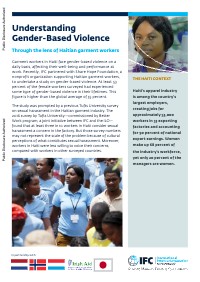
Comprendre la violence basée sur le genre à travers le prisme des ouvriers du textile haïtiens
Resume — Ce rapport examine la violence basée sur le genre vécue par les ouvriers du textile haïtiens. Il souligne la prévalence des abus verbaux, physiques et sexuels, tant à la maison qu'au travail, et son impact sur le bien-être et la productivité des travailleurs. L'étude suggère la nécessité de politiques de respect au travail, de mécanismes de signalement anonymes et de cadres juridiques renforcés pour lutter contre la violence basée sur le genre en Haïti.
Constats Cles
- 53 % des ouvrières du textile interrogées ont subi une forme de violence basée sur le genre au cours de leur vie.
- La violence basée sur le genre affecte la productivité des travailleurs et leur capacité à travailler efficacement.
- 85 % des femmes interrogées pensent que le harcèlement sexuel est un problème courant auquel sont confrontées les ouvrières du textile.
- Les stratégies de prévention et d'atténuation pour lutter contre l'impact de la violence basée sur le genre sur le lieu de travail sont insuffisantes.
- Haïti n'a pas de législation sur la violence domestique ni de législation traitant spécifiquement du harcèlement sexuel sur le lieu de travail.
Description Complete
Ce rapport, fruit d'un partenariat entre IFC et la Share Hope Foundation, étudie la violence basée sur le genre (VBG) chez les ouvriers du textile haïtiens. L'étude, menée dans 12 usines Better Work à Port-au-Prince, révèle qu'au moins 53 % des travailleuses interrogées ont subi une forme de VBG au cours de leur vie, dépassant ainsi la moyenne mondiale. La recherche met en évidence diverses formes de violence, notamment les abus verbaux, le harcèlement, la violence physique et la coercition sexuelle, et souligne le besoin urgent de politiques de respect au travail, de mécanismes de signalement anonymes et de programmes de formation complets. En outre, le rapport souligne l'importance de renforcer le cadre juridique en Haïti pour lutter contre le harcèlement sexuel et la discrimination sexuelle sur le lieu de travail.
Texte Integral du Document
Texte extrait du document original pour l'indexation.
THE HAITI CONTEXT Haiti’s apparel industry is among the country’s largest employers, creating jobs for approximately 53,000 workers in 33 exporting factories and accounting for 90 percent of national export earnings. Women make up 68 percent of the industry’s workforce, yet only 20 percent of the managers are women. In partnership with: Understanding Gender-Based Violence Through the lens of Haitian garment workers Garment workers in Haiti face gender-based violence on a daily basis, affecting their well-being and performance at work. Recently, IFC partnered with Share Hope Foundation, a nonprofit organization supporting Haitian garment workers, to undertake a study on gender-based violence. At least 53 percent of the female workers surveyed had experienced some type of gender-based violence in their lifetimes. This figure is higher than the global average of 35 percent. The study was prompted by a previous Tufts University survey on sexual harassment in the Haitian garment industry. The 2016 survey by Tufts University—commissioned by Better Work program, a joint initiative between IFC and the ILO— found that at least three in 10 workers in Haiti consider sexual harassment a concern in the factory. But those survey numbers may not represent the scale of the problem because of cultural perceptions of what constitutes sexual harassment. Moreover, workers in Haiti were less willing to voice their concerns, compared with workers in other surveyed countries. Public Disclosure Authorized Public Disclosure Authorized Public Disclosure Authorized Public Disclosure Authorized 56% EXPERIENCED VERBAL ABUSE AT WORK 35% WERE HARASSED IN THE STREET/ON TRANSPORT 33% WERE FORCED TO HAVE SEX BY A PARTNER 2 6% EXPERIENCED PHYSICAL VIOLENCE BY A PARTNER 18% WERE TOUCHED AT WORK AGAINST THEIR WILL 15% WERE ASKED FOR SEX FOR A WORK BENEFIT HAITIAN WOMEN ARE EXPERIENCING VIOLENCE IN EVERY SPACE THEY OCCUPY 68 percent of the survey participants said gender- based violence is never acceptable, 26 percent said these practices are acceptable, and 5 percent said it can be acceptable under certain conditions (for example, when the husband is financially stressed). An increasing body of evidence documents that violence experienced at home and in the workplace affects workers’ productivity and their ability to work efficiently. A 2014 World Bank study estimated the economic cost of violence against women and girls to be between 1.2 percent and 3.7 percent of global GDP. The Share Hope Foundation study, which included surveys, focus groups, and interviews with garment workers in 12 Better Work factories in Port-au-Prince, sought to assess workers’ experiences with various types of gender-based violence and explore its impact on the workplace. Results of the analysis* show that gender-based violence is a major issue in Haitian woman’s lives. “I am a victim of psychological violence and so are my coworkers; this happens when we are working and someone tells us something mean that upsets us the entire day, or when the supervisor yells at us.” — Focus Group Participant “Women are not objects. Women are people like men.” — Focus Group Participant 85 percent of the women surveyed believed that sexual harassment was a common problem that garment workers face in their everyday lives. *The data reflect qualitative and quantitative research involving 148 male and female garment workers in Port-au-Prince, Haiti. The statistics reflect the results of quantitative research concerning 60 female garment workers from four different factories. These factories combined employ approximately 6,000 workers. While the results provide insights into various types of gender-based violence affecting workers in the participating factories (including verbal, physical, and sexual abuse at home and in the workplace), the sample size of factories was small. Therefore, the research results are not indicative of the Haitian garment industry as a whole. Further research is required to better understand gender-based violence trends in the garment industry in Haiti. BUILDING RESPECTFUL WORKPLACES Respectful workplaces are safe and supportive environments where sexual harassment is not tolerated and where workers affected by other forms of gender- based violence feel comfortable to disclose their experience and seek support. Raising awareness about a respectful workplace. In Haiti, prevention and mitigation strategies to address the impact of gender-based violence on the workplace are insufficient. One way to implement effective measures to address this violence is to strengthen and raise awareness about respectful workplace policies. Since August 2018, Better Work is working with a number of factories in Port-au-Prince, Caracol, and Ouanaminthe to deliver a new training, “Sexual Harassment Awareness and Prevention”. Better Work factories also started introducing a respectful workplace policy targeting workers, supervisors, and senior management. In order for employees to benefit from the existing policies, factories could consider launching an awareness-raising campaign about respectful behaviors in the workplace. Anonymous reporting and confidential grievance mechanisms. To ensure that incidents of disrespectful behaviors in the workplace are reported, garment factories can introduce an anonymous reporting mechanism. As workers’ trust in this reporting mechanism increases, some workers may choose to have their cases investigated through a confidential grievance mechanism. Worker and supervisor training. Training programs for supervisors and workers, in particular nurses, can ensure that all employees are aware of the factory’s respectful workplace policies and reporting, grievance, and referral mechanisms. During the Share Hope Foundation study, factory nurses requested training to address the needs of sexual violence victims who came to factory clinics for help. They said they weren’t equipped either to advise workers experiencing gender-based violence or to refer them to medical, legal, and social services. STRENGTHENING THE LEGAL FRAMEWORK Haiti does not have domestic violence legislation, nor does it have legislation that specifically addresses sexual harassment in the workplace. Gender discrimination is currently part of the Labor Law reform agenda. In this context, the government can consider introducing legal provisions on sexual harassment in the workplace as a key step toward ensuring women’s protection at work. Awareness raising activities at the factory level can help develop a common understanding of what is expected of workers and supervisors to create a safe workplace for everyone. CONTACT Sabine Hertveldt, Senior Operations Officer: shertveldt@ifc.org Anna Kalashyan, Operations Analyst: akalashyan@ifc.org Additional resources available at: IFC Textiles & Apparel: https://www.ifc.org/Textiles Better Work: https://betterwork.org/ IFC Gender: https://www.ifc.org/gender