
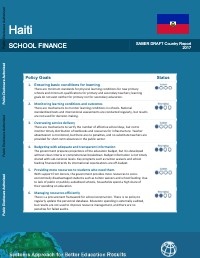
Finansman Lekòl ann Ayiti: Rapò Peyi SABER
Rezime — Rapò sa a evalye sistèm finansman lekòl ann Ayiti a avèk kad Apwòch Sistèmik pou Pi Bon Rezilta nan Edikasyon (SABER) Bank Mondyal la. Li egzamine politik ki gen rapò avèk kondisyon lekòl yo, alokasyon resous yo, sous revni yo, depans edikasyon yo, ak kontwòl fiskal, epi li idantifye pwen fò ak pwen fèb nan sistèm nan.
Dekouve Enpotan
- Ayiti gen nòm minimòm pou kondisyon fizik debaz pou aprantisaj ak kalifikasyon pwofesè yo, men nòm sa yo sèlman kontwole konstriksyon nouvo lekòl primè yo.
- Ayiti pa fikse objektif pèfòmans pou aprantisaj elèv yo, ni nan nivo primè ni nan nivo segondè.
- Kalite ak vitès koleksyon done yo, pwosesis yo, ak diseminasyon yo ta ka amelyore anpil.
- Gouvènman an prepare pwojeksyon senk ane pou bidjè edikasyon an, men li devlope san kritè alokasyon klè oswa klasifikasyon bidjetè konplè.
- Kay nan Ayiti depanse yon gwo pati nan depans yo nan edikasyon, etandone sistèm edikasyon piblik limite a.
Deskripsyon Konple
Rapò sa a bay yon evalyasyon sou sistèm finansman lekòl ann Ayiti a ki baze sou kad Apwòch Sistèmik pou Pi Bon Rezilta nan Edikasyon (SABER) Bank Mondyal la. Analiz la kouvri senk domèn kle pou kolekte done: kondisyon ak resous lekòl yo, mekanis alokasyon yo, sous revni yo, depans edikasyon yo, ak kontwòl ak kapasite fiskal yo. Li evalye nan ki nivo sistèm nan bay resous yo yon fason efikas pou tout timoun ka aprann, avèk sis objektif politik: asire kondisyon debaz pou aprantisaj, siveye kondisyon ak rezilta aprantisaj yo, sipèvize livrezon sèvis yo, fè bidjè avèk enfòmasyon adekwat ak transparan, bay plis resous pou elèv ki bezwen yo, epi jere resous yo avèk efikasite. Rapò a idantifye pwen fò ak pwen fèb nan politik finansman lekòl ann Ayiti yo epi li ofri rekòmandasyon pou amelyorasyon.
Teks Konple Dokiman an
Teks ki soti nan dokiman orijinal la pou endeksasyon.
THE WORLD BANK Haiti SCHOOL FINANCE SABER DRAFT Country Report 201 7 Policy Goals Status 1. Ensuring basic conditions for learning There are minimum standards for physical learning conditions for new primary schools and minimum qualifications for primary and secondary teachers; learning goals do not exist neither for primary nor for secondary education. 2. Monitoring learning conditions and outcomes There are mechanisms to monitor learning conditions in schools. National standardized tests and international assessments are conducted regularly, but results are not used for decision - making. 3. Overseeing service delivery There are mechanisms to verify the number of effective school days, but not to monitor timely distribution of textbooks and resources for infrastructure. Teacher absenteeism is monitored, but there are no penalties, and no substitute teachers are provided for short - term absences in the public sector. 4. Budgeting with adequate and transparent information The government prepares projections of the education budget, but it is developed without clear criteria or comprehensive breakdown. Budget information is not timely shared with sub - national leve ls. Key programs such as tuition waivers and school feeding financed directly by international organizations are off - budget. 5. Providing more resources to students who need them With support from donors, the government provides more resources to socio - economically disadvantaged students such as tuition waivers and school feeding. Due to lack of public or publicly - subsidized schools, households spend a high share of their spending on education. 6. Managing resources efficiently There is a procurement framework for school construction. There is no policy to regularly update the personnel database. Education spending is externally audited, but results are not used to improve resource management, and there are no penalties for failed audits. Public Disclosure Authorized Public Disclosure Authorized Public Disclosure Authorized Public Disclosure Authorized THE WORLD BANK Overview of SABER - School Finance All education systems rely on financing to function, but the characteristics and actions of a successful school finance system are not always clear. Research has often failed to find a strong relationship between spending and learning outcomes in education, which leads some researchers and policy makers to question whether the amount of spending in education matters at all (Hanushek 1986). Among countries with similar le vels of income, those that spend more on education do not necessarily score higher on international assessments such as the Program for International Student Assessment (PISA). Even within an education system, student achievement can vary substantially amo ng localities that spend comparable amounts (Wagstaff & Wang 2011). The observation that learning outcomes are seemingly unrelated to spending levels supports the argument that how money is spent, not simply how much, matters in education finance. Although the availability of financial resources does not guarantee quality education, it is impossible to achieve this goal without adequate resources (Reschovsky & Imazeki 2001), which often co me from public sources. Education spending comprises a large share of government budgets — particularly in low−income countries, where 18 percent of public expenditures, on average, is devoted to education (EdStats 2011). Governments are responsible for usin g these public funds in a way that promotes the highest possible learning levels, especially given the pressure placed on budgets by the global financial crisis and continuing economic volatility. Understanding how to use resources for education wisely should thus be a top priority for education policy makers. The Systems Approach for Better Education Results (SABER)− School Finance informs this conversation with a focus on the policies that drive performance in a school finance system. It collects, analyzes, synthesizes, and disseminates comprehensive information on school finance policies in primary and secondary education across different education systems. Our goal is to enable policymakers to learn about how other countries a ddress the same policy challenges related to school finance and thus, how to make well−informed policy choices that will lead to improved learning outcomes. To this end, SABER−School Finance ’s framework primarily examines education finance policies, relying on key informants and official document review to map out the policy landscape. In doing so, it provides new data that illuminates a key education area under the direct control of education policymakers. Where possible, SABER−School Finance also incorporates measures of policy implementation at the central level, although other larger−scale surveys at the local and school level would be necessary to do a full analysis of implementation. To de scribe the essential functions of an education finance system, SABER−School Finance collects information in five data collection areas: (i) School Conditions and Resources; ( ii ) Allocation Mechanisms; (iii) Revenue Sources; (iv) Education Spending; and (v) Fiscal Control and Capacity. These core areas follow resources for education throughout the complex funding cycle, although related activities do not always occur sequentially. After identifying how a particular education finance system functions, SABER− School Finance determines the extent to which the system effectively provides resources so that all children can learn, using six policy goals widely shared across countries : (i) Ensuring basic conditions for learning; (ii) Monitoring learning conditions a nd outcomes; (iii) Overseeing service delivery; (iv) Budgeting with adequate and transparent information; (v) Providing more resources to students who need them; and (vi) Managing resources efficiently (see Figure 1) . These policy goals reflect actionable ways that systems can follow to achieve the three well−known foundational concepts in school finance: adequacy, equity, and efficiency. Progress toward s each of these goals is measured by policy levers, which are actions a government can take to improve it s education finance system. This country report uses this framework to assess the education finance system in Haiti . Ensuring basic Managing resources Monitoring learning conditions and School Finance Providing more Budgeting with Figur e 1 . SABER - School Finance Framework SYSTEMS APPROACH FOR BETTER EDUCATION RESULTS 10 Education context in Haiti Achieving universal primary education, increasing access to secondary, and improving quality remain as challenges for the Haitian education system . In 2010, Haiti was str uck by a devastating earthquake that affected more than 4, 5 00 schools of the nation’s 15,000 primary schools and 1,500 secondary schools , and left nearly 200,000 children out of school (Reliefweb, 2010) . Although p rimary net enrollment has increased over the last decade , from about 50 - 60 percent in the early 2000s to 70 - 80 percent in 2012, repetition and overage rates continue to be rampant (World Bank 2014 ) . C hildren start primary school two years late on average, and fewer than 60 percent complete secondary education ( Adelman et. al 2015) . Additionally, learning outcomes are low . For example, 25 percent of sixth - graders and 28 percent of ninth - graders failed the national exams. Similarly, a nationally representative Early Grade Reading Assessment (EGRA) administered in 2016 found that 42 percent of students could not read a single word of Creole at the end of second grade. Institutional context The main law that governs the system is the Organic Law of the Ministry of Primary and Professional Education (hereinafter Ministry of Education) of 1989. This law establishes that t he Ministry of Education is responsible for overseeing the education system , which is divided into four main levels: preschool (3 - 5 years old); primary (6 - 1 5 years old); secondary (1 6 - 18 years old) and tertiary or university (See Table 1 ). O nly the first and second cycles of primary are compulsory . The implementation of the law is governed by the Operational Plan (2010 - 2015), which the Mi nistry of Education is currently updating for the next ten - year period. It is expected that this new Operational Plan is also aligned with the 12 Priority Measures for the education sector approved by the government in 2014 and that it outlines concrete actions and activities to achieve them. The 12 Priority Meas ures describe the main actions that the government will pursue to improve the quality of education in Haiti. Education financing system in Haiti Due to limited public provision of education services , three quarters of primary and secondary students are enr olled in non - public schools . In Haiti, s chools are very diverse and are run by the government, communities, religious groups , non - governmental organizations (NGOs) , or for - profit institutions (see Table s 2 and 3 ) . Public schoo ls, consisting of 16 percent of primary and secondary schools serving 24 percent of students , do not charge fees to families . Non - public schools , on the other hand, usually require tuition fees that are paid either by households or through subsidies by religious organizations , NGOs or international organizations (see Table 4 ) . S ince public provision is not enough, m any families opt for non - public school s , which serve 76 percent of primary school students and 73 percent of secondary students . In these schools, f amilies no t only pay tuition , but also other costs, such as transport ation, books, and uniform s. Table 2 : Number of s chool s and students by type of school management at the primary level Type of school Public schools Non - public Total Total students 688,869 2,200,681 2,889,550 Total schools 2 , 710 14 , 319 17,029 Non - religious 2 , 173 4 , 801 6,974 Faith - based 96 6 , 038 6134 Community - m anaged 107 2 , 585 2,692 Undefined 334 895 1,229 Source : Ministry of National Education and Professional Education (MENFP). 2015. Statistical Yearbook (2013 - 2014) . Port - Au - Prince: DPCE. Table 1 : Structure of the pre - primary, primary and secondary education systems Preschool Level/ Cycle Grade Age Levels Small (Petit) 3 years Medium (Moyen) 4 years Big (Grand) 5 years Primary First cycle First (Premier AF) 6 years Second (Deuxi è me AF) 7 years Third (Troisième AF) 8 years Fourth (Quatrième AF) 9 years Second cycle Fifth (Cinquième AF) 10 years Sixth (Sixième AF) 11 years Third cycle Seventh (Septième AF) 12 years Eighth (Huitième AF) 13 years Ninth (Neuvième AF) 14 years Tenth (Dixième AF) 15 years Secondary Levels First (Premier) 16 years Second ( Deuxième) 17 years Terminal (Terminale) 18 years Source : Adapted from Ministry of National Education and Vocational Training (2007). La Stratégie Nationale d’Action pour l’Education Po ur Tous . Port - au - Prince: MENFP . SYSTEMS APPROACH FOR BETTER EDUCATION RESULTS 10 Table 3 : Number of s chool s and students by type of school management at the secondary level Type of school Public schools Non - public Total Total students 73,513 198,703 272,216 Total schools 260 4,585 4,845 Non - religious 240 2,440 2,680 Faith - based 5 1,688 1,693 Community - m anaged 0 367 367 Undefined 15 90 105 Source : Ministry of National Education and Professional Education (MENFP). 2015. Statistical Yearbook (201 3 - 201 4 ) . Port - Au - Prince: DPCE. Table 4 : School classification by type of financing School classification by type of financing Type of school Source of funding Tuition and fees Public schools 100% from government budget No tuition Non - public schools Funding comes from sources different than the government Tuition and fees are charged Publicly - subsidized Subsidy by multilateral organizations through the government Subsidized and some fees paid by parents Privately - subsidized Direct s ubsidy by religious organizations or NGOs Subsidized and some fees paid by parents For - profit Parents Parents Source: Ministry of National Education and Professional Education (MENFP). 2015. Statistical Yearbook (2013 - 2014). Port - Au - Prince: DPCE. Figure 2 : Household e ducation expenditures by socioeconomic status Source : World Bank staff estimates using ECVMAS 2012 . Haiti’s public education expenditures are low compared with those of other countries of the region. According to a World Bank report (2015) , t he government devotes only about 5 percent of GDP to the combined expenditures of education, health, and social protection. This is low compared with other countries from the region . For example, in 2013, Honduras and Belize invested 5.9 and 6.2 percent of GDP in e ducation alone, respectively . Similarly, Barbados spent 6.7 percent on education in 2014 (EdStats 2017) . The government heavily rel ies on external donors to finance education . Sources of revenue include property income, and sales taxes (Decree Establishing the General Budget 2015 - 2016) . However, tax collection efforts are limited, and historically , international actors such as the World Bank, UNESCO, Canada, the European Union, and the Inter - American Development Bank, among others, finance education activities in Haiti thr ough projects, loans, and grants. After the earthquake of 2010 , the internation al community strengthened its financial support to the Haitian education system. Financing provided by international donors has mostly focused on increasing enrol l ments at both primary and secondary education levels through joint - programs such as tuition - waivers, school feeding , and school construction. I n 201 6 - 201 7 , donor financing account ed for approximately 23 percent of the budget of the Ministry of Education ( s ee Figure 3) . In fact, domestic resources cover ed mostly operating costs while international funds financed more than half of the investment costs ( s ee Figure 4 ) . Nearly half of the investment financing comes from multilateral organizations such as the World Bank and the Inter - American Development Bank, and the other half from bilateral o rganizations, especially, from the Canadian government . 0% 10% 20% 30% 40% 50% 60% 70% 80% 90% 100% Poor Not Poor Education expenditures by type (ages 6-14) Other Transport Uniforms Books Tuition Figure 3: Domestic vs. External Financing (2016 - 2017 budget ) 23% 77% External financing Domestic financing Figure 4: Current vs. Capital budget (2015 - 2016 actual / 2016 - 2017 budget) Source: World Bank calculations based on BOOST database - 5 10 15 20 25 2015 -2016 2016-2017 Billions Current budget Capital budget SYSTEMS APPROACH FOR BETTER EDUCATION RESULTS 10 Haiti’s School Finance System Results Goal 1: Ensuring basic conditions for learning School finance systems should create an environment t o support and promote learning for all students . To do so, successful education systems define minimum standards for inputs to ensure basic conditions for learning and provide adequate resources to meet the standards. Successful systems also set goals for students’ learning outcomes . In these systems, standards for inputs and student learning outcom es drive the effective use of resources. SABER−School Finance uses two levers to assess progress in this goal: (1) Are there policies to provide basic inputs? and (2) Are there established learning goals? (1) Haiti recently approved polic ies that establish ed minimum standards for physical learning conditions for all new primary schools as well as minimum qualifications for teachers . In 2014, the Ministry of Education approved the Practical Guide for Conception and Creation of Primary Schools for both public a nd non - public primary schools . While it established infrastructure standards for new construction, including access to water, electricity, hygienic facilities, libraries, and anti - seismic conditions, it did not specify standards for existing facilities. Ad ditionally , there is a policy that regulates the provision of textbooks and the availability of libraries for primary schools . However , w hen it comes to secondary schools, there is no policy governing either hard or soft learning conditions at all. In terms of human resources, the National Policy for the Education of Teachers and Principals (2015) requires a diploma from a Teacher Training School ( Écoles Normales Superior ) for primary teachers and a university degree for secondary teachers. (2) In Hait i, there are no student learning goals . In the past, policies focused on increasing enro l lments . O nly recently, did the government approve 12 Priority Measures to improve the Haitian Education System (National Pact for Education Quality, 2016 - 2020). Althou gh these measures aim at reforming the education sector and improving quality through teacher certifications, teacher trainings, school quality certifications, and new student evaluation measures, the y do not set precise student learning goals. Goal 2: Monitoring learning conditions and outcomes Accurate information on learning conditions and outcomes is necessary for informed decision−making about spending. First, successful education systems document learning conditions and use these data to redirect resources to the neediest schools or to act in schools that are not providing the specified inputs (see Box 2 for an example from the United Kingdom). Data are particularly useful to encourage objective decision−making in challenging political economy envi ronments. As more data become consistently available, policymakers are more likely to use them (Crouch 1997). Second, successful systems use student achievement data to identify schools in need of greater monetary and human resource investment to improve s tudent performance. Hence, knowing which inputs are available will inform school finance policymakers about how funds are being used at the school level, and access to assessment results will show whether funds are being used effectively. SABER−School Fin ance uses two levers to assess progress in this goal: (1) Are there systems in place to monitor learning conditions? and (2) Are there systems in place to assess learning outcomes? ( 1 ) Haiti collects information on learning conditions annually , including administrative school data . Since 2010, the Haitian government has conducted a lmost a yearly school census , which covers both public and non - public schools from preschool to secondary education across Haiti. The census also collects data on availability of textbooks, libraries, qualified teachers, computers, water, hygienic facilities, and electricity in schools (School Census 2013 - 2014). Data is collected mainly through interviews to school principals. The government and the international donor community u se the data collected by the census to inform decision - making , e speciall y to guide school construction plans. However, the data is processed and disseminated with substantial delays, and the information is often of poor quality or incomplete , as no data quality checks exist in the process of data collection . Because the school census is collected via paper and in a completely voluntary man n er , data is often incomplete and submitted very late. Limited capacity within the Ministry to process the data compou nds these challenges, and most census results have not been made publicly available. In addition, schools do not have unique identifiers that are consistent across years, making it very difficult to track changes in individual school conditions over time. The Haitian Institute of Statistics and Informatics (IHSI) also periodically collects data at the household level, including primary and secondary attendance of disabled children and youth . E ven though Haiti collects SYSTEMS APPROACH FOR BETTER EDUCATION RESULTS 10 disaggregated data that contributes to identifying disadvantaged students, including those with special needs, the government does not use it to inform d ecision - making on how to provide better learning conditions for disabled students. In addition, this ty pe of data is only collected periodically depending on external financing — t he most recent data currently comes from the 2012 household survey. Box 2. Collection and use of school facility data in the United Kingdom Source: Adapted from Ofsted. (2011). “Who we are and what we do.” Available online: h ttp://www.ofsted.gov.uk. (2) Haiti conducts regular student learning assessments, b ut results are not used for policy - making , and are limited to the few students that make it to the end of secondary . The National Bureau of State Exams (BUNEXE) within the Ministry of Education is responsible for conducting yearly standardized tests to measure student learning in 6 th and 9 th grades. These tests are applied to a representative sample of students and measure student c ompetencies in French, Creole , Mathematics , History, Biology, Chemistry and English . Assessment results are disaggregated by subnational level, but not by school or student demographics. T hese results are made available for decision - makers, but are not used to inform polic ies, allocate resources , or disseminate across regional departments and schools to guide teaching and learning . Moreover, by the 6 th grade, a large share of students have already dropped out, limiting the government’s ability to use results from these exams to improve learning for all students. In addition to the Ministry’s efforts, the Early Grade Reading Examination (EGRA) and Early Grade Mathematics Examination (EGMA) have been conducted since 2007 by various organizations with support from the United States Agency for International Development (USAID) and the World Bank . In Haiti, i nternational organizations such as Save the Children and Concern Worldwide have also performed student learning assessments but not on a regular basis and not on representative samples . A lthough international organizations are likely to continue sponsoring the administration of these standardized tests in the short - and medium - term, there is no policy in place to guarantee their long - term sustainability. The same happens with a student assessment carried out with the support of the Inter - American Development Bank for the 4 th grade . Goal 3: Overseeing service delivery A n efficient school finance system should c onfirm that financial resources are converted into adequate service delivery at the provider level , including how much time children spend in school, how timely the distribution of instructional materials (especially, textbooks) is , and how efficient schoo l construction expenditures are . Otherwise, t here is no guarantee that reported public expenditure on education even reaches schools and ensure teacher attendance, let alone that resources are used well to provide schooling. Research shows that increases i n instructional time are linked to learning gains across subjects and settings and that having access to learning materials such as textbooks have better learning outcomes (Lavy 2010; Bellei 2009; Cerdan - Infantes & Vermeersch 2007 ; Labbé 2007; Leung 2005 ). So, it is imperative that school finance systems have mechanisms to measure the quality of service delivery at the school level. SABER−School Finance examines these mechanisms using two levers: (1) What mechanisms are in place to verify the availability o f physical resources at schools? and (2) What mechanisms are in place to verify the availability of human resources in schools? (1) Mechanisms to monitor physical resources and ensure their timely distribution are unclear in Haiti. Z one inspectors must visit schools quarterly to monitor the number of effective days , supervise schools’ infrastructure conditions, and teaching practices . However, there are no mechanisms to collect information on the delivery of education services throughout the school year, such as the situation of textbooks inventories. Without an effective mechanism to verify the availability of textbooks at the beginning of the school year , the Ministry of Education is unable to ensure the ir timely distribution (see Box 3 for a good practice ex ample). United Kingdom’s Office for Standards in Education, Children’s and Services and Skills (OFSTED) In 2004, the United Kingdom incorporated analysis of school facility data into its school improvement framework. School inspections and self−evaluations were major components of this reform. The reform created the Office for Standards in Education, Children’s Services and Skills (Ofsted) to monitor whether schools have met standards in learning outcomes, student well−being, school facilities, and other areas. The central level uses these data on i nputs, intermediate outputs, and outcomes to monitor progress towards national targets and to inform the external inspection of individual schools by the national Ofsted inspectorates. Schools are also able to analyze their performance with RAISEonline, a tool that provides interactive analysis of school and student performance, as well as comparisons to peers. SYSTEMS APPROACH FOR BETTER EDUCATION RESULTS 10 Box 3 : New procedure of textbook inventory in DC public schools In Washington, DC, a new procedure for textbook inventory increased the share of public schools with textbooks at the start of the school year from less than half to almost all of sch ools through increasing staffing at the warehouse where books are stock and instituting a common electronic form for schools to submit order rapidly (Labbé 2007). Most of the s chool construction expenditure is currently financed by international organizations who provide funding to support school construction since the earthquake. However, there are no mechanisms in place to constantly monitor contractor’s progress, especially in remote and rural areas, where school constructions tend to be delayed. S chool construction expenditures should be monitored throughout construction processes to hold the project’ s expenditures to the estimated budget and timeframe. (2) By policy, teacher attendance is monitored in Haiti, but substitutes are only available for long - term absences . In Haiti, according to policy, each decentralized department reporting to the Ministry of Education has an inspectorate unit. Inspectors monitor teacher attendance through announced and unannounced visits ( Governance Manual 2015 ; World Bank and Ministry of Education and Vocational Training 2016 ). Furthermore, principals also supervise their teachers and keep records on their attendance. However, there are no penalties for teacher absenteeism . Th ere is no policy on sub stitute teacher s for short - term absences, though there is one for long - term absence s . Goal 4: Budgeting with adequate and transparent information G overnment s should provide guidelines for budget planning procedures and allocation criteria. Although the Ministry of Finance typically sets the overall allocation of resources for education in most countries , sound budget preparation requires participation from many actors in the school finance system, including central and subnational education authorities. Throughout the process, information is essential to develop a budget that reflects sector priorities and to communicate it to education stakeholders. International best practices suggest that budgets include economic, administrative, functiona l and programmatic budget classifications. A clear and rule - based funding method would help allocate resources strategically and transparently and make the education system accountable (Alonso & Sanchez 2011). Also, s uccessful education finance systems report on what share of the previous year’s budgeted resources was actually spent (outturn) and the amounts of revenue expected from various sources , and provide timely information to sub - national and local governments to allow for planning. SABER−School F inance uses two levers to assess progress in this policy goal: (1) Is information used to inform the budget process? and (2) Is the budget comprehensive and transparent? (1) The budgeting process in Haiti could be improved by using more information. In Haiti, c urrent and capital budgets are managed by different units within the Ministry of Education . The Studies and Programming Unit oversees the capital budget, which is classified by item and source of funding , whereas t he Budget Service manages the current bud get. The latter consolidates budget requests from all units , including technical and regional offices, and submits them to the Ministry of Finance . No policy is in place to determine which criteria should be considered while developing the education budget request. Budget negotiations and final approvals are based on the priorities established by the Ministry of Finance and donor funding availability. T he Ministry of Education develops five - year projections for education expenditures through its Op erational Plan . These budget projection s include current and capital expenditure for primary and secondary education , and are drafted taking into consideration financial commitments from international donor organizations . This allows predictability of funding over time (see Box 4 for a Korean example of Medium - Term Expenditure Framework). Box 4. Success of the medium - term expenditure framework (MTEF) in Korea Source : Adapted from Jin, Yang−Hyun (2011). Korea’s Experience with Medium−Term Expenditure Framewor ks. Available online: http://blog - pfm.imf.org/ The national government finances the education system. S ubnational and local governments do not generate revenues for the education sector. By p olicy, revenues from international organizations cannot be used to pay teacher salaries and/or extracurricular activities. These funds are invested mostly in school operations through tuition waiver programs and school feeding and in infrastructure improve ments . As in most countries, teacher and other After public finance reforms beginning in the mid−2000s, Korea has experienced success using an MTEF. The national fiscal management plan (NFMP) covers five years and is revised annually for all sectors, including education. To prepare the NFMP proposal, the cabinet first determines the total planned expenditure and provides expenditure ceil ings to each sector. Lastly, each sector prepares a budget proposal that reflects policy priorities and budget ceilings. The NFMP has helped to create consensus building across sectors and maintain fiscal sustainability. SYSTEMS APPROACH FOR BETTER EDUCATION RESULTS 10 personnel salaries still make up the bulk of the education budget, and teacher salary arrears remain a major challenge for the government. (2) The education budget is not comprehensive . Haiti’s education budget is categorized by administrative and economic classifications , but leaves out functional and programmatic classifications . It includes only some of the key financers such a s the World Bank and UNESCO, but omits other s such as the Inter - American Development Bank who have become increasingly relevant since the earthquake. Additionally, some crucial operational costs such as tuition waivers are off - budget . T here is no mechanism to account for all current education expenditures (See Goal 5) . Annual budget repor ts do not provide breakdown by source of funds at subnational, local and school levels . P olicies mandate reports on the planned budget and its execution throughout the year , but t hese reports are only partially made available to the public through the website of the Ministry of Finance . This poses a challenge to the education system because there is no adequate information on budget planning or execution that clearly establishes how much is spent o n education in Haiti . Policy establishes that intergovernmental transfers to regional units and reporting should take place o n a quarterly basis. In Haiti, there is no policy to provide timely information to subnational and local governments. This may be because the Minist ry of Education lacks financial resources to regularly transfer funds to regional departments. Transfers only occu r o n a case - by - case basis when there is a need to finance specific project or activity . These ad - hoc transfers may or may not be planned in the budget , and f unds usually come from international organizations , in which case reports on fund execution are written to comply with donor requirements. In practice, when transfers do occur, it is unclear whether subnationa l and local governments receive timely information on the amount of funds that they will have to execute. Goal 5: Providing more resources to students who need them Promoting equity in financing of education is essential for several reasons. Access and the opportunity for success in education should not depend on a student’s background. In many countries, however, socio−economic background, as well as other non−school factors, is the most important determinant of completion and learning by students (Glick & Sahn 2009; Filmer 2008; Patrinos & Psacharopoulos 1992). Additional resources in schools may compensate for disadvantaged backgrounds (Baker & Green 2008; Rivkin, et al. 2005). Efforts on the demand side to reduce fees may increase the opportunity for the poorest and girls to attend school (Kattan 2006). SABER−School Finance considers two policy levers that education systems can use to distribute funds according to students’ needs: (1) Are more public resources available to students from disadvanta ged backgrounds? and (2) Do payments for schooling represent a small share of income for low income families? (1) The major government - and donor - financed tuition waiver programs use a self - targeting mechanism to support more disadvantaged students, but both programs are quickly phasing out. The government program, Programme de Scolarisation Universelle Gratuite et Obligatoire (PSUGO) and the donor - financed Education Pour Tous (EPT) program have both been in place for several years, providing a per - student tui tion waiver for students to attend low - cost private schools. However, EPT will end in 2018 as donor financing phases out, and PSUGO, which in principle could have expanded to replace donors, stopped financing waivers in 2016 due to mounting program debts. A new program that would finance tuition congress and that will replace PSUGO is being designed and its funding come from the same that PSUGO was using. The government, with support from the international community, has implemented programs to provide more funding to students from the most socio - economically disadvantaged backgrounds and for students with disabilities . T o increase attendance, the government, supported by international organizations, developed a school feeding program that has successful ly contributed to school attendance. The details of the program vary across implementing entities, but generally involve the provision of a hot midday meal. Although plans have been drafted to ensure that programs are sustainable over time, it is unclear w hether Haiti will be able to maintain it when donor funding is not available. In addition, the Operational Plan 2010 - 2015 defines policies to expand access to education services for disabled children and youth, including how to improve school facilities t o serve disabled students and providing adequate training to teachers on the basic principles of special education and differentiated instruction. (2) A relatively higher proportion of students from poor families attend free public schools — 40 percent, compared to only 22 percent of the non - poor — but the rest go to private schools that charge fees. Although public schools are free in Haiti, non - public schoo ls charge various types of fees for tuition, matriculation, and assessments. The government does not regulate school fees. To help SYSTEMS APPROACH FOR BETTER EDUCATION RESULTS 10 disadvantaged children to attend school, in partnership with international organizations, the government has created tuition - waiver programs. However, even in cases where tuition waivers are available, families are expected to assume the costs of uniforms, meals, and other expenses, which is a considerable burden on poor households. Both the richest and the poorest households sp end around 10 percent of their total annual income on education (IHSI 2012). Goal 6: Managing resources efficiently Experience in developing and developed countries has shown that providing resources is not enough to ensure good learning outcomes. Well−developed school finance systems also include governance arrangements that can hold all parties accountable for using resources efficiently for their intended purposes. First, it is essential to have competitive and transparent procurement procedures and monitoring mechanisms for capital investment. Second, as teachers’ salaries account for the majority of education expenditures in many systems, it is necessary to maintain an updated personnel database and check it against the payroll database at least every other month throughout the year. Then, measures to hold actors accountable are necessary to ensure efficient use of public resources throughout the system (see Box 4 for the use of payroll). SABER−School Finance uses two policy levers to assess the efficiency of the expenditure process: (1) Are there systems in place to verify the use of educational resources? and (2) Are education expenditures audited? (1) There is a procurement framework for school construction in place, but personnel and payroll databases can be improved . In line with best practices and multilateral organization’s requirements, the legal framework for procurement makes open competition the default method of offering contracts in construction projects financed by multilateral organ izations . In addition, opportunities to bid for contracts are publicly announced, and there is a defined process to submit and address complaints. In Haiti, t he policy that mandates how often to update the personnel database hosted by the Ministry of Educa tion is not clear . Additionally, it might be different from the one that t he Ministry of Finance uses to transfer salaries directly to all teachers. Due to outdated databases, teachers do not get paid on time. This may be a cause for teacher absenteeism an d lack of motivation. (2) In Haiti, external audits are in place, but internal auditing systems do not exist . By policy, the Haiti’s Superior Court of Auditors and Administrative Disputes carries out yearly audits. No penalties exist in case of failed audits. Also, audit results are not taken into account in decision - making. Summary and Policy Options for Haiti Haiti has developed useful policies in several important areas related to school financing along the pains taking recovery process after the devastating earthquake in 2010 , and more recently the devastating effects of Hurricane Matthew in October 2016 . However, school fina ncing mechanisms can be strengthened to improve adequacy, equity, and efficiency . Recommendations to guide Haiti on how to achieve SABER - School Finance policy goals may be found below. Box 5. Main Findings Goal 1: Ensuring basic conditions for learning Haiti has minimum standards for basic physical learning conditions and teacher qualifications . However, the physical standards regulate only the construction of new primary schools . It is important that the government develop s a regulation that also cover s existing schools as well as secondary schools to ensure safety and minimum learning conditions. Haiti does not set performance go als for student learning either at primary or secondary level . It is essential to set learning goals , such as proficiency scores, to track progress . Goal 2: Monitoring learning conditions and outcomes Haiti has made s ome progress towards achieving this goal. By applying a regular school census , the Ministry of Education can monitor whether schools provide adequate conditions for learning and comply with the policies mentioned in P olicy G oal 1 . However, the quality and speed of data collection, processing, and dissemination could be School Finance Policy Goals Ensuring basic conditions for learning Monitoring learning conditions and outcomes Overseeing service delivery Budgeting with adequate and transparent information Providing more resources to students who need them Managing resources efficiently Progress SYSTEMS APPROACH FOR BETTER EDUCATION RESULTS 10 improved substantially ; some successful expe riences on this are available in the country through the EPT program. In addition , although Haiti conducts student learning assessments, their results are not used to inform decision - making . R esults should be made widely available to schools, families an d students in simplified formats to increase the accountability of the system , and to improve the quality of education through strengthening school management and planning. Goal 3: Overseeing service delivery Although the central government mandates that zone inspectors quarterly visit schools to monitor schools’ infrastructure conditions, the number of effective days, and teacher attendance , among others , monitoring results are not necessarily used to improve the quality of service delivery. In order to t ackle this situation, the government should move towards establishing a clear and specific quality assurance framework linked to consequences for both public and private schools that also clarifies the roles of supervisors and regional offices in monitorin g schools in the non - public sector . Goal 4: Budgeting with adequate and transparent information W ith support from the internatio nal donor community , the government prepares five - year projections for education budget. However, it is developed without clear allocation criteria or comprehensive budget classifications. Since some of the major donor - funded programs are off - budget and directly go to schools , it is difficult to track total education expenditures . It is essential to develop a more comprehensi ve budget and a database that records all education expenditures coming from both internal and external sources and along with more detailed breakdown . The budget could include education expenditures from the essential programs such as tuition waivers and school feeding . In addition, the central government should inform the newly created subnational governments timely about potential future intergovernmental transfers. Goal 5: Providing more resources to students who need them Given that the public education system is limited and many parents send their children to expensive non - public schools, households in Haiti spend a high share of their spending on education . Under this circumstance, the tuition waiver and school feeding pr ogram s that assign more resources to the most vulnerable students in Haiti have proven to successfully increase student attendance. The weakness of these programs is th eir h igh dependen ce on resources from the international donor community. As international support may decline in the future , the government will need to develop a medium - term plan to institutionalize them and make them sustainable , possibly with further targeting to the most vulnerable . Goal 6: Managing resources efficiently Altho ugh the government has developed a procurement framework for school construction following requests by international donors , the management of other resources can be improved . F irst , the Ministry of Education need s to regularly update the personnel databas e , which should be linked with the payroll database of the Ministry of Finance to ensure timely and transparent salary payments . In addition, d espite the existence of external financial audits , their results are not used to improve the efficiency and effectiveness of education spending . The education system would greatly benefit from better planning on how to use audit results to improve the management of resources. I nternal auditing would allow for detailed financial monitoring wit hin the Ministry of Education and a n increased ability to identify areas of improvement . SYSTEMS APPROACH FOR BETTER EDUCATION RESULTS 11 Acknowledgements This report presents findings on the strengths and weaknesses of the education finance system in Haiti . To collect the necessary information, Carlos Mejía (Consultant) interviewed respondents with knowledge of education finance in H aiti and completed the S ABER− School Finance data collection instrument developed in July 2012. The report was written by Katherina Hruskovec ( Consultant ) of the SABER− School Finance team, under the supervision of Sachiko Kataoka ( Senior Economist, Global Education Practice ) wit h inputs from Juan Baron (Senior Economist , LCSHE). References Adelman, M. Baron J.D., Blimpo, M . , Evans, D .K., Simbou, A. and Yarrow, N. (2015) “Why Do Students Learn So Little? Seeking Answers Inside Haiti’s Classrooms” Policy Documents 96500. Washington DC: World Bank. Baker, B. D. and Green, P. C. (2008). “Conceptions of Equity and Adequacy in School Finance.” In H. F. Ladd and E. B. Fiske (Eds.) Handbook of Research in Education Finance and Policy. New York, NY: Routledge. Bellei, C. (2009). “Does lengthening the school day increase students’ academic achievement? Results from a natural experiment in Chile.” Economics of Education Review (28), 629 - 640. Boost Initiative (2017). Open Budgets Portal. World Bank: Washington DC . Cerdan - Infantes, P. and Vermeersch, C. (2007). “More Time is Better: An Evaluation of the Full - Time School Program in Uruguay.” World Bank Policy Research Paper 4167. Washington, DC: The World Bank. Crouch, L. (1997). “Sustainable EMIS: Who is accountable? ” In D. Chapman, L. Mählck, and A. Smulders (Eds.) From Planning to Action: Government initiatives for improving school−level practices. Paris: UNESCO International Institute for Educational Planning. Delaubier, Jean - Pierre and Roques, C. 2016. Assessment of the primary education supervision system in Haiti. Port Au Prince: World Bank and Ministry of National Education and Vocational Training of Haiti. Edstats (Education Statistics Database). n.d. World Bank, Washington, DC. http://go.worldbank.org/ITABCOGIV1 . Filmer, D. (2008). “Inequalities in Education: Effects of Gender, Poverty, Orphanhood, and Disability.” In M. Tembon and L. Fort (Eds.) Girls’ Education in the 21 st Century. Washington, DC: The World Bank. Fiszbein, A., Ringold, D., and Rogers, F. H. (2011). “Indicators, Assessments, and Benchmarking of the Quality and Governance of Public Service Delivery in the Human Development Sectors.” World Bank Policy Research Working P aper 5690. Washington, DC: The World Bank. Glick, P. and Sahn, D. E. (2009). “Cognitive skills among children in Senegal: Disentangling the roles of schooling and family background.” Economics of Education Review 28 (2), 178− 188. Hanushek, E. A. (1986). “The Economics of Schooling: Production and Efficiency in Public Schools.” Journal of Economic Literature, 24 (3), 1141−1177. Institut Haïtien de Statistique et d´Informatique. (2012). Enquête sur les Conditions de Vie des Ménages Ap rès Seisme. Port - Au - Prince. Kattan, R. B. (2006). “Implementation of Free Basic Education Policy.” Education Working Paper Series Number−7. Washington, DC: The World Bank. Lavy, V. (2010). "Do Differences in Schools' Instruction Time Explain International Achievement Gaps in Math, Science and Reading? Evidence from Developed and Developing Countries." NBER Working Paper 16227. Cambridge, MA: National Bureau of Economic Research (NBE R). Labbé, T. (2007). “Rhee Races to Deliver Most Books by Monday.” Washington Post : Aug. 21. Leung, G. (2005). “Textbook Count and Civil Society Participation: Effecting System Reforms in the Department of Education.” Makati, the Philippines: Ateneo Schoo l of Government. Ministry of National Education and Professional Education (MENFP). 2015. Statistical Yearbook (2013 - 2014). Port - Au - Prince: Direction of National Planning and External Cooperation. OECD (2010). PISA 2009 Results: What Students Know and Can Do. Paris, France: OECD. Patrinos, H. A. and Psacharopoulos, G. (1992). “Socioeconomic and Ethnic Determinants of Grade Repetition in Bolivia and Guatemala.” World Bank Policy Working Papers 1028. Washington, DC: The World Bank. Reliefweb (2010). INTER VIEW - Haitian education system 'totally collapsed'. In http://reliefweb.int/report/haiti/interview - haitian - education - system - totally - collapsed. United Nations Office for the Coordination of Humanitarian Affairs: New York City. Reschovsky, A. and Imazeki, J. (2001). “Achieving Educational Adequacy Through School Finance Reform.” Journal of Education Fi