
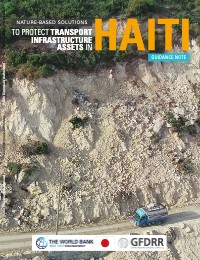
Nature-Based Solutions to Protect Transport Infrastructure Assets in Haiti: Guidance Note
Summary — This guidance note focuses on nature-based solutions (NBS) to protect transport infrastructure assets in Haiti. It addresses Haiti's vulnerability to natural hazards and climate change, and provides a framework for incorporating NBS into road transport projects to build a stronger and more resilient Haiti.
Key Findings
- Haiti is highly vulnerable to natural hazards and climate change, with over 96% of the population at risk of two or more hazards.
- The transport sector in Haiti is severely impacted by natural disasters, with significant damage to roads and bridges.
- Nature-based solutions (NBS) offer a cost-effective and sustainable alternative to hard engineering solutions for protecting transport infrastructure.
- Integrating NBS into road infrastructure projects can enhance resilience, reduce disaster risk, and provide multiple socio-economic and environmental co-benefits.
- Hybrid interventions, combining NBS with hard engineering solutions, are often the most effective approach in Haiti's context.
Full Description
This guidance note provides a framework for integrating nature-based solutions (NBS) into transport sector investment projects in Haiti. It highlights sustainable, evidence-based approaches to ensure that current and future road infrastructure investments are resilient against natural hazards and climate change effects in a cost-effective, environmentally responsible, and socially beneficial way. The note emphasizes the importance of considering the landscape in a holistic manner and integrating disaster risk reduction and climate change adaptation interventions into existing and future designs of road infrastructure.
Full Document Text
Extracted text from the original document for search indexing.
TO PROTECT TRANSPORT INFRASTRUCTURE ASSETS IN GUIDANCE NOTE NATURE-BASED SOLUTIONS Public Disclosure Authorized Public Disclosure Authorized Public Disclosure Authorized Public Disclosure Authorized TO PROTECT TRANSPORT INFRASTRUCTURE ASSETS IN GUIDANCE NOTE NATURE-BASED SOLUTIONS © 2021 International Bank for Reconstruction and Development / The World Bank 1818 H Street NW Washington DC 20433 Telephone: 202-473-1000 Internet: www.worldbank.org This work is a product of the staff of The World Bank with external contributions. The findings, interpretations, and conclusions expressed in this work do not necessarily reflect the views of The World Bank, its Board of Executive Directors, or the governments they represent. The World Bank does not guarantee the accuracy, completeness, or currency of the data included in this work and does not assume responsibility for any errors, omissions, or discrepancies in the information, or liability with respect to the use of or failure to use the information, methods, processes, or conclusions set forth. The boundaries, colors, denominations, and other information shown on any map in this work do not imply any judgment on the part of The World Bank concerning the legal status of any territory or the endorsement or acceptance of such boundaries. Nothing herein shall constitute or be construed or considered to be a limitation upon or waiver of the privileges and immunities of The World Bank, all of which are specifically reserved. Rights and Permissions The material in this work is subject to copyright. Because The World Bank encourages dissemination of its knowledge, this work may be reproduced, in whole or in part, for noncommercial purposes as long as full attribution to this work is given. Any queries on rights and licenses, including subsidiary rights, should be addressed to World Bank Publications, The World Bank Group, 1818 H Street NW, Washington, DC 20433, USA; fax: 202-522-2625; e-mail: pubrights@ worldbank.org. Cover photo: Lorgensky Pelicier/UNOPS On Saturday August 14, 2021, a 7.2 magnitude earthquake struck the southern and southwestern part of Haiti. The U.S. Geological survey locat- ed the epicenter of this earthquake 8 kms from the town of Petit Trou de Nippes, about 150 kms from the capital of Port-au-Prince, and the same region devastated by Hurricane Matthew 5 years ago this month. Three departments in Haiti, the South, the Nippes and Grand’Anse were severely impacted. Although being less catastrophic than the January 2010 earthquake, according to official data, an estimated 800,000 people were affected, of which 2,207 have died, 12,268 were wounded, and 650,000 need humanitarian response. The earthquake severely impacted the in- frastructure sector specially the transport assets. Estimates indicated that 147 km of national and departmental roads and about 510 km of no pri- mary roads were damages in those three depart- ments. The total effects to the transport sector summed up to 150 million dollars including dam- ages and economic losses. Due to road damage many communities lost all access to the rest of the island that resulted in 407,000 additional people in Note from the Authors the Grand’Anse and the Sud Department losing access to critical services for days. This guidance note was finalized few weeks prior to the disaster and hence its content does not reflect the impacts and damages described above. this note focusses extensively in the affected ar- ea, as the motivation for this work came as result from the reconstruction efforts after Hurricane Matthew. The three same departments affected by the recent earthquake were part of the pilot areas and were visited by the team in 2019 and 2020. For example, it provides National Road 7 (RN7) and Departmental Road 25 (RD25) as case studies from application of NBS solutions and both roads were severely impacted by the earthquake. We hope that this guidance note can support the recovery efforts by providing and strengthen- ing the knowledge and framework to incorporate nature-based solutions in road transport projects and by ensuring that the infrastructure sector fol- lows a Build Back Better Approach for a Stronger and Resilience Haiti. October 2021 - Malaika and Xavier Nature-Based Solutions to Protect Transport Infrastructure Assets in Haiti GUIDANCE NOTE VII This guidance note is a joint effort between the Transport Global Practice and the Urban, Disaster Risk Management, Resilience, and Land Global Practice under the umbrella of the Resilient Transport Community of Practice. The note was developed by Malaika Becoulet, trans- port specialist, Xavier Espinet Alegre, Transport economist, Jordy Chan, transport consultant, and Beatriz Pozueta, DRM consultant with support from Roland Alexander Bradshaw, se- nior disaster risk management specialist, Juliana Castano Isaza, natural resources management specialist, Aminata Nguitone Dia, Ibrahima Sekou Fakourou Kante and Claudia Ann-Sylvia Tassy. This note builds on the report elaborat- ed by the consortium of firms TYPSA-AAE- AGREER 1 under the leadership of Patricia Rullan de la Mata and in collaboration with Laura Abram, Guido Fernandez de Velasco, Kyoshi Yasuo Ochoa Kato, Carmen Cabrera, Mauricio de los Santos, and Lilli Ilieva. This report was made possible with the fi- nancial support from a the Global Facility for Disaster Reduction and Recovery Multi-Donor Trust Fund and the Japan-Bank Program for Mainstreaming DRM in Developing Countries, which is financed by the Government of Japan and receives technical support from the World Bank Tokyo Disaster Risk Management Hub. The guidance note benefitted from the peer-review comments from Van Anh Vu Hong, senior urban development specialist, Oceane Keou, transport specialist, Nicolas Desramaut, senior environmental engineer, the Nature-Based Solutions CoP team composed by Brenden Jongman, DRM specialist, Borja Gonzalez Reguero, Steven Alberto Carrion and Boris Ton Van Zanten, Kevin McCall, senior environmental specialist and Andrew Drumm, environmental consultant. Most importantly, the report was elabo- rated with the support of, and in consultation with, the Government of Haiti, and notably its Ministry of Public Works, Transport, and Communications. The team would like to ac- knowledge the contributions of Robenson Jonas Léger, Frantz Duroseau, Georges, Yves- Fritz, Saint-Victor, Judith, Frantz, Loubens Jovin, Audibert Michel, Ramon Adrien, Frantz Elie Desormes, Luc Clervil, Marie Eveline Larrieux, Arnold Africot, Brismé Jean Claudy, Edzer Lesperance, and Alfred Times. The team would also like to acknowledge the collaboration of the Inter-American Development Bank, and specifically Albaret Géraud and Nastasia Keurmeur, who pro- vided valuable advice in the preparation of this report. The team would like to acknowledge the timely and valuable support, guidance, and advice received from Anabela Abreu, country director for Haiti, Nicolas Peltier-Thiberge, practice manager for Latin America and the Caribbean, Shomik Raj Mehndiratta, prac- tice manager for the South Asia region, Denis Jordy, program leader for Haiti and Pierre Xavier Bonneau, program leader for IAWT4. The team also received logistics support from Licette Moncayo, program assistant, and Kelly Amanda Jules, CO program assistant. Acknowledgments Nature-Based Solutions to Protect Transport Infrastructure Assets in Haiti GUIDANCE NOTE 1 INDEX 1. INTRODUCTION 5. GUIDELINES FOR PLANNING AND IMPLEMENTING NBS FOR STRENGTHENING ROAD RESILIENCE 3. NATURE BASED SOLUTIONS (NBS): CONCEPTS AND PRINCIPLES 7. SOLUTIONS CATALOGUE Haiti’s vulnerability to natural hazards and climate change 1.1 Nature-based solutions for resilient road infrastructure 1.2 Step 1. Situation analysis to define scope and problem 5.1 Purpose and scope of the guide 1.3 Step 2. Climate vulnerability and risk assessment 5.2 Nature-based solutions for infrastructure resilience 3.1 NBS Factsheets 7.1 Audience 1.4 Step 3. Identification and prioritization of NBS options 5.3 Nature-based solutions and hybrid interventions 3.2 Tools and resources for NBS 1.6 Step 5. Monitoring, evaluation and maintenance of NBS interventions 5.5 The role of nbs in climate proofing road infrastructure 3.4 Structure of the guide 1.5 Step 4. Design and implementation of NBS interventions 5.4 Principles for implementing nature based solutions 3.3 2. HAITI’S COUNTRY CONTEXT - ROAD NETWORK AND DISASTERS 6. STAKEHOLDER ENGAGEMENT 4. THE ECONOMICS OF NBS FOR ROAD INFRASTRUCTURE Haiti’s key geographical features 2.1 Stakeholder engagement and NBS 6.1 Tools for the selection of risk reduction and adpatation strategies 4.1 Haiti’s natural hazards and climate change context 2.2 Stages for stakeholder engagement 6.2 Assessing benefits and co-benefits of NBS 4.2 Impacts of natural hazards and climate change on haiti’s road infrastructure 2.4 Recommendations 6.4 Key summary factors to consider when assessing benefits and costs of NBS 4.4 Road infrastructure in Haiti 2.3 Identification of relevant stakeholders 6.3 Assessing costs of NBS 4.3 Page 5 Page 75 Page 17 Page 129 Page 29 Page 145 ANNEXES Page 193 Page 53 Useful resources ANNEX 1 Glossary ANNEX 2 List of species suitable for NBS in Haiti ANNEX 4 ANNEX 3 Methodology for producing vulnerability maps for Haiti and results ANNEX 5 Step 1 to 4: Identifying nature-based solutions for road infrastructure resilience in Haiti 1. INTRODUCTION Haiti’s vulnerability to natural hazards and climate change 1.1 Nature-based solutions for resilient road infrastructure 1.2 Purpose and scope of the guide 1.3 Audience 1.4 Tools and resources for NBS 1.6 Structure of the guide 1.5 1.1 Located in the Caribbean Sea Haiti is approxi- mately 28,000 square kilometers. Haiti occupies the western third of the island of Hispaniola (La Isla Española); and the Dominican Republic which occupies the eastern two-thirds of the island. Northwest of the northern penin- sula is the Windward Passage, a strip of water that separates Haiti from Cuba, which is about ninety kilometers. The eastern edge of the coun- try borders the Dominican Republic. The mainland of Haiti has three regions: the northern region, which includes the northern peninsula; the central region; and the southern region, which includes the southern peninsu- la. In addition, numerous small nearby islands make up a part of Haiti’s total territory, the most notable of which are Gonâve, Tortue – Tortuga -, Grande Caye, and Vache. The rugged topography of central and west- ern Hispaniola is reflected in Haiti’s name, which derives from the indigenous Arawak place-name Ayti (“Mountainous Land”); about two-thirds of the total land area is above 1,600 feet (490 meters) in elevation. Haiti’s irregular coastline forms a long, slender peninsula in the south and a shorter one in the north, separat- ed by the triangular-shaped Gulf of Gonâve. Within the gulf lies Gonâve Island, which has an area of approximately 290 square miles (750 square km). Haiti is one of the countries to be most ex- posed to hazards in the world, with more than Haiti’s vulnerability to natural hazards and climate change 96 percent of its population at risk of two or more hazards 2 . Due to its geographical location, on the fault line between two tectonic plates, the Caribbean Plate and the North American Plate, Haiti is highly prone to earthquakes and tsunamis. As a mountainous country, landslides are very common along all river valleys, where years of deforestation has left the upper reaches of the western basins bare. Furthermore, be- cause Haiti is in the path of the Atlantic re- gional hurricane belt, every year Haiti is sub- jected to the impact of severe storms during the regular hurricane season between June 1st and November 30 th . This usually results in signifi- cant inland and coastal flooding. Also, during that time the country is exposed to other natu- ral hazards such as increased coastal erosion or drought (usually within a period of five years, coinciding with El Niño conditions). Climate change has been forecast to in- crease the frequency and severity of extreme hydro-meteorological events in Haiti, there- fore exacerbating the impact of these hazards. This will result in higher temperatures and prolonged the duration and intensify trop- ical storms and hurricanes. Extreme rainfall events are also expected to worsen, while the dry season will add to the effects of cli- mate change, with changes in the periodicity and frequency of drought. Sea level rise will increase the impact of coastal erosion and flooding for coastal areas. 6 Introduction Figure 1: Geographical and topographical map of Haiti (Source: https:// commons.wikimedia.org/wiki/File:Haiti_topographic_map-fr.svg) The impact of climate change on road infrastructure has already been observed in many areas such as in the deterioration of pavements, on road foundations, in eroding road bases, the incapability of the capacity of drainage and overflow systems to deal with stronger or faster velocity of water flows, and impacted bridge foundations. The country’s vulnerability, in particular the road infrastructure to natural hazards and climate change has increased by development trends. For instance, the deforestation process in the country, which has resulted in the loss of most of its for- est cover, making the country prone to increased erosion processes and landslide events. The im- pact of hurricanes, tropical storms, floods, and droughts has aggravated other anthropogenic factors such as inappropriate urbanization prac- tices, the unsustainable use of natural resourc- es, and inadequate waste management practices. Additionally, decades of poverty, political in- stability, and violence has left its infrastructure severely compromised, and its inability to cope with climate impacts and natural hazards. Due to its geographical location right on the fault line between two tectonic plates, the Caribbean Plate and the North American Plate, Haiti is highly prone to earthquakes and tsunamis. 7 Introduction 1.2 Conventional hard engineering/grey infra- structure interventions are not able to adapt and compensate for the various effects of cli- mate change (e.g., sea level rise), and thus need to be regularly maintained and reinforced, with significant cost implications. In addition, these structures often use unwanted negative im- pacts (e.g., coastal erosion) in other locations of the surrounding environment, significantly altering the function of the specific physical environment (e.g., shorelines) because of the interaction of the protection strategies with natural processes, as well as the corresponding ecosystems. In the coastal environment, hard engineered structures such as seawalls, break- waters, or revetments, often result in reductions of sediment transport and the loss of intertidal habitats of wetlands and beaches. Biodiversity and ecosystems provide im- portant benefits to society, specially to adapt to the adverse effects of climate change and reducing disaster risk. For example, coastal vegetation, like mangroves can dissipate wave action, protect shorelines, accommodate flood flows, and forested mountains and slopes can Nature-Based solutions for resilient road infrastructure stabilize sediments, mitigating landslides ( 3 ; 4 ). The ecosystem can prolong the sustainability and life spans of infrastructures such as roads, protecting investments in engineered defenses and restoring salt marshes adjacent to sea walls. Strengthening the resilience of natural hazards and adapting to climate change is a process that should be incorporated in road authority’s planning cycle and risk manage- ment procedures. Nature-based solutions (NBS) are an attractive alternative to hard engineering solutions, very often recognized as cost-effective interventions, which when feasible within a specific context, can enhance the sustainability and resilience of road infra- structure against the impact of natural hazards and climate change effects. There is a need to integrate disaster risk re- duction and climate change adaptation inter- ventions NBS, into existing and future designs of road infrastructure to build its resilience. One condition would be to provide the tools to ensure that Haitian stakeholders can plan, manage, and initiate interventions that would consider the landscape in a holistic manner. 8 Introduction 10 Introduction 1.3 This Guide builds on the continuous growing work of NBS, including existing guidelines, frameworks, and principles relevant to climate change adaptation, disaster risk reduction, conservation, and development. An overview of existing guidelines, on which this Guide is based, is provided in Annex 1. This Guide aims to promote the use of na- ture-based interventions as part of a broad- er portfolio of structural (risk reduction and adaptation) measures to enhance the sustain- ability and the resilience of road infrastructure in Haiti, as an alternative or with similar con- ventional hard engineered solutions, providing unambiguous evidence to why NBS should be considered by national and local transporta- tion/road management agencies. Through the provision of a step-by-step meth- odological approach to assist practitioners in the integration of NBS into transport sector invest- ment projects, this Guide presents a resource and a tool for identifying/selecting, funding, design- ing, and implementing NBS for the protection of road infrastructure in the specific context of Haiti. The document highlights sustainable ev- idence-based approaches to ensure that current and future road infrastructure investments, as well as wider land use developments, can be made re- silient against natural hazards and climate change effects in a more cost-effective, environmentally responsible, and socially beneficial way. The NBS approaches highlighted in this Guide have multiple use and can be applied in different contexts, often overlapping across sec- tors, with the understanding that the site-spe- cific context often determines the design, ma- terials, and construction methods needed to be used. Ideally, NBS should be promoted and built into sector policies and design standards, taking into consideration that in some contexts they work best when used in combination with conventional engineering solutions. Purpose and scope of the guide 11 Introduction 1.4 Audience The Guide is meant to be used as a strategic tool to support local and national governments, the private sector, practitioners, donors, NGOs, and civil society organizations in the planning, design, implementation, and management of NBS enhancing resilience of road infrastruc- ture. The Guide is therefore intended for: A. Public sector and Civil Society Organization Stakeholders from public organizations and governments responsible for the planning, de- signing, or monitoring maintenance of trans- port infrastructure projects. Such users include professionals involved in infrastructure asset management, emergency and civil contingency planning and response, appraisal and design of road networks, shoreline management, as well as local community groups. B. Private sector Engineers, developers, designers, and contractors (and other organizations) involved in the plan- ning, development and/or construction of infra- structure and infrastructure management systems. 12 Introduction 1.5 Structure of the guide The Guide consists of seven sections: Section 1 which introduces the scope and target audience of the Guide, Section 2 outlines the context of Haiti and its road infrastructure at risk from disaster, Section 3 introduces the concept of NBS, Section 4 presents a brief introduction to the economics of NBS Section 5 provides a stepwise approach to the planning and im- plementation of NBS, Section 6 demonstrates the importance of stakeholder engagement in NBS, Section 7 provides a catalogue of NBS for enhancing the resilience of road infra- structure suitable for Haiti’s context, and fi- nally Section 8 presents designs prepared to strengthen Haiti’s road infrastructure for two pilot sites in Haiti. 13 Introduction 1.6 Tools and resources for NBS Over the last decade, there has been a growing awareness, interest and momentum from com- munities, donors, policy, and decision-makers for the application of Nature-based solutions (NBS) as part of disaster risk reduction, cli- mate change adaptation, mitigation, and sus- tainable development strategies. In addition, by increasing resilience to natural hazards and climate change, NBS interventions have pro- vided multiple other socio-economic and en- vironmental co-benefits. The NBS concept has received immense in- terest in the scientific community in the last few years. A growing body of knowledge and experience continues to support the application of NBS in a diversity of settings, accompanied by an increasing number of tools and resources for their design and implementation for disas- ter risk reduction and climate change adapta- tion. Protocols, guidelines, and lessons learnt from the application of these approaches on several case studies exist, for the use of coastal areas and urban areas, as well as for agriculture and landscape management. In contrast to tra- ditional hard engineered solutions, which has a long history of development of protocols and standards, these solutions are still emerging approaches that have yet to be fully evaluat- ed and standardized, and further guidance and standards need to be developed to support all professionals involved in project development (e.g., designers, implementers, funders, evalu- ators, and others). The progress of guidelines and lessons learnt from case studies helps to achieve a mutual understanding of the effectiveness, risk reduction and adaptation outcomes of these approaches. As a result, there is a need to continue building the body of knowledge and experiences on the application of NBS for disaster risk reduction and climate change adaptation of other sectors, such as the trans- port sector. By building on existing literature, this document aims to be one step closer to the standardization of guidelines for the use of NBS for the protection of road infrastruc- ture, describing how these solutions can be conceptualized and applied in practice. 14 Introduction NBS have been identified by the European Commission as a strategic frame to support sustainability. “The vision of the European Commission is to position the EU as a leader in nature-based innovation for sustainable and resil- ient societies”, and in order to achieve this, it has been very active in establishing an NBS evidence and knowledge base, developing a repository of best practices, creating an NBS Community of Innovators, and improving communication and NBS awareness. The following table lists the EU funding programs, NBS projects, platforms, and networks that have been or are being funded by the European Commission since 2011. ThinkNature (https://www.think-nature.eu/) Oppla (https:/www.oppla.eu/) EU Smart Cities Information System (SCIS) (https://www.smartci- tiesinfosystem.eu/) EU Climate Adaptation Platform CLIMATE-ADAPT (https://cli- mate-adapt.eea.europa.eu/) Sustainable Cities Platform (http://www.sustainablecities.eu/) Biodiversa (http://www.biodiversa.org/) Clever Cities (http://clevercities.eu/) Connecting Nature (https://connectingnature.eu/) EdiCitNET (https://cordis.europa.eu/project/rcn/216082_de.html) Eklipse (http://www.eklipse-mechanism.eu/) GRaBS (http://www.ppgis.manchester.ac.uk/grabs/) Green surge (https://greensurge.eu/) Grow Green (http://growgreenproject.eu/) Inspiration (http://www.inspiration-h2020.eu/) Nature4Cities (https://www.nature4cities.eu/) Naturvation (https://naturvation.eu/) NAIAD (http://www.naiad2020.eu/) OpeNESS (http://www.openness-project.eu/) OPERAs (http://operas-project.eu/) OPERANDUM (https://www.operandum-project.eu/) PHUSICOS (https://phusicos.eu/) proGIreg (http://www.progireg.eu/) Reconnect (https://reconnect-europe.eu/) TURAS (http://r1.zotoi.com/) Unalab (https://www.unalab.eu/) Urban GreenUp (http://www.urbangreenup.eu/) URBINAT (http://urbinat.eu/) ReNAture (http://renature-project.eu/) EU Initiatives for the promotion of NBS Source: 5 Research and innovation | Actions and partnerships Dialogue platforms to promote innovation with NBS 15 Introduction 2. HAITI’S COUNTRY CONTEXT - ROAD NETWORK AND DISASTERS Haiti’s key geographical features 2.1 Haiti’s natural hazards and climate change context 2.2 Road infrastructure in Haiti 2.3 Impacts of natural hazards and climate change on Haiti’s road infrastructure 2.4 2.1 The mainland of Haiti has three regions: the north- ern region, which includes the northern peninsula; the central region; and the southern region, which also includes the southern peninsula. The country has approximately 1,771 km of coastline, which are rocky and rimmed with cliffs, and the island’s shelf extension totals around 5,000 square kilometers. The country is distinguished by its narrow coastal plains lying between steep mountain ranges and the coastline, and is also characterized by several major mountain ranges that extend from East to West (see Figure 1). About two-thirds of the total land area has an elevation above 490 meters. Located in northern region is the Massif du Nord (Northern Massif ), an extension of the central mountain range (Cordillera Central) of the Dominican Republic, which begins at Haiti’s eastern border, north of the Guayamouc River, and extends to the northwest through the northern peninsula. The Massif du Nord ranges in elevation from 600 to 1,100 meters. It is ad- jacent to the Plaine du Nord (Northern Plain), which lies along the northern border of the Dominican Republic, between the Massif du Nord and the North Atlantic Ocean. This low- land area of 2,000 square kilometers, is about 150 kilometers long and 30 kilometers wide. The central region consists of two plains and three sets of mountain ranges. The Plateau Central (Central Plateau) extends along both sides of the Guayamouc River, south of the Massif du Nord. It runs eighty-five kilometers from south- east to northwest and is thirty kilometers wide. The Plateau has an average elevation of about 300 meters. It is located on the southwest side by Montagnes Noires (Black Mountains), with an elevation of approximately 600 meters. The Haiti’s key geographical features most northwestern part of this mountain range merges with the Massif du Nord. The Southwest of Montagnes Noires is near the Artibonite River, Plaine de l’Artibonite, which has a surface of about 800 square kilometers. South of this plain lies the Chaîne des Matheux and the Chaîne du Trou d’Eau, which is an extension of the Sierra de Neiba range of the Dominican Republic. The southern region consists of the Plaine du Cul-de-Sac and the mountainous southern peninsula. The Plaine du Cul-de-Sac is bound- ed in the north by the Chaîne des Matheux and the Chaîne du Trou d’Eau, is twelve kilo- meters wide and extends thirty-two kilometers from the border of the Dominican Republic to the coast of the Baie de Port-au-Prince (Bay of Port-au-Prince). The mountains of the southern peninsula, an extension of the southern moun- tain chain of the Dominican Republic (the Sierra de Baoruco), extends from the Chaîne de la Selle in the east to the Massif de la Hotte in the west. The highest peak in this range is Pic la Selle, the highest point in Haiti, rising to an altitude of 2,680 meters, and located at a distance of 18 km from the coastline, with an average slope of 18.5°. The Massif de la Hotte varies in elevation from 1,270 to 2,255 meters. Rivers are numerous but short, and most are not navigable. In total, Haiti has approximately 3,300 km of major (perennial) rivers, located in the Southwest and Central North. Although, over a hundred streams flow through Haiti, the largest river is the Artibonite river, which has a length of 245 kilometers (145 miles). It is shallow and long, and its flow averages ten times that. Second in length is Les Trois Rivières, which spills into the Atlantic in the town of Port-de-Paix. Haiti country context – road network and disasters 18 2.2 Haiti’s natural hazards and climate change context According to data collected by the Haitian Ministry of Agriculture, Natural Resources, and Rural Development (Ministère de l‘Ag- riculture, des Ressources Naturelles, et de Développement Rural, MARNDR), the av- erage observed temperatures rose by more than 1 degree centigrade between 1973 and 2003. Extreme and variable weather condi- tions alternate between drought in the dry sea- son (December to April) and intense storms and hurricanes in the wet season (May to November). Haiti lies in the hurricane belt of tropical storms that originate in the Atlantic Ocean and strike Caribbean islands every hur- ricane season. According to Haitian natives, the country has experienced radical changes in climate variability, especially during the rainy season and the frequency and intensity of hur- ricanes and tropical storms, which has led to flooding and erosions. The impacts which are magnified by severe environmental degrada- tion and is highly likely attributed to climate change. The changes in variability and extreme weather noted by Haitian citizens are in line with the Fourth Assessment Report of the Intergovernmental Panel on Climate Change (IPCC). For example, the report indicates that in the 1990’s, 35 percent of tropical cyclones were classified as Category 4 or 5, in compari- son to only 20 percent in the 1970’s. Flooding is a major problem in almost all of Haiti‘s 30 major watersheds, due to intense 2004 Tropical cyclones Jeanne and Ivan killed more than 2500 and affected more than 300,000 people in the northern city of Cap- Haïtien, Artibonite, and Central Region. 2008 Four storms killed more than 600 people and destroyed three-quarters of the country’s agricultural land. 2000 2004 2002 2006 2008 2001 2005 2003 2007 2009 Recent disasters in Haiti 7 # of severe events (more than 5,000 people affected) # of deadly events (more than 50 people killed) seasonal rainfall, storm surges in the coastal zones, deforested and eroded landscape, and sediment-laden river channels. During trop- ical storms and hurricane season an average of 200 millimeter of rain may fall in a month 6 . This leads to rapid runoff from deforested and eroded mornes (small mountains) and hills (flash floods), as well as the overflowing of rivers. Flooding washes away fertile soil, depos- iting it on riverbeds of the Artibonite, the Grande Rivière de Jacmel, and the Rivière de Grande Anse). Massive sedimentation has raised the beds of many waterways and have created a complete absence of embankments and levees. These factors intensify the next round of flooding, leading to the destruction of crops, farmland, and agricultural infrastruc- ture, as well as the loss of livestock and human lives. Climate change is expected to exacerbate these problems. The low-lying plains of the Ouest and Artibonite departments and the narrow coastal zones of the Sud, Sud-Est, Grande Anse, and Nippes departments are especial- ly vulnerable to flooding. On the Cul de Sac Plain of the Ouest department, the Rivière Blanche and Rivière Grise basins are par- ticularly subject to severe flooding. Heavily populated coastal towns, such as Jacmel, Les Cayes, and Gonaïves, lie in the direct path of the storms. 2010 The deadliest earthquake in 200 years, which marked history by its devastating capacity and its tragic impact on the population. More than 300,000 people lost their lives, hundreds of thousands were injured, and 2 million people were displaced. Nearly, all of Haiti’s major infrastructure were damaged or destroyed. 2016 Hurricane Matthew caused flooding of approximately 1 meter and storm surge levels of up to 3 meters. At least 580 people were killed and more than 35,000 people were left homeless by the storm. 2020 Latest storm, hurricane Laura killed 39 people and affected an estimated 40,000 people. 2010 2014 2012 2016 2018 2011 2015 2013 2017 2019 2020 Haiti country context – road network and disasters Haiti country context – road network and disasters 20 21 2.3 Road infrastructure in Haiti Haiti has a road network length of approxi- mately 3,400 km. It is degraded, having lost about 30% of its extension during the last 15 years. The road network national, departmental, and municipal scales, has the following classi- fication (see Figure 2): • The national network (primary) covers 978 km and connects main cities of socioeco- nomic or political importance. • The departmental network (secondary) has a length of about 1,615 km and connects urban areas with the national network. • The municipal network (tertiary) covers ap- proximately 873 km and ensures connectiv- ity with the rest of the municipalities. The road network is characterized by: • A small portion of paved roads (less than 20%) is concentrated along the primary network. • Limited number of roads are bounded by bridges at river crossings and gullies. In the past, Haiti has witnessed severe damage to its main roads and bridges as a result of the impacts of various natural hazards. Such impacts still limit the access and usage of functioning roads, with severe implications (e.g. connectivity) for people. Damaged roads prevent the passage of goods and services between the different regions of the coun- try and hinder fast access to impacted communi- ties in times of crisis and quick post-emergency recovery. These challenges, limit the transportation of food and primary goods, have perpetuated hun- ger and poverty throughout the country. The most vulnerable configurations commonly identified in Haiti are mountain roads, coast- al roads, and crossings (bridges and culverts). These configurations are presented schemati- cally in Figure 3. Haiti country context – road network and disasters 22 Figure 2: Haiti’s Road Network Classification (Source: https:// commons.wikimedia.org/wiki/File:Haiti_road_map-fr.svg) Department Border International Border Primary Road Secondary Road Water Body In the past, Haiti has witnessed serious damage to its main roads and bridges as a result of the impact of various natural hazards. Port-au-Prince Gonaives Cap-Haitien 23 2. Coastal roads: A large part of the country’s road network is located close to the coast and is therefore ex- posed to the impact of storm surges and coastal erosion. To reduce these impacts, NBS mea- sures can be used to restore and promote the marine-coastal environment and combined hy- brid measures for stabilization and protection. In Haiti, roads often have configurations (A) and (B). In these cases, there are no one- fits-all solutions that can provide protection against the hazards typically impacting both types of configurations. As such, in this con- text, the implementation of a combination of appropriate solutions responding to configura- tions (A) and (B) should be considered. Figure 3: Road Configurations A and B: mountain and coastal roads Coastal road (B) Mountain + Coastal road Mountain road (A) 1. Mountain roads: Haiti’s mountainous ecosystems have been significantly altered by the severe deforestation process which has resulted in high levels of soil erosion, consequently increasing the risk of slope failure and landslides. To mitigate impacts on mountain roads, NBS aims at providing greater stability to uphill and downhill slopes of roads and redesigning drainage systems. One of the most common problems in Haiti is related to the impact of river flows on crossing infrastructure. Figure 4: Road management unit C (crossing infrastructure) and road management unit D (actions on crossings’ surrounding ecosystems) 3. Crossings/bridges: One of the most common problems in Haiti is related to the impact of river flows on crossing infrastructures. In addition, to the increasing and more intense floods, riverbank degradation and the consequent excess sediment that accu- mulates at the base of crossing infrastructure undermine its stability. At this point, the sed- iments cause the water speed to increase and thus flow rates end up modifying the structure. In such configurations, NBS can operate both at the specific site of the infrastructure (C), and at the basin level, with actions upstream of the infrastructure (D) (see Figure 4). River Road D C Haiti country context – road network and disasters Haiti country context – road network and disasters 24 25 2.4 Impacts of natural hazards and climate change on haiti’s road infrastructure Haiti’s road infrastructure is significantly ex- posed to the impacts of natural hazards and sensitive to the increased frequency and sever- ity of hydro-meteorological hazards associated with climate change. Among relevant climate change those af- fecting the transport sector include increase frequency and intensity of extreme events that trigger more intense precipitation events, storm surges, increased temperatures, increased land- slide frequency and increases in drought condi- tions, among other things. Sea level rise increase coastal erosion rates and long-term coastal flooding. There is already evidence of climate change having an impact on road infrastructure: deteriorating pavement integrity, impacting road foundations, eroding road bases, affecting the capacity of drainage and overflow systems to deal with stronger or faster velocity of wa- ter flows, and impactingbridge foundations.. A non-exhaustive list of potential impacts of cli- mate change on road infrastructure are present- ed in Table 1. Some examples of NBS measures that are considered relevant to counteract these impacts in the context of Haiti are presented in Section 6 “Solutions catalogue”. Similarly, projected climate change is ex- pected to have a significant impact on the planning, design, construction, operation, and maintenance of road infrastructure. Overall, cli- mate change presents a significant risk for road authorities, requiring the adaptation principles and strategies to address potential impacts 8 . Although road infrastructure tends to be de- signed to withstand local weather and climate, designers and engineers typically rely on histor- ical records of climate when designing road in- frastructure. However, in the context of climate change, using historical climate data alone is no longer a reliable predictor of future impacts. Most paved roads are usually built to last for 50 years or longer.; Understanding how future changes in climate may affect this infrastructure is import- ant for protecting long-term investments. Haiti country context – road network and disasters 26 Climate Change Projection in Haiti Potential natural hazard and climate change Impacts on Road Infrastructure in Haiti Temperatures are expected to increase by 0.5 to 2.3°C by 2060 Increased temperatures • More frequent bucking experienced by roads • Deterioration of pavement integrity • Thermal expansion on bridge expansion joints and paved surfaces Projected increases in temperature, coupled with decreases in rainfall during the critical summer months ( June- August) are likely to intensify drought conditions Increase temperatures and decreased precipitation • Corrosion of steel reinforcements in concrete structures due to increase in surface salt levels in some locations Increase in drought conditions • Damage to road infrastructure due to increased susceptibility to wider uncontrolled wildfires • Damage to infrastructure due to increased susceptibility to mudslides in areas deforested by wildfires Sea level is projected to rise between 0.05 and 0.22 m at 2030 in the Caribbean Sea Level Rise added to storm surges • Inundation of roads in coastal areas • More frequent or severe flooding of low-lying infrastructure • Damage to roads, and bridges due to flooding, inundation in coastal areas, and coastal erosion • Damage to infrastructure from land subsidence and landslides • Erosion of road base and bridge supports • Bridge scour • Reduced clearance under bridges • Loss of coastal wetlands and barrier shoreline Hurricane rainfall may increase by 6-17% and surface wind speeds of the strongest hurricanes will increase between 1-8%, with associated in- creases in storm surge levels. Increase in intense precipitation events • More frequent washouts of unpaved surfaces • Increase of flooding and damage to roads and drainage systems due to flooding • Overloading of drainage systems, causing backups and street flooding • Increase in scouring of roads, bridges, and support structures • Damage to road infrastructure due to landslides and flash floods • Deterioration of structural integrity of roads and bridges due to increase in soil moisture levels • Adverse impacts of standing water on the road base Increase of storm intensity (more fre- quent strong hurricanes, Category 4-5) • Damage to road infrastructure and increased probability of infrastructure failures • Increased threat to stability of bridge decks • Increased damage to signs, lighting fixtures, and supports • Decrease expected lifetime of roads exposed to storm surge Increase in wind speed • Signs, and tall structures at risk from increasing wind speeds Table 1: Potential Impacts of Climate Change on Road Infrastructure ( 9 , 10 ). Haiti country context – road network and disasters Haiti country context – road network and disasters 28 29 3. NATURE BASED SOLUTIONS (NBS): CONCEPTS AND PRINCIPLES Nature-based solutions for infrastructure resilience 3.1 Nature-based solutions and hybrid interventions 3.2 Principles for implementing nature based solutions 3.3 The role of nbs in climate proofing road infrastructure 3.4 3.1 Nature-based solutions (NBS) are defined by the International Union for Conservation of Nature (IUCN) as “actions to protect, sustain- ably manage, and restore natural or modified ecosystems that address societal challenges ef- fectively and adaptively, simultaneously provid- ing human well-being and biodiversity bene- fits” (2). The NBS framework emerged from the ecosystem approach, which underpins the Convention on Biological Diversity (CBD) and considers biodiversity conservation and human well-being to be dependent on func- tioning and resilient natural ecosystems 11 . NBS aim to conserve or restore nature to support conventionally built infrastructure sys- tems and can reduce disaster risk and produce more resilient and lower-cost services in de- veloping countries. In the disaster risk man- agement and water security sectors, NBS can be applied as a green infrastructure strategy that can work in harmony with gray infrastruc- ture systems. NBS can also support commu- nity well-being, generate benefits for the en- vironment, and advance progress toward the Sustainable Development Goals (SDGs) in ways that gray infrastructure systems cannot. Nature-based solutions for infrastructure resilience NBS can be considered an umbrella concept (2) covering a range of ecosystem-based ap- proach that address specific or multiple societal challenges while simultaneously providing hu- man well-being and socio-economic and bio- diversity benefits. Approaches under NBS can be classified into five categories, as described in Table 2 and Figure 6: (1) Restorative, (2) Issue- specific, (3) Infrastructure, (4) Management and (5) Protection. • Related Terminology 60 : • Coastal green infrastructure • Natural infrastructure • Living shoreline • Natural and nature-based features (NNBF) • Engineering With Nature® (EWN) • Building with Nature (BwN) • Working with Nature (WwN) Nature based solutions (NBS): concepts and principles 30 Category of NBS approach Description Types Examples 12 Restorative Technical process that aims to recreate, ini- tiate, or accelerate the recovery of an eco- system that has been disturbed - degraded, damaged, or destroyed. Restoration activities may not be a primary goal for transportation infrastructure projects, but it can be used as part of compensatory mitigation efforts. 13 • Ecological restoration (ER) is the process of assisting the recovery of an ecosystem that has been degraded, damaged or destroyed. (SER 2004) • Ecological Engineering (EI) focuses on the design of sustainable ecosystems that inte- grate human society with its natural environ- ment for the benefit of both 14 . • Forest landscape restoration (FLR) is the long-term process of regaining ecological functionality and enhancing human well-be- ing across deforested or degraded forest land- scapes 15 . • Revegetation: Vegetated buffers that protect water quality in riparian ecosystems from urban or agricultural runoff • Habitat enhancement: • Remediation: Tidal wetlands restoration; • Mitigation: legally mandated remediation for loss of protected species or ecosystems. • Design of tidal creeks • Introduction of particular plant species for salt marsh restoration Use of species that trap sediment for coastal protection of a sandy shore Issue-specific Ecosystem-related approaches that vary based on their ob- jective, including Ecosystem-based adaptation (EbA), Ecosystem-based mitigation (EbM), Ecosystem-based disaster risk reduc- tion (Eco-DRR) and Climate adaptation services (CAS). • Ecosystem-based approaches to adaptation (EbA) use of biodiversity and ecosystem ser- vices to help people adapt to the adverse ef- fects of climate change. • Ecosystem-based approaches to mitigation (EbM) use of ecosystems for their carbon storage and sequestration service to aid cli- mate change mitigation. • Ecosystem-based disaster risk reduction (Eco-DRR) reduces disaster risk by mitigat- ing hazards and by increasing livelihood re- silience. 16 • Climate Adaptation Services (CAS) are ben- efits to people from increased social ability to respond to change, provided by the capacity of ecosystems to moderate and adapt to climate change and variability 17 • Coastal habitat restoration in ecosystems such as coral reefs, mangrove forests, and marshes to protect communities and infrastructure from storm surges • Coastal realignment • Agroforestry to increase resilience of crops to droughts or excessive rainfall (crop diversification to include drought-tolerant varieties) • Integrated water resource management to cope with consecutive dry days and change in rainfall patterns • Sustainable forest management interventions to stabilize slopes, prevent landslides, and regulate water flow to prevent flash flooding • Restoration of terrestrial forests (degraded or deforested landscapes) and vegetated coastal eco- systems (seagrass meadows, tidal marshes and mangrove forests) for carbon sequestration • Coastal roads protection: Restoration of mangroves of salt marshes for coastal protection; arti- ficial reinforced dunes; • Roadside slope protection: Protection of forests that stabilize slopes; use of brush mattresses for slope protection and stabilization; log terracing for erosion protection of road embankments. Table 2: Description and examples of NBS categories Nature based solutions (NBS): concepts and principles Nature based solutions (NBS): concepts and principles 32 33 Category of NBS approach Description Types Examples 12 Infrastructure These approaches rely on services produced by ecosystems, often utiliz- ing natural landscapes to minimize flood dam- ages, purify and store water, and reduce urban stormwater runoff. Incorporating green in- frastructure into road and highway design can protect f rom the brunt of storm surges and waves and avoid- ing erosion and sedi- mentation. Some can adapt to sea level rise by accreting sediment or migrating inland. They can also provide bene- fits such as recreation opportunities, habitat needed for commercial fisheries, and a healthier environment. • Natural Infrastructure (NI) manages natu- ral lands, such as forests and wetlands that conserves or enhances ecosystem values and functions and provides associated cobenefits 18 • Green Infrastructure (GI) is natural and semi-natural areas with other environmen- tal features designed and managed to deliver a wide range of ecosystem services. GI rep- licates or mimics the natural functions of a landscape by integrating functions like stor- age, detention, infiltration, evaporation, and transpiration, or uptake by plants, and are cre- ated by human design and engineering. () 19 • Oyster reefs for wave attenuation • Marsh and dune plantings to prevent erosion • Tide flap on the stormwater outfall to prevent backflow • Bioswales or grassed swales: grassy areas on the side of the road that convey drainage; they can be designed to promote pollutant removal and infiltration of runoff. • Rain gardens: landscaping features planted with vegetation that collect, infiltrate, evaporate, and transpirate runoff. • Wetlands (whether natural or engineered) for water storage and filtering of pollutants Nature based solutions (NBS): concepts and principles Nature based s