
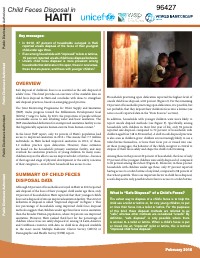
Child Feces Disposal in Haiti
Summary — This brief examines child feces disposal practices in Haiti using data from the 2012 Haiti DHS. It highlights the prevalence of unsafe disposal methods and disparities based on household sanitation, location, and wealth. The brief also suggests potential interventions to improve safe disposal practices.
Key Findings
- 37% of households surveyed in Haiti reported unsafe disposal of the feces of their youngest child under age three in 2012.
- Even among households with “improved” toilets or latrines, 15% reported unsafe child feces disposal behavior.
- Unsafe child feces disposal is more prevalent among households that defecate in the open, those in rural areas, those that are poorer, and those with younger children.
- Safe disposal of child feces increased nationally between 2005-2006 and 2012, from 56% to 63%.
Full Description
This brief provides an overview of child feces disposal practices in Haiti, based on data from the 2012 Haiti DHS. It highlights that while 63% of households reported safe disposal of their youngest child's feces, only 18% used improved sanitation facilities for disposal. The brief identifies key factors influencing unsafe disposal, including lack of access to improved sanitation, rural residence, poverty, and the child's age. It also discusses the health impacts of unsafe disposal and suggests potential interventions, such as behavior change programs, integration of child sanitation into existing interventions, and partnerships with the private sector.
Full Document Text
Extracted text from the original document for search indexing.
1 Key messages: • In 2012, 37 percent of households surveyed in Haiti reported unsafe disposal of the feces of their youngest child under age three. • Even among households with “improved” toilets or latrines, 15 percent reported unsafe child feces disposal behavior. • Unsafe child feces disposal is more prevalent among households that defecate in the open, those in rural areas, those that are poorer, and those with younger children. 1 OVERVIEW Safe disposal of children’s feces is as essential as the safe disposal of adults’ feces. This brief provides an overview of the available data on child feces disposal in Haiti and concludes with ideas to strengthen safe disposal practices, based on emerging good practice. The Joint Monitoring Programme for Water Supply and Sanitation (JMP) tracks progress toward the Millennium Development Goal (MDG) 7 target to halve, by 2015, the proportion of people without sustainable access to safe drinking water and basic sanitation. The JMP standardized definition for an improved sanitation facility is one that hygienically separates human excreta from human contact. 2 In the latest JMP report, only 24 percent of Haiti’s population had access to improved sanitation in 2012. 3 This means that 7.7 million individuals in Haiti lacked improved sanitation in 2012; of these, 2.2 million practice open defecation. However, these estimates are based on the household’s primary sanitation facility, and may overlook the sanitation practices of young children. In many cases, children may not be able to use an improved toilet or latrine—because of their age and stage of physical development or the safety concerns of their caregivers—even if their household has access to one. SUMMARY OF CHILD FECES DISPOSAL DATA Although 63 percent of households surveyed in Haiti in 2012 reported safe disposal of the feces of their youngest child under age three, only 18 percent of households in Haiti reported that their youngest child’s feces were disposed of into an improved sanitation facility. This stricter definition of disposal is called “improved disposal” in Figure 1. This low percentage of households using improved child feces disposal methods suggests that children under age three have worse sanitation than the broader Haitian population, where 24 percent use improved sanitation. However, Haiti ranked third best for the percentage of children whose feces are safely disposed of, among 14 Latin America and Caribbean countries with data on child feces disposal available in the most recent Multiple Indicator Cluster Survey (MICS) or Demographic and Health Survey (DHS) report. HAITI Child Feces Disposal in What Is “Safe Disposal” of a Child’s Feces? The safest way to dispose of a child’s feces is to help the child use a toilet or latrine or, for very young children, to put or rinse their feces into a toilet or latrine. For the purposes of this brief, these disposal methods are referred to as “safe,” whereas other methods are considered “unsafe.” By definition, “safe disposal” is only possible where there is access to a toilet or latrine. When a child’s feces is put or rinsed into an “improved” toilet or latrine, this is termed “improved child feces disposal.” Households practicing open defecation reported the highest level of unsafe child feces disposal, at 81 percent (Figure 2). For the remaining 19 percent of households practicing open defecation, it is possible, but not probable, that they deposit their children’s feces into a latrine (see notes on self-reported data in the “Data Sources” section). In addition, households with younger children were more likely to report unsafe disposal methods (see Figure 3). Specifically, among households with children in their first year of life, only 59 percent reported safe disposal, compared to 72 percent of households with children aged four (48 to 59 months). A shift in safe disposal practices is also seen as children grow: children are increasingly likely to use a toilet/latrine themselves, or have their feces put or rinsed into one. At these young ages, the behavior of the child’s caregiver is critical to dispose of their feces safely and shape the child’s toilet training. Among those in the poorest 20 percent of households, the feces of only 37 percent of the youngest children were safely disposed of, compared to 81 percent among the richest (Figure 4). Moreover, in these poorest households with children under age three, only 37 percent reported having access to a toilet/latrine of any kind, compared to 98 percent of the richest quintile. This is an important factor in child feces disposal, as safe disposal is only possible where there is access to a toilet/latrine. February 2015 Public Disclosure Authorized Public Disclosure Authorized Public Disclosure Authorized Public Disclosure Authorized 2 FIGURE 2 Even among households with improved sanitation, 15 percent reported unsafe child feces disposal behaviors. Reported feces disposal practice for households’ youngest child under age three, by household sanitation facility type, Haiti, 2012. Safe disposal of child feces increased nationally between the DHS surveys of 2005–2006 and 2012, from covering 56 percent of the youngest children per household nationally in 2005–2006 to 63 percent in 2012. Behind this national-level data, there is wide variation in child feces disposal practices, with a greater prevalence of unsafe practices among households without access to improved sanitation, in rural areas, and those that are poorer. For example, unsafe disposal in rural areas and among the poorest 40 percent of households is worse than among children overall. Although this brief only focuses on one socioeconomic indicator at a time, applying multiple lenses would show even greater extremes of disparity—with the poorest rural households reporting the greatest prevalence of unsafe disposal (Figure 5). IDEAS FOR CONSIDERATION In Haiti, there are few interventions aimed at the safe disposal of children’s feces during the first years of life. In general, sanitation for children under age three has been a neglected area of policy and program intervention. Given the relatively few programs focusing on children’s sanitation in Haiti and globally, there is not a strong evidence base of effective strategies for increasing the safe disposal of children’s feces. Significant knowledge gaps must be FIGURE 3 Households with younger children were more likely to report unsafe disposal methods. Reported feces disposal practice for children of different ages, Haiti, 2012. FIGURE 1 In Haiti in 2012, almost two-thirds (63 percent) of households reported that the feces of their youngest child under three were safely disposed of. Percentage of households reporting each feces disposal practice for their youngest child under age three, Haiti, 2012. Put/rinsed into drain or ditch, 8% Thrown into garbage, 11% Unsafe Disposal Safe Disposal Child feces put/rinsed in toilet/latrine but HH used unimproved sanitation, 42% Child feces put/rinsed in toilet/latrine & HH used improved sanitation, 18% Child used toilet/latrine & household (HH) used improved sanitation, 1% Child used toilet/latrine, but HH used unimproved sanitation, 2% Other, 2% Improved disposal = 18% Left in the open, 15% Buried, 2% Safe disposal = 63% % of children 100 80 60 40 20 0 Open defecation (29% of households) Type of sanitation facility used by household (HH) Unimproved (21% of households) Shared (28% of households) Improved (22% of households) 4% 66% 4% 12% 7% 18% 21% 11% 42% 1% 3% 4% 3% 3% 3% 3% 1% 0% 83% 5% 6% 3% 0% 0% 0% 5% 8% 82% Other Left in the open Put/rinsed into drain Buried Thrown into garbage Put/rinsed into toilet/latrine Child used toilet/latrine % of children 100 80 60 40 20 0 0 2 3 4 1 58% 12% 12% 12% 1% 2% 1% 0% 0% 1% 3% 1% 2% 2% 1% 2% 1% 3% 63% 10% 6% 15% 7% 20% 38% 59% 55% 34% 9% 17% 5% 5% 16% 5% 17% Child age (years) Other Left in the open Buried Thrown into garbage Put/rinsed into drain or ditch Put/rinsed into toilet/latrine Child used toilet/latrine 3 and ensuring that midwives’ training, as well as early childhood development materials and preschool programs, includes information on safe child feces disposal • Partnering with the private sector to improve feces management tools, such as potties, diapers, tools for retrofitting latrines for child use, and scoopers • Improving the enabling environment for management of children’s feces, by including specific child feces related criteria in open defecation free (ODF) verification protocols and in national sanitation policies, strategies, or monitoring mechanisms. What Is the Impact of Unsafe Disposal of Children’s Feces? There is widespread belief that the feces of infants and young children are not harmful, but this is untrue. In fact, there is evidence that children’s feces could be more risky than adults’ feces, due to a higher prevalence of diarrhea and pathogens—such as hepatitis A, rotavirus, and E. coli —in children than in adults. 7 Therefore, children’s feces should be treated with the same concern as adult feces, using safe disposal methods that ensure separation from human contact and household contamination. In particular, the unsafe disposal of children’s feces may be an important contaminant in household environments, posing a high risk of exposure to young infants. 8 Poor sanitation can result in substantial health impacts in children, including a higher prevalence of diarrheal disease, intestinal worms, enteropathy, malnutrition, and death. According to the World Health Organization (WHO), most diarrheal deaths in the world (88 percent) are caused by unsafe water, sanitation, or hygiene. More than 99 percent of these deaths are in developing countries, and about eight in every 10 deaths are children. 9 Diarrhea obliges households to spend significant sums on medicine, transportation, health facility fees, and more, and can mean lost work, wages, and productivity among working household members. 10 Stunting and worm infestation can reduce children’s intellectual capacity, which affects productivity later in life. The WHO estimates that the average IQ loss per worm infection is around 3.75 points.” 11 filled before comprehensive, practical evidence-based policy and program guidance will be available. Nevertheless, organizations and governments interested in improving the management of children’s feces could consider: • Conducting formative research to understand the behavioral drivers and barriers to safe child feces disposal • Strengthening efforts to change the behavior of caregivers through programs that encourage cleaning children after defecation, potty training children, and using appropriate methods to transport feces to a toilet/latrine as well as handwashing with soap after fecal contact and before preparing food or feeding a child • Exploring opportunities to integrate child sanitation into existing interventions that target caregivers of young children, such as including key messages in antenatal/newborn care materials and infant and young child feeding guidance provided to parents, FIGURE 4 Safe disposal differs across wealth asset quintiles, 4 with safe disposal far more likely among households in the richest quintiles. Reported feces disposal practice for households’ youngest child under age three, by household wealth quintile, Haiti, 2012. % of children 100 80 60 40 20 0 Poorest Middle Richer Richest Poorer 35% 13% 5% 15% 29% 49% 12% 8% 23% 68% 11% 6% 9% 2% 2% 3% 3% 2% 2% 1% 1% 0% 0% 0% 3% 3% 2% 79% 5% 7% 5% 79% 13% 4% Wealth quintile of child’s household Other Left in the open Buried Thrown into garbage Put/rinsed into drain or ditch Put/rinsed into toilet/latrine Child used toilet/latrine FIGURE 5 Safe disposal remains less prevalent among rural households than urban households. Percentage of households reporting safe feces disposal for their youngest child under age three, by urban and rural residence, Haiti, 2005–2006 5 and 2012. 6 100 80 60 40 20 0 Urban Rural 2005–2006 78% 44% 76% 56% Urban Rural 2012 % of children 4 7 Feachem, R., D. Bradley, H. Garelick, et al. 1983. Sanitation and Disease: Health Aspects of Excreta and Wastewater Management. World Bank Studies in Water Supply and Sanitation 3. Chichester, UK: John Wiley & Sons. 8 Gil, A., C. Lanata, E. Kleinau, and M. Penny. 2004. Children’s Feces Disposal Practices in Developing Countries and Interventions to Prevent Diarrheal Diseases: A Literature Review. Strategic Report 11. Peru: Environmental Health Project (EHP). 9 WHO. 2009. Global Health Risks: Mortality and Burden of Disease Attributable to Selected Major Risks. Geneva: World Health Organization, 23. 10 Favin, M., G. Naimoli, and L. Sherburne. 2004. Improving Health Through Behavior Change: A Process Guide on Hygiene Promotion. Joint Publication 7. Washington, DC: Environmental Health Project (EHP). 11 WHO. 2005. Report of the Third Global Meeting of the Partners for Parasite Control: Deworming for Health and Development. Geneva: World Health Organization, 15. 12 Stanton, B., J. Clemens, K. Azis, and M. Rahamanr. 1987. “Twenty-Four- Hour Recall, Knowledge-Attitude-Practice Questionnaires and Direct Observations of Sanitary Practices: A Comparative Study.” Bulletin of the World Health Organization. Geneva: World Health Organization. 13 Akhtaruzzaman, M. N., and S. N. Islam. 2011. Nutrition, Health and Demographic Survey of Bangladesh—2011: A Preliminary Report. Bangladesh: University of Dhaka, 19. NOTES We’re interested in your thoughts. Have you found different evidence of what works through your own programming? If you have thoughts to share, or know of a program that is encouraging the safe disposal of child feces, please contact WSP at worldbankwater@worldbank.org or UNICEF at WASH@unicef.org so that we can integrate your information into future program guidance. ACKNOWLEDGEMENTS This brief was developed jointly by WSP and the United Nations Children’s Fund (UNICEF) as part of a series of country profiles about sanitation for children under age three. The findings, interpretations, and conclusions expressed herein are those of the author(s), and do not necessarily reflect the views of the International Bank for Reconstruction and Development / The World Bank and its affiliated organizations, or those of the Executive Directors of The World Bank or the governments they represent, or of the UNICEF. © 2015 by International Bank for Reconstruction and Development / The World Bank and UNICEF. Photo Credit: Dominic Chavez/© World Bank (pages 1 and 3). DATA SOURCES Unless otherwise specified, all analysis in this brief is based on households’ self-reported behavior for disposing of childrens’ feces, as collected in the 2012 Haiti DHS, which is the latest MICS/DHS available for Haiti that records child feces disposal behavior. The MICS and DHS collect data in a generally harmonized manner and hence are the basis for this country profile series. However, whereas the DHS collects data on the youngest child under age five living with the mother for each household, the MICS collects data on all children under age three who live with the respondent (mother or caretaker). To maximize comparability, we restricted all analysis to children under age three in all figures, except Figure 3. It is likely that self-reports overestimate safe disposal. 12 In Bangladesh, for example, although 22 percent of children reportedly either used a toilet/latrine or their feces were put or rinsed into the toilet/latrine (according to MICS 2006), a structured observation of behavior conducted under UNICEF’s Sanitation, Hygiene Education and Water Supply in Bangladesh (SHEWA-B) program in 2007 found that only 9 percent of subjects disposed of child feces into a toilet/ specific pit. 13 Regardless of this issue, self-reports are currently regarded as the most efficient method for gauging safe disposal of children’s feces. REFERENCES 1 Ministry of Public Health and Population [ le Ministère de la Santé Publique and de la Population ] (MSPP), Haitian Childhood Institute [ l’Institut Haïtien de l’Enfance ] (IHE) and ICF International. 2013. 2012 Haïti Mortality, Morbidity, and Service Utilization Survey: Key Findings. Calverton, Maryland: MSPP, IHE, and ICF International. Please see the “Data Sources” section. 2 The JMP has established a set of standardized definitions to categorize improved sanitation, which are used to track progress toward Millennium Development Goal 7. However, these definitions are not always the same as those used by national governments. See Progress on Drinking Water and Sanitation: Update 2014. 3 WHO/UNICEF Joint Monitoring Programme. 2014. Progress on Drinking Water and Sanitation: Update 2014. Geneva: World Health Organization. 4 These asset indices used to classify households into wealth quintiles have not been adjusted to remove drinking water or sanitation variables. 5 Cayemittes, Michel, Marie Florence Placide, Soumaïla Mariko, Bernard Barrère, Blaise Sévère, and Canez Alexandre. 2007. Enquête Mortalité, Morbidité et Utilisation des Services, Haïti, 2005–2006. Calverton, Maryland: Ministère de la Santé Publique et de la Population, Institut Haïtien de l’Enfance, and Macro International Inc. 6 Ministry of Public Health and Population [ le Ministère de la Santé Publique and de la Population ] (MSPP), Haitian Childhood Institute [ l’Institut Haïtien de l’Enfance ] (IHE) and ICF International. 2013. 2012 Haïti Mortality, Morbidity, and Service Utilization Survey: Key Findings. Calverton, Maryland: MSPP, IHE, and ICF International.