
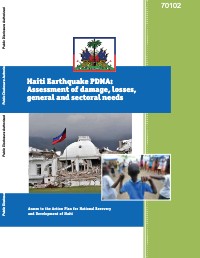
Anèks nan Plan Aksyon pou Rekiperasyon Nasyonal ak Devlopman Ayiti
Rezime — Dokiman sa a se yon anèks nan Plan Aksyon pou Rekiperasyon Nasyonal ak Devlopman Ayiti apre tranbleman tè 2010 la. Li prezante yon evalyasyon bezwen apre katastwòf (PDNA) ki fèt pou evalye domaj, pèt, ak bezwen atravè divès sektè pou mete fondasyon pou rekonstriksyon ak devlopman alontèm.
Dekouve Enpotan
- Valè total domaj ak pèt yo estime a 7.804 milya dola ameriken, ekivalan a PIB Ayiti an 2009.
- Lojman se sektè ki pi afekte a, ki reprezante apeprè 40% nan domaj total yo.
- Bezwen ki depase rekonstriksyon yo estime a 11.5 milya dola ameriken sou twa ane, ak 52% atribiye nan sektè sosyal yo.
- Yo estime tranbleman tè a ap diminye kwasans ekonomik an 2010 pa plis pase 8%.
- Yo estime povrete a retounen nan nivo 2001 apre tranbleman tè a.
Deskripsyon Konple
Anèks sa a nan Plan Aksyon pou Rekiperasyon Nasyonal ak Devlopman Ayiti a bay detay sou Evalyasyon Bezwen Apre Dezas (PDNA) ki te fèt apre tranbleman tè devastatè 12 janvye 2010 la. Evalyasyon an, ki te fèt avèk sipò Nasyonzini, BID, CEPALC, Bank Mondyal, ak Komisyon Ewopeyen an, evalye gwo domaj ak pèt atravè divès sektè tankou gouvènans, anviwònman, jesyon risk dezas, sektè sosyal yo, enfrastrikti, ak pwodiksyon. Li dekri bezwen reyabilitasyon kout tèm ak egzijans rekonstriksyon alontèm, bay evalyasyon pri pou chak sektè ak tèm transvèsal tankou jèn yo, sèks, ak popilasyon vilnerab yo. Rapò a gen pou objaktif pou enfòme yon plan devlopman estratejik nasyonal pou rekonstwi Ayiti epi adrese gwo enpak sosyo-ekonomik dezas la.
Teks Konple Dokiman an
Teks ki soti nan dokiman orijinal la pou endeksasyon.
Annex to the Action Plan for National Recovery and Development of Haiti Haiti Earthquake PDNA: Assessment of damage, losses, general and sectoral needs Public Disclosure Authorized Public Disclosure Authorized Public Disclosure Authorized Public Disclosure Authorized Public Disclosure Authorized Public Disclosure Authorized Public Disclosure Authorized Public Disclosure Authorized 1 Haiti PDNA 2010 Foreword We are pleased to present you with the results of the post-disaster needs assessment conducted in Haiti from February 18 to March 24 2010, at the request of and under the direction of the Government of the Republic of Haiti, with the technical support of the UN, the IDB, the ECLAC, the World Bank and the European Commission. The earthquake on January 12, 2010 has caused an unprecedented situation in Haiti with enormous repercussions affecting all sectors of society, well beyond the areas directly affected by the catastrophe. Over 200,000 lives were lost. Hundreds of thousands of Haitians have been left homeless and have fled the affected area to find refuge in the provinces, adding to an economic situation which was already difficult in these regions. In order to respond to a catastrophe of this scale, this assessment has been designed to go further than traditional post-disaster assessments. The objective has been to lay the foundations for a fresh start in the country’s development efforts, as well as to reconstruct the damaged areas and contribute to a long- term national strategic development plan, in order to begin rebuilding Haiti. This assessment was carried out under the supervision of the High Level Management Team led by the Prime Minister and including the following members: the United Nations Humanitarian/Resident Coordinator, a representative of the United Nations Special Envoy for Haiti, the World Bank Mission Leader, the Resident Representative of the IDB, three G11 representatives, and the European Union Head of Delegation. The Management Team has given strategic advice and provided the necessary resources throughout the process. In addition to the damage and loss assessment which usually constitutes the central part of this type of assessment, an analysis of short-term rehabilitation needs and an analysis of the needs to rebuild the country have led to costed assessments for eight essential themed sectors: governance, the environment, disaster risk management, social sectors, infrastructure-related sectors, the production sector, a macro- economic analysis, and cross-cutting sectors (youth, gender, vulnerable persons, employment). The government led each of these themed teams, which had the responsibility of collecting and collating information on damage, losses, the impact of the earthquake on human development, and post-disaster needs for reconstructing and rebuilding the country. The work accomplished by the teams of experts now enables us to present (i) a multi-sector review of damage and losses incurred following the earthquake on January 12, 2010 and an estimation of the impact of the earthquake on each themed sector; (ii) an action plan for the identification of needs for recovery and rebuilding the country in the very short term (6 months), short term (18 months), medium term (3 years) and long term (10 years). Jean Max Bellerive Prime Minister Port-au-Prince March 2010 2 Haiti PDNA 2010 Acknowledgements This Post-Disaster Needs Assessment (PDNA) report was prepared by a joint team composed of representatives of the Government and members of the International Community, under the direction of the Government of the Republic of Haiti. Coordination was provided by a coordination team composed of representatives of the Government, the World Bank, the Inter-American Development Bank, the United Nations system, the European Commission and the Economic Commission for Latin America and the Caribbean. Over two hundred national and international experts worked in eight themed teams: governance, production, social sectors, infrastructures, regional development, the environment and disaster risk management, cross-cutting themes and a macro-economic analysis. The PDNA Coordination Team wishes to acknowledge the strong, positive support of bilateral donors, who have exhibited great interest in the exercise, as well as the technical and financial partners: Germany, Canada, the United States of America, Great Britain, Italy, Japan, Norway, the Dominican Republic, Sweden, Switzerland, the International Monetary Fund and the International Financial Corporation together sent 35 experts in agriculture, civil society affairs, disaster risk management, education, energy, the environment, governance, health, housing, trade and industry, telecommunications, regional development, and urban infrastructure to work with their counterparts from Haitian and international agencies on the arduous assessment of damage, loss and needs in these important sectors. In addition to identifying and sending experts, the bilateral donors also provided financial support and food supplies. Furthermore, they exchanged current and previous assessments and reports which were of invaluable help to the themed teams. The bilateral donors showed great interest in being kept informed of the progress of the preparation of the PDNA and its final report, expressing the desire that the PDNA supply them with sufficient themed information to be able to coordinate in such as way as to guarantee that the needs in Haiti are fully covered. In particular, the government of Haiti, the World Bank, the Inter-American Development Bank, the European Union and the United Nations wish to thank in the governments of Sweden, Switzerland and Luxembourg and the European Commission for their financial support for the PDNA and their contribution to the Global Facility for Disaster Reduction and Recovery (GFDRR). 3 Haiti PDNA 2010 Table of contents PREFACE ................................................................................................ 1 ACKNOWLEGMENTS ................................................................................. 2 HAITI SUMMARY OF THE PDNA .................................................................................. 5 Human Impact .....................................................................................................5 Infrastructure impact ............................................................................................5 Environmental impact ...........................................................................................5 Estimating damage, losses and needs ........................................................................ 6 Seven main messages. ...........................................................................................9 MAJOR AREAS OF INVOLVEMENT FOR EACH SECTOR – PDNA PROPOSAL ........................... 9 Governance .........................................................................................................9 Regional development .........................................................................................11 Environment ......................................................................................................11 Risk and disaster management ..............................................................................12 Social sectors ....................................................................................................13 Infrastructure ....................................................................................................15 Production sectors ..............................................................................................16 Cross-cutting themes .........................................................................................16 SOCIO-ECONOMIC IMPACT ....................................................................................... 18 Macroeconomic impact ........................................................................................18 Impact on employment .......................................................................................18 Impact on poverty ..............................................................................................19 METHODOLOGY ...................................................................................... 19 CHAPTER I: THE DISASTER ........................................................................ 23 1.1. DESCRIPTION AND EXTENT OF THE EARTHQUAKE ................................................. 24 The disaster ......................................................................................................24 The impact ........................................................................................................24 Haiti’s vulnerability to natural disasters .................................................................24 1.2. HAITI’S SOCIAL AND ECONOMIC CONTEXT ........................................................... 25 Political and social context ..................................................................................25 Population and poverty .......................................................................................25 Economic framework ...........................................................................................26 Links between poverty, environment and vulnerability to disasters .............................26 1.3 THE RESPONSE FROM THE GOVERNMENT AND THE INTERNATIONAL COMMUNITY....... 27 CHAPTER II: OVERALL SOCIO-ECONOMIC IMPACTS AND NEEDS ......................... 29 2.1 SUMMARY OF THE DAMAGE, LOSSES AND NEEDS ASSESSMENTS .............................. 30 2.2 IMPACT OF THE EARTHQUAKE AND NEEDS ON RE-SHAPING HAITI ........................... 35 2.3 CROSS-CUTTING THEMES .................................................................................... 37 Youth ...............................................................................................................38 Gender..............................................................................................................38 Vulnerable people, special needs and social welfare .................................................38 4 Haiti PDNA 2010 2.4 CONSEQUENCES AND NEEDS BY SECTOR ............................................................... 39 Governance ........................................................................................................... 39 Rule of law, justice and security ...........................................................................39 Public administration and public services ...............................................................41 Democratic process .............................................................................................42 National development .........................................................................................43 Environment ......................................................................................................... 50 Risk and disaster management ............................................................................... 55 Social sectors ........................................................................................................ 60 Health ..............................................................................................................60 Education..........................................................................................................62 Food security and nutrition ..................................................................................65 Drinking water, sanitation and hygiene ..................................................................66 Sport and leisure ................................................................................................69 Culture .............................................................................................................71 Infrastructure sectors ............................................................................................ 73 Housing ............................................................................................................73 Strategy ............................................................................................................83 Estimate of damage and losses .............................................................................86 Recovery and reconstruction requirements ..............................................................87 Telecommunications............................................................................................91 Production sector ...............................................................................................95 CHAPTER III: MACROECONOMIC AND SOCIAL IMPACT ................................... 101 3.1 SUMMARY OF DAMAGE AND LOSSES ...................................................................102 Overall economic impact.................................................................................... 104 3.2 THE SITUATION BEFORE THE DISASTER ...............................................................104 Recent economic development ........................................................................... 104 Economic governance and policies ...................................................................... 105 3.3 PRE-DISASTER PROJECTIONS FOR THE YEAR 2010 ...............................................106 Main indicators ................................................................................................ 106 Reform programme ........................................................................................... 107 3.4 CHANGES TO THE MACROECONOMIC SITUATION AFTER THE DISASTER .....................107 Real sector ...................................................................................................... 108 Inflation ......................................................................................................... 109 Public finances................................................................................................. 109 Revenue and expenditure ................................................................................... 109 External sector ................................................................................................. 110 3.5 IMPACT ON EMPLOYMENT, HOUSEHOLD LIVING CONDITIONS AND POVERTY ............111 Impact on employment ..................................................................................... 111 Damage and losses caused by the earthquake ....................................................... 112 Needs assessment ............................................................................................. 113 Recommendations: an appeal for an employment policy in Haiti .............................. 113 The Appendices mentioned in the report will be available online only. 5 Haiti PDNA 2010 Haiti – Summary of the PDNA Damage, losses, and needs assessment by sector The January 12 2010 earthquake and its impacts (Working document) Prepared by the Government of the Republic of Haiti with support from the International Community On January 12 2010, just before 17:00, an earthquake of magnitude 7.3 on the Richter scale shook Haiti for 35 seconds. It was the most powerful earthquake to hit the country in 200 years. The hypocentre of the earthquake was close to the surface (at a depth of 10 km) and its epicentre was close to the town of Léogâne, around 17 km south-west of the capital Port-au-Prince in the Department of Ouest. The effects were felt in the Departments of Ouest, Sud-est, and Nippes. The Port-au-Prince metropolitan area (including the communes of Port-au-Prince, Carrefour, Pétionville, Delmas, Tabarre, Cité Soleil, and Kenscoff) suffered extremely severe damage. Eighty percent of the town of Léogâne was destroyed. The earthquake has created an unprecedented situation, affecting the country’s most populous area as well as its economic and administrative centre. The situation is all the more tragic because for three years the country had been experiencing a tendency towards stabilization of the socio-political situation, of security, of economic growth, and the beginnings of an improvement in people’s living conditions. Human Impact The human impact is immense in a country marked by a high incidence of poverty (prior to the earthquake, around 67% were living on less than US$ 2 a day). Around 1.5 million people, representing 15% of the population, have been directly affected. Over 220,000 people lost their lives and over 300,000 were injured. Thousands of people are in need of psychological support or psychosocial supervision. Around 1.3 million people are living in temporary shelters in the Port-au-Prince metropolitan area and over 500,000 people have left the disaster areas to seek refuge in the rest of the country. The result is an exacerbation of the difficulties that already existed in gaining access to food and basic services. By striking at the very heart of the Haitian economy and administration, the earthquake had an acute effect on the human and institutional capacity of both the public and the private sectors, and of international technical and financial partners and certain non- governmental organisations (NGOs). Impact on infrastructure There has been massive infrastructure destruction. Some 105,000 homes have been completely destroyed and more than 208,000 damaged. Over 1,300 educational establishments, and over 50 hospitals and health centres, have collapsed or are unusable. Part of the country’s main port is not operational. The President’s Palace, Parliament, the Law Courts, and most of the Ministry and public administration buildings have been destroyed. Environmental impact At a time when environmental indicators were already in the ‘red’ zone, the earthquake added to considerably to the pollution, nuisances, and risks that were already afflicting the people in the disaster zones, and increased the pressure on the environment, natural resources, and the country’s protected areas, thereby placing the people of Haiti in conditions of extreme vulnerability. 6 Haiti PDNA 2010 Damage, Losses, and Needs In order to prepare estimates of damage, losses, and needs, around 200 national and international experts worked in teams covering eight themes: governance, environment and risk and disaster management, social sectors, infrastructures, production, cross-cutting themes, regional development, and macro-economic analysis. Estimating damage, losses, and needs Damage, losses, economic impact, and needs were estimated in the following manner: • Damage is estimated at the replacement value of physical assets wholly or partly destroyed, built to the same standards as prevailed prior to the disaster; • Losses are estimated from the economic flows resulting from the temporary absence of the damaged assets; • From the damage and losses, the disaster’s impact on economic performance, employment, and poverty can be assessed; • Needs take into account the activities of recovery, reconstruction, and setting up the Haitian State again. The total value of the damage and losses caused by the January 12 2010 earthquake is estimated at US$ 7.804 billion 1 , equivalent to slightly more than the country’s GDP in 2009. In fact, in the 35 years that the DALA method for estimating damage and losses has been employed, this is the first time the cost of a disaster is so high compared to the size of a country’s economy. Most of the damage and losses have been suffered by the private sector: US$ 5.722 billion, i.e. 70% of the total, while the public sector share amounts to US$ 2.081 billion, i.e. 30%. The value of physical assets destroyed – including amongst others housing units, schools, hospitals, buildings, roads and bridges, ports and airports – has been estimated at US$ 4,302 billion, i.e. 55% of the total effects of the disaster. The variation in economic flows (losses of production, reduction in revenue, loss of jobs and wages, increases in production costs, etc.) amounts to US$ 3.561 billion, i.e. 45% of the total). Housing is undoubtedly the sector most affected by the earthquake, given that the total damage amounts to US$ 2.300 billion. The housing sector thus represents approximately 40% of the effects of the earthquake. This figure includes the value of different types and standards of housing which were destroyed, the value of houses which were partly destroyed, and household goods. It should be further stated that losses for housing are estimated at US$ 739 million, and involve the costs of providing temporary shelters, the cost of demolition, and the value of rental losses. The other sectors, in descending order of importance of the effects suffered, are commerce (damage and losses of US$ 639 million, i.e. 8% of the total), transport and public administration buildings (US$ 595 million each) and education and health (with an average of 6% of the total). The total value of needs above and beyond reconstruction amounts to US$ 11.5 billion over three years and breaks down as follows: 52% for the social sectors; 15% for infrastructure (including housing); 11% for the environment and risk and disaster management; and the rest between the production sectors, governance, and the cross-cutting aspects. (These results are only the preparatory stage for the New York fund-raising conference planned for March 31 2010). 1 The sum given as the total value of damage and losses differs from the arithmetic sum of the assessments per sector, as duplicated ac- counting has been eliminated. A standard exchange rate of 42 Gourdes = US$ 1 has been used. 7 Haiti PDNA 2010 Note: These estimates have not yet been arbitrated, prioritized or validated by the government. Besoins financiers de relèvement et de reconstruction sur la base des groupes de travail sectoriels du PDNA – estimation provisoire (cf. tableau 3). Table 2: Summary of damage and losses Theme/Sub-theme: Damage Losses Public Private Total Public Private Total Environment & disaster risk management 3.00 0.00 3.00 321.40 1750.00 496.40 Social sectors 153.80 805.40 959.40 197.80 355.60 553.30 Water and sanitation 20.90 13.10 34.00 8.40 193.00 201.40 Health 94.70 101.70 196.40 187.70 86.10 273.70 Education 38.20 395.60 434.00 1.70 41.50 43.20 Food safety and nutrition 0.00 295.00 295.00 0.00 35.00 35.00 Infrastructure 628.1 2 538.60 3 166.7 774.2 520.60 1294.8 Housing 0.00 2333.2 2333.20 459.40 279.30 738.70 Transport 188.50 118.6 307.10 91.60 197.50 289.10 Telecommunications 66.00 28.00 94.00 24.00 22.00 46.00 Energy 20.80 0.00 20.80 37.23 0.00 37.23 Urban and community infrastructure 352.80 58.80 411.60 162.00 21.80 183.80 Production sectors 3.10 394.00 397.10 0.00 933.30 933.30 Agriculture 3.10 49.90 53.00 0.00 96.00 96.00 Industry 0.00 74.60 74.6 0.00 267.70 267.70 Retail 0.00 148.70 148.7 0.00 490.60 490.60 Finance and banking 0000 98.20 98.2 0.00 0.00 0.00 Tourism 0.00 22.60 22.6 0.00 79.00 79.00 Total 781.80 3,738.00 4,526.2 1,293.4 1,984.50 3,277.8 8 Haiti PDNA 2010 Table 3: Summary of Needs (US$ million) (6 MOIS sept 2010) (18 MOIS sept 2011) 3 ans Total Total 1,477.5 3,086.1 7,627.2 12,190.9 Governance 329.3 374.3 215.0 918.6 Rule of law, Justice, Security 40.0 215.5 200.0 455.5 Democratic process 40.3 35.2 0.0 75.5 Administrative governance and public services 249.0 123.6 15.0 387.6 Regional development 0.0 192.0 533.0 725.0 Regional development 0.0 46.0 118.0 164.0 Land tenure management 0.0 54.0 100.0 154.0 Decentralisation and deconcentration 0.0 92.0 315.0 407.0 Environment - Disaster risk management 60.1 345.4 992.7 1,398.2 Environmental governance 3.0 15.0 12.5 30.5 Land and resource management 10.0 58.5 380.8 449.3 Pollution and nuisance 43.1 221.9 472.9 737.9 Disaster Risk Management 4.0 50.0 126.5 180.5 Social sectors 900.4 1,547.0 3,928.9 6,376.3 Health 283.0 500.0 708.0 1,491.0 Education 449.3 465.4 1,685.1 2,599.8 Food safety and nutrition 21.0 299.1 399.5 719.6 Water and sanitation 95.4 199.2 776.9 1,071.5 Sport and leisure 11.4 22.8 258.5 292.7 Culture 40.3 60.5 100.9 201.7 Infrastructure 124.9 417.4 1,295.1 1,837.5 Housing 5.2 149.8 505.0 660.0 Urban and community infrastructures 0.7 68.0 96.6 165.3 Transport 29.7 118.8 448.0 596.5 Energy 83.3 71.8 192.2 347.3 Telecoms 6.0 9.0 53.3 68.3 Production sectors 29.6 108.3 204.5 342.4 Agriculture and fishing 6.9 13.7 20.5 41.1 Tourism 1.7 16.2 25.7 43.6 Trade and Industry 6.1 75.8 151.7 233.6 Employment 14.9 2.6 6.6 24.1 Transversal 48.1 101.7 458.0 607.8 Youth 45.0 93.0 440.5 578.5 Gender 2.8 8.4 16.9 28.1 Vulnerable persons and social welfare 0.2 0.3 0.6 1.1 Information management 0.1 0.0 0.0 0.1 9 Haiti PDNA 2010 Seven principal messages • Prepare for the 2010 rainy / cyclone season ensuring participation by women and young people (identifying risk areas, making victims secure, strengthening the alert and evacuation system, strengthening the operational capacities of the sectors and of the SNGRD’s [National System for Risk and Disaster Management] territorial network). • Provide for the well-being, nutrition, and care of Haiti’s children, and early access to schooling , and regard access to basic services as a pillar of the humanitarian and reconstruction efforts for the future of the Republic of Haiti and for recovery and economic growth in Haiti. • Immediately and systematically incorporate environmental aspects in all decisions connected with the recovery and development process. • Build risk and disaster management measures into the (re)construction process for all sectors (i.e. building code, insurance, consolidation and maintenance budget, contingency and operational continuity plans). • Put in place an active employment policy based on micro-businesses, strengthening vocational training, particularly for young people, incorporating and implementing the principles of the ‘highly labour intensive’ (HLI / HIMO) approach 2 , and bringing together Haitian entrepreneurs, the local workforce, and the communities. • Reconstruct the State and the economy so they are able to serve all the people of Haiti, and include this within a perspective of founding a new Haiti. • Relieve congestion in the Port-au-Prince metropolitan area by putting in place incentives for settling the population around growth hubs. Major areas of involvement for each sector – PDNA proposal Governance Despite a tangible improvement in conditions of socio-political stability and security, Haiti is still experiencing major difficulties in terms of the functioning of state services. The impact of the earthquake is reflected in a deterioration in security, particularly for people living in the camps. The situation is even more precarious for women and children. Governance in Haiti must be revisited in such a way as to win back the trust of the citizens and to ensure that the collective good wins out over individual interests. 2 Also referred to as “Cash For Work” 10 Haiti PDNA 2010 Faced with these challenges, the PDNA proposes the following major areas for action: State of law, justice, and public security • Overhaul and improve the functioning of the infrastructure and re-establish as a matter of urgency the minimum service for justice and security. • Adopt special measures to facilitate legal requirements directly linked to the consequences of the earthquake (registering deaths, etc.). • Provide protection from and prevention of violence for the most vulnerable groups, through strengthening of the police force and preventive measures and community initiatives. • Address dysfunctionality in the penal system, increase the system’s productivity, and combat corruption; place a high value on services that respect ethics and human rights. • Re-launch the process of structural reforms to the justice system with a view to guaranteeing respect of international instruments, overhaul of the civil registry, law reform, legislation for child protection, and implementation of the law on the CSPJ (Superior Council of the Judiciary). • Relieve prison overcrowding, through new building inland respecting international standards, and implementing alternatives to pre-sentence imprisonment. • Continue implementing the plans for developing the PNH (Haiti National Police Force) and the DAP (Direction of Penitentiary Administration), strengthen their operational capacities, and deploy the PNH over the whole of the territory (including a border presence), taking the geographical distribution of crime into account and paying particular attention to exposed social groups. • In the long term, implement legal, institutional, and management reforms across the whole of the justice, police, and prisons system. • Put in place a special mechanism within the PNH aimed at promoting the protection of women against sexual violence and strengthening the synergies with the other partners involved in taking care of victims of violence. • Ensure equal representation of women in the judicial chain and the Haiti National Police Force. Democratic process • Seek a participatory political consensus during the period of (re)construction. • Adopt a consensual method for managing constitutional deadlines and guarantee participation and representation of women in decision-making areas and their participation in politics (in accordance with the minimum quota of 30% as quoted in the Constitution amendment proposal statement, September 2009). • Strengthen the democratic process through support to Parliament and the political parties. • Support civil society and young people’s associations with a view to promoting dialogue on public policies. • Extend the scope of activities of the Provisional Electoral Commission (CEP). • Support the institutional strengthening of the National Identification Office (ONI). Public administration and public service • Set up administrative centres on a local scale, to be equipped with sufficient human and physical resources to co-ordinate service provision. • Grant more power to local authorities to start the process of decentralization. • Strengthen human resources so that they are capable of carrying out the main thrusts of this reform. • In the very short term, build or repair the physical framework of the public administration at central and local levels. 11 Haiti PDNA 2010 Regional development 65% of Haiti’s economic activity is located in the Port-au-Prince area, while the economic possibilities of the other departments are poorly exploited. Following the earthquake, over 500,000 people moved away to the secondary cities and towns. This new distribution of the population across the country is an opportunity for developing other growth hubs. Faced with these challenges, the PDNA proposes the following major areas for action: • Use rebuilding grants to encourage the displaced populations to settle around new growth hubs. • Develop the infrastructures and services necessary for rapid expansion of economic activities outside the Port-au-Prince area. • Speed up the process of deconcentration and decentralization. • Draw up a regional development plan (planning, sectorals, building and zoning standards) and strengthen the capacities of the local authorities in terms of land use and development. • Identify building land in order to support humanitarian aid (inventory, surveying, planning) and protect the property rights of vulnerable groups. Environment The situation in Haiti before the earthquake was characterized by an extremely damaged environment, with forests now representing less than 2% of the territory, and the concentration of population in the few large catchment basins, which are prone to flooding. The population faces acute poverty and a geographical, geological, geomorpho¬logical, and climatic setting that exposes the country to a broad range of threatening natural phenomena. This in turn leads to disruption and constant deterioration of the productive space, along with increasing vulnerability of the people over the country as a whole. The earthquake has aggravated and amplified these problems — for example, by creating 40 million m³ of debris. The country’s environmental fragility and the population’s dependence on natural resources combine to make the process of reconstruction a threat for the country’s independence with respect to international aid. Hence it is essential to provide a humanitarian, reconstruction, and development model that protects, respects, and regenerates Haiti’s environmental bases. Faced with these challenges, the PDNA proposes the following major areas for action: • Empower the Ministry for the Environment with an organic law clarifying its remit, and set up environmental technical units in each sector to make it easier for the various sectors to take responsibility for managing the environment and natural resources. • Carry out improvements to rivers and ravines in all the catchment basins by physical structures and reforestation in order to stabilize the ground and control the circulation of water. • Launch a policy, based on subsidies and cross-taxation, to substitute gas for wood as a source of power in order to reduce the consumption of wood. • Set up a training centre for environmental and natural resource management. • Put environmental protection measures in place during the rebuilding process. • Take into account the adaptation and resilience of ecosystems in the face of climate changes. • Take emergency measures to reduce pollution and nuisances caused by the earthquake including the management of debris by way of emergency storage activities. • Put in place an integrated system for managing solid waste and waste water. 12 Haiti PDNA 2010 Faced with these challenges, the PDNA proposes the following major areas for action: • Reinforcement of environmental governance: it is imperative that the Ministry for the Environment’s (MDE) political/policy base and its multi-sector power to set standards should be confirmed through an organic law and by the strengthening of its capacities. This will allow the MDE (i) to carry out its monitoring, control, assistance, and consultation functions, and (ii) to participate actively in the roundtables for coordinating and planning the recovery and rebuilding process. • Rehabilitation of the ecosystems affected by the earthquake: in the short term, highly labour-intensive works for stabilizing the catchment basins, clearing the coastal areas, and rehabilitating the ecosystems must be undertaken in order to counter the heightened threats to the environment and natural resources arising out of the earthquake. • Sustainable management of natural resources: sustainable reversal of the degradation of resources must be ensured by consolidating institutional and individual capacities in human, technical, physical, and financial terms in order to ensure effective, integrated management of the catchment basins, the protected areas, and the coastal and marine zones. • Adaptation to climate change and resilience to catastrophes by protection of the ecosystems: reducing vulnerability to environmental risks and natural disasters must include investment in ecosystem protection in order to optimize their role in reducing risks and adaptation for the population. As an example, soil stabilization by reforestation of damaged areas considerably reduces the highest risks of erosion and flooding. • Emergency pollution management: guidelines for and implementation of emergency measures at institutional and operational levels must be put in place in order to reduce pollution and nuisances directly caused by the earthquake in the form of solid, dangerous, and liquid waste and debris. These measures will be undertaken on the basis of special feasibility and environmental impact studies. • Consolidation of integrated systems for controlling and managing pollution: systemic, technical, and human measures must be put in place to accompany the reconstruction process by reducing the ecological footprint as much as possible and aiming for sustainable development. To this end, the activities undertaken will be accompanied by systematic monitoring/environmental assessment processes and appropriate technical support. Risk and disaster management Haiti has the highest cyclone risk index of all the small, developing island states. In addition to the known exogenic phenomena (hydro-meteorological, geologic-hydrometeorological, geological, etc.), Haiti has recently been identified as one of the countries most vulnerable to climate changes. Each occurrence makes the country’s resources more fragile, and the increasing vulnerability in turn worsens the impact of the next crisis. Faced with these challenges, the PDNA proposes the following areas for action: • Concerning the disaster victims: (i) adapt (local and central) contingency plans with respect to the displaced people and homeless, (ii) evacuate the camps in at-risk areas, orientate rebuilding efforts according to earthquake- and cyclone-resistance standards. • Concerning roles and responsibilities: (i) adapt the ministries’ legal framework, (ii) make the civil society and the private sector more responsible for prevention (building code, insurance) and reaction capacity (operational continuity plans, first-aid training, etc.). • Concerning operational preparation and response capability: (i) train the managers in the sector ministries and provide them with resources, (ii) recruit, train, and equip the fire- and-rescue service corps, (iii) strengthen the country-wide network of RDM [Risk & Disaster Management] committees (equipment, training, including among other things the special protection measures for women and girls in a post-disaster situation developed in 2008 by the MCFDF [Ministry for the Female Condition and Women’s Rights], alert and evacuation system, etc.). 13 Haiti PDNA 2010 • Concerning prevention and risk management capability: (i) establish capabilities in each sector for surveillance and risk analysis, (ii) plan, budget, and implement sector- based measures for the protection of investments of physical capital and reconstruction, (iii) establish a mechanism for mobilizing young people and youth organizations in prevention. Social sectors Mother and infant mortality rates were significantly higher in Haiti than in the other countries in the region. Over half the population had no access to either formal health service or drinking water. Even before the earthquake, 30% of children were already suffering from chronic malnutrition and it is estimated that 40% of households were living in food insecurity. Over 500,000 children between the ages of 6 and 12 were not receiving schooling, 70% of those who were going to school showed an educational deficit of over 2 years, and 38% of the population over the age of 15 were illiterate. Improvements in immediate and future living conditions, the state of health and productivity of the people directly and indirectly affected by the earthquake, along with the rest of the population of Haiti, are going to depend on the speed and effectiveness with which the social sector is able to respond to the immediate needs, whilst at the same time incorporating a medium- and long- term transformation of the State’s role in these sectors. Detailed, prioritized development plans will facilitate investment decisions and will make it possible for the people of Haiti to benefit from their fundamental right to social services in the immediate future and in the longer term. The January 12 earthquake has aggravated the situation by affecting social services staffing, by destroying much of social service infrastructure, and by reducing the ability of households to pay to obtain these services. Vulnerable populations, including disaster victims, are still further disadvantaged in accessing social services. Faced with these challenges, the PDNA proposes the major areas for action that will make it possible to rebuild the country and lay down the bases for a new Haiti: Health • Ensure universal access to health services, especially for vulnerable groups and disaster victims. • Develop services in maternal and reproductive health and to combat the spread of HIV/ AIDS. • Integrate the protocols and inputs required for providing medical care for women and girls who are victims of violence. • Strengthen the leadership, coordination, and regulatory role of the Ministry of Public Health, together with its role as facilitator in decentralized health sector management. • Re-establish and strengthen human resources in the sector. • Strengthen governance at central and decentralized level and put in place a system of results-based joint funding. • Ensure effective, efficient management of essential drugs and inputs and put in place mechanisms to ensure they are free. • Respond to women’s special health needs and provide appropriate local services. Education • Encourage a return to school by covering certain costs of schooling, including wage compensation to education staff in the private sector for a period of 6 months, and support for the building of secure temporary accommodation. • Aim for free basic education by 2020. • Reorganize the educational system, in particular by instituting an information system, setting up an accreditation system, reviewing and then implementing effectively 14 Haiti PDNA 2010 the partnership framework with the non-public sector, and drawing up a map of establishments. • Put in place the means to guarantee the quality of education, particularly curriculum reform and a policy for assessing the educational function. • Ensure respect of girls’ and boys’ differing needs and rights, and re-adapt programmes in order to lessen discrimination and the perpetuation of gender-based stereotypes. • Put in place mechanisms for getting children into school and keeping them there, especially targeting women and girls. • Develop literacy programmes aimed at women and girls. Nutrition and food security • Improve the way acute malnutrition in children (6–59 months) is handled through the distribution of lipid-based supplements. • Put in place a national system of multi-skilled agents at community level in order to implement a programme of malnutrition prevention. • Ensure households have regular, adequate (in quantity and quality) access to food. • Establish a system for early warning of and response to risks and disasters. • Reinforce national capabilities for managing and implementing policies and programmes for nutrition and food security. • Disseminate information broken down by gender in order to make decision-makers more aware of the relevance of problems of gender equality in food security programmes and strategies. Drinking water, sanitation, and hygiene • Improve management of solid waste over a period of 18 months by ensuring collection and disposal of solid waste from AMPAP (Port-au-Prince Metropolitan Area) and the ten largest other urban areas. Priority will be given to setting up 13 waste disposal sites between now and 2013. • Awareness-raising and training for 10,000 healthcare staff in 18 months and 5,000 more by 2013 in managing medical waste, mobilization of the communities in the face of the risks entailed, and provision of facilities and equipment for 150 healthcare centres. • Build infrastructures and a drinking water supply and sanitation system in the country, favouring inexpensive, socially-appropriate technologies and phasing out gradually over the next 18 months the provision of temporary basic SDW (sanitation and drinking water) and hygiene services through international aid. • Make sure sanitary installations are safe for women and girls and ensuring that they have access to sanitary facilities for feminine hygiene. • Engage the communities’ participation in identifying needs and selecting and managing water, hygiene, and sanitation systems. Sports and leisure • Encourage access to physical, sporting, and cultural activities, which are considered factors in the social and economic integration of young people. Culture • Mobilize and pay students to recover documentary assets (manuscripts, documents, and publications) and rescue cultural property; store these and keep them safe. • Create a blacklist to combat potential illegal trafficking in Haiti’s cultural heritage. This urgent action will need to be followed up in the medium term by restoration actions, including training students. 15 Haiti PDNA 2010 Infrastructure Before the earthquake, the construction sector was suffering from rapid, unregulated development. Moreover, neither construction techniques nor the location of dwellings made due allowance for the various risks like floods, landslides, or earthquakes. With 3,400 km of roads, 800 km of them paved, the road network was very limited. The port and air infrastructures were in no position to act as a platform for economic growth. The earthquake has caused massive destruction to residential and public buildings. As for the road transport network, around 70 km of main roads have been damaged, including certain heavily- used routes. The port of Port-au-Prince is severely affected (north wharf destroyed, south wharf severely damaged), as is the airport (control tower destroyed, runway damaged, etc.) However, the telecommunications sector has suffered only limited damage. Faced with these challenges, the PDNA proposes the following areas for action: Urban and commune infrastructure • Set up a fund for rebuilding urban and community infrastructures. • Support the national authorities and strengthen the institutional framework of the local authorities for rebuilding and maintaining structures. • Strengthen the role and capability of local community organizations and civil society for reconstructing the community infrastructures. • Strengthen the capacities of public and private construction companies and recapitalize them for reconstruction, with a view to adapting to new techniques and building regulations. Housing • Set up a fund for rebuilding housing. • Set up a fund for improving safety in order to take account of the risks associated with the locations of vulnerable districts. • Regulate the land use situation. • Provide training in construction techniques which take the various risks into account. Transport • Assess the sector’s needs in human and physical resources and strengthen the capacities of the Ministry and its decentralized services and Supervised Autonomous Bodies (OAST), and the capacity of the private sector. • Re-establish optimal operating capacity for the Port-au-Prince port and airport. • Re-establish the highway and urban road network to a state equivalent to that prior to the earthquake. • Take the risks into account in designing and maintaining the transport system. • Settle the populations in the areas other than Port-au-Prince through basic investments and highly labour-intensive works. Power • Complete short-term repair work in order to ensure a minimum of service to the population. • Increase the degree of coverage of the population and respond to the needs of the development hubs, taking migration and risks into account, while improving the management of Electricité d’Haiti [Haiti electricity utility] in order for it to achieve financial balance. • Update the legal and regulatory framework. 16 Haiti PDNA 2010 Telecommunications • Complete the recovery of the public telecommunications infrastructure. • Re-establish international access to the undersea cable and create a new landing station. • Conclude the process of adapting the legal and regulatory framework. • Carry out studies and deploy the national backbone network and the government network. • Train managers and set up ICT facilities for children, young people, and the public administration. Production sectors There are multiple obstacles to effectively achieving Haiti’s potential in the production sectors. In particular, these include a non-competitive regulatory framework and an infrastructure network concentrated on Port-au-Prince. Faced with these challenges, the PDNA proposes the following major areas for action: • Set up a recapitalization fund to ensure continuity of operation for the financial sector to deal with the problems resulting from the damage in the small- and medium-sized business sector. • Update the legal and regulatory framework for the private sector. • Within the context of the reconstruction, strengthen the capacities of the private sector to enable it to compete with international companies. • Support development in the agriculture and tourism sectors, along with the textile sector, in accordance with the principles of growth hubs. • In the agricultural sector, increase support for production by family farms. • Reinforce the capacities of women and ensure they are integrated into all production