

Rapò Baz PARE
Rezime — Rapò sa a prezante evalyasyon debaz pou pwojè Pwogram Apui pou Rentabilizasyon Elvaj (PARE) an Ayiti. Evalyasyon an, ki fèt nan Zòn Konsantre Rezilyans Nò ak Sid yo, egzamine pratik pwodiksyon bèt, rezilyans fanmi yo, ak aksè a sèvis pami pwodiktè bèf, kabrit/mouton, ak volay.
Dekouve Enpotan
- Majorite nan fanmi nan echantiyon debaz la (78%) kenbe kabrit/mouton, ki te swiv pa bèf (56%) ak volay (52%).
- Yo te idantifye sechrès kòm youn nan defi ki pi enpòtan pwodiktè bèt yo ap fè fas nan tout depatman yo.
- Anpil ti pwodiktè (3% nan bèf, 3% nan kabrit/mouton ak 1% nan volay) te gen aksè a fòmasyon fòmèl oswa sèvis ekstansyon nan ane ki sot pase a.
- Lavant anyèl total de pwodwi bèt vize yo te an mwayèn $205 USD pou chak fanmi.
- Sou yon lis 21 chòk, fanmi yo te fè eksperyans yon mwayèn de 7.8 nan ane ki sot pase a, pi komen an se yon gwo ogmantasyon nan pri manje (94%) ak ogmantasyon nan antre agrikòl (87%), osi byen ke chomaj jèn yo (80%).
Deskripsyon Konple
Rapò Debaz PARE a prezante rezilta yon evalyasyon konplè ki fèt nan Zòn Konsantre Rezilyans (RFZ) Nò ak Sid Ayiti yo. Etid la, Land O’Lakes Venture37 aplike an patenarya ak AGIRED, itilize yon apwòch melanje pou analize sitiyasyon aktyèl pwodiktè bèt yo, konsantre sou chèn valè bèf, kabrit/mouton, ak volay. Evalyasyon an vize dokimante pratik jesyon, rannman, lavant, ak kapasite rezilyans fanmi yo, bay rekòmandasyon pou rafine objektif pwogram yo epi idantifye zòn entèvansyon potansyèl pou sipòte pwodiktè yo ak kominote yo. Rezilta kle yo kouvri distribisyon bèt yo, pratik jesyon, rannman ak lavant, gwo kontrent, aksè a sèvis ak antre, ak rezilyans fanmi yo.
Teks Konple Dokiman an
Teks ki soti nan dokiman orijinal la pou endeksasyon.
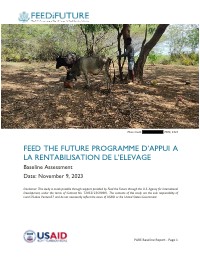
Photo Credit: PARE, 2023 FEED THE FUTURE PROGRAMME D’APPUI A LA RENTABILISATION DE L’ELEVAGE Baseline Assessment Date: November 9, 2023 Disclaimer: This study is made possible through support provided by Feed the Future through the U.S. Agency for International Development, under the terms of Contract No. 72052123C00001. The contents of this study are the sole responsibility of Land O’Lakes Venture37 and do not necessarily reflect the views of USAID or the United States Government. PARE Baseline Report - Page 1 Contents Feed the Future Programme d’Appui à la Rentabilisation de l’Elevage.................................................................1 Acronyms and Abbreviations..........................................................................................................................................4 I. Executive Summary ...............................................................................................................................................6 1.1 Summary of Findings .............................................................................................................................6 II. Introduction ............................................................................................................................................................9 2.1 Project Background......................................................................................................................................9 2.2 Haiti Context .................................................................................................................................................10 2.3 Baseline Purpose and Objectives .........................................................................................................10 III. Baseline Methodology .........................................................................................................................................12 3.1 Study Design...................................................................................................................................................12 3.2 Study Area, Population and Sample Design...................................................................................12 3.3 Sampling Design...........................................................................................................................................15 3.4 Data Collection Tools................................................................................................................................18 3.5 Data Collection.............................................................................................................................................19 3.6 Data Analysis..................................................................................................................................................21 3.7 Challenges Faced and Limitations.......................................................................................................22 IV. Findings ..............................................................................................................................................................23 4.1 Overview of Sample ...................................................................................................................................23 4.2 Overview of Cattle Producers and Their Herds ..........................................................................28 4.3 Overview of Goat/Sheep Producers and Their Herds...............................................................52 4.4 Overview of Poultry Producers and Their Flocks .......................................................................70 4.5 Summary of Livestock Production and Sales ................................................................................90 4.6 Access to Inputs, Services and Markets............................................................................................99 4.7 Household Resilience.............................................................................................................................. 114 V. Conclusion & Recommendations.................................................................................................................. 145 5.1 Conclusions .................................................................................................................................................. 145 5.2 Recommendations.................................................................................................................................... 150 VI. Annexes.......................................................................................................................................................... 152 PARE ANNUAL PRODUCER HOUSEHOLD SURVEY _ BASELINE ............................................................ 162 VII. SAMPLING & SCREENING....................................................................................................................... 163 Section A: Sampling Information............................................................................................................. 163 Section B: Household Screening............................................................................................................... 164 Section C. Informed Consent & Respondent Selection ................................................................ 165 PARE Baseline Report - Page 2 VIII.................................................................................................................................................................................. 166 IX. DEMOGRAPHICS........................................................................................................................................ 166 Section D. Respondent & Household Demographics..................................................................... 166 X. LIVESTOCK PRODUCTION AND SALES................................................................................................ 168 Section E. Goats and Sheep ........................................................................................................................ 168 Section F. Cattle ............................................................................................................................................... 184 Section G. Poultry............................................................................................................................................ 200 Section H. Shocks and Stresses................................................................................................................. 218 XI. ASSETS & ACCESS ...................................................................................................................................... 223 Section I. Asset Ownership ......................................................................................................................... 223 Section J. Access to Infrastructure, Services & Markets............................................................... 226 Section K. Access to Financial Resources ............................................................................................ 229 Section L. Access to Information ............................................................................................................. 232 XII. HOUSEHOLD INCOME & INVESTMENT ........................................................................................... 235 Section N. Survey Close & Contact Information ............................................................................. 237 1.- ENTREVUES AVEC LES LEADERS COMMUNAUTAIRES.......................................................................... 240 XIII. 2.2- Exemple: Institution de formation en lien avec l’élevage............................................................ 243 XIV. 2.3.- Exemple: Vulgarisateurs..................................................................................................................... 245 3.- DISCUSSIONS EN FOCUS GROUPES ............................................................................................................ 248 XV. 3.1.- Discussions en focus groupes avec les producteurs................................................................... 248 XVI. 3.2.- Discussion de focus groupes avec les femmes ........................................................... 252 PARE Baseline Report - Page 3 ACRONYMS AND ABBREVIATIONS ARSSI Ability to Recover from Shocks and Stressors Index CASEC Conseil d'Administration de la Section Communale CNSA Coordination Nationale de la Sécurité Alimentaire COP Chief of Party COR Contracting Officer’s Representative DCOP Deputy Chief of Party DDA Departmental Agricultural Directorate DO Development Objectives FAO Food and Agriculture Organization of the United Nations FAMV FGD La Faculté d’Agronomie et de Médecine Vétérinaires Focus Group Discussion FTF Feed the Future GOH Government of Haiti GYI Gender and Youth Inclusion KII Key Informant Interview LMSRA Livestock Market Systems Resilience Assessment MARDNR Ministère de l’Agriculture des Ressources Naturelles et du Développement Rural MEL Monitoring, Evaluation & Learning MIF Market Ignition Fund MSD Market Systems Development MSME Micro, Small and Medium-sized Enterprises MUSO Mutuelles de Solidarité NGO Non-governmental Organizations PARE Baseline Report - Page 4 PMELP Project Monitoring, Evaluation and Learning Plan RFZ Resilience Focus Zones SIB Système d'Identification du Bétail SDE Section d’Enumeration (Enumeration Areas) TOC Theory of Change PARE Programme d’Appui à la Rentabilisation de l’Elevage US United States USG United State Government USAID United States Agency for International Development Venture37 Land O’Lakes Venture37 PARE Baseline Report - Page 5 I. EXECUTIVE SUMMARY Land O’Lakes Venture37 (Venture37) conducted a Baseline Assessment for the five-year Programme d’Appui a la Rentabilisation de l’Elevage (PARE) project, funded by the United States Agency for International Development (USAID). PARE focuses on enhancing household and community resilience in Haiti's Northern and Southern Resilience Focus Zones (RFZs) by bolstering the livestock market system, particularly within the cattle, goat/sheep, and poultry value chains. The Baseline Assessment study was conducted by the PARE Monitoring, Evaluation & Learning (MEL) team in collaboration with the Haitian research firm AGIRED. This study utilized a mixed-method approach that collected quantitative data from a representative sample of smallholder livestock producer households in the Northern and Southern RFZs through a Producer Household Survey as well as qualitative data from producers, community leaders and other stakeholders. The purpose of the Baseline Assessment is to document the current status of livestock producers and their communities in the Northern and Southern RFZ in terms of their management practices, yield and sales and to understand households’ resilience capacities and coping mechanisms to shock. The Baseline Assessment, in cooperation with the simultaneous Livestock Market Systems Resilience Analysis (LMSRA) study and Gender and Youth Analysis Report will provide recommendations to refine or set program targets and identify potential areas of intervention needed to support producers and communities. A summary of findings is below. In addition, PARE indicators which have baseline values that are informed by the Baseline Assessment are included throughout this report in their relevant sections, and are also attached in Annex 2. Indicator Table. 1.1 Summary of Findings Distribution of livestock value chains ● The majority of households in the baseline sample (78%) keep goats/sheep, followed by cattle (56%) and poultry (52%). ● On average, respondent households in the sample reared two of the three target value chains. About a third (35%) of households engaged in just one of the target value chains, 45% engaged in two and 20% engaged in all three. ● Almost all (96% of cattle producers, 93% of goat/sheep producers and 100% of poultry producers) are smallholder farmers according to the Feed the Future (FTF) definition of smallholder 1. ● The average current herd size of cattle was 2.5, with a minimum of 1 and a maximum of 50. 92% of producers had a herd size of 5 or less. The average total herd size over the past year was 3.7. ● The average current herd size of goat/sheep was 5.1, with a minimum size of 1 and a maximum size of 45. 92% of producers had a herd size of 10 or less. The average total herd size over the past year was 8.1. ● The average flock size was 9.0 birds with a minimum of 1 and a maximum of 60. 83% had a flock size of 15 or fewer birds. The average total flock over the past year was 20.5. ● Most livestock consisted of local breeds, with 95% of cattle herds, 97% of goat/sheep herds and 89% of poultry herds comprised of local animals. 1 From Feed the Future Indicator Handbook: Smallholder producer is one who holds 5 hectares or less of arable land or equivalent units of livestock, i.e. cattle: 10 beef cows; dairy: two milking cows; sheep and goats: five adult ewes/does; camel meat and milk: five camel cows; pigs: two adult sows; chickens: 20 layers and 50 broilers. The farmer does not have to own the land or livestock. PARE Baseline Report - Page 6 Management practices ● Livestock was almost universally owned within the household with 2% of cattle producing households and 1% of goat/sheep producing households having an owner outside of the household. ● Tethering was the most common method for feeding and housing cattle and goat/sheep (88% of cattle producers and 86% of goat/sheep producers fed their cattle through a tethering system). ● Almost all (97%) of poultry producers fed and housed their animals in the barnyard or homestead area, and only 3% kept their birds in a chicken coop or enclosure. ● Obtaining a sufficient quantity of feed was the most pressing challenge for producers. The provision of additional feed was not widespread, with 61% of cattle producers and 64% of goat/sheep producers providing additional feed, including fresh grasses and crop residue. In addition, 16% of poultry producers gave supplemental feed to their birds. ● Accessing sufficient water is another challenge, as 74% of cattle producers and 25% of goat/sheep producers walk their animals to a water source. ● The rate of providing animal health treatments is low, with 41% of cattle producers, 37% of goat/sheep producers and 47% of poultry producers treating their animals for disease or administering preventative health measures. ● Vaccination rates are similarly low, as 52% of cattle producers, 65% of goat/sheep producers and only 9% of poultry producers have given vaccines to their animals in the past year, despite the persistent challenge of disease. These vaccinations are typically recommended on an annual basis. ● Overall, 84% of producers have applied a defined improved management practice, but producers averaged 1.5 improved practices, indicating that while the majority implemented one or two good management practices, they are not implementing them in a universal manner. Yield and Sales ● Beef yield of all producer households, including those who with a yield of 0, averaged 26.5 kilograms/herd. Of producers who engaged in any offtake activity, the average yield was 98.3 kg/herd, representing 47% of the total herd. ● Goat/sheep yield averaged 1.9 kg/herd kilograms/herd amongst all producers. Of just producers who engaged in offtake activities, average yield was 5.2 kilograms/herd, representing 34% of the total herd. ● Poultry averaged 0.6 kilograms/flock amongst all producer households. Of producers who engaged in any offtake activity, this average was 1.3 kilograms/flock, representing 30% of the total flock. ● Milk yield averaged 493 liters per cow and egg yield averaged 53 eggs per hen. ● Overall annual sales from target livestock commodities averaged $205 USD per household. This average includes the 40% of producer households who made no sales of any target livestock product in the past year. Amongst producers who sold a livestock commodity in the past year, annual sales averaged $442 USD. ● Cattle sales averaged $243 USD amongst all cattle producers, goat/sheep sales averaged $60 amongst all goat/sheep producers and poultry averaged $16. ● Amongst just those who sold, cattle sales averaged $892 USD, goat/sheep sales averaged $178 USD and poultry sales averaged $64 USD. ● Only 10% of cattle producing households sold milk, which averaged $231 amongst those who sold milk, and $23 annually across all cattle producers. ● 6% of poultry producer sold eggs, averaging $59 USD among those who sold them. PARE Baseline Report - Page 7 ● Producers noted that the price for livestock commodities, aside from eggs, has risen recently and that those with livestock to sell can benefit. Major constraints ● Drought was identified as one of the most significant challenges livestock producers face in all departments, affecting their ability to procure enough feed and water for their livestock and contributing to disease. ● Disease was another recurring issue, particularly for goats/sheep and poultry. It was the primary driver for a high rate of loss for poultry and identified as the most pressing problem for goat/sheep producers. ● Theft of cattle and goats was another persistent issue mentioned by producers throughout both quantitative and qualitative fieldwork, with theft leading to loss of cattle and goats. ● Access to credit for livestock activities was identified as another major constraint, with producers struggling to access loans to invest in their livestock activities, contributing to their inability to implement improved practices at scale. Access to Services and Inputs ● Very few producers (3% of cattle, 3% of goat/sheep and 1% of poultry) have accessed formal training or extension services in the past year. ● 71% of producers feel that they can access animal health workers, though they note that this access requires significant time and money. ● 30% of producers feel that they are able to access veterinary medicines. ● Markets are somewhat accessible to producers, who overwhelmingly sell in local markets. Some note that the distance is significant and 59% feel that they have sufficient access to markets for selling animals. ● 76% of households have been exposed to critical information in the past year, with rainfall and weather information being the most common (60%) followed by market prices (41%). ● For many topics, mass media, including newspapers, radio and television, was the most common source, with informal networks of friends and family and word of mouth being other frequent sources of information. ● Less than half of producers (44%) feel that they could access a loan, and fewer (38%) of households have taken a loan in the past year. The most common sources of loans were informal, with village savings/credit group as the most common, followed by friends or relatives. 10% of households took a loan from a formal lender in the past year, emphasizing the difficulty that livestock producers have in accessing formal credit. Household Resilience ● Out of a list of 21 shocks, households experienced an average of 7.8 in the past year, with the most common being a sharp increase in the price of food (94%) and increase in agricultural inputs (87%), as well as youth unemployment (80%). ● Drought was felt to be the most severe of these top shocks, with 57% citing it as having an extremely severe impact on household income and 52% on food consumption. ● In terms of absorptive resilience capacities, cash savings is low, with 37% of households holding savings, primarily kept at home. The availability of government or NGO aid is also low. However, ownership of livestock assets was high. PARE Baseline Report - Page 8 ● Adaptive resilience strategies relied most on households’ ability to diversify their livelihoods, with an average of 3 income sources per household. Crop production was the most common at 58% with 47% earning income from the sale of livestock commodities in the past year. ● Transformative resilience capacities available for households were low, with little access to general services like electricity (32%), though access to markets was, particularly local markets, was higher at 59%. ● The coping strategies that households employed most often to deal with shocks and stresses was reducing their household expenses (53%) and reducing their food for consumption (40%) ● Only 14% of households sold their livestock in the past year to deal with a shock, which is often a last resort. Geographic Differences ● There were marked geographic differences in the distribution of livestock, due to the agro ecological zones found in each of the 4 departments found in the study. ● Similarly, management practices differed by department as well, with producers in Nord Est most likely to practice open grazing due to the higher availability of land. ● Producers in Sud perceived higher access to animal health workers, and this is reflected in a higher rate of providing animal health treatments and vaccines to their cattle and goats/sheep. Producers in Nord also had the highest rate of providing vaccines. Centre saw the lowest rates of vaccination and provision of animal health treatments. ● Producers in Sud also practiced intentional breeding for cattle, goats/sheep and poultry at a higher rate than those in other departments, particularly Nord, which had the lowest rate of intentional breeding. II. INTRODUCTION 2.1 Project Background PARE is a 5-year, $23 million project funded by the United States Agency for International Development (USAID). PARE is implemented by Venture37 in partnership with Heifer International (Heifer) and Papyrus S.A. (Papyrus) from January 9, 2023 – January 8, 2028. The program aims to increase the resilience of households and communities in 4 Departments (Nord, Nord-Est, Sud and Centre) and 34 communes in the Northern and Southern RFZs of Haiti through the improvement of the livestock market system. PARE will focus on inclusive commercialization of the cattle, goat, sheep, and poultry value chains. PARE will take a market systems development (MSD) approach to reach its goal. PARE will foster livestock market system resilience through strategically partnering with diverse, existing public and private sector market actors to implement livestock systems innovations that support PARE’s objectives. The PARE approach places Haitian partners at the center of implementation and will strategically utilize a $3.6 million Market Ignition Fund (MIF) as a flexible tool to build capacity and buy down risk for market actor investment in inclusive livestock sector growth. The three main objectives that PARE will achieve are: Objective 1: Improve productivity of the livestock sector in the Resilience Focus Zones. PARE will improve livestock productivity in the RFZs by strengthening the private sector to support farmers to adopt on-farm productivity-enhancing technologies and management practices that are climate smart, contextually adapted and specific to each livestock species. Innovative partnership models, grants and private sector co-financing mechanisms deployed through the MIF will be at the core of building more sustainable extension systems and assisting producers and communities to build more resilience in the face of shocks. Importantly, outcomes from Objective 2 related to access to inputs and services are necessary PARE Baseline Report - Page 9 components for the achievement of this objective. Partners will include private actors such as agro-dealers, end buyers, agro-vets, research universities and NGOs. Objective 2: Increase the accessibility of inputs and services in the livestock market system. PARE will improve producer access to inputs and services in four key areas: Provision of animal stock inputs and services, livestock nutrition inputs, animal health products and services, access to market information, and access to financial services. PARE will explore business models that provide embedded service provision as well as the expanded networks for input providers. Potential partners could include agro-dealers, cooperatives, end market buyers, aggregators and financial institutions. Objective 3: Improve marketing and private sector engagement in the sector. To achieve this, PARE will engage the private sector to increase utilization of available financial products, enhance their ability to produce higher-value products for rural and urban markets, and access the inputs and services they need to invest further in the sector and increase profitability. Interventions will include light-touch approaches such as improving linkages through regional platforms, and heavier-touch such as co-investment grants in improved infrastructure and packaging materials for slaughterhouses, meat packers and mini-dairy networks to improve quality and marketing campaigns. 2.2 Haiti Context Agriculture is an important sector in Haiti, employing just under half of Haiti’s workforce and contributing to over 20% of Haiti’s GDP in 20222. Livestock is a key component of the agriculture sector with about 75% of households owning some type of livestock 3. Haiti has a large livestock population, with nearly 5.8 million chickens, 1.5 million cattle, and over 2 million goats and sheep. 4 The prevalence of livestock across the country, in addition to the growing demand for animal sourced foods in Haiti provides an opportunity for economic investment and expansion of the sector. Currently, a significant portion of Haiti’s animal sourced foods are imported from outside of Haiti, some of which could be produced locally. Some existing public and private sector actors are interested in further investment in the livestock sector. In recent years, Haiti has suffered numerous natural disasters and crises. The assassination of President Jovenel Moïse in July 2021 plunged the country into political turmoil and further weakened the government's ability to respond to other crises and pursue its agenda for sustainable development. Gangs have rapidly expanded their territory and blocked key road arteries, making travel to and from the capital dangerous and stifling trade to/from Port au Prince. A magnitude 7.2 earthquake in August 2021 in Les Cayes killed more than 2,200 people and injured over 12,000, causing widespread damage to infrastructure and housing, and leaving many people displaced. Flooding in June 2023 displaced thousands more, particularly in Grand Anse, Sud Est, Nippes, Nord Ouest, Centre and Ouest departments. In addition, some crises have had a particular effect on specific departments. In the Nord Est, recent drought has significantly affected livestock and agricultural activities. Sud is also more prone to hurricanes, including the 2016 Hurricane Matthew, and subsequent flooding. These crises will be kept in consideration throughout the discussion of data in this report. 2.3 Baseline Purpose and Objectives The purpose of the Baseline Assessment was to document the current status of livestock producers in the Northern and Southern RFZs of Haiti. By doing this, the Baseline Assessment will help: 2 World Bank Open Data. Agirculture, forestry and fishing, value added (% of GDP- Haiti. https://data.worldbank.org/indicator/NV.AGR.TOTL.ZS?locations=HT 3Coello, B., Oseni, G., Savrimootoo, T., & Weiss, E. (2014). Rural development in Haiti. 4 FAO Stat 2020. https://www.fao.org/faostat/en/#home PARE Baseline Report - Page 10 ● Set or validate baseline values for relevant program outputs and outcome indicators at the household level. ● Provide recommendations based on findings on: o Refining or setting PARE indicator targets o Potential areas of intervention needed to support livestock producers Concurrently, PARE carried out a Gender & Youth Inclusion (GYI) analysis. Both the Baseline Assessment and GYI analysis drew from the same data sources. The GYI analysis findings will be shared in a separate report. PARE Baseline Report - Page 11 III. BASELINE METHODOLOGY 3.1 Study Design The Baseline Assessment study was conducted by the PARE MEL team in partnership with AGIRED. The PARE MEL team led the study design, analysis and reporting while AGIRED managed all fieldwork data collection. This study utilized a mixed-method approach using quantitative and qualitative data collection methods to achieve the objectives described above. The quantitative component included a cross-sectional population-level producer household survey among households that produce at least one of the 3 target value chains (cattle, goats/sheep, poultry). Focus Group Discussions (FGD) with producers and Key Informant Interviews (KII) with community leaders, government officials, extension officers, and other stakeholders were conducted to provide qualitative data to give additional insights, nuance and complexity. 3.2 Study Area, Population and Sample Design 3.2.1 STUDY AREA As a Market Systems Development (MSD) activity, PARE’s interventions are not pre-determined but instead rely on co-creation with partners. Therefore, at Baseline, it is not possible to create a precise list of program participants. Through partner co-creations, the PARE Program will target the Northern and Southern RFZs which include 34 communes across 4 departments – 3 departments in the Northern RFZ (Nord, Nord Est and Centre) and 1 department (Sud) in the Southern RFZ. These communes are listed below in Table 0. The Baseline Assessment was population-based and conducted in the same geographic areas that PARE will target for activities, as the goal was to establish a baseline of livestock producers in the program areas. Ultimately, 16 communes were selected for this study using the methods described below in Section 3.1.1. Sampling Approach for Producer Household Survey. Selected communes are noted below in Table 0. Figure 1 provides a map of both sampled and non-sampled communes in the Northern and Southern RFZs. Table 0. Communes included in Baseline Assessment Department RFZ Communes Selected for Baseline study Nord Acul du Nord Yes La Victoire No Limonade Yes Pignon Yes Plaine du Nord No Quartier Morin No Ranquitte No Saint Raphaël Yes PARE Baseline Report - Page 12 Nord Est Capotille No Caracol No Carice No Ferrier No Fort-Liberté Yes Mont-Organisé No Ouanaminthe Yes Perches No Sainte Suzanne No Terrier Rouge Yes Trou du Nord No Vallières Yes Centre Cerca Carvajal Yes Cerca la Source Yes Hinche Yes Sud Arniquet No Camp-Perrin Yes Chantal Yes Chardonnières Yes Côteaux No Les Cayes No Port-à-Piment No Port-Salut No Roche-à-Bâteau No Saint Jean du Sud Yes Torbeck Yes PARE Baseline Report - Page 13 Figure 1. Map of communes included in Baseline Assessment 3.2.2 STUDY POPULATION Livestock producer households are the primary unit of analysis for quantitative data collection. Households were defined as “a group of people living together under the same roof and sharing from the same pot of food”. This is a widely accepted definition of household and shared by the Coordination Nationale de la Sécurité Alimentaire (CNSA) and the Food and Agriculture Organization of the United Nations (FAO). While the concept of household in Haiti is more nuanced and complex, this standard definition was selected as the most efficient and appropriate for the purposes of this study. Randomly selected households were considered eligible for this study if they had produced (at any scale) the target livestock in the past year. For the quantitative producer household survey, a member of each household 18 years of age or older was selected to respond on behalf of the household. This respondent is defined as “the person most knowledgeable about the care and raising of livestock in this household”. The definition was deliberately selected, rather than head of household, to increase the number of women respondents, especially in the small ruminant and poultry value chains, where women are typically the primary producers. For qualitative fieldwork, different targeted producers within the household (women, youth, etc.) were purposely selected for the FGDs. For the KIIs, community leaders were recruited from the local areas in which the quantitative survey was conducted and included leaders of producer associations and cooperatives, NGOs and other community institutions related to livestock. A full list of KII participants is included in Annex 3 Summary of Qualitative Instruments for FGDs and KIIs. PARE Baseline Report - Page 14 3.3 Sampling Design 3.3.0 OVERVIEW OF SAMPLE DESIGN As an MSD project, given that interventions are not pre-determined but rely on co-creation with partners, at Baseline, PARE does not know who the precise participants will be. Thus, the Baseline Assessment will be based on the estimated population of livestock producer households in the RFZs to provide a contextualized snapshot of conditions at Baseline, but follow up data collection will be targeted at program participants. The quantitative Producer Household Survey used a multi-stage stratified sample with random selection of primary sampling units and secondary sampling units. The qualitative FGDs and KIIs utilized purposive sampling to ensure that a wide range of relevant stakeholders and perspectives were included. 3.3.1 SAMPLE SIZE FOR PRODUCER HOUSEHOLD SURVEY The sample size was calculated considering the variability and size of the population of household producers, the sampling design, the confidence level, and the response rate. The team used the results of the General Census of Agriculture of the Ministère de l’Agriculture des Ressources Naturelles et du Développement Rural (MARNDR) 5, which was carried out in 2009, to estimate the study population (total number of agricultural producers in the targeted departments). Table 1 below illustrates this population in each of the 4 departments amongst the 34 targeted communes in the RFZ, which are listed in Table 0. Agricultural producer households were selected as the population of interest for several reasons. While the census does specify the number of households for whom livestock is a principal activity, PARE aims to also target smallholder livestock producers with only a few animals currently, for whom livestock production is not a principal activity. Furthermore, as noted in the USAID/HAITI Economic Growth and Agriculture Development: Gender Analysis Report 6, most rural households in Haiti practice some form of traditional small-scale livestock farming and livestock is typically a complement to crop production. Thus, agricultural households were found to be a suitable proxy for the type of households that this survey is targeting. Noted below in study limitations, the census was conducted in 2009, making the information dated. However, in the absence of recent census data and given the current lack of quality population and livestock data in Haiti, this limitation was accepted. Given geographic, economic and socio-political differences across the four departments included in the study, as well as a desire to compare results across departments, the sample was designed to be statistically significant at the department level and each department was considered as a separate population with equal allocation of sample allotted. To calculate the sample size, parameters were set in terms of a margin of error of 5% and a confidence level of 95%. The standard sample size formula 7 below was applied to each department independently. These recommended sample sizes are listed below in Table 1. A margin of 10%, to account for non response and outliers was added to each department and the final sample size was rounded up for an easily communicated number for the field team. The final sample size was calculated as n=425 in each department, with a total sample size of n=1700, as shown below in Table 1. 5 Ministère de l’agriculture des ressources naturelles et du développement rural (MARDNR). Synthèse nationale des résultats du recensement général de l’agriculture (RGA), 2009. Annex 1 : Exploitants et exploitations agricoles, Tableau 11.5 : Nombre total d'exploitations, répartition des exploitations par commune et selon l'activité principale de l'exploitant (in each respective district report) 6 Banyan Global. 2022. USAID/Haiti Economic Growth and Agricultural Development: Gender Analysis Report. 7 Rea, L. M., & Parker, R. A. Designing and Conducting Survey Research: A Comprehensive Guide. San Francisco, CA: Josey-Bass Publishers. 1997. PARE Baseline Report - Page 15 Table 1. Sample size calculation Department Population of agricultural households in 34 RFZ communes Initial sample size of producer households + 10% margin Final rounded sample size of producer households Nord 38,743 380 38 425 Nord-Est 37,189 380 38 425 Centre 34,949 380 38 425 Sud 48,975 381 38 425 Total 159,856 1,512 1,700 This sample size is also above the “rule of thumb” minimum acceptable sample size of n=384 for a population above 5,000 with a 5% margin of error. Since it is highly likely based on information in the Agricultural Census that the population of livestock producers in each department in above 5,000, this rule of thumb sample size provides additional assurance that the selected sample size is sufficiently large for the purposes of this study. 3.3.2 SAMPLING STAGES Four stages of sampling were used to allocate the total sample to different strata. In the first stage, a sample of the 34 PARE target communes listed in Table 0 was selected. To maximize time and efficiency and with respect to budget, 16 was selected as the number of communes and was considered a reasonable sample of communes as it represents half (50%) of the universe of 34 communes. The sample of 16 communes was then allocated across the 4 departments. This allocation was proportional to the population of livestock in PARE communes in each department, using animal population data from the MARNDR 2009 Agricultural Census 8. The resulting allocation of communes is illustrated below in Table 2. Finally, the communes themselves were selected. This selection was purposive based on the importance of livestock to the commune, using population data from the MARNDR 2009 Agricultural Census on proportion of livestock and expert knowledge of the PARE team. 8 Ministère de l’agriculture des ressources naturelles et du développement rural (MARDNR). Synthèse nationale des résultats du recensement général de l’agriculture (RGA), 2009. Annex 1 : Exploitants et exploitations agricoles, Tableau 11.2 : Nombre total d'exploitations, répartition des exploitations par commune et selon l'activité principale de l'exploitant (in each respective district report) PARE Baseline Report - Page 16 Next, the sample was allocated to the first stage cluster, defined here as enumeration areas, or Sections d’Enumération (SDEs). As there is no reliable sampling base on producer households in communal sections concerned by the survey, the General Population and Housing Census (RGPH), 20039 with a partial update in 2011 was used as the sampling frame and the census EAs were used as the primary sampling unit. A standard of 17 households per SDE was set for all SDEs to simplify the sampling strategy to enable easier fieldwork management and thus higher quality data. Given that the number of household interviews allocated to each department was 425, the number of SDEs per department was established as 25 (425/17 = 25) for a total of 100 SDEs. The 25 SDEs per department were allocated to each selected commune based on proportion of livestock amongst selected communes in the department. Before this allocation, SDEs that were identified as urban were removed from the universe of SDEs. Table 2 illustrates the final distribution. SDEs were then randomly selected from each commune. Finally, households were defined as the secondary sampling unit. Households were selected using the random walk method. In the final stage, respondents were selected from within households, using the criteria described above in Section 3.1.2 Study Population. Table 2. Allocation of sample Department Selected Communes # SDEs allocated Total # household interviews allocated Nord Acul du Nord 9 153 Limonade 5 85 Pignon 6 102 Saint-Raphaël 5 85 TOTAL 25 425 Nord Est Fort-Liberté 5 85 Ounaminthe 9 153 Terrier-Rouge 8 136 Vallières 3 51 TOTAL 25 425 Cerca Carvajal 2 34 Cerca la Source 8 136 Hinche 15 255 9 https://microdata.worldbank.org/index.php/catalog/1626/related-materials PARE Baseline Report - Page 17 TOTAL 25 425 Sud Camp-Perrin 5 85 Chantal 7 119 Chardonnières 4 68 Saint-Jean du Sud 4 68 Torbeck 5 85 TOTAL 25 425 TOTAL 16 100 1700 3.3.3 SAMPLING FOR QUALITATIVE FGDS AND KIIS The qualitative FGDs and KIIs utilized purposive sampling to ensure that a wide range of relevant stakeholders and perspectives are included. 48 FGDs with producers, 45 KIIs with community leaders and 20 KIIs with other stakeholders were allocated. Producers were recruited for FGDs from the same areas as the quantitative household survey. The data collection team convened three FGDs per commune, including one with a general group of producers, one with women producers and one with youth producers, for a total of 48. Producers were purposively selected to represent a range of livestock value chains and size of production. Community leaders for KIIs were also purposively selected from the target population. This sample of 45 was distributed across each commune in each department. Other stakeholders in the livestock value chain were distributed evenly across each of the four departments for a total of 20. 3.4 Data Collection Tools 3.4.1 PRODUCER HOUSEHOLD SURVEY The quantitative Producer Household Survey Questionnaire was developed by the PARE MEL team based on the relevant PARE Indicators for the baseline as well as technical consultations and a desk review of relevant literature The questionnaire includes all required data points for PARE indicators measured in the Producer Baseline. The questionnaire included 14 separate modules, though respondents only received the relevant livestock production module for the livestock their household raises. Table 3 below illustrates the questionnaire topics and lines of questioning. Where possible, questions include don’t know and refuse options to minimize non-response and improve data quality. The questionnaire was translated from English to Haitian Creole by the AGIRED team. It was then programmed into Kobo Collect by the AGIRED team and tested for quality by AGIRED and the PARE MEL team. The full questionnaire can be found in Annex 4 Data Collection Tools. PARE Baseline Report - Page 18 Table 3. Lines of questioning in quantitative questionnaire Topic Lines of questioning Demographics Respondent Demographics Household Demographics Livestock production and sales (one section for each value chain, with goats and sheep combined) Production and yield of animals Sales and income of livestock Production and sales of animal product (milk/eggs) Livestock rearing practices Shocks and Stresses Exposure to shocks Severity of shocks Coping strategies Assets and Access Asset ownership Access to infrastructure, services & markets Access to financial Resources Household income and Investment Income Investment 3.4.2 DISCUSSION GUIDES FOR QUALITATIVE FIELDWORK Discussion Guides for qualitative fieldwork were developed based on the quantitative questionnaire as well as the desk review of relevant literature and technical consultations. Different discussion guides were created for each type of FGD and KII. The goal of the qualitative research was to deepen PARE’s understanding of key issues by providing additional nuance and complexity through non-numeric data. Qualitative guides have been created with this goal in mind and focus on questions of “why” and “how”. Discussion guides can be found in Annex 4 Data Collection Tools. 3.5 Data Collection 3.5.1 DATA COLLECTION TEAM Data collection was carried out by AGIRED and included a team of two regional coordinators, four supervisors and 34 local enumerators. Two regional enumerator trainings (one in the north and one in the south) were conducted for three days each, followed by a one-day pilot and debrief. Training focused on the survey methodology, a detailed review of the survey instrument, and best practices in ensuring high quality data collection. The PARE MEL Manager attended the trainings and the initial days of data collection. PARE Baseline Report - Page 19 Data collection was conducted face-to-face in Haitian Creole by AGIRED’s team of trained enumerators using tablets for computer-assisted personal interviews (CAPI). Each tablet was programmed with the survey collection software Kobo Collect. The PARE MEL Manager provided remote daily oversight of fieldwork. Selected communal sections were informed one week in advance about the objectives of the survey and the sampling methodology. An official letter was sent to the local guides to disseminate information with households and facilitate the penetration of the field team. 12 SDEs (12% of total sample of SDEs) were replaced due to security issues, lack of households in the SDE, or difficulty in traveling to location. Replacement was done using a rigorous replacement protocol to ensure that replaced SDEs were randomly selected. 3.5.2 DATA COLLECTION TIMING The fieldwork activities were conducted from April 24th to July 14th, 2023. The questionnaire asked respondents to recall values for the previous year, from April 2022 to April 2023. 3.5.3 FINAL SAMPLE ACHIEVED AGIRED completed 2,112 total interviews, which were all reviewed by the fieldwork coordinators and AGIRED statistician. Of those, 548 were rejected for reasons of non-compliance such as the inconsistency of the information provided by respondent, and 1683 (80%) were accepted. The final sample distribution is illustrated in Table 4. The PARE team conducted a t-test to determine whether the planned sample distribution differs significantly from achieved sample distribution. The t-test determined that there is no statistically significant difference. Therefore, the sample was not weighted. Table 4. Final sample achieved compared to planned sample Department Selected Communes Planned Sample Achieved Sample # SDEs Total # household interviews # SDEs Total # household interviews Nord Acul du Nord 9 153 9 151 Limonade 5 85 5 84 Pignon 6 102 6 98 Saint-Raphaël 5 85 5 85 TOTAL 25 425 25 418 Nord Est Fort-Liberté 5 85 5 83 Ounaminthe 9 153 9 151 Terrier-Rouge 8 136 8 136 Vallières 3 51 3 47 TOTAL 25 425 25 417 PARE Baseline Report - Page 20 Centre Hinche 15 255 15 255 Cerca Carvajal 2 34 2 34 Cerca la Source 8 136 8 135 TOTAL 25 425 25 424 Sud Camp-Perrin 5 85 5 85 Chardonnières 4 68 4 68 Chantal 7 119 7 118 Saint-Jean du Sud 4 68 4 68 Torbeck 5 85 5 85 TOTAL 25 425 25 356 TOTAL 100 1700 100 1683 3.6 Data Analysis 3.6.1 QUANTITATIVE DATA ANALYSIS The PARE MEL team used descriptive statistics such as counts, proportions, and means to look for common trends and patterns in the data. To the extent possible, PARE disaggregated these descriptive statistics to reveal differences across project geography and type of livestock value chain (gender and age of producers is considered in the accompanying GYI Analysis report). Quantitative analysis was performed in Excel, STATA and Python. To support the quantitative analysis, qualitative methods were used to provide insights into connections between different practices being used and desired outcomes such as yield and sales. Finally, baseline values of relevant project indicators were calculated and disaggregated as required in the Project Monitoring and Evaluation Plan (PMELP). A thorough data cleaning process was conducted that checked data for a range of issues including data completeness, validity and consistency. During the cleaning process, four data issues were identified, and a protocol was developed to address these issues. (1) During the data cleaning and analysis process, an outlier analysis was performed on all numeric variables. A floor and ceiling of 3 times the interquartile range was established to identify extreme outliers. Outliers were removed, except for cases where the variable was required in a calculation and missing values needed to be filled in. In these cases, outliers were replaced with the average of the variable after outliers were removed. which were removed. (2) Respondents were asked to identify the average price received for a single unit of different agricultural commodities sold including cattle, milk, goats/sheep, poultry and eggs. Analysis determined that in many instances respondents erroneously multiplied the pr