

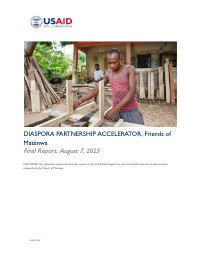
DIASPORA PARTNERSHIP ACCELERATOR, Friends of Matènwa Final Report
Summary — This final report details the Diaspora Partnership Accelerator project implemented by Friends of Matènwa (FoM) with USAID/BHA assistance. The project focused on constructing seven houses in La Gonave, Haiti, using sustainable practices and providing access to water and gardens for residents.
Key Findings
- The project infused $163,200 USD into the La Gonave economy.
- Over 120 residents of La Gonave benefited directly from the project.
- Building techniques were transferred to local masons, improving earthquake resistance.
- Recycled materials were used to reduce waste.
- Financial instruments were made available to families for access to safe and secure housing.
Full Description
The Diaspora Partnership Accelerator project, implemented by Friends of Matènwa (FoM) with support from USAID/BHA, aimed to reduce exposure to natural disasters and public health risks among residents of La Gonave, Haiti. The project constructed seven houses in the communities of Matènwa, Ti Klewon, Nan Mango, and Plenn Mapou, adhering to strict environmental standards and providing water access and garden plots. The innovative loan model pilot sought to influence construction standards, provide affordable housing with disaster-resilient designs, and generate funds for additional homes through loan repayments. The project faced challenges, including debates over the use of recycled materials and rising construction costs, but ultimately achieved its goal of building sturdier, more sustainable homes for vulnerable families.
Full Document Text
Extracted text from the original document for search indexing.
DIASPORA PARTNERSHIP ACCELERATOR, Friends of Matènwa Final Report, August 7, 2023 DISCLAIMER This publication was produced at the request of the United States Agency for International Development, It was prepared independently by Friends of Matènwa USAID.GOV CONTENTS PROGRAM OVERVIEW.................................................................................................................... 3 SUMMARY OF RESULTS...................................................................................................................4 CHALLENGES...................................................................................................................................10 SUMMARY OF CAPACITY SESSIONS........................................................................................ 11 LESSONS LEARNED........................................................................................................................12 APPENDIX I: Feedback................................................................................................................... 14 USAID.GOV 2 PROGRAM OVERVIEW Write a brief summary of your project and include Project location With assistance from USAID/BHA, Vistant, Miyamoto, and under the direction of the Matènwa Community Learning Center Direction Committee, Friends of Matènwa (FoM) built seven houses in the communities of Matènwa, Ti Klewon, Nan Mango, and Plenn Mapou on the island of Lagonav, Haiti. Built under strict environmental standards that protect prospective buyers from natural and environmental disasters, the homes are equipped with water access and garden plots. This ensures households can grow produce to eat and sell, thereby increasing their income while reallocating some of their food budget. They spend less, and they make more. Main objective of the project Overall objective: To reduce exposure to natural disasters and public health risks among residents of La Gonave by improving their access to safe and dignified shelter through an innovative, sustainable loan model pilot that provides: 1. model homes to influence community members’ and builders’ standards of the level of quality that is possible in their context 2. affordable housing for three preliminary cohorts, including innovative designs that reduce disaster exposure, reduce waste, and connect residents with long-term, resilience-building services such as income-generating gardens 3. generates funds through a loan repayment program for the provision of additional homes. Innovative design: Our innovations are three-fold: 1) building with recycled materials that reduce waste and result in sturdier structures and reduce vulnerability to hurricanes, earthquakes and erosion, 2) providing families with a financial instrument that accelerates their access to safe, secure housing, and 3) ensuring stored water access and restoring land surrounding the household for long-term resilience and self-sufficiency that reduces vulnerability. Start and end date of project: May 31, 2022 - July 31, 2023 USAID.GOV 3 What local partners did you work with, if any? The Matènwa Community Learning Center SUMMARY OF RESULTS The project’s main objective was to build houses for families living on La Gonave. From November 2022 through June 2023, the project has infused $163, 200 USD into the economy of La Gonave. Aside from travel expenses to make onsite supervisory visits. All $163,200 was infused into the Lagonav economy. This was achieved through the purchase of 80% of materials and construction equipment from the island itself. We also hired 20 local seasonal workers and invested in fortifying the local infrastructure. FoM estimates that more than 120 residents of La Gonave benefited directly from the project. We have also achieved the transfer of building techniques. Our masons learned the techniques of building blocks and reinforcing the foundations so they are earthquake-resistant. As a result, we were able to build sturdier homes that are resistant to natural disasters. We also used recycled materials to reduce waste. We used recycled plastic bottles to build the inner non weight bearing walls for two of the houses. We also used compost for the latrines. We have also made available financial instruments in order for the families’ access to safe and secure housing is affordable. Most importantly, we have tried to infuse sustainability into the structures by ensuring access to stored water and building gardens for growing produce. MONITORING AND EVALUATION Did you conduct any monitoring and evaluation? If so, explain any data collection or feedback. Please list your activities and what were the outcomes of each activity in the table below. MONITORING AND EVALUATION Did you conduct any monitoring and evaluation? If so, explain any data collection or feedback. Please list your activities and what were the outcomes of each activity in the table below. RESULTS TABLE ACTIVITIES RESULTS USAID.GOV 4 ● Will create drawings of the architectural design of the houses to be reviewed by Miyamoto’s disaster-resistant construction and engineering experts. ● Will finalize training and counseling plans. ● Will select builders and prospective homebuyers. ● Communities have already begun selecting project sites. We will start the legal land purchasing process in all 4 communities during this phase. The MatènwaCommunity Learning Center has undertaken this process many times and has not encountered issues on the island of La Gonave. ● Collect bottles for the first 4 houses ● The drawings were submitted, reviewed, and approved by Miyamoto’s engineering team. ● Two teams of builders and masons were hired to work on the constructions; a prospective homebuyers’ profile was developed by the MCLC Direction Committee. ● Four project sites were identified and land purchased with assistance from community leaders residing in the four identified communities. ● Miyamoto engineers said that plastic bottle bricks would not meet Haiti’s post earthquake building codes, therefore the MCLC Direction Committee had to forgo using water bottle bricks for the four outer weight bearing walls of each house. Will launch in 2 communities: ● Will construct 4 houses. This initial construction period will also serve as a disaster- resistant construction training opportunity for builders from all 4 communities that we intend to work with over the course of the project. ● Will provide an initial cohort of families with homebuyers’ bootcamp, including training and counseling. ● Continue bottle collection for the next 4 houses ● The four houses were constructed and made available for inspection by the deadline date. ● A screening and recruitment plan of prospective homebuyers was developed by the MCLC Direction Committee. ● Miyamoto engineers said that plastic bottle bricks would not meet Haiti’s post earthquake building codes, therefore the MCLC Direction Committee had to forgo using water bottle bricks to construct the four outer weight bearing walls. In Phase 1 communities: ● Under the supervision of the Miyamoto engineer, the four houses were retrofitted by July 31, 2023 USAID.GOV 5 ● Will retrofit 4 constructed houses to improve structural safety and integrity ● Will expand to 2 more communities: ● Will construct 3 additional houses. ● Construction in the two other communities was finalized by July 31, 2023. ● Will complete construction on 7 houses in the 4 communities. ● Will provide Cohort 2 families with homebuyers’ bootcamp, including training and counseling. ● Construction on the seven houses were completed on July 31, 2023. ● To prioritize the retrofit and final construction of the two houses, the homebuyers’ bootcamp was rescheduled for August. Description of Data Collection: We interviewed a total of 40 people; 10 from each community. We picked these people randomly, from a larger group that had been involved with the project since the summer of 2022 and saw the project through. They attended the meetings and were part of the conversations that we had with community leaders. They came forward to speak to our interviewer of their free will since they were interested in the project and made themselves available to us. We conducted the surveys one-on-one in an open space to ensure that each interviewee could interact and provide responses freely. And, that we maintained an atmosphere of transparency. We also wanted to be sure that the people did not feel the impact of outside pressure, such as neighbors raising questions on why a particular member did not like the project. Or why did it not please them. Our objective was to gain people’s true perspectives. The interviewer talking to the people was someone who we were confident was not a familiar face in the community. It was helpful that most people did not know her. USAID.GOV 6 USAID.GOV 7 USAID.GOV 8 USAID.GOV 9 CHALLENGES What were the major challenges of the project? Did you achieve the results you thought you would at the beginning? Why or why not? How did you respond to these challenges? Friends of Matènwa: We continue to debate how much we could have pressed Miyamoto and USAID to include recycled bottles in our construction. At the start of the project, we highlighted the benefits of including recycled bottles in local construction. During periods of intense heat, like the kind residents of Matènwa are currently experiencing, houses constructed in part with recycled bottles allow for the cool breeze to flow freely throughout the house. Not only does the construction use less water and cement, but the recycled bottles help lessen the intensity of the heat. We understand the safety concerns raised by Miyamoto and USAID. However, we believe the discussion around the usage of recycled water bottles was rushed and we should have taken more time to discuss the pros and cons. Friends of Matenwa (FoM) was created to fund MCLC and any other projects related to the organization. The housing and agriculture projects are indirectly related to the school but they USAID.GOV 10 are a part of the efforts for improving the lives of the residents of Matenwa and neighboring communities. MCLC is the school that Chris Lowe and Abner founded in 1996 to promote mother tongue education on the island of Lagonav and Haiti. The Matènwa Direction Committee - Fiscal: The project was conducted in an atmosphere of volatility with construction costs increasing because of the rise in the United States Dollar (USD), especially during November - March. We implemented a three-prong strategy to control expenses and to stay within budget: From the perspective of the Matenwa Direction Committee, we took necessary efforts like: ● We worked closely with our buyers to buy wholesale as far in advance as possible and when materials were available on the island. ● Our team negotiated with our local partners to give us discounts where possible to control the high cost of materials that had to be purchased on the mainland and transported to Lagonav. For example, the price of wood to make windows, doors, etc. doubled during phase I of the project. ● Friends of Matènwa was able to advance us the funds needed to continue with the project uninterrupted. This support made it possible to keep our staff motivated and allowed us to negotiate prices from a position of strength. We were able to accomplish this because we were among the few projects operating on the island that could ensure timely payments of salaries and payments for goods. SUMMARY OF CAPACITY SESSIONS What capacity building training did you participate in with Miyamoto? Were they helpful? Why/why not? Have you used any of the material or information from the sessions? Are there other session topics you would have liked to see? In partnership with Miyamoto, the FoM team participated in the following capacity sessions: ● SoW and Task Order writing ● Grant Writing ● Introduction to Monitoring and Evaluation ● Data for Impact (multiple sessions) ● Data collection tool development ● Funding Opportunities: USAID DIV ● Housing Finance Loans ● Concrete Brick Making ● Disaster resistant masonry/construction USAID.GOV 11 ● Report Writing ● Construction Design The following capacity sessions informed our discussion on how to proceed to recruiting prospective buyers and developing a financial product that would make it viable for selected buyers to purchase these houses: ● Housing Finance Loans ● Concrete Brick Making The capacity sessions helped our team through the challenge of developing a financial model that would allow residents of Lagonav to purchase the seven properties that are now available to be purchased. The process of developing such a financial product has proven to be daunting for our team. The potential buyers who have contacted us are all interested in a "rent to own" model, but the challenge is creating a 10-15 or 20-year mortgage that would appeal to a family earning USD $3,000 a year. The Direction Committee believes that the financial product they will develop in Matenwa could be a model that private and public entities can use if they wish to invest in affordable residential development in Haiti. LESSONS LEARNED What lessons did you learn as a result of implementing this project? This could include lessons about how to work with USAID, partners, or your community. It could include lessons about your activities, results, operating context, or challenges. One of the key lessons learned from this project is that MCLC is a robust institution. It has all the required leverage to deal with emergency situations and has earned the trust of the community. We were able to overcome a lot of the challenges we faced on the ground thanks to MCLC’s support. As mentioned earlier, despite problems like the rise of the dollar and the uncertainties arising from the volatile political situation in the capital, we continued to make progress because our partners believed in us. They trusted us because of our achievement record in the community and were confident of what we were hoping to accomplish with this project. USAID.GOV 12 Our partners continued to support us even through difficult times that were potentially hitting their profit margins. However, they knew that the project was worth the investment. We’ve proved that we are a strong institution on the island where there is a lack of such leadership. We have benefited not only our immediate community, but we also have a significant impact on the island. We did, however, identify areas where we can do better. First, we continue to have internal conversations on how to collect data in real time. We need to work out how to measure the time and money spent on developing these houses. Tracking the value of these resources is essential. We also need data to measure the economic impact the project had on the people who worked on the project. This data is particularly significant given the uncertain economic and political conditions on the island. That’s something we think we can improve and thus, communicate the impact we have made, more in terms of quantity than quality. That’s something the project has taught us. The data will also help us to assess in real time how the money we are spending is helping the community and how the members are taking advantage of the equity we’re providing. If collected efficiently, this information can prove to be a powerful tool for us to do better. Moving on the second lesson we learned, this is our first experience matching a project with USAID and international partners. It taught us a lot about how we think of the 30th anniversary of MCLC, what we need to do, and how we can be better partners in the future. If we enter into these partnerships in the future, we now understand how to make sure we’re communicating our objectives and making our voices heard early. We have learned that a lot of the difficulties we faced through launching the project stemmed from a lack of seamless communication in the early stages. Things improved dramatically afterward, but that’s an area where we need to work on for the future. USAID has its objectives and we have our own goals. Ultimately, with USAID and Miyamoto, we all want to champion what people on the ground want. There has to be an ongoing communication between ourselves and our partners to make sure that we are capturing what’s really happening on the ground. Finding a middle ground would be an ideal situation, but we don’t want to feel like we’re losing sight of MCLC’s essence. USAID.GOV 13 APPENDIX I: FEEDBACK Partnership Dynamics Please discuss your experience working with USAID, PMCG and Miyamoto. Please feel free to be honest about what worked and what did not. Examples of discussion questions include: • How was working with USAID? PMCG? Miyamoto? What were the advantages and challenges? • Were these partners responsive to your needs? • Were local actors and communities appropriately engaged? • Did you feel that these partners valued and respected your time, expertise, and challenges? • Were the requirements of the project clear? Fair? Appropriate for your organization? RECOMMENDATIONS FOR FUTURE PROJECTS The Diaspora Partnership Accelerator (DPA) intended to turn traditional partnership dynamics on its head and put new, innovative, and local actors in the driver’s seat. The DPA was designed to create a dynamic in which diaspora partners were not simply executing the vision of donors or implementing partners; rather, the goal was that USAID and Miyamoto adjust to effectively leverage the skills and assets of diaspora partners. Please discuss your thoughts on this. For example: Did the three winners and FoM feel that the project achieved their goals? We were successful in building seven houses on the island of Lagnonav. The houses are physically sturdy and they have a garden. We also use compost for the latrines which are luxuries not typically made available to the people on the island. We are very proud of the houses we built. One of the lasting legacies of these houses is that we facilitated the process of knowledge transfer between Miyamoto, the engineering firm that was contracted by USAID to assist us in these constructions, and our team in Haiti. Miyamoto enhanced our team’s block-making processes that we used and after their intervention, we are now making sturdier blocks. What we had before were very good quality blocks, but now they are even better. Our masons received training from Miyamoto on techniques to reinforce the new and existing houses. This knowledge was not previously available on the island but is now. That will guarantee that any future houses built on the island will be much sturdier than they were before. All of these goals have been made possible because of this project. It will not only benefit the seven families that will have moved into the houses in the coming weeks, but will also benefit future construction on the island. We now have a group of people who are up to date with the most recent techniques on building sturdier homes that can withstand natural disasters. USAID.GOV 14 This knowledge wasn’t available before which is why this was a great collaboration of different organizations including USAID, Miyamoto, and FoM. Together we accomplished a project that benefited the people of Lagonav. Were local actors and communities properly engaged? The project was led by the direction committee. Each time we approached a local community, we made sure we dealt with local political officials and groups and sometimes church groups also. Our objective was to make sure everyone was on the same page. We consulted community associations before entering them and ensured that they wanted the project and welcomed our initiative. Sometimes, we asked them to provide equipment or places to store our supplies as a sign of goodwill. We received their wholehearted support and in return, the community found that they had something beautiful and attractive to look at. They could tell others about it and that made the situation a win-win deal for everyone. The project was supported by MCLC that has a long history with the community and is assisted by the community and church groups. They all played a crucial part to make sure that this project is successful. I would also like to add that the vendors who worked with us supported us all through. Whether it was issues with delayed payment or providing credit, they trusted our word and that we were good for it. They ensured that the project continued unabated. In all, it was totally a community project. How was working with USAID? Vistant? Miyamoto? The relationship was fantastic. People in Haiti have this perception about USAID-funded projects that they are out of touch with the reality on the ground. However, all the entities, including USAID, Miyamoto, and Vistant did their best to make sure that the project was very much in line with what the community wanted. They also tapped into the local expertise to make the project better. It was like a breath of fresh air working with them especially in the months when the economic situation was unstable. The political situation was such that it did not allow movement across the island and even between the island and the capital. USAID, Vistant and Miyamoto understood the challenges and they came through by adjusting as and when needed. They understood that the goal was to finish the project. The most commendable factor was that they accepted that things can change on the ground and they must adapt accordingly. This is something that needs to be carried through further projects--the understanding that things are flexible. USAID.GOV 15 Our job is to respond to the situations on the ground. If we cannot do that, we relay the perception to the community that our proposals are not realistic. But, we were able to rise up to the challenges. This was a very unique experience for everyone involved. The flexibility demonstrated by USAID came across as surprising, impressive, and something entirely new. In that way, we were very pleased with the relationship. What were the advantages and challenges? The best advantage we had was clear and open lines of communication between all stakeholders including USAID, PMCG, Miyamoto, and our team in Haiti. We always felt that we could go and talk to our partners about the realities on the ground and the adjustments we were making. We could count on their support which was absolutely fantastic. As for the challenges, we dealt with economic and political setbacks that impacted the costs of the materials and ease of movement across Lagonav and mainland Haiti. Since we are a non-profit organization, we had the flexibility that allowed us to move money around while we waited for USAID to send their funds. But, if we had been a private sector actor, we would have had strict budgets that would have restricted our ability to organize the funding. In terms of the funding and when we received it, I think USAID was well aware of that. A lot of the things we were able to achieve was because we happen to have general funds to borrow from inside our organization while we waited for the USAID funding to come through. Some other agencies and organizations might not have had the same flexibility as FoM. Or, are not as well funded as FoM. Moving forward, I think USAID should advance funds before the work needs to be done. They should be more mindful of the timeline of when the support they provide will actually be needed in order for the grantee to respect USAID’s timeline. What should USAID do differently? How would you redesign this project if you were to do it again? We were not made aware that we would be partnering with an engineering company that would review our design as well as project building materials before and during construction. If we were partnering again to make our bottle brick homes, I would have it be a requirement that the Miyamoto engineers come out to the site before construction begins. Then they could look at our already constructed 30+bottle brick homes that have weathered many storms as well as the more recent earthquakes in the South. If they did not think these homes were up to code, they could discuss with us how we could reinforce these pre-existing bottle brick homes. USAID.GOV 16 Next our engineer and Miyamoto's engineer could have come up with a bottle brick design that would address Miyamoto's concerns. Once we came to a consensus, the new plan would be shared with the communities before land was purchased and ground was broken, not after. We would also look at how this would change the budget. All this would be done before the communities started gathering discarded plastic bottles. We would rather have had reinforcements to our present design rather than Miyamoto’s recommendation to make the four main walls with cement bricks instead of bottle bricks. The recommendations provided by Miyamoto suggested that our construction plans abide by the country’s building codes. To conform with Haiti’s building codes, the use of bottle bricks, an atypical material, within structural elements of buildings in the manner proposed by FoM, first requires laboratory and system testing. They had experience in using plastics in some other countries, but there had not been any studies done on our technique in Haiti. Perhaps USAID, knowing what we proposed in our construction plan, should have brought on an additional engineer to the team that did have experience in this technique and provided the time and funds to test our method. There are many countries that do build with bottle bricks. One could have been part of our early zoom calls. USAID.GOV 17 Resilience in Craft: Upholding Mr. Lubin's Woodworking Legacy Through Adversity Our success story centers around Mr. Dieufaitson Lubin, our cabinet maker in Masikren, Lagonav, who excels in woodworking. He has been our contractor for constructing the doors and windows of the seven houses split between four communities we built on La Gonave. He has also been assisting us with the tables, chairs, and other furniture. During the fall, from September through November 2022, political and economic challenges in Haiti resulted in Mr. Lubin finding it hard to access funds. He was unable to withdraw money from his bank account or get customers or vendors to pay him. A lot of the people he was counting on to place orders, stopped or canceled their orders entirely. Mr. Lubin was in a very bad shape because of the lack of liquidity. He has three people working for him, two of whom are full-time employees and the third is an apprentice. Even if he did not pay the apprentice, he needed to pay salaries to the full-time people working for him. In addition, Mr. Lubin would hire day workers from the island to assist him when he had large orders to complete. His trade is a big establishment on that part of the island and is the only one of its kind. But, at the time, he was facing a huge money crunch. USAID.GOV 18 However, Mr. Lubin was able to pull through because of Friends of Matenwa’s large orders. He could rely on our project to pay him on time and he was able to leverage that income to get by. He had confirmed orders from the MCLC Direction Committee, and since the project was funded by USAID, he had credibility. His vendors also trusted MCLC and the Matenwa team because of the work they have done on La Gonave in the past. The fact that the project was being conducted in partnership with USAID, MCLC, and the Matenwa team carried a lot of weight. These factors allowed him to purchase inventory on credit, which was something he wasn’t able to do earlier. The money we paid him allowed him to pay his full-time employees on time. Our orders helped keep his business afloat during early fall when things were looking bleak. Not just for Mr. Lubin’s business, but also for the others across the island, the conditions were very unstable. But, the fact that he had a confirmed source of income with backing from a USAID project, gave assurance to people that they would get their money on time. Mr. Lubin always thanks us for that because without our assistance he would have had to terminate his employees’ jobs, even if it was for a short time. He would have had to rely only on his apprentice and himself to deliver on our project’s requirements. That would have been a problem for him. Mr. Lubin now has a steady business. He hasn’t returned to his full form because the conditions on the island are still very hard, especially now when transportation to the island is very difficult. But, we kept him open and working during the tough months and now that he knows that he has money coming in from us, monthly or quarterly, that helps him a lot with his liquidity issues. Thankfully, Mr. Lubin can rely on our project in a way that he cannot rely on the bank or his other customers. He is one of our biggest success stories and we are happy that we have kept him going and in business. He is one of the leading contractors on the island and since we were servicing half the island, it was important for him to stay open. We were glad to be able to contribute to his business sustaining through some of the most challenging times on the island. USAID.GOV 19 USAID.GOV 20 USAID.GOV 21