

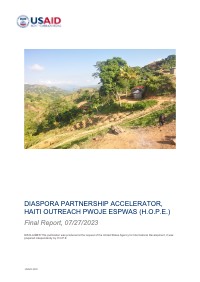
Diaspora Partnership Accelerator, Haiti Outreach Pwoje Espwas (H.O.P.E.) Final Report
Summary — The H.O.P.E. project aimed to increase access to healthcare and disaster risk reduction education in the Commune of Borgne, Haiti. The project exceeded its goals by re-establishing regular mobile clinics and screenings, conducting public health education sessions, and responding to a cholera resurgence. It also reinvigorated mother's clubs and expanded the community health outreach team's activities.
Key Findings
- The project re-established regular mobile clinics and screenings in the Commune of Borgne.
- 5 screening clinics served 571 people.
- 18 free mobile clinics served 1,822 people.
- 10,670 people were vaccinated for COVID-19 and 887 children received routine vaccinations.
- 42 public health education sessions reached 42,400 people.
Full Description
The USAID-funded H.O.P.E. project focused on expanding access to life-saving healthcare and disaster risk reduction education in the remote Commune of Borgne, Haiti. The project utilized the Sante’ nan Lakou healthcare model, emphasizing community involvement, health surveillance, distributed health workers, trained professionals, and appropriate infrastructure. Activities included expanding peer health support programs, conducting mobile screening programs, expanding the scope of the Community Outreach Team, conducting mobile clinics, and designing a “Sante’ nan Lakou” curriculum. The project successfully re-established regular mobile clinics and screenings, conducted public health education sessions reaching over 42,000 people, and responded to a cholera resurgence by treating 243 people and conducting education programs reaching over 40,000 people.
Full Document Text
Extracted text from the original document for search indexing.
DIASPORA PARTNERSHIP ACCELERATOR, HAITI OUTREACH PWOJE ESPWAS (H.O.P.E.) Final Report, 07/27/2023 DISCLAIMER This publication was produced at the request of the United States Agency for International Development, It was prepared independently by H.O.P.E. USAID.GOV CONTENTS PROGRAM OVERVIEW .......................................................................................3 SUMMARY OF RESULTS ....................................................................................5 CHALLENGES......................................................................................................7 SUMMARY OF CAPACITY SESSIONS ...............................................................7 LESSONS LEARNED ...........................................................................................7 APPENDIX I: Feedback ........................................................................................8 USAID.GOV 2 PROGRAM OVERVIEW Project Location & Context The Commune of Borgne belongs to the Department du Nord/Northern Department and is 30 miles West of Cap-Haitian. It is roughly 100 square miles with a population of 80,000. A single (mostly dirt) road links the commune to the rest of the country. Most travel is by foot along rough mountain trails. There are no public utilities—water, electricity, nor sewer. Internet and cell phone service is rare and does not function in the most remote areas. There are 64 gran habitasyons, agglomerations of villages of extended family compounds, dispersed in the seven rural districts of the commune [see map below]. Most people in the commune survive on less than $2 per day. The economy is largely agrarian with many small land-holders engaged in subsistence farming and related market activities. Access to health care delivered at fixed facilities–especially during disasters or disruptions such as floods, earthquakes, or disease outbreaks–is typically limited to those who live in proximity to the hospital and clinic.As a result, the commune of Borgne experiences: • High incidence of parasitic infection • High incidence of infant and child malnutrition • High incidence of hypertension • High incidence of water borne diseases • High incidence of typhoid • High incidence of preeclampsia • High incidence of untreated injury and resulting sepsis or other complications • Unknown incidence of trauma, depression, and other behavioral health challenges. . USAID.GOV 3 Main Objective To increase access to life-saving health care and disaster risk reduction education by expanding both the scope and frequency of the five operational elements of the Sante’ nan Lakou health care model to build the capacity of remote communities through decentralized services and training. For context, the operational element of Sante’ nan Lakou include: 1. Deep community involvement 2. Community-led health surveillance 3. Distributed health workers and mobilized resources 4. Trained Haitian health professionals who have deep knowledge of the community 5. Distributed and appropriate treatment infrastructure Start date: May 27, 2022 End date: July 14, 2023 Summary of activities Activity 1: Expand peer health support programs by hiring an additional community healthnurse. These groups include “Mothers’ Clubs” and “Girls’ Clubs” with a focus on improving behavioral health outcomes and reproductive health outcomes for women and girls. Activity 2: Conduct 5 mobile screening programs focusing on anemia, cervical cancer screening and specialized immunization clinics. Activity 3: Expand scope of S.E.E. Team (Community Outreach Team) activities to include additional programs related to prevention of COVID-19, early detection of preeclampsia andhigh-risk pregnancies, and disaster risk reduction strategies. Activity 4: Conduct 9 mobile clinics in remote communities (3 per quarter, starting the 2nd quarter). Activity 5: Conduct 1 multi-day mobile hospital in the 5th quarter of the performance period. Activity 6: Design and document a “Sante’ nan Lakou” curriculum for dissemination to medical professionals and global health practitioners in Haiti, the Caribbean, and the United States. What local partners did you work with, if any? We worked with the Haitian Ministry of Health (MSPP) and local community groups. Our ties to local peasant organizations is long-standing and ensures that H.O.P.E.’s work reflects the needs and preferences of the community. MSPP has been a partner with H.O.P.E for over 17 years. The partnership with MSPP ensures the people of Borgne have access to HIV/AIDS prevention and treatment programs through USAID-PEPFAR, as well as numerous other services and resources that flow from the international donor community via the ministry. USAID.GOV 4 H.O.P.E. provides funding to support the salaries of doctors, nurses, and technicians; as well as technical and administrative support that ensures the continued operation of the hospital, clinic, and public health outreach and education programs. Other H.O.P.E partners who indirectly supported the project include UNICEF and PAHO, who respectively provide vaccines and health management training in Haiti. SUMMARY OF RESULTS In a few paragraphs, summarize your project’s accomplishments. What were the results of the project? Did the project achieve what it set out to do in the Task Order? The project exceeded our goals and objectives as outlined in the Task Order. Due to the global COVID 19 Pandemic, Haiti political turbulence, and the associated funding challenges, we had not been able to conduct regular mobile clinics and mobile health screenings, prior to the project funding. Though we had continued to conduct health surveys and public health education programs, we had not been able to mobilize treatment and screening resources. The project enabled us to re-establish regular mobile clinics, screenings, and other mobile services. The project afforded us the opportunity to reach the isolated and remote regions of the commune, thereby giving us a better overall understanding of the health challenges and associated disaster risks it faces. We translated our understanding into action by conducting five screening clinics serving 571 people; 18 free mobile and open-door clinics that served 1,822 people; a comprehensive COVID-19 and routine vaccination program that resulted in 10,670 people being vaccinated for COVID-19 and 887 children receiving the full complement of routine vaccinations. We were able to reinvigorate our mother’s club program with the funding provided by this project. We formed 6 mother’s clubs, one in each of the rural sections. These groups regularly convened and met with H.O.P.E’s community outreach team. Two hundred and twenty seven women participate in mother’s clubs. One of our objectives was to increase the activities of our community health outreach team (S.E.E Team). The team was very active and critical to the success of the project. We conducted 42 public health education and information sessions. The sessions focused on disaster risk reduction, cholera prevention, HIV-AIDS prevention, and general health education. These sessions reached 42,400 people from across the commune, many in some of the most remote areas. Haiti experienced a resurgence of cholera during the project. The project funding allowed us to respond to this disaster by establishing cholera education and treatment programs. Between December of 2022 and May of 2023, we treated a total of 243 people for cholera at our clinic in Tibouk and at the main hospital in Borgne. We also conducted 39 public health education programs on cholera that reached more than 40,000 people. Eleven open community events were held to distribute cholera prevent resources. More than three thousand (3159) people received oral rehydration salts and water treatment supplies at the sessions. . MONITORING AND EVALUATION Did you conduct any monitoring and evaluation? If so, explain any data collection or feedback. Our monitoring and evaluation plan included the following: 1. Weekly meetings with Dr. Voltaire on project implementation. The data collected in these meetings was mostly qualitative related barriers and progress made on the project. 2. Completion of a quarterly indicator table tracking basic data related to the number of activities, number of beneficiaries, and number of staff participants. USAID.GOV 5 3. A summative meeting with Dr. Voltaire. The meeting focused on addressing the final report questions and any lessons learned because of the project. 4. A summative indicator table showing all project activities and related number of participants, beneficiaries. Please list your activities and what were the outcomes of each activity in the table below. RESULTS TABLE ACTIVITIES RESULTS Activity 1: Expand peer health support programs by hiring an additional community health nurse. Target: 100-150 participants in Mother’s Clubs We formed 6 mother’s clubs, one in each of the rural sections. These groups regularly convened and met with H.O.P.E’s community outreach team. Two-hundred and twenty seven (227) women now participate in mother’s clubs. Activity 2: Conduct 5 mobile screening programs focusing on anemia, cervical cancerscreening and specialized immunization clinics. Target: 400 women screened We conducted five screening clinics and screened 571 people. Our initial goal focused on women’s health and specifically screening for cervical cancer and anemia, with a target of screening 400 women & girls. We did not screen that many women and girls for cervical cancer simply because there was no clinical need for the screening. However, more than 400 women and girls were screened for a range of sexually transmitted diseases (including cervical cancer), as well as anemia. In addition, approximately 500 people were screened for hypertension. As noted above, 10,670 people were vaccinated for COVID-19 and 887 children received the full complement of routine vaccinations. Activity 3: Expand scope of S.E.E. Team (Community Outreach Team) activities to include additional programs related to prevention of COVID-19, early detection of preeclampsia andhigh-risk pregnancies, and disaster risk reduction strategies. We conducted 42 public health education and information sessions. The sessions focused on disaster risk reduction, cholera prevention, HIV-AIDS prevention, and general health education. These sessions reached 42,400 people from across the commune, many in some of the most remote areas. In addition, we conducted 43 visits to domiciles (habitasyons) reaching 250 people with hygiene and water treatment interventions for cholera. Activity 4: Conduct 9 mobile clinics in remote communities (3 per quarter, starting the 2nd quarter). We conducted 18 free mobile and open door clinics that served 1,822 people. This includes a 3-day clinic in one rural district (see Activity 5). Activity 5: Conduct 1 multi-day mobile hospital in the 5th quarter of the performance period. See above. The three days in one district served 375 people Activity 6: Design and document a “Sante’ nan Lakou” curriculum for dissemination to medical professionals We have completed outlines for the Sante nan Lakou curriculum and developed basic learning outcomes for each. Our original plan was to develop 7 modules, but as we USAID.GOV 6 and global health practitioners in Haiti, the Caribbean, and the UnitedStates. worked on the curriculum, we realized that some of the material could be consolidated. We are working with Miyamoto to connect Konbit San Pou San, a Haitian NGO working on health education issues in Northern Haiti, as reviewer of the modules. CHALLENGES What were the major challenges of the project? Did you achieve the results you thought you would at the beginning? Why or why not? How did you respond to these challenges? The single biggest challenge we faced related to the current political and economic crisis engulfing Haiti. The work, and specifically the work of this high profile project, has become a political “lightening rod” for those who feel threatened by the success of H.O.P.E. and the success of this project. We have received extraordinary support from the people of Borgne and many people across the Haitian government, including those in the Ministry of Health and in the Haitian Embassy in the U.S. However, personal threats against Dr. Thony Voltaire and members of our staff, by high-level politicians seeking to control health resources, and presumably the funding associated with those resources, was a challenge. SUMMARY OF CAPACITY SESSIONS What capacity building trainings did you participate in with Miyamoto? Were they helpful? Why/why not? Have you used any of the material or information from the sessions? We hosted AGERCA for three multi-day disaster risk-reduction and disaster response and preparedness training sessions for medical personnel. Participants included 20 H.O.P.E staff members and members of the community in each session. The sessions ranged from general disaster risk-reduction strategies, to full simulation exercises for responding to disasters. The simulation exercises were especially helpful as they focused on practical skills needed for first responders. Staff noted that specific exercises related to management of a disaster site and the triage of injuries as being particularly useful for our context. H.O.P.E’s Executive Director, Jim Myers, participated in the “Data Collection and Showing Impact” training session. This session was useful in understanding how USAID uses data and how to communicate the impact of humanitarian projects using both data and written reports. Are there other sessions topics you would have liked to see? LESSONS LEARNED What lessons did you learn as a result of implementing this project? This could include lessons about how to work with USAID, partners, or your community. It could include lessons about your activities, results, operating context, or challenges. The project allowed us to establish a regular cadence of services out in the community. We have always delivered services across the commune, but this grant allowed us to provide those services on a consistent and regular cycle for a full year. The regularity of contact provided us an opportunity to be consistent and more effective in our public health education programs. Mother’s Clubs were able to meet regularly and our S.E.E team (community outreach team) had regular contact even with the most remote communities. The consistent contact and communication with the community meant that we were able to reinforce messaging and education. We were able to conduct regular surveillance to determine if the outreach was helping to change behaviors. Though we knew consistency was important, we have not had the resources USAID.GOV 7 necessary to make it possible; and we did not know the full extent to which consistent health outreach and clinical care effected the community. Working with two subcontractors- Miyamoto and PMCG/Vistant—was a new experience. Both organizations were wonderful to work with. Each wonderfully executed their distinct roles. We believe that having Miyamoto’s knowledge and network in Haiti was very important and useful. We have not previously worked with an international consulting/contract organization with a comparable network in Haiti. APPENDIX I: FEEDBACK Partnership Dynamics Please discuss your experience working with USAID, PMCG and Miyamoto. Please feel free to be honest about what worked and what did not. Examples of discussion questions include: • How was working with USAID? PMCG? Miyamoto? What were the advantages and challenges? This was the best experience we have had with a sponsoring organization. In the past, working with other donors, we were the “aid recipient” and there was little genuine interest in the project. The project directors tended to care only about the deliverables and the extent to which we met goals outlined in our initial proposals. They obsessed about log-frames and deadlines with little regard for the complexities and uncertainties of working in Haiti. The flexibility afforded by USAID and the support provided by Miyamoto was terrific. Our interaction with PMCG was largely limited to monthly meetings and the focus in those meetings was primarily on the financial transactions. The engagement with Miyamoto was different. Both organizations were clearly supportive partners, but Miyamota engaged in solving problems related to training; helped us draft our task order; provided support as we faced particular challenges; and overall was more engaged and approachable. We spoke regularly and the Miyamoto team was very engaged and interested in our work. We can’t thank Daniella enough. It was clear that she set a tone for this project that was supportive, focused on impact, and flexible. Her personal engagement in the monthly reporting meetings made it clear that we were partners—not just grantees. Recommendations for Future Projects The Diaspora Partnership Accelerator intended to turn traditional partnership dynamics on its head and put new, innovative, and local actors in the driver's seat. The DPA was designed to create a dynamic in which diaspora partners were not simply executing the vision of donors; rather, the goal was that USAID and Miyamoto adjust to the needs and strengths of the diaspora partners. Please discuss your thoughts on this. For example USAID and the partners met the goal. We have lots of experience with “top-down” projects, where the donor has an idea and then we try to fit our goals and work into that idea. This project was completely different. We were held accountable, but were held accountable for tasks and activities that we defined. Everyone seemed to understand the current context of Haiti and the inherent challenges, but there was a consistent “can-do” attitude to make the best of the situation. The process of engaging our networks to vote for us in the final stage was really a great exercise. It forced us to outreach and promote our work in ways that we do not normally. It helped us build contacts and expand the network of people interested in our work. The regular meetings were also a good practice. Too often donor meetings are only quarterly. Having a regular monthly meeting was very helpful in communicating both the progress and challenges we faced. USAID.GOV 8 Marketing and communication is an area where there could be improvement. We simply didn’t feel like we knew about opportunities for making videos, posting to established websites, or writing blog posts. This may have been a problem on our end, but we felt like we learned about these opportunities somewhat last minute and then had to rush to meet a deadline. In some cases, the material we supplied was not used. Overall, this is a great project and great concept. We applaud the overarching goal of partnering with smaller organizations and engaging with their priorities. Small organizations such as ours, organizations in the rural parts of Haiti, grassroots organizations, have deep insights into the humanitarian challenges, disaster risks, and health needs of the people they serve. These types of organizations can have substantial impact. As a small organization with a 100% volunteer support staff, we struggle to be responsive to extensive demands in project monitoring and evaluation, and we appreciated the pragmatic and trusting approach taken to monitoring and evaluation on this project. We greatly valued the partnership with USAID, HRA, PCMG, and Miyamoto. USAID.GOV 9 BRIDING THE GAP: USAID-Sponsored Mobile Clinics Extend Healthcare to Remote Communities Write the narrative of your success story here, including any personal stories about someone your project impacted. Add photos and any results or numbers that show your achievements. If possible, also include a quote from someone your project impacted or a member of your team. H.O.P.E’s Mobile Clinics: Reaching people in our most remote communities Although we operate a hospital and clinic in the two largest population centers in the Commune of Borgne, these facilities are out of reach for many people. In many cases, the walk from the most remote rural sections to one of these facilities can take up to 6 hours. The walk is not easy and requires traversing mountains and crossing rivers. The mobile clinics we have been able to conduct as part of this project enabled H.O.P.E to reach people who otherwise might not ever see a doctor, people who live where infectious and chronic diseases go untreated. During our USAID sponsored mobile clinic in Margot, a mountainous rural section about 2 hours from the hospital, the team of doctors and nurses were preparing to leave after a long day of seeing more than 300 patients. The clinic had gone well and as the hour approached 5:00, they were tired and anticipating the evening hike back to Borgne. Just as they were preparing to depart, Mr. Pierre Paul arrived in acute hypertensive crisis. Two days before the clinic, he started to experience dizziness, headaches, and sweats. When he arrived at the clinic site, Mr. Paul’s blood pressure was 220/140—a critically high life threating blood pressure. The staff acted immediately, administering medicines to lower his blood pressure and put him on intravenous hydration. Within an hour, his blood pressure started to normalize. The staff stayed with Mr. Paul and escorted him to the hospital in Borgne where he stayed for three days of treatment. Upon leaving the hospital, Mr. Paul’s blood pressure was a normal 120/80. “I was so proud that our team stayed and made sure this man was properly treated. There is no question that he would have suffered a stroke and likely died, if we had not been there for the mobile clinic”; said Dr. Thony Voltaire, H.O.P.E’s Medical Director. At another mobile clinic, our team treated a 12-year-old boy who was very sick and malnourished. During the intake interview, the team learned the boy was an orphan living with his aunt. The team learned that both of his parents had died from AIDS and then tested him for HIV. Unbeknownst to the boy and his aunt, he was HIV positive and his current desperate state was due to the virus. He was taken to the hospital where he was stabilized and given ARV’s. When describing this case, Dr. Voltaire said, “The orphans in these remote villages almost never come to the hospital. We would not have known about this boy if we had not be out in the field on mobile clinic. He surely would have died. He is now doing well. He has a future now.” There are numerous such stories. Stories where our presence in these areas resulted in H.O.P.E. staff identifying and preventing the early stages of disease; addressing acute conditions for patients with chronic conditions; or being present for emergency treatment of injuries. The mobile clinics and mobile screening programs supported by USAID have saved lives and prevented diseases from becoming larger challenges for the communities we serve. USAID.GOV 10 USAID.GOV 11 USAID.GOV 12