

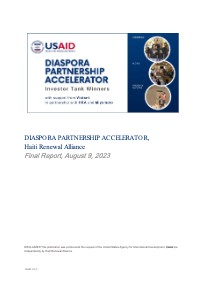
Haiti Renewal Alliance Final Report
Summary — The Haiti Renewal Alliance (HRA) led the Diaspora Partnership Accelerator (DPA) project, funded by USAID/BHA, to engage the Haitian diaspora in addressing humanitarian challenges in Haiti. The project involved an Investor Tank competition where diaspora organizations pitched projects in health, agribusiness, and shelter, with winners receiving funding and support.
Key Findings
- The DPA pilot showcased innovative partnerships across local, diaspora, and private sectors.
- The project identified and supported underfunded diaspora-led projects in Haiti.
- The Investor Tank competition awarded $150,000 to three diaspora organizations.
- The project faced challenges related to the COVID-19 pandemic and communication among partners.
- The DPA highlighted the need for capacity building and clear communication in future projects.
Full Description
The Diaspora Partnership Accelerator (DPA), led by the Haiti Renewal Alliance (HRA) and funded by USAID/BHA, aimed to unlock barriers to direct engagement with diaspora communities in addressing humanitarian problems in Haiti. The project consisted of two phases: an Investor Tank competition and project implementation. In Phase 1, diaspora organizations pitched projects in health, agribusiness, and shelter to a Technical Evaluation Committee and the public. Three winners received $150,000 to implement their projects in Phase 2, with HRA providing advisory support. The DPA Closing Ceremony showcased project results and lessons learned, emphasizing the importance of innovative partnerships and capacity building for local organizations.
Full Document Text
Extracted text from the original document for search indexing.
DIASPORA PARTNERSHIP ACCELERATOR, Haiti Renewal Alliance Final Report, August 9, 2023 DISCLAIMER This publication was produced at the request of the United States Agency for International Development. It was pre pared independently by Haiti Renewal Alliance. USAID.GOV CONTENTS PROGRAM OVERVIEW 3 SUMMARY OF RESULTS 6 CHALLENGES 8 LESSONS LEARNED 9 RECOMMENDATIONS FOR FUTURE PROJECTS 10 USAID.GOV 2 PROGRAM OVERVIEW Given the ever-growing importance of advancing the localization agenda, institutional humanitarian actors and donors find themselves at a crossroad where new approaches and partnerships must be explored to deliver more impactful aid. Moreover, the localiza tion agenda has served to underscore a lack of diversity of perspectives and resources amongst institutional humanitarian actors, often to the exclusion of non-traditional or marginalized actors. The aim of the Diaspora Partnership Accelerator (DPA) is to unlock the barriers of direct engagement with diaspora communities. Historically, donor’s stance towards diaspora engagement has been top-down and “supply-driven”. USAID/BHA has actively engaged diaspora through invitations to diaspora calls, roundtables, and outreach events, as well as, informing diaspora’s donation practices. While important and necessary, these efforts have been largely one - sided. This pilot adopts a “bottom-up” approach to diaspora engagement by putting diaspora in the driver’s seat and having BHA respond to the priorities, needs, and capacities they identify. At its core, the DPA is designed to engage the diaspora in a substantive and meaningful fashion throughout the entirety of the programming cycle. This partnership model empowers the diaspora, in conjunction with affected communities in their countries of origin, to identify and design solutions for the humanitarian problems affecting their environments. The DPA was divided into two phases. Phase 1: Investor Tank Com petition The Haiti Renewal Alliance ( HRA) led the Investor Tank platform for the planning and facilitation of three virtual pitch competitions in Health, Agribusiness and Shelter. HRA developed objective criteria and launched an open community campaign, seeking out Haitian diaspora organizations with existing projects in Haiti that would benefit from additional funding within the sectors identified per USAID/BHA’ approval. A total of 56 applications were received from Diaspora organizations and 13 finalists were selected to participate in the competition: 5 agriculture, 5 health and 3 shelter (lower recruitment in this category) applications. The 13 Haitian diaspora organization finalists pitched their projects virtually to a live YouTube audience composed of global community members of the Haitian diaspora at large and a Technical Evaluation Committee (TEC) that evaluated their project. Finalist presentations USAID.GOV 3 The Technical Evaluation Committee (TEC) served as judges for the competition . After each pitch, four judges (3 from BHA, 1 from Vistant, formally PMCG, and 1 from HRA) asked questions to learn more about each project and scored the presenters. Projects evaluations were based on 10 key indicators: Assessment and Scope of Needs , Management, Beneficiary Engagement, Innovation, Feasibility, Planning, Project Impact, Disaster Risk Reduction, Sustainability, and Presentation . In addition, community members of the Haitian diaspora were galvanized over a 3 -dayperiod and voted for their favorite projects after the live event. The popular vote was considered for the final selection made by the TEC. The TEC’s assessment acco unted for 75% of the total score, while the public vote counted for 25% of the total score. The maximum total score was 200 (150 points for the TEC and 50 points for the public voting). Three applicants -CariBBrew for agribusiness, Haiti Outreach Pwoje Espwa (H.O.P.E.) for health, and Friends of Matènwa for shelter - were selected to receive $150,000 to work with USAID/BHA and its partners to implement their Haitian -driven ideas in Phase II of the DPA. The pitch competition was watched by over 15,000 v iewers from around the world and had over 1.1 million impressions on social media. Hashtags such as #USAIDSavesLives and #InvestorTank2021 were used to promote the DPA event. Over 32,000 public votes were received on the voting platform. This was the first event of its kind and offered an opportunity for communities and their supporters to vote for their great work on the ground, also serving as a form of marketing campaign. Outreach To attract a broad participation from the Haitian diaspora community for the Investor tank Competition, HRA implemented a comprehensive diaspora outreach and communications strategy. The campaign was designed with an innovative grass roots model to share i nformation and to attract new support and engage participation of the global Haitian diaspora community from Europe, Africa, North America, and the Caribbean. The campaign also served to convene, connect and broker additional financial leads via promo tion for the projects beyond the competition. The success of this community engagement approach was also due to the trusted reputation of HRA and its wide USAID.GOV 4 reach, along with its diaspora partners, and selection of the competition’s host, the popular Haitian community radio personality, Carel Pedre. The outreach strategy involved the creation and dissemination of various outreach materials, including several short promotional videos and pitches from candidate organizations disseminated via social media platforms, such as WhatsApp, Facebook, Instagram, and twitter. Additionally, traditional media channels such as TV, radio, and print media were employed to further amplify the campaign across socioeconomic groups. Technical Evaluation Committee (TEC) in the In vestor Tank with Host Carel Pedre The use of both a TEC and the popular vote to tally the final scores was important in order to address challenges around community trust and it allowed for a more transparent and objective review and selection of projects. The program was also presented in both English and Creole to further engage local communities being served (see images from the Investor Tank Competition below). DPA Winners’ Announcement USAID.GOV 5 Phase II Phase 2 was led and implemen ted by USAID/BHA, Vistant, and Miyamoto intl. During the second phase, HRA transitioned into an advisory role for the project, as needed. Prior to this transition, HRA provided formal recommendations to the incoming partners to ensure more nuanced aspects of the project as it relates to diasporas were incorporated in Phase 2. Our goal was to support the three winning organizations. HRA provided guidance and support to these organizations, leveraging its expertise to maximize the experience, overall imp act and success of the DPA projects. We attended all of the meetings, ad hoc calls, troubleshooted diaspora issues and communications, where required. DPA Closing Ceremony HRA led the planning and logistics for the DPA Project Closing Ceremony held in per son at the Embassy of Haiti in Washington, DC. This event provided an opportunity for project participants, funders, and implementers to showcase their project results, and share valuable insights with participants including diaspora organizations, th e Haitian Ambassador, private sector, and other esteemed guests. The event served as a platform for celebrating achievements and discussing lessons learned from the DPA. The event drew an attendance of nearly 55 in -person participants and was video recorded to be broadcasted at a later time in August 2023 via Investortank.org. See below some pictures from the DPA Closing Ceremony. SUMMARY OF RESULTS Forging New Partnerships for Unmet Need The DPA pilot was a great opportunity to showcase and operationalize innovative partnerships across local, diaspora and private sectors. It provided new ways for BHA to do business with different actors, such as private sector and diaspora organizations, i n order to facilitate their participation in the government solicitations and to secure funding through innovative mechanisms and strategies that address localization priorities. The project also served as a vehicle to identify the plethora of underfunded existing projects and provide financial support for ensuring sustainability and scalability/expansion of impactful initiatives spearheaded by the diaspora working in Haiti. Fostering Sustainability of Local Partners Beyond Aid In the second phase, the DPArecognized the importance of training and capacity building for effective project management and financial allocation. By offering training, the project enhanced the skills and capabilities of diaspora organizations, leading to improved operational effici ency. The DPA USAID.GOV 6 improved short-term outcomes by equipping organizations with administrative capacity, operational skills and knowledge necessary for successful projects. It also allowed some mapping of existing humanitarian assistance projects, their gaps an d needs across sectors. Overall, the DPA successfully empowered local organizations by actively engaging diaspora communities and affected communities in their countries of origin. This approach enabled nonprofits to play a significant role in identifying and designing solutions for humanitarian challenges due to climate change and other disasters for their respective environments. Creating Innovative Funding Mechanisms for Nontraditional Actors Investor Tank Competition: The DPA’s investor tank compet ition awarded $150,000 to three diaspora organizations with winning project ideas in agribusiness, health, and shelter. This financial support directly benefited diaspora organizations operating in these sectors, allowing them to implement innovative ideas, expand their programs, and make a positive impact on the Haitian community. The DPA provided new funding and support for scaling up existing projects, which had a direct impact on three nonprofit organizations in Haiti. Through financial assistance and a ccess to resources, diaspora nonprofits were able to expand their programs and increase their impact within the communities they serve. It successfully established teaming/partnership opportunities with a traditional USAID prime, leveraging the extensive d iaspora network of nonprofits across different regions. This collaboration provided Haitian nonprofits with valuable partnerships, additional resources, and expertise to implement projects and address pressing societal challenges. (i.e. Miyamoto and Friends of Matènwa supported capacity building in the construction sector). Despite the complex local context and implementing the project during multiple disasters, the DPA achieved significant accomplishments, including the successful implementation of th e investor tank competition and the selection of three winning projects. The project's ability to captivate a global audience and engage over 32,000 viewers showcases its impact and potential for future success. In addition, HRA was able to complete all de liverables on time and on budget without any delays and extensions. CHALLENGES The project faced several challenges throughout its implementation. Firstly, the implementation of the investor tank was challenging during COVID -19 pandemic. The investor tank event competition was supposed to take place before an in -person live audience. However, due to C ovid-19, it was changed to a virtual event. Organizing an event of this magnitude online was challenging because of the global nature of the com petition and the world’s growing use of digital programming. To face these challenges, we had to procure the services of Sypremelab, a company with experience in the IT environment (virtual event) to assist in organizing the virtual event platform flawlessly. Since none of the finalists had ever participated in such a competition, HRA held various coaching sessions for the finalists to ensure competencies for both the technological platform and the business competition. For the finalists as well as the judgs, we provided ongoing feedback during multiple rehearsal sessions, assisted in formatting presentations, as well as overall coordination of the business competition, TEC criteria and support for the program delivery. The USAID.GOV 7 success of the Phase I competition was a testimony of the positive multiple collaborations and overall coordination and implementation by HRA. Operational challenges stemmed from a misunderstanding amongst the winning diaspora groups of HRA's role In the DPA second phase focused on project implementation. Recipients initially assumed that HRA was there to provide ongoing operational support instead of the advisory role . Due to proactive outreach to organizations, HRA clarified its role, however, it was much later towards the end of the project. This represented a risk for HRA and its positive reputation in the community. A better understanding of HRA's advisory role from the beginning and communication of this would have been helpful in avoiding this confusion. Secondly, the phase 2 kickoff meeting failed to explicitly state the roles of all partners. As a result, the benefits of the program were not fully realized until later in the project and HRA’s intervention as Phase 2 advisors was very beneficial. Conducting a capacity and need assessment of project implementer in the planning process could have helped address this issue. Compliance with USAID's communication guidelines and standards posed another challenge. Ensuring consistency and adherence to branding, messaging, and formatting requirements required careful attention. Additionally, not having all the necessary information at the onset of the project, such as the logo and website name and design, caused delays and complications. The approval process for the devlopment of the DPA website was another obstacle. Multiple levels of review and approval required by USAID communications led to delays and necessitated rethinking of the website resulting in additional hours and increases in budget/work for HRA and the vendor. To mitigate this in the future, it is important to allocate more time for the approval process when considering the co-creation of a USAID project-associated branding/website requirements. Aligning the priorities and objectives of diaspora organizations, local communities, and local municipality authorities proved to be another challenge. Security issues and limited access to essential resources in the country further complicated project implementation and caused delays. Effective coordination and communication among stakeholders were crucial for successful project implementation. Overall, the project overestimated the administrative capacity of the organizations. Building capacity within diaspora organizations and local communities was a hurdle. Training and technical skill development required significant time and resources. Some organizations lacked the necessary technical skills and equipment to create visually appealing communication content to showcase their project accomplishments. LESSONS LEARNED The DPA highlighted how successful partnerships and collaborations with different partners can create greater impact in the humanitarian sector. While the project faced various challenges, the responses to these challenges were addressed through clarification of roles, intervention by HRA, and open dialogue and communication. Others highlighted the need for upfront surveys and involving recipients in project planning. It also emphasized the importance of allocating sufficient time for the approval process, effective coordination among stakeholders, and capacity-building initiatives. USAID.GOV 8 Overall, the project's results were influenced by these challenges, leading to adjustments and learnings throughout the implementation process. Good communication and transp arency to help manage expectations, particularly, as it relates to the USAID procurement process is required for future initiatives. For example, the winners were operating under the impression that USAID would hand them a check for $150,000 to implement t heir project. It was not well understood that they would be required to go through the USAID procurement process (e.g. scope of work and contract). This posed a risk for their project operations and unfortunately set the tone for some of their challenges due to financial plans made on the assumption rather than facts about the funding process. RECOMMENDATIONS FOR FUTURE PROJECTS The DPA intended to turn traditional partnership dynamics on its head and put new, innovative, and local actors in the driver's seat. The DPA was designed to create a dynamic in which diaspora partners were not simply executing the vision of donors or implementing partners; rather, the goal was that USAID/BHA and Miyamoto adjust to effectively leverage the skills and assets of diasp ora partners. While this is a shift in paradigm, the vision is to foster greater localization, which is currently not sufficiently realized with traditional partners. To truly achieve this, overcoming capacity constraints and implementing effective trainin g programs are essential, but not enough for achieving sustainable project outcomes. Working with new partners also requires a new mindset to be able to pivot into bolder models of engagement for greater impact. Should USAID/BHA decide to implement such project again, we would recommend the following: 1. Encourage a new mindset for future strategic policies, operations and planning including partner feasibility assessments beyond funding usual suspects. Change cannot occur if the expectation is to approach new models by using the same actors and within old ways of operating in the humanitarian sector. 2. Clarify the role and responsibility of each partner from the beginning taking traditional power structures into consideration. 3. Diaspora-led and supported implementing partnership model is warranted to intervene in troubleshooting and for overall understanding of needs. Too often many Haiti projects are in the name of Haiti, but not intentional about being led by Haiti. 4. Using the novel mechanisms s uch as IDS to meet the growing gaps and needs of the field. Establish more flexible platforms to fund and leverage numerous existing portfolios that are otherwise underfunded due to inefficiencies of starting and funding new pilot projects. Or insteadof funding traditional actors that often do not benefit, link, bridge or engage local community initiatives. This is perhaps one of the greatest losses for the field. 5. Project launch: Given the small amount of funds, a larger lump payment upfront should be allocated for project startup. Streamline administrative process for a more efficient process to allow the project implementation to start soon after awards/ announcement. 6. Establish clear mechanisms for information sharing regarding the procurement process, including differences in vehicles, grants vs contracts/sub awards criteria and limitations. Most seasoned USAID.GOV 9 contractors struggle with these processes let alone new actors a nd small businesses not familiar with all the regulations. 7. Design realistic projects with sector focused pre -interviews to shape the needs of the SOW. Of note, diaspora projects are provided far less funding with at times increased expectations and outputs compared to resources and deliverables often seen in traditional Prime awards. 8. Assist the winners in developing a sustainable planning strategy. This will ensure that projects are not often left without sustainable features to apply these learnings in subsequent funding to test success. 9. Eliminate viscosity in doing work with small b usinesses. Recognize that diaspora organizations are small businesses often marginalized despite their technical expertise and experience as consultants across every sector of the HA and development landscape. The inability to identify project and funding mechanisms to capture this expertise continues to be a shortcoming for the field evidenced by the growing local disparities, increased challenges and ineffective use of aid resulting in harm for the affected people. Overall, the DPA confirmed what we already know that it is possible to establish innovative collaborative mechanisms given the right partners. Despite numerous obstacles, the success of this initiative further highlighted the unique value -add and capacities of local actors and diaspora to fill gaps across the humanitarian field. More importantly, it demonstrated the ability of small organizations/businesses to rise to the occasion when given the opportunity. With the growing global need for funding, is it critical for USAID/BHA to pivot past old ways of funding humanitarian initiatives in a siloed manner as opposed to leveraging innovative aid actors, such as diaspora organizations, to fuel ongoing recovery efforts and local operations. A lack of innovative approaches and actors has fostered a lack of global trust in the field and is a major barrier to addressing localization priorities, partnerships and measurable impact . USAID.GOV 10