

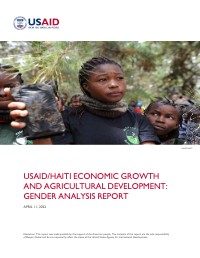
USAID/Haïti Croissance Économique et Développement Agricole: Rapport d'Analyse Genre
Resume — Ce rapport présente une analyse genre du portefeuille Croissance Économique et Développement Agricole (EGAD) de l'USAID/Haïti. L'analyse se concentre sur les moyens de subsistance agricoles et ruraux (chaînes de valeur du bétail), l'environnement (gestion des bassins versants et des forêts) et la mobilisation des ressources intérieures, en identifiant les progrès, les contraintes et les opportunités en matière d'égalité des sexes.
Constats Cles
- Les hommes dominent généralement la production de gros bétail (bovins), tandis que les femmes dominent la production de petit bétail et la commercialisation.
- Les femmes gardent souvent secrète la propriété du bétail en raison des normes de genre, employant des « gardiens » masculins qui peuvent les exploiter.
- Les systèmes agrosylvopastoraux (ASPS) peuvent accroître la participation des femmes à la production bovine.
- La concurrence des importations à bas prix constitue un obstacle majeur à l'amélioration de l'accès au marché pour les éleveurs.
- Les femmes sont principalement responsables de l'abattage artisanal du bétail, mais manquent de connaissances et de formation en matière d'assainissement.
Description Complete
Le Rapport d'Analyse Genre de la Croissance Économique et du Développement Agricole (EGAD) de l'USAID/Haïti, préparé par Banyan Global, examine la dynamique de genre dans trois sous-secteurs : les moyens de subsistance agricoles et ruraux (en particulier les chaînes de valeur du bétail), l'environnement (planification, gestion, gouvernance et protection des bassins versants et des forêts) et la mobilisation des ressources intérieures (MRI) par le biais des systèmes fiscaux. L'analyse identifie les progrès, les contraintes et les opportunités en matière d'égalité des sexes dans les zones de résilience nord et sud de l'USAID/Haïti pour les trois sous-secteurs, et dans la zone métropolitaine de Port-au-Prince pour la MRI. Le rapport aborde également la prévention et la réponse à la violence basée sur le genre (VBG) et l'autonomisation économique des femmes (AEF) en tant que thèmes transversaux, fournissant des recommandations pour intégrer les considérations de genre dans la planification stratégique et la conception des programmes de l'USAID/Haïti.
Texte Integral du Document
Texte extrait du document original pour l'indexation.
USAID/HAITI ECONOMIC GROWTH AND AGRICULTURAL DEVELOPMENT: GENDER ANALYSIS REPORT APRIL 11, 2022 Disclaimer: This report was made possible by the support of the American people. The contents of this report are the sole responsibility of Banyan Global and do not necessarily reflect the views of the United States Agency for International Development. USAID/HAITI This publication was produced for the United States Agency for International Development (USAID), Contract Number 47QRAA18D00CM. It was prepared by Banyan Global under the authorship of Jane Kellum, Ulrick Jean Claude, and Stephen Louis. Implemented by: Banyan Global 1120 20th Street NW, Suite 950 Washington, DC 20036 Phone: +1 202-684-9367 Recommended Citation: Jane Kellum, Ulrick Jean Claude, and Stephen Louis. USAID/Haiti Economic Growth and Agricultural Development Gender Analysis Report. Prepared by Banyan Global. 2022. TABLE OF CONTENTS ACRONYMS 1 ACKNOWLEDGEMENTS 4 EXECUTIVE SUMMARY 5 1. INTRODUCTION 13 1.1 BACKGROUND 13 1.2 PURPOSE AND FOCUS OF THE USAID/HAITI EGAD GENDER ANALYSIS 13 2. METHODOLOGY 14 2.1 LITERATURE REVIEW 14 2.2 PRIMARY DATA COLLECTION 14 2.3 PRESENTATION OF PRELIMINARY FINDINGS AND RECOMMENDATIONS TO USAID 15 2.4 DATA ANALYSIS AND INTERPRETATION AND REPORT DRAFTING PHASE 15 2.5 PROTECTION OF INFORMANT INFORMATION 16 3. GENERAL AND GENDER EQUALITY CONTEXT 16 3.1 GENERAL CONTEXT 16 3.2 AGRICULTURAL AND RURAL LIVELIHOODS 17 3.3 ENVIRONMENT 18 3.4 DOMESTIC RESOURCE MOBILIZATION 18 4. LIVESTOCK VALUE CHAINS: FINDINGS 19 4.1 OVERVIEW OF GENDER ROLES, RESPONSIBILITIES, AND DECISION-MAKING 19 4.2 CATTLE AND BEEF VALUE CHAINS 21 4.3 DAIRY COW VALUE CHAINS 22 4.4 GOAT MEAT VALUE CHAIN 23 4.5 GOAT DAIRY VALUE CHAIN 24 4.6 COUNTRY CHICKEN (POULET PAYS) VALUE CHAIN 25 4.7 BROILER CHICKEN (POULET DE CHAIR) VALUE CHAIN 25 4.8 EGG VALUE CHAINS 26 4.9 ENTREPRENEURIAL AND EMPLOYMENT OPPORTUNITIES IN LIVESTOCK VALUE CHAINS27 4.10 BUSINESS OPERATING ENVIRONMENT AND ACCESS TO MARKETS IN LIVESTOCK VALUE CHAINS 29 4.11 ACCESS TO CREDIT 32 4.12 PRODUCTIVE RESOURCES (LAND, LABOR, AND INPUTS) 34 4.13 AGRICULTURE EXTENSION, NEW TECHNOLOGIES, AND INNOVATION 36 4.14 BUSINESS DEVELOPMENT SERVICES (TRAINING, TECHNICAL SUPPORT, AND NETWORKING) 39 4.15 AGRICULTURAL COOPERATIVES/PRODUCER GROUPS 40 4.16 RESILIENCE TO SHOCKS/VULNERABILITY AND FOOD SECURITY 41 4.17 SECURITY RISKS AND GENDER-BASED VIOLENCE 42 5 LIVESTOCK VALUE CHAINS: RECOMMENDATIONS 43 5.1 GENDER ROLES, RESPONSIBILITIES, AND DECISION-MAKING 43 5.2 CATTLE (MILK AND BEEF) VALUE CHAINS 44 5.3 GOAT VALUE CHAINS 44 5.4 CHICKEN AND EGG VALUE CHAINS 44 5.5 ENTREPRENEURIAL AND EMPLOYMENT OPPORTUNITIES IN LIVESTOCK VALUE CHAINS44 5.6 BUSINESS OPERATING ENVIRONMENT AND ACCESS TO MARKETS 44 5.7 PRODUCTIVE RESOURCES (LAND, LABOR, AND INPUTS) 44 5.8 AGRICULTURE EXTENSION, NEW TECHNOLOGIES, AND INNOVATION 45 5.9 BUSINESS DEVELOPMENT SERVICES (BDS), ENTREPRENEURIAL TRAINING, AND NETWORKS 45 5.10 AGRICULTURAL COOPERATIVES/PRODUCER GROUPS 45 5.11 ILLUSTRATIVE INDICATORS 45 6. ENVIRONMENT: KEY FINDINGS 48 6.1 ENVIRONMENTAL INSTITUTIONS, LAWS, AND POLICIES 48 6.2 PARTICIPATION IN FOREST AND WATERSHED PLANNING, MANAGEMENT, AND GOVERNANCE 50 6.3 AGROFORESTRY, WATERSHED AND FOREST PROTECTION, AND REFORESTATION GENDER ROLES AND RESPONSIBILITIES 52 6.4 FOREST USES 53 6.5 CLIMATE CHANGE, DEFORESTATION, AND WATERSHED DEGRADATION 55 6.6 BARRIERS TO REFORESTATION AND WATERSHED/FOREST PROTECTION 56 6.7 ALTERNATIVE SUSTAINABLE LIVELIHOOD OPPORTUNITIES 59 6.8 PAYMENTS FOR ECOSYSTEMS SERVICES (PES) 60 6.9 GENDER-BASED VIOLENCE 61 7 ENVIRONMENT: RECOMMENDATIONS 61 7.1 PARTICIPATION IN FOREST AND WATERSHED PLANNING, MANAGEMENT, AND GOVERNANCE 61 7.2 AGROFORESTRY, WATERSHED AND FOREST PROTECTION, AND REFORESTATION GENDER ROLES AND RESPONSIBILITIES 62 7.3 CLIMATE CHANGE, DEFORESTATION, AND WATERSHED DEGRADATION 62 7.4 ALTERNATIVE SUSTAINABLE LIVELIHOOD OPPORTUNITIES 62 7.5 PAYMENTS FOR ECOSYSTEMS SERVICES (PES) 62 7.6 ILLUSTRATIVE INDICATORS 62 8 DOMESTIC RESOURCE MOBILIZATION: KEY FINDINGS 65 8.1 TAXATION POLICY FRAMEWORK 65 8.2 TAXATION INSTITUTIONAL FRAMEWORK 66 8.3 TAXATION LAW, POLICY, AND PRACTICE 68 8.4 GENDER-RESPONSIVE BUDGETING (GRB) 71 8.5 BUILDING TRUST IN THE TAX SYSTEM 72 8.6 DIGITIZATION OF THE TAX REGIME 73 8.7 CIVIL SOCIETY 73 8.8 TAX EVASION 74 8.9 RELATIONSHIP BETWEEN COMMUNAL AND NATIONAL TAX COLLECTION MECHANISMS 74 9 DOMESTIC RESOURCE MOBILIZATION: RECOMMENDATIONS 75 9.1 TAXATION POLICY FRAMEWORK 75 9.2 TAXATION INSTITUTIONAL FRAMEWORK 76 9.3 TAXATION LAW, POLICY, AND PRACTICE 76 9.4 GENDER-RESPONSIVE BUDGETING (GRB) 76 9.5 BUILDING TRUST IN THE TAX SYSTEM, DIGITIZATION OF THE TAX SYSTEM, AND CIVIL SOCIETY 77 9.6 TAX EVASION 78 9.7 RELATIONSHIP BETWEEN COMMUNAL AND NATIONAL TAX COLLECTION MECHANISMS 78 9.8 ILLUSTRATIVE INDICATORS 78 ANNEX A: USAID/HAITI ECONOMIC GROWTH AND AGRICULTURE DEVELOPMENT GENDER ANALYSIS SCOPE OF WORK 80 ANNEX B: LIST OF KEY DOCUMENTS CONSULTED 89 ANNEX C: INTERVIEW GUIDES FOR THE GENDER ANALYSIS 95 ANNEX D: LIST OF KEY INTERVIEWEES 109 ACRONYMS ADS Automated Directives System AGD Administration Générale des Douanes/Customs General Administration AGLDT Appui à la Gouvernance Locale et au Développement Territorial/Support to Local Governance and Development ANAP Agence Nationale des Aires Protégées/National Agency for Protected Areas APROLIM Association des Producteurs de Lait du Limonade/Association of Milk Producers of Limonade ASEC Assemblée de la Section Communale/Assembly of the Communal Section ASPS Agrosilvopastoral Systems AVSF Agronomes et Vétérinaires Sans Frontiéres/Agriculturists and Veterinarians Without Borders BAC Bureau Agricole Communale/Communal Agriculture Bureau BDS Business development services BNDA Banque Nationale de Développement Agricole/National Agricultural Development Bank BSAP Brigade de Sécurité des Aires Protégées/Protected Areas Security Brigades CAEPA Comité d’approvisionnement en eau potable et assainissement/Potable water and sanitation provision committee CASEC Conseil d'Administration de la Section Communale/ Administrative Council of the Communal Section CBO Community-based organization CCI Cadre de Cooperation Intermédiaire/Framework for Medium-term Cooperation CCIH Haitian Chamber of Commerce and Industry CFGDCT Contribution Fiscale pour la Gestion des Collectivités Territoriales/Fiscal Contribution to the Management of Territorial Collectives CIAT Comité Interministériel d’Aménagement du Territoire/Committee for Territorial Development CSO Civil society organization DEED Développement Économique pour un Environnement Durable/Economic Development for Sustainable Environment DGI Direction Générale des Impôts/General Directorate of Taxation DRM Domestic resource mobilization EGAD Economic Growth and Agricultural Development FENAFEMH Fédération Nationale des Femmes Maires d'Haïti/National Federation of Women Mayors of Haiti 1 | USAID/HAITI EGAD GENDER ANALYSIS REPORT USAID.GOV FENAMH Fédération Nationale des Associations des Maires d’Haiti/National Federation of Associations of Mayors of Haiti FGD Focus group discussion FONHDAD Fondation Haïtienne pour le Développement de l’Agriculture/Haitian Foundation for the Development of Sustainable Agriculture GBV Gender-based violence GDP Gross Domestic Product GEDW Group of Livestock Raisers of Ouanaminthe GERE Gestion Efficace des Ressources de l’État/ Supporting the Efficient Management of State Resources GEWE Gender equality and female empowerment GITA Gender Integration Technical Assistance GOH Government of Haiti GRB Gender-responsive budgeting IFOSUD International Farmers’ Organization for a Sustainable Development IGA Income generating activities ILO International Labour Organization INARHY Institut National des Ressources Hydriques/National Institute of Water Resources LGBTQI+ Lesbian, Gay, Bisexual, Transgender, Queer, and Intersex MARNDR Ministère de l'Agriculture, des Ressources Naturelles et du Développement Rural/Ministry of Agriculture, Natural Resources and Rural Development MCFDF Ministère à la Condition Féminine et aux Droits des Femmes/Ministry for the Status of Women and Women’s Rights MDE Ministère de l’Environnement/Ministry of Environment MEF Ministère de l’Économie et des Finances/Ministry of Economy and Finance MICT Ministère de l’Intérieur et des Collectivités Territoriales/Ministry of the Interior and Territorial Communities MOE Ministry of Education MPCE Ministère de Planification et de la Coopération Externe/Ministry of Planning and External Cooperation MSME Micro, small, and medium enterprise NGO Non-governmental organization NRM Natural resource management NRMG Natural resources management group OFADEB Organisation des Femmes en Action pour le Développement de Bézin/Organization of Women in Action for the Development of Bézin USAID.GOV USAID/HAITI EGAD GENDER ANALYSIS REPORT | 2 PDL Partenariat pour le Développement/Partnership for Development PES Payments for ecosystems services PMAC Programme de Modernisation de l’Administration Communale/Program for Modernization of Communal Administration PNCC Politique Nationale de Lutte Contre les Changements Climatiques/National Policy to Combat Climate Change PNEFH Politique Nationale Égalité Hommes-Femmes/National Policy for Equality between Women and Men PSDH Plan Stratégique de Développement d’Haïti/National Strategic Development Plan REDD+ Reducing Emissions from Deforestation and Forest Degradation RFEO Regroupement des Femmes Engagées d’Ouanaminthe/Group of Engaged Women of Ouanaminthe RGA Recensement Général de l’Agriculture/General Census of Agriculture RM Resource management SAPEN Société Agricole de Production et d’Élevage du Nord/ Agricultural Production and Livestock Society of the North SBCC Social and Behavior Change Communication SFA Smallholder Farmers’ Alliance SIP Solidarity Investment Program SNCRP Stratégie Nationale pour la Croissance et pour la Réduction de la Pauvreté/National Strategy for Growth and Poverty Reduction SOFA Solidarité Fanm Ayisyèn/Haitian Women’s Solidarity SOW Scope of work TCA/VAT Taxe sur le chiffre d’affaires/value-added tax UNDP United Nations Development Programme UNEP United Nations Environment Programme USAID United States Agency for International Development USD United States dollar USG United States Government VSLA Village Savings and Loan Associations WEE Women’s economic empowerment WEEE Women’s entrepreneurship and economic empowerment 3 | USAID/HAITI EGAD GENDER ANALYSIS REPORT USAID.GOV ACKNOWLEDGEMENTS The authors thank Jason Fleming (USAID/Haiti) for facilitating the organization of the gender-analysis activities. The authors express their gratitude to other USAID/Haiti Mission staff who helped identify key informants for the primary data collection portion of the gender analysis. We appreciate USAID’s partners and other stakeholders who shared their experiences and recommendations during the interviews and focus group discussions. Their contributions will support USAID’s efforts to enhance gender equality and women’s empowerment in the mission’s Office of Economic Growth and Agricultural Development activities for the coming years. The team recognizes the contributions of Nahomie Jean Baptiste, who carried out data collection on the livestock value chain. A special thanks to Victoria Rames (Chief of Party), Ashley Ross (Deputy Chief of Party), Andrew Cooney (Senior Program Coordinator), and Avelardo Rivera (Program Coordinator) — members of the USAID Gender Integration Technical Assistance II Task Order team at Banyan Global, whose support ensured a successful gender analysis. USAID.GOV USAID/HAITI EGAD GENDER ANALYSIS REPORT | 4 EXECUTIVE SUMMARY INTRODUCTION The United States Agency for International Development (USAID)/Haiti contracted Banyan Global to carry out a sector-specific gender analysis to inform its strategic planning on economic growth and agricultural development (EGAD). The gender analysis focuses on three sub-sectors: agricultural and rural livelihoods, specifically livestock value chains; environment, specifically watershed and forest planning, management, governance, and protection; and domestic resource mobilization (DRM), specifically through tax systems. This analysis identifies gender equality advances, constraints, and opportunities in USAID/Haiti’s Northern and Southern Resilience Zones for all three sub-sectors, and in the Metropolitan Port-au-Prince area for DRM. This report also addresses gender-based violence (GBV) prevention and response and women’s economic empowerment (WEE), as crosscutting themes. METHODOLOGY Banyan Global prepared this report at the culmination of a multi-stage process, which included: the analysis of secondary data (Annex B); the development of data collection instruments (Annex C); and the implementation of key stakeholder interviews with diverse organizations as well as focus group discussions with women and men farmers and agricultural technicians/agronomists (Annex D). GENDER ANALYSIS FINDINGS AND RECOMMENDATIONS The table below summarizes the key findings and recommendations of the report by sub-sector. The report presents more detailed findings and recommendations in Sections 4 through 9. SUMMARY OF FINDINGS AND RECOMMENDATIONS FINDINGS RECOMMENDATIONS AGRICULTURAL AND RURAL LIVELIHOODS (LIVESTOCK VALUE CHAINS) Gender Roles, Responsibilities, and Decision-Making ● In general, men typically dominate production in larger livestock (cattle); women dominate production of small livestock as well as transformation and commercialization. They prefer this division of labor because it enables women to remain close to home. ● Husbands/adult males tend to dominate decision- making over livestock production in male-headed households. ● Due to the gender norms on livestock decision- making, women who own their own livestock will often keep it secret by employing a “gardien,” who is a producer (usually male) paid to raise their livestock off their homestead. This is linked to robbery/abuse by the “gardien.” • Create specific targeting plans related to livestock husbandry and enterprise for the diverse range of households and needs (women-led; polygamous; male-led). • Incorporate social and behavioral change communication approaches (SBCC) in all activities in this sub-sector, with a focus on critical reflection and dialogue around gender roles, responsibilities, decision-making, and power, to empower all adult household members to have equal and equitable access to income-generating activities in the livestock value chain. Cattle (Milk and Beef) Value Chains 5 | USAID/HAITI EGAD GENDER ANALYSIS REPORT USAID.GOV ● The cattle (meat) value chains (production and commercialization) are predominantly male- dominated because the demands of grazing take place far from home. Women have domestic responsibilities that preclude them from carrying out this task. ● When men are absent from the homestead, women will assume responsibility for raising and selling cattle. ● Agrosilvopastoral Systems (ASPS) is not only a way to address the increasing impacts of climate change like drought and ability to water cattle, but also an important way to increase women’s involvement in cattle production. ● There is only one national dairy producer in Haiti (Lèt Agogo), which engages male and female milk producer associations. National production of dairy milk and derivative products through Lèt Agogo typically involves more female breeders. Supply does not meet demand. ● Scale up the use of Agrosilvopastoral Systems (ASPS) and participation of women in cattle production through partnerships with the Ministry of Agriculture, Natural Resources, and Rural Development (MARNDR), Haitian universities, the private sector, and NGOs. ● See related recommendations under Market Access and Employment/Entrepreneurial Opportunities that support women’s and men’s economic empowerment. Goat Value Chains ● Men and boys are typically responsible for caring for goats, in large part because the tethering of goats takes place far from home, which poses many risks for the goats, including hypothermia and becoming prey to stray dogs or angry landowners whose gardens may be ravaged by goats. ● Women are responsible for slaughtering goats, usually in unsanitary conditions. ● Women are responsible for selling both butchered and live animals. For live goats, Madan Sara can travel very far to buy goats for resale in their local market or in the palan (formal livestock market). ● The goat dairy value chain is practically non-existent in Haiti, because goat’s milk is culturally unacceptable because it is considered “unclean.” ● Many parts of goats that go to waste (hide, hooves, bones) could have uses in leather and artisan crafts, which presents an opportunity for increased women’s engagement. ● Build on lessons learned from ASPS with cattle, applying them to corralled goats and other small ruminant herding that could create more possibilities for women livestock farmers. ● See related recommendations under Market Access and Employment/Entrepreneurial Opportunities that support women’s and men’s economic empowerment. Chicken and Egg Value Chains ● Women typically are responsible for raising and selling “country” free-range chicken and eggs in Haiti. ● A small number of small, medium, and large companies produce broiler chickens and participate in commercial egg production in Haiti, limited by competition from imported chicken and high cost of inputs. These companies are making efforts to expand. ● Small and medium poultry enterprises are mostly headed by young men, who are primarily ● Support women chicken and egg producers to organize into formal producer groups to have greater access to credit and inputs. This is especially important in border areas. See related recommendations under Access to Credit and Access to Inputs. ● See related recommendations below under Agriculture Extension, Access to Markets, etc. USAID.GOV USAID/HAITI EGAD GENDER ANALYSIS REPORT | 6 agronomists or agricultural technicians. Enterprises run by young women tend to be much smaller operations. ● Medium and large poultry enterprises buy from small farmers (mostly women) via purchasing associations dominated by men. Employees of large chicken farms are mainly men. Entrepreneurial and Employment Opportunities in Livestock Value Chains ● Several potential entrepreneurial and employment opportunities for women and men may be found in the cattle, small ruminants, and poultry value chains. ● Many of these opportunities emerge in transformation/processing, where women already play a predominant role, and require skills that most women already possess (e.g., food preparation). ● Support women’s economic empowerment through value addition of livestock and other meat products (goat, chicken, and beef), for sale to local markets. ● Provide specialized support to micro-enterprises and micro-systems, ensuring that women are equally targeted in livestock production, considering the complex context of insecurity and inadequate infrastructure (transportation, energy, and water systems). This will ensure that women and those who are poorest are included in livestock development initiatives. Access to Markets ● Competition with cheap imports presents a major barrier to increased market access to male and female livestock farmers. ● Women are primarily responsible for artisanal slaughtering of livestock. However, they lack knowledge and training, especially in sanitation, and may lack access to butchering tools. ● Prioritize locally produced food, ensuring gender- equal representation of producers, in government food programs like the school canteen program and social safety net /food voucher programs. ● Conduct a needs assessment to ascertain what female artisanal butchers need to become more profitable. Access to Credit and Productive Resources (Land, Labor, and Inputs) ● Access to formal credit is a challenge for all livestock farmers but has a disproportionate impact on women, due to: 1) their engagement in livestock as a high-risk sector, and 2) gender discrimination by lending institutions, including unfavorable terms (high interest rate, collateral requirements, etc.). ● The cost of inputs (e.g., feed, vaccines, vitamins, etc.) for raising livestock is largely prohibitive for farmers, especially women, leading to a lack of investment to produce higher-yielding animals. ● Women are visible as input sellers in small but limited shops in rural Haiti. ● Explore input-based lending as opposed to credit lending as potential alternative loans to livestock farmers, which would support men and women farmers to access the majority of needed inputs. ● Support Haitian university efforts to develop locally- adapted feed that is nutritionally optimal, which is one of the most pressing challenges facing predominantly female poultry farmers, for example. ● Support the development of national and local enterprises in the input sector, in areas often run by women: feed, medicine, and incubation of chicks, kids, and other infant livestock. Agriculture Extension, New Technologies, and Innovation ● Agricultural extension is fragmented, with NGOs and universities providing the majority of services. The MARNDR plays a relatively small role in this area. ● Prioritize training on gender-specific, farmer- identified agriculture extension needs. ● Support gender-adapted networking opportunities (including conferences) that target women and men, 7 | USAID/HAITI EGAD GENDER ANALYSIS REPORT USAID.GOV to ● Overall, there is insufficient access to training, technical assistance, and innovative practices for highlight and disseminate innovative approaches in the livestock value chain. micro- and small-scale farmers, especially for women. Business Development Services (BDS), Entrepreneurial Training, and Networks ● Women and men livestock producers typically do not see themselves as entrepreneurs. This is especially true at the micro-producer level, where most women are engaged. ● Women and men livestock farmers lack business development/management capacity. Women in this field also lack confidence in their entrepreneurial and technical abilities. ● Young women and men become interested in livestock when they can see an economic future in farming. ● Women have largely been introduced to livestock breeding through NGOs and development projects that often are unsustainable programs. ● Offer financial management and business development services, including a focus on sustainable business models that are adapted to women’s lifestyle in rural areas; and offer entrepreneurial training and coaching to women and men livestock farmers, including a specific focus on leadership and confidence building with female participants. ● Engage young women and men to become involved in the livestock profession generally through the use of new technologies, professionalization of animal husbandry, and business development services, which can serve as incentives for them to stay in rural areas. Agricultural Cooperatives/Producer Groups ● Livestock producers are mostly fragmented, with a limited number of organized cooperatives. ● Livestock cooperatives/producer groups are an essential way for small-scale livestock producers to grow their enterprises. They are particularly important as a resource for women and young producers for networking, training, and access to credit. ● However, most producer groups continue to be male-dominated; few women hold leadership positions in mixed-gender groups. ● In all-female producer groups, women often engage men to manage the association/cooperative for them. ● Use milk producer associations formed through Lèt Agogo as models for successfully organizing in a gender-equitable manner. ● Support increased participation and leadership of women and youth in livestock producer organizations, through incentives such as increased access to information technologies, innovative farming practices, leadership and managerial training, and access to credit with adapted and favorable terms. ● In USAID support for agricultural cooperatives and producer groups, integrate social, behavioral change communication (SBCC) interventions that encourage critical reflection and dialogue on gender norms and practices related to leadership, roles, and responsibilities. ENVIRONMENT (WATERSHED AND FOREST PLANNING, MANAGEMENT, GOVERNANCE, AND PROTECTION) Participation ● Global as well as Haiti-specific evidence indicates that better environmental protection results when women participate in decision-making. Yet men typically hold leadership positions in forest and watershed resource management groups because of discriminatory gender norms as well as women’s lack of time and limited access to technical training. ● Support increased participation of women in environmental protection decision-making bodies through enforced gender quotas, leadership training and coaching for women, and hands-on technical environmental protection training programs. ● Provide technical assistance to youth and women’s organizations to increase their political influence USAID.GOV USAID/HAITI EGAD GENDER ANALYSIS REPORT | 8 related ● Some advances in women’s leadership include: 1) Haitian women’s organizations are becoming to forest and watershed planning, management, and governance. proactive in environmental advocacy, training, and ● Encourage male and female youth participation in needs assessments; and 2) Women-led natural environmental advocacy and reforestation/watershed resource management groups are becoming more protection activities through incentives like prevalent. scholarships, related professional internships, and ● There is a near total absence of youth interest and stipends. leadership related to environmental protection in Haiti, counter to global trends. Gender Roles and Responsibilities ● Deeply rooted discriminatory gender norms still exist in regard to division of roles and responsibilities as well as men’s control over income generated from agroforestry. ● Reforestation initiatives with greater participation and leadership by women show better results than those led by men, in terms of maintenance, monitoring, and sustainability. Women are typically more receptive than men to payment for environmental protection activities. ● Integrate SBCC interventions in agroforestry, watershed, and reforestation activities, to shift norms and practices related to gender roles and responsibilities, including control and decision-making at the community and household levels. Forest Uses, Climate Change, Deforestation, and Watershed Degradation ● Male and female farmers lack access to timely information about climatic hazards or impending disasters; they also lack information and training on how to adapt agroforestry practices in light of climate change. ● Women and men clear and use forests for a number of reasons: agricultural clearing for cash crops and/or livestock grazing; charcoal and cooking wood; tree fruit cultivation; and wood for construction. ● Although deforestation and watershed degradation impact all Haitians, women bear a disproportionate burden of that impact. ● Support the creation of gender-sensitive, community- based Disaster and Climate Change Risk Reduction plans and programs as well as resilience strategies that aim to reduce the impacts of climate change and related disasters on women, men, boys, and girls by considering the specific needs and strengths of Haitian women and men. ● See also recommendations for Alternative Livelihoods Opportunities. Alternative Sustainable Livelihoods Opportunities ● Several opportunities in the production and transformation of forest-related products have the potential to support economic empowerment, especially for women, as they require skills that most women already possess. ● Male and female farmers need resources like equal access to credit, technical training and accompaniment, business development training and coaching, and supportive governmental policies to incubate new livelihoods. ● Support women’s economic entrepreneurship through value addition, in areas such as forest product transformation and ecotourism. Specific examples of forest products include: juices, fruit leather, liquor, preserves, vinegar, natural cosmetics, cultivation of medicinal plants and derivative natural medicines, essential oils, and natural cosmetics. Payment for Environmental Services (PES) 9 | USAID/HAITI EGAD GENDER ANALYSIS REPORT USAID.GOV ● ● PES schemes are by and large absent in Haiti. Design gender-sensitive PES schemes that are ● PES has great potential to incentivize Haitians, especially women, to participate in sustainable conservation, reforestation, and watershed protection. adapted to the context of Haiti. At a minimum, there should be a requirement that at least 50 percent of participants from the soliciting community are women. DOMESTIC RESOURCES MOBILIZATION Taxation Policy Framework ● There is little or no gender integration in Haiti’s policy documents related to DRM. ● Support the revision of relevant national policy documents that involve DRM to include specific provisions for how gender and women’s empowerment will be addressed in taxation. Taxation Institutional Framework ● Women occupy only 18 percent of senior leadership positions in the Customs General Administration (AGD); they hold 39 percent of such positions in the General Customs Agency (DGI). ● At the municipal level, less than 10 percent of staff and elected officials (e.g., mayors or deputy mayors) with DRM responsibilities are female. ● In the municipalities where mayors were interviewed, there are no women in the DRM leadership. ● Varying degrees of gender-responsive human resources policies are in place at DGI and AGD. These policies have resulted in advances in the gender balance and professional development opportunities for women in these institutions. ● Building on past and current experiences/efforts, develop a gender strategy for staff recruitment and development, in partnership with: Canadian Cooperation, UN Women, General Directorate of Taxation, AGD, National Federation of Associations of Mayors of Haiti/Fédération Nationale des Associations des Maires d’Haiti (FENAMH), and the National Federation of Women Mayors of Haiti/Fédération Nationale des Femmes Maires d'Haïti (FENAFEMH), as well as departmental associations of Mayors and some selected communes. ● Promote mentoring and professional development opportunities for women currently working in DRM institutions to support promotion from within. Taxation Law and Its Application ● Haiti’s tax codes do not include explicit gender bias, in value-added tax/business tax (VAT/TCA), personal income tax, business/corporate tax customs. Nevertheless, implicit bias advantaging men emerges in practice, in all three areas. ● Most interviewed stakeholders did not perceive any explicit or implicit gender bias in Haiti’s taxation system. ● Conduct trainings with relevant taxation institutions on detecting and mitigating implicit gender bias in taxation practice. ● Support the revision of relevant tax codes to eliminate implicit gender biases that disadvantage women (e.g., change the regressive 20-percent flat rate personal income tax). ● Support efforts to mitigate the regressive impact of Haiti’s personal income tax by promoting increasing participation of women in the formal sector and formalizing “informal” workers (predominantly women). ● Support the implementation of specific changes to tax law, implementation policies, and practice to make it USAID.GOV USAID/HAITI EGAD GENDER ANALYSIS REPORT | 10 gender-equitable and to encourage more female taxpayers into the system. Gender-Responsive Budgeting (GRB) ● Gender-responsive budgeting is extremely limited in Haiti. ● National and municipal budgets do not provide for gender-based violence response services. ● Support the creation of a national data collection system to produce reliable, gender-disaggregated data (on socio-economic, tax payments, and expenditures) in-depth analysis of the gendered effects of fiscal policies. ● Strengthen the role of the Women’s Rights Ministry in supporting GRB across sectors, to ensure that budgets align with DRM efforts to support gender equality, women’s economic empowerment, and other groups facing social or economic marginalization and vulnerability. ● Encourage the Haitian government to use GRB to set aside funds from DRM to develop programs and public policies to facilitate GBV prevention and response. ● Collaborate with women’s organizations and leaders and male allies to have a critical mass of gender- sensitive men and women in these bodies to advocate for budgetary resources targeted to address issues of gender equality and social inclusion. Building Trust, Digitization, and Civil Society ● Haitians distrust the tax system and feel little obligation to pay taxes to a dysfunctional system that fails them in terms of public service delivery. ● To increase trust in paying taxes, men and women will need to experience efficient, effective, and transparent collection of taxes and receive quality public services in return. ● There is a belief among respondents that having more women in public decision-making/leadership positions in DRM agencies would create more trust in the taxation system. ● Encourage greater participation in DRM policy- making of organizations that are led by or represent women, youth, LGBTQI+ persons, and persons with disabilities: 1) facilitate linkages with the civil society/private organizations typically involved in fiscal policy, such as the Observatoire des Finances Publiques, Haitian Chamber of Commerce and Industry (CCIH), and Departmental Chambers of Commerce; and 2) provide shared training for these groups to work together to encourage payment of taxes and to demand government (central and local/municipal) accountability and transparency. ● There is a perception among respondents that women leaders deliver more results than men and are much more gender-sensitive. ● Only a handful of civil society/private sector actors are aware of their right to demand accountability, participation, and transparency regarding resource utilization through the national budget. These actors rarely encourage other citizens to pay taxes. ● The FENAMH advocates on behalf of Haiti’s mayors and communes, specifically for decentralization and the legal transfer of public ● Strengthen the engagement of women in municipal politics and civic forums by: 1) building the capacity of the FENAMH and FENAFEMH to be more financially sustainable; 2) supporting gender-inclusiveness of FENAMH for women and other diverse mayors; and 3) providing direct financial and technical support to FENAFEMH. This will enable women to: 1) engage key stakeholders and educate them about leadership roles in municipal governments; 2) involve women citizens to improve direct communication with city leaders; 3) increase the number of women mayors 11 | USAID/HAITI EGAD GENDER ANALYSIS REPORT USAID.GOV funds from the GOH to the communes. Women mayors established FENAFEMH to: increase the number of women mayors; provide targeted capacity-building support to women mayors already in office; and create a space for women mayors to be at the forefront of decision-making and action. ● FENAFEMH provides specialized support to aspiring and existing women mayors and advocates increased DRM at the municipal level. ● The FENAMH and FENAFEMH do not have sufficient financial resources to meet their objectives. ● Women-led organizations, as well as organizations that represent LGBTQI+ persons, youth, and persons with disabilities, are absent from these accountability efforts in DRM policy making. ● Despite limited civil society participation in DRM, increasingly Haitian women and men are beginning to discuss budget, priorities, and public finances at both central and local levels. and deputy mayors in Haiti; and 4) create municipal tax collection systems. ● Support, reinforce, and systematize modernization and digitization efforts to facilitate user-friendly online tax services, including applications, requests, research, and payment. Support training and awareness-raising on the online system targeting women as well as men. (Modernization efforts have been supported by Expertise France/European Union, Canadian Cooperation, USAID with MICT, DGI, Customs, IFMS, LOKAL+, GERE, and others.) ● Collaborate with DRM administrations (DGI, Customs) to create a gender- and socially-inclusive one-stop shops for paying taxes in-person, including both mobile and in-person options. Tax Evasion ● While data on tax evasion is not available, global research consistently lists Haiti as a locale for offshore enterprises and for companies to evade paying taxes. ● According to the International Monetary Fund, excessive tax evasion and low tax revenue limits what Haiti can spend on poverty reduction. This disproportionately impacts women because they bear the higher burden of poverty in the country. ● Many respondents said that Haitian men are more likely to evade taxes, as they have the ability to pay the tax authorities or not, or to steal from the tax authorities. ● Another group of respondents considered tax evasion as a matter of fraud, reflecting individual education, values, and principles as well as influence, and a system whose inherent design is conducive to fraud and corruption. ● Haitian society is more tolerant of fraud (including tax evasion) among men than women. ● Support the establishment of a solid system of tax verification to address tax evasion, fraud, and corruption in the system, with penalty mechanisms for tax evasion and other fiscal fraud to mitigate losses of revenue needed for essential public services that support gender equality and women’s empowerment, including in education, health, women’s entrepreneurship, etc. ● See above recommendations under Building Trust in the Tax System, Digitization of the Tax System, and Civil Society. Relationship between Communal and National Tax Collection Mechanisms ● All respondents, including those from DGI itself, recognize the lack of collaboration between DGI and the communes in regard to resource mobilization, with negative consequences for communes’ revenues. ● Support increased collaboration among DRM agencies at the central and communal levels to encourage sustainable and consistent transfer of revenue to communal governments, enabling programs and public USAID.GOV USAID/HAITI EGAD GENDER ANALYSIS REPORT | 12 services that support gender equality and women’s empowerment. ● Non-collaboration between the DGI and the communes in resources management has negative consequences for the communes regarding revenues. ● Regarding gender equality, communes’ lack of resources has a negative impact on services to citizens, particularly WASH, education, health, etc. that are a priority for women. 1. INTRODUCTION 1.1 BACKGROUND In accordance with the USAID Automated Directives System (ADS) items 201.3.2.9 and 205, USAID/Haiti hired Banyan Global to undertake a sector-specific gender analysis to inform the strategic planning of the USAID/Haiti Office of Economic Growth and Agricultural Development (EGAD) (see Annex A for Scope of Work). The gender analysis aligns with the USAID Gender Equality and Female Empowerment Policy (2012), U.S. Strategy to Prevent and Respond to Gender-Based Violence (2016), and the 2018 Women’s Entrepreneurship and Economic Empowerment (WEEE) Act, as well as the first United States National Strategy on Gender Equity and Equality, launched in November 2021. A gender analysis is a systematic process used in a specific context to identify, understand, and describe 1) gender differences and the relevance of gender roles, 2) individual responsibilities, rights, opportunities, and patterns of decision making and leadership, and 3) patterns of access to resources and services. It is a tool for examining the causes and consequences of inequality and for identifying gender program priorities, for more effective and equitable development interventions. 1.2 PURPOSE AND FOCUS OF THE USAID/HAITI EGAD GENDER ANALYSIS The USAID/Haiti EGAD gender analysis provides data to enhance the integration of gender equality and women’s empowerment in program design and in the implementation of the mission’s EGAD portfolio. The gender analysis is structured around three key sub-sectors of EGAD’s portfolio (see Table 1). It also addresses the USAID ADS 205 gender analysis domains, priority crosscutting themes, and key variables, as specified in the scope of work (SOW) in Annex A of the report. TABLE 1. OVERVIEW OF GENDER ANALYSIS AREAS OF FOCUS SUB-SECTORS CROSSCUTTING THEMES KEY SOCIALLY CATEGORIES VARIABLES/ RELEVANT USAID ANALYSIS ADS DOMAINS 205 GENDER 13 | USAID/HAITI EGAD GENDER ANALYSIS REPORT USAID.GOV ● Agricultural and rural livelihoods (livestock value chains) ● Environment ● Domestic resource mobilization ● Resilience ● Gender-based violence (GBV) prevention and response ● Women’s Economic Empowerment (WEE) ● Women, men, boys, and girls ● Women, men, boys, and girls ● Women, men, boys, and girls ● Laws, policies, regulations, and institutional practices ● Laws, policies, regulations, and institutional practices ● Laws, policies, regulations, and institutional practices ● Laws, policies, regulations, and institutional practices ● Cultural norms and beliefs ● Cultural norms and beliefs ● Cultural norms and beliefs ● Gender roles, responsibilities, and time use ● Gender roles, responsibilities, and time use ● Access to and control over assets and resources ● Patterns of power and decision-making Section 2 of the report describes the gender analysis methodology; Section 3 provides the country context and background; Sections 4 through 9 present the gender analysis findings, recommendations, and illustrative indicators by sector. Annex A is the gender analysis’s scope of work (SOW); Annex B lists the key documents consulted; Annex C includes the interview guides for the gender analysis; and Annex D lists key informants. 2. METHODOLOGY 2.1 LITERATURE REVIEW A research team comprised of four consultants (one international and three national) conducted a desk review of secondary data sources from October 25, 2021 to November 19, 2021, to identify the major gender equality and women’s empowerment advances, gaps, and constraints in Haiti in the EGAD sub- sectors, taking into consideration the crosscutting themes and key populations listed above. Annex B provides a list of the key documents consulted. Gaps in data identified during the desk review informed the design of the research tools (question guides) for primary data collection (shown in Annex C). The research team tailored these tools to each stakeholder or sector to gather additional data on the advances and gaps identified in the literature review. 2.2 PRIMARY DATA COLLECTION The research team carried out in-person primary data collection in Haiti from January 3, 2022 to February 4, 2022, with key informants that USAID/Haiti and the research team recommended. Using a snowball method with identified key informants, the team identified additional stakeholders to interview (Annex D). The main data collection tools included semi-structured interviews and focus group discussions. See Table 2 for more detail. USAID.GOV USAID/HAITI EGAD GENDER ANALYSIS REPORT | 14 TABLE 2. PRIMARY DATA COLLECTION METHODS AND TOOLS TECHNIQUE STAKEHOLDERS PURPOSE Semi-structured interviews USAID staff, USAID partners, Government of Haiti (GOH) counterparts, national gender equality and women’s empowerment organizations, international donor organizations, national and international non-governmental organizations (NGOs) ● To gather data on gender equality advances, gaps, challenges, constraints, and opportunities in line with the USAID/Haiti EGAD priority sub-sectors, crosscutting themes, and geographical areas of intervention. ● To identify lessons learned from previous gender integration efforts and provide recommendations based on those lessons learned. Focus Groups Participants participants (male, female, in and other USAID potential gender) activities future National civil society organizations (CSOs) and community-based organizations (CBOs) ● To gather data on gender equality advances, gaps, challenges, constraints, and opportunities in line with the USAID/Haiti EGAD priority sectors, crosscutting themes, and geographical areas of intervention. ● To capture project participants’ opinions and perceptions regarding gender advances and gaps, and recommendations for future USAID strategic planning and programming. ● To identify lessons learned from previous gender integration efforts, and to assess gender priorities moving forward. Using the question guides, remote and in-person primary data collection took place in USAID/Haiti’s Northern Resilience Focus Zone and Southern Resilience Focus Zone. The team registered basic demographic data of the respondents (name, sex, organization, sector, etc.) to allow for verification of the extent and type of consultation. The interviewer took notes during each interview/focus group and digitally recorded interviews for backup purposes, with permission of the interviewees. For data quality control purposes, the Team Leader randomly selected a sample of interview notes and recordings to compare the produced notes with the interview recording. The team archived all interview notes and recordings and provided them to USAID/Haiti. 2.3 PRESENTATION OF PRELIMINARY FINDINGS AND RECOMMENDATIONS TO USAID Following the completion of primary data collection, the research team provided a remote presentation of the preliminary findings and recommendations of the gender analysis on February 25, 2022 to USAID/Haiti staff. The purpose of the presentation was to validate and receive feedback on the preliminary findings and recommendations. 2.4 DATA ANALYSIS AND INTERPRETATION AND REPORT DRAFTING PHASE The research team analyzed and interpreted the primary data using a five-step process. 1) Team members reviewed and cleaned their interview notes within a week of completing each interview or 15 | USAID/HAITI EGAD GENDER ANALYSIS REPORT USAID.GOV focus group. 2) The Team Leader conducted a secondary review of the interview notes for quality control purposes and to ensure clarity of data. 3) The Team Member consulted with respective team members when questions arose about interview responses.1 4) Team members analyzed and interpreted the data for their assigned sector to identify common themes and responses to interview questions. 5) The Team Leader validated each team member’s analysis and interpretation of the data to ensure consistency and rigor, by comparing raw primary data with the inputs to their respective sections of the gender analysis draft report. Finally, the team delivered the draft gender analysis report—which combines both secondary and primary data—to USAID/Haiti on March 29, 2022. The final report has been revised to address USAID/Haiti’s written feedback on the draft report as well as comments and observations provided during the presentation of preliminary findings and recommendations. 2.5 PROTECTION OF INFORMANT INFORMATION At the beginning of every semi-structured interview or focus group, the research team obtained free and prior informed consent at the organizational and individual levels. This included: • An explanation of the purposes of the research, how long it would take, and the procedures to be followed • A description of any risks to the person participating (if relevant) • A description of any expected benefits to the person participating, or to their community, because of participation • A statement describing whether the data would be anonymous or stored confidentially • Contact information, in case the participant later had questions or concerns regarding the research • A statement that participation was voluntary, that refusal to participate would involve no penalty, and that the participant might stop participating at any time For interviews with individuals and groups whose physical safety might be put in danger if they participated in interviews (such as Lesbian, Gay, Bisexual, Transgender, Queer, and Intersex (LGBTQI+) persons, activists, and GBV service provider staff), the research team took measures to ensure confidentiality when scheduling the interviews and did not cite names of respondents in the gender analysis report. Specifically, the research team obscured and did not record personally identifying information, including names, ages, organizations, and even times and dates of interviews. 3. GENERAL AND GENDER EQUALITY CONTEXT 3.1 GENERAL CONTEXT The protracted political crisis in Haiti—worsened by the assassination of President Jovenel Moïse on July 7, 2021, as well as by civil unrest, ex