

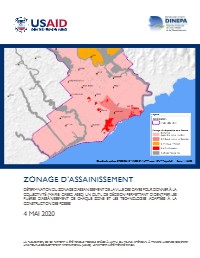
Zoning of Sanitation: Determination of Sanitation Zoning for the City of Les Cayes
Summary — This report details the sanitation zoning determination for the city of Les Cayes, Haiti. It aims to provide local authorities with a decision-making tool to identify sanitation methods for each zone and appropriate technologies for pit construction, supported by USAID's Water and Sanitation Project.
Key Findings
- The city of Les Cayes faces significant constraints in implementing sanitation technologies due to the shallow water table, high soil permeability, low economic capacity, and high population density.
- The zoning analysis recommends tailored sanitation solutions for different areas, including AIR with retention in slum areas and septic tanks with soakaways in less dense areas.
- The study emphasizes the need for a participatory approach involving local stakeholders in the zoning process.
- The report highlights the importance of aligning sanitation zoning with existing conditions, such as the presence of a water supply system.
- The study recommends that the zoning plan be used as both a communication tool and a planning tool, to inform the public and guide investments.
Full Description
The report focuses on determining sanitation zoning for Les Cayes, Haiti, as part of the USAID Water and Sanitation Project. The project, initiated in December 2017, aims to sustainably increase access to water and sanitation services in urban areas of Cap Haitien, Mirebalais, Croix-des-Bouquets (Canaan), Les Cayes, and Jérémie. This zoning project seeks to assist the DINEPA in establishing advisory services in collaboration with municipalities, a key aspect of its national sanitation strategy. The study assesses soil suitability for traditional systems, culminating in communal sanitation zoning plans, delineating areas for collective and non-collective sanitation, and measures to manage stormwater runoff.
Full Document Text
Extracted text from the original document for search indexing.
ZONAGE D’ASSAINISSEM ENT DÉTERMINATION DU ZONAGE D’ASSAINISSEMENT DE LA VILLE DES CAYES POUR DONNER À LA COLLECTIVITÉ (MAIRIE, CASEC, ASEC) UN OUTIL DE DÉCISION PERMETTANT D’IDENTIFIER LES FILIÈRES D’ASSAINISSEMENT DE CHAQUE ZONE ET LES TECHNOLOGIES ADAPTÉES À LA CONSTRUCTION DES FOSSES 4 MAI 2020 Coordinate system: EPSG :32618 - WGS 84 / UTM zone 18N – Projected Scale: 1:16,633 L A P U B L I C A T I O N D E C E R A PP O R T A É T É R E N D U E P O S S I B L E G R Â C E À L ’ A P P U I D U P E U P L E A M É R I C A I N À T R A V E R S L ’ A G E N C E D E S E T A T S - U N I S P O U R L E D É V E L O PP E M E N T I N T E R N A T I O N A L ( U S A I D ) . L E R A P P O R T A É T É P R É P A R É P A R D A I LES OPINIONS ICI EXP RIMÉES SONT CELLES D ES AUTEURS ET NE REF LÈTENT PAS NÉCESSAIR EMENT LES POINTS DE VUE DE L’USAID NI DE DAI, ORGANISME D’ EXÉCUTION DU PROJET EAU ET ASSAINISSEMEN T . PROJET EAU ET ASSAIN ISSEMENT USAID DÉTERMI NATION DU ZONAGE D’ASSAINISSEMENT DE LA VILLE DES CAYES POUR DONNER À LA COLLECTIVITÉ (MAIRIE, CASEC, ASEC) UN OUTIL DE DÉCISION PERMETTANT D’IDENTIFIER LES FILIÈRES D’ASSAINISSEMENT DE CHAQUE ZONE ET LES TECHNOLOGIES ADAPTÉES À LA CONSTRUCTION DES FOSSES Nom du projet : Projet Eau et Assainissement USAID Bureau d’USAID garant: USAID/HAITI Numéro de contrat: AID - OAA - I - 14 - 00049/720521 Contracteur: DAI Date d’émission: 4 M ai 2020 Auteurs: Dawine Pierre et Papa Cheikh Diop LA PUBLICATION DE CE RAPPORT A ÉTÉ RENDU E POSSIBLE GRÂCE À L ’APPUI DU PEUPL E AMÉRICAIN À TRAVER S L’AGENCE DES ETATS - UNIS POUR LE D ÉVELOPPEMENT INTERNA TIONAL (USAID). LE RAPPORT A ÉTÉ PRÉ PARÉ PAR DAI TABLE DES MATIÈRES I. INTRODUCTION -------------------------------- -------------------------------- ------------------------------- 6 2. LOCALISATION DE L A ZONE DU PROJET -------------------------------- --------------------- 7 2. Caractéristiques de la commune -------------------------------- -------------------------------- ------------------------ 8 2.1 Localisation géographique -------------------------------- -------------------------------- -------------------------------- -- 8 2.2. Topographie -------------------------------- -------------------------------- -------------------------------- ----------------- 9 2.3. Climat de Les Cayes -------------------------------- -------------------------------- -------------------------------- -------- 9 2.4. Hydrologie -------------------------------- -------------------------------- -------------------------------- ------------------- 9 2.5. Géologie -------------------------------- -------------------------------- -------------------------------- ------------------- 10 2.6. Hydrogéologie -------------------------------- -------------------------------- -------------------------------- ------------ 10 2.6.1. Puits superficiels -------------------------------- -------------------------------- -------------------------------- -------- 11 2.7. Voi rie -------------------------------- -------------------------------- -------------------------------- ----------------------- 11 2.8. Cadre économique -------------------------------- -------------------------------- -------------------------------- ------- 11 3. DESCRIPTION SOMMA IRE DES INFRACTRUCTU RES EXISTANTES ----------- 12 3.1 Description sommaire de la situation act uelle des infrastructures d’eau potable -------------------- 12 3.2 Description de la situation actuelle des infrastructures d’assainissement ------------------------------- 13 3.2.1. Vue d'ensemble des systèmes des infrastructures et chaîne d'approvisionnement ou de valeur ------------ 13 3.3 La situation de l’assainissement du centre - ville -------------------------------- -------------------------------- - 14 3.3.1 Volet drainage : -------------------------------- -------------------------------- -------------------------------- ---------- 14 3.3.2 Vole t eaux usées -------------------------------- -------------------------------- -------------------------------- ----- 15 3.3.3 Volet traitement des eaux usées : -------------------------------- -------------------------------- ----------------- 16 3.3.4 Site de la station de traitement des excreta -------------------------------- -------------------------------- ------ 16 4. OBJECTIFS D’UN ZO NAGE D’ASSAINISSEMEN T -------------------------------- ---------- 18 4.1 Questions relatives au zonage -------------------------------- -------------------------------- ------------------------ 18 4.2 Détermination du zonage d’assainissement des Cayes -------------------------------- ----------------------- 19 Sols et roches -------------------------------- -------------------------------- -------------------------------- ------------------ 20 Eau -------------------------------- -------------------------------- -------------------------------- ------------------------------- 21 Pente -------------------------------- -------------------------------- -------------------------------- ----------------------------- 21 Densité de la population -------------------------------- -------------------------------- -------------------------------- ------ 22 Service de base -------------------------------- -------------------------------- -------------------------------- ----------------- 22 Espace disponible -------------------------------- -------------------------------- -------------------------------- -------------- 22 Niveau de risque -------------------------------- -------------------------------- -------------------------------- --------------- 23 Remarque générale -------------------------------- -------------------------------- -------------------------------- ------------ 23 4.3 Considération des éléments de diagnostic -------------------------------- -------------------------------- -------- 24 LES OPINIONS ICI EXP RIMÉES SONT CELLES D ES AUTEURS ET NE REF LÈTENT PAS NÉCESSAIR EMENT LES POINTS DE VUE DE L’USAID NI DE DAI, ORGANISME D’ EXÉCUTION DU PROJET EAU ET ASSAINISSEMEN T . 4.4 Processus de définition du zonage -------------------------------- -------------------------------- -------------- 25 4.4.1 Premier critère : le sol permet - il l’absorption des excreta -------------------------------- -------------------- 25 4.4.2 Deuxième critère : Y - a - t - il une nappe phréatique située à moins de (1.5 m) de la surface du sol ? ------ 27 4.4.3 Troisième critère : quels sont les matériaux formant la superficie du sol? -------------------------------- -- 28 4.4.4 Quatrième critère : Y - a - t - il des zones inondables ? -------------------------------- ----------------------------- 29 4.4.5 Cinquième crit ère : Le sol présente - t - il une pente suffisante pour un écoulement des effluents par gravité? 30 4.4.6 Sixième critère : la densité urbaine est - elle inférieure ou supérieure à 15 000 habitants/km ² ? ---------- 31 4.4.7 Septième critère : Quelle est la tendance d’extension de la population des CAYES ? --------------------- 32 4.4.8 Huiti e ̀ me crit e ̀ re : Quelles sont les contraintes socio - e ́ conomiques de la ville des Cayes? ------------------ 33 5. PRÉSENTATION ET ANAL YSE DES RÉSULTATS DU ZONAGE -------------------- 34 5.1 Critères de choix pour la définition du zonage -------------------------------- -------------------------------- -- 34 6. CONCLUSIONS ET RE COMMANDATIONS -------------------------------- -------------------- 37 7. ANNEXES -------------------------------- -------------------------------- -------------------------------- --------- 38 7.1 ANNEXE : PHOTOGRAPHIES, TESTS DE PERCOLATION, LES CAYES1. ------------------------- 38 6.2 ANNEXE : PHOTOGRAPHIES ET COUPES STRATIGRAPHIQUES, LES CAYES1 --------- 42 5 LISTE DE FIGURES FIGURE 1 : LOCALISAT ION DE LA ZONE D’ETU DE 7 FIGURE 2 : LOCALISATION DU DE PARTEMENT DU SUD 8 FIGURE 3 : RESEAU D’ADDUCTION D’EAU POTABLE DES C AYES . 12 FIGURE 4 : PLAN DE LOCALISATI ON DE LA STATION DE TRAITEMENT DES EXCRE TA 13 FIGURE 5 : NETTOYAGE DRAINAGE EXISTANT 14 FIGURE 6 : MODÈLES DE TOILETTES DE CERTAIN S MÉNAGES AUX CAYES 15 FIGURE 7 : BATIMENT ET OUVRAG E DE DEGRILLAGE DE L A STATION DE TRAITEM ENT 17 FIGURE 8 : IMAGE DU DECANTEUR INITIAL 17 FIGURE 9 : SOLS PEU PERMEABLES . 25 FIGURE 10 : SOLS IMPERMEABLES ET TRES PERMEABLES 26 FIGURE 11 : INFILTRATION PAR PER COLATION PROFONDE . 26 FIGURE 12 : NIVEAU NATUREL DE LA NAPPE 27 FIGURE 13 : DESCRIPTION DES SOL S ET ROCHES SELON LA FORMATION SUPERFICI ELLE DU SOL 28 FIGURE 14 : INONDATION PAR QUANT ITE DE PRECIPITATION TOUCHANT DES BATIMENTS 29 FIGURE 15 : LOCALISATION DES PE NTES . 30 FIGURE 16 : DENSITE DE POPULAT ION EN 2018 31 FIGURE 17 : ÉTALEMENT URBAIN 32 FIGURE 18 : STANDING DE L’HABIT AT 33 FIGURE 19 : ZONAGE D’ASSAINISSE MENT DE LA VILLE DES CAYES 35 6 I. INTRODUCTION Lancé en Haïti en Décembre 2017, le Projet Eau et Assainissement de l’USAID a pour objectif d’augmenter de manière durable l’accès aux services d’eau et d’assainissement dans les zones urbaines des communes suivantes : Cap Haïtien, Mi rebalais, Croix - des - Bouquets (Canaan), Les Cayes and Jérémie. Le projet est subdivisé en trois composantes : Component 1. Augment er l’accès durable aux services d’approvisionnement en eau ; Component 2. Augment er l’accès durable aux services d’assainissem ent ; Component 3. Renforc er la mise en œuvre d’un environnement favorable facilitant de manière durable les opérations d’approvisionnement, de maintenance et la gestion des services d’eau et d’assainissement. À travers ces cinq communes, les intervention s du projet Eau et d’Assainissement de l’USAID résultera à un meilleur accès aux services d’eau à 250 000 personnes et un accès à des services d’assainissement à 75 000 personnes. Dans ce contexte, le projet appuie la DINEPA dans son effort pour lancer la mise en place de véritables services - conseils en étroite collaboration aux municipalités, axe important de sa stratégie nationale de l’assainissement, et de marquer ce lancement pa r la réalisation d’une étude de l’aptitude des sols à la mise en place des systèmes traditionnels concrétisée par des plans communaux de zonage de l’Assainissement. Ce projet de zonage d’assainissement vise à répondre aux obligations que chaque commune d oit délimiter : • D es zones d’assainissement collectif où la collectivité doit assurer la collecte des eaux usées domestiques et le stockage, l’épuration et le rejet ou la réutilisation de l’ensemble des eaux collectées; • D es zones relevant de l’assainisseme nt non collectif où la collectivité est seulement tenue, afin de protéger la salubrité publique, d’assurer le contrôle des dispositifs d’assainissement, et, si elle le décide, leur entretien ; • D es zones où des mesures doivent être prises pour limiter l’im perméabilisation des sols et pour assurer la maîtrise du débit et de l’écoulement des eaux pluviales et de ruissellement s’il y a lieu. 7 2. LOCALISATION DE LA Z ONE DU PROJET La ville des Cayes est le Chef - lieu du Département du Sud d'Haïti. Elle est la t roisième ville de la République d'Haït i et est située à environ 194 kilomètres de Port - au - Prince. La plaine des Cayes est limitée au Nord par le Massif de la Hotte, au sud - ouest par une chaîne secondaire côtière et à l'est par des collines qui la séparent de la Plaine de Cavaillon. Elle présente une superficie de 325 k m ² environ et une population de plus de 80 0000 habitants. Avec une dénivelée d'une vingtaine de mètres, la ville des Cayes est une ville relativement plate. Le quadrillage régulier de ses ru es lui confère le statut de ville la mieux tracée du pays. Mais sa position géographique est soumise à de nombreuses intempéries. Elle reçoit souvent de fortes averses, ce qui fait d'elle la plus arrosée du pays. La saison pluvieuse commence à partir du mo is d'Avril à Novembre et la saison sèche de Décembre à Mars. Cette pluviométrie élevée combinée à une topographie très peu marquée et une géologie favorable maintient un volume d'eau souterraine réputé inépuisable. FIGURE 1 : LOCALISAT ION DE LA ZONE D’ ETUDE FIGURE 3 : RESEAU D’ ADDUCTION D’EAU POTA BLE DES CAYES FIGURE 1 : LOCALISAT ION DE LA ZONE D’ETU DE 8 2. CARACTERISTIQUES DE LA COMMUNE 2.1 LOCALISATION GEO GRAPHIQUE Les Cayes (de même connotation en créole) est une commune d'Haïti, située dans le département et le district sud, elle est sa capitale. Pays Haïti Coordonnées 18°11 ′ 34 ″ N - 73° 44 ′ 53 ″ W Département Sud (Lat – Lon/WGS 84) 2'011,976 m N – 632,403 m E Arrondissement Les Cayes Altitude 10 msnm Elle est limitée, au Nord par la rivière de l'ISLET et le Bois d'Etat, au Sud et à l'Est par la mer, à l'Ouest par la ravine du Sud et partiellement par des localités des sections de la commune de Torbeck et de la plaine à Jacob. D'après les données statistiques disponibles à l'Institut Haïtien de Statistique et d'Informatique (IHSI), 53,71% des habitants de la ville des Cayes étaient propriétaires de leur logement en 1982, 16,53% étaient locata ires 19,41% fermiers et 6,40% occupaient leur logement gratuitement. Pour le 3,92% restant, la situation est indéterminée. FIGURE 2 : LOCALISAT ION DU DEPARTEMENT D U SUD FIGURE 2 : LOCALISAT ION DU DEPARTEMENT D U SUD FIGURE 2 : LOCALISAT ION DU DEPARTEMENT DU SUD 9 2.2. TOPOGRAPHIE La ville des Cayes est de relief peu accidenté, partant de 0 à 2 mètres d’élévation en bordure de la mer et allant jusqu’à 17 mètres d’altitude dans sa partie la plus a u nord. La faible élévation des quartiers en bordure de mer les rend vulnérables aux inondations et à la stagnation des eaux de pluie due aux faibles pentes. 2.3. CLIMAT DE LES C AYES La commune des Cayes a un climat tropical et est une ville avec des pré cipitations importantes. Même pendant le mois le plus sec il y a souvent de la pluie. La classification de Köppen - Geiger est de type Af. En moyenne la température à Les Cayes est de 26.7 °C. Chaque année, les précipitations sont en moyenne de 2028 mm. La v ariation des précipitations entre le mois le plus sec et le mois le plus humide est de 235 mm. Entre la température la plus basse et la plus élevée de l'année, la différence est de 3.0 °C. Avec une température moyenne de 28.0 °C, le mois de Juillet est le plus chaud de l'année. Janvier est le mois le plus froid de l'année. La température moyenne est de 25.0 °C à cette période. Tableau 1. Climat des Cayes TEMPERATURE JAN FEV MARS AVRIL MAI JUI JUIL AOÛT SEPT OCT NOV DEC Température moyenne (°C) 25 25.2 25.9 26.2 26.8 27.6 28 28 27.9 27.6 26.6 25.6 Température minimale moyenne (°C) 19.1 19.5 20.8 21.6 22.3 23.4 23.5 23.2 23 22.9 21 20.2 Température maximale (°C) 31 30.9 31 30.9 31.4 31.8 32.5 32.9 32.9 32.4 32.2 31.1 Température moyenne (°F) 77.0 77.4 78.6 79.2 80.2 81.7 82.4 82.4 82.2 81.7 79.9 78.1 Température minimale moyenne (°F) 66.4 67.1 69.4 70.9 72.1 74.1 74.3 73.8 73.4 73.2 69.8 68.4 Température maximale (°F) 87.8 87.6 87.8 87.6 88.5 89.2 90.5 91.2 91.2 90.3 90.0 88.0 Précipitations (mm) 98 84 103 178 269 190 165 184 251 317 107 82 2.4. HYDROLOGIE L'hydrologie de la Plaine des Cayes est caractérisée par deux importantes rivières, la Ravine du Sud et la Rivière de l'Acul qui ont un vaste bassin versant s'étirant dans les mon tagnes. Ces deux rivières possèdent un régime torrentiel. Pendant la saison pluvieuse elles peuvent charrier des flots violents et considérables, alors qu'en saison sèche le débit est très faible voir nul. 10 Dans les piémonts, un grand nombre de petits cours d'eau prennent naissance à partir de l'eau superficielle des zones karstiques. Plusieurs petites rivières localisées dans la partie basse de la plaine, sont alimentées par l'eau souterraine montant à la surface. Elles donnent lieu souvent à des marécages. La ville des Cayes est située à l'estuaire de deux rivières : la Ravine du Sud et la Rivière de l'Acul. Pour ces rivières, il n'y a pas de mesures de débit disponibles permettant l'établissement d'une relation spécifique précipitation/débit. Il est à not er que la capacité de rétention des bassins versant a décliné considérablement, du fait d'une dégradation considérable de l'environnement due à l'érosion du sol ; le résultat en est une augmentation des débits de pointe contre une diminution des débits de base. 2.5. GÉOLOGIE L'histoire géologique de la Plaine des Cayes remonte au Crétacé quand des affleurements de calcaires un peu argileux se transforment en couches compactes. On les appelle formation Macaya dans la région de Camp - Perin . Elles sont recouvertes en quinconce de plaques calcaires plissées du Palaécocène et de l'Eocène. L'Oligocène est faiblement représenté. De petites collines de marbre surgissent au nord de la Plaine des Cayes. Elles consistent en des calcaires tendres en alternance avec des couches de marbre et de sable. Les plus anciennes formations alluvionnaires du quaternaire sont cimentées et les plus récentes sont répandues en couches non cimentées. On rencontre une formation lithosphérique et sédimentaire dans la pa rtie occidentale de la plaine. Les structures sont généralement dirigées d'Ouest en Est, dû à une formation des chaînes de montagne (orogenèse) à l'Eocène supérieur qui a affecté le Massif de la Hotte. 2.6. HYDROGÉOLOGIE L'eau souterraine est rechargée par infiltration de l'eau des pluies tombées sur la plaine par percolation de l'eau superficielle à travers de petits drains naturels et par l'eau souterraine s'écoulant des zones karstiques des régions montagneuses. L'eau souterraine des couches alluviales r emonte à la surface quand elle rencontre un obstacle du fait de la présence de la couche d'argile imperméable. Il existe dans les parties basses de la Plaine des Cayes deux lignes presque parallèles le long desquelles des sources peuvent être localisées. L eur débit varie avec les saisons. Les flots ne sont pas forcés (comme décrit ci - dessus) mais diffus le long d'un front parallèle et voisin de la ligne de côte pouvant atteindre jusqu'à plusieurs kilomètres et provoquant la formation de marécages. Ces deux lignes ci - dessus mentionnées et la présence de nombreux puits artésiens artificiellement forés sont des indicateurs de la présence de trois nappes aquifères, l'une sur l'autre, reliée ou pas. La première ligne de sources située entre les courbes de niveau 40 m et 20 m correspond à la nappe supérieure d'aquifère. La seconde ligne de source située entre les courbes de niveau 10 m et 5 m correspond à la deuxième nappe aquifère. Enfin, les puits artésiens en ville, à proximité de la côte correspondent à la troi sième nappe aquifère qui décharge au - dessous de l'océan. 11 Dans la partie orientale de la plaine, on trouve des puits de grand diamètre (1m) creusés à la main, d'une profondeur variable de 20 à 35 m. En suivant le courant vers le sud la profondeur de ces pui ts diminue (2m). Ces puits sont fortement sujets à pollution. La profondeur des forages varie entre 20 et 60 m et le diamètre entre 100 et 200 mm. L’aquifère inférieur avec une profondeur variant de 30 à 80 m était considéré comme sain pour l’approvisionn ement en eau de boisson et de cuisson dans les années 90. Mais les résultats d’une série d’analyse menés en 2011et récemment ont montré qu’un nombre de puits artésiens privés creusés entre 20 et 30 m de profondeur dans certains endroits de la ville sont co ntaminés par des coliformes. Ceci est causé par le mauvais assainissement au niveau de la ville, de l’élevage libre qui se fait dans le bassin versant et de la géologie de la zone (Karstique) qui ne favorise pas une filtration lente des eaux dans la nappe. Le CTE exploite actuellement cet aquifère à travers des forages dans un champ captant situé au Nord de la ville. Il y existe un grand risque de contamination de la nappe car la station de pompage est placée à l’intérieur d’une zone très urbanisée. Un plan de gestion de la sécurité sanitaire de l’eau (PGSSE) doit être mis en place par le CTE et la désinfection systématique de l’eau avant sa distribution doit être réalisée systématiquement afin de garantir sa potabilité. 2.6.1. PUITS SUPERFI CIELS Des puits superficiels, souvent creusés à la main, de 6 à 10 mètres de profondeur et d'un diamètre d'un mètre environ sont souvent trouvés dans les zones rurales; mais on en trouve également à l'intérieur des limites de la ville des Cayes. Comme déjà mentionné, l'ea u des puits superficiels, spécialement en ville, est sujette à des pollutions fécales. Ces puits superficiels ont un usage très limité, seulement pour le nettoyage, la lessive et l'hygiène personnelle. La population paraît très consciente des dangers pour la santé liée à l'usage de cette eau comme boisson et la fait bouillir avant consommation. 2.7. VOIRIE La majorité des rues principales de la ville des Cayes sont revêtues. Bien que nous n’ayons pas de données précises sur la quantité de chaque type de rec ouvrement utilisé (revêtement bitumineux, béton ou adoquin), des montants pour les travaux de démolition et de réfection des chaussées seront importants dans les évaluations budgétaires. 2.8. CADRE ÉCONOMIQU E Le secteur primaire c'est - à - dire, les activités agricoles telles que les cultures de maïs, d'haricot, de vétiver est la plus dominante au niveau de la commune des Cayes. Cependant, au sein même de la ville on rencontre les industries représentées par les ateliers d'extraction d'huiles essentielles dont l'huile de vétiver et les usines à glace. Les principales activités économiques que nous notons sont : les activités de transport, les épiceries, les supermarchés de proximité , les shops, les restaurants, les dépôts, les salons de beauté, les pressings , l es banques, les pharmacies et le commerce. 12 3. DESCRIPTION SOMMA IRE DES INFRACTRUCTU RES EXISTANTES 3.1 DESCRIPTION SOMM AIRE DE LA SITUATION ACTUELLE DES INFRASTRUCTURES D’EA U POTABLE Le système d’approvisionnement en eau de la ville des Cayes est alimenté par un système de pompage de quatre forages. Le réseau actuel comporte environ plus de 60 km de conduites de différents diamètres et de treize 13 kiosques construits dans les périphéries de la ville. Ce réseau est actuellement alimenté par un réservoir de 300 m 3 , et un autre réservoir de 700 m 3 en cours de finition sera mis en service du côté de la Savane pour améliorer la pression sur le réseau. FIGURE 3 : RESEAU D’ADDUCTION D’EAU POTABLE DES C AYES FIGURE 5: NETTOYAGE DRAINAGE EXISTANT FIGURE 4: PLAN DE LOCALISATION DE L A STATION DE TRAITEM ENT DES EXCRETAS DES CAYESSE FIGURE 5: NETTOYAGE DRAINAGE EXISTANT FIGURE 5: NETTOYAGE DRAINAGE EXISTANT STATION DE TRAITEME NT DES EXCRETAS DES CAYESFIGURE 3 : RESE AU D’ADDUCTION D’EAU POTABLE DES CAYES 13 3.2 DESCRIPTION DE L A SITUATION ACTUELLE DES INFRASTRUCTURES D’ASSAINISSEMENT L’objectif général de l’Assainissement est de protéger la Sa nté Publique et préserver l’environnement à travers le changement de comportement Haïtien par rapport à l’assainissement. 3.2.1. VUE D'ENSEMBL E DES SYSTÈMES DES I NFRASTRUCTURES ET CH AÎNE D'APPROVISIONNEMENT OU DE VALEUR Il existe deux types de services de vidange aux Cayes notamment le transport des privés qui sont mécanisé s ou manuel s . Peu de ménages utilisent le système de transport mécanisé. Malgré tout, on a noté une absence d’un espace aménagé autorisé ou les bayakous qui pratiquent le système de tran sport manuel , peuvent déposer les boues de vidange sans fragiliser la santé de la population. C’est ainsi qu’on constate de sacs remplis de matières fécales déposés dans les rues et / ou dans les canaux de drainage, les bords de mer etc.. tant bien que la lo i de 1919 stipule que le fait d’étaler des matières fécales dans les espaces publiques est une infraction qui est punie par la loi et la personne doit payer une amende en conséquence. Site de la station de traitement : Bien avant le début de la constructio n de la station qui est située en banlieue de la ville des Cayes, dans la localité Dabarelle au niveau de la section communale Fonfred, ce site a été (et est encore) utilisé comme décharge non contrôlée, destinée à contenir en tout ou en partie les déchets de la ville des Cayes et des zones avoisinantes. La station des Cayes a été réalisée en 2012 à l’occasion du carnaval tenu dans la ville en Février 2012 et la fête patronale de cette même année avec la mise en place de deux (2) bassins anaérobies, un mini bassin de réception, et une plateforme de décharge. FIGURE 4: PLAN DE LO CALISATION DE LA STA TION DE TRAITEMENT D ES EXCRETA FIGURE 8 : IMAGE DU DECANTEUR INITIAL FIGURE 7: BATIMENT E T OUVRAGE DE DEGRILL AGE DE LA STATION DE TRAITEMENT N FIGURE 8 : IMAGE DU DECANTEUR INITIAL FIGURE 9. SOLS PEU P ERMEABLES FIGURE 8 : IMAGE DU DECANTEUR INITIAL DE LA STATION DE TRA ITEMENT DES EXCRETAS DES CAYES 14 Ce site qui n’est plus opérationnel depuis des années et , qui ne re çoit plus les eaux usées , a été l’objet de trava ux de réhabilitation, de mise à niveau et de finition en 2017 sur financement de la BID et est en cours de réhabilitation avec le support de la Banque Mondiale et de l’ USAID. 3.3 LA SITUATION DE L’ASSAINISSEMENT DU CENTRE - VILLE 3.3.1 VOLET DRAINAGE : On r encontre dans la plupart des rues du centre - ville des Cayes des canaux et des caniveaux qui dirigent les eaux de ruissellement vers la mer. Les fossés et les pentes naturelles dirigent les eaux pluviales soit vers la rivière l’Isles située à l’est de la v ille, soit vers la Ravine du sud ou à la mer vis - à - vis le centre - ville, via la ravine du centre et les canaux de drainage. Cependant, les faibles pentes de la ville des Cayes rendent difficiles l’évacuation des eaux de ruissellement ce qui cause souvent d es inondations. En effet , la ville a toujours été historiquement exposée aux désastres par sa position géographique dans le département du Sud d’Haïti. La ville aurait essuyé plusieurs ravages issus de la série des ouragans enregistrés de 1680 à nos jours. La ravine du Sud et la r ivière l’Isle, avec leur régime torrentiel et la déforestation accélérée du bassin versant qui les alimente, menacent sévèrement la ville en période pluvieuse. En 2016, suite au passage du cyclone Mat t hew, ces deux cours d’eau étaient en crue provoquant l ’inondation de la ville. Des hauteurs d’eau d’environ un mètre ont été enregistrées dans certains endroits de la ville. La saturation du sol en raison du manque de drainage adéquat de la ville, à sa forte perméabilité répertoriée dans la région, au manque d’assainissement, exigent une gestion immédiate des ressources hydriques de la ville et de sa région périurbaine. La ville des Cayes est caractérisée par sa topographie , qui présente un relief très plat. Certains endroits de la ville sont à peu près au mêm e niveau que la mer. L’altitude maximale est de 10 m par rapport au niveau moyen des mers. FIGURE 5: NETTOYAGE DRAINAGE EXISTANT FIGURE 5: NETTOY FIGURE 9. SOLS PEU P ERMEABLES FIGURE 10. SOLS IMPE RMEABLES ET TRES PER MEABLESFIGURE 9. SOL S PEU PERMEABLES AGE DRAINAGE EXISTAN T FIGURE 5: NETTOYAGE DRAINAGE EXISTANT 15 3.3.2 VOLET EAUX USÉ ES La situation de l’assainissement du centre - ville des Cayes est marquée par : • Le centre - ville des Cayes ne dispose pas de système d’assainissement collectif pour ses eaux usées et excréta. La population utilise des installations individuelles limitées à des latrines et à quelques fosses septiques ; • Des installations individuelles : latrines et quelques fosses t outes eaux à proximité des puits privés ; • Les pratiques de la défécation à l’air libre ; • Les eaux ménagères sont déversées sur la rue ou dans les caniveaux à ciel ouvert ; • Etc. FIGURE 6 : MODELES DE TOILETT ES DE CERTAINS MENAG ES AUX CAYES, CREDIT PHOTO : STAFF DU PROJET FIGURE 11. INFILTRAT ION PAR PERCOLATION PROFONDE FIGURE 10. SOLS IMPE RMEABLES ET TRES PER MEABLES TI FIGURE 11. INFILTRATION PAR PER COLATION PROFONDE FIGURE 12. NIVEAU NA TUREL DE LA NAPPEFIG URE 11. INFILTRATION PAR PERCOLATION PROFONDE DE FIGURE 12. NIVEAU NA TUREL DE LA NAPPE 16 La gestion des eaux noires, la vidange des boues, l’évacuation et le traitement de celles - ci demeurent des problèmes auxquels doivent encore faire face les autorités locales (la municipalité) des Cayes. Les excréta provenant de la vidange manuelle ou mécanisée, si a ucun site de traitement n’est proposé, sont : • soit déversés à côté de l’habitation d’où ils proviennent • soit transportés puis déversés un peu plus loin sur des terrains vagues ou même dans certains cas près des cours d’eau. Ces pratiques d’évacuation des boues de vidange ont donc pour conséquence de créer des risques très élevés de transmission de maladies liées à la gestion des excréta. 3.3.3 VOLET TRAITEME NT DES EAUX USÉES : En février 2012 lors du Carnaval , la DINEPA avait avec le financement de la BID et l’assistance de CNE construit 2 bassins p our prendre en charge les volumes importants de boues vidangés et améliorer la situation sanitaire comme première étape du projet. Cette première Phase 1 de la Station de Traitement des Cayes basée sur la stabili sation des eaux usées (WSP) avait été construite en urgence pour recevoir les excrétas issus des toilettes portables déployées . Par la suite, la DINEPA a dû fermer les stations construites et renvoyer les camions qui déjà en demandaient l’accès. Ces premie rs bassins construits constituaient la 1ère phase de la construction de la station de traitement. La Phase 2 a été mise en œuvre en Juillet 2012 pour répondre à la fête patronale de Gelée pendant la période allant du vendredi 10 au dimanche 19 aout. Ce d euxième groupe de bassins constituera la Phase 2 de cette Station et devrait permettre un fonctionnement minimal en attendant l’achèvement de la Station et sa mise en service. La phase 3 devrait être la phase finale des travaux avec le financement de la BI D pour achever la station et l’appui de l’ USAID pour la gestion efficace et rentable de la station. 3.3.4 SITE DE LA STA TION DE TRAITEMENT D ES EXCRETA Le site sur lequel la STE est implantée est situé en banlieue de la ville des Cayes, dans la localité Dab arelle au niveau de la section communale Fonfred. Fonfr e d de coordonnées géographique s 18°13' 07.24'' Nord et 73° 46' 28.86'', est une localité de la commune des Cayes, (2ème section de la commune des Cayes, département Sud, Haïti). Limité e au Nord par la commune de Camp - P e rrin et 3ème section Laborde, au Sud par la 1ère section Bourdet, à l’Est par la 4ème section Mercy et 1ère section Bourdet, à l’Ouest par la commune de Torbeck. Sa population est de 7754 habitants. Elle a été conçue pour un débit de 50 m 3 /j. Elle a fonctionné en mars 2012 pendant le carnaval puis pendant un mois et a cessé de recevoir des camions de vidange depuis Mai 2013. 17 La réception des boues au niveau du dégrillage comme le montre la figure 7 ci - dessus, à ce point il y a un tri qui se produit ou les boues glissent entre le grillage de diam ètre 10 à 20 mm, les résidus solides sont restés sur la grille et ensuite déposés à proximité pour être séchés. Les boues passent par un décanteur initial qui se rétrécie progressivement jusqu’au décanteur final. FIGURE 7: BATIMENT E T OUVRAGE DE DEGRILL AGE DE LA STATION DE TRAITEMENT FIGURE 8 : IMAGE DU DECANTEUR INITI AL FIGURE 7: BATIMENT E T OUVRAGE DE DEGRILL AGE FIGURE 14. INONDATIO N PAR QUANTITE DE PRECIPITATION TOU CHANT DES BATIMENTS. FIGURE 15. LOCALISA TION DES PENTES FIGURE 14. INONDATIO N PAR QUANTITE DE PR ECIPITATION TOUCHANT DES BATIMENTS. LA FIGURE 15. LOCALISA TI ON DES PENTES FIGURE 16. DENSITE DE POPULATION EN 201 8 FIGURE 15. LOCALISA TION DES PENTES STATION DE TRAITEME NT FIGURE 7: BATIMENT E T OUVRAGE DE DEGRILL AGE DE LA STATION DE TRAITEMENT FIGURE 8 : IMAGE DU DECANTEUR INITIAL FIGURE 7: BATIMENT E T OUVRAGE DE DEGRILLAGE FIGURE 14. INONDATIO N PAR QUANTITE DE PRECIPITATION TOU CHANT DES BATIMENTS. FIGURE 15. LOCALISA TION DES PENTES FIGURE 14. INONDATIO N PAR QUANTITE DE PR ECIPITATION TOUCHANT DES BATIMENTS. LA FIGURE 15. LOCALISA TION DES PENTES FIGURE 16. DENSI TE DE POPULATION EN 2018 FIGURE 15. LOCALISA TION DES PENTES STATION DE TRAITEME NT FIGURE 8 : IMAGE DU DECANTEUR INITIAL FIGURE 9. SOLS PEU P ERMEABLES FIGURE 8 : IMAGE DU DEC FIGURE 16. DENSITE DE POPULATION EN 201 8 FIGURE 17. ÉTALEMENT URBAIN FIGURE 16. DENSITE DE POPULATION EN 201 8 UR FIGURE 17. ÉTALEMENT URBAIN 18 4. OBJECTIFS D’UN ZO NAGE D’ASSAINISSEMEN T Un zonage a pour objectif de répondre à plusieurs questions concernant l’assainissement d’une localité . 4.1 QUESTIONS RELATI VES AU ZONAGE Quelles sont les différentes zones homogènes au regard des contraintes liées à l’assainissement sur le territoire de la localité ? Une même localité peut regrouper différents espaces aux profils naturels et technico - s ocio - économiques très variables. Il est primordial, lors du diagnostic de la localité, d’identifier et de regrouper les zones qui présentent des profils homogènes d’un point de vue physique, urbain et socio - économique, afin de proposer des solutions cohére ntes et adaptées à celles - ci. Quel type d’assainissement est possible pour chaque zone ? Une fois les zones homogènes identifiées, chacune doit être analysée afin de déterminer les filières adaptées aux besoins. Pour chaque zone, l’assainissement individ uel regroupé est - il la seule solution possible ? Ou bien est - ce l’assainissement collectif ? Ou bien est - ce l’assainissement non collectif ? Les deux sont - ils envisageables ? Dans ce cas, quelle filière privilégier ? Une fois cette étape franchie, il est p ossible de détailler les technologies adaptées à chaque zone de la localité. Les réponses à ces questions sont généralement présentées sous forme de cartes, outils les plus visuels et les plus synthétiques. Le zonage est alors un classement de secteur dét erminant le mode d'assainissement. La commune n'est pas assujettie à un délai précis de réalisation de réseau collectif. Par ailleurs, le zonage d'assainissement n'entre pas dans la catégorie des documents d'urbanisme déterminant ou non la constructibilité de locaux dans son périmètre. Cela est du ressort du Plan Local d'Urbanisme (PLU) de la mairie. Faute d'être raccordées à un réseau d'assainissement collectif, les habitations doivent disposer de leur propre système d'assainissement dit autonome ou non co llectif pour traiter leurs eaux usées domestiques avant leur rejet dans le milieu naturel. Les conseils municipaux proposent la répartition des zonages d'assainissement en fonction de l'aptitude des sols, de l'hygiène publique, des perspectives communales de développement, des coûts et des raccordements possibles ou non techniquement au réseau collectif. Pour cela ils s’appuient sur les études de zonage d’assainissement préalablement exécutées. Cette présente étude permettra alors de choisir le meilleur pa quet de solutions technico - économiques en assainissement pour la commune des Cayes. Spécifiquement, elle permettra: 19 • D’imposer des caractéristiques particulières de construction des systèmes individuels selon la situation du site ; • D'orienter le choix de la filière de traitement la mieux adaptée en fonction des terrains rencontrés notamment en imposant les caractéristiques particulières de traitement des boues vidangées ou des eaux usées, le cas échéant ; • D’interdire certaines filières dans les secteurs o ù les caractéristiques du sol ne leur sont pas adaptées. 4.2 DÉTERMINATION DU ZONAGE D’ASSAINISSE MENT DES CAYES Le zonage de l’assainissement des Cayes vise à répondre à plusieurs questions concernant l’assainissement de cette localité. Une localité peut regrouper différents espaces aux profils naturels et technico - économiques très variables. Il est donc primordial d’identifier et regrouper les zones qui présentent des profils homogènes afin de proposer des solutions d’assainissement cohé rentes et adaptées à ces zones. Une fois les zones homogènes identifiées, chacune doit être analysée, afin de déterminer les filières d’assainissement individuel regroupés (AIR), non collectifs, possibles et le zonage pluvial. Pour cela, plusieurs critère s ont été sélectionnés pour choisir les technologies adaptées : Les critères physiques (SOL – ROCHE – EAU – PENTE) • La perméabilité des sols ; • La structure du sol (teneur en limon, argile, sol, etc.) ; • La dureté du sol ; • Le niveau de la profondeur de la na ppe ; • La pente. Les critères urbains • L’étalement urbain; • La densité de population. Les critères des contraintes socio - économiques • Le service de base ; • L’espace disponible; • Le réseau routier (circulation); • Le niveau de risque . 20 S OLS ET ROCHES Les sols et les roches sont considérés du point de vue de l’ingénierie (données primaires) et de la géologie (données secondaires du CNIGS). Du point de vue de l’ingénierie, nous considérons l’aspect descriptif des sols et des roches. Pour pouvoir les identifier d ans cet aspect, nous étudions les minéraux constituants les roches et les sols. Nous identifions un terrain donc à partir de leurs propriétés lesquels vont nous permettre d’étudier le comportement des fosses à construire pour le zonage. En ce sens les so ls ont été classés en 2 grandes familles : 1. Les sols grenus ou pulvérulents (par ex. cailloux, graves, sable) 2. Les sols fins ou cohérents (par ex. argile, limon silt) Les sols grenus peuvent être constitués de roches sédimentaires ou métamorphiques. Les roches sédimentaires sont formées à la surface de la terre. Elles sont beaucoup plus étendues en surface qu’en profondeur tandis que les roches métamorphiques sont formées à partir de roches préexistantes qui sous l’effet de la température ou la pression se transforment. D’un autre c ô té , les sols sont considérés comme des matériaux triphasé s . En réalité , ces phases sont intim e ment lié e s. Les paramètres d’identification des sols sont : e : indice des vides n : porosité Sr : degré de saturation ω : teneur en eau, poids (exprimé en Newton) ω v : volume exprimé en m3 γ ’ = γ sat - γ w (poids spécifique déjaugé) γ = # $ (N/m3) n = V $ 𝑉 d = ) ) * (N/m3) 𝑆 , = - . / 0 *100 e = - 0 / 2 (N/m3) ω = # * # 2 *100 Du point de vue géologique, les études sont portées sur la formation superficielle du sol. Ces formations sont cartographiées en tant que matériaux détritiques d’âge récent : c’est la géologie du quaternaire. Une fois que ces formations superficielles on t été identifiées, elles sont caractérisées ensuite par des paramètres utilisés en mécanique des sols. Les étapes sont les suivantes : 21 1. Sols (formations superficielles) 2. Détermination des propriétés 3. Etude du degré d’altération des minéraux et des roches c onstituants les formations superficielles 4. Etude des nappes E AU Afin de conna î tre le niveau de la nappe et la capacité d’infiltration du sol, il est possible de réaliser des tests d’infiltration. Ces tests d’infiltration peuvent être réalisés de manière très simple. La mesure est effectuée en calculant la quantité d’eau écoulée à tr avers le sol pendant un temps donné. Il est possible de réaliser ces tests à différents endroits. Le test doit être réalisé lorsqu’il ne pleut pas. Le déroulement des tests se fait de la façon suivante : • Creuser un trou à l’aide d’une tarière ou d’une bê che. En fonction des outils utilisés, le trou aura un diamètre de 15 cm ou de 30 cm. La profondeur recommandée est de 80 cm, ce qui correspond à la profondeur d’installation du système d’infiltration des ouvrages d’assainissement ; • Griffer les parois et l e fond du trou ; • Tapisser le fond du trou d’une couche de 5 cm de gravier fin (diamètre de 1,2 à 1,8 cm) ; si possible, utiliser un PVC crépine pour maintenir également une couche de gravier sur les parois ; • Verser de l’eau dans le trou jusqu’à une haute ur minimale de 30 cm ; • Maintenir le niveau d’eau à une hauteur de 30 cm durant au moins quatre heures, voire une nuit entière, afin de saturer le sol ; • Une fois la saturation terminée : - Ajuster le niveau d’eau à 15 cm de hauteur, - Mesurer la baisse de n iveau toutes les 30 minutes, - Réajuster le niveau d’eau à 15 cm ; • Lorsque les mesures horaires obtenues sont constantes, ou au bout de quatre heures, le test s’arrête. P ENTE Pour déterminer la pente, le modèle numérique de terrain de 30m est considéré . L e MNT brut présente des valeurs aberrantes et des données ponctuelles manquantes. Afin d’assurer correctement les traitements sur la topographie, il a été nettoyé puis découpé sur l’emprise de la zone d’étude. Le retrait de la mer a permis aux outils de ca lcul de pente, de s’arrêter à la côte en contraignant l’espace de travail à la zone terrestre. L’incertitude de la méthode d’acquisition du MNT à disposition et des artefacts locaux génèrent un bruit de fond dans les données de notre MNT. Il peut causer des courbes de niveau irrégulières, des pentes ponctuellement inexactes ou un réseau hydrographique localement fragmenté. Ce bruit de fond est atténué par un lissage statistique (ArcGIS 10.6 « statistiques focales », moyenne sur un cercle de 3 cellules). Étalement urbain L’étalement urbain est un phénomène spatial durant lequel une ville s'étend vers l’extérieur, au - delà de sa banlieue, jusqu’à sa périphérie. L'étalement urbain est également qualifié de développement irresponsable et souvent mal planifié ( la plupart du temps en raison d'un manque de réglementation) qui détruit les terres et les écosystèmes agricoles et naturels. 22 En effet, l’étalement physique de la surface bâtie d’une ville consomme les espaces ruraux ou peu urbanisés ainsi que les terrain s vierges environnants. L’urbanisation de faible densité, qui caractérise l’étalement urbain, entraîne, souvent, une dépendance à l’automobile et un manque d’accès aux infrastructures et services urbains. Pour cela il est important de planifier la croissa nce d'une ville afin de déterminer quelles sont les limites de son extension, quelles sont les zones à consolider avant d'en développer de nouvelles et comment se répartissent les différentes typologies de densité. Dans la ville des Cayes, le développemen t des dernières années s’est fait de manière très étendue et de faible densité. Ceci se traduit par un manque d’accès aux infrastructures de base et un usage peu efficient des terres. Pour déterminer l’étalement, les images satellites (Landsat 2003, 2013, 2018, 2020) comme données brutes ont été considérées . Celles - ci s ont été analysées avec par classification supervisée (ArcGIS 10.6 « classification d’image », gestionnaire d’échantillons de terrain). Les bâtiments ont été utilisés comme témoin et les rés ultats finaux ont été triangulés avec l’étude de l’ONU - Habitat DENSITÉ DE LA POPULA TION Selon les estimations, la zone urbaine compte 86 780 habitants et la ville s’étale sur une surface d’environ 8,98 k m 2 avec une densité de 9 664 hab/k m 2 au sein de la zone urbaine (IHSI, 2015). La population féminine est plus élevée, avec 1,11 femme pour chaque homme. La plus haute densité de population se retrouve dans le centre - ville historique, alors que plus on s’éloigne de la mer et plus la densité s'affaiblit. En effet, les constructions plus récentes sont peu planifiées et la structure urbaine est moins définie. Afin de considérer les zones qui ont une densité homogène. Cinq classes de densité ont été définies : • Densité très faible : moins de100 habitants/k m 2 • Dens ité faible : de 100 à 5000 habitants/ k m 2 • Densité moyenne : de 5 000 à 10 000 habitants/ k m 2 • Densité haute : de 10 000 à 15 000 habitants/ k m 2 • Densité très haute : plus de 15 000 habitants/ k m 2 SERVICE DE BASE Les services de base tels que la santé, l’édu cation et l’administration sont cartographiés à partir des points d’intérêts de Open Street Map (OSM). Toute personne est en droit d’avoir accès à ces services de bases et donc chaque zone reçoit une pondération de contraintes socio - économiques suivant le s services de base. ESPACE DISPONIBLE La construction d’une fosse requiert une certaine quantité d’espace pour l’installation des infrastructures. Les zones ayant peu d’espaces (moins que 2 m 2 ) sont moins favorables à l’installation de nouvelles fosses. N ’ayant pas la superficie de chaque parcelle, celle - ci a été estimée à partir de la superficie des bâtiments (géométrie en forme de polygones) extraits de Open Street Map (OSM). 23 NIVEAU DE RISQUE La croissance démographie accompagnée d’une augmentation cont inue des concentrations a poussé la population des cayes à construire à proximité des rivières, notamment la ravine du Sud. A ceci , il a été possible de définir le niveau de risque lié aux mouvements de terrain. Ils se divisent en trois grandes catégories mais deux sont susceptibles d’être retrouvés dans la zone d’étude : • Les mouvements de sol à composantes verticales tel que : les affaissements, les tassements, les effondrements • Les mouvements intermédiaires : chute de blocs, éboulements, écoulements Les tassements sont définis comme une descente verticale du sol sous l’effet d’une charge appliquée. Le danger provient lorsqu’une partie de la fondation succombe et que l’autre reste en place. C’est ce qu’on appelle un tassement différentiel. Les conséquen ces sont les fissures voire des ruptures si les fissures sont importantes . Les affaissements se traduisent par une dépression topographique sans rupture apparente, parfois en cuvette peu profond. Il est lent, progressif et plus ou moins continu. Les effondrements sont brutaux, discontinu s et provoquent l’apparition d’une dépression plus ou moins circulaire dont les bords sont verticaux ou escarpés et montre la rupture du terrain. Avec le temps, un affaissement peut se transformer en effondrement. Au niveau de la ville des C ayes, les tassements, affaissements et effondrements sont dus aux causes suivantes : 1. Surcharge : La construction sur des sols compressibles (argile noir et/ou gris). C’est le cas des constructions à proximité des berges de la ravi ne du Sud 2. Le soutirage des matériaux fins : les particules fines sont entra î nées par la ravine du Sud, phénomène de Renard. Les eaux qui circulent dans la ravine du Sud vers des points o ù elles émergent en source dans la zone de construction des bâtiments (ceux qui sont construits à proximité des berges), peuvent entra î ner des particules fines et soustraire au terrain suffisamment de matière pour que les affouillements appelés Renard se répercutent en surface. REMARQUE GÉNÉRALE • Le zonage de l’assainissemen t doit être en adéquation avec les conditions existantes (par exemple, présence d’un AEP ou non sur la localité ciblée) ; • Nécessité d’avoir tout d’abord un zonage global, avant une étude plus localisée, afin de ne pas désarticuler l’ensemble ; • Le zonage d e l’assainissement devrait - il rester un outil réglementaire ou devenir un outil d’aide à la décision ? 24 4.3 CONSIDÉRATION DES ÉL ÉMENTS DE DIAGNOSTIC Éléments du diagnostic Données secondaires considérées Pourquoi Physique Milieu naturel La capacité à recevoir les effluents d’une station de traitement, l’aptitude des sols à l’épuration (capacité d’infiltration notamment), la topographie, la pédologie, le réseau hydrographique en surface et souterrain (existence de zones inondables, niveau de la nappe p hréatique). Les caractéristiques du milieu récepteur se répercutent sur la faisabilité des différentes technologies. Urbain Population et évolution démographique La population de 2003, 2013, 2018, 2020 et les projections en 2021, 2022 Cela permet d’estimer la demande présente et future et de comprendre l’étalement urbain Urbanisme : Occupation des sols et habitat Identification des zones urbanisées, des zones naturelles et des zones urbanisables. Description de l’étalement urbain de 2003 à 2020 en se basant principalement sur les images Satellites L’analyse de l’urbain donnera une image de la disponibilité des espaces, des statuts fonciers et des services existants. Assainissement existant Évaluation du SAEP des Cayes conduite par l’équipe d’ingénierie du projet WATSAN Les solutions proposées s’appuieront sur les existantes Contraintes socio - économique Niveau de risque Modèle numérique de terrain de 1m et outils d’analyse spatiale de ArcGIS 10.6 Les constructions dans les zones à risque de mouvement de terrain expliquent en partie les difficultés financières de la population Service de base Base de données spatiales du CNIGS et de Open Street Map (OSM) Les populations pauvres ont peu d’accès aux services de base Consommation d'eau des ménages Évaluation du SAEP des Cayes conduite par l’équipe d’ingénierie du projet WATSAN Les volumes d’eau consommés sont un critère discriminant dans le choix des filières et des technologies. 25 4.4 PROCESSUS DE DÉF INITION DU ZONAGE 4.4.1 PREMIER CRITÈR E : LE SOL PERMET - IL L’ABSORPTION DES EX CRETA FIGURE 9. SOLS PEU P ERMEABLES FIGURE 10. SOLS IMPE RMEABLES ET TRES PER MEABLESFIGURE 9. SOL S PEU PERMEAB FIGURE 18. ZONAGE D’ ASSAINISSEMENT DE LA VI LLE DES CAYES FIGURE 2 : LOCALISAT ION DU DEPARTEMENT D U SUD FIGURE 18. ZONAGE D’ ASSAINISSEMENT DE LA VILLE DES CAYES LES