

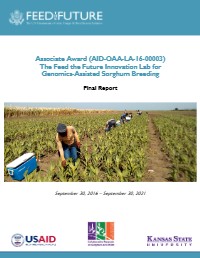
The Feed the Future Innovation Lab for Genomics-Assisted Sorghum Breeding - Final Report
Summary — This final report details the activities and achievements of the Feed the Future Innovation Lab for Genomics-Assisted Sorghum Breeding. The project focused on developing genomic approaches to improve sorghum breeding in Haiti, specifically targeting traits like sugarcane aphid resistance and drought tolerance. The lab fostered collaboration between scientists in Haiti, Cornell University, and Kansas State University.
Key Findings
- Genomics-assisted breeding can be effectively implemented in developing countries with limited resources.
- Genomic selection can accelerate genetic gain in sorghum breeding programs.
- Sugarcane aphid resistance and drought tolerance can be improved through genomic approaches.
- A collaborative network between US universities and Haitian institutions is effective for sorghum breeding.
- Stay Green trait is a major component of both stem sugar yield and grain yield under water stress.
Full Description
The Feed the Future Innovation Lab for Genomics-Assisted Sorghum Breeding aimed to determine if small countries with limited plant genomics experience could use advanced breeding approaches to accelerate new variety generation. This model was tested in Haiti, focusing on improving dual-purpose sorghums for smallholders. The project established a network of scientists in Haiti, Cornell University, and Kansas State University, with each member specializing in phenotyping, genomic selection tool development, and bioinformatics, respectively. The project successfully identified genomic regions conferring resistance to sugarcane aphid and improved drought tolerance. Activities are being continued under the Sorghum and Millet Innovation Lab with a focus on durable adaptation to aphid and drought for smallholder sorghum in the Americas.
Full Document Text
Extracted text from the original document for search indexing.
1 S org hum a nd M illet Innova tion L a b A nnua l P erform a nce Report – F Y 2021 Associate Award (AID-OAA-LA-16-00003) The Feed the Future Innovation Lab for Genomics-Assisted Sorghum Breeding Final Report September 30, 2016 – September 30, 2021 2 T he F eed the F uture (F tF ) Innova tion L a b for Genom ics-A ssisted S org hum B reeding - F inal Report Associate Award (AID-OAA-LA-16-00003) The Feed the Future Innovation Lab for Genomics-Assisted Sorghum Breeding Final Report This final report for is made possible by the generous support of the American people through the United States Agency of International Development (USAID). The contents are the responsibility of Kansas State University and do not necessarily reflect the views of USAID or the United States Government. Program activities are funded by the United States Agency for International Development (USAID) under Cooperative Agreement No. AID-OAA-LA-16-00003. Cover photo: Sorghum tissue collection from the fields at CHIBAS for sequencing at Cornell University. Photo credit: Dr. Gael Pressoir on August 29, 2019 This publication may be cited as: The Feed the Future Innovation Lab for Genomics-Assisted Sorghum Breeding. December 2021. Associate Award (AID- OAA-LA-16-00003) The Feed the Future Innovation Lab for Genomics-Assisted Sorghum Breeding Final Report. Sorghum and Millet Innovation Lab, Kansas State University, Manhattan, KS, pp. 12. 3 T he F eed the F uture (F tF ) Innova tion L a b for Genom ics-A ssisted S org hum B reeding - F inal Report Management Entity Information The management entity completed the fiscal year 2021 with the following staff members: • Timothy J. Dalton, Ph.D. – Director • Nathanael D. Bascom – Assistant Director • Benjamin E. Kohl, Ph.D. – Program Administrator • Kimberly A. Suther – Fiscal Analyst External Advisory Board Information Since the inception of the Feed the Future Innovation Lab for Collaborative Research on Sorghum and Millet (SMIL), the External Advisory Board (EAB) has played a key role in ensuring that SMIL’s research and management practices are both high-quality as well as relevant. 1) Dr. Faith B. Tarr – Agreement Officer Representative (AOR) at USAID 2) Dr. Brhane Gebrekidan - Ethiopian Academy of Sciences 3) Prof. Bettina Haussmann - University of Hohenheim, also serving as West Africa Liaison Scientist for the McKnight Foundation and Capacity Development Manager at the KWS SAAT SE 4) Mr. Timothy Lust - Chief Executive Officer of the National Sorghum Producers 5) Dr. Peter Matlon - Adjunct Professor at Cornell University 6) Prof. Barbara Stoecker - Regents Professor and Marilynn Thomas Chair at Oklahoma State University As in previous years, the management entity continued to provide periodic updates on activities and research-related developments to the EAB throughout the year, as well as consult them for guidance when areas of challenge arose. 4 T he F eed the F uture (F tF ) Innova tion L a b for Genom ics-A ssisted S org hum B reeding - F inal Report List of Program Partners United States of America Colorado State University Cornell University Kansas State University USDA-Agricultural Research Service Haiti CHIBAS Foundation Université Quisqueya 5 T he F eed the F uture (F tF ) Innova tion L a b for Genom ics-A ssisted S org hum B reeding - F inal Report Table of Contents Management Entity Information ................................................................................................................................................................ ... 3 External Advisory Board Information ................................................................................................................................ ......................... 3 List of Program Partners ................................................................................................................................................................ ................ 4 Table of Contents ................................................................................................................................................................ ............................ 5 Associate Award Final Report ................................................................................................................................................................ ...... 6 6 T he F eed the F uture (F tF ) Innova tion L a b for Genom ics-A ssisted S org hum B reeding - F inal Report Associate Award Final Report Associate Award "The Feed the Future (FtF) Innovation Lab for Genomics-Assisted Sorghum Breeding" (AID-OAA-LA-16-00003) performance period ended 9/30/2021 Administered by the Feed the Future Innovation Lab for Collaborative Research on Sorghum and Millet 148 Waters Hall Kansas State University Manhattan, KS 66506 December 10, 2021 7 T he F eed the F uture (F tF ) Innova tion L a b for Genom ics-A ssisted S org hum B reeding - F inal Report Final Report and Closeout Documentation Associate Award "The Feed the Future (FtF) Innovation Lab for Genomics-Assisted Sorghum Breeding" (AID-OAA-LA-16-00003) performance period ended 9/30/2021 Administered by the Feed the Future Innovation Lab for Collaborative Research on Sorghum and Millet Financial: Submission of final SF425 quarterly financial statement All financial documents have been submitted by SMIL to the Kansas State University Sponsored Programs Accounting (SPA) department, which is finalizing SF425. The Kansas State University SPA will submit this form directly to USAID before the required deadline with copy to SMIL. All Associate Award (AA) funds have been expended and there will be no unspent funding. Other financial requirements The Kansas State University SPA department is aware of the AA closeout and will work closely with SMIL to provide any additional financial information requested by USAID. Final Disposition of Equipment: There were no equipment purchases under this AA. Appendix 1 presents a letter stating that no equipment was purchased. The Kansas State University SPA will also provide a verification of this. Confirm USAID receipt of all Reporting Deliverables Project Management Plan / MEL plan The Performance Management Plan (PMP) was submitted previously for this AA and provides an overview of the results framework, FtF indicators, project planning matrix, impact pathway and the Theory of Change (ToC), data management plan, risk assumptions and mitigation, and FtF indicators and collection plans. A copy is provided in Appendix 2. A Data Management Plan (DMP) for all of the SMIL research projects was previously submitted to USAID, which included planning for this AA under Subawards #S17179 and #S17062. Specific data repository information is provided in the DMP. Annual work plans Annual work plans have been documented and recorded in the SMIL web-based reporting hub for each fiscal year. Annual narrative performance reports All SMIL annual narrative performance reports have been submitted to USAID and are available on the Development Experience Clearinghouse (DEC). Information about Associate Award "The Feed the Future (FtF) Innovation Lab for Genomics-Assisted Sorghum Breeding" (AID-OAA-LA-16-00003) was integrated into these SMIL annual narrative performance reports. All datasets uploaded to DDL (as per project data management plan) 8 T he F eed the F uture (F tF ) Innova tion L a b for Genom ics-A ssisted S org hum B reeding - F inal Report A Data Management Plan (DMP) for all of the SMIL research projects was submitted to USAID, which included planning for this AA under Subawards #S17179 and #S17062. Specific data repository information is provided largely for the genomic sequence data and phenotype data. FTFMS/DIS reporting submitted for final performance increment All FTFMS/DIS reporting was submitted for this AA as per the USAID reporting timelines. Final report A final report is provided as per the cooperative agreement guidelines. This report has been uploaded to the DEC and is presented in the following section. F T F IL for Genom ics-A ssisted S org hum B reeding Award number: AID-OAA-LA-16-00003 Led by Led by Dr. Geoffrey Morris – Kansas State University (now Colorado State University), Dr. Gael Pressoir – CHIBAS, and Dr. Ed Buckler – Cornell University Location (Department Level) Haiti: CHIBAS Foundation; Université Quisqueya (UNIQ) Executive Summary The Feed the Future Innovation Lab for Genomics-Assisted Breeding was designed to determine whether small- countries with limited plant genomics experience could use state-of-the-art breeding approaches to increase the pace and success of new variety generation. This model was tested in Haiti. The Genomics-Assisted Sorghum Breeding Lab approached the problem in a novel manner. Rather than equipping Haiti with all the technology and human capacity to undertake the program on its own, the lab developed a small network of scientists in Haiti, at Cornell University and at Kansas State University. Each member of the network had a well-defined role in the process: phenotyping was centered in Haiti, tools for genomic selection developed at Cornell and bioinformatics conducted at Kansas State University. The approach was successful and identified genomic regions of sorghum that confer genetic resistance against the sugarcane aphid, which is a widespread pest in Haiti and other regions around the world, including the United States. In addition, the pace of genetic progress was hastened over phenotypic selection and tolerance against drought stress improved. Activities initiated under the associate award are being continued under the Sorghum and Millet Innovation Lab. We have allocated core funding to this project and will continue to do so until termination in July 2023. It is now known as: “Durable adaptation to aphid and drought for smallholder sorghum in the Americas.” We are doing this to continue the process of identifying additional sources of sugarcane aphid tolerance so plant protection will be ready as the insect biotype evolves. We also see that genetic gain and drought tolerance is accumulating at a faster pace than traditional phenotypic recurrent selection. Overall Description Globally, there is great interest in applying new genomic technologies to accelerate genetic gains in developing country breeding programs. However, these methods have not been adopted in developing country level National Agricultural Research Institutes (NARI) due a mismatch between available genomic selection approaches and the existing operations 9 T he F eed the F uture (F tF ) Innova tion L a b for Genom ics-A ssisted S org hum B reeding - F inal Report of NARI breeding programs. This project aims to develop genomic approaches from within a NARI breeding program to reduce barriers for adoption. Specifically, these improved genomics selection approaches will be deployed to address several key constraints for dual-purpose sorghums used by smallholders in Haiti. The targets will be improving grain yield while maintaining forage yield and quality, improving tolerance to low/high pH soils, and improving tolerance to post-emergence and post-flowering water limitation. Tolerance to sugarcane aphid is another key goal. By designing genomics-assisted breeding approaches in a NARI, the resulting technology will be better suited for adoption by other NARI globally. The tools and resources developed in this project will facilitate adoption of genomics- assisted breeding by partner programs in West and East Africa and will be diffused globally via breeding informatics initiatives (GOBII and BMS). Launch of Haiti project: “ Durable adaptation to aphid and drought for smallholder sorghum in the Americas” When the associate award ended in 2021, the Management Entity developed a follow-on project to ensure continuity. This project, “Durable adaptation to aphid and drought for smallholder sorghum in the Americas” will extend the work started under the associate award. This project will ensure that innovations on aphid and drought resilient varieties by the UniQ and CHIBAS sorghum program lead to durable solutions for smallholder farmers and downstream stakeholders in Haiti. Further, we will facilitate the diffusion of the technology from Haiti to other smallholder-serving breeding programs in Latin America and beyond. The project launched in the second quarter of 2021 and has been progressing on schedule. The US-based members of the project team have been recruited and onboarded, the project team in the US and Haiti have been meeting regularly. The Haiti team has conducted their field activities on schedule despite the political unrest and security problems in Port-au-Prince, the earthquake in the south (near the breeding station in Cayes), and the move of the program from Port-au-Prince to Mirebalais. Assessment of Progress, Achievements, and Important Research Findings In 2017 we were successful at getting both rAmpSeq and Nextera based protocols to work with low quality DNA preps in the U.S. The bioinformatics to use rAmpSeq as anonymous markers worked quite well, but it does not integrate seamlessly with other marker systems. The nature of DNA sequencing is changing with low-cost pore-based sequencing, and we feel that we should be migrating genotyping to these systems. Basic analysis of population structure and diversity for CHIBAS germplasm was completed. Based on the GBS data, Muleta and Rigaud estimated the effective population size for the CHIBAS breeding program, which is the key value needed to reparameterize the genomic selection simulations. Initial simulations confirm improved genetic gain based on GS versus conventional recurrent selection. Young breeding programs in developing countries, like the CHIBAS sorghum breeding program in Haiti, face the challenge of increasing genetic gain with limited resources. Implementing genomic selection (GS) could increase genetic gain, but optimization of GS is needed to account for these programs’ unique challenges and advantages. We used simulations to identify conditions under which genomic-assisted recurrent selection (GARS) would be more effective than phenotypic recurrent selection (PRS) in small breeding programs. We compared genetic gain, cost per unit gain, genetic variance, and prediction accuracy of GARS (two or three cycles per year) versus PRS (one cycle per year) assuming various breeding population sizes and trait genetic architectures. The maximum relative genetic gain advantage of GARS over PRS was 12–88% for oligogenic architecture with high heritability and 26–165% for polygenic architecture with low heritability. Average prediction accuracy declines substantially after several cycles of selection, suggesting the prediction models should be updated regularly. Updating prediction models every two or three cycles increased the genetic gain compared to no-update scenarios (by up to 39% or 33%, respectively). For small populations and oligenic traits, cost per unit gain was lower in PRS than GARS. However, with larger populations and polygenic traits cost per unit gain was up to 67% lower in GARS than PRS. Collectively, the simulations suggest that GARS could increase the genetic gain in small breeding programs by accelerating the breeding cycles and enabling evaluation of larger populations. We have showed that Stay Green is a major component of both stem sugar yield and grain yield (particularly under water stress). The weight of green (and physiologically functional) leaves after grain maturity needs to be a major selection target to make progress on stem sugar and grain yields simultaneously. Green leaves allow to continue to accumulate stem sugars after grain filling and grain maturity. Therefore, progress on the traits will depend on predictive 10 T he F eed the F uture (F tF ) Innova tion L a b for Genom ics-A ssisted S org hum B reeding - F inal Report ability and selection intensity. Our simulation results (Kebede et al., 2018) show that genomic selection should outperform conventional selection in both speed and cost. Overall, the research team has showed that genomic selection can be performed in a low budget developing world breeding program. The technologies enabling it were developed at Cornell and they have achieved an <10 USD per sample for accurate genotyping and CHIBAS has incorporated the information into their breeding methodology. The team’s simulation study (Kebede et al, 2019, G3: Genes, Genomes, Genetics, 9(2), 391-401.) suggests that with these achieved costs, genomic selection should achieve a faster genetic gain at a cheaper cost per unit of genetic gain. Evaluation of the first advanced inbred lines coming out of their genomic selection cycles (4 cycles to date) are currently underway. The technology used for sequencing sorghum plants allowed the team to achieve excellent prediction accuracy (e.g., mean correlation between predicted and observed values above 0.5 across all trials, for grain yield). The practical haplotype graph, a software for sequencing many samples at very low cost, has been developed and tested in the CHIBAS populations (founders and training set). In a study recently submitted and currently available, they have shown that this imputation method achieved imputation accuracy similar or higher than standard methods, especially for sequencing many samples (low-depth sequencing) (Jenssen et al., 2020). Specific institutional achievements include: 1. Researchers have developed the technologies and pipeline to efficiently extract DNA and genotype sorghum plants for less than 10 USD per sample, using to dry leaf punch in 96-well plates. 2. Sorghum plants were sequenced using rhAmpSeq, a targeted sequencing technology which was cost-effective and yielded high-quality sequencing data at thousands of sites (1740 to 3047 single-nucleotide polymorphisms). 3. The practical haplotype graph has been developed and tuned for accurate genotyping in the CHIBAS populations. Researchers have constructed the database used to store variants of gene regions across CHIBAS founder lines. 4. Researchers have developed a pipeline to extract similarity about gene regions as alternative genomic information and proved the usefulness of this approach in genomic selection. 5. Researchers have completed 4 cycles of genomic selection while performing one cycle of phenotypic S1 selection. 6. Researchers have fine mapped the male sterility ms3 gene. 7. With the Geoffrey Morris lab at Kansas State University, researchers have fine mapped the SCA resistance gene (sorghum sugarcane aphid) and have developed markers for it. 8. Morris’ lab has validated the SCA markers in an independent population. 9. Researchers have characterized the GxE and wide adaptation (good performance across environments) and low ecovalence (stable yield across environments). Both are heritable and can be chosen by genomic selection. This is certainly one of the major advantages of genomic selection as compared to traditional phenotypic breeding, selection for wide adaptation and yield stability is very costly. 10. Researchers have showed that Stay Green contributes to yield stability across environments. 11. Three new inbred lines (from populations developed before the start of the project) have been selected from multilocation trials for their broad adaptation and yield stability across environments. 12. Two Haitian Master students have now completed their theses with partial support and using data generated by the project: Jean Rigaud Charles (Master from the school of Agriculture of Montpellier, France) and Marie Darline Dorval (Master from University of Florida, USA). 13. Two new sugarcane aphid resistant varieties are under research and will be forwarded for official registration in due course. A follow-on project to the associate award was initiated. The project is developing new aphid resistance marker technology to further reduce aphid damage and mitigate the possibility that the RMES1 gene is overcome by the aphid. Genotype and phenotype data collection for aphid resistance in the Quisqeya University (UniQ) program was 11 T he F eed the F uture (F tF ) Innova tion L a b for Genom ics-A ssisted S org hum B reeding - F inal Report completed, and initial mapping of new aphid-resistance loci should be completed by the first quarter of 2022. Similarly, we are identifying new drought tolerance loci based on field phenotyping of drought response in the UniQ program. To understand the role of dhurrin, a cyanogenic glycoside, in the Stay Green post-flowering drought tolerance of UniQ germplasm we have been testing and improving low-cost assays cyanogenic potential (cyanide production). Using the same aphid and drought phenotype data, we will be testing hypotheses on potential tradeoffs and limitations of the current aphid and drought resilience traits used by UniQ, so we can develop breeding strategies that circumvent these issues. Conclusions on Lessons Learned Shipping DNA, tissue, and some reagents into Haiti has been challenging. We have developed a number of strategies to make this more efficient and hope these efforts will make genomic selection go smoothly. Long term, we will work to reduce the number of shipping exchanges needed between the U.S. and Haiti. Work has been very useful to characterize the genetic diversity and agronomic performance of the CHIBAS germplasm and is helping us to make better decisions on where to take the program in the future. The practical haplotype graph can be very accurate for genotyping sorghum plants at low cost, but it requires proper tuning of imputation parameters (“consensus threshold” used for condensing haplotypes at gene regions). The practical haplotype graph can be used for dense marker assay and imputation, which will be critical for subsequent detection of deleterious variants and characterization of mutation load at gene regions. There are considerable constraints to exchanging germplasm between low-income countries and the United States that limits the speed and efficiency of collaboration. During the last (fifth) cycle of genomic selection (June 2020), a series of tests were developed to check the quality of the plant samples, the DNA profiling data, and the data analysis. After such tests, we identified a source of contamination which would have otherwise been detrimental to the accuracy of our predictions. The “checklist” we developed will be useful in future selection cycles to avoid losses in accuracy. Significance of these Activities Improved sorghum varieties have been developed for Haiti and will serve as a local public good to the farming community. Initial scientific advances on sugarcane aphid resistance have generated strong interest from other areas of the world. This interest will lead to global public goods and spill-in benefits to the United States. A general model of collaboration ensures that small countries can benefit from state-of-the-art technologies for genomic selection and plant breeding. Capacity Building An additional aim of the project was to train the next generation of US researchers for careers in smallholder-serving R&D. A M.S. student (female; Kristen Johnson; 05/21–) and a postdoc (male; Brian Rice; 10/21–) have been recruited onto the new project, and an additional Ph.D. student (male; Carl VanGessel; 07/21–) funded by a CSU fellowship, is also participating on the project. Kristen is testing hypotheses on the role of the cyanogenic glycoside dhurrin in UniQ's drought tolerance and Stay Green traits, which will provide critical information to guide the UniQ breeding program (and others) on potential tradeoffs for forage quality and drought tolerance. Brian is developing and implementing new genomic methods that will accelerate UniQ's genetic gain for complex interrelated traits (aphid resistance, drought tolerance, forage quality, grain, and forage yield) and facilitate the transfer of useful traits to other smallholder-serving programs. Carl is working to understand the genetic and physiological basis of the RMES1 aphid resistance used by UniQ, to head-off any tradeoffs or vulnerabilities in this defense mechanism and facilitate the discovery of new resistance mechanisms. We're also working closely with early-career faculty member Terry Felderhoff (Kansas State University), leveraging funding from Innovative Seed Systems (e.g., Dekalb sorghum brand), to develop new aphid-resistance marker 12 T he F eed the F uture (F tF ) Innova tion L a b for Genom ics-A ssisted S org hum B reeding - F inal Report technology that will combat the aphid across the Americas. Two Haitian M.S. students have now completed their theses with partial support and using data generated by the project: Jean Rigaud Charles (Master from the school of Agriculture of Montpellier, France) and Marie Darline Dorval (Master from University of Florida, USA). In Haiti, there has been remarkable success through the creation of a platform which pairs the genomics mapping and bioinformatics capacity of land grant university departments with a traditional small country breeding program. This has been the basis for unique discoveries and a product development capacity to respond to the emerging smallholder demands linked to sugarcane aphid pressure, climate adaptation and end-use requirements in Haiti. The SMIL/USAID support to establish this global genomics-enabled breeding network has resulted in global access to unique sugarcane aphid (SCA) resistant materials. This has benefited the US sorghum industry and a “no strings attached” private sector funding was provided by a US seed company to further the SCA science. This Haiti experience is one example of the SMIL/USAID program’s strategic support to cutting-edge research and a truly global genomics enabled breeding network that is accelerating genetic exchange for the benefit of our USAID target countries/regions. This has provided tangible global good and key spill-in benefits to US sorghum production. Comments and Recommendations The Feed the Future Innovation Lab of Genomics-enabled Breeding refuted a widely held hypothesis that genomics- enabled breeding is not possible nor cost-effective in small nations with limited scientific staff. The strategy to decentralize the process and allow collaborators to specialize in a limited number of tasks proved to be successful. Specialization is cost- and time-effective and decentralization spreads the risk across institutions while at the same time creating a network where peer-pressure encourages collaborators to complete tasks and innovate. The development of a network and selection of participants is crucial for success. What provided to be one of the most challenging issues was the exchange and shipment of genetic material between Haiti and the U.S. Presentations and Publications Charles, J., Muleta, K., Morris, G., & Genome, G. P.-P. and A. (n.d.). Newly Developed Melanaphis Resistant Sorghum Lines in Haiti Show a Strong Selective Sweep at a Locus on Chromosome 6 Collocated with the Known RMSE1. Researchgate.Net. Retrieved December 7, 2021, from https://www.researchgate.net/profile/Jean- Charles/publication/351972830_Newly_developed_Melanaphis_resistant_Sorghum_lines_in_Haiti_show_a_stro ng_selective_sweep_at_a_locus_on_chromosome_6_collocated_with_the_known_RMSE1_gene/links/60b2af60 299bf1f6d5849624/Newly-developed-Melanaphis-resistant-Sorghum-lines-in-Haiti-show-a-strong-selective- sweep-at-a-locus-on-chromosome-6-collocated-with-the-known-RMSE1-gene.pdf Jensen, S. E., Charles, J. R., Muleta, K., Bradbury, P. J., Casstevens, T., Deshpande, S. P., Gore, M. A., Gupta, R., Ilut, D. C., Johnson, L., Lozano, R., Miller, Z., Ramu, P., Rathore, A., Romay, M. C., Upadhyaya, H. D., Varshney, R. K., Morris, G. P., Pressoir, G., … Ramstein, G. P. (2020). A sorghum practical haplotype graph facilitates genome- wide imputation and cost-effective genomic prediction. The Plant Genome, 13(1), e20009. https://doi.org/10.1002/TPG2.20009 Muleta, K. T., Felderhoff, T., Winans, N., Walstead, R., Charles, J. R., Armstrong, J. S., Mamidi, S., Plott, C., Vogel, J. P., Lemaux, P. G., Mockler, T. C., Grimwood, J., Schmutz, J., Pressoir, G., & Morris, G. P. (2021). The recent evolutionary rescue of a staple crop depended on over half a century of global germplasm exchange. BioRxiv, 2021.05.11.443651. https://doi.org/10.1101/2021.05.11.443651 Muleta, K. T., Pressoir, G., & Morris, G. P. (2019). Optimizing Genomic Selection for a Sorghum Breeding Program in Haiti: A Simulation Study. G3 Genes|Genomes|Genetics, 9(2), 391–401. https://doi.org/10.1534/G3.118.200932