

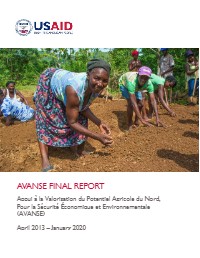
Rapport Final AVANSE : Appui à la Valorisation du Potentiel Agricole du Nord, pour la Sécurité Économique et Environnementale
Resume — Le projet AVANSE visait à augmenter les revenus agricoles dans le corridor nord d'Haïti en améliorant la productivité, la stabilité des bassins versants et l'accès au marché pour les producteurs de riz, de cacao et de plantain. Pendant sept ans, le projet a introduit des technologies améliorées, renforcé les agro-entreprises et augmenté les revenus des agriculteurs, contribuant ainsi à un changement transformateur dans le secteur agricole.
Constats Cles
- Le revenu agricole moyen des agriculteurs a plus que doublé, passant de 443 $ en 2013 à 960 $ en 2019.
- Les rendements de plantain sont passés de 6 TM en 2013 à 18 TM en 2019.
- Les exportations de cacao sont passées de 942 360 $ en 2013 à 6 899 937 $ en 2019.
- Plus de 6 millions d'arbres et de plantes cultivées ont été distribués pour la conservation des sols et la génération de revenus.
- 22 entreprises, dont 13 appartenant à des femmes, ont été modernisées grâce à des investissements dans la transformation à valeur ajoutée.
Description Complete
Le projet AVANSE (Appui à la Valorisation du Potentiel Agricole du Nord, pour la Sécurité Économique et Environnementale), doté d'un budget de 85,8 millions de dollars, s'est déroulé d'avril 2013 à janvier 2020. Son objectif principal était d'augmenter les revenus agricoles dans le corridor nord d'Haïti en s'attaquant à l'accès limité à la technologie et aux pratiques de production inefficaces. AVANSE s'est concentré sur les chaînes de valeur du riz, du cacao et du plantain, dans le but d'accroître la productivité agricole, d'améliorer la stabilité des bassins versants, de renforcer les marchés agricoles et de renforcer les capacités des organisations locales. Le projet a introduit 32 technologies améliorées, aidé plus de 30 agro-entreprises et augmenté de manière significative les rendements et les revenus des agriculteurs. Les principales interventions comprenaient des écoles pratiques agricoles, des partenariats public-privé et un soutien aux universités locales et au ministère de l'Agriculture.
Texte Integral du Document
Texte extrait du document original pour l'indexation.
AVANSE FINAL REPORT Appui à la Valorisation du Potentiel Agricole du Nord, Pour la Sécurité É conomique et Environnementale (AVANSE) April 2013 – January 2020 USAID.GOV AVANSE FINAL REPORT | ii FI NAL REPORT Appui A la Valorisation du Potentiel Agricole du Nord, pour la Sécurité Économique et Environnementale (AVANSE) Program Title: Appui à la Valorisation du Potentiel Agricole du Nord, pour la Sécurité Économique et Environnementale (AVANSE) Sponsoring USAID Office: USAID/Haiti Contract Number: AID – 521 – C – 13 – 00006 Contractor: DAI Global, LLC Date of Publication: January 2020 Author: DAI Global, LLC Cover Photo: Grison Garde, North Haiti. The USAID/AVANSE Jardin Lakay (Home Garden) program trained women to raise vegetables for their families in small gardens near their homes. The authors’ views expressed in this publication do not necessarily reflect the views of the United States Agency for International Development or the United States Government. iii | AVANSE FINAL REPO RT USAID.GOV TABLE OF CONTENTS ABBREVIATIONS AND AC RONYMS V OVERVIEW 1 OBJECTIVE AND SCOPE 1 TECHNICAL APPROACH 1 MAJOR OUTCOMES AND A CCOMPLISHMENTS 1 LESSONS LEARNED & RE COMMENDATIONS 4 IR 1: AGRICULTURAL P RODUCTIVITY INCREASE D 7 RICE 7 CACAO 10 PLANTAIN 14 IR 2: WATERSHED STAB ILITY IMPROVED 17 MAJOR OUTCOMES A ND ACCOMPLISHMENTS 17 LESSONS LEARNED AND RECOMMENDATIONS 18 IR3: AGRICULTURAL MARKETS STRENGTHENED 20 MAJOR OUTCOMES AND A CCOMPLISHMENTS 20 LESSONS LEARNED AND RECOMMENDATIONS 24 INFRASTRUCTURE 25 MAJOR OUTCOMES AND ACCOMPLISHMENTS 25 LESSONS LEARNED AND RECOMMENDATIONS 26 CROSS CUTT ING 28 MONITORING AND EVALU ATION 28 ENVIRONMENTAL COMPLI ANCE 28 COMMUNICATIONS 30 YOUTH AND WOMEN’S EM POWERMENT 31 ADDENDUM TO FINAL RE PORT 32 509 SANITATION 35 ANNEX 1: IPTT 38 USAID.GOV AVANSE FINAL REPORT | iv TABLES AND FIGURES TABLES TABLE 1: INDICATORS, TARGETS, AND LOP RESULTS FOR IR3 20 TABLE 2: INDICATORS BY FY AND LIFE OF PROJECT TOTALS FY 2014 - FY 2019 – IR 3 23 FIGURES FIGURE 1: TOTAL ANNUAL RAINFALL FOR CAP HAITIEN OVER 47 YEARS 8 FIGURE 2: ANNUAL CACAO EXPORTS 10 FIGURE 3: AVANSE NATURAL RESOURCES MANAGEMENT AND LOCAL COMMUNITY - BASED ORGANIZATION MOPEJ MEMBERS APPLYING IMPROVED SOIL CONSERVATION TECHNIQUES TO HILLSIDES IN THE JASSA WATERSHED 16 FIGURE 4: INSIDE CLES'S RICE PROCESSING FACILITY 19 FIGURE 5: CHALOPIN IRRIGATION SYSTEM SEEN FROM ABOVE 24 FIGURE 6: COMMERCIAL BANANA FARM ESTABLISHED WITH AVANSE SUPPORT 31 v | AVANSE FINAL REPO RT USAID.GOV ABBREVIATIONS AND AC RONYMS APFL Association des Producteurs de la Ferme La Chapelle /La Chapelle Farmers’ Association AVANSE Appui à la Valorisation du Potentiel Agricole du Nord, pour la Sécurité Économique et Environnementale/Support for the Promotion of the Agricultural Potential of the North, for Economic and Environmental Security AU Auburn University BRGM Bureau de Recherc hes Géologiques et Minières/ French Geological Survey CLES Collectif de Lutte contre l’Exclusion Sociale/Collective Fight Against Social Exclusion CPCN Northern Cacao Producers Cooperative DR Dominican Republic EC Environmental Compliance EMMP Environmenta l Mitigation and Monitoring Plan FFS Farmer Field School GOH Government of Haiti ha Hectare HTG Haitian Gourde (currency) IR Intermediate Result kg Kilogram LOP Life of Project M&E Monitoring and Evaluation MARNDR Ministère de l'Agriculture, des Ressources Naturelles et du Développement Rural/Ministry of Agriculture, Natural Resources, and Rural Development MT Metric Ton NGO Non - Governmental Organization NRM Natural Resource Management PEA Project Environmental Assessment PERSUAP Pesticide Evaluation Report and Safer Use Action Plan PHS Post - Harvest Survey PIF Production Intensive par Fragmentation/Intensive Production via Fragmentation PISA Produit des Iles S.A. (A Northern Haitian cacao processor and exporter) SIBA Système d’Incitation via les Bons d’Achat /System of Incentives through Vouchers SIMA Système d’Information sur les Marches Agricoles/Agricultural Market Information System SRA Système de Riziculture Améliorée/System of Rice Improvement SRI Le Système Rizicole Intensive/Intensive Rice - Production System UCNH University of Northern Haiti UEH National University of Haiti UPBH L’Union des Producteurs de Banane d’Haïti/Union of Haitian Banana Producers USAID United States Agency for International Development WUA Water User Associations 1 | AVANSE FINAL REPO RT USAID.GOV OVERVIEW OBJECTIVE AND SCOPE The $85.8 million, seven - year Appui à la Valorisation du Potentiel Agricole du Nord, pour la Sécurité Économique et Environnementale (AVANSE) project, started in April 2013, with the specific objective of increasing agricultural incomes in Haiti’s Northern Corridor. Prior to the project, farmers’ average income in that area was restricted by limited access to technology and services and inefficient agricultural production practices. AVANSE aimed to increase farmers’ income by achieving the following outcomes in the rice, cacao, and plantain value chains: 1) agricultural productivity increased, 2) watershed stability above selected plains improved, 3) agricultural markets strengthened, and 4) capacity of local organizations strengthened. Over the course of the last seven years, AVANSE has realized all of these goals and achieved its targets , except for strengthening the capacity of local o rganizations , which was removed from the project goals following a scope of work modification in 2015. TECHNICAL APPROACH A value chain approach — guided by the core tenets of local ownership of solutions, in creased use of technologies, market - led interven tions, gender mainstreaming, and active collaboration with local institutions — informed AVANSE’s interventions. As appropriate, AVANSE employed a farmer field school (FFS) approach to extend and disseminate improved agricultural production practices. FFS is a participatory approach, which allows farmers to test and adapt improved techniques to their particular circumstances. A parallel focus on market - based solutions enabled innovative inclusive, profitable public - private partnerships to be forged between ag ribusiness es, farmer associations , and producer groups. The gender mainstreaming approach contributed to 26 percent of the project beneficiaries being women and 22 female - owned agribusinesses being established or upgraded . Collaboration with local institut ions, particularly local universities and the regional branches of the Ministry of Agriculture , facilitated the sustainability of AVANSE’s varied, widespread , and high - impact interventions. MAJOR OUTCOMES AND A CCOMPLISHMENTS During the life of the project, AVANSE made significant contributions to transformative, positive change in the agriculture sector in the Northern Corridor of Haiti. Not only did average farmers’ yields and income more than double, but 32 improved technologies were introduced and used b y more than 50,000 farmers, and over 30 small , medium , and large agribusinesses were assisted and strengthened . T he major outcomes and achievements of the AVANSE project follow . Detailed outcomes and achievements for each component are presented in the various subsections of this final report , and additional detail is available in the previous annual and quarterly reports. • Farmers’ income increased . Average a gricultural income f or beneficiary households more than doubled: from $443 in 201 3 to $960 in 2019. • Agriculture yields significantly increased . Annual p lantain yields increased from the baseline value of 6 metric tons ( MT ) in 201 3 to 18 MT in 2019 . Single crop rice yields increased from USAID.GOV AVANSE FINAL REPORT | 2 2.5 MT in 2013 to 6 MT in 201 8 , and annual cacao yields increased from 319kg/ha in 2013 to 455 kg/ha in 2019 . • Greater utilization of improved practices/technologies by farmers leading to increased yields. Thirty - two different techniques or technologies were disseminated across the Northern Corridor and applied by 51,455 farmers on 27,930 ha . • Increased export sales of cacao from the North . In 2013, a particular bad year for Haitian cacao production, A VANSE calculated a baseline value of $942,360 (427 MT) in export cacao sales. In 2019 export sales were estimated at $6,899,937 (8,630 MT) . AVANSE ’s efforts to increase total production and its assist ance to growers and exporters had helped them to expand total exports and their percentage of sales into the premium markets for fermented, organic, and fair - trade cacao and contribut e d to this positive trend. • Market system change in cacao sector. A VANSE’s assistance has expanded the capabilities of a ll three major cacao exporters in the Northern Corridor to export fermented cacao , leading to greater revenue for the sector and for farmers. • High - demand and essential agricultural services developed and established locally. AVANSE applied m arket - based solutions to remove inefficiencies in supply chain by enab ling small suppliers to import fertilizer in bulk ; to in troduce and increas e the availability of clean, high - yield rice seed and plantain planting materials ; and to deliver irrigation, cultivation , and harvesting services to remote agricultural lands . • Greater access to irrigation. Two irrigation systems were rehabilitated and constructed , including 7.2 km of masonry canals, to irri gate 430 hectares . Approximately 200 irrigation pumps were subsidized to allow the provision of irrigation water to at least 660 hectares annually . Ten three - wheeled motorcycles and 20 irrigation pumps given to the Ministry of Agriculture to encourage local entre preneurs to provide irrigation services to remote agricultural lands. • Hillsides stabilized . More than 6 million trees and crop plants were distributed, contributing not only to soil conservation and erosion prevention by stabilizing slopes above selected plains, but also contributing to household food security and increased income for farmers. • Three key public - private partnerships forged . AVANSE’s funds were used catalytically to leverage private sector (agri - enterprises) investments to benefit farmers, for example through expanding farmer’s access to the higher - value organic and fermented cacao markets and through enabling increased farmer engagement with a local agro - processor rice firm. • Small and medium enterprises strengthened. Twenty - two enterprises, 13 of which are female - owned, upgraded through investment in value - added processing that transform unprocessed commodities into market goods with higher value , boosting job creation, and ge nerating greater revenues for local enterprises. • Youth and women (agri - preneurs) eagerly engaging in commercial, agricultural activities. Youth and gender mainstream ing in AVANSE activities contribut ed to 1,207 3 | AVANSE FINAL REPO RT USAID.GOV formerly unemployed and/or underemployed yout h and 22 female - led agribusiness es starting to generat e income from their agriculture activities . USAID.GOV AVANSE FINAL REPORT | 4 5 | AVANSE FINAL REPO RT USAID.GOV LESSONS LEARNED & RECOMMENDA TIONS Lasting change in the way farmers produce. Farmers and other s including universities and the Ministry of Agriculture have accepted the improved production practices AVANSE promoted . In addition, t here ha s been a lasting change in farmers’ practices and in how agriculture , especially rice production, is taught in the local universities. However, in some cases, farmers found some technology packages, namely the System of Rice Intensification (SRI) , too demanding , and farmers did not ado pt the entire syste m. Consequently, we recommend gradual or stepwise introduction of technology packages . AVANSE recommends future projects work with farmers to tailor new technologies to farmers’ particular agro - ecolo gical conditions and financial resources . This tailored approach, along with introducing agronomy students to new technologies and providing them with field experience, will help increase the overall adoption rate of new and improved technologies. Collabo ratin g with farmers on adapting technologies to their specific circumstances yield s encouraging results . Techniques adapted by farmers to their circumstances are likely to yield more sustainable results than those given to them in a top - down approach . This accounts for the success of the Farmer Field School approach , which uses a participatory method allowing farmers to test and to adapt technology to their circumstances . For example, i n the cacao value chain, chan ging from large nurseries delivering in bulk to small community nurseries, as recommended by farmers, reduced cacao seedling mortality . L ocal rice seed production, as opposed to imported seed, contribute d to lower costs and increased production . L ocally produced, clean plantain plantlets eliminated the problem of transporting , often low quality, plantain suckers from other regions . T he recommendation, therefore, is to continue collaboration with farmers , f urther integrat ing them in to the extension process , in order to identify the best solutions to farmers’ main production problems. Working to expand innovations encourages market system change. E xpansion of successful innovat ions stimulate s system improvements and encourage s c ompetition amongst private sector actors, steering the private cacao sector toward more inclusive ways of doing business with farmers . For example, all three of the main cacao exporters in the Northern Corridor have eng aged in or expanded their involve ment in cacao fermentation ; A VANSE ’s support facilitated th e ir shift to this higher priced market. A ll of the exporters now have the capabilities to improve the quality and expand the amounts of fermented cacao they produce , which increase s their revenues. These changes in turn encouraged exporters to engage in two other profitable specialty markets : fair - trade and organic. We recommend continuation of these efforts to partner with the private sector in order to incorporate even more farmers into higher value markets, and to multiply these profitable , agri - business activities . Deepened engagement with private sector to foster inclusive economic growth. AVANSE, through public - private partnerships and grants , made progress toward creating sustainable “win - win” partnership s between agribusinesses and farmers’ groups and associations. Examples include the BOX 1: EARLY TRANSPL ANTING “Early Transplanting” is one of the five SRI principles. This practice — transplanting young rice seedling s about 8 to 12 days after germination instead of the traditional 40 days — has been adopted by nearly all the rice farmers in the Northern Corridor. An AVANSE survey found that adopting t his simple practice alone l eads to higher yield s , in the range of 20 percent increase. USAID.GOV AVANSE FINAL REPORT | 6 Collectif de Lutte contre l’Exclusion Sociale/Collective Fight against Social Exclusion (CLES), L’Union des Producteurs de Banane d’Haïti/Union of Haitian Banana Producers (UPBH) and Produit des Isles (PISA). Future projects can build on these successes, by scaling up these partnerships and encouraging more far mer involvement . Key to expanding inclusive economic growth is to work with firms that have shown interest in fostering win - win economic opportunities for farmers. Greater investment in irrigation and water management system is crucial. Deferred maintenance increases the subsequent costs for rehabilitation of and repairs to irrigation systems . Because these maintenance needs are not being addressed, the ensuing system inefficiencies and failures have red uce d water availability in most of the Nort hern Corridor ’s irrigated perimeters. This lack of a reliable water supply affected the uptake of the technologies AVANSE promoted, reduce d farmers’ investments in improved agricultural technologies, and subsequently reduce d the overall impact of AVANSE’s programs. Going forward, more emphasis should be placed on developing the capacity of the Ministry of Agriculture and water user associa tions to maintain, repair , and rehabilitate the existing irrigation systems and expand improved water management on the major perimeter s in Northern Haiti. A f lexible approach, in light of current climate realities, to facilitate resilien ce outcomes. Long periods of drought and erratic rainfall negatively affected agricultural production in the Northern Corridor throughout the duration of the AVANSE project. This trend is likely to continue. To prevent significant loss es in farmers’ livelihoods caused by climat e shocks, flexibility in project design , implementation , and even crop selection, is needed . Crop diversification and mixed farmer systems, for example interspersing cacao with yams , plantain, vanilla, fruit , and timber trees can contribute to sho rt - term cash flow and a long - term increase in farmer’s revenue, and spreads the cash returns across the year, making farmers more resilient. Harmoniz ation with other projects and the M inistry to maximize impact and avoid duplication . In a bid to promote sustainability, AVANSE gradually reduced subsidies on agricultural inputs and services. However, other projects provided these inputs and services for free, resulting in a disincentive for collaboration with AVANSE. The recommendation i s to ensure that the relevant authorities and other projects are included in the design phase of new projects and in the annual work planning process. While the Ministry of Agriculture was appreciative of AVANSE’s information sharing and its incorporat ion of the ir local staff into project activities and training s , the Ministry needs to be encouraged to play a greater role in implementing sustainable approaches across all projects. 7 | AVANSE FINAL REPO RT USAID.GOV IR 1: AGRICULTURAL P RODUCTIVITY INCREASE D Sixty percent of the rural popula tion in Haiti works i n agriculture, yet agricultural yields , virtually across all value chains , are low when compared to those of neighboring counties . To increase agricultural productivity, and by extension the agricultural income of farmers , f rom 2013 to 2019, AVANSE implemented a number of extension and training activities with rice, plantain, and cacao farmers. These activities increased Northern farmers’ use of improved technologies and practices, boosted th e commercial supply of agricultural inputs/services, built the resilience of farmers to drought, and strengthened AVANSE’s beneficiary farmer s’ knowledge and capacity i n crop husbandry, integrated pest and disease control, soil and water management, and post - harvest procedures. RICE MAJOR OUTCOMES AND A CCOMPLISHMENTS INCREASE IN INCOME . A verage gross margins increased from $217 /hectare in 2013 to $990/hectare in 2019 . T HREE - FOLD INCREASE IN YIELDS . Rice y ields increased from a baseline value in 2013 of 2,561 kg/ha to 6,290kg/ha in 201 8 . AVANSE shared information about improved methods of rice production , provi ded of machinery for threshing, land preparation and weed ing , subsid iz ed input s (fertilizer and seed) on a USAID.GOV AVANSE FINAL REPORT | 8 declining scale, and promot ed SRI, a production methodology that allows rice farmers to increase yields while using less inputs. TECHNICAL CAPACITY O F A WIDE RANGE OF STAKEHOLDERS ST R ENGTHENED . Ov er the life of the project (LOP), AVANSE trained 6,799 rice farmers, extension agents, input suppliers, agricultural workers , agronomy students , and professors from al l the regional universities on various improved rice production techniques . This wide - rang ing approach increase s sustainability likelihood of AVANSE interventio ns. The North and North East regions now have ample competent professionals to guide farmers in integrated pes t management, proper pesticide application, and improved production methods for growing healthy rice crops with little to no technical training needed from external experts . LOCAL SEED PRODUCTIO N ESTABLISHED TO REMOVE INEFFICIENCIES IN SUPPLY CHAIN . AVANSE trained a selected group of farmers in the production , marketing , and storage of quality rice seed for their own use and also for sale . This activity helped reduc e seed imported from Dominican Republic, increase d the use of high - quality seeds by farmers, expand ed the availability of high - quality seed of local varieties , and generate d extra income for farmers. T he farmers trained are now producing rice seed and selling to agro - enterprises and other farmers across the region. LESSONS LEARNED AND RECOMM ENDATIONS MECHANIZATION. L abor became increasingly difficult to find , particularly at peak periods such as land preparation , transplanting , and harvesting . While mechanized services are available, especially close to the border from suppliers in the Dominican Republic (DR), the lack of accessible roads delayed the availability of these tractor services to Haitian farmers. Nonetheless, AVANSE organized and sub sidized plowing services through an IR3 program, but competition from the tractors available under a Haitian government program reduced the long - term viability of these private services. As agricultural labor becomes increasingly scarce , o ur recommendation is to encourage nascent private sector service providers to provide more plowing and harvesting services, while pursuing better harmonization with competing government programs . BOX 2: MECHANIZATION AVANSE farmer demonstrates the use of a mechanical cultivator to Haiti's President Jovenel Moise. L abor , especially at peak periods during land preparation, is often unavailable or difficult to find, in efficient , and frequently cost prohibitive — it accounts for as much as 40 percent of the cash costs for rice farmers. Access to improved equipment that is appropriate and cost - effective for small farms — from hand tools to mechanical power - driven machines such as mechanical cultivators and rice threshers — is crucial to increasing production and reducing inefficiencies. AVANSE subsidized, at 75 percent, mechanical cultivators for rapid land preparation and provided rice thres hers to associations to help farmers to reduce their production costs. 9 | AVANSE FINAL REPO RT USAID.GOV FLEXIBLE APPROACH ES TO RESPOND TO EXTERNAL SHOCKS. Throughout the project, intermittent and localized drou ghts were a significant challenge for rice. Farmers who planted their rice nurseries at the traditional time either lost their seedlings, or had to replant , Other farmers, uncertain of the availability of water, either avoided planting entirely , or reduced their investment in inputs such as fertilizer. AVANSE adapted and shift ed its focus on building farmers ’ resilience to the drought by informing them about mitigation measures including growing more short season crops that require less water than rice, such as okra, beans, and maize . H owever, the project was not allowed to work directly with crops other than the ones stipulated in the contract. As a result, farmers did not receive specific training and input s fro m AVANSE for these crops, which was a missed opportunity to improve farmer’s revenues under difficult conditions and to strengthen their ability to recover from drought. Going forward, a flexible approach, and perhaps one that is crop agnostic, should be a dopted during periods of external shocks and environmental shifts to prevent significant loss es in farmers’ livelihood s. BOX 3: PEST MANAGEME NT A combination of classroom and practical in - field training on integrated pest management provide d AVANSE rice farmers and other stakeholders with the knowledge and tools to combat apple snails and rats, two major causes of losses in rice production . The project developed p ictorial guides in Creole and Fre nch t hat helped participant s analyze , identify, and manage pest and predators in their rice fields. Stakeholders also now have access to “Rice Doctor,” a field diagnostic tool from IRRI that enables farmers to quickly identif y problems in their rice crops by answering a few simple questions . 400 600 800 1000 1200 1400 1600 1800 2000 2200 1970 1975 1980 1985 1990 1995 2000 2005 2010 2015 mm3 year Figure 1: Total annual rainfall for Cap Haitien over 47 years (with the 10 - year averages in red ) USAID.GOV AVANSE FINAL REPORT | 10 DEVELOPMENT OF GREAT ER CAPACITY TO CONST RUCT AND REHABILITAT E IRRIGATION SYSTEMS. A widespread tendency to defer irrigation maintenan ce increases the need for rehabilitation and repairs. When these needs are not addressed in a timely manner, they cause system inefficiencies and failures that over time have resulted in reduced availability of water on nearly all the irrigated perimeters in Northern Haiti. T he uncertainty this created around the timing and volume of water available slowed the uptake of SRI plus reduced the level of farmer investment . These factors reduced the overall impact of AVANSE’s rice program. Going forward, more emphasis should be placed on working with the Ministry of Agriculture to repair and rehabilitate the existing irrigation systems and expand improved water management on the major perimeters and rivers in Northern Haiti. TAILORED APPROA CH TO SRI EXTENSION. While SRI uses significantly less water, both in the nursery and during the growing season, and increases yields over farmers’ traditional practices, the adoption of the entire SRI package without any modifications was somewhat limited . Farmers frequently made adaptations to address the higher labor requirements of SRI at transplanting time, unreliable access to irrigation water, or their limited financial resources. While optimum results only come from adoption of the complete SRI pack age, there are still significant benefits to partial adoption. Our recommendation is therefore to tailor the introduction of SRI using a gradual, step - wise approach, based on the agroecological factors of the region and the farmers ’ socio - economic capaciti es. BOX 4: MULTIPLYING R EVENUE WITH SRI Skeptical of the promises of SRI, 67 - year - old Florvil Saincius tested the methodology on the smallest and most deteriorated portion of his rice field. The increased yields from that first trial silenced his doubt s. With each passing year, Saincius expanded the area under SRI and saw his production costs gradually reduce and his rice paddy output increase, and he became more and more convinced of SRI’s effectiveness. In January 2019, despite a prolonged drought, Sa incius harvested 359 50 kg bags of rice, which he sold for 800 gourdes per bag, earning him a total of 287,200 gourdes. After deducting production costs for plowing, seeds, field levelling, and transportation, he netted 260,000 gourdes profit — 10 times more than what he was earning before AVANSE trained him on SRI. 11 | AVANSE FINAL REPO RT USAID.GOV CACAO Worldwide, market demand for premium cacao (whether for fermented beans, organic produc tion , or from specialty niche suppliers) is strong. Through out the life of the project , AVANSE worked with farmers and exporters to take advantage of th ese market opportunit ies and increas e d cacao producers’ incomes by implementing activities that: 1) increase d cacao production; 2) improve d cacao quality (through fermentation and drying); an d 3) certif ied cacao growers’ plots as fair trade and organic. Below we present the main achievement s of AVANSE’s intervention s in the cacao value chain. MAJOR OUTCOMES AND A CCOMPLISHMENTS INCREASED INCOME. Average gross margins for cacao near ly doubled, from $205/hectare in 2013 to $403/hectare in 2019. INTENSIFICATION AND EXPANSION OF CACAO. M ore than 2. 9 million cacao seedlings were grown and transplanted with AVANSE ’s assistance. These seedlings have now begun producing , and a s a result, a record quantity of cacao was harvested in 2019 (8,630 MT) , despite a prolonged drought that reduced production . INCREASES IN YIELD. Average cacao yields went from 319 kg/ha in the baseline survey of 2013, to 322 kg/ha in the third Post Harvest Survey ( PHS ) in FY 2106, to 455 kg/ha in the sixth PHS in FY 2019 . AVANSE contributed to these increases by supporting farmers to produc e seedlings and expand the ir area planted , and to intensify their production by improving their farm management through pruning, shade control, pest and disease managemen t , and harvesting. Producers were supported to establish 173 nurseries to produce cacao seedlings, and 7,796 technical guides on improved production tec hniques were distributed to farmers. A SUSTAINABLE TREND : INCREASED CACAO EXPORTS. Due in part to the increase d production generated by AVANSE’s activities , cacao exports from the North increase d from 427 tons in the 2013 season to 2,717 tons in the 2019 season . Cacao valued at m ore than $22 million has been exported from Northern Haiti over the past six years. The numerous new cacao plantings that AVANSE supported will help ensure that the positive trend in cacao export continue s post - project . Figure 2 : Annual Cacao Exports - 1,000,000 2,000,000 3,000,000 4,000,000 5,000,000 6,000,000 7,000,000 8,000,000 2013 2014 2015 2016 2017 2018 2019 USD Year USAID.GOV AVANSE FINAL REPORT | 12 GREATER ACCESS TO PR EMIUM FAIR TRADE AND ORGANIC MARKETS. AVANSE helped cacao exporter PISA and its associated cacao producers to gain fair trade certification, enabling farmers to benefit from fair trade pr emium s . In addition, AVANSE worked with NOVELLA to establish a new cooperative to represent cacao producers — the Northern Cacao Producers Cooperative (CPCN). The partnership entailed organizing local producers into groups and certify ing their cacao parcels as organic and fair trade, which will enable CPCN to not only consolidate production and increase sales volumes , but also benefit from enhanced purchase prices once certification is received during the first half of 2020. ENCOURAGED EX PANSION IN THE PRODU CTION OF FERMENTED BEANS TO INCREASE FARM GATE PRICES FOR FARMERS . Increased c ompetition in the cacao sector was likely to increase farm gate prices for farmers, so AVANSE work ed with all three private - sector exporters in the North on expanding the volume and the quality of fermented cacao . Fermented cacao brings higher price s on the international market . The increase in revenue s that resulted from the improvements in cacao fermentation supported by AVANSE, led to higher income s for bo th exporters and far m ers . The s ame trend occurred in the other premium market expansions s upported by AVANSE , fair trade and organic cacao. As a result of all these activities, by the end of the AVANSE project, 28,682 cacao farmers had used s ome or all of these new and improved technologies on a total area of 16,631 ha. REFILLING GAPS A study conducted in Q4 FY 2019 revealed a survival rate of 53 percent for cacao trees planted from 2014 to 2018. Cacao seedling mortality was largely attributed to the drought . T o intensify production, and to replace seedlings that died, AVANSE distributed 384,010 cacao seedlings grown from 50 AVANSE - supported local nurseries. Planting M oringa, a fast - growing, drought - resistant tree that can reach up to three meters in height during its first year, was also promoted. A total of 8,732 moringa seedlings were planted to help shade young cacao plants from heat and the stresses caused by droug ht Box 5: Port Margot, North Haiti. Distribution of seedlings from a community nursery 13 | AVANSE FINAL REPO RT USAID.GOV LESSON S LEARNED AND RECOMMENDATIONS PROMOTION OF IMPROVE D TECHN I CAL PACKAGE TO ADDRE SS PRODUCTIVITY CHAL LENG E S . Notwithstanding the undisputed successes of the AVANSE cacao pr ogram, and despite similarities in climate, Haiti still lags well behind the Dominican Republic in terms of total production of beans per tree. This is due to a variety of reasons, many of which AVANSE has started to address , and, therefore, w e recommend c ontinued promotion of the technical package AVANSE promoted . In specific, t rees that are 60 to 70 years old need to be replaced by new plantations or, at minimum, need pruning and shade management. Farmers need to continue to lay out new orchards with an optimum spacing while using nurse crops for shade and income. Community nurseries (perhaps funded by the exporters) should continue operating to replace seedlings that die due to drought or other factors . HUSBANDRY AND MAINTE NANCE OF EXIST ING ORCHARDS . Pruning and managing shade in old farms can rapidly increase yields by up to 50 percent. To sustain the yield improvements already made through the AVANSE program, farmers must be supported to continue to maintain their cacao orchards. Withou t proper pruning and shade management, yields will decline again, and the trees will return to being unproductive. Future projects and the M inistry of A griculture should prioritize this activity. INTERCROPPING TO ADA PT TO DROUGHT IN NEW ORCHARDS : Over the past four years, long periods of drought have negatively affected cacao production in the Northern Corridor. A s part of its adaptation strategy, AVANSE distributed yams, plantain, vanilla, and moringa, plus a range of fruit and forest trees to : i) provide shade and act as a nurse crop for the young cacao plants , ii) contribute to some short - term cash flow before the new cacao trees come into bearing , and iii) diversify risk and continue to provide a long - term supplement to the farmer’s revenue fr om fruit and timber . The mixed cropping system is recommended because it spreads returns across the year, making cacao farmers more resilient . CLONAL GARDENS MAINTAINED . AVANSE ha d preserved some of the elite cacao lines collected and evaluated under USAID’s DEED program. These “super trees” are kept in 13 locations throughout the production area and, if used for seedling production in local nurseries, can lead to increases in yields of 100 - 2 00 percent. In addition, budwood from super trees grafted on existing trees can help regenerate old orchards. We recommend expansion of the availability of these improved varieties; a wider distribution of these improved materials can displace inferior var ieties and improve the overall production of Northern Haiti’s cacao. We also recommend that grafted material from these trees be widely available at the appropriate time. In order to facilitate these actions, AVANSE has funded the University of Northern Ha iti (UCNH) cacao center of excellence to train grafters and maintain the se clonal gardens . USAID.GOV AVANSE FINAL REPORT | 14 PL ANTAIN Over the past seven years, AVANSE facilitated the us e and expansion of improve d technologies to intensify production of high - quality plantain in the region . T he technologies promoted include high yielding, disease - resistant plantlets , and m echanized land preparation and irrigation pumps . Despite the challenges of drought and plant disease, t he project was able to deliver some impressiv e results . MAJOR OUTCOMES AND A CCOMPLISHMENT S PLANTAINS YIELDS TRI PLED. Plantain yields went from a baseline of 6,040 kg/ha in 2013, to 9,175 kg/ha in the third PHS in FY 2016, to an average of 18,021 kg/ha in the sixth and final PHS in FY 2019. MARKET - BASED SOLUTIONS FOR LOCAL PRODUCTION OF IMPROVED PLANTAIN MA TERIAL . Eighteen for - profit plantain plant l e t production center s , 13 of which are female - owned were established . These centers produced disease resistant and high yielding plantlets by us in g the Production Intensive par Fragmentation/Intensive Production via Fragmentation (PIF) method — which makes it possible for one plantain stem over the course of 2 to 4 months to produce more than 100 high - quality , small plants (plantlets) . It is conservativ e ly estimate d that these centers have already produc ed 900,000 plantain plantlets — enough to plant a total of 562 hectares. Owners of PIF centers have seen revenues of 640,000 HTG (approximately $7,000) over the course of just seven months of ope ration. 15 | AVANSE FINAL REPO RT USAID.GOV TRAINING AND PEST MA NAGEMENT . AVANSE used FFS to demonstrate the application of good agricultural practices for increased plantain production. Farmers worked with field specialists to diagnose the main problems with their plantain crop. The y the n received field training on irrigation and water management, pruning, mulching, and removal of the male flower. In collaboration with the University of Aubu rn, an extension specialist provided AVANSE’s farmers with techniques for identifying and limiting the spread of sigatoka , a serious fungal disease. Over the course of the project, AVANSE trained 9,228 farmers and extension agents on these various improved plantain production techniques. By the end of the project, 6,236 plantain farmers had applied some or all of these new and improved technologies on a total of 4,785 hectares. IRRIGATION PUMPS TO RESIST DROUGHT . A subsidy program allowed farmers to purchas e 18 6 pumps subsidized at 75 percent by AVANSE, in order to irrigate their land and those of others, contributing to at least 660 hectares able to be regularly irrigated. The pumps helped mitigate the impact of the drought, which had considerably reduced plantain yields. In addition, AVANSE distributed 1 0 three - wheeled motorcycles, 20 irrigation pumps , and 3 , 000 meters of flexible hoses to the Ministry of Agriculture, which in turn provide d these machines to existing agricultural services providers . The motorcycles, pumps , and hoses allow the service providers to reach remote farms with irrigation services. INCORPORATION OF YOU TH IN COMMERCIAL FARMING. Youth were increasingl y mainstreamed in p lantain activities , with 1,207 young farmers receiv ing training on the PIF method to grow high - yielding, disease - resistant plantain. These young farmers received material assistance and agricultural inputs from AVANSE to begin planting P IF parcels on 16.32 hectares. As many of the young farmers were either unemployed or under - employed, this assistance enabled them to engage in plantain production and represents a significant step toward increasing their income and establishing new commerc ial farming ventures. BOX 6: MARKET INSTRU MENTS TO COMBAT DROUGHT Only a limited number of farmers in Haiti’s Northern Corridor have enough land to justify buy ing their own irrigation pumps, so many plantain growers have to just rely on rainfall, which is increasingly erratic and limited . To help address this constraint, AVANSE distributed 10 th ree - wheeled motorcycles, 20 irrigation pumps , and 3 , 000 meters of flexible hose to the Ministry of Agriculture, which in turn provide d these machines to existing agricultural services F armers can now procure the irrigation services they need at a fraction of the cost of buying a pump , mean ing that farmers have greater capacity to manage the risk associated with the drought. Moreover, the service providers, many of whom are youths, have a viable means of generating an income . USAID.GOV AVANSE FINAL REPORT | 16 LESSON S LEARNED AND RECOMMENDATION S DEVALUATION OF THE G OURDE COMPARED TO US D NEGATIVELY AFFECTED INCOME INDICATOR. While some plantain farmer s yields triple d , drought severely affected most of the Northern plantain farmers. At the same time the costs of imported inputs increased sharply due to the deteriorating USD /HTG exchange rate, and the local sales prices for plantain in HTG only increased slightly. The e xc hange rate deteriorated from 45 HTG/$ in 2013 to 84.13 HTG/$ in 2019. Both the drought and the unfavorable prices resulted in the gross margins for plantain, measured in USD, staying nearly static: from $5,035/ha in 2013 (baseline) to $5,021/ha measured in the sixth PHS at the end of 2019. PROVIDING PLANT MATE RIALS . In the early stages of the project, plantain suckers were purchased from commercial nurseries and distributed free of charge along with compost to beneficiaries. This approach had several probl ems: it did not adequately engage the farmers, who had no personal investment in the activity; suckers were delivered from the supplier in large quantities and often arrived at the farms before farmers had completed land preparation or had sufficient soil moisture at their location to plant; and the mixed varieties produced by these commercial nurseries often did not align with the farmers ’ preferences . A ll of these factors led to inefficiencies and did not help ensure sustainability. In 2016, AVANSE shifted away from free distributions through large nurseries to encourag ing local commercial production on a large scale of preferred varieties using the PIF method , but this did not prove economic ally viable . The next step was reducing the scale an d providing training and support t hat allow ed farmers to produce planting material using the PIF method to rapidly increase the number of plants for their own use or to sell to immediate neighbors. This was a much more successful approach. Consequently, we recommend promotion, continuation , and expansion of the PIF multiplication method at a small local scale through selected farmers . RESPONSE TO DROUGHT. The long drought period s and the erratic rainfall negatively affected plantain production in the region . AVANSE adapted to this c hallenge by provid ing subsidized irrigation pumps, which enabled farmers to provide supplemental irrigat ion during times of drought. This intervention was combined with the promotion of good agricultural practices such as mulching to conserve soil moisture and field training in soil and water management. All these activities helped to avoid the reduction in the weight and size (and marketability) of the plantain bunches typically results from drought . Our recommendation is to conti nue promotin g subsidized pumps and soil moisture conservation techniques. VALUE ADDITION TO HA RVESTED PLANTAINS . As individual producers’ production volumes increased, farmers were organized to aggregate the production from several farms for transport to more distant markets. Test shipments of plantain to the larger processors in Port au Prince, such as AYABOMBE, dem onstrated that the cost of assembling a full load and transporting fresh plantain to Port au Prince was too high, especially given the competition from closer suppliers. In response , in - kind grants were made to three local entrepreneurs to produce papita a nd other plantain products in the North , and the demand this created open ed additional market s for Northern plantain producers. Our recommendation is to continue supporting young entre preneurs and small and medium enterprises working in plantain value addi tion and facilitating their entry to profitable markets for processed products . 17 | AVANSE FINAL REPO RT USAID.GOV IR 2 : WATERSHED STABILITY IMPROVED AVANSE applied a community - based approach to its natural resource manag ement (NRM) activities. Working with local organizations, AVANSE identified each community’s priority needs and prepare d detailed soil and water conservation plans for their sub - watersheds. Grants to 11 community - based organizations located in six watershed s helped protect eroded hillsides , through planting trees , reduc ing erosion , and stabilizing slopes . MAJOR OUTCOMES AND A CCOMPLISHMENTS LOCAL SOLUTIONS APPR OACH ADOPTED FOR GRE ATER IMPACT Using the konbit 1 approach, AVANSE solved the issue of the labor force required to make long - term investments on a hillside block. G rants were awarded to local community organizations, who, with the support of the NRM technical team, organized the field work and arranged fo r the traditional meal . This transferred the technical NRM responsibilities to the local organizations and reinforced community ties. 1 1 A konbit is a Hai tian tradition, a mechanism of social solidarity found in rural areas where a group agrees to work together to carry out various activities, particularly in agriculture. This tradition had started to disappear until AVANSE’s NRM team encouraged farmers to reinstate it and to use it to renovate their eroded hillsides. Figure 3 : Gens de Nantes, Northeast Haiti. AVANSE Natural Resources Man agement and local community - based organization MOPEJ members applying improved soil conservation techniques to hillsides in the Jassa Watershed. 2016 - 09 - 22 Photo: Audius Petit Jacques / CBO MOPEJ / AVANSE USAID.GOV AVANSE FINAL REPORT | 18 AVANSE also supplied the up - front investment required to provide the plant materials needed to replant a n eroded hillsi de with mixed species. As a result, AVANSE achieved the following results: • A measured 52 percent survival rate (490,377 trees) of trees planted , compared to the more usual 20 - 30 percent. • A reinvigoration of the traditional communal workgroup system ( konbi t ), which had started to disappear in many regions of Haiti. • Treatment of a total of 2,918 hectares of hillside farmland (measured by GPS), against the LOP target of 3,000 hectares . • Training for 6,525 beneficiaries (4,144 men and 1,837 women) in NRM and so il conservation, against a LOP target of 6,000. • 5,462 beneficiaries observed applied improved technologies and receiv ing economic benefits from sustainable NRM/conservation . • A total of 2,766,370 linear meters of biomechanical structures/anti - erosion contou r structures installed on eroded hillsides. S USTAINABLE LIVELIHOOD APPROACH TO SOIL CONSERVATION — 6 MILLION FOOD PLANTS AND FRUIT AND FOREST TRE ES DISTRIBUTED . 2 AVANSE centered its soil conservation activities around selecting and planting crops and trees that produce food, and so not only conserved soil and prevented erosion by stabilizing slopes above selected plains but also contributed to household food securi ty, consumption of nutritious products , and an increased income for farmers from sales . LESSONS LEARNED AND RECOMMENDATION S USE OF DROUGHT RESISTANT PLANTS. The use of pineapple plants to reinforce and stabilize the earth berms constructed along the contours across eroded slopes was very popular with farmers. The drought - resistant pineapple plants ma k e an effective barrier to erosion and provid e farmers with a 2 They include 648,877 fruit and forest trees, 168,557 plantain suckers, 1,447,943 pineapple cuttings, 325,621 yam plants, 1,356,863 elephant grass cuttings, 1,449,066 sugar cane cuttings, 229,000 vetiver seedlings, 6,834 kg of maize seed, 14,655 kg of Congo pea seed, 15,634 kg of pea seed, and 36,841 acacia tree seedlings . BOX 7: INCREASING YIELDS, MANZÈ ROSE, PERCHES Before development of the soil conservation activities at Manzè Rose, during periods of intense rainfall, the rice fields downstream of the slopes were often buried under mud because of soil erosion in the upstream areas . Because of the damage this silting process caused, rice yield for farmers downstream was approximately 1.2 MT/ha . With AVANSE’s support, the community installed new bio - physical structures at Manzè Rose, which reduced runoff and soil erosion. After establishment of the renovations, even in periods of intense rains, silting was drastically reduced downstream and the average rice yield more than doubled to approximately 3 M T /ha . A s well as the increased income from their rice, a n economic analysis using data collected from landowners in the managed hillside blocks at Manzè Rose suggested that the value of thei r hil lside land ha d doubled one year after the bio - physical structure s were installed , from $600 to $1,200 per hectare. 19 | AVANSE FINAL REPO RT USAID.GOV reliable cash crop. We recommend continued promotion and s caling up of the use of pineapples and other climate - resilient species to stabilize hillsides along contour berms . PROMOTION OF LOCAL O WNERSHIP AND LOCAL I NVESTMENT. T here is a long tradition of donor - funded projects imposing external solutions and, in som e cases, even paying hillside farmers to change work their own land, all of which discourages ownership and reduces sustainability. AVANSE’s approach built the capacity of local non - governmental organizations ( NGOs ) to work with the farmers themselves to i mplement solutions. AVANSE worked with the farmers with plots downstream, and those with plots along the slope and engaged the m all in activities, providing the plant materials and hiring local woman to prepare a midday meal (part of the traditional konbit practice). To facilitate these community actions, we recommend the production of additional plant material for erosion control in l ocal community nurseries. This would not only provide an additional income source but would also help ensure that material was available for transplanting at the optimal time. STRATEGIC SELECTION OF CROPS FOR BOTH SH ORT - TERM AND LONG - TE RM ECONOMIC BENEFIT S. Rather than focusing on j