

Rapò Final IFRP Ayiti
Rezime — Rapò sa a rezime rezilta pwojè "Grangou pou Edikasyon" an Ayiti, ki te vize amelyore sekirite alimantè, sitiyasyon nitrisyonèl, ak kapasite aprantisaj elèv vilnerab yo atravè pwogram manje lekòl. Pwojè a te bay manje midi senk jou pa semèn pou 12,733 elèv nan sis sant lekòl pandan ane eskolè 2016-2017 la, ak manje dirèk soti janvye 2017 rive oktòb 2017.
Dekouve Enpotan
- Pwojè a te reyisi ogmante disponiblite manje lè li te voye disnèf kontenè 40 pye manje pou nouri 12,746 elèv.
- Mezi BMI yo te montre rezilta melanje, ak kèk sant ki te wè yon diminisyon nan MAM pandan ke lòt yo pa t.
- Done prezans yo te montre yon ogmantasyon jeneral nan absans, men kèk sant te wè yon diminisyon, patikilyèman Gressier ak Gonaives.
- Pwogram manje a te amelyore konsantrasyon ak nivo enèji elèv yo, espesyalman nan lekòl teknik ak pwofesyonèl yo.
- Pwojè a te kreye yon santiman lajwa ak kamaradri pami elèv yo pandan lè manje yo.
Deskripsyon Konple
Pwojè "Grangou pou Edikasyon" te vize amelyore sekirite alimantè, sitiyasyon nitrisyonèl, ak kapasite aprantisaj elèv vilnerab yo an Ayiti lè li bay pwogram manje lekòl konplemantè. Objektif pwojè a se te ogmante aksè a manje pou pwogram manje lekòl 10 mwa nan senk sant Salesyen lè li voye manje Breedlove ak manje Stop Hunger Now, distribye yo pami sant nan Fò-Libète, Kap-Ayisyen, Okay, Gressier, ak Pòtoprens, epi ekipe lokal kafeterya yo. Li te vize tou amelyore sante elèv yo ak kapasite aprantisaj yo lè li fòme kizinye yo epi li bay manje midi senk jou pa semèn pou 12,733 elèv pandan ane eskolè 2016-2017 la. Pwojè a te dire soti septanm 2016 rive mas 2018, ak manje dirèk soti janvye 2017 rive oktòb 2017, epi li te kontinye anba yon dezyèm ane finansman.
Teks Konple Dokiman an
Teks ki soti nan dokiman orijinal la pou endeksasyon.
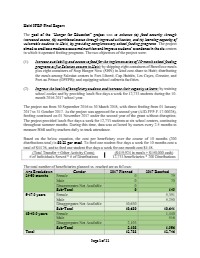
Page 1 of 11 Haiti IFRP Final Report The goal of the “Hunger for Education” project was to enhance (a) food security through increased access, (b) nutritional status through improved utilization, and (c) learning capacity of vulnerable students in Haiti, by providing complementary school feeding programs . The project aimed to eradicate moderate acute malnutrition and improve students’ attendance in the six centers in which it operated feeding programs. The two objectives of the project were: (1) Increase availability and access to food for the implementation of 10 - month s chool feeding programs at five Salesian centers in Haiti: by shipping eight containers of Breedlove meals plus eight containers of Stop Hunger Now (SHN) in - kind cost - share to Haiti; distributing the meals among Salesian centers in Fort - Liberté, Cap - Haitién , Les Cayes, Gressier, and Port - au - Prince (OPEPB); and equipping school cafeteria facilities. (2) Improve the health of beneficiary students and increase their capacity to learn: by training school cooks; and by providing lunch five days a week for 12,733 stu dents during the 10 - month 2016 - 2017 school year. The project ran from 30 September 2016 to 30 March 2018, with direct feeding from 01 January 201 7 to 31 October 2017. As the project was approved for a second year (AID - FFP - F - 17 - 00028), feeding continued on 01 November 2017 unde r the second year of the grant without disruption. Th e project provided lunch five days a week for 12,733 students at six school centers, continuing throughout summer months. During this time, data was collected by nurses every 2.5 months to measure BMI and by teachers daily to track attendance. Based on the below equation , the cost per beneficiary over the course of 10 months (200 distributions total) is $0.22 per meal . To feed one student five days a week for 10 months cost a total of $44.76 , and to feed one student five days a week for one month cost $4.48. (Total Transfer + O ther A ctivity Costs) ($419,924 in meals + $150,000 cash ) # of Individuals Served * # of Distributions 12,733 beneficiaries * 20 0 Distributions The total number of beneficiaries planned vs. reached are as follows: Age Breakdown Gender 2017 Planned 2017 Reached 24 - 59 months Female 0 79 Male 0 70 Disaggregates Not Available 0 Sub - Total 0 149 5 - 17.9 years Female 5,391 Male 5,250 Disaggregates Not Available 10,630 Sub - Total 10,630 10,641 18 - 49.9 years Female 1,440 Male 516 Disaggregates Not Available 2,103 Sub - Total 2,103 1,956 Total 12,733 12,746 Page 2 of 11 The data tracking the progress of each goal are attached in the BMI and Absences Analysis spreadsheets. Summer programs were held during July and August, but sample class sizes differed. Thus , summer attendance data are shown numerically on the attached documents but not included in the graphs or as part of the overall assessment, so as not to skew the results. All data can be assessed in total and disaggregated by gender and age group . The rem aining narrative of this final report provides a full analysis of the challenges and successes of the project based on the three - part goal outlined above . (a) Food Security: Assessed through Increased Access Over the course of ten months (October 2016 - July 2017), Salesian Missions (SM) shipped to Haiti eight 40 - foot containers of Breedlove Harvest Lentil Pro meals and eight 40 - foot containers of Rise Against Hunger (formerly named Stop Hunger Now) fortified ri ce meals, as planned. SM also shipped an additional three containers of Feed My Starving Children meals throughout the life of the project to supplement the feeding program. All food was prepared by the project cooks and distributed to students as hot meal s in the school cafeterias in order to ensure that the intended beneficiaries benefitted from the meals and to reduce the risk of food being sold on the market or misappropriated. Only t he school director and head cook had access to each school’s storage w arehouse . Overall , the project was successful in increasing the availability of food by shipping a total of nineteen 40 - foot containers of Harvest Lentil Pro and fortified rice meals (plus added purchased/grown ingredients) to feed 12,746 students one meal a day, five days a week, over the course of a ten - month period. Challenges 1. The target number of students to feed was 12,733 students during the 10 - month school year at five Salesian educational centers in Haiti (Cap Haitien, Fort Liberte, OPEPB/Port - au - Prince, Gressier, and Les Cayes). Between the time that SM submitted the grant and the time that it was approved, the target number of beneficiaries at the OPEPB center dropped (OPEPB serves many “little schools” in the area, and some come in and out of its network) . Therefore, Salesian Missions add ed in a sixth beneficiary school to make up the numbers: the Salesian Cardinal Keeler Center in Gonaives, which operates an agricultural school, electricity shop, auto mechanics shop, cooking classes, and art classes to serve 370 young women and men ages 16 through 35. Salesian Missions also included the Lakay street children living at the Salesian centers in Cap Haitien and Port - au - Prince (part of the OPEPB complex). The total number of students to benefit from the Hunger for Education school feeding program ended up being slightly more than planned, with 12,746 total beneficiaries. 2. In the initial feedback reports gathered from the field, several of the school directors noted shortages in the supply of food vs. the rate of usage. Among the chief reasons f or the reported shortages was that, since many of the children come to school on an empty stomach and the meal they receive at school may be their only meal of the day, the children need to eat several serving sizes to maintain their health and energy. The refore, Salesian Missions shipped an additional three 40 - foot containers of fortified rice meals from Feed My Starving Children, staggered throughout the feeding period. With the addition of the Feed My Starving Children containers, site directors Page 3 of 11 reported a sufficient quantity of food and an appropriate rate of usage throughout the remainder of the ten - month feeding program. 3. In addition to the donated containers of Harvest Lentil Pro and fortified rice meals, the project planned to purchase select esse ntial ingredients needed to prepare the meals at each of the beneficiary school centers: propane gas, cooking oil, tomato paste, and spices. All other ingredients (vegetables, occasional meat, etc.) were to be purchased or grown by the local Salesian schoo l. From the beginning of budget preparation, the requested amount of ingredients from each center had to be cut down in order to fit within the $150,000 maximum budget for the grant, which all school directors agreed to. However, added external circumstanc es such as the sudden and significant devaluation of the Haitian Gourde (which put a strain on the economic situation of each school), as well as the destruction of crops and rising food prices post Hurricane Matthew, led to an increased budget gap in the amount of resources available to complete the preparation of meals every day. Calculated in January 2017, at the beginning of the feeding activities (01 January 2017 – 31 October 2017), the total budget gap for the select essential ingredients alone had ri sen to USD $30,579. In response, Salesian Missions agreed to send 50% of the needed funds from its own money to Haiti ($15,289.50), and each of the school directors agreed to supply the remaining 50% of the needed funds with their school’s money. All expen ses were covered successfully, but school directors still expressed a desire for more of their shared expenses to be covered (especially the high costs of propane gas). Successes 1. The Cardinal Keeler Center in Gonaives is the only school which never had operated any type of feeding program prior to the Hunger for Education project, and it did not even have a kitchen set up. Therefore, the project had to purchase all new cooking equi pment, serving utensils, etc. for Gonaives (kitchen equipment was also updated for the other centers depending on their needs). Gonaives was the most difficult center to get up and running with the feeding program, but once the program was in full working order it demonstrated one of the highest levels of improvement in student attendance and qualitative reports from students and teachers. The establishment of a kitchen in Gonaives truly “increased access” for students who had never experienced a school fee ding program before, while empowering the school with the necessary equipment to continue feeding students even after the close of project funding for sustainable results. 2. Prior to the “Hunger for Education” project (2015 - 2016 school year), the Salesia n schools in Cap Haitien, Fort Liberte, OPEPB/Port - au - Prince, and Les Cayes would feed students a few days a week when donated food was available to them, but they did not have regular daily feeding programs in place. Thus, the project achieved more regula r and reliable access to school feeding across all of the centers. The Salesian school in Gressier was the only participant to have a regular feeding program in place during the 2015 - 2016 school year. 3. The project was implemented in the form of cooked school lunches so as to directly feed students and diminish their hunger and its side - effects as well as to provide an incentive to go to school. There were reports from students that felt like the food was too monotonous, but after hearing that, cooks s tarted to vary the meals between the two kinds and then combin e them to implement a three - day rotation that the students enjoyed. More creative meal preparation developed throughout Page 4 of 11 the life of the project. The students report ed positive feedback on the food , with one student saying that he appreciates the meal because if he did not have the provided meal at school he would not eat that day. The on - site project manager gathered feedback from parents saying they are very grateful for the meals but wish there was an option to take the food home to their children starving in their homes. Instructors report ed that they hope d the program can continue and , if possible , that funding can expand in the future in order to support more of th e added food preparation costs . (b) Student Health: Assessed by BMI m easurements The second part of the Hunger for Education goal was to improve the nutritional status of students. The project aimed to eradicate moderate acute malnutrition in the six centers operating the feeding program . Hired nurses tracked BMI at each center by measuring the height and weight of consistent sample classes quarterly throughout the year. Two nurses were hired: one to vi sit the northern schools of Fort Liberte, Cap Haitien, and Gonaives; and one to visit the southern schools of OPEPB, Gressier, and Les Cayes. Based on height, weight, and age , s tudents who se BMI fe l l at least 2 standard deviations below the mean were considered to experience moderate acute malnutrition (MAM) . Baseline measurements showed that across the six centers, 4% of students suffered from MAM. Individually, some centers showed more MAM than others. For example, OPEPB, a cluster of smaller schools , only measured 2% of student s with MAM in the baseline data. Gonaives was the only center with no type of feeding program previously , and the program proved positive results, where implementation of this project cut the “at risk” population in half from 2 2% to 11%. The other centers previously had occasional feeding when food was available. The four other centers each measur ed MAM in 6% of students. The following analysis looks at the challenges and success of BMI measurements at the six centers. Challenges While MAM persisted in approximately 5% of students at project close, many factors contribute to this. Age, gender, home lives, amount of exercise from participating i n afterschool sporting programs, and more can affect the height and weight of children, e ven if they begin to receive a free meal daily. For many students, supervisors continued to say that the meal received at school was their only meal of the day. When this is the case, it is hard to eradicate MAM with so many other outlying factors. This se ction will explain some of the challenges found through BMI measurements, and also challenges that occurred during the measurement process. Some of these challenges are caused by a lack of data from the fourth reporting session of students. 1. At the beg inning of the project, medical scales to measure weight were purchased for each of the center s , along with tape measures to measure height. Only one center (Fort Liberte) had a medical scale that measured both height and weight. During the second visit of the headquarters’ (HQ) project manager to monitor the project (in November 2017 , during the fourth data point measurements ), she observed the nurses as they measured the heights and weights of sample classes of students and found that the method of measuri ng height was not consistent (the nurses were placing the tape measures against the students’ bodies and not against the wall) . This may account for a few faulty data points in which individual students appeared to shrink in height. The HQ project manager instructed the nurses in a more consistent method of using the tape measures in order to complete the fourth data point s. New medical scales, this time with height rods, were Page 5 of 11 subsequently purchased in the U.S. and shipped to Haiti with the next container of food to ensure more consistent measurements during the second year of the project. 2. As the feeding program ran from January 2017 through October 2017 , the final BMI measurement points took pla ce during the following school year (2017 - 2018). Thus, during the fourth measurement (completed by the nurses in November), some of the students that were being tracked had already graduated or did not return the following year. The number of students that were not available for the final BMI measurement by center are as follows : 5 from Fort Liberte ; 12 from Gonaives ; entire graduated class Gressier ; 52 graduated students from Les Cayes ; and entire graduated class from OPEPB. The lack of so many students pr esent during the fourth measurement posed difficulties for the final evaluation. As feeding during year 2 of the project runs from November 2017 through August 2018, one consistent class of students will be measured throughout the same school year, which w ill hopefully facilitate final comparisons. 3. Some teachers, especially among the older classes, did not want their classes to be disrupted by students visiting the nurse to take height and weight measurements. As the nurses do not have cars and were bo und by the unpredictable bus schedules to travel to each school (and only when the roads were passable and not flooded, especially in the North), it was difficult for the nurses to align their schedules with the students’ free time in order to take measure ments. The nurses had to come into agreement with the school directors in order to gain permission from the teachers. 4. During the second visit of the HQ program manager to Haiti in November 2017, she observed that not all of the cooks were adding in the vitamin packets to the Rise Against Hunger meals that Salesian Missions sent as cost - share for the project, to avoid c hanging the taste of the meals. The local project manager explained to the cooks that the vitamin packets were very important, as they were meant to improve the health of the students. They subsequently changed the format of the quarterly reports to ensure that the local project manager was checking up consistently on the use of the vitamin packets, and the cooks have since shown positive results (during the second year of the project) in using the packets , adding in additional spices as needed. 5. During the initial meeting between FFP staff in Haiti and the HQ and local Hunger for Education Staff (November 2016), FFP staff brought up the question of what the nurses would do when they found a malnourished child through BMI measurements. The project did no t have a built - in method to attend to the medical needs of undernourished children outside of the general proposal of giving them a nutritious meal each day. HQ staff, upon initial analysis of BMI results, asked that the school directors be made aware of s tudents that were found to be malnourished in order to present any additional assistance to their families (social or material) as needed and as possible. Nevertheless, a more organized method to attend to cases of malnourished children, either through med ical or other referrals, would improve the reach of the project in the future. 5 . Often, the most inexpensive food and most accessible to people of low to no income, is cheap, unhe althy food. This phenomenon may play a part in the decrease in healthy BMIs reported as the total of overweight students increased in four centers. 6 . D isaggregated data by age did not show strong trends of improved or diminished health. Four centers tracked the BMI of students aged 5 - 15 years and another two centers tracked the BMIs of Page 6 of 11 students aged 18 - 31 and t he age dat a did not strongly correlate to health measurements. The lack of relationship between age and safe BMI measurements coul d be due to the varying situations students face at home and outside of the classroom. With varying metabolic makeups, further daily caloric intake, and activity levels, the increase in one meal a day will have fluctuating results in the beneficiaries as w ell. Successes 1. Healthy BMI results were most positive in Les Cayes where there were no reported cases of MAM in the final measurement. Les Cayes measured the BMIs of students aged 18 - 29 who proved to be receptive to the feeding program. The project manager reported that the students at Les Cayes are “more mature…and they give so much importance to the food because they don’t eat anything when they return home…and it helps them to focus on wha t they learn in class . ” Positive results in Les Cayes were especially encouraging since the Hunger for Education program began its feeding in the wake of Hurricane Matthew, which struck southwestern Haiti in October 2016 and destroyed the homes and crops o f a large number of the Salesian students in Les Cayes. Les Cayes was not alone in demonstrating positive results , as three centers saw a decrease in MAM of their students throughout the program. While the students faced external factors contributing to t heir nutrition , the beneficiaries were outspoken about the importance of the meal provided daily at the center. 2. From qualitative data collected through interviews, reporting, and observations, the teachers and students reported their appreciation for the project across all centers . The students ask if there will always be food; parents ask if they can take some home to their starving children not in school; teachers recognize more focus in students as a result. One student in Fort Liberte commented on the program saying , "Now I will be able to work well at school, because this is the first time I w ill have food at sc hool. ” Parents expressed their satisfaction with the program because now they can allocate the money for their children’s lunches towards other needs. 3. T his project was especially beneficial for practical training at technical vocational schools, such as Les Cayes, where teachers noted instances of students fainting during work sessions before the feeding program began, but now students have energy to work through a full session. Moreover , school directors noted that more students are able to participate in after - school sporting programs now that meals are provided, whereas before they did not have enough energy. While quantitative data lacks extreme resul ts, quantitative analysis proves this project extremely beneficial towards the health and wellness of the beneficiaries. Gender Analysis in BMI Disaggregated data by gender showed that in each center but one, male students were more likely to have a healthy BMI than female students. Females are especially prone to developing anemia based on an iron insufficient diet . T he effects of anemia can cause fatigue and a weakened immune system, resulting in unhealthy BMIs , either underweight or over weight . Despite the meal provided daily , female students still m ay not have been getting all the daily nutritional values necessary. The American College of Obstetricians and Gynecologists note s that, “ Many women, irrespective of demographic characteristic s or income, are vulnerable to becoming overweight or obese because Page 7 of 11 of limited resources for physical activity and healthy food choices, work commitments, and family demands. Clinicians and public health officials should address not only individual behavio r but also the built environment in their efforts to reduce overweight and obesity in their patient populations . ” 1 While males also suffer challenges to maintaining healthy BMIs, difficulties for women continue to prevail due to additional factors as those listed above. (c) Learning Capacity: O bserved through presences and absences The third part of the Hunger for Education goal was to enhance the learning capacity of vulnerable students in Haiti. The project aimed to see a 5% increase in same - student attendance rates as compared to baseline records . An increase in attendance rates measure s the presence of students in the classroom, thus improving the likeliness of increased learning . 2 Data was collected daily in each center to track the attendance trends throughout the year. Based on attendance records from sample classes at each school, a final comparison of the data points in graphical format, broken down by center , month, age, and gender of students can be found in the attached document “Absences Data Analysis.xlsx.” Baseline data was collected from the year before the program was initiated (2015 - 2016 school year). The months compared for baseline analysis were January - October 2016 . Considering the baseline data, the 2017 project had mixed attendance rates result s. The results analyze the data of the sample classes but are represented in percentage form to indicate school - wide values . The following analysis provides a breakdown of the challenges and successes of the project. Challenges 1. At project end , the quantitative data showed that there was an overall increase in absences by 0. 2 9 % (from a rate of 0.64 daily absences per 100 students to a rate of 0.93 daily absences per 100 students. ) T here was an overall increase in absences at four centers and a decrease at t wo centers. The variance in results in these schools can be due to assorted causes. Geographical locations, home - life situations, and health reasons are some factors that may play a role in student s’ attendance. One large factor that greatly impacted final results was that there was substantial flooding in the north of the country in 2017, adversely affecting the roads and making it difficult , and even impossible at times, for students to travel to school in Ft. Liberte and Cap - Haitien. The data showed this complication in the spike of absences in October of 2017. Hurricane Irma, which struck the North of the country in September 2017, also caused substantial flooding. Overall, total absence rates did in fact decrease during January, Febr uary, May, and June, and they stayed about the same during March and April. Absence rates rose slightly in September from 1.00 to 1.20. However, the large spike in absences in October 2017 (from a rate of 0.81 to 2.23) drove overall absence rates up greatl y, thus impacting final results. 2. The ages of students did appear to play a factor in overall absenteeism at first glance, since overall absenteeism rose for children aged 5 - 17.9 and actually went down for youth over the age 1 Challenges for Overweight and Obese Women, The American College of Obstetricians and Gynecologists, Women’s Health Care Physicians, 2016, https://www.acog.org/Clinical - Guidance - and - Publications/Committee - Opinions/Committee - on - Health - Care - for - Underserved - Women/Challenges - for - Overweight - and - Obese - Women . Accessed 18 June 2018. 2 Wh y Does Attendance Matter, National Center for Education Statistics , Institute of Education Sciences, 2009, https://nces.ed.gov/pubs2009/attendancedata/chapter1a.asp . Accessed 25 Apri l 2018. Page 8 of 11 of 18. However, the fact that the schools located in the North, which saw a huge spike of absences during October 2017, both cater to s tudents 5 - 17 years old seems to contribute more to the overall increasing absence rate for this age group than anything else, since absences among this age group did decline or remain around the same during the other months measured. Fort Liberte, Cap - Hait ien, Gressier, and OPEPB tracked the attendance of students 5 - 17.9 years old, while Les Cayes and Gonaives assessed the attendance of students 18 years and old er . 3. The overall increase in absences in Les Cayes may have been affected by other outside in fluences, including the destruction seen in the aftermath of Hurricane Matthew. Even though the total number of absences slightly increased at the Salesian technical and vocational school in Les Cayes, t he director was particularly enthusiastic to note tha t when there is food available, very few students choose to skip class. Successes Despite the challenges posed by the collection of attendance at the six centers, the project also recorded many succes ses. Although there was a n increase in the overall percentage of absences throughout the project across all six schools, Gressier and Gonaives saw the percentage of absences decrease . 1. The two schools which reported a decrease in absence rates during the first year of the Hunger of Education program were Gressier and Gonaives. The daily total absence rate at Gressier dropped from 1.01 absences per 100 students to 0.80 absences per 100 students, with both male and fem ale absences rates declining (1.08 to 0.80 and 0.97 to 0.80 respectively). The daily total absence rate at Gonaives dropped from 1.10 absences per 100 students to 0.81 absences per 100 students, with both male and female absence rates declining (2.00 to 1. 19 and 0.80 to 0.70 respectively). It is significant to note that Gonaives was the only school to have never participated in any type of school feeding program before, and it was also the school to see the greatest improvement in presences among the studen ts. 2. For many students , th e meal provided through this project wa s their only meal of the day. Teachers note d that students make more of an effort to get to school due to the feeding program , and that once they are there, the students are able to focus better on their studies. The project manager explain ed in his reports that “We visited the program a day after t he Carnival celebrations. In many schools there is poor attendance on such days; however, students recounted that they came to school because of the meal.” This shows the dedication and motivation of students to improve their attendance as a direct result of the feeding program . At Gressier, the director of the school remarked that the passing rates of students are improving along with their behavior. At this center, the lunch time has been moved to earlier in the day to accommodate the hungry students, he lp ing students’ focus. 3 . School feeding has had a particularly notable impact among the students of the Salesian technical and vocational schools, especially those learning hands - on trades such as carpentry, welding, plumbing, auto mechanics, etc. Prior to the start of the Hunger for Education program, school administrators noted instances of technical school students fainting during their practical exercises because they had not ea ten for an extended period of time. After giving the affected Page 9 of 11 students food, they were normally fine to continue in their studies. The implementation of the program has eliminated the occurrence of students fainting during class and granted poor students the needed energy to carry through their practical exercises. 4 . It is significant to note that, in a ddition to strides made to enhance participation in the classroom, the implementation of the Hunger for Education project also produced an unanticipated positive result of increasing participation in afterschool activities , particularly the afterschool soc cer programs in Les Cayes . Before students were provided daily lunch at school, few had the energy to participate in afterschool activities. However, after the implementation of feeding, participation in the soccer program at Les Cayes increased tremendous ly, producing positive effects of companionship, teamwork, and joy among poor youth living in difficult situations. 5 . Not all results of the project can be measured quantitatively. One important result of the feeding program, as observed by the HQ projec t manager during site visits to each individual school during meal times, was the level of joy and comradery that the presence of food created in the schools as the students came together to partake in a shared meal. Even within the classrooms following me altimes, a general atmosphere of joy can be observed among the students who have eaten. The contrast was made more obvious when the HQ project manager visited two additional schools that were not currently participating in the feeding program, which thankf ully were able to join in during the second year of the project under the OPEPB allocation. Students at the two schools that were not receiving food were noticeably more downcast than the students that were receiving food. Concerned, the HQ project manager questioned the directors about the reason, and they replied, “where there is food, there is joy.” Through the quantitative and qualitative collection of data and analysis of such, this program has proven to benefit the lives of the students taking part in the project. These indicators will continue to move in the direction of accomplishing the goals of the eradication of MAM and a 5% increase in attendance rates in the students through the continuation of the project in 201 8 . Gender Analysis in Attendance Female absence rates increased from 0.64 to 1.01 daily absences per 100 students in 2017 , while male absence rates increased from 0.65 to 0.86 . High er female absence rates may be attributed to health a nd familial responsibilities . 3 Female enrollment in education continues to be a challenge for these Haiti centers, consistent with national trends. One reason for this is tuition fees. Tuition fees are common with private education centers, however, even if they are low, they act as a b arrier to entrance for many girls. Parents might have to choose which child to educate and when given the option between a son and a daughter, parents are still more likely to educate their male children. Educators and faculty at the centers continue to en courage female education in schools and attendance to fight low enrollment numbers. Another cause of higher female absence rates is , in part, due to lower rates of female enrollment to male. For example, Cap - Haitien is the most disproportionate center wi th less than 10% female 3 School Attendance and Enrollment: Global trends and projections, United Nations Educational, Scientific and Cultural Organization, Education Policy Data Center, 2007, http://unesdoc.unesco.org/images/0015/001555/155501e.pdf . Accessed 3 May 2018. Page 10 of 11 students . Cap - Haitien also shows the highest rates of female absence. Large gender enrollment gaps lead to the large percentage of female rate of absences in Cap - Haitien, because if any of the four female students in the 48 student class were absent, it raise d the rate much more than male absences. Cap Haitien showed the highest rate of absences . The sample class at Les Cayes, a vocational training school, did not have any women in the class, thus no gender assessment could be made t here. Women do participate in the vocational training programs in Les Cayes, but mostly in the afternoon class groups, while the morning class groups show a majority of male participants. In Haiti, m ale students continue to outnumber their female counter parts in Salesian schools. However, throughout this project, the six schools saw an increase in female enrollment. Gressier experienced the greatest increase in female attendance , with the absence rate of girls decreasing by 0. 16 %. (d) Learnings on Selected Modalities: The Hunger for Education project shipped food from the United States to the central warehouse in Port - au - Prince, Haiti. Eight containers of food came from Breedlove through the I nternational F ood R elief P artnership program and an additional e leven containers came from Salesian Missions’ partners Rise Against Hunger and Feed My Starving Children as a cost - share component of Salesian Missions. With these nine teen containers, there was n o problem with the shipment of i n - kind food aid from the United States. Furthermore , a ll containers cleared through customs without a problem and were delivered to their final destination s seamlessly . Ease of customs clearance can be attributed to the tireless efforts of Salesian Priest Fr. Wim Boksebeld, who has years of experience engaging with customs officials and shipping companies and fighting for a quick resolution to any posed issue. As customs officials and shipping companies in Haiti are notorious for creating red tape in order to make more money on demurrage charges, the Salesians are grateful to have secured a smooth and consistent importation process. The containers underwent inventory tracking in the central warehouse and then the boxes were separated in the warehouse for del ivery to each school. One difficulty experienced with the shipping component of the project was the challenge of implementing a consistent inventory tracking system for the boxes of food aid once they reached the individual schools. This led to a danger of meals deviating to the local marke t. During the second year of the program, project staff heightened inventory control methods (including the implementation of a “box return system” to ensure that no boxes have gone missing), and the y have buckled down on the enforcement of consistent inventory logs among the six participating centers in order to assure better controls and prevent any possible leakages in the boxes of meals. Another challenge on the selected modality is the recycling of waste material (plastic bags and cardboard boxes used in packing). Even after extensive searching, project managers were not able to locate any recycling companies in Haiti who could collaborat e in the project. Centers reused the boxes and bags as much as possible, but more creative methods for reusing and recycling the packing material are wanted. Now that all six centers are returning their empty cardboard boxes to the central warehouse as an inventory control method as a prerequisite to receiving more boxes of food, larger scale reuse/recycling may be possible. SM is attempting to work with its partners to come up with some more creative solutions for both the bags and the boxes . Page 11 of 11 One lesson l earned in monitoring the objective “improve learning capacity of students” is that it is not enough to track rates of presences and absences to determine if the students are receiving more out of their education. The “Hunger for Education” program tracked quantitative data through rates of presences and absences, and it tracked qualitative data by interviewing students, teachers, and school administrators. School administrators and teachers noted better attentiveness in the classroom and an improvement in t he final grades of the stu dents in qualitative reports; thus, it may be useful to track final grades of students through quantitative data analysis in future projects. It may also be noteworthy to track overall retention rates at the schools in the future. Providing variety in the feeding program was a challenge. Salesian Missions shipped both Breedlove meals and Rise Against Hunger meals to Haiti in order to provide two different types of food - aid, and it provided some funding for the purchase of addition al ingredients (oil, tomato paste, spices). The rest of the ingredients needed to give variety and added taste and nutrition to the meals were the responsibility of each individual center (vegetables, meat when available, butter, garlic, etc.) To prepare t he meals, fifteen cooks were hired and effectively arranged meals creatively throughout the project. To avoid monotony of meals and to further encourage student attendance based on presence of a meal, cooks combined food from different boxes for variation as well as adding local spices to create a more culturally appreciated flavor. Cooking centers were established, and equipment was procured for use in preparation, all without issue. It is valuable to note the effect that the feeding program had based on the age of the students. In schools catering to younger students aged 5 - 17, directors noted that feeding the students helped them to stay awake during afternoon hours . In Gressier, the director move d up lunch from the afternoon to 10:30 in the morning because he found that it helped the children to learn better if they had eaten (and for many, the meal at school is their first and sometimes only meal of the day). Conversely, i n Gonaives (catering to older students over the age of 18), the director decided to push back the lunch hour from 10am until 12pm, until after class was finished, because some students were falling asleep after eating. However, the feeding program in Gonaives did prove to have th e most positive effect of all of the schools in motivating students to come to class each day. Across the board, school directors and parents were greatly appreciative of the program and asked about the possibility of take - home rations for the children – especially those with siblings at home who do not attend school and do not benefit from the feeding program. During meal times there was no waste, as school directors noted that students who did not finish their meal would bring home the rest of the food in a bag to share. The possibility of providing take - home rations, especially for the poorest families with multiple children at home, may be a point to consider for future programming.