

Integrated Financial Management System Final Report
Summary — This report summarizes the activities of the Integrated Financial Management System (IFMS) project in Haiti from 2014 to 2019. The project aimed to improve financial planning and public financial management by upgrading network infrastructure and financial management systems, and by providing the government with a Unified Exchange Platform (UXP) for data sharing.
Key Findings
- The IFMS project upgraded the Network Operations Center (NOC) at the Ministère de l'Economie et des Finances.
- The project installed a Unified Exchange Platform (UXP) at 13 Haitian government institutions, enabling secure and rapid data exchange.
- The project streamlined human resource management operations by developing the SIGRH software for the OMRH.
- The project upgraded IT equipment and trained staff in 25 DGI offices to automatically register local tax payments and share tax records in real time.
- The project partnered with USAID’s LOKAL+ project to install IT equipment in nine municipalities using CIVITAX software to improve efficiency and transparency in municipal tax collection.
Full Description
The Integrated Financial Management System (IFMS) project in Haiti, implemented from September 2014 to July 2019, aimed to enhance financial transparency and decision-making capacity within the Haitian government. The project focused on restoring, improving, and expanding the government's IFMS-related network infrastructure and financial management systems. Key achievements included upgrading the Network Operations Center (NOC), installing a Unified Exchange Platform (UXP) for seamless data sharing between institutions, streamlining human resource management operations through the SIGRH software, and automating tax payment registration in regional offices. The project faced challenges such as political instability and infrastructure limitations, but ultimately provided the Haitian government with tools to boost efficiency, transparency, and accountability in public financial management.
Full Document Text
Extracted text from the original document for search indexing.
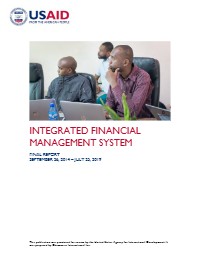
This publication was produced for review by the United States Agency for International Development. It was prepared by Chemonics International Inc. INTEGRATED FINANCIAL MANAGEMENT SYSTEM FINAL REPORT SEPTEMBER 26, 2014 – JULY 25, 2019 DISCLAIMER The authors’ views expressed in this publication do not necessarily reflect the views of the United States Agency for International Development or the United States government. , INTEGRATED FINANCIAL MANAGEMENT SYSTEM FINAL REPORT SEPTEMBER 26, 2014 – JULY 25, 2019 Contract No. AID-OAA-I-12-00035, Task Order No. AID-521-TO-14-00001 Cover photo: Haitian Ministry of Finance help desk technician, system administrator, and IT managers participate in an IT security (“vmware”) training delivered by IFMS through its partner Dell at the Ministry of Finance training room in Port-au-Prince, Haiti. (Credit: Chemonics/IFMS). INTEGRATED FINANCIAL MANAGEMENT SYSTEM FINAL REPORT | i CONTENTS Acronyms ............................................................................................................... iii Executive Summary ................................................................ ............................... 4 Task Order Key Outcomes ................................................................ ................... 9 Section 1. Project Context and Review of the Country Situation.................. 10 Section 2. Major Program Activities: IFMS Highlights and Achievements ... 12 Project Purpose and Evolving Scope ........................................................................................12 Updated data platform and computer equipment improve customs services ................................................................................................................................ 13 Key Outcome 1: IFMS Network Infrastructure Updated and Improved ........................14 Replacement of Network Hardware .................................................................................14 Upgrade of the NOC.............................................................................................................15 Expansion and Upgrade of Tax System Automation ......................................................16 Renovation: Network operations center gets a much-needed makeover ..... 17 Key Outcome 2: Capacity to Utilize the IFMS for Financial Reporting and Auditing Processes Expanded ....................................................................................................................18 Business Intelligence Tools ...................................................................................................18 Replacing typewriters: Haiti’s tax authority receives critical upgrades......... 20 Key Outcome 3: Capacity of the Network to Support both Operational Support and Financial Auditing Built ................................................................................................................21 Financial Audit Software........................................................................................................21 Human Resource System ......................................................................................................22 Revamped IT systems lead to greater transparency in data management... 25 Key Outcome 4: Expenditure and Revenue Systems Integrated, and Financial Management Improved................................................................................................................26 Establishment of an Electronic Data-Exchange Capability .............................................26 New online platform improves government efficiency, data security ........... 29 Exchange of Local Government Tax Data ........................................................................30 Key Outcome 5: Capabilities to Properly Document and Implement Governance Policies and Procedures Enhanced ...........................................................................................30 IFMS Capacity Building...........................................................................................................30 Development of Policies and Procedures for Governance and Management ..........31 INTEGRATED FINANCIAL MANAGEMENT SYSTEM FINAL REPORT | ii Development of IT Maintenance Plan ................................................................................32 Section 3. Problems Encountered: Solutions and Lessons Learned............... 34 Challenges and How to Address Them ..................................................................................34 Lessons Learned for Future Programs ....................................................................................35 Annex A. Summary of Performance Indicators ............................................... 37 Annex B. Summary of Training Sessions Through Quarter 4 of Fiscal Year 2017........................................................................................................................ 43 EXHIBITS Exhibit 1 Dashboard Expenditure on Operating Budget .........................................................19 Exhibit 2. Dashboard Expenditure on Investment Budget.......................................................19 Exhibit 3. Dashboard on Public Revenue.....................................................................................21 Exhibit 4. SIGRH Interface I............................................................................................................24 Exhibit 5. SIGRH Interface II ..........................................................................................................26 Exhibit 6. Sample of Tax importation from Customs ...............................................................27 IFMS FINAL REPORT | iii ACRONYMS AGD Administration Générale des Douanes CSC/CA Cour Supérieure des Comptes et du Contentieux Administratif DGI Direction Générale des Impôts IFMS Integrated Financial Management System IT Information Technology KO Key Outcome KONEKTE KONesans E Konpetans TEknik project LAN/WAN Local Area Network/Wide Area Network LOKAL+ Limyè ak Oganizasyon pou Kolektivite yo Ale Lwen project MOU Memorandum of Understanding NOC Network Operations Center OMRH Office de Management et des Ressources Humaines SDI Schéma Directeur Informatique SIGRH Système Interministériel de Gestion des Ressources Humaines ULCC Unité de Lutte Contre la Corruption UXP Unified Exchange Platform INTEGRATED FINANCIAL MANAGEMENT SYSTEM FINAL REPORT | 4 EXECUTIVE SUMMARY The Integrated Financial Management System (IFMS) project began in September of 2014, in the wake of increased public discontent in Haiti over delayed elections and perceived government corruption. The state of information technology (IT) infrastructure supporting financial transparency in the country had been deprioritized given more urgent needs following the devastating 2010 earthquake. Much of the government of Haiti’s IFMS network equipment had been damaged in the earthquake. A dearth of real-time data for decision-making contributed to governance challenges for the government of Haiti. Haiti’s 2014-2019 Schéma Directeur Informatique (SDI or IT Master Plan) laid out the key challenges hampering its IT systems, such as a lack of planning and leadership; a desperate need for physical upgrades; undertrained staff; outdated, overlapping, and unconnected software; expensive and complicated communication systems; and poor physical and virtual security. The IFMS project was designed to tackle these challenges and support the government of Haiti in achieving greater financial transparency and decision-making capacity. Emerging from nearly a decade of planning between USAID and the government of Haiti, the IFMS project engaged the government of Haiti to improve financial planning and public financial management by restoring, improving, and expanding its IFMS-related network infrastructure and financial management systems. The project was successful in upgrading this infrastructure, strengthening public financial management systems and governance, and providing the government of Haiti with an innovative interface (the Unified Exchange Platform or UXP), which allows the government of Haiti the ability, for the first time ever, to seamlessly share data between institutions. The project experienced significant hurdles during its five-year lifespan, including hurricanes, a period of more than a year without a legitimate government after delays in presidential elections, key counterpart leadership transitions, and mass protests that shut down the country for weeks at a time. Additionally, the government of Haiti was unable to fulfill some of its commitments, such as contributing resources to repair IFMS BY THE NUMBERS • Number of t raining days provided to executive branch personnel: 71 days for men and 57 days for women • Number of servers installed: 52 • Number of data-exchange transactions using the Unified Exchange Platform in the project’s last quarter: 33,132 • Number of government staff receiving project-supported training: 184 (24 of whom were women) • Number of municipalities using CIVITAX that receive data from the Direction Générale des Impôts to monitor daily tax collection at the commune level: 10 • Average days to onboard employees before the project: 60 days • Average days to onboard employees after the project: 1 day • Average time to license a business before the project: 7 days • Average time to license a business after the project: 45 minutes INTEGRATED FINANCIAL MANAGEMENT SYSTEM FINAL REPORT | 5 existing IFMS network site microwave towers and providing the leadership required to ensure that the IFMS-provided human resources software — Système Interministériel de Gestion des Ressources Humaines or SIGRH 2.0 – be rolled out across the government. Despite these real impediments, the IFMS project adapted and identified creative ways to move activities forward throughout the life of the project, such as using cost savings from other activities to repair all 42 IFMS network sites when the government of Haiti was unable to do so. Today, because of IFMS support, Haitian government agencies have real-time access to expenditure data through the improved IFMS network. Entities can send and receive key data faster, and make more informed planning decisions. IFMS installed the UXP, a technology developed in Estonia that enables peer-to-peer data exchange over encrypted and mutually authenticated channels. Through the UXP, the decision-making processes have improved for agencies because they now have access to data from different agencies that they didn’t previously have. For example, the Ministère de l'Economie et des Finances can now directly access data on revenue from the Tax Agency (Direction Generale des Impots, or DGI) and the Customs Agency (Administration Generale des Douanes or AGD) to inform budgeting and key planning decisions. This improvement allows budgeting and planning to be grounded in actual data, reducing the opportunity for political influence over resource allocation and helping to ensure that plans are more responsive to citizen needs. The IFMS project also revamped the “nucleus” of the Ministère de l'Economie et des Finances’s network, the Network Operations Center (NOC). Before IFMS, the NOC was in disarray with outdated hardware and software, exposed wiring, few security protocols, and no backup systems, which put critical government data at great risk should Haiti experience another emergency — such as an earthquake. Now, thanks to IFMS, the NOC includes greatly improved and robust security protocols and software protection, including redundancies for data storage and backup. Today, the system could continue to operate and the government could still function even if one server fails. If there should be another earthquake, Haiti now has strong data backup and could recover faster. IFMS contributed to increasing transparency on tax revenue data by connecting the three municipalities with the highest populations in the country with the DGI to share information on taxes. Prior to IFMS, data-sharing (if done at all) was conducted through the exchange of hard copy (paper) documents and the process often took months. “IMAGINE IF A MAIL ADDRESS SHOULD BE HACKED, IMAGINE HOW EASILY A PIECE OF PAPER COULD BE FALSIFIED, IMAGINE AN OFFICIAL NEED FOR QUICK INFORMATION TO MAKE A STRATEGIC DECISION… THE OLD METHOD WAS NEITHER SECURE NOR EFFECTIVE...”— DONALD MARCELIN, MINISTÈRE DE L'ECONOMIE ET DES FINANCES, INFORMATION SYSTEMS DIRECTOR INTEGRATED FINANCIAL MANAGEMENT SYSTEM FINAL REPORT | 6 Municipalities are now actively sharing information in real time with the DGI on property assessments and property ownership, and the DGI is sharing data on property taxes collected. Thanks to IFMS support, both the DGI and municipalities can obtain more accurate information more quickly. This has in turn increased the overall transparency of the government of Haiti, reducing the opportunity for corruption and leakage in revenue collection activities. The Ministère de l’Intérieur et des Collectivités Territoriales has announced plans to invest in providing remaining municipalities the required private network capabilities to enable them to communicate with DGI. Overall, IFMS contributions included hardware and software procurement, installation, implementation, and training across a broad spectrum of government IT management and information-sharing functions. These activities contributed to improving current IFMS functionality, access, security, and system accountability; developing business continuity and contingency plans; and better aligning government business processes with technology. As a result, the project helped to pioneer electronic submissions of budget requests, improve monitoring capabilities, increase management control of budget expenditures, instill greater transparency and accountability in revenue collection, and improve public services. At its start, the IFMS project focused on acutely needed infrastructure upgrades and equipment procurement. Later, the project turned to application development, process improvement, and capacity building of government institutions to put new systems and tools to effective use. By project end, the Ministère de l'Economie et des Finances demonstrated ownership of the UXP platform — for example, presenting on the transformational potential of UXP at an international finance summit held in Port-au- Prince in April 2019 and independently organizing and financing training sessions on the UXP for end-users. The IFMS project provided the Haitian government with tools to boost efficiency, transparency, and accountability in public financial management, thereby strengthening the government’s ability to identify and combat corruption. Now the government of Haiti must step up and make the best use of the tools provided. Below are some steps the government of Haiti should take to ensure sustainability of IFMS investments: • Internet connectivity and electricity challenges . Internet connectivity and electricity challenges remain persistent problems. The extent to which the government of Haiti commits resources (financial and human) to ensure reliable Internet connections and continuous power supplies to maintain USAID's IT investments will be a measure of its commitment to improved public financial management using IFMS. The primary institutions of the government of Haiti involved with IFMS (Ministère de l'Economie et des Finances, Office de Management et des Ressources Humaines or OMRH, DGI) should commit to renewing high-speed Internet access with appropriate providers and to maintaining redundant systems to ensure a continuous electricity supply (e.g., generators, inverters). INTEGRATED FINANCIAL MANAGEMENT SYSTEM FINAL REPORT | 7 • Commitment to maintenance of the NOC. There has been a vast improvement in the infrastructure, hardware, and software at the NOC that will allow the Ministère de l'Economie et des Finances to store and access data related to public financial management safely and efficiently. The new systems allow for IFMS data to be exchanged much faster than before — and in a secure way. However, maintenance of the renovated NOC by the Ministère de l'Economie et des Finances is essential to its sustainability. The government of Haiti should adhere to the IFMS-provided maintenance plan, and include the costs for this maintenance in its annual budget. • General budget for IFMS network maintenance . IFMS prepared a budget for the maintenance of the IT hardware and software. The government of Haiti needs to include budgetary line items for the maintenance of existing equipment, the purchase of spare parts, the renewal of high-speed Internet contracts, the renewal of software licenses, and the provision of continuous and reliable power. • Sharing data through tools provided. The tools provided by IFMS present a remarkable opportunity for the government of Haiti to digitize information- sharing and achieve real gains in financial transparency. However, a public financial management system is only as useful as the data it has access to. Certain agencies (i.e., DGI and AGD) have already begun sharing critical data on revenue and expenditures related to taxes and customs. Municipalities and the DGI are exchanging information on property and tax revenue. However, the government of Haiti has not yet populated certain tools provided by the IFMS project — for example, business intelligence tools — with real data, limiting the tools’ utility. Additionally, intragovernmental government of Haiti memoranda of understanding (MOUs) prepared by the project to allow formal data exchanges between government of Haiti institutions were never signed by Ministère de l'Economie et des Finances, OMRH, and others, although the draft MOUs were provided three years ago. The government of Haiti must commit to populating IFMS tools with useful data in order to harness their full potential. INTEGRATED FINANCIAL MANAGEMENT SYSTEM FINAL REPORT | 8 HIGHLIGHTS OF THE PR OJECT’S MOST SIGNIFI CANT ACHIEVEMENTS: • Completely renovating and upgrading the NOC at the Ministère de l'Economie et des Finances, giving the ministry state-of-the-art servers with secured access and big-data analysis capability. • Engaging an Estonian firm to develop a UXP that allows government institutions to securely and rapidly exchange information related to government financial flows. The project installed and made the UXP operational at 13 Haitian government institutions. • Streamlining human resource management operations by developing the SIGRH software for the OMRH. This software automates financial transactions for government staff and makes the process of onboarding and paying staff faster and more accurate. • Upgrading IT equipment and training staff in 25 DGI offices to automatically register local tax payments and share tax records in real time. Additionally, the IFMS project partnered with USAID’s Limyè ak Oganizasyon pou Kolektivite yo Ale Lwen project (LOKAL+) project to install IT equipment in nine municipalities using CIVITAX software to improve efficiency and transparency in municipal tax collection. INTEGRATED FINANCIAL MANAGEMENT SYSTEM FINAL REPORT | 9 TASK ORDER KEY OUTCOMES This report serves as the Integrated Financial Management System (IFMS) project’s final report, which covers activities from September 2014 to July 2019. The purpose of this task order was to provide continued assistance to the Haitian government’s Ministère de l'Economie et des Finances in developing a full and complete IFMS. The IFMS project’s overall strategy was to provide technical, logistical, and managerial strengthening support to the ministry to restore, operate, and expand IFMS- related infrastructure and its financial management system. The project worked to address the following key outcomes (KOs) under this task order: 1. KO1: The IFMS network infrastructure is updated and improved 2. KO2: The Haitian government’s capacity to utilize the IFMS for financial reporting and auditing processes is expanded 3. KO3: The capacity of the IFMS network to support both operational support and financial auditing is built 4. KO4: The expenditure and revenue systems are integrated, and financial management is improved 5. KO5: The Ministère de l'Economie et des Finances’ [information technology] IT governance and management capabilities to document and implement governance policies and procedures for each stakeholder ministry and municipality are enhanced INTEGRATED FINANCIAL MANAGEMENT SYSTEM FINAL REPORT | 10 SECTION 1. PROJECT CONTEXT AND REVIEW OF THE COUNTRY SITUATION The IFMS project has been a result of fruitful collaboration between USAID and the Haitian government for more than a decade. It served its primary goal of providing the Haitian government, the Ministère de l'Economie et des Finances, and other entities with the tools and infrastructure needed to support efficient, transparent, and accountable financial management activities. The IFMS project emphasized providing appropriate access and tools to prevent and fight corruption and empowering civil society organizations and government oversight institutions to monitor the Haitian government’s financial transactions. The Haitian Government’s IT infrastructure, anchored by its IFMS for decades, evolved through several phases of implementation and upgrades, and experienced significant setbacks after the 2010 earthquake in Haiti. It served as the backbone of the Ministère de l'Economie et des Finances’ network infrastructure and was the major communication and data-exchange channel for other government ministry applications (e.g., DGI and AGD). It needed to be completely reliable, accessible, scalable, and dependable for end-users. Post-earthquake, USAID’s assessments and the Ministère de l'Economie et des Finances’ 2014-2019 SDI (IT Master Plan) outlined the IFMS’ continued need for modernization, which led to this iteration of the IFMS project, implemented by Chemonics from 2014 to 2019. Building on the successes of past USAID projects and previous collaboration among implementers and Haitian government institutions, the project’s scope of work identified a number of priority interventions, including greater integration of systems among the ministry’s autonomous bodies; upgrades and updates to existing systems, software, hardware, and infrastructure; expanded functionality; training of IT staff; and improvement and consolidation of governance processes. Despite turbulent national elections in 2016, and the lack of a functional government for several months, the IFMS project made progress toward supporting the government of Haiti’s goals of improving financial efficiency, transparency, and accountability through strengthened infrastructure, software integration, and capacity building. In 2018 and into 2019, Haitian citizens’ discontent with the way funds were managed by the government reached a boiling point, with protests calling for the resignation of government officials shutting down the country for weeks at a time. Now that the IFMS is online and functional, the new tools provided by IFMS, such as the UXP, have the capacity to bring additional transparency to funds management by the government of Haiti. Today’s IFMS INTEGRATED FINANCIAL MANAGEMENT SYSTEM FINAL REPORT | 11 has evolved to support the growing demands and needs of Haiti’s public financial management functions and IFMS tools have been successfully transferred to the Haitian government. It is now up to the Haitian government to make the best use of tools that have been provided. INTEGRATED FINANCIAL MANAGEMENT SYSTEM FINAL REPORT | 12 SECTION 2. MAJOR PROGRAM ACTIVITIES: IFMS HIGHLIGHTS AND ACHIEVEMENTS PROJECT PURPOSE AND EVOLVING SCOPE The IFMS project’s Year 1 and 2 work plans focused on strengthening the existing IFMS network, including upgrading the Ministère de l'Economie et des Finances’ NOC server room security; replacing servers, storage hardware, and network communications hardware and software; and establishing links for data exchange between key Ministère de l'Economie et des Finances institutions that manage budget, treasury, revenue, and expenditure functions. Beginning in Year 1, the project also undertook a major initiative to automate DGI headquarters and regional offices, resulting in the provision of hardware to DGI headquarters and 13 regional tax offices. In Year 2, the project configured data exchange software on servers that were delivered to eight government of Haiti institutions that were participating in UXP between ministries. The project also continued renovations of the NOC, and identified needs and conducted a competitive procurement process for the development of software to upgrade the OMRH’s automated human resource system. The project also procured business intelligence solutions for the Ministère de l'Economie et des Finances. Lastly, the project conducted a procurement to repair infrastructure at 14 IFMS network sites, including repairs or complete replacement of microwave towers. In Year 3, the project automated 12 additional DGI tax offices, installing equipment after ensuring they were ready to receive IT hardware, and trained staff at these locations to use tax-processing software. The project also focused on installation of procured IFMS network equipment. After the government of Haiti communicated its inability to repair the 42 remote IFMS network sites, the project changed direction and repaired the sites to ensure they were secure and that equipment could be safely installed and stored. In total, IFMS repaired 43 sites, including the NOC. IFMS then installed equipment at each of these sites, and trained Ministère de l’Economie et des Finances IT staff responsible for maintenance of these sites. In Years 4 and 5, the project transitioned towards operationalizing the equipment installed in key sites, troubleshooting system maintenance and oversight software (e.g., network monitoring tools), and providing training/capacity building for IT staff and end- users on tools provided. INTEGRATED FINANCIAL MANAGEMENT SYSTEM FINAL REPORT | 13 SNAPSHOT UPDATED DATA PLATFORM AND COMPUTER EQUIPMENT IMPROVE CUSTOMS SERVICES Thanks to new computer equipment and enhanced connectivity, the AGD can function more smoothly. The General Administration of Customs (AGD) is responsible for collecting customs revenue in Haiti. Traditionally, paying taxes at the AGD level has involved long days of dealing with heavy bureaucracy. The country’s complicated administrative system is not conducive to efficiency nor to the well-being of the citizens. As a result, the state is unable to replenish its coffers proportionally to ensure the flow of goods. As part of its extensive public finance reform campaign, the Haitian government has leveraged US government expertise through the USAID-funded Integrated Financial Management System (IFMS) project to optimize the AGD’s operations. As part of this, IFMS isntalled a Unified Exchange Platform (UXP) data exchange platform at the national and the AGD level, facilitating the exchange of information between various entities of the Haitian public administration. Today, with this data exchange platform in place, a customs officer has the ability to connect from his workstation to the database of the Direction Générale des Impôts (DGI) to check in real time the validity of an importer’s patent number. This approach will eliminate the need for time-wasting back- and-forth within the AGD and significantly improve the clearance process for goods entering the country. The DGI, for its part, has the ability to check in real time the customs taxes paid by importers, and can also verify the information provided by importers in their final tax return documents. Strong political will from the AGD and DGI, as well as strong collaboration with the IFMS project was all that was needed to: improve the work of customs agents, increase the state’s tax revenue, strengthen the capacity of the DGI to control tax duties, and reduce wait time for taxpayers at the AGD. INTEGRATED FINANCIAL MANAGEMENT SYSTEM FINAL REPORT | 14 KEY OUTCOME 1: IFMS NETWORK INFRASTRUCTURE UPDATED AND IMPROVED The government’s interministerial communication system for financial reporting uses a microwave-based technology established with USAID funding. The system, generally referred to as the IFMS network, is managed by the Ministère de l'Economie et des Finances’ IT department. Although a microwave communication network of this type is generally capable of two-way transmission of any data type, the ministry has used the system primarily for one-way daily transmission of expenditure data, typically from remote network installations at line ministries’ headquarter offices and other government budget institutions to the data center. The network sites are all located in the Port-au-Prince metropolitan area. The Ministère de l'Economie et des Finances owns the IFMS communication equipment at these remote sites; the equipment is kept physically and electronically separated from line ministries’ and other budget institutions’ IT units, and is operated and maintained by ministry IT specialists. To report expenditure data through the IFMS network, IT specialists working for each budget institution had to re-enter data from their own internal IT systems into the IFMS system servers, which was inefficient, vulnerable to transcription errors, and created opportunities for corruption. The massive earthquake that devastated the Port-au-Prince area in 2010 destroyed or damaged most of the physical infrastructure supporting the network’s operation. In the three years that followed, USAID funded infrastructure repair and equipment replacement on a piece-by-piece basis. Large parts of the system, however, were not functional at the start of the IFMS project in 2014 and as many as one-third of the network sites were down on any given day. REPLACEMENT OF NETWORK HARDWARE The IFMS project was tasked with replacing and upgrading all end-of-life hardware and network support software, including communication equipment at the NOC and the 41 remote network sites — for a total of 42 sites, which comprise all of the Ministère de l’Economie et des Finances’s priority spending sites. The project’s scope of work also included renovating and upgrading the NOC and its physical support systems, including fire suppression, access security, and air conditioning. However, when the project assessed the IFMS infrastructure and functionality during project startup, it was clear that a more holistic approach was required for restoring and upgrading the network. Following the network assessment, the project prepared a comprehensive plan for replacing all communication equipment in the NOC and existing remote sites, plus expanding the network to additional sites. New communication equipment provided at each site included a wireless bridge (transmitter/receiver), router, and switch. In addition, the plan included replacing physical servers with a newer technology that featured virtual servers. The project conducted an international competitive procurement for the communication equipment, servers, and virtualization software. INTEGRATED FINANCIAL MANAGEMENT SYSTEM FINAL REPORT | 15 The Ministère de l'Economie et des Finances committed to repairing the microwave towers and electrical connections, ensuring proper grounding of each site. During the project’s second year, after the purchased equipment arrived, the project team learned that the Ministère de l'Economie et des Finances did not have the funds to repair the microwave towers and electrical connections. Accordingly, the project shifted resources to provide these needed repairs, working beyond its original scope. The project waited to install new communication equipment at each remote site until the repair work was complete to avoid exposing the new equipment to damage from lightning strikes. Using reprogrammed resources, the project also repaired transmission towers and cabling at the 42 sites; some sites required completely replacing the transmission towers, while others required replacing or repairing damaged sections of the towers. In addition, the project regrounded most of the towers, and rewired the electrical connections from the towers to the control rooms. Concurrently, the project hired an engineer to test the new transmission equipment purchased for various combinations of distance and terrain. Based on the test results, the project team and the Ministère de l'Economie et des Finances’ IT department agreed on a final configuration of the network sites, using a hub-and-spoke design with five backbone sites and the remaining remote sites clustered around them. After installing the new communication equipment at the remote sites, the project trained Ministère de l’Economie et des Finances IT directors responsible for maintaining each piece of equipment and network connection, ensuring that capacity existed within the MEF to maintain and fix equipment. Procedure manuals were developed by IFMS and shared with Ministère de l’Economie et des Finances IT staff, serving an important need for proper documentation that will improve the sustainability of activities. UPGRADE OF THE NOC In 2015, the project engaged a Haitian engineering firm to assess the NOC’s physical infrastructure and design a full facility renovation and upgrade. Before these upgrades, the NOC was in disrepair. Security and access to the NOC room was limited — data could be easily stolen, equipment could be easily removed, and cords were a tangled mess, requiring hours to sort out which cords connected which pieces of equipment. Because of the repairs made by IFMS, the NOC now has increased physical security to restrict physical access to sensitive equipment as well as security cameras and an “ID card swipe” requirement allowing only authorized personnel to monitor access. The NOC is now fully protected against fire, and the NOC features redundancy in electrical power sources to ensure servers continue to operate even if the main electrical grid turns off. Cabling is now properly labeled and configured and connections between different pieces of equipment can be more easily adjusted, limiting the need for outside maintenance assistance. A Haitian construction consortium provided these renovation services, which included replacing the floor and interior walls of the server room, replacing and upgrading the electrical switching equipment for the entire building, installing systems for fire suppression and access security, carrying out electrical INTEGRATED FINANCIAL MANAGEMENT SYSTEM FINAL REPORT | 16 rewiring and replacement/relocation of backup batteries, rewiring all electronic connections, and installing control room furniture and system monitors. Following these renovations, the project installed the new network management equipment and high-level servers. To prepare for future growth and system additions, the project included two VXRails, which are computers on which servers can be virtualized. VXRail technology is easy to manage, provides more security to a system, and simplifies deployment of big-data analytics and business intelligence tools. The project trained ministry staff on Data Domain (a Dell system that focuses on computer storage, networking, and backup systems), VXRail, and troubleshooting using Dell helpdesk software. In total, five IT staff from the Ministère de l'Economie et des Finances and three from the DGI received full VXRail training. The last phase of the NOC upgrade, conducted during the project’s final months, included installing Cisco network monitoring software and network converters. These tools monitor how the network is functioning at all 42 sites. IT network administrators were trained on these tools by a Haitian-American IFMS senior network architect with advanced Cisco certifications. The new network monitoring software provides immediate alerts to NOC system operators about incidents affecting systems operation, including power outages at sites and other types of system failures or interruption at the NOC or remote sites. The administrators do not have to wait for an issue to be reported by the remote site administrator before taking action. It also provides performance statistics and usage data. A tape backup system and Avamar backup software were also configured to ensure that data can be restored in the event of a disaster that destroys all the equipment in the NOC. EXPANSION AND UPGRADE OF TAX SYSTEM AUTOMATION The Haitian tax authority, known as the DGI, underwent a major automation effort, including upgrading infrastructure, hardware, software, and training. The IFMS project was tasked with providing hardware to the DGI, while other donors funded new software (through the company “Tax Solutions”) and the Haitian government upgraded software and trained DGI staff. DGI operates its own network using the government- owned communication company NATCOM’s optical fiber system, which allows data transmission over mountainous terrain to regional Centre des Impôts locations. INTEGRATED FINANCIAL MANAGEMENT SYSTEM FINAL REPORT | 17 SNAPSHOT RENOVATION: NETWORK OPERATIONS CENTER GETS A MUCH-NEEDED MAKEOVER The NOC at the Ministère de l'Economie et des F inances serves as a central storage room for critical electronic financial data. Previously, the Network Operations Center ( NOC ) was a confusion of server boxes and cords, making it difficult for the IT department to identify and troubleshoot challenges. This meant that issues often went unaddressed, since internal capacity was limited and the MEF lacked resources to hire external assistance. The room was not properly air conditioned, increasing the likelihood of equipment overheating and malfunctioning. Additionally, the room was not properly secured, increasing the risk of equipment theft. To improve this situation, the Ministère de l'Economie et des Finances partnered with the IFMS project to organize and update this important electronic data storage room. Through a few key renovations — detailed below — the ministry has now significantly improved the NOC’s organization and its networks’ data security. Brightly colored cords held in place by zip ties now clearly twist and turn around servers housed in metal shelving units neatly placed around the room. Each storage unit is easy to access, bringing clarity and organization to a once-chaotic space. Metal trays that run across the room just below the ceiling hold bright blue network cables, which were previously hidden away in a false ceiling, making them difficult to access. This improvement keeps the cables safely out of the way, while providing clearer organization. Now IT staff can quickly access them to make adjustments as needed. In addition, the IFMS project installed new drywall, creating a separate room for the air conditioning unit, which now safely keeps the room at a consistent cool temperature. The IFMS project also installed additional security measures, such as security cameras, fire suppression equipment, and an upgraded door with a high-security lock system, which allows direct access only to IT technicians servicing the room. Before its renovation , the NOC’s server boxes and cords lacked organization. After the NOC’s renovation, servers and cords are clearly organized and easier to access. PHOTO S : IFMS project INTEGRATED FINANCIAL MANAGEMENT SYSTEM FINAL REPORT | 18 At the beginning of their partnership, DGI and project staff agreed that the physical security of each site that required equipment had to be prepared to protect the new equipment from theft or damage. For many of the remote facilities, this involved building a new facility or conducting major upgrades. The timing for purchasing and delivering new hardware was thus dependent on DGI’s construction schedule. In total, the project procured new servers and storage hardware for DGI’s headquarters and equipped 25 regional tax offices once upgrades were completed. While the project installed new equipment in each remote office, staff received training on the system and equipment. For some, the idea of such a major change was daunting, but DGI’s IT director assured them that no one would lose their job or be left behind. Employees completed the training and are now proud to provide the public with better, more efficient, and more transparent services. AGD has utilized these tools and made information available to other institutions. The Ministère de l’Economie et des Finances and DGI are now actively exchanging information on business registration, and what goods are being imported, providing the government of Haiti with better information on revenues versus expenditures so it can make more informed decisons. KEY OUTCOME 2: CAPACITY TO UTILIZE THE IFMS FOR FINANCIAL REPORTING AND AUDITING PROCESSES EXPANDED One of the IFMS project’s key objectives was to build the Ministère de l'Economie et des Finances' IFMS technical support team’s capacity to become a best practices-based IT organization, with the skills and tools to ensure IFMS transparency and accountability. Previously, the ministry had been unable to produce and publish accurate, timely monthly revenue and expenditure reports, which prevented evidence-based budgeting and planning decisions and limited international donors’ ability and willingness to provide financial support. BUSINESS INTELLIGENCE TOOLS The IFMS project helped the government generate real-time dashboards and scorecards displaying GOH financial flows, which gave authorities accurate data to form sound policies and manage day-to-day public finance tasks with a higher level of quality and reliability. These business intelligence tools allowed end-users to generate reports and dashboards without extensive assistance from the ministry’s IT units. The project consulted ministry representatives to better understand the needs of government stakeholders, and investigated alternative software applications, including data warehousing and business intelligence software products. After extended discussions, staff agreed to purchase a business intelligence software from Sisense, which offered the best combination of functionality, user-friendliness, and acquisition and maintenance cost. The project installed this software on the NOC’s VXRails for better security and easier maintenance and reconfiguration. The project then developed three INTEGRATED FINANCIAL MANAGEMENT SYSTEM FINAL REPORT | 19 sample dashboards (see Exhibits 1 to 3) for operating budgets, investment budgets, and public revenue. At project end, these dashboards were awaiting ministry population of real data. At this stage, dashboards are complete, have been validated through tests with sample data, and are ready to be populated with information so they can be used to assist GOH stakeholders in making key budgeting and planning decisions. The government of Haiti should now provide access to key databases to link real information into the business intelligence tools provided by IFMS. EXHIBIT 1 DASHBOARD EXPENDITURE ON OPERATING BUDGET EXHIBIT 2. DASHBOARD EXPENDITURE ON INVESTMENT BUDGET INTEGRATED FINANCIAL MANAGEMENT SYSTEM FINAL REPORT | 20 SNAPSHOT REPLACING TYPEWRITERS: HAITI’S TAX AUTHORITY RECEIVES CRITICAL UPGRADES The IFMS project has installed IT equipment at 25 regional DGI sites, which are now fully equipped and programmed to use the tax processing software, Tax Solution. The recent installation of new equipment and tax - processing software at 25 regional DGI sites has resulted in a significant increase in taxpayer and DGI staff satisfaction. Filing processing times have gone down from five to seven business days to only 45 minutes. With drastically reduced wait times of only five to 10 minutes, employees are thrilled with the significant improvement in productivity they experience. They now look forward to the busy tax period in March and April, knowing they have the equipment to meet demand effectively. One DGI employee said, “Before the computers arrived, we had to keep all the calculations and institutional knowledge in our heads. Now I can calculate more efficiently and accurately and look [up] past records more easily." Another echoed this sentiment, saying, “Before, it was not possible to report on revenue each day. There was a two-month delay due to manual processing. Now I can do it immediately with just a few clicks.” Regional tax authorities reported how much easier it is for headquarters to access their data online, whereas previously, the regional offices had to hand-deliver boxes of hard-copy files and reports. Electronic data greatly reduces the opportunity for corruption and allows for timely inputs into the budgeting process. This upgrade has not only improved efficiency, but also gave DGI employees an opportunity for professional development, as staff members were trained on how to use the new hardware and software. One team member with 15 years of experience working with tax-processing software said she was excited to use her expertise to train colleagues. Tax offices can potentially increase revenue due to their ability to provide additional services, such as issuing passports, driver’s licenses, and identification cards, which previously were only provided at DGI headquarters in the capital. Additionally, DGI’s headquarters have added a call center to address citizens’ questions, and launch RMS, a tax refund program. New computers make it easier for DGI employees in Cayes to provide high-quality, efficient services to customers. PHOTO: IFMS project INTEGRATED FINANCIAL MANAGEMENT SYSTEM FINAL REPORT | 21 EXHIBIT 3. DASHBOARD ON PUBLIC REVENUE KEY OUTCOME 3: CAPACITY OF THE NETWORK TO SUPPORT BOTH OPERATIONAL SUPPORT AND FINANCIAL AUDITING BUILT FINANCIAL AUDIT SOFTWARE The IFMS project was tasked with expanding the Haitian government’s capacity to use the IFMS network for financial reporting and auditing processes. This involved identifying the training, tools, and processes necessary to support financial auditing capability, and then procuring new auditing software and tools for the government’s oversight agencies, Unité de Lutte Contre la Corruption (ULCC) and Cour Supérieure des Comptes et du Contentieux Administratif (CSC/CA). In the project’s third year, staff engaged a Haitian auditing firm, Analytics, to assess, in collaboration with their leadership, government institutions’ auditing capabilities. The assessment identified gaps and recommendations for implementing auditing processes, performed a requirements analysis for procuring and rolling out audit software, and identified the types of training appropriate for ULCC’s and CSC/CA’s needs. The assessment resulted in a thorough market analysis of available audit software with suitable features for both agencies. Upon examination, the project determined that the audit software required would be too complex for the ULCC to implement at this time given basic capacity gaps. Instead, the project focused on strengthening the ULCC’s capacity in UXP network and Windows Server administration. Other donors (notably the United Nations Development Programme) are considering supporting the ULCC with additional auditing capacity building and monitoring their readiness to absorb new tools at a later date once their basic capacity has been strengthened. INTEGRATED FINANCIAL MANAGEMENT SYSTEM FINAL REPORT | 22 HUMAN RESOURCE SYSTEM The project’s scope of work called for implementing a government-wide human resource management application within the OMRH, utilizing the IFMS network. OMRH works closely with line ministries to provide the Ministère de l'Economie et des Finances with key employee information needed for payroll processing. Previously, this information was transmitted via hard copy and submitted to the payroll team on a case- by-case basis as new employees were onboarded or as employees experienced a change in status. These paper-based processes involved many staff, and it was not uncommon for a payroll action to spend months in review before it was ultimately entered into payroll. Initial meetings with OMRH staff indicated that they were already working on an upgrade of the existing human resource management software and did not need project support. However, in the project’s second year, OMRH determined that the upgraded system did not function as expected. The project team determined that the software needed another upgrade. This upgrade would require a link to the Ministère de l'Economie et des Finances’ payroll software, which is responsible for preparing the payroll and serves as a repository for budget and payroll expenditure data. The system also lacked a time-reporting function, which was needed to