

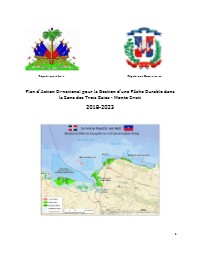
Binational Action Plan for Sustainable Fisheries Management in the Three Bays - Monte Cristi Area
Summary — This binational action plan aims to establish conditions for long-term fisheries management and governance in the transboundary maritime zone encompassing the Three Bays Protected Area in Haiti and Monte Cristi National Park in the Dominican Republic. It focuses on collaborative efforts to improve fisheries management along the northern coast of Hispaniola, addressing unsustainable practices and ecosystem degradation.
Key Findings
- The plan identifies four key priorities: promoting alternative livelihoods for fishermen.
- enforcing fisheries regulations through international collaboration and training.
- improving Haiti's fisheries information system for data collection and management.
- enhancing fishing practices and value addition through gear adaptation and protected areas.
- The plan aims to transition the area towards sustainable fisheries management, ecosystem restoration, economic viability, and social equity.
- A binational committee composed of Haitian and Dominican government representatives has been established to implement the plan and collaborate on transboundary fisheries issues.
Full Description
The binational action plan focuses on creating enabling conditions for long-term fisheries management and governance in the transboundary area of the Three Bays Managed Natural Resources Protected Area (AP3B) in Haiti and the Monte Cristi National Park in the Dominican Republic. Recognizing the ecological importance of this region, the plan emphasizes the urgent need for effective measures to improve fisheries management along the northern coast of Hispaniola. The plan is based on previous studies, plans for AP3B and Monte Cristi National Park, and binational workshops. It outlines four priorities: promoting alternative livelihoods, enforcing fisheries regulations, improving Haiti's information system, and enhancing fishing practices and value addition. A binational committee will implement the plan, aiming to transition the area towards sustainable fisheries management, ecosystem restoration, economic viability, and social equity.
Full Document Text
Extracted text from the original document for search indexing.
1 République d’Haïti République Dominicai ne Plan d’ A ction B i - national pour la G estion d’une P êche D urable dans la Z one des Trois Baies - Monte Cris ti 2018 - 2023 2 Préparé par : Maxene Atis, Miguel Silva de la Cruz, Carlos M. García Cartagena, 19 août 2018 pour le Département de la P êche et de l’ A quaculture d’Haïti (DPAQ) et le Consejo Dominicano de Pesca y Acuicultura (CODOPESCA) en République Domi nicaine Pour citer ce document : Atis M., Silva M., and Garcia C. (2018) Plan d’action binational pour la gestion d’une pêche durable dans la zone des Trois Baies - Monte Cristi The Nature Conservancy. Pp. 1 - 37 Coopération et partenariat : Agence Americ aine pour le Developpement International (USAID) The Nature Conservancy (TNC) Ce document a été rendu possible grâce au généreux soutien du peuple A méricain à travers l’Agence Americ ai ne pour le D éveloppement I nternationa l (United States Agency for International Development ou USAID). Le contenu est de la responsabilité de The Nature Conservancy et ne reflète pas nécessairement les opinions d’USAID ou du gouvernement des États - Unis. 3 C ONTENU Sommaire .. ……………………………………………………………………………………… … … … … … … … … … … … … … … … … … … … .. 4 Introduction ……………………………………………………………………………………………………………………………………… .. 5 1.1. C ontexte …………………………………………………………………………………………………… ……………….……… . 5 1.2. Aire Protégée de Ressources Naturelles Gérées des Trois Baies, Haïti (AP3B) ……………… .. . 6 Contexte General et Caractéristiques Biophysiques………………………………………………………… …… . .6 1.3. Complexe des aires marines protégées de Monte Cristi, République Dominicaine …… .. …… 6 Contexte General et Caractéristiques Biophysiques …………………………………………………………… .. …6 2. Objet et portée du plan d'acti on binational ………………………………………………………… …… .. … 7 3. Approch e : Processus de Preparation du Plan d ’Action………………………………………………… . … 8 3.1 Aire Protégée de Ressources Naturelles Gérées des Trois Baies .………………………………………… 8 3.2 Parc National Sous - marin de Monte Cristi1 ……………………………………………………………………… … . .1 1 3.3 At eliers binationau x…………………………………………………………………………………………………………… . 1 3 RESUME DU CADRE DU PLAN D’ACTION BINATIONAL POUR LA GESTION D’UNE PÊCHE DURABLE DANS LA ZONE DES TROIS BAIES ET DE MONTE CRISTI … … … … … … … … … ….. … … … … … … … .. . 1 5 4. P LAN BINATIONAL POUR LA PÊCHE DURABLE DANS LA ZONE DES TROIS BAIES - MONTE CRISTI ………………………………………… ……………………………………………………………………………………………… . 17 RÉFÉRENCES ET ENTRETIENS …………………………………………………………………………………………………… . …… 27 7 Annexes 1 - 3 … … … … … … … … … … … … … … … … … … … … … … … … … … … … … … … … … … … … … … … … … … … … … … … . . … 2 8 - 31 Annexe 4: écosystèmes marins et côtiers dans la zone des T rois B aies - MonteCristi .. ………… . … … . . . 32 Écosystèmes marins et côtiers dans la zone protégée des T rois B aies .………………………………… . … . .. . 32 Pêche ………………………………………………………………………………………………………………………………………… … … .3 3 Écosystèmes marins et côtiers dans les aires marines protégées de Montecristi . ………………… . …. . . 3 6 Pêche ……………………………………………………………………………………………………………………………………… … … … . 3 7 Aires protégées …………………………………………………………………………………………………………………………… … . 3 8 4 S OMMAIRE L’objectif de ce plan d’action binational est de créer les conditions habilitantes pour une gestion et une gouvernance à long terme de la pêche dans la zone maritime transfrontalière couvrant l’Aire Protégée de Ressources Naturelles Gérées des Trois Baies (AP3B) en Haïti et le Parc National de Monte C risti en République Dominicaine . En raison de l’importance des écosystèmes de cette zone pour la région , il y a un besoin urgent d’instaurer des mesures efficaces pour améliorer la gestion de la pêche le long du paysage maritime de la côte nord d’Hispaniola. Une gestion efficace de la pêche à la fois dans le Complexe des Aires Marines Protégées de Monte Cristi et dans l’AP3 B ne peut être atteinte qu’ à travers une étroite collaboration transfrontalière. Ce plan d’action binational est base sur des études et des plans antérieurs, développés pour l’A P3B e t le Parc National Sous - marin de Monte Cristi, ainsi que deux ateliers binationa ux organisés en 2016 et en 2017 entre des représentants des gouvernements d’Haïti et de la République Dominicaine. Il décrit les quatre priorités suivantes et les actions qui s ’y rattachent : 1) Promotion de moyens de subsistance alternatifs ou sup plémentaires a) Promouvoir des moyens de subsistances alternatifs et sup plémentaires pour les pêcheurs afin de générer des revenus tout en réduisant la pression exercée sur les ressources ha lieutiques 2) Application de s dispositions légales sur la pêche a) Renforce r la collaboration internationale, interinstitutionnelle et binationale sur le plan technique b) Éduquer et former les représentants des gouvernements et les acteurs sur la régulation envir onnementale et la régulation de la pêche c) S ensibilis er l es associations de pêcheurs et des organisations loca les et d) Promouvoir l’autorégulation et les droits de pêche communautaires 3) Doter Haiti d’un système d’information amélioré et automatisé (sur l’AP3B ) a) Collecter les données relatives à la pêche dans la zone de l’ AP3B utilisant une approche standardisée b) Mettre en place un système de gestion des données dans la Direction des Pêches et Aquaculture d’Haiti pour assurer la g estion d es données de la pêche da ns l’AP3B c) Mettre à jour le recensement national y - compris l es ressources, le matériel de pêche, l es caractéristiques démographiques et socio - économiques ( ex. type de pêche, type de gestion, type de matériel de pêche, zones de pêches, méthodes, nombre de pê cheurs, ménages du secteur de la pêche) en rapport à la pêche dans les deux pays et d) Disséminer de l’i nform ation sur la pêche et sur d es sujets connexes 5 4) Pratiques de pêche a mélioré es et valeur ajoutée a) Adapter le matériel de pêche et promouvoir des pratique s de pêche durable b) Créer des réserves ( zones de non - droit) et de s zones pour la reproduction Au cours des cinq prochaines années, ce plan d’action doit guider la transition d’ une zone caractérisée par des pratiques de pêche non durables et la dégradatio n des écosystèmes, vers une zone dans laquelle prévaut une bonne gestion de la pêche qui favorise la restauration de la productivité du milieu marin, la viabilité économique et l’équilibre social. Ce plan d’action aidera également à diminuer la pauvreté, à améliorer les conditions de vie, à soutenir des mo yens de subsistances alternatifs ainsi qu’à améliorer la gouvernance, l’administration et la viabilité financière. Un comité binational composé de représentants des gouvernements haïtien et dominicain a ét é constitué afin de mettre en œuvre ce plan et collabor er sur les questions liées à la pêche transfrontalière . INTRODUCTION 1.1 Contexte Ce cadre de plan d’action a été préparé par le Programme Caribéen pour la Conservation de la Biodiversité Marine ( Caribbean Marine Biodiversité Program - CMBP) financé par l’ USAID et géré par The Nature Conservancy. Les objectifs du CMBP sont de réduire les menaces qui pèsent sur la biodiversité marine et côtière dans d es zones prioritaires d e l a Caraïbe, entretenir l es services écosystémiques et réaliser des progrès concrets sur le bien - être humain pour les populations vivant dans le voisinage des Aires Marines Gérées (AMG) , . Mis en œuvre dans cinq pays cibles (République Dominicaine, Grenade, Haïti, Jamaïque et St. Vincent et les Grenadines) le programme se concentre sur la création et la gestion efficace d ’ aires marines protégées, la promotion de la pêche durable et de mo yens de subsistances alternatifs durables. Ce programme est axé sur une utilisation durable des ressources marines et côtières dont dépendent les économies et communautés locales, ainsi que sur l ’ établissement d’un financement fiable à long terme, pour supporter la gestion et les initiatives pour la conservation marine dans le futur. The Nature Conse rvancy (TNC) a établi un consortium d’organisations non gouvernementales locales bien implantées afin de mettre en œuvre le CMBP dans quatre espaces maritimes ciblés. En Haïti l a TNC collabore avec la Fondation pour la Protection de la Biodiversité Marine (FoProBiM) dans le Parc National des Trois Baies sur la côte nord d’Hispaniola. En République Dominicaine, L a TNC collabore avec le Centro para la Conservación y Ecodesarrollo de la Bahia de Samaná y su Entorno (CEBSE) dans la baie de Samaná. 6 1.2. A IR E P ROTEGEE DE R ESSOURCES N ATURELLES G EREES DES T ROIS B AIES , H AÏTI ( AP3B ) Contexte général et Caractéristiques B iophysiques La côte nord - est d’Haïti fait partie d’un large écosystème marin (paysage marin) ayant une importance au niveau régional, et possédan t une richesse en ressources de biodiversité marine et côtière, particulièrement dans les baies de Limonade, de Caracol et de Fort Liberté, ainsi que dans le Lagon aux Bœufs . Cette zone a été dé clarée comme l’Aire Protégée des Trois Baies (AP3B) en 2014 (l a deuxième plus grande aire protégée d’ Haïti et la deuxième plus grande forêt sèche tropicale des Caraïbes). Cette aire protégée couvre une superficie de 75 406 hectares et protège des espèces et des habitats terrestres, marins et d ’eau douce . La partie ma rine est composée d’un complexe unique de récifs coralliens frangeants et barrières, d’herbiers marins, de mangroves, d’eaux profondes et de plaines côtières adjacentes connues pour la diversité de leurs différents habitats aquatiques et saumâtres. L’AP3B est principalement composée d’habitats marins, avec une zone marine profonde (> 30 mètres), une zone marine peu profonde (< 30 mètres) et ses forêts de mangroves (principalement composées de palétuviers rouges ( Rhizophora mangle)), qui représentent 77 % de la totalité de l ’aire protégée (soit 57 930 hectares). Dans les zones tampons de l’AP3B vivent des milliers de pêcheurs dont la survie dépend en grande partie du bon état des habitats marins et de la pêche. La mangrove fournit un large éventail de servic es écosystémiques aux communautés locales dont , du combustible, des matériaux de construction, des frayères , blocage des sé diments et une barrière protectrice lors des tempêtes. Cette dépendance des communautés locales vis - à - vis des ressources côtières et marines les rend vulnérables aux effets de la dégradation de l’environnement et au changement climatique. 1.3. C OMPLEXE DES AIRES MA RINES PROTEGEES DE M ONTE C RISTI , R EPUBLIQUE D OMINICAINE Contexte général et Caract é ristiques B iophysiques Les Aires Marines Protégées de Monte Cristi se situent dans la zone côtière du nord de la province de Monte Cristi et à l’extrême ouest de la province de Puerto Plata. Elles couvrent les zones maritimes et côtières de l’embouchure de la Rivière du Massacre jusqu’à l’embouch ure de la rivière Yaque del Norte, les ilots Sept Frères et la côte depuis le Parc National El Morro jusqu’au sanctuaire marin pour les mammifères marins d’Estero Hondo dans la province de Puerto Plata. La zone côtière et maritime ( Marine Coastal Zone (ZCM )) comprend une bande de terre d’environ 10 km, parallèle au littoral, couvrant 986,28 km 2 et des espaces marins de 1392,34 km 2 , ce qui donne une zone délimitée totale de 2378,62 km 2 (237 861,77 Ha). La part occupée par les récifs à l’intérieur du Parc Nat ional Sous - marin de Monte Cristi (PNSM) fait 56,31 km 2 (5631,3 Ha) 1 . La pêche artisanale est une des activités économiques les plus traditionnelles dans la zone 1 López, J. y M. Silva. 2012. Diagnóstico de la situación natural y social de la zona costero y marina de la provincia de Monte Cristi . Ministerio de Medio Ambi ente y Recursos Naturales. 303 pages . 7 côtière de Monte Cristi. Au moins 16 sites de débarquement ont été identifiés , à partir desquel s opèrent 214 embarcations. Les bateaux sont principalement des dériveurs en fibre de verre ou en bois avec moteur hors - bord. Selon des données officielles, le nombre total de pêcheurs est de 502, mais cela n’inclut pas 300 ramasseurs. Côte nord d’ Hisp aniola 2. Object et portée du plan d’action binational L’objectif principal de ce plan d’action binational est de créer les conditions habilitantes pour une gouvernance et une gestion à long terme de la pêche dans la zone de l’AP3B – Monte C risti ( voir la carte ci - dessus ). En raison de l’importance des écosystèmes de cette zone pour la région , il y a un besoin urgent de mettre en place des mesures efficaces pour améliorer la gestion de la pêche à travers le paysage marin de la côte nord d’Hispaniola. Il apparaît évident qu’une gestion efficace de la pêche, à la fois dans le Complexe des Aires Marines Protégées de Monte Cristi et dans l’Aire Protégée de Ressources Naturelles Gérées des Trois Baies, ne peut être atteinte qu’à travers une étroite collaborati on transfrontalière. Par exemple, des interactions se produisent tous les jours entre l es pêcheurs des deux côtes de la frontière qui ne sont pas au courant d es régulations en vigueur dans ces aires protégées, et les pratiques de pêche destructrices contin uent de se développer à un rythme préoccupant. 8 Au cours des cinq prochaines années et au - delà, ce plan d’action doit guider la transition d’ une zone caractérisée par des pratiques de pêche non durables et la dégradation des écosystèmes, vers un e zone dans laquelle prévaut une bonne gestion de la pêche qui favorise la restauration de la productivité du milieu marin, la viabilité économique et l’équilibre social. Plus particulièrement, la mise en œuvre de ce plan d’action aidera à diminuer la pauvreté, à amé liorer les conditions de vie, à favoriser des moyens de subsistances alternatifs et à fournir une meilleure gouvernance, une meilleure administration et une pérennité financière. Cette mission est en accord avec la loi H aïtienne sur la pêche de 1978, la l oi D ominicaine sur la pêche (loi 307 - 04), les plans de gestion de l’AP3B et la loi D ominicaine sur les aires protégées (202 - 04), ainsi qu’avec le Plan d’Action du Secteur Pêche sur le parc des Trois Baies ( Fisheries Sector Action Plan for Three Bays ), qui a reçu un large soutien de la part des gouvernements locaux, des pêcheurs et des acteurs concernés. Ce plan d’action sur cinq ans requiert l’application d’actions prioritaires et une évaluation à mi - parcours . L’objectif de cette évaluation trois ans après son entrée en application est de permettre aux gouvernements d’évaluer les progrès sur la mise en œuvre du plan et de le réorienter si nécessaire. Il est établi que toutes les activités envisagées ne seront peut - être pas mises en œuvre au cours des cinq an nées que couvre le plan et que son application s’étendra possiblement au - delà de cette période. La mise en œuvre du plan doit être assez flexible pour s’adapter aux dynamiques socio - é conomi ques des pays concernés, et par conséquent, des consultations perma nentes doivent être menées auprès des communautés, des acteurs et des représentants des gouvernements sur la base de la disponibilité de s ressources humaines, techniques et financières . Une gestion efficace de la pêche dans l’AP3B et Monte Cristi en tant q u e continuum d ’aires protégées représentera un changement important dans le domaine de la préservation de la biodiversité sur la côte nord d’Hispaniola et pour les communautés qui y vivent, ainsi que pour ses écosystèmes. Au regard de l ’interconnectivité e ntre les deux pays, du point de vue géographique, l’étendue de ce plan d’action peut inclure des activités à être implémentées à l’échelle nationale dans les deux pay s . 3. Approche : P rocessus de Préparation du P lan d ’ A ction Le plan d’action binational e st base sur des études et des plans antérieurs développés pour l’Aire Protégée de Ressources Naturelles Gérées des Trois Baies et le Parc National Sous - marin de Monte Cristi, ainsi que deux ateliers binationa ux entre des représentants des gouvernements d’H aïti et de la République Dominicaine. 3.1 Aire Protégée de Ressources Naturelles Gérées des Trois Baies 9 En 2015 et 2016 le CMBP a mené une E valuation Rapide du Secteur P êche ( Rapid Fisheries Sector Assessments ou RFSA) et par la suite préparé un Plan d’A ction du Secteur Pêche (Fisheries Sector Action Plan ou FSAP) pour l’Aire Protégée de s Trois Baies en Haïti. Le FSAP a servi de feuille de route pour les actions du CMBP visant à renforcer la gestion de la pêche. Les principaux problèmes identifiés par l e FSAP étaient les suivants : ● P olitiques de pêche désuètes - besoin de réformes des lois ● S urpêche non sélective ● P ratiques de pêche non durables ● B raconnage ( par les Dominicains et les Haïtiens ) ● M anque de moyens de subsistance alternatifs ● F aiblesse ou quas i absence de gestion de la pêche ● M anque d’application des réglementations Parmi d’autres problèmes supplémentaires identifiés par l a Direction des pêche s du Ministère de l’Agriculture d’Haïti figurent l’instabilité socio - politique, le manque d’infrastructu res pour les services, le manque d’éducation et de sensibilisation des acteurs, le manque d’investissements directs d u le secteur privé, le manque de données scientifiques et le manque de personnel qualifié. Au niveau national la stratégie du Ministère de l’Agriculture est principalement axée sur : ● L’installation et la bonne gestion de D ispositifs de C oncentration de P oisson (DCP) ● La restauration des mangroves ● La création de bonnes conditions favoris ant une augmentation de la production de poisson et autr es fruits de mer de 12 000 tonnes à 20 000 par an tonnes sur une période de 5 ans, de façon durable ● Le renforcement des institutions et de la législation, et ● La création ou l’amélioration des infrastructures pour permettre une meilleure conservation, un meilleur transport et une meilleure commercialisation des prises de la pêche . Sur la base des problèmes identifiés, le FSAP a émis 16 recommandations essentielles pour améliorer la gouvernance et la gestion de la pêche dans le Parc National des Trois Baie s : 1. Mettre en place une autorité de gestion du parc des Trois Baies ( Three Bays Park Management Authority (PMA)) 2. Formation en gestion et leadership pour les a ssociations de pêcheurs et les pêcheurs individuels 3. Recenser les pêcheurs, le matériel, les batea ux 4. Éliminer les filets à petit maillage et remplacer par des engins de pêche durable 5. Protéger les m angroves 6. Améliorer la dynamique de la chaîne d'approvisionnement 6.a Étude de marché 7. É tabli r de s zones protégées où la pêche est interdite à l ’intérieur du parc 10 8. Établir des sites de débarquement (7) 9. Créer une marque pour les produits issus du parc 10. A ctivités alternatives ou effectuées par les femmes 11. Mariculture 12. Dispositifs de concentration de poisson 13. Collecte de l’espèce invasive Pterois (poisson - lion) 14. Écotourisme 15. Conf é rence sur la pêche 16. Loi et réglementations pour encadrer la pêche En outre , le FSAP a émis quatre recommandations prioritaires a être exécutées par CMBP : 1. Autorité de Gestion du Par cet F ormation : une A utorité de Gestion du Parc des Trois Baies 2. Programme d’échange (remplacement) de matériel de pêche 3. Création de sites de débarquement de poisson s 4. Mise en œuvre d’initiatives de moyens de subsistance alternatifs Alors que ce plan d’action est en cours de préparation, le CMBP travaille a ctivement à la réalisation des recommandations 1, 2 et 4. En plus du FSAP, le CMBP a achevé le plan de gestion de l’AP3B en 2017 à travers un long processus participatif impliquant de nombreuses réunions avec les gouvernements locaux et le gouvernement ce ntral d’Haïti et les acteurs des principales communautés de la côte, et tous ont fourni des conseils et des commentaires utiles. Le plan de gestion propose une vision qui doit guider la transition d’ un environnement exploite de façon non durable , avec la pauvreté et les mauvaises conditions de vie qui s’y rattachent, vers une zone protégée caractérisée par une bonne gestion de l’environnement, une viabilité économique et un équilibre social. Le plan comprend neuf programmes de gestion et environ 120 actio ns spécifiques devant être mises en œuvre au cours des dix prochaines années, de 2017 à 2027. Les neuf programmes de gestion sont les suivants : 1. Conservation de la biodiversité 2. Sensibilisation et éducation environnement ale 3. Utilisation durable des ressource s 4. Préservation des ressources culturelles 5. É cotourisme 6. Gestion communautaire 7. Gouvernance, c ogestion et application des régulation 8. Infrastructures 9. Suivi Biologique Le P lan de G estion propose aussi un système de zoning pour la gestion de l’AP3B avec les zone s suivantes : 11 1. Zone de régénération - Pour fournir le niveau de protection le plus élevé aux espèces marines et terrestres, aux habitats et aux écosystèmes, en raison de leur caractère unique, rare, menacé, et/ou en raison de la valeur qu’ils représentent, des caractéristiques spéciales qu’ils possèdent ou un statut d’habitat sauvage essentiel. 2. Zone de conser vation - Pour permettre la conservation des caractéristiques naturelles et culturelles du paysage terrestre et/ou marin, tout en fournissant des moyens de subsistances modestes, une utilisation pour le tourisme ou les loisirs, et une zone tampon adjacente aux zones de régénération. 3. Zone d’utilisation durable - Pour permettre la poursuite des pratiques de l’utilisation des ressources terrestres durables et restreintes qui sont compatibles avec la préservation de la nature, principalement l’agriculture biologique. 4. Zone de gestion communautaire - Pour protéger les éléments archéologiques, historiques culturels présents dans l’AP3B, pour mener des recherches e t, là où cela est approprié et possible, des visites culturelles pour le public. 5. Zone de conservation culturelle - Pour permettre la gestion collaborative des terres situées à l’intérieur de l’AP3B sur lesquelles vivent des communautés, où se trouvent des industries et qui appartiennent à des propriétaires fonciers ; mené par et en coopération avec les gouvernements locaux. Le plan de gestion final a été présenté aux autorités municipal es et aux autorités du gouvernement central lors de deux ré unions différ entes. Il a d’abord été présenté le 19 juin aux autorités municipales et départementales des communautés de l’AP3B, dont le s maire s et « CASEC » de Limonade, Caracol, Fort - Liberté et Ferrier. Cette rencontre a été conduite par le Directeur Départemental du Ministère de l’Environnement, Luckin Charles. Il a ensuite été présenté officiellement lors d’une rencontre qui s’est tenue à Port - au - Prince le 20 juin en présence de représentants du Ministère de l’Environnement, de l’ANAP, d’USAID, d’autres agences de d éveloppement, d’autres ministères, agences et acteurs du secteur privé concernés, ainsi que la presse. 3.2 Parc National Sous - marin de Monte Cristi En 2014 le gouvernement dominicain et ses partenaires ont développé un plan de zonage pour la pêche pour le Parc National Sous - marin de Monte Cristi afin de rétablir, protéger et préserver les écosystèmes grâce à une gestion durable et à la participation des différents acteurs. Alors que le plan de zonage ne couvre pas toute la zone de Monte Cristi, le Par c National Sous - marin de Monte Cristi est la plus grande composante du Complexe des aires marines protégées de Monte Cristi et les réponses apportées aux problèmes peuvent également être appliquées dans les autres zones. Les objectifs du plan de zonage pou r la pêche pour le Parc National Sous - marin de Monte Cristi sont les suivants : • Permettre la continuité des processus biologiques et évolutifs dans les écosystèmes marins de l’aire protégée PNSM. 12 • Gérer les ressources naturelles du Parc National et des zon es associées à l’actuel système récifal , avec un accent mis sur la protection des communautés et des écosystèmes , des espèces fragiles essentielles pour la bonne santé de cet écosystème, unique parmi les zones marines nationales, et sur la protection sp é ci ale de ces zones ayant une importance économique actuellement et potentiellement dans le futur . • Préserver les paysages insulaires et marins, ainsi que leurs éléments naturels, pour en faire usage, ainsi que pour améliorer la qualité de vie des groupes soci aux locaux et pour le plaisir des visiteurs . • Promo uvoir la conservation de la biodiversité marine et la p roductivité biologique qui permet la continuité et les interactions entre les espèces qui vivent dans les récif s. • Réaliser des études et des recherches , deux éléments qui contribuent à produire des propositions en termes de méthodes de gestion et d’a lternatives pour une utilisation durable des ressources, et en même temps pour élargir et approfondir les connaissances à leur sujet ; et • Appliquer les conna issances, les pratiques et les technologies , traditionnelles ou nouvelles, qui permettent la pr é servation et l’utilisation durable des ressources halieutiques dans la zone . Les actions suivantes ont été proposées afin d’atteindre ces objectifs : • Zonage ▪ Zo nes exclusives de pêche ▪ Contr ôle de la pêche ▪ Tourisme et loisir • Restauration ▪ Rétablissement des populations des espèces prioritaires ▪ Rest au ration des écosystèmes menacés • Information ▪ Promotion de la recherche et des connaissances pour une gestion efficac e ▪ D é veloppement d’ inventaires, d ’un référentiel et d ’une surveillance de l’environnement ▪ Système d’information pour la pêche, dont une collecte régulière des informations sur les sites de débarquement, les prises et d’autres statistiques en lien avec la pêc he ▪ Diffusion des informations au près des différents acteurs ▪ Actions de sensibilisation et d’éducation à l’environnement ▪ Suivi des activités de loisirs pour les touristes et le public • Gestion ▪ Op é ration, protocoles et logisti que ▪ Infrastructures et signalemen t des différentes zones, à l ’aide de repères (bouées et repères sur les terres ) ▪ Accords légaux et institutionnel s ▪ Respect de la réglementation et incitations 13 ▪ Surveillance de la santé des écosystèmes des récifs ▪ É laboration et application de mesures spécifiq ues concernant les espèces essentielles et les groupes ciblés • Un programme de formation pour l’application et la supervision des bonnes pratiques de pêche pour atteindre une utilisation durable des ressources marines et côtières doit impérativement être mi s en place. Cette formation doit concerner : ▪ Les autorités, pour le contrôle de l’application des lois ▪ Les pêcheurs , pour qu ’ils aient un meilleur respect et un meilleur comportement vis - à - vis des ressources halieutiques ▪ La commercialisation du poisson et les entreprises du secteur du tourisme pour que tous soient impliqués dans la gestion des ressources côtières et marines ▪ Les organisations non gouvernementales, pour promouvoir de façon plus efficace la gestion participative de la gestion et de la protecti on des ressources halieutiques Parmi les principaux problèmes identifiés par le Conseil dominicain pour la pêche et l’aquaculture (CODOPESCA) figurent : • La surpêche • Les pratiques de pêche non durables • Le braconnage (de la part des Dominicains et des Haïti ens) D es mesures sont entreprises dans le secteur de la pêche afin de remédier à ces problèmes, y - compris : • Évaluation et adaptation de la clôture des saisons de pêche, en particulier en ce qui concerne le crabe Xanthidae • Créer un mécanisme de régulation p our ce qui concerne les ornements pour les aquariums • Surveiller et contrôler la pêche à la senne • Surveillance des échanges de produits de la mer dans les deux pays, dans le cadre de l’accord CITES avec à la fois la Marine dominicaine et l’Armée dominicain e À ce jour, les projets suivants sont appliqués sous la supervision de MARENA : • Conservation de la biodiversité marine et développement économique durable à Monte Cristi (Conservation of Marine Biodiversité and Sustainable Economic Development in - Montec risti), d’AgroFrontera • Projet pour la biodiversité et le tourisme (Project on Coastal Biodiversité and Tourisme ), des Ministères du Tourisme et de l’Environnement 3.3 Atel ier s binationaux Trois ateliers binationaux ont été conduits en 2016 , 2017 , et en 201 8 par le CMBP, avec la 14 participation de représentants des gouvernements des deux pays, afin de faire avancer la collaboration transfrontalière. Atelier binational 1 - Dajabón / Ouanaminthe - Lors de l’atelier qui s’est déroulé à Dajabón en 2016, la pêche d urable a été identifiée comme étant l’élément clé pour augmenter la collaboration entre les acteurs de Monte Cristi et de l’AP3B, et il a été convenu qu’un plan d’action binational doit être établi afin de guider cette collaboration dans le futur. En outre , il a été convenu qu’un plan d’action binational doit cibler les activités menées au - delà de la côte nord d’Hispaniola et concerner les deux pays . Atelier binational de Sa nto - Doming o - En juillet 2017 un atelier binational a été conduit à Sant o - Doming o af in d’identifier les priorités et problèmes communs en lien avec la gestion durable de la pêche dans la zone des Trois Baies - Monte Cristi ; pour identifier les domaines de collaboration et les échanges, pour améliorer la gestion transfrontalière de la pêc he et utiliser ces informations pour développer une première version d ’un plan d’action pour parvenir à une de gestion de la pêche commune . Des représentants du gouvernement et les ONG partenaires de la République Dominicaine et d’Haïti y ont participé. L ors de cet atelier plusieurs problèmes en lien avec la pêche et la gestion du parc ont été abordés. Cependant, l’accent a principalement été mis sur la gestion de la pêche sur la côte nord d’Hispaniola. Les participants à cet atelier se sont aussi mis d’ac cord sur le fait que toutes les informations collectées lors des discussions serviraient à alimenter un plan d’action binational devant être partagé avec les représentants des gouvernements concernés afin d’assurer le soutien nécessaire à sa mise en œuvre. Après le second atelier qui s’est tenu à Sant o - Doming o l’équipe du CMBP a préparé le plan de travail pour l’ élaboration du plan d’actio n et un questionnaire qui ont été partagé s avec les acteurs concernés pour collecter davantage d’informations ; et elle a aussi compilé les informations collectées lors des ateliers, des réunions et des entretiens. Sur la base de ces informations, le CMBP a préparé une ébauche du plan d’action binational et l’a remise au x gouvernement s , aux organisations non gouvernemental es et aux principaux acteurs afin qu’ils l’examinent et qu’ils émettent des commentaires. Sur la base de ces commentaires, le CMBP a préparé une version avancée en 2018 . Atelier binational 2 - Dajabón / Ouanaminthe - En 2018 le CMBP a continué de facilite r le dialogue entre Haïti et la République Dominicaine afin de promouvoir une coopération binationale concernant la gestion de la zone AP3B - Monte Cristi. Le CMBP a organisé un atelier binational les 3 et 4 mai afin d’examiner et de finaliser une ébauche avancée du plan d’action binational. Lors de cet atelier, une formation sur la gestion des données concernant la pêche a été donnée aux représentants du gouvernement haïtien. Lors des premiers jours de l’atelier, dix techniciens haïtiens de la Direction de s Pêche et Aquaculture du Ministère de l’Agriculture ont reçu, sur une journée, une formation donnée par leurs homologues Dominicains sur la collecte des données. La deuxième journée a été consacrée à la finalisation du plan d’action binational pour la ges tion d’une pêche durable. 44 personnes des deux pays ont participé à l’atelier binational, y compris des représentants des entités responsables de la pêche , la Commission binationale de haut niveau, les institutions qui gèrent les aires 15 protégées, les mair es, les représentants des gouvernements locaux, d’USAID, TNC, IDB, UNDP, et du Corridor B iologique Car ibéen , d’Agrofrontera, de la FOPROBIM et de Counterpart International . En tout, 23 institutions haïtiennes et dominicaines étaient représentées à cet atel ier. Les trois principaux résultats obtenus à l’issue de cet atelier sont les suivants : la validation du cadre du plan d’action, avec quelques modifications ; des problèmes concernant la mise en œuvre et les principales étapes ont été identifiés ; et u n comité de pilotage pour la mise en œuvre du plan a été instauré. L’atelier binational a également débouché sur un engagement fort de la part des partenaires en ce qui concerne le soutien de l’initiative que constitue ce plan d’action. En plus du CMBP, l e Corridor biologique des Caraïbes (CBC) s’est engagé à utiliser une partie de ses fonds actuels pour mettre en œuvre les activités sélectionnées dans le plan d’action binational. La Banque I nteraméricaine de D éveloppement (DIB) s’est aussi engagée à reche rcher des fonds pour soutenir la mise en œuvre du plan. Resume d u Cadre d u Plan d ’ A ction Binational p our l a Gestion d ’ U ne Pêche Durable Dans l a Zone d es Trois Baies e t d e Monte Cristi Le cadre du Plan d’action binational ci - dessous présente 4 priorités principales désignées par les représentants des gouvernements d'Haïti et de la République Dominicaine. Ces priorités sont les suivantes : Promotion de moyens de subsistance alternatifs - Un des mot ifs essentiels des pratiques non durables et de la surexploitation des ressources dans la zone est le manque d’alternatives économiques. Durant les consultations avec les représentants du gouvernement il a été convenu que la principale priorité serait la promotion, pour les pêcheurs, de mo yens de subsistance alternatifs ou c omplémentaires afin de générer des revenus tout en réduisant la pression exercée sur les ressources halieutiques. Application de la réglementation concernant la pêche - Afin de promouvoir l’application des régulations concernant la pêche, le cadre de ce plan d‘action vise à renforcer la collaboration internationale, interinstitutionnelle et binationale sur le plan technique, ainsi que la mise en place d’activités de formation, d’éducation et de sensibilisation dans la zone des Trois Baies - Monte Cristi . Ce cadre vise également à renforcer la capacité des communautés à gérer la pêche autorégulée afin de compenser d’éventuels défauts de la part du gouvernement. Un système d’information a mélior e et automatis e pour l’AP3B en Haïti - Ce plan binational vise à soutenir un système de gestion des données dans le département en charge de la pêche à Haïti. Ce système sera donné par la République Dominicaine et introduit à travers un projet pilote qui sera d’abord mis en place dans la région des Trois Baies. Le cadr e du plan d’action action supportera également la mise à jour des recensements dans les deux pays, ainsi que la collecte et le partage des données et des informations en lien avec la pêche. 16 P ratiques de pêche améliorées et valeur ajoutée - Cette priorité se concentrera principalement sur la mise en place de programmes d’échange de matériel de pêche et sur des améliorations concernant la chaîne de valorisation dans les deux pays afin de promouvoir des pratiques de pêche durables. Une autre de ces actions se ra la définition de réserves de pêche et de zones de reproduction, comme suggéré dans les plans de gestion et de zonage qui concernent les parcs. Les priorités sont décomposées en différents plans et activités devant être mis en œuvre dans les deux pays. Une fois le mécanisme de mise en œuvre opérationnel, un plan d’action détaillé sera développé afin d’englober toutes les activités importantes, les différentes tâches, les partenaires clés, le calendrier concernant la mise en œuvre, et le protocole de suiv i pour suivre les progrès réalisés en ce qui concerne chaque objectif. Un budget prévisionnel est également présenté dans le cadre du plan d’action. Cependant, le budget définitif sera établi par les autorités compétentes, les partenaires et les donateur s impliqués dans la mise en œuvre du plan d’action . 17 4. CADRE DU PLAN BINATIONAL POUR LA PÊCHE DURABLE DANS LA ZONE DES TROIS BAIES - MONTE CRISTI Priorité 1 : Promotion de moyens de subsistance alternatifs Action 1 : Promotion de moyens de subsista nce alternatifs ou complémentaires pour les pêcheurs afin de générer des revenus tout en réduisant la pression exercée sur les ressources halieutiques Resources nécessaires Acteur principal/ Partenaires/ Facilitateurs Jalon Chronologie Coût (dollar US) A ctivités − Création de projets pilotes de kayak (écotourisme) pour les pêcheurs à Haïti et en République Dominicaine − Création d’une coopérative d’apiculteurs avec les pêcheurs dans l’AP3B pour générer de manière efficace des revenus − Identifier et mettre en œuvre une palette d’autres activités pratiques alternatives ou complémentaires pour générer des revenus dans la zone de Montecristi et de l’AP3B Consultants pour mener les activités concernant les moyens de subsistance avec les communautés locales Le T NC/le CMBP (financement partiel pour 1 an) Peut inclure d’autres donateurs (Banque de développement des Caraïbes (CDB), IDB) - 1 entreprise pilote de kayak (écotourisme) créée dans l’AP3B (coopérative) - 1 entreprise pilote de kayak (écotourisme) créée à Monte Cristi (coopérative) - 1 coopérative d’apiculteurs créée dans l’AP3B 4 ans 600 000 Priorité 2 : Application de la réglementation de la pêche 18 Action 1 : Renforcement de la collaboration internationale, interinstitutionnelle et binationale su r le plan technique Ressources nécessaires Acteur principal/ Partenaires/ Facilitateurs Jalon Chronologie Activités − Faciliter le processus pour les échanges entre les techniciens des deux pays − Compiler et diffuser les lois et réglementations concernant la pêche − Effectuer une évaluation de l’application et de la formation dans l’AP3B Programmes de formation et matériel pour soutenir les échanges Support de la part du gouvernement pour institutionnaliser la collaboration binationale Consultant pour su pporter la mise en œuvre sur le terrain Le TNC/le CMBP (financement partiel pour 1 an) Peut inclure d’autres donateurs ( Banque de développement des Caraïbes (CDB), IDB) Au moins trois formations et échanges binationaux 3 ans 120 000 Action 2 : Éducation et formation sur l’environnement et la réglementation concernant la pêche dans la zone pour les représentants du gouvernement et les acteurs clés Ressources nécessaires Acteur principal/ Partenaires/ Facilitateurs Jalon Chronologie Activités − Développer des contenus pour la formation sur la législation concernant la pêche en République Dominicaine et à Haïti, respectivement Dévelo ppement de contenu Formation des facilitateurs (développer/compiler des Acteurs principaux : CODOPESCA / DPAQ/IDB République 20 représentants du gouvernement dominicain formés à la législation sur la pêche en 2 ans 30 000 19 − Fournir une formation à destination des représentants des gouvernements en République Dominicaine et à Haïti, respectivement contenus et former 30 techniciens et représentants des gouvernements) Dominicaine - Facilitateurs potentiels : CMBP (TNC), Agr ofrontera Facilitateurs potentiels à Haïti : IDB, ANAP, CBC République Dominicaine 30 représentants du gouvernement haïtien formés à la législation sur la pêche à Haïti (a vec des participants pour l’AP3B) Développer 2 supports de formation - un pour chaque pays Ressources disponibles : République Dominicaine : Formation du CMBP sur la législation sur la pêche pour les autorités environnementales et de la pêc he locales en coordination avec le CODOPESCA Documents Projet CLME Projet PBCyT Haïti : Plan d’action pour le secteur de la pêche dans le Parc National des Trois Baies Plan de gestion du Parc National des Trois Ba ies Loi sur la pêche de 1978 Décret inter communal de 2018 pour la zone des Trois Baies Action 3 : Augmenter la sensibilisation des associations et des groupes locaux de pêche Ressources nécessaires Acteur principal/ Partenaires/ Facilitateurs Jalon Chronologie 20 Activités − Développer et appliqu er un programme de sensibilisation et d’éducation pour la zone des Trois Baies - Monte Cristi en utilisant différentes plateformes de communication en direction de publics ciblés et axé sur l’importance écologique d’un espace transfrontalier protégé pour l a pêche dans les deux pays − Développer une stratégie ou plan de communication afin d’aider à organiser et à suivre l’évolution des programmes éducatifs et de sensibilisation. − Création d’une table ronde binationale sur la pêche pour aborder les problèmes co mmuns dans la zone des Trois Baies - Monte Cristi − Introduction de formation sur la pêche dans les écoles situées dans les villes côtières Un défenseur local dans chaque zone (Haïti - TBD ; Monte Cristi - TBD) Des fonds pour des rencontres régulières (esti mation : 4 800 $ US/pays/an - 6 rencontres) Un salaire pour un coordinateur dans chaque pays - TBD Support de la part des autorités locales qui participeront aux rencontres et débattront des problèmes avec les acteurs du secteur Acteur principal : Haïti - TBD République Dominicaine - TBD Facilitateurs potentiels : Haïti - IDB, UNDP - EBA République Dominicaine - USAID, CEBSE , CBC Haïti : 12 groupes différents de pêcheurs participant à la table ronde des acteurs du secteur République Dominicaine : 7 gro upes différents de pêcheurs et au moins 3 poissonneries participant à la table ronde des acteurs du secteur 5 ans 215 000 Ressources disponibles : Carte des acteurs réalisée par AGROFRONTERA pour la zone de Monte Cristi Rapport d’avancement pour les acteu rs de Trois Baies préparé par l'Université de Limonade Plan d’action pour la pêche et plan de gestion pour la zone des Trois Baies Plans de gestion qui existent pour les zones protégées de Monte Cristi Action 4 : Promotion de l’autorégulation – droits de pêche communautaires Ressources nécessaires Acteur principal/ Partenaires/ Jalon Chronologie 21 Facilitateurs Activités − Mettre en place une licence de pêche et un processus d’enregistrement des pêcheurs − Travailler avec les autorités locales pour la promu lgation de décrets réglementant l’extraction des ressources halieutiques − Fournir une formation sur le respect de la gestion aux agences gouvernementales responsables de l’application de la régulation, des décrets, des zones fermées et de la mise en œuvre de l’échange de matériel Support gouvernemental pour développer les processus de délivrance de licences et de l’enregistrement des pêcheurs, et pour faire appliquer les décrets sur la pêche Consultant pour fournir une formation ANAP et DPAQ/IDB Un pro cessus d’enregistrement coordonné mis en place et un comité permanent de coordination 4 ans 335 000 Priorité 3 : Amélioration et automatisation du système d’information à Haïti (dans la région des Trois Baies) Action 1 : Appliquer un système de gest ion des données dans le département en charge de la pêche à Haïti pour collecter et gérer les données concernant la pêche dans l’AP3B Ressources nécessaires Acteur principal/ Partenaires/ Facilitateurs Jalon Chronologie 22 Activités − Collecter les données sur la pêche en utilisant une approche standard − Installer un système de gestion des données dans le DPAQ à Haïti afin de gérer les données relatives à la pêche − Traduire les manuels d’utilisation de l’espagnol vers le français et le créole − Améliorer les i nformations relatives à la pêche et le système de gestion des données en République Dominicaine − Former au moins 2 techniciens du département en charge de la pêche pour la gestion et l’utilisation du système d’information − Former de la même manière d’autres techniciens du Département en charge de la pêche d’Haïti pour améliorer les capacités Système d’information - Le CODOPESCA met à disposition son système d’information pour le Département en charge de la pêche d’Haïti 6 ordinateurs 6 ASI Un manuel d’ut ilisation traduit en français et en créole Une connexion Internet viable Une entreprise pour le support de l’amélioration du système de gestion des données et des informations relatives à la pêche en République Dominicaine Acteur principal : CODOPESCA/D PAQ Facilitateurs : CMBP (TNC) Facilitateurs potentiels à Haïti : IDB Un système d’information pour la pêche livré au Département en charge de la pêche à Haïti 10 techniciens formés à la gestion et à l’utilisation du système d’information 1 an 205 0 00 Ressources disponibles : Le système de collecte, de stockage, de traitement, d’analyse et de transmission des données et des informations sur la pêche du CODOPESCA. 23 Le personnel technique du CODOPESCA est disponible pour réaliser les formations des te chniciens haïtiens Action 2 : Mettre à jour le recensement national concernant la pêche dans les deux pays Ressources nécessaires Acteur principal/ Partenaires/ Facilitateurs Jalon Chronologie Activités − Effectuer un recensement à Haïti en incluant les ressources, le matériel de pêche, les caractéristiques socio - économiques et démographiques (type de pêche, type de gestion, type de matériel de pêche, zones de pêche, méthodes, nombre de pêcheurs, nombre de foyers de pêcheurs), et mettre les données à jou r en République Dominicaine Entreprise pour collecter et analyser les données, et consolider les informations Support de la part des deux Départements de la pêche pour effectuer le recensement et intégrer les données collectées dans leurs base de donnée s Acteurs principaux : Département de la pêche, Ministère de l’Agriculture/ CODOPESCA Facilitateurs : IDB Un recensement concernant la pêche effectué à Haïti Mise en place d’un système de collecte des données relatives à la pêche à Haïti 3 ans 500 000 Action 3 : Collecter les données et partager les informations concernant la pêche et les sujets connexes Ressources nécessaires Acteur principal/ Partenaires/ Facilitateurs Jalon Chronologie 24 Activités − Discuter des leçons tirées concernant les méthodolo gies d'enregistrement des informations actuellement en cours d’instauration − Établir une base de données pour les sites de débarquement − Formation sur l’analyse des données pour au moins 2 techniciens du DPAQ − Production d’informations pour les décideurs − C réer une plate - forme binationale (site Internet, via un cloud, etc.) pour le partage des informations, des résultats des études, des recherches et des évaluations en lien avec la pêche ainsi que d’autres sujets connexes Des employés des deux Départements en charge de la pêche pour identifier les documents et les télécharger pour le partage Une connexion Internet Lecteur en ligne partagé Support de la part des deux gouvernements pour une mise en œuvre sur le terrain Entreprise pour le support des bases de données et création d’une plateforme binationale République Dominicaine : CODOPESCA HAITI: DPAQ Facilitateurs : IDB CBC Un système d’information commun / plate - forme créée puis opérationnelle pour que les deux gouvernements puissent partager des infor mations 3 ans 100 000 Ressources disponibles : Système de collecte, de stockage, de traitement, d'analyse et de suivi des données et informations relatives à la pêche du CO DOPESCA Priorité 4 : Amélioration des pratiques de pêche et de la valeur ajoutée Action 1: Adaptation du matériel de pêche et promotion des pratiques de pêche durable Ressources nécessaires Acteur principal/ Partenaires/ Jalon Chronologie 25 Facilitateurs Activités − Diagnostic sur l’impact du matériel de pêche non durable − Mise en œuvre de l’échange de matériel de pêche pilote dans l’AP3B et de Monte Cristi, respectivement − Amélioration de la chaîne de valorisation des produits de la pêche − Formation sur la gestion de la chaîne du froid − Formation sur le système HACPP − Collecter / lister tous les acteurs en lien avec la pêche dans la zone des Trois Baies - Monte Cristi − Déterminer le niveau de développement actuel des associations − Échange avec les partenaires concernés et les agences (des deux pays) pour identifier les zones pour la promotion des coopératives Matériel pour l’échange et la logistique, et un soutien pour la formation des pêcheurs Fournitures et formation pour les activités alternatives pouvant générer des revenus et amélioration de la chaîne de valorisation des pro duits de la pêche Consultant pour évaluer le niveau de développement des associations, et pour effectuer la mise en œuvre sur le terrain Départements en charge de la pêche/ Agence des Zones Protégées – CMBP Facilitateurs : TNC/CMBP IDB CBC UNDP 2 échange s de matériel pilote effectués à Haïti et en République Dominicaine - Carte des acteurs et création d’au moins un projet binational entre des coopératives 3 - 5 ans 675 000 Action 2 : Création de réserves de pêche et de zones de reproduction Ressources néce ssaires Acteur principal/ Partenaires/ Facilitateurs Jalon Chronologie Activités - Mise en œuvre de la zone de réserve définie dans le plan de gestio