

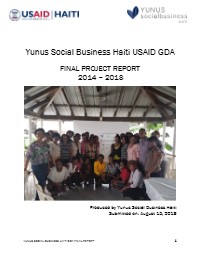
Rapport final du projet Yunus Social Business Haïti USAID GDA 2014 – 2018
Resume — Ceci est le rapport final du projet Yunus Social Business Haïti (YSBH) Global Development Alliance (GDA) avec l'USAID, couvrant la période de 2014 à 2018. Le rapport détaille les activités entreprises par YSBH pour soutenir les Micro, Petites et Moyennes Entreprises (MPME) et les Entreprises Sociales (ES) en Haïti, dans le but d'accroître la sécurité alimentaire et économique.
Constats Cles
- YSBH a fourni une assistance technique et un soutien à l'incubation pour améliorer la viabilité des plans d'affaires.
- YSBH a fourni des services post-investissement pour assurer la durabilité à long terme des ES.
- YSBH a fourni des capitaux d'investissement à des ES de haute qualité et à fort impact grâce à un processus d'investissement structuré.
- YSBH a facilité la formation et le renforcement des capacités, ce qui a permis de dispenser 11 619,75 heures de formation.
- YSBH a financé ou cofinancé 12 ES au cours de la durée du projet.
Description Complete
Le projet Yunus Social Business Haïti (YSBH) Global Development Alliance (GDA), en partenariat avec l'USAID, visait à établir la sécurité économique en Haïti en soutenant les Micro, Petites et Moyennes Entreprises (MPME), en particulier les Entreprises Sociales (ES). Le projet a fourni une assistance technique, un soutien à l'incubation et des capitaux d'investissement à des ES de haute qualité et à fort impact. Les activités comprenaient l'émission et la restructuration de prêts, la fourniture d'un soutien technique supplémentaire, la conduite de programmes d'accélération et l'offre de services de développement des entreprises (SDE) dans tout le pays. Le projet s'est orienté vers les composantes d'éducation et de formation tout en suspendant les activités de financement vers la fin de l'exercice 2016. Le rapport détaille les résultats obtenus d'octobre 2014 à mars 2018, notamment la création d'emplois, les heures de formation et la génération de revenus.
Texte Integral du Document
Texte extrait du document original pour l'indexation.
YUNUS SOCIAL BUSINESS HAITI GDA FINAL REPORT 1 Yunus Social Business Haiti USAID GDA FINAL PROJECT REPORT 2014 – 2018 Produced by Yunus Social Business Haiti Submitted on: August 15, 2018 YUNUS SOCIAL BUSINESS HAITI GDA FINAL REPORT 2 PAGE LEFT BLANK INTENTIONALLY YUNUS SOCIAL BUSINESS HAITI GDA FINAL REPORT 3 Table of Contents 1. List of Acronyms ………………………………………………………………………………………………………………4 2. Program Overview and Activities …….…………………………………………………………………………………5 3. Overview of Activities Undertaken from October 2014 to March 201 8……..…………………………6 4. Summary of Results …………………………………………………………………………………………………………7 5. Results Narratives…………………………………………………………………………………………………………….9 6. Technical Assistance to SBs …………………………………………………………………..……………………… .15 7. Technical Assistance through BDS ………………………………………………………………………………… 1 7 8. Amount Leveraged………………………………………………………………………………………………………… 20 9. Financial Information ……………………………………………………………………………………………….......2 1 10. Methods used and overall achievements …………………………………………………………………………22 11. Lessons Learned…………………………………………………………………………………………………………….2 4 12. YSBH post- GDA ………………………………………………………………………………………………………………2 6 13. Annex ……………………………………………………………………………………………………… . ……………………2 7 YUNUS SOCIAL BUSINESS HAITI GDA FINAL REPORT 4 Acronyms AOR Agreement Officer’s Representative BDS Business Development Services B/IO Bureau/Independent Office BIP Branding Implementation Plan BP Business Plan c. Circa EMPR Environmental Mitigation Plan and Report GDA Global Development Alliance GOH Government of Haiti GP Global Partnerships IC Investment Committee IP Investment Process KPIs Key Performance Indicators LAB/CTP U.S. Global Development Lab/ Center for Transformational Partnerships LOP Life of Project m. Million MSME Micro, Small, and Medium Enterprises PSDS Private Sector Development Strategy SME Small and Medium Enterprises NGO Non-Governmental Organization RC Review Committee SB Social Business TA Technical Assistance T&C Terms & Conditions USD US Dollar USG U.S. Government YSB Yunus Social Business YSBH Yunus Social Business Haiti YUNUS SOCIAL BUSINESS HAITI GDA FINAL REPORT 5 1. Program Overview and Activities 1.1 Overview of the GDA The Global Development Alliance (“GDA”) is a United State Agency for International Development program (USAID) created in 2001 with the goal of achieving long and sustainable development impacts in emerging countries through private-public partnerships. USAID believes that engaging and aligning private and public resources, interests, and expertise will expand development impact beyond just stimulating economic growth through developed businesses and augmented workforces, addressing environmental and health issues, reducing food insecurity and poverty, increasing access to education and establishing the rule of law. With such objective in mind, on September 30, 2014 USAID and Yunus Social Business Haiti (“YSBH”) entered into a 3 year -partnership (October 1 st , 2014 to September 31st, 2017) to sustain and expand on YSBH and USAID’s mutual objective of establishing economic security in Haiti by supporting Micro, Small and Medium Sized Enterprises (“MSMEs”), and particularly Social Businesses (“SBs”). However, on September 1,2017, one month before the end of the GDA, USAID extended the contract for another six months, running from October 1, 2017 to March31, 2018. Pioneered by Nobel Peace Prize Laureate Professor Muhammad Yunus, a Social Business is a company created for social benefit rather than private profit. In addition, the SBs are built to address specific social or environmental problems in a financially self-sustainable way. Investors in SBs are entitled to only the original principal of their investment. Profits generated by the SB are recycled into the same business or in to a socially beneficial activity. However, towards the end of FY 2016, a strategy change was implemented and YSBH shifted towards the education and training components of the program while suspending financing activities. The GDA’s most important result which is to increase food and economic security in Haiti will be achieved through one intermediate result (IR2) divided into sub-categories targeting different activities and yielding different results. This approach will contribute to developing sustainable and productive MSMEs and particularly SBs. YSBH’s activities are designed to directly support the achievement of USAID’s objectives. From October 2017 to March 2018, YSBH strove to achieve the following three USAID sub-results: - SR1.1 Technical assistance and incubation support provided to enhance viability of business plans; - SR1.2 Post-investment services provided to ensure long-term sustainability of SBs; and - SR2.1 Investment capital provided to high quality high impact SBs through the structured investment process, leveraging private sector capital in order to launch and scale SBs. Investments made to companies already in the portfolio that needed further financing would be supported. YUNUS SOCIAL BUSINESS HAITI GDA FINAL REPORT 6 1 st Accelerator program con ducted 2. Overview of Activities Undertaken from October 2014 to March 2018 As previously reported in the three annual and semi-annual reports covering the period of October 2014 to March 2018, YSBH conducted the following activities: - Issued and or restructured loans of the 12 SBs within its portfolio. - Provided additional technical support for portfolio businesses as to increase capacity building and management services and investments to mitigate economic strife due to currency devaluation. - Conducted two accelerator programs which are intensive training course supporting a group of 15-20 entrepreneurs providing BDS and capacity building in every element of running and growing a social business in Haiti. - Conducted throughout the country workshop sessions for several SBs that provided business owners with the knowledge and tools necessary to succeed. YSBH heavily focused on the education and training component of the program because it realized that the lack of social business awareness in the business environment made it difficult to source and cultivate social entrepreneurs. - Provided BDS to entrepreneurs and businesses throughout the country that requested assistance. BDS are training, technical assistance, consultation, and other support provided to enterprises to build their capacity. - Held Open Hours and visit municipalities throughout Haiti in various sectors. - participated in a televised program to promote the concept of social business and how to access financing. YSBH Managers participated in conferences and panels with Quisqueya University, CFI, MCI, and Port-au-Prince Startup Week YUNUS SOCIAL BUSINESS HAITI GDA FINAL REPORT 7 3. Summary of Results The Table below (Table 1) wants to particularly emphasize the results achieved from October to March 2018. The previous three years’ results which were already reported in the annual reports for FY 2015, FY 2016, FY 2017 are reproduced below for comparison purposes. Indicator Number Indicator Title Unit of measure FY 15 FY 16 FY 17 FY2018 Oct2017 - Mar2018 LIFE OF PROJECT RESULTS 1 YSBH 1 (Custom - Ref. 4.5.2) # of jobs measured by full time equivalents (FTEs) created by Social Businesses FTEs 50 52.10 45.5 33 47 * YSBH 2 (Custom - Ref. 4.5.2) # of new jobs created as a result of USG - sponsored Public - Private Partnerships (PPP) Jobs 470 753 670 253 53 9 * YSBH 3 (PPP1) # of new jobs sustained as a result of USG - sponsored Public - Private Partnerships Jobs 134 1,335 670 253 603 * YSBH 4 (F4.6.2.11) Person hours of training completed in private sector productive capacity supported by USG assistance Person Hours 668 1,493 5,9 99 . 1 2651,6 11 ,6 19.7 ~ YSBH 5 (Custom ref 4.5.2.37) # of SBs receiving Business Development Services (BDS) from USG assisted sources # 25 61 7 6 86 86 YSBH 6 (Custom) # of SBs in the portfolio which have made an increase in revenues # 5 4 4 1 3 * YSBH 7 (Custom) Revenues generated by SBs created or sustained $ $1,109,440.16 $2,253,358.90 $1,368,057.09 $761,354.59 $ 5 , 4 21 , 599 . 30 ~ YSBH 8 (Custom) Percentage increase in revenues among SBs assisted % 72% 36.81% 35% - 23% 30% * YSBH 9 (4,6,2 - 9) # of SBs that have improved management practices as a result of USG assistance # 12 16 28 33 33 YSBH 10 (Custom) Percentage of female participants in USG assisted SBs % 48.0% 23% 3 7% 46% 3 9 . 2 5% * YSBH 11 (Custom) # of SBs financed or co - financed by YSBH # 11 12 12 12 12 YSBH 12 (Custom) Total value of investments made (debt and equity) $ $777,000 $877,000 $2,497,912 $2,497,912 $2,497,912 1 1 Some indicators are not cumulative as per the M& E plan thus the “average” formula was used to calculate the life of project results. Those indicators are marked with a * in the table above. For the other indicators that are not cumulative, the yearly results were summed to determine the life of project results and are marked with ~. The indicators that were already cumulative are just reported for life of project results. YUNUS SOCIAL BUSINESS HAITI GDA FINAL REPORT 8 YSBH 13 (Custom) Total # of customers of social businesses targeting low income households, purchasing goods and services at below market costs # of households 8,256 20,084 503,240 3,294 53 5 , 113 ~ YSBH 14 (custom) # of SBs formalized as a result of YSBH assistance # of SBs 3 6 7 7 7 YSBH15 (custom) # of trees planted as a result of YSBH SB activities which are six months old or more # of trees 0 0 0 0 0 YSBH 16 (custom) Total value of funds leveraged from private sector $ $812,767 $866,987 $1,298,287 $1, 575,767 1,575,767 YUNUS SOCIAL BUSINESS HAITI GDA FINAL REPORT 9 4 . Results Narrative _____________________________________________________________________________ As previously stated, YSBH works to enhance MSMEs and SBs in Haiti, which is an essential step in establishing economic stability and security in Haiti. Since 2014, YSBH has worked with SBs throughout the country and has focused on activities that help strengthen them in terms of management practices, job creation and sustainability, and income creation and growth. The following are project life results covering the period of October 2014 to March 2018 YSBH1 Number of jobs measured by Full Time Equivalents (FTEs) created by Social Businesses * The “average” formula was u sed to calculate the life of project results LOP Target: 85 | LOP results: 47| Percentage Achieved: 55 % This indicator measures the amount of full-time jobs equivalent (FTE) created by the SBs supported through YSBH’s funding. Supporting SBs is a key step in achieving growth and development because jobs generated by SBs help unqualified and otherwise unemployable individuals have an income since they are left out of the employment markets. From October 2014 to March 2018, the SBs in YSBH’s portfolio pr ovided full-time equivalents jobs on average to 47 individuals. This represents 55% of full time job equivalents created throughout the life of the project based on LOP targets. An FTE is an employment measurement method in which jobs are standardized against the number of hours worked in a full-time position over a 12-month period. To count as a job, person must be employed for at least 22 working days completed and work a minimum of 8 hours per day. For Yunus’ purpose, one Full Time Equivalent represents 260 days of work per year. An FTE could reflect the work of one individual or the aggregation of part time work of multiple people. Several factors contributed to obtaining these results: Haiti’s economic environment is undeniably struggling. This continuous economy-crisis, with a wobbly currency and weak government caused unattainable sales projections. As a result, several SBs defaulted on loans, went bankrupt and shut down operation thus reducing the number of people employed on a full-time basis. YSBH2 Number of new jobs created as a result of USG-sponsored Public-Private Partnerships * The “average” formula was used to calculate the life of project results LOP Target: 200 | LOP results: 538.5 |Percentage Achieved: 269.25% Throughout the project life, an average of 539 new jobs were created annually. This indicator measures the number of upstream jobs (farmers) and less so to indirect jobs (micro-entrepreneurs) created. Through the life of the project upstream farming jobs were affected by several environmental and climatic events such hurricanes and thus impacted the total of farming jobs created. However, an increase in the number of indirect jobs (POS) was noticed. When surveyed the SBs indicated that advices received during the BDS and YUNUS SOCIAL BUSINESS HAITI GDA FINAL REPORT 10 workshops sessions helped in strengthening and increasing their marketing strategies that attracted continuously POS and resellers. YSBH3 Number of new jobs sustained as a result of USG-sponsored Public-Private Partnerships * The “average” formula was used to calcu late the life of project results LOP Target: 368 | LOP results: 602.75| Percentage Achieved: 163.7% This indicator illustrates the number of jobs that are being sustained from one reporting period to another. On average, a total of 602.75 or 163.7 % of jobs were sustained per year including direct employment and indirect employment created by the micro-entrepreneurs. Although the target has been reached, the total number of job has been impacted by several factors including Haiti’s weak economy, cu rrency and government. This resulted in several SBs shutting down operation being unable to stay solvent. YSBH4 Person hours of training completed in private sector productive capacity supported by USG assistance * The yearly results were summed to determine the life of project results LOP Target: 4,500 | LOP results: 11,619.75| Percentage Achieved: 258.21% Training and capacity building is a key way in which YSBH supports entrepreneurs and SBs to both find and, importantly, create and sustain jobs in Haiti, in turn helping to create and sustain economic and social impact. These training sessions increase private sector capacity, by giving entrepreneurs and potential entrepreneurs training in issues such as corporate governance, best practice, marketing, environmental management, and development of accounting and management systems. The participation rate at training and educational opportunities were better attended than YSBH anticipated. YSBH conducted several one-day, two-day and weekly events throughout the country. Training sessions can last from one day to a week, depending on the needs of the group attending. A total of 11,619.75 training hours were provided throughout these four years of project life. It is important to note that the format for the workshop and training sessions has been the same. Workshops and training sessions would last from 2 to 8 hours and would cover themes such as: - Introduction to Entrepreneurship and Social Business, Group presentation during workshop held in Cap - Haitien YUNUS SOCIAL BUSINESS HAITI GDA FINAL REPORT 11 - How to create Social Impact in communities, - Sustainable Development Goals (SDGs), - Access to Market: how to get clients both locally and internationally, - Market Research: how to assess demand for product/service, - Market Research as part of business plan, pitch to investors / funders, - Introduction to Business Plan: purpose, sections of business plan, - Introduction to the Business Model Canvas (BMC) as a complement to business plan and pitch preparation - Working in Groups and Pitch to audience, - Legal structure of business (pros and cons of each) - How to access finance, Difference between microfinance and commercial banks - Financial literacy (Exchange rate, interest rates, compound interest) - Introduction to accounting, filing taxes (déclaration fiscale) Below is a non-exhaustive list of SBs that attended workshop sessions offered by YSB during the past four years: Ace School and Ateliers Pilotes Agroartisanal de Meyer (ACE School- APLADEM), Association des Jeunes Elèves Chrétiens de Tabarre (AJECT), the Becker College, the Centre de Formation et Encadrement Technique (CFET SA), DIGO, Fédération des Coopératives Cacaoyères du Nord (FECCANO - Federation of Northern Cocoa Cooperatives in English), the Haitian Education & Leadership Program (HELP), Protect the People (PTP), Haiti Creative, Lakou Lapè, Organizational pour le Développement des Pêcheurs d’Aquin (ODPA), Refuges des Femmes – Croix-des-Bouquets, Refuges des Femmes – Saint-Marc, and the Union des Coopératives Agricoles de le Région de Beaumont (UCARB - Union of Agricultural Cooperatives of the Beaumont Region in English) YSBH5 # of social businesses receiving Business Development Services (BDS) from USG assisted sources *These are cumulative totals LOP Target: 90 | LOP results: 86 | Percentage Achieved: 96% Providing BDS services to SBs is one vital component of the YSBH program. These services are mostly one on one consultation- type meetings between YSBH’s representatives and SBs directors/owners/managers that last for most from 1 to 3 hours during which topics such as business planning, procurement, market access, input supply, technical support in production techniques, technology and product development, quality control and marketing, micro-enterprise loans, etc. are discussed and provided advices and guidance. These services helped to develop the capacity of enterprises to better plan and manage their operations, improve their technical expertise, and overall establish sustainable YUNUS SOCIAL BUSINESS HAITI GDA FINAL REPORT 12 infrastructures. From October 2014 to March 2018, YSBH was able to provide BDS consultations to agents of 86 SBs aware of the services and assistance offered by YSBH. During the life of the project, YSBH met entrepreneurs of different industries including: agriculture, aquaculture, art-jewelry, export, food, publishing/media, real estate, technology, textile, and tourism. YSBH6 Number of SBs in the portfolio, which have made an increase in revenues *These are cumulative totals LOP Target: 16.25| LOP results: 3.25 | Percentage Achieved: 20% SBs with increased revenues demonstrate the impact that YSBH’s supports has on economic activity. Revenues help SBs ensure their sustainability and increase their social impact. On annual basis through the life of the project, a total of 3 SBS reported an increase in revenue. This represents a toal of 20%. The reason why this indicator was not achieved is that 8 of the original 12 SBs shut down operation due to inability to develop and market products results of a crashing economy. YSBH7 Revenues generated by SBs created or sustained * The yearly results were summed to determine the life of project results LOP Target: $3,600,000| LOP results: $5,421,599.30 | Percentage Achieved: 150.5 % Revenues generated by SBs are a way for YSBH to evaluate the success of SBs. These revenues are an indicator of both the economic and social impact of SBs. Revenues reflect the popularity of the SB's goods/services and utility to customers. Revenues are also what allow the SB to pay staff, putting this money back into the Haitian economy. These revenues will be used by each SB in the way that best helps the SB to ensure its sustainability and increase its social impact. Throughout the life of the project SBs generated a total amount $5,421,599.30. While the target was surpassed during these 4 years of life projects, SBs were impacted by various economic crisis and environmental issues that slowed the revenue productions. Events like natural disasters, continuous pacific and violent strikes or protests against the government, unstable currency causing lack of purchasing power all influenced the revenues reported by the SBs throughout the four years of project implementation YSBH8 Percentage increase in revenues among SBs assisted *The “average” formula was used to calculate the life of project results LOP Target: 50% | LOP results: 30 %| Percentage Achieved: 60% This indicator shows through percentage (%) increase the extent of those increased revenues discussed in indicator YSBH7. While on the surface it may appear that this indicator was not achieved, if you review the financial success of the operational SBs see YSBH7, in regard to revenues, it will show that SBs have indeed been surpassed the revenues target. YSBH9 Number of SBs that have improved management practices as a result of USG YUNUS SOCIAL BUSINESS HAITI GDA FINAL REPORT 13 assistance * These totals are cumulative LOP Target: 24| LOP results: 33 | Percentage Achieved: 137.5% This indicator measures the number of firms receiving USG assistance that improved their management practices (financial management, strategic planning, marketing or sales). Firms improve their productivity and in turn their competitiveness by adopting improved management practices. One way to measure this impact was to invite SMEs/SBs’ owners or representatives to complete a short survey form with yes/no questions that targets specific areas of business development. An answer of yes to more than 4 questions is considered for monitoring purposes as an improvement in management practices. A copy of the survey is attached to this report (see Annex 1 p.17). A total of 33 SBs participated and voluntarily answered the questions and showed improvement in their management practices. The 33 SBs with improved management practice are: - the 12 participants of the 1st accelerator program, Care 2 Communities, New Life Training Center, BelFwi Distribution, Kiki’s, Les Produits Pyram, Tea Lakay, Myabel, Haiplast Recycling, Seed Apparel, Sara's Farm, Sourire Sublime, West Indies Imaging Center; - 4 of the participants of the 2nd accelearator program, Ecole de Camp-Perrin, Projet de Vetiver, Projet de Production de Plantules Will-Roche, Standard Atelier Artisanat d'Haïti; - Anacaona, Huina, Café Caraibes, Feccano, Himalaya, Madame Carmen Cooking School, Izifwi, Palmis Eneji, Pain O Quotidien, Secret Lingerie of Haiti, Standard Atelier Artisanat d’Haiti, Wild and Fierce Children Wear, Satin, Agrobizz, Sandilou, Bijou Lakay, and Co-Expra YSBH10 Percentage of female participants in USG assisted SBs * The “average” formula was used to calculate the life of project results LOP Target: 21.25%| LOP result: 39.25% | Percentage Achieved: 184.7% This indicator underlines the importance of women in any given economy and tracks the number of women who gain access to productive economic resources including employment in YSBH supported SBs, workshop sessions and BDS services. The percentage of women to have benefited from BDS, training sessions, and employment from the SBs in YSBH’s portfolio now stands at 39.25%. This illustrates that SBs, and YSBH’s portfolio companies are making a concerted effort to sustain and recruit and encourage women participation. The women are increasingly participating in professional capacities. The target for this indicator was surpassed and demonstrate YSBH efforts to create events that cater to women YSBH11 # of SBs financed or co-financed by YSBH *These totals are cumulative LOP Target: 23| LOP results: 12 | Percentage Achieved: 52.17% YUNUS SOCIAL BUSINESS HAITI GDA FINAL REPORT 14 During the life of the project, YSBH financed 12 SBs. These SBs were chosen following unique criteria. In addition, throughout the end of the project, YSB-global decided to stop funding due to companies defaulting on loans and decided to shift the focus of its activities to the education component of the programs. The 12 SBs fi nanced by YSBH are : CBPM (Cooperative de Production Bellevue la Montagne), COPRABEP (Cooperative De Production Agricole De Bel Platon), Digo, ESN (Entrepreneurs Sociaux de Nicolas), Etre Ayisien, Hajica, Kreyol Essence, Palmis Enèji, Pain O Quotidien, SES A (Société Energétique et Sécurité Alimentaire), Izifwi and Snack Fresh. YSBH12 Total value of investments made (debt and equity) *These totals are cumulative LOP Target: $1,500,000| LOP results: $2,497,912 | Percentage Achieved: 166.52% This indicator measures the total value of funds that has been disbursed to create SBs in Haiti. Throughout the life of the project, YSBH financed a total of 12 SBs. YSB disbursed investment in more than one tranche, with later tranches dependent on SB achievement of financial/social indicators. The total amount of investment made throughout the four years of project implementation is $2,497,912. YSB Global met all the YSBs in Germany in Fall 2016 and decided to move away from Albania, Haiti and Tunisia. After an internal review by the Boston Consulting Group, YSB Global decided to focus on the other countries with a larger population, and where they can partner with large companies to create social businesses rather than finance start-ups to do social businesses. YSBH13 Total number of customers of social businesses targeting low-income households, purchasing goods and services at below market costs * The yearly results were summed to determine the life of project results LOP Target: 88,000 |LOP results: 535,113| Percentage Achieved: 608% - This indicator measures the total number of customers purchasing goods/services at below market costs. This is relevant to those SBs who operate on a model of creating impact by giving low-income Haitians access to essential goods and services. This is a key way to measure the additional social impact created through the SBs. During the life of the project a total 535,113 individuals/businesses purchased good from SBs supported by YSBH at low price. For monitoring purpose, the customers who are the bottom of the pyramid (BOP) are low income customers who are able to afford these products and services. YSBH14 Number of SBs formalized as a result of YSBH assistance *These totals are cumulative LOP Target: 15| LOP results: 7 | Percentage Achieved: 47% This is a key way to measure the additional social impact created beyond just the SBs which YSBH invests in. This indicator demonstrates the number of new registered Haitian entities YUNUS SOCIAL BUSINESS HAITI GDA FINAL REPORT 15 facilitated by YSBH services. Still today, the 7 SBs reported to have been formalized remained the same including Huina, IZIFWI, Kreyol Essence, Myabel, Palmis Eneji, Snack Fresh, and Standard Atelier Artisant d'Haiti. While more than 50% of SB touched by YSBH’s services have formalized, there are two commonly observed factors that have led to this unsatisfactory figure. 1) The SBs have already started the formalization process prior to any assistance from YSBH. 2) Because of the length required to process paperwork, usually due to government inefficiencies, the entrepreneurs spend a considerable amount of time waiting. This waiting period usually occurs over multiple reporting periods, thus limiting the number of firms we can confirm that have been formalized. YSBH15 Number of trees planted as a result of YSBH SB activities which are six months old or more *These totals are cumulative LOP Target: 50,000| LOP Results: 0 | Percentage Achieved: 0% This is a key way to measure the additional social impact created beyond just the SBs which YSBH invests in. To date there have been 0 (zero) trees planted which have reached a maturity of at least 6 months. YSBH contracted with two Haitian 2 cooperatives during the extension period with the goal of planting 144,000 trees (72,000 cocoa trees, 72,000 coffee). Trees are scheduled to be planted during summer 2018. We expect to have 20% of the trees to not survive after 6 months of being planted. YSBH16 Total value of funds leveraged from private sector *These totals are cumulative LOP Target: 1,500,000| LOP results: $1,575,767| Percentage Achieved: 105% YSBH has reached the target of funds leveraged, and the remaining funds will be spent by September 2018 through CASELI as implementer for YSBH. All leveraged funds from private sector have been spent during the life of the project. YUNUS SOCIAL BUSINESS HAITI GDA FINAL REPORT 16 5. Assistance and Support to Social Businesses (SBs) For the companies in the portfolio, YSB Haiti had set up a monthly reporting system where the companies had to not only give financial information but also data on social impact such as number of employees. The financial data has improved from the initial investments of YSB Haiti in 2013, where businesses were only sending receipts of expenses. This was a big challenge to analyze the operational performance on a month to month basis of the Social Businesses, but this would take at least 1 week to recreate t he company’s monthly financials. Some of the Social Businesses benefited from the monthly reporting given that it created a discipline to track monthly expenses. It took a couple of years for some of the SBs to regularly send their financial data to YSB Haiti. Pain O Quotidien had used the monthly reporting as a “check and balance” for their accounting and keeping all the owners on the same page for expenditures. This was also helpful when the Haitian Gourde had devalued in late 2016, the owners of Pain O Quotidien had to carefully watch cash flows in order the pay the quarterly debt payments that increased by 25%. Another challenge many SBs faced were legal issues. A few of the entrepreneurs (owners) were not in agreement on how the company should be managed – thus YSB Haiti had to arrange bi-weekly meetings to guide them in keeping the business operational. The owners of Digo would not agree on which expenses to pay for, and how to order raw materials to produce the detergent. YSB Haiti organized meetings to come up with an agreement on solving most pressing issues. But the challenges were too great to overcome and Digo had stopped operating formally as of July 2017. Most of the companies had a challenge in getting clients also known as “Market Linkages” YSB Haiti assisted some of the SBs with marketing to get new clients and how to present the product to the client. YSB Haiti assisted Palmis Eneji in growing their sales network with collaboration with Hope for Haiti in the South and cooperatives in the North that could assist them with sales. This follows many challenges with Palmis Eneji in operating profitably, thus we had recommended that they slash operating costs by 50% in Year 2, and close unprofitable stores outside of Port-au-Prince. YSB Haiti had to restructure the loan payments since they were in no position to pay the debt payments. Some of the companies were impacted due to natural disasters which delayed production, whereas others could not have a strong enough positive cash flow to pay their expenses and debt. Izifwi (LCH) was impacted by Hurricane Matthew which created a shortage of breadfruit, and prices had doubled soon after. This had postponed production of the baby food and only started to produce in May 2017. Sales have picked up for Izifwi in 2017, but not strong enough to make the loan payments. In summary YSBH provided assistance to SB. This assistance took several forms: - YSBH and YSB Global restructured different loans, helped solved issues in sourcing of castors seeds with cooperatives in Haiti for Kreyol Essence for example. YUNUS SOCIAL BUSINESS HAITI GDA FINAL REPORT 17 - YSBH taught Palmis Eneji how to not sell or stop selling on credit and helped increase network of sales in the South/ North through cooperatives - For example, with Digo, YSBH met with owners to solve production issues, cash flow, loan restructuring. Social Business Assistance provided CBPM (Cooperative de Production Bellevue la Montagne) SB secured financing from YSB Haiti to build a bakery but had difficulty in consistent production, selling bread at a profit and selling bread through bakery through different point of sales. YSB supported management to improve operations, financial projections and with budget. After different attempts for the bakery to produce on a full time basis, the bakery had run out of c ash to sustain operations. Even with changes on managing the bakery, sales never picked up to sustain its expenditures. COPRABEP (Cooperative De Production Agricole De Bel Platon) SB obtained financing to purchase the land, and build the chicken farm in La Gonave. The farm was built in a challenging environment exposed to sun and erosion from the mountain. The chickens were impacted with heat and disease that would kill at times 25% of the chickens in a 45 - day period. YSB consultants assisted farm in obtaining the chicks and feed using a credit system with Haiti Broilers, but the transportation costs were too high to sell the chickens back to Haiti Broilers on a contract basis. The f arm focused selling chickens to restaurants and hotels in La Gonave, but most sales were through women merchants at 250 HTG per chicken which was inferior to the cost of the chicken during the 45 day period.l Several efforts were attempted to improve manag ement, operations, reporting, and miniminz exposure to disease with assistance from vetenerians, but the farm could not sustain operations and repay its debt. Digo S B had to produce monthly report in order to evaluate progress. Based on the information re ceived, YSBH would provide assistance based on needs. For example, with Digo, YSBH met with owners to solve production issues, cash flow, loan restructuring. ESN (Entrepreneurs Sociaux de Nicolas) SB received financing to lease the land and build the chicken farm. The management had many difficulties in coming up with a consistent reporting of expenses and revenues. The farm had similar difficulties to the other chicken farms with most sales focused on women merchants at 250 HTG per chicken, thus selling at a loss. YSB Haiti helped in ESN to get a sale contract with Haiti Broilers. Farm would buy chicks and feed to Haiti Broilers and resell the chickens after 45 days. However, the terms were not in t he interest of the farm due to margin on the chickens, and managing the cash flow to sustain operations. The farm did face obstacles with disease as well, and YSB worked with many consultants, even with the Dutch government, but the revenues were not consi stent enough and margins too low to support its operations and repay its debt. * Etre Ayisien The SB received financing to support potential entrepreneurs in writing business plans, but the entrepreneurs were not willing to pay for the service or support and Etre Ayisien, though was able to successfully raise funds, but could repay the loan to YSB due to a model that was not sustainable. The level of the teachers was not adequate as well, as most of the business plans were poorly written with no financial projections. H ajica S B received financing to purchase land and build farm. The farm had many of obstacles of other farms, such as disease that would wipe out 24% to 40% of chickens – especially during the summer. The management preferred to sell chickens to women merchants rathe r than slaughter the chickens and sell to supermarkets, restaurants and hotels. If the farm had sold most of chickens slaughtered, it would increase its revenues two - fold, but this required better management of logistics (truck and traffic in Carrefour), b etter management of cash flows, credit with Haiti Broilers (as a result of support with YSB). Sale of chickens to Haiti Broilers was not the main source of revenue and margins were too thin to maintain farm sustainably. It YUNUS SOCIAL BUSINESS HAITI GDA FINAL REPORT 18 had issues in produc ing monthly r eport , and limiting risk of disease . YSB assisted in getting retail clients, but management would not sell test batches to Moulin Sur Mer, Big Star Market as an example. Sales to Marriott Hotel were not consistent enough and management did not develop a re lationship with the “chefs” at the Hotel that would decide on procurement of chickens. Eventually operations could not be sustained with unsteady and low revenues.. YSB is tr ying to sell the farm to other buyer s that c ould turn the f a rm around . Company sti ll oper ating informally and most sales are to women merchants. I zifwi S B had to produce monthly report in order to evaluate progress. Based on the information received, YSBH would provide assistance based on needs. For example, with IZIFWI, their operation started in May 2017, and production gradually progressed. Production im pacted by hurricane Matthew and Irma. Kreyol Essence S B had to produce monthly report in order to evaluate progress. Based on the information received, YSBH would provide assistance based on needs. For example, with Kreyol Essence, YSBH and YSB Global res tructured different loans, helped solved issues in sourcing of castors seeds with cooperatives in Haiti. Palmis Enèji S B had to produce monthly report in order to evaluate progress. Based on the information received, YSBH would provide assistance based on needs. For example, with Palmis Eneji, company negatively impacted by credit and sales. Company advised to no longer sel l on credit and to improve distribution network. Company progressed on providing financial information on timely basis. POQ (Pain O Quotidien) S B had to produce monthly report in order to evaluate progress. Based on the information received, YSBH would pr ovide assistance based on needs. For example, with Pain O Quotidien, company negatively impacted by national currency crisis. Looking to open other branches. SESA (Société Energétique et Sécurité Alimentaire) SB received financing to purchase seeds and plant jatropha trees in the intent of producing bio - diesel. The SB received support from YSB to create business plan, recruit the team to manage operations, and teach them on creating financial reports. The SB wa s negatively impacted by the drought soon after planting, and unfortunately the trees were not the right variety for Haiti . The SB decided to halt operations and repaid the unspent amount of the loan. The SB is now continuing operations through support of other partners with a new hybrid v ariety . The jatropha will not produce bio - diesel, but rather to manufacture feed for animals. Snack Fresh SB received financing to create the entity with the Haitian government, assisted the SB in obtaining additional financing through other partners. The SB had difficulty in sourcing raw materials from cooperatives, thus several meetings were organized with cooperatives to understand supply chain management and role of the SB for the cooperative. Additional support pr ovided in writing business plan, coming up with financial projections, and market research with supermarkets on demand for product. Management of SB had difficulty in coming up with financial reporting on expenses, and not cooperative once funds were rece ived. Entrepreneur has since left Haiti for the US and company is not operational. *Etre Ayisien defaulted on its debt before the GDA began with USAID in October 2014. YUNUS SOCIAL BUSINESS HAITI GDA FINAL REPORT 19 6. Technical Assistance through BDS With all the entrepreneurs that YSB Haiti met during the GDA, many at first were looking for cheap or concessional loans but could not qualify with YSB Haiti given our criteria of no dividends and YSB Haiti financing cost between 8%-10% per year in US dollars. The entrepreneurs that were more mature i n their “project” had no business plan, no strategy or marketing plan. Thus, meetings focused in assisting them with an accounting system, and a defined business model rather than a “boutique” of different items. Once achieved, they could return to YSB Haiti and based on the business, work on becoming a Social Business. Some entrepreneurs did return several times and moved along with an improved pitch of the business, and more concrete financial projections. For many of the SBS to be investment ready they would need more than just a 3-month Accelerator to receive investments. Many of the entrepreneurs that we met, were referred by other programs either for more financing or more support. We obtained referrals from the Ministry of Finance (IDB program), Ministry of Commerce (IDB program), from PADF LEAD, from LEVE and the CFI. The issue is not the referral but when entrepreneurs seek capital from all projects and are unable to progress due to mentors giving them conflicting advice on how to proceed with the business. This shows the necessity for all projects to communicate on companies they are supporting and financing. Company Assistance Provided Period \ 1 BelFwi Distribution Participant in 1 st Accelerator in PAP. Year 1 2 Care 2 Communities Participant in 1 st Accelerator in PAP. Year 1 3 Culligan S.A Met with the entrepreneur who was looking for additional financing to support a local juice brand rather than importing concentrate from another country in the Caribbean. The entrepreneur was supposed to follow up with YSB. Entrepreneur did seek financing opportunities from Root Capital as well, but was looking for cheap financing. The terms of no profits for entrepreneurs was not well received. They finally raised financing through PROFIN in a 3 tranche issue. Year 1 4 Cyber Centre Participant in 1 st Accelerator in PAP. Year 1 5 Haiplast Recycling Participant in 1 st Accelerator in PAP. Year 1 6 Happy Farms S.A. Business wanted to expand chicken meat business away from Jacmel to PAP to decrease transportation costs and met with YSB consultants to create new farms, seeking financing and later to acquire YSB portfolio company in Leogane. In addition, was looking for financing to expand on agro forestry projects in Leogane region. Year 1 7 Kiki's Participant in 1 st Accelerator in PAP. Year 1 8 Les Produits Pyram Participant in 1 st Accelerator in PAP. Year 1 9 Madame Sara Participant in 1st Accelerator in PAP. Year 1 10 Myabèl Participant in 1 st Accelerator in PAP. Year 1 11 New Life Training Center Participant in 1 st Accelerator in PAP. Year 1 YUNUS SOCIAL BUSINESS HAITI GDA FINAL REPORT 20 12 Roots Carbon Met with them through the 1 st AOR of YSB Haiti and were looking for additional financing and assistance with sales of charcoal through Palmis Eneji who were selling cook stoves. Met with them several times, but the grants received were not enough to continue operations, needed additio nal financing that could not be supported by YSB at that time, and they did not agree with model of no profitability by shareholders. Year 1 13 Sara's Farm Participant in 1 st Accelerator in PAP. Year 1 14 Seed Apparel Participant in 1 st Accelerator in PAP. Year 1 15 Sienna Ag Participant in 1 st Accelerator in PAP. Year 1 16 Soins Bucco Dentaires Pour Tous Participant in 1 st Accelerator in PAP. Year 1 17 Sourire Sublime Participant in 1 st Accelerator in PAP. Year 1 18 Tea Lakay Participant in 1 st Accelerator in PAP. Year 1 19 West Indies Imaging Center Participant in 1 st Accelerator in PAP. Year 1 20 ACCESSO Looking for financing to support planting operations in Mirebalais and the South. Not in line with nonprofit model of Social Business. Year 2 21 AECOM Looking for support and ideas on Social Business. Not looking for financing. Year 2 22 Agribiz Looking for quick financing at low cost. Not in line with Social Business Model of no profits. Year 2 23 Agropak S.A Looking for quick financing at low cost. Not in line with Social Business Model of no profits. Year 2 24 ALORO Looking for quick financing at low cost. Not in line with Social Business Model of no profits. Year 2 25 Anseye pou Ayiti Entrepreneur looking for ideas to support program and how to become sustainable. Not looking for financing, and wanted YSB to join Board. Year 2 26 CADPH Cooperative Looking for quick financing at low cost. Not in line with Social Business Model of no profits. Year 2 27 Caribbean Artisanat Looking for quick financing at low cost. Not in line with Social Business Model of no profits. Year 2 28 Chocalateris Askanya S.A. Looking for quick financing at low cost. Not in line with Social Business Model of no profits. Year 2 29 Chremiss Looking for quick financing at low cost. Not in line with Social Business Model of no profits. Year 2 30 Collecte de fruits et de légumes frais en milieux ruraux pour leur distribution à Port - au - Prince Participant in 2 nd Accelerator in Les Cayes. Year 2 31 Ecole de sport Participant in 2 nd Accelerator in Les Cayes. Year 2 32 Espri - Sel Looking for quick financing at low cost. Not in line with Social Business Model of no profits. Year 2 33 Ethical Fashion Initiative Entrepreneur is a USAID grant recipient but looking for more quick financing at low cost. No accounting structure, not formalized. Entrepreneur would return once ready and more formalized. Year 2 34 Etude Notaire Alphonse Looking for quick financing at low cost. Not in line with Social Business Model of no profits. Year 2 35 Event & Wedding Planner Looking for quick financing at low cost. Not in line with Social Business Model of no profits. Year 2 36 HTRIP Looking for quick financing at low cost. Not in line with Social Business Model of no profits. Year 2 YUNUS SOCIAL BUSINESS HAITI GDA FINAL REPORT 21 37 INSOLFOR Looking for quick financing at low cost. Not in line with Social Business Model of no profits. Year 2 38 JF Productions Looking for quick financing at low cost. Not in line with Social Business Model of no profits. Year 2 39 Kaleos Looking for quick financing at low cost. Not in line with Social Business Model of no profits. Year 2 40 La Fondacion Sel Looking for quick financing at low cost. Not in line with Social Business Model of no profits. Year 2 41 LIFE S.A. Looking for quick financing at low cost. Not in line with Social Business Model of no profits. Year 2 42 MAKBENGLOBE Participant in 2 nd Accelerator in Les Cayes. Year 2 43 Maxima S.A Entrepreneur was initially looking for short term financing quickly to resolve cash flow issues to produce orders of furniture. The company was legally registered but not a social business. Company could not meet criteria of social business for $250,000 of 3 to 6 months financing. Year 2 44 Mellio Joseph (Entrepreneur) Looking for quick financing at low cost. Not in line with Social Business Model of no profits. Year 2 45 Mini Centres d'approvisionnement et de commercialisation de produits agricoles Looking for quick financing at low cost. Not in line with Social Business Model of no profits. Year 2 46 Miyamoto Looking for quick financing at low cost. Not in line with Social Business Model of no profits. Year 2 47 NORAMISE Looking for quick financing at low cost. Not in line with Social Business Model of no profits. Year 2 48 Organisation des Planteurs de Mailloux de Gaëtan et de Troirac (OPMAGAT) Participant in 2 nd Accelerator in Les Cayes. Year 2 49 Port Sain Louis du Sud Looking for quick financing at low cost. Not in line with Social Business Model of no profits. Year 2 50 Projet de Construction d'une Usine d'huile de Ricin Participant in 2 nd Accelerator in Les Cayes. Year 2 51 Projet de production de plantules Participant in 2 nd Accelerator in Les Cayes. Year 2 52 Projet de transformation de l'huile de vétiver Participant in 2 nd Accelerator in Les Cayes. Year 2 53 Rapino Foundation Looking for quick financing at low cost. Not in line with Social Business Model of no profits. Year 2 54 SAPENSA S.A Looking for quick financing at low cost. Not in line with Social Business Model of no profits. Year 2 55 SISALCO Entrepreneur looking for additional financing at low cost, but not in line with strategy of Social Business and no profits. Year 2 56 Societe des Entrepreneurs Agricoles pour la Modernization Commerciale d'Haiti Looking for quick financing at low cost. Not in line with Social Business Model of no profits. Year 2 57 Usine de Transformation Participant in 2nd Accelerator in Les Cayes Year 2 58 Valerie Alvarel Looking for quick financing at low cost. Not in line with Social Business Model of no profits. Year 2 59 Valoren Looking for quick financing at low cost. Not in line with Social Business Model of no profits. Year 2 YUNUS SOCIAL BUSINESS HAITI GDA FINAL REPORT 22 60 Wastek Solutions Met with the entrepreneurs as a referral through PADF LEAD. They were looking for additional financing for a factory to create charcoal. The financing would have been used as collateral with PADF LEAD. They were supposed to return once they had started operations and s ee how sales would progress. They were referred to the Ministry of Finance program with FDI on additional financing and they were able to get a short term loan in local currency. Year 2 61 Zafen (Fonkoze) Looking for financing at low cost for portfolio. Not in line with Social Business Model of no profits. Year 2 62 Anacaona French Entrepreneurs to recycle soap, seeking better ways to sources. Referred by Entrepreneurs du Monde. Advice on working on business model and financial projections Year 3 63 Atelier Ecole de Camp Perrin Assistance with establishing financial projections and creating business plan. Entrepreneur received grant from H