

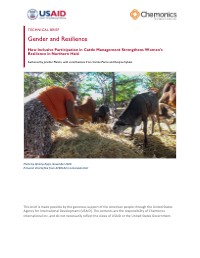
Gender and Resilience: How Inclusive Participation in Cattle Management Strengthens Women’s Resilience in Northern Haiti
Summary — This technical brief explores the role of women in agriculture in Haiti, the challenges they face, and the effects of inclusive livestock management in strengthening household resilience. It provides insights to inform future resilience activities for the USAID Reforestation Project and other resilience programs in Haiti, emphasizing the importance of gender inclusion in agricultural practices.
Key Findings
- Women in Haiti face significant social, political, and economic disadvantages.
- Inclusive livestock management strengthens women's household resilience to shocks.
- ASPS forage production disrupts traditional agropastoral roles and empowers women.
- Gender-inclusive approaches in agricultural programs lead to more effective resilience-building interventions.
- Investment in livestock management improves household and community resilience to economic and natural shocks.
Full Description
This technical brief examines the critical role of women in Haitian agriculture and the significant challenges they encounter, including social, political, and economic disadvantages. It highlights how inclusive livestock management practices, particularly within the USAID Reforestation Project in the Nord and Nord-Est departments, can enhance women's resilience to various shocks such as food insecurity, natural disasters, and economic instability. The brief explores the effects of integrating women into livestock management programs, focusing on forage production, conservation techniques, and veterinary training, and provides insights for future resilience initiatives in Haiti, emphasizing the importance of gender-sensitive approaches to agricultural development.
Full Document Text
Extracted text from the original document for search indexing.
TECHNICAL BRIEF Gender and Resilience How Inclusive Participation in Cattle Management Strengthens Women’s Resilience in Northern Haiti Authored by Jennifer Plantin, with contributions from Carole Pierre and Evelyne Sylvain Photo by Djimmy Regis, November 2020. Pictured: Vital Sefina from APROLIM in Limonade Haiti This brief is made possible by the generous support of the American people through the United States Agency for International Development (USAID). The contents are the responsibility of Chemonics International Inc. and do not necessarily reflect the views of USAID or the United States Government. USAID/HAITI REFORESTATION PROJECT February 2021 Introduction Women in Haiti are often at social, political, and economic disadvantages compared to their male counterparts, as evidenced by Haiti's ranking in the Gender Inequality Index (152 out of 162 countries) (UNDP, 2020). The gap is especially significant and consequential for rural women who engage primarily in subsistence farming with little to no access to or control over productive assets and financial services. The patriarchal system that persists today exacerbates these entrenched disparities, especially in rural Haiti. These challenges make women more vulnerable to the many shocks Haiti continues to experience, such as food insecurity, natural disasters, climate change, political instability, and economic shocks. One emerging opportunity to improve livelihoods and bolster household resilience while mitigating climate change is inclusive livestock management. International development practitioners have observed promising results for increasing household resilience to natural and economic shocks when activity designs apply a gender lens to livestock management (Chanamuto, 2015). So is the case for the USAID Reforestation Project, which has emphasized the inclusion of women in program design for livestock management the Nord and Nord-Est Départements of Haiti, This five-year project, implemented by Chemonics International, with its partners the International Center for Tropical Agriculture (CIAT) and the National Cooperative Business Association Cooperative League of the USA (NCBA CLUSA), addresses threats to deforestation and reforestation holistically by providing livelihood alternatives and building household resilience to economic and natural shocks. In establishing its strategy for targeted interventions, the project utilized a participatory approach to conduct surveys and focus groups, which showed how local livestock management, as practiced by men and women, poses a threat to deforestation and reforestation. The data collected also revealed the opportunity for inclusive cattle management to build household resilience to climate change and economic shock. This brief explores 1) women in agriculture in Haiti, their role, and the challenges they face; 2) effects of inclusive livestock management in helping women strengthen household resilience; and 3) insights to inform future resilience activities for the USAID Reforestation Project and future resilience programs in Haiti. I. Women in Agriculture in Haiti Haitian society refers women to as a "poto mitan" (“central pillar”) in Creole, a phrase that attests to the important role women play in daily life and the burden they shoulder. "Poto mitan" also powerfully alludes to the ancestral religion of Voodoo —whose ceremonial dances revolve around a central pillar; this allusion strengthens sociocultural imagery that reinforces Haitian women’s importance. In some respects, these metaphors glamorize the burden placed on Haitian women, but they also reflect women’s integral role in providing for their household and community. In many ways, women “Fanm nou se rozo. Yo mèt koupe nou, yo mèt koupe rasin nou, lè lapli a tonbe, nap boujounen” “Women, we are reeds, they may cut us down, they pull our roots, when the rain comes, we will bud again.” — Popular song in feminist associations in Haiti play a large role in the Haitian economy and food system. Sixty-two percent of Haitian women work which is one of the higher percentages of women's labor force participation in the world (UNDP, 2020). Women play a key role in Haiti's local food production and distribution systems. Haitian women led the 2 USAID/HAITI REFORESTATION PROJECT February 2021 internally oriented food economy from the time of colonization. Today, they are involved in the household economy, the subsistence food economy (jaden lakou or home garden), the social economy (sharing of plates and harvest with elders or widows), the informal market economy (in which 75% of women work), and the informal market distribution system (madan sara); in a lesser capacity, they are also involved in the formal food economy (Vansteenkiste, 2017). The Women Empowerment in Agriculture Index captured Haitian women's status in agriculture at 0.85 (max is 1) in 2014; this index considers Haitian women's empowerment relative to men’s in agriculture across five areas: production, resources, income, leadership, and time use (Malapit, 2014). Surveys conducted by the USAID Reforestation Project in the Nord and Nord-Est Départements between 2018 and 2021 found that women were involved at various agricultural production stages, including soil preparation, seed planting, seedling maintenance, harvest, post-harvest activities, and livestock management (e.g., cattle keeping). However, although madan saras are central traders of locally produced staple foods, the role of women in agriculture and the food system is generally relegated to oversight of lower earning crops and production for household consumption. Except for in the rice sector, a sector in which women are a significant portion of the wholesalers, women tend to participate largely in local and small scale transactions (Famine Early Warning System Network, 2018). However, the domestic food economy does not exclude men. Men often play a supporting role, providing labor and assets such as land in mixed-headed households, and they dominate food production of higher value crops destined for the local market or commercial exportation. Women in Haiti play a crucial role in the economy despite the numerous constraints they face (see Table 1). The United Nations Development Programme (UNDP) Gender Inequality Index report for 2020 indicates that 63.6% of the loss in Haiti's potential human development is due to gender inequality. Table 1. Women in Haiti Income and financial services Health Demographics Women make 32% less per hour than men in the formal economy (Banyan, 2016). Adolescent birth rate (births/1,000 women ages 15–19) is 51.7 (World Bank Data, 2020). 50.66% of the total population (World Bank Data). 75% of women work in the informal sector (Banyan). Maternal mortality ratio (deaths/100,000 live births) is 480 (World Bank Data). Women represent 45.1% of heads of households nationally (World Bank Data) and 45% in the Project’s areas of intervention (USAID) The national unemployment rate is twice as high for women than for men (Banyan). Population with at least some secondary education (% ages 25 and older): 26.9% vs. 40% for men (UNDP, 2020). In rural areas, women are almost three times more likely to be unemployed than men (Banyan). Literacy rate 58.3% vs. 65.3% for men (Central Intelligence Agency, 2019). In addition, national data report the unequal distribution of used agricultural area (UAA), with women planting only 25.3% of farms counted throughout the country and the size of the farms exploited by women amounting to only 20.4% of the total UAA (Ministère de l’Agriculture, 2008/2009). In 2017, the Ministry of Agriculture estimated that 22% of all farm managers were women; In 2018, only 6% declared having sole ownership of a house, and only 7% owned land (République d’Haïti Ministère de La Santé Publique et de La Population, 2018). A lack of capital and low financial literacy leads to weaker access to financial markets. Family, friends, and self-managed solidarity groups are the primary providers of credit in rural areas, with 58% of the population having recourse to credit, as compared to 16% in urban areas; 3 USAID/HAITI REFORESTATION PROJECT February 2021 in 2019, 41% of women had formal or informal credit and indebtedness, and only 14% of women had a formal and informal savings account (World Bank Group, 2019). Another significant hindrance is the opportunity cost of caring for the sick, elderly, children, and household duties such as fetching water and collecting firewood. The socioeconomic fallout from the COVID-19 pandemic has compounded these effects, further reducing women's income from trade and other subsistence activities due to border market closures directly affecting women in the Nord-Est Département, working at the border with the Dominican Republic. These challenges limit women's absorptive, adaptive, and transformative capacities, making them less resilient to natural and economic shocks, and increase the negative economic effects that often accompany these shocks (Chemonics, 2019). Women’s resourcefulness and fortitude in surviving despite these circumstances are commonly referred to as “resilience.” USAID formally defines “resilience” as "the ability of people, households, communities, countries, and systems to mitigate, adapt to, and recover from shocks and stresses in a manner that reduces chronic vulnerability and facilitates inclusive growth" (USAID, 2012). This definition is a clear break with past understandings of resilience as mere survival; now, going beyond helping people survive one shock after another; and building resources for them to thrive and advance despite recurring shocks, stresses, and uncertainties (Hillier, 2013). II. Effects of Inclusive Livestock Management in Helping Women Strengthen Household Resilience Many food security assessments overlook rural women's knowledge and labor, especially in relation to livestock production and agroforestry (BRIDGE, 2014). However, the implementation of food security projects in sub-Saharan countries have documented women's role in livestock management, which has proven to be a great alternative asset in societies, like that of Haiti, in which land ownership is less accessible to women (Quisumbing, 2014). For rural Haitian households, livestock is a critical asset and often considered an investment or savings "account" because families use the revenue from animal, meat, or by-product sales to finance household expenditures for health care, significant life events (weddings and funerals), or recurring payments, such as school fees. The USAID Reforestation Project identified improving livestock management as a potential avenue for the to reduce the threats to deforestation and reforestation by promoting alternatives to fuelwood as a source of income and energy. In 2018, the USAID Reforestation Project held workshops and focus group discussions on livestock management practices in the Nord and Nord-Est Départements to better understand animal nutrition practices (USAID, 2018). Participants listed the constraints hindering breeding activities and identified opportunities to improve animal husbandry and pasture management. This participatory learning activity informed the design of the project’s current livestock management program, which focuses on introducing techniques that promote sustainable, forest-friendly cattle management: 1. Forage production in agrosilvopastoral systems 2. Forage conservation (hay and silage production) 3. Veterinary training 4. Cattle deworming activities and awareness campaigns The first two components of the program address the negative impact of variable rainfall on cattle nutrition while providing alternatives to open grazing, a significant threat to the project's reforestation efforts. The Nord and Nord-Est Départements have experienced extended droughts in recent years. This trend has not only decreased crop output but has also resulted in the death of thousands of heads of cattle per annum (approximately 3,000 in 2019 alone) due to the unavailability of pasture and grasses for 4 USAID/HAITI REFORESTATION PROJECT February 2021 open grazing (the primary source of animal food for smallholder farmers), forage, and feed (USAID, 2019). The project introduced techniques to improve the availability of animal feed through sustainable forage production in agrosilvopastoral systems (ASPS) and forage conservation methods like hay and silage1 production to build resilience to these natural shocks (see Figure 1). Forage Production Agrosilvopatoral Systems Figure 1. Open grazing, climate change, and women ASPS is an eco-friendly agroforestry method of combining forage, woody perennial, and crop components on the same lot (USAID, 2015). ASPS benefits farmers through productive and protective functions by diversifying land use to grow food for humans and livestock to increase their output (such as meat, milk, and manure) while the application of manure builds soil, organic matter, and water holding capacity for improved crop production; in turn, crop residues are collected to enrich livestock feed (Snapp, 2017). If managed correctly, agrosilvopastoral systems grow on this repeating cycle of benefits to help diversify income for farmers: cash crops contribute to cash savings, timber and fruit trees are long term investments, livestock are an asset, and forage can be preserved for self-use or sold during dry seasons to feed cattle. ASPS methods adapt to many climates and have worked especially well for smallholder farmers living in changing climatic conditions on mid- and highlands. ASPS is well suited for Haitian farmers due to the relatively small average size of lots utilized, estimated nationally at 2.3 acres or 0.93 hectares (Ministère de l’Agriculture, 2009). Similarly, ASPS worked well for the smaller mean lot size of 0.52 hectares of farmer-beneficiaries of the project. Evidence from countries such as Niger and Ethiopia demonstrate that trees planted in agroforestry settings have a better chance of survival than those that are not (Reij, 2013). Trees planted in the ASPS plots in the USAID Reforestation Project's area have, on average, a survival rate that is six percentage points higher than those planted in woodlots. The ASPS techniques introduced by the project in the Nord and Nord-Est targeted forage production in the traditional jaden lakou or home garden. Demonstrations covered the construction and use of contour delineating devices to install anti-erosive structures, such as alternating strip grasses with pineapple shoots. Training emphasized high-value crops and diverse forage trees and grass species, such as moringa, gliricidia sepium, elephant grass, guinea grass, and pangola grass with velvet bean planted between crop rows to provide added value. These techniques helped dismantle the long-held belief that 1type of fodder made from green foliage crops which have been preserved by acidification, achieved through fermentation. 5 USAID/HAITI REFORESTATION PROJECT February 2021 grasses suitable for animal feed were invasive species that would compete with human food production. The project also partnered with regional universities, local branches of the Ministry of Agriculture, agropastoral associations, and community-based organizations to establish demonstration plots across six communes in the Nord and Nord-Est as practical training grounds and seed banks for farmers. The demonstration plots have been useful in promoting the adoption of these production techniques for personal use and selling to other livestock farmers. By applying practices adapted to the prevalent climatic conditions, the plots produced 159 tons of dry matter in 2020. Forage Conservation Techniques After providing forage production training, the USAID Reforestation Project focused on promoting harvesting and conserving forage as hay and silage. Before these techniques’ introduction, local farmers relied primarily on fresh forage, crop residues, and by-products, which were insufficient during the dry season (USAID, 2018). These forage conservation techniques contribute to expanding the availability of animal feed for improved livestock zootechnical performance through recurring droughts. The project developed step-by-step guides in local language (Figure 2) to train over 250 livestock farmers (including 97 women) in forage, hay, and silage production, including choice of adapted plant species, harvesting, feeding, and storage. Some livestock owners partnered with other members of their associations to create new hay processing units that package and conserve fodder crops. The project is holding more training to create micro or small enterprises to further the forage value chain to diversify these farmers' income sources. Cattle Deworming Activities and Awareness Campaigns The USAID Reforestation Project also led deworming awareness campaigns to promote the benefits of regular vaccination and cattle veterinary care while advertising existing services offered by the Ministry of Agriculture's Groupman Sante Bèt (its veterinary unit). In preparing for the campaign, the project donated supplies and sponsored training for the ministry's designated communal veterinary agents from Groupman Sante Bèt to update their knowledge of animal vaccination delivery services. In partnership with the ministry, the project allocated an accessible price for these services to make them sustainable beyond the life of the project. Figure 2. Training material for hay production in local language produced by the USAID Reforestation Project Figure 3. Two vetenary agents from GSB deworming cattle in Limonade in June 2020. Photo by E. Oscar Jacob 6 USAID/HAITI REFORESTATION PROJECT February 2021 Impact on Women Considering that 45% of women in the project's area raise livestock (USAID, 2019), the rate of women's participation across the cattle management program was significant (ASPS forage production and hay production 31.17%, veterinary training 25%, deworming campaign 29.43%). A follow-up survey conducted in 2021 asked 69 individuals who participated in training on forage production (46 women and 23 men) whether they knew about ASPS forage production techniques before the training. Of these participants, 80% said they did not (49% were women). Over 98% of the participants reported having applied these techniques since the training; 65% were female respondents. These promising results are largely due to the USAID Reforestation Project's efforts to foster gender inclusion in the cattle management program. The project did so by layering several approaches and interventions: 1. Collecting sex-disaggregated data of all people-level indicators and setting targets for women's participation at 30% across all activities for the life of the project but especially for activities aiming to improve livelihoods and build resilience. 2. Using a participatory approach such as the Community Options Assessment and Investment Tool (COAIT), producing a political economy analysis, workshops, and focus groups to learn from beneficiaries and to engage them at the program design stage in identifying challenges and opportunities for gender inclusion. Applying the women’s participation quota in these learning activities allowed the project to gain insights from a diverse set of stakeholders and created spaces for men and women to exchange their understanding of local cattle management practices. 3. Leading gender inclusion awareness programs for project staff (direct implementation) and grantees who carry out project activities. The gender inclusion coordinator developed guides and training modules on the importance of gender inclusion, how to lead gender-inclusive activities, and how to report on gender inclusion efforts and impact in project activities in Haitian Creole, the more widely spoken official language in rural areas. 4. Modeling women's leadership and by including women in visible roles in extension services and training whenever possible. In large communal planting efforts known as “konbits,” the project advocated for an adequate representation of women as group leaders. In the deworming campaign, close to 30% of the veterinary agents were women. 5. Carefully considering training dates and times to accommodate women's participation. With a majority of female beneficiaries engaging in commerce, the project avoided holding training and planting activities on market days. 6. Relying on community-based organizations like the Association of Milk Producers of Limonade (APWOLIM) and the Group of Livestock Raisers of Ouanaminthe (GEDW) to expand outreach potential, reach community stakeholders, and build local capacity. The impacts of the program on male and female participants were significant. By October 2020, 518 farmers had received ASPS forage techniques, 1,656 farmers (42.57% were women) had gained access to forage crops by producing 159 metric tons of dry fodder, and nine hay productions centers were created. 7 USAID/HAITI REFORESTATION PROJECT February 2021 Beneficiaries reported the following results: 1. Increased availability of forage materials throughout the year to improve animal nutrition 2. Increased in animal output (weight gain, increase in milk production) and improvement of the animal's overall health from better nutrition and deworming services 3. Increase in agricultural output of jaden lakou, leading to improved nutrition for humans and diversification of income 4. Reduction of open grazing leading to decrease in land conflict and cattle theft ASPS forage production turned out to be a gender-responsive way of disrupting customary agropastoral roles because it combines women's "traditional role" of cultivating food for their family in a jaden lakou with the less traditional roles of growing larger timber trees and cattle feed. The introduction of forage species on plots makes cattle management more accessible for women because it provides an alternative to pastoralism (open grazing), which is perceived to be a male-only activity, thus presenting a social barrier to entry for women to keep larger cattle. In addition, female beneficiaries are already reporting gains from the increase in animal output brought upon by better nutrition and overall health of their cows. For instance, female members of APWOLIM have reported an average two-fold increase in milk production (from half a gallon per day to one gallon per day). The price per gallon of milk varies, but at the average price of 227 gourdes, the revenue that these groups have seen from higher milk production can be up to 6,810 gourdes per month (59% of the average monthly household income). Twenty-five female members of GEDW, a livestock farmer group in Ouanaminthe, who learned techniques on forage production and conservation plan on replicating this training for the 200 members of their association. Anecdotally, some women have reported that they could harvest enough from their improved jaden lakou to supplement for produce they would typically get at cross-border markets that have been closed during the COVID-19 pandemic (Chemonics, 2020). The animals' increase in weight from improved forage will command a higher price at sale and increase women's bargaining power when negotiating the sale of their cattle with the Atizan (typically, a man) who will sell the animal in cattle markets or to slaughterhouses in Ouanaminthe, Trou du Nord, or Cap Haïtien. In addition, women's participation in the program helped shift the perception of women's role in cattle management. After receiving forage production and conservation training, the percentage of participants who thought that women could keep large cattle (cows, horses, donkeys) went up by 33 points. The percentage of respondents who believed women's role in forage production is “very important and “important” went up by 41 points. The techniques women in the Nord and Nord-Est Départements have adopted have improved their absorptive capacity to prevent, respond to, and recover from shocks and stresses. And with an average of six people per household and 45% of women-headed households in this region, women are expected to be key actors in building household resilience to natural and economic shocks. Table 2 (next page) summarizes the two cattle nutrition techniques that women learned improved household resilience. 8 USAID/HAITI REFORESTATION PROJECT February 2021 Table 2. Inclusive Cattle Management: Path to Resilience Technique Intermediate Result Impact Improved Resilience Inclusive ASPS forage production in jaden lakou and forage conservation Increases forage availability. Improved livestock nutrition/cattle thrive through all seasons. Natural shocks (i.e., drought and soil degradation). In the near term, soil retention Reduces open grazing. Increase in trees survival rate. qualities of trees and ASPS jaden lakou prevent damage/loss to human and Maximizes and diversifies land use. Improved pasture management. animal lives from floods and droughts. In the long term, reforestation is viable, and threats to deforestation are reduced, thereby mitigating the effects of climate change. Increases animal output, such as milk production. Diversified sources of household income food from greater variety in jaden lakou production. Changes perceptions of gender roles; more men and women believe a woman can raise cattle. Expanded opportunities for women to enter cattle management and agroforestry production. Economic shocks (food price hikes, crop loss, unexpected expenditure): Increased and diversified sources of income provide household savings to respond or recover from economic Improved social capital. shocks. Inclusive veterinary training and deworming campaign Improves overall animal health. Increased household income from increased animal output. Increases animal output. III. Insights for Existing and Future Resilience Programs In addition to the insights provided in Section II, Effects of Inclusive Livestock Management in Helping Women Build Household Resilience, and in Table 2, the implementation of the cattle management program revealed the following: 1. Understanding and applying a gender lens on local agricultural practices lead to more effective resilience-building interventions. The cattle management program was effective thanks to the information gathered through a participatory process to collect disaggregated data and engage with beneficiaries in focus groups and workshops to encourage conversations about constraints and opportunities, ensuring both women and men provided insight into gender differences in perceptions and realities. It enabled implementers to understand gender roles better while improving the likelihood of adoption of newly introduced techniques. Adapting ASPS forage production techniques to home gardens, a traditional role for women, was key to the program's success. Also, encouraging women's participation in the forage production and conservation and the cattle deworming campaign improved perceptions of women's role in cattle management. This builds social capital for women that can be leveraged for decision-making about assets. 9 USAID/HAITI REFORESTATION PROJECT February 2021 2. Investment in improving participation in livestock management helps build household and community resilience to Haiti's economic and natural shocks. This impact can be sizable due to the relatively large average household size and share of female-headed households. Cattle being an asset that increases income and contributes to household savings, increasing the share of female cattle owners, can improve women's absorptive capacity to natural and economic shocks and stresses to the percentage of women involved directly and indirectly in cattle management. 3. Forage production in ASPS and its conservation as hay and silage provide an alternative to open grazing. Pastoralism has long been viewed as male function. Forage production eliminates this social barrier for women. Forage production could help integrate a larger number of women in cattle management and help existing female cattle managers grow the size of their herd. 4. Forage production and conservation techniques diversify sources of food and income. Women and men who have adopted ASPS forage production techniques have diversified their land use, income, and food sources (for humans and animals) while mitigating climate change’s effects. ASPS techniques enhanced local knowledge and practices utilized in cultivating home gardens to show that various forage species, fruit, and timber trees can co-exist with food crops on the same lot. The availability of forage is increased throughout the year, preserving livestock assets during extended droughts. The USAID Reforestation Project is continuing technical assistance to rural men and women in the Nord and Nord-Est Départements. In the next phase, the project aims to conduct additional studies and evaluations to collect more sex-disaggregated data on these techniques' effectiveness to verify the results observed. 10 USAID/HAITI REFORESTATION PROJECT February 2021 References Banyan Global. (2016). Gender assessment – USAID/Haiti. BRIDGE. (2014). Gender and food security -towards gender-just food and nutrition security. Central Intelligence Agency. (2019). Haiti. In The world factbook. Retrieved from https://www.cia.gov/library/publications/the-world-factbook/geos/br.html Chanamuto, N.J.C & Hall, S.J.G. (2015). Gender equality, resilience to climate change, and the design of livestock projects for rural livelihoods. doi:10.1080/13552074.2015.1096041 Chemonics International Inc. (2019). USAID Reforestation resilience baseline survey report – Volume 1. Chemonics International Inc. (2020). USAID Reforestation Project interviews for the International Day of Rural Women. Chemonics International Inc. (2021). USAID Reforestation Project resilience follow-up survey. Famine Early Warning System Network (FEWS NET). (2018). Haiti Staple Food Market Fundamentals. Hillier D & Castillo, G. No Accident: Resilience and the Inequality of Risk. 2013 Hillier, D. & Castillo, G. E. (2013). No Accident: Resilience and the Inequality of Risk. Briefing Paper No. 172. Oxford: Oxfam. Malapit, H. et al. (2014). Measuring progress toward empowerment: Women's empowerment in agriculture index: Baseline report. Washington, D.C.: International Food Policy Research Institute (IFPRI). http://ebrary.ifpri.org/cdm/ref/collection/p15738coll2/id/128190 Ministère de l’Agriculture, des Ressources Naturelles et du Développement Rural (MARNDR). (2009). Recensement General de L’Agriculture : Exploitants et exploitations agricoles. Ministère de l’Agriculture, des Ressources Naturelles et du Développement Rural (MARNDR). (2008/2009(. Recensement Général de l’Agriculture: Synthèse nationale des résultats. Quisumbing, AR et al. (2014). Gender in agriculture – closing the knowledge gap. FAO [Food and Agriculture Organization of the United Nations]. Reij, C. et al. (2013). “Learning from African farmers: How “re-greening” boosts food security; curbs climate change. investigation of survival rate of trees planted in agroforestry and forest plantations in Huyedistrict from 2007 to 2011 and underlying factors.” Rwanda Journal, Volume 1, No 1. République d’Haïti Ministère de La Santé Publique et de La Population (MSPP)-Haïti. (2018). Enquête Mortalité et Utilisation des Services (EMMUS-VI 2016-2017). Snapp, S. & Pound B. (2017). Agricultural Systems: Agroecology and Rural Innovation for Development Second Edition. Academic Press. UNDP. (2020). Human Development Reports: Gender Inequality Index (GII): Haiti. USAID. (2012). Building resilience to recurrent crisis: Policy and program guidance. USAID. (2015). Sector environmental guideline-forestry: Full technical update. 11 USAID/HAITI REFORESTATION PROJECT February 2021 USAID. (2018). Rapport d'évaluation de la situation d’élevage dans les zones d’interventions du projet. USAID Reforestation Project. USAID. (2020). fiscal year 2019: annual progress report. USAID Reforestation Project. USAID. (2020). Resilience Baseline Survey Volume 1. USAID Reforestation Project Vansteenkiste S. J. (2017). Food insecurity in Haiti: A gendered problem in the making. The World Bank Data. (2020). Population, female (% of total population)-Haiti. World Bank Group. (2019). Agricultural financing in Haiti: Diagnosis and recommendations. https://openknowledge.worldbank.org/handle/10986/33178 License: CC BY 3.0 IGO.” World Bank Data. (2017). Female headed households (% of households with a female head) - Haiti 12